Atrial Fibrillation Market

Atrial Fibrillation Market Size and Share Forecast Outlook 2026 to 2036

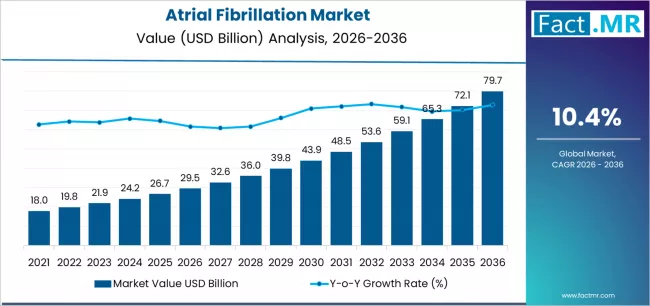
Atrial fibrillation market is projected to grow from USD 29.5 billion in 2026 to USD 79.7 billion by 2036, at a CAGR of 10.4%. Pharmacological Treatment will dominate with a 66.5% market share, while hospitals will lead the end use segment with a 60.4% share.

Atrial Fibrillation Market Forecast and Outlook 2026 to 2036

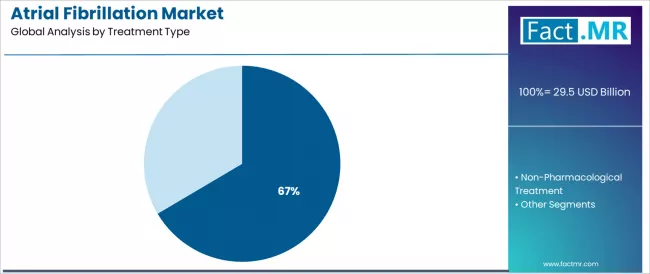
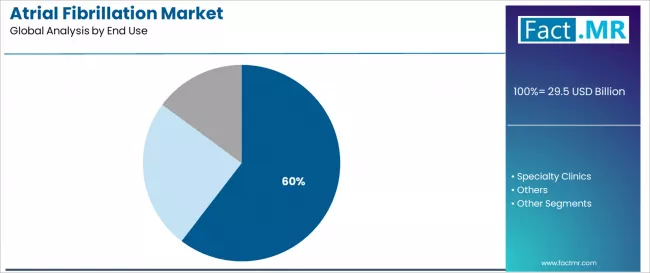
The global atrial fibrillation market is valued at USD 29.52 billion in 2026 and is projected to reach USD 79.66 billion by 2036, expanding at a CAGR of 10.4% over the decade. In 2026, the pharmacological treatment segment is estimated to hold a 66.5% share, while Hospitals constitute 60.41% by end-use.

Key Takeaways from the Atrial Fibrillation Market Report

  • Market Value (2026): USD 29.52 Billion
  • Market Forecast Value (2036): USD 79.66 Billion
  • Forecast CAGR (2026-2036): 10.4%
  • Leading Treatment Type: Pharmacological Treatment (66.5%)
  • Leading End Use: Hospitals (60.41%)
  • Key Growth Regions: Asia Pacific, North America, Europe
  • Key Players: Abbott, AtriCure Inc., Boehringer Ingelheim GmbH, Boston Scientific Corporation, Bristol-Myers Squibb Corporation, Cardio Focus Inc., Sanofi Aventis, Biosense Webster Inc., Endoscopic Technologies Inc., Johnson & Johnson
Atrial Fibrillation Market Market Value Analysis

Exponential growth in the aging global population and the corresponding surge in cardiovascular disease prevalence are the primary forces propelling market expansion. This demographic shift creates a vast and growing patient pool requiring advanced rhythm management and stroke prevention solutions.

Heightened clinical recognition of AF-related stroke risk and the imperative for early, effective intervention are driving healthcare systems worldwide to prioritize comprehensive AF management protocols. This shift represents a strategic move from reactive treatment to proactive, guideline-directed management aimed at improving long-term patient outcomes and reducing systemic healthcare burdens.

Technological innovation across both pharmacological and non-pharmacological domains is critical to market growth. Advancements in novel oral anticoagulants (NOACs) offer improved safety profiles and convenience, while breakthroughs in catheter ablation technology, such as pulsed field ablation, contact force-sensing, and high-density 3D mapping, are enhancing procedural efficacy, safety, and accessibility. These parallel advancements are enabling more personalized and effective treatment pathways, catering to the diverse spectrum of AF patients from paroxysmal to persistent forms of the condition.

Market Overview

Metric Value
Estimated Value in (2026E) USD 29.52 Billion
Forecast Value in (2036F) USD 79.66 Billion
Forecast CAGR (2026 to 2036) 10.4%

Market Segmentation

Category Segments
Treatment Type Pharmacological Treatment: Anti-arrhythmic Drugs, Anticoagulant Drugs; Non-Pharmacological Treatment: Catheter Ablation (Radiofrequency, HIFU, Cryoablation, Microwave, Laser), Maze Surgery, Electric Cardioversion
End Use Hospitals, Specialty Clinics, Others
Region Asia Pacific, North America, Europe, Latin America, MEA

Segmental Analysis

How does Pharmacological Treatment Drive Market Leadership?
Atrial Fibrillation Market Analysis By Treatment Type

Pharmacological treatment commands a dominant 66.5% share, as it forms the foundational and most widely accessible pillar of AF management. This segment addresses the two critical pillars of AF care: stroke prevention via anticoagulation and symptom/rhythm control via antiarrhythmic drugs.

The widespread adoption and continuous evolution of Novel Oral Anticoagulants (NOACs), which offer superior convenience and a better safety profile compared to traditional warfarin, solidify this segment's growth. Medication-based management is essential for long-term chronic care, pre-and post-procedural therapy, and for patients who are not candidates for invasive procedures, ensuring its central role in all comprehensive treatment guidelines.

  • The extensive clinical evidence and real-world data supporting pharmacological interventions build strong confidence among cardiologists and primary care physicians, ensuring continued first-line use.
  • Innovation focuses on next-generation anticoagulants with even lower bleeding risks and antiarrhythmic drugs with improved efficacy and fewer side effects, further entrenching this segment's dominance.

Why do Hospitals Command Majority Market Share in AF Care Delivery?
Atrial Fibrillation Market Analysis By End Use

Hospitals hold a 60.41% share as the central hub for complex AF diagnosis, intervention, and acute management. They house the necessary sophisticated infrastructure including EP labs, advanced imaging, cardiac surgery suites, and intensive care units required for catheter ablation procedures, maze surgery, and managing complications.

The increasing procedural volume of catheter ablations, which are predominantly performed in hospital-based EP labs, directly fuels this segment's growth. Hospitals are also the primary setting for initial diagnosis, stroke management in AF patients, and treatment of comorbid conditions, making them indispensable in the AF care continuum.

  • The expansion of hospital EP labs and investment in advanced mapping and ablation technology are directly increasing institutional capacity and driving procedural volume.
  • Hospitals facilitate a multidisciplinary approach, allowing seamless collaboration between electrophysiologists, cardiologists, cardiac surgeons, and neurologists, which is crucial for optimal AF and stroke management.

What are the Drivers, Restraints, and Key Trends in the Atrial Fibrillation Market?

The market is fundamentally driven by the global demographic shift towards an older population, which has a directly correlated higher incidence of AF. Increasing disease awareness among both physicians and patients, coupled with strong clinical guideline recommendations for early rhythm control and stroke prevention, is creating a powerful demand pull for effective treatments.

A primary restraint is the high cost of advanced ablation procedures and newer pharmaceuticals, which can limit access in cost-sensitive markets and healthcare systems. The risk of procedural complications from ablation and bleeding risks from anticoagulation also necessitate careful patient selection and management.

The market is trending strongly towards minimally invasive and pulsed field ablation (PFA) technologies, which promise faster, safer, and more durable lesions. Integration of digital health and remote monitoring is a key trend, utilizing implantable loop recorders and wearables for better AF detection, burden assessment, and long-term patient management outside clinical settings.

Analysis of the Market by Key Countries
Atrial Fibrillation Market Cagr Analysis By Country

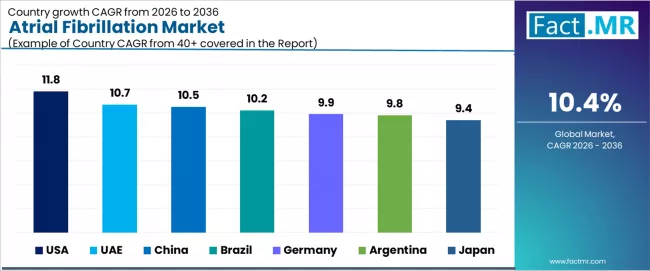
Country CAGR (2026-2036)
USA 11.8%
UAE 10.7%
China 10.5%
Brazil 10.2%
Germany 9.9%
Argentina 9.8%
Japan 9.4%

What underpins the USA's exceptional market growth?
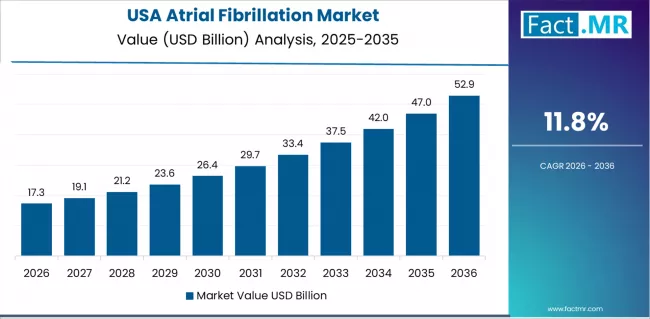
Atrial Fibrillation Market Country Value Analysis

The USA leads with an 11.8% CAGR, driven by the highest AF prevalence rates in its large, aging population, superior healthcare infrastructure with widespread EP lab access, and early adoption of the most advanced ablation technologies and NOACs. High healthcare expenditure and favorable reimbursement frameworks further accelerate market penetration.

How does the UAE demonstrate rapid market development?

The UAE's 10.7% CAGR is fueled by strategic national investments in establishing world-class, specialized cardiac centers aimed at medical tourism and regional leadership. Government-led healthcare modernization and awareness campaigns are rapidly improving AF diagnosis and treatment accessibility.

What factors propel China's strong expansion?

China's 10.5% CAGR is anchored in its massive aging population, representing the world's largest potential AF patient pool. Concurrent hospital modernization programs and growing collaborations with international medical device companies are rapidly expanding electrophysiology capabilities and treatment access.

What drives growth in Germany's mature market?

Germany's 9.9% CAGR reflects its advanced, guideline-driven healthcare system with excellent early detection programs and a high adoption rate for evidence-based ablation technologies. Strong emphasis on quality outcomes and integrated care supports sustained growth.

Competitive Landscape
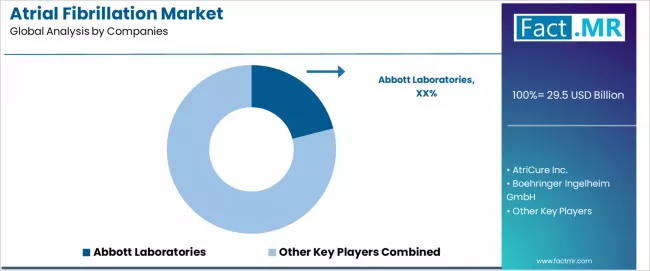
Atrial Fibrillation Market Analysis By Company

The competitive landscape is characterized by intense rivalry between diversified global medical device giants and specialized pharmaceutical companies. Device leaders like Abbott, Boston Scientific, and Johnson & Johnson (Biosense Webster) compete on technological innovation in ablation catheters and 3D mapping systems.

Pharmaceutical giants like Boehringer Ingelheim, Bristol-Myers Squibb, and Sanofi compete on drug efficacy, safety data, and lifecycle management of their anticoagulant portfolios. Competition hinges on robust clinical evidence generation, deep electrophysiologist training and support, and demonstrating superior long-term patient outcomes and cost-effectiveness.

Key Players Profiled in the Atrial Fibrillation Market

  • Abbott Laboratories
  • AtriCure Inc.
  • Boehringer Ingelheim GmbH
  • Boston Scientific Corporation
  • Bristol-Myers Squibb Corporation
  • Cardio Focus Inc.
  • Sanofi Aventis
  • Biosense Webster Inc.
  • Endoscopic Technologies Inc.
  • Johnson & Johnson

Scope of the Report

Items Values
Quantitative Units (2026) USD 29.52 Billion
Treatment Type Pharmacological Treatment (Anti-arrhythmic Drugs, Anticoagulant Drugs), Non-Pharmacological Treatment (Catheter Ablation - Radiofrequency, HIFU, Cryoablation, Microwave, Laser; Maze Surgery; Electric Cardioversion)
End Use Hospitals, Specialty Clinics, Others
Regions Covered Asia Pacific, North America, Europe, Latin America, MEA
Key Companies Profiled Abbott, AtriCure Inc., Boehringer Ingelheim GmbH, Boston Scientific Corporation, Bristol-Myers Squibb Corporation, Cardio Focus Inc., Sanofi Aventis, Biosense Webster Inc., Endoscopic Technologies Inc., Johnson & Johnson
Additional Attributes Analysis of treatment adoption patterns, impact of clinical guidelines, pricing and reimbursement landscape, innovation in ablation energy sources, pipeline analysis for novel anticoagulants, and regional healthcare infrastructure development.

Atrial Fibrillation Market by Segments

  • By Treatment Type :

    • Pharmacological Treatment
    • Anti-arrhythmic Drugs
    • Anticoagulant Drugs
    • Non-Pharmacological Treatment
    • Catheter Ablation
    • Radiofrequency
    • HIFU
    • Cryoablation
    • Microwave
    • Laser
    • Maze Surgery
    • Electric Cardioversion
  • By End Use :

    • Hospitals
    • Specialty Clinics
    • Others
  • By Region :

    • Asia Pacific

      • China
      • India
      • Japan
      • South Korea
      • ASEAN
      • Australia & New Zealand
      • Rest of Asia Pacific
    • North America

      • USA
      • Canada
      • Mexico
    • Europe

      • Germany
      • France
      • UK
      • Italy
      • Spain
      • Nordic
      • BENELUX
      • Rest of Europe
    • Latin America

      • Brazil
      • Argentina
      • Chile
      • Rest of Latin America
    • MEA

      • Saudi Arabia
      • Other GCC Countries
      • Turkey
      • South Africa
      • Other African Countries
      • Rest of MEA

Table of Content

  1. Executive Summary
    • Global Market Outlook
    • Demand to side Trends
    • Supply to side Trends
    • Technology Roadmap Analysis
    • Analysis and Recommendations
  2. Market Overview
    • Market Coverage / Taxonomy
    • Market Definition / Scope / Limitations
  3. Market Background
    • Market Dynamics
      • Drivers
      • Restraints
      • Opportunity
      • Trends
    • Scenario Forecast
      • Demand in Optimistic Scenario
      • Demand in Likely Scenario
      • Demand in Conservative Scenario
    • Opportunity Map Analysis
    • Product Life Cycle Analysis
    • Supply Chain Analysis
    • Investment Feasibility Matrix
    • Value Chain Analysis
    • PESTLE and Porter’s Analysis
    • Regulatory Landscape
    • Regional Parent Market Outlook
    • Production and Consumption Statistics
    • Import and Export Statistics
  4. Global Market Analysis 2021 to 2025 and Forecast, 2026 to 2036
    • Historical Market Size Value (USD Million) Analysis, 2021 to 2025
    • Current and Future Market Size Value (USD Million) Projections, 2026 to 2036
      • Y to o to Y Growth Trend Analysis
      • Absolute $ Opportunity Analysis
  5. Global Market Pricing Analysis 2021 to 2025 and Forecast 2026 to 2036
  6. Global Market Analysis 2021 to 2025 and Forecast 2026 to 2036, By Treatment Type
    • Introduction / Key Findings
    • Historical Market Size Value (USD Million) Analysis By Treatment Type, 2021 to 2025
    • Current and Future Market Size Value (USD Million) Analysis and Forecast By Treatment Type, 2026 to 2036
      • Pharmacological Treatment
      • Non-Pharmacological Treatment
    • Y to o to Y Growth Trend Analysis By Treatment Type, 2021 to 2025
    • Absolute $ Opportunity Analysis By Treatment Type, 2026 to 2036
  7. Global Market Analysis 2021 to 2025 and Forecast 2026 to 2036, By End Use
    • Introduction / Key Findings
    • Historical Market Size Value (USD Million) Analysis By End Use, 2021 to 2025
    • Current and Future Market Size Value (USD Million) Analysis and Forecast By End Use, 2026 to 2036
      • Hospitals
      • Specialty Clinics
      • Others
    • Y to o to Y Growth Trend Analysis By End Use, 2021 to 2025
    • Absolute $ Opportunity Analysis By End Use, 2026 to 2036
  8. Global Market Analysis 2021 to 2025 and Forecast 2026 to 2036, By Region
    • Introduction
    • Historical Market Size Value (USD Million) Analysis By Region, 2021 to 2025
    • Current Market Size Value (USD Million) Analysis and Forecast By Region, 2026 to 2036
      • North America
      • Latin America
      • Western Europe
      • Eastern Europe
      • East Asia
      • South Asia and Pacific
      • Middle East & Africa
    • Market Attractiveness Analysis By Region
  9. North America Market Analysis 2021 to 2025 and Forecast 2026 to 2036, By Country
    • Historical Market Size Value (USD Million) Trend Analysis By Market Taxonomy, 2021 to 2025
    • Market Size Value (USD Million) Forecast By Market Taxonomy, 2026 to 2036
      • By Country
        • USA
        • Canada
        • Mexico
      • By Treatment Type
      • By End Use
    • Market Attractiveness Analysis
      • By Country
      • By Treatment Type
      • By End Use
    • Key Takeaways
  10. Latin America Market Analysis 2021 to 2025 and Forecast 2026 to 2036, By Country
    • Historical Market Size Value (USD Million) Trend Analysis By Market Taxonomy, 2021 to 2025
    • Market Size Value (USD Million) Forecast By Market Taxonomy, 2026 to 2036
      • By Country
        • Brazil
        • Chile
        • Rest of Latin America
      • By Treatment Type
      • By End Use
    • Market Attractiveness Analysis
      • By Country
      • By Treatment Type
      • By End Use
    • Key Takeaways
  11. Western Europe Market Analysis 2021 to 2025 and Forecast 2026 to 2036, By Country
    • Historical Market Size Value (USD Million) Trend Analysis By Market Taxonomy, 2021 to 2025
    • Market Size Value (USD Million) Forecast By Market Taxonomy, 2026 to 2036
      • By Country
        • Germany
        • UK
        • Italy
        • Spain
        • France
        • Nordic
        • BENELUX
        • Rest of Western Europe
      • By Treatment Type
      • By End Use
    • Market Attractiveness Analysis
      • By Country
      • By Treatment Type
      • By End Use
    • Key Takeaways
  12. Eastern Europe Market Analysis 2021 to 2025 and Forecast 2026 to 2036, By Country
    • Historical Market Size Value (USD Million) Trend Analysis By Market Taxonomy, 2021 to 2025
    • Market Size Value (USD Million) Forecast By Market Taxonomy, 2026 to 2036
      • By Country
        • Russia
        • Poland
        • Hungary
        • Balkan & Baltic
        • Rest of Eastern Europe
      • By Treatment Type
      • By End Use
    • Market Attractiveness Analysis
      • By Country
      • By Treatment Type
      • By End Use
    • Key Takeaways
  13. East Asia Market Analysis 2021 to 2025 and Forecast 2026 to 2036, By Country
    • Historical Market Size Value (USD Million) Trend Analysis By Market Taxonomy, 2021 to 2025
    • Market Size Value (USD Million) Forecast By Market Taxonomy, 2026 to 2036
      • By Country
        • China
        • Japan
        • South Korea
      • By Treatment Type
      • By End Use
    • Market Attractiveness Analysis
      • By Country
      • By Treatment Type
      • By End Use
    • Key Takeaways
  14. South Asia and Pacific Market Analysis 2021 to 2025 and Forecast 2026 to 2036, By Country
    • Historical Market Size Value (USD Million) Trend Analysis By Market Taxonomy, 2021 to 2025
    • Market Size Value (USD Million) Forecast By Market Taxonomy, 2026 to 2036
      • By Country
        • India
        • ASEAN
        • Australia & New Zealand
        • Rest of South Asia and Pacific
      • By Treatment Type
      • By End Use
    • Market Attractiveness Analysis
      • By Country
      • By Treatment Type
      • By End Use
    • Key Takeaways
  15. Middle East & Africa Market Analysis 2021 to 2025 and Forecast 2026 to 2036, By Country
    • Historical Market Size Value (USD Million) Trend Analysis By Market Taxonomy, 2021 to 2025
    • Market Size Value (USD Million) Forecast By Market Taxonomy, 2026 to 2036
      • By Country
        • Kingdom of Saudi Arabia
        • Other GCC Countries
        • Turkiye
        • South Africa
        • Other African Union
        • Rest of Middle East & Africa
      • By Treatment Type
      • By End Use
    • Market Attractiveness Analysis
      • By Country
      • By Treatment Type
      • By End Use
    • Key Takeaways
  16. Key Countries Market Analysis
    • USA
      • Pricing Analysis
      • Market Share Analysis, 2025
        • By Treatment Type
        • By End Use
    • Canada
      • Pricing Analysis
      • Market Share Analysis, 2025
        • By Treatment Type
        • By End Use
    • Mexico
      • Pricing Analysis
      • Market Share Analysis, 2025
        • By Treatment Type
        • By End Use
    • Brazil
      • Pricing Analysis
      • Market Share Analysis, 2025
        • By Treatment Type
        • By End Use
    • Chile
      • Pricing Analysis
      • Market Share Analysis, 2025
        • By Treatment Type
        • By End Use
    • Germany
      • Pricing Analysis
      • Market Share Analysis, 2025
        • By Treatment Type
        • By End Use
    • UK
      • Pricing Analysis
      • Market Share Analysis, 2025
        • By Treatment Type
        • By End Use
    • Italy
      • Pricing Analysis
      • Market Share Analysis, 2025
        • By Treatment Type
        • By End Use
    • Spain
      • Pricing Analysis
      • Market Share Analysis, 2025
        • By Treatment Type
        • By End Use
    • France
      • Pricing Analysis
      • Market Share Analysis, 2025
        • By Treatment Type
        • By End Use
    • India
      • Pricing Analysis
      • Market Share Analysis, 2025
        • By Treatment Type
        • By End Use
    • ASEAN
      • Pricing Analysis
      • Market Share Analysis, 2025
        • By Treatment Type
        • By End Use
    • Australia & New Zealand
      • Pricing Analysis
      • Market Share Analysis, 2025
        • By Treatment Type
        • By End Use
    • China
      • Pricing Analysis
      • Market Share Analysis, 2025
        • By Treatment Type
        • By End Use
    • Japan
      • Pricing Analysis
      • Market Share Analysis, 2025
        • By Treatment Type
        • By End Use
    • South Korea
      • Pricing Analysis
      • Market Share Analysis, 2025
        • By Treatment Type
        • By End Use
    • Russia
      • Pricing Analysis
      • Market Share Analysis, 2025
        • By Treatment Type
        • By End Use
    • Poland
      • Pricing Analysis
      • Market Share Analysis, 2025
        • By Treatment Type
        • By End Use
    • Hungary
      • Pricing Analysis
      • Market Share Analysis, 2025
        • By Treatment Type
        • By End Use
    • Kingdom of Saudi Arabia
      • Pricing Analysis
      • Market Share Analysis, 2025
        • By Treatment Type
        • By End Use
    • Turkiye
      • Pricing Analysis
      • Market Share Analysis, 2025
        • By Treatment Type
        • By End Use
    • South Africa
      • Pricing Analysis
      • Market Share Analysis, 2025
        • By Treatment Type
        • By End Use
  17. Market Structure Analysis
    • Competition Dashboard
    • Competition Benchmarking
    • Market Share Analysis of Top Players
      • By Regional
      • By Treatment Type
      • By End Use
  18. Competition Analysis
    • Competition Deep Dive
      • Abbott Laboratories
        • Overview
        • Product Portfolio
        • Profitability by Market Segments (Product/Age /Sales Channel/Region)
        • Sales Footprint
        • Strategy Overview
          • Marketing Strategy
          • Product Strategy
          • Channel Strategy
      • AtriCure Inc.
      • Boehringer Ingelheim GmbH
      • Boston Scientific Corporation
      • Bristol-Myers Squibb Corporation
      • Cardio Focus Inc.
      • Sanofi Aventis
      • Biosense Webster Inc.
      • Endoscopic Technologies Inc.
      • Johnson & Johnson
  19. Assumptions & Acronyms Used
  20. Research Methodology

List Of Table

  • Table 1: Global Market Value (USD Million) Forecast by Region, 2021 to 2036
  • Table 2: Global Market Value (USD Million) Forecast by Treatment Type, 2021 to 2036
  • Table 3: Global Market Value (USD Million) Forecast by End Use, 2021 to 2036
  • Table 4: North America Market Value (USD Million) Forecast by Country, 2021 to 2036
  • Table 5: North America Market Value (USD Million) Forecast by Treatment Type, 2021 to 2036
  • Table 6: North America Market Value (USD Million) Forecast by End Use, 2021 to 2036
  • Table 7: Latin America Market Value (USD Million) Forecast by Country, 2021 to 2036
  • Table 8: Latin America Market Value (USD Million) Forecast by Treatment Type, 2021 to 2036
  • Table 9: Latin America Market Value (USD Million) Forecast by End Use, 2021 to 2036
  • Table 10: Western Europe Market Value (USD Million) Forecast by Country, 2021 to 2036
  • Table 11: Western Europe Market Value (USD Million) Forecast by Treatment Type, 2021 to 2036
  • Table 12: Western Europe Market Value (USD Million) Forecast by End Use, 2021 to 2036
  • Table 13: Eastern Europe Market Value (USD Million) Forecast by Country, 2021 to 2036
  • Table 14: Eastern Europe Market Value (USD Million) Forecast by Treatment Type, 2021 to 2036
  • Table 15: Eastern Europe Market Value (USD Million) Forecast by End Use, 2021 to 2036
  • Table 16: East Asia Market Value (USD Million) Forecast by Country, 2021 to 2036
  • Table 17: East Asia Market Value (USD Million) Forecast by Treatment Type, 2021 to 2036
  • Table 18: East Asia Market Value (USD Million) Forecast by End Use, 2021 to 2036
  • Table 19: South Asia and Pacific Market Value (USD Million) Forecast by Country, 2021 to 2036
  • Table 20: South Asia and Pacific Market Value (USD Million) Forecast by Treatment Type, 2021 to 2036
  • Table 21: South Asia and Pacific Market Value (USD Million) Forecast by End Use, 2021 to 2036
  • Table 22: Middle East & Africa Market Value (USD Million) Forecast by Country, 2021 to 2036
  • Table 23: Middle East & Africa Market Value (USD Million) Forecast by Treatment Type, 2021 to 2036
  • Table 24: Middle East & Africa Market Value (USD Million) Forecast by End Use, 2021 to 2036

List Of Figures

  • Figure 1: Global Market Pricing Analysis
  • Figure 2: Global Market Value (USD Million) Forecast 2021 to 2036
  • Figure 3: Global Market Value Share and BPS Analysis by Treatment Type, 2026 and 2036
  • Figure 4: Global Market Y to o to Y Growth Comparison by Treatment Type, 2026 to 2036
  • Figure 5: Global Market Attractiveness Analysis by Treatment Type
  • Figure 6: Global Market Value Share and BPS Analysis by End Use, 2026 and 2036
  • Figure 7: Global Market Y to o to Y Growth Comparison by End Use, 2026 to 2036
  • Figure 8: Global Market Attractiveness Analysis by End Use
  • Figure 9: Global Market Value (USD Million) Share and BPS Analysis by Region, 2026 and 2036
  • Figure 10: Global Market Y to o to Y Growth Comparison by Region, 2026 to 2036
  • Figure 11: Global Market Attractiveness Analysis by Region
  • Figure 12: North America Market Incremental Dollar Opportunity, 2026 to 2036
  • Figure 13: Latin America Market Incremental Dollar Opportunity, 2026 to 2036
  • Figure 14: Western Europe Market Incremental Dollar Opportunity, 2026 to 2036
  • Figure 15: Eastern Europe Market Incremental Dollar Opportunity, 2026 to 2036
  • Figure 16: East Asia Market Incremental Dollar Opportunity, 2026 to 2036
  • Figure 17: South Asia and Pacific Market Incremental Dollar Opportunity, 2026 to 2036
  • Figure 18: Middle East & Africa Market Incremental Dollar Opportunity, 2026 to 2036
  • Figure 19: North America Market Value Share and BPS Analysis by Country, 2026 and 2036
  • Figure 20: North America Market Value Share and BPS Analysis by Treatment Type, 2026 and 2036
  • Figure 21: North America Market Y to o to Y Growth Comparison by Treatment Type, 2026 to 2036
  • Figure 22: North America Market Attractiveness Analysis by Treatment Type
  • Figure 23: North America Market Value Share and BPS Analysis by End Use, 2026 and 2036
  • Figure 24: North America Market Y to o to Y Growth Comparison by End Use, 2026 to 2036
  • Figure 25: North America Market Attractiveness Analysis by End Use
  • Figure 26: Latin America Market Value Share and BPS Analysis by Country, 2026 and 2036
  • Figure 27: Latin America Market Value Share and BPS Analysis by Treatment Type, 2026 and 2036
  • Figure 28: Latin America Market Y to o to Y Growth Comparison by Treatment Type, 2026 to 2036
  • Figure 29: Latin America Market Attractiveness Analysis by Treatment Type
  • Figure 30: Latin America Market Value Share and BPS Analysis by End Use, 2026 and 2036
  • Figure 31: Latin America Market Y to o to Y Growth Comparison by End Use, 2026 to 2036
  • Figure 32: Latin America Market Attractiveness Analysis by End Use
  • Figure 33: Western Europe Market Value Share and BPS Analysis by Country, 2026 and 2036
  • Figure 34: Western Europe Market Value Share and BPS Analysis by Treatment Type, 2026 and 2036
  • Figure 35: Western Europe Market Y to o to Y Growth Comparison by Treatment Type, 2026 to 2036
  • Figure 36: Western Europe Market Attractiveness Analysis by Treatment Type
  • Figure 37: Western Europe Market Value Share and BPS Analysis by End Use, 2026 and 2036
  • Figure 38: Western Europe Market Y to o to Y Growth Comparison by End Use, 2026 to 2036
  • Figure 39: Western Europe Market Attractiveness Analysis by End Use
  • Figure 40: Eastern Europe Market Value Share and BPS Analysis by Country, 2026 and 2036
  • Figure 41: Eastern Europe Market Value Share and BPS Analysis by Treatment Type, 2026 and 2036
  • Figure 42: Eastern Europe Market Y to o to Y Growth Comparison by Treatment Type, 2026 to 2036
  • Figure 43: Eastern Europe Market Attractiveness Analysis by Treatment Type
  • Figure 44: Eastern Europe Market Value Share and BPS Analysis by End Use, 2026 and 2036
  • Figure 45: Eastern Europe Market Y to o to Y Growth Comparison by End Use, 2026 to 2036
  • Figure 46: Eastern Europe Market Attractiveness Analysis by End Use
  • Figure 47: East Asia Market Value Share and BPS Analysis by Country, 2026 and 2036
  • Figure 48: East Asia Market Value Share and BPS Analysis by Treatment Type, 2026 and 2036
  • Figure 49: East Asia Market Y to o to Y Growth Comparison by Treatment Type, 2026 to 2036
  • Figure 50: East Asia Market Attractiveness Analysis by Treatment Type
  • Figure 51: East Asia Market Value Share and BPS Analysis by End Use, 2026 and 2036
  • Figure 52: East Asia Market Y to o to Y Growth Comparison by End Use, 2026 to 2036
  • Figure 53: East Asia Market Attractiveness Analysis by End Use
  • Figure 54: South Asia and Pacific Market Value Share and BPS Analysis by Country, 2026 and 2036
  • Figure 55: South Asia and Pacific Market Value Share and BPS Analysis by Treatment Type, 2026 and 2036
  • Figure 56: South Asia and Pacific Market Y to o to Y Growth Comparison by Treatment Type, 2026 to 2036
  • Figure 57: South Asia and Pacific Market Attractiveness Analysis by Treatment Type
  • Figure 58: South Asia and Pacific Market Value Share and BPS Analysis by End Use, 2026 and 2036
  • Figure 59: South Asia and Pacific Market Y to o to Y Growth Comparison by End Use, 2026 to 2036
  • Figure 60: South Asia and Pacific Market Attractiveness Analysis by End Use
  • Figure 61: Middle East & Africa Market Value Share and BPS Analysis by Country, 2026 and 2036
  • Figure 62: Middle East & Africa Market Value Share and BPS Analysis by Treatment Type, 2026 and 2036
  • Figure 63: Middle East & Africa Market Y to o to Y Growth Comparison by Treatment Type, 2026 to 2036
  • Figure 64: Middle East & Africa Market Attractiveness Analysis by Treatment Type
  • Figure 65: Middle East & Africa Market Value Share and BPS Analysis by End Use, 2026 and 2036
  • Figure 66: Middle East & Africa Market Y to o to Y Growth Comparison by End Use, 2026 to 2036
  • Figure 67: Middle East & Africa Market Attractiveness Analysis by End Use
  • Figure 68: Global Market - Tier Structure Analysis
  • Figure 69: Global Market - Company Share Analysis

- FAQs -

How big is the atrial fibrillation market in 2026?

The global atrial fibrillation market is estimated to be valued at USD 29.5 billion in 2026.

What will be the size of atrial fibrillation market in 2036?

The market size for the atrial fibrillation market is projected to reach USD 79.7 billion by 2036.

How much will be the atrial fibrillation market growth between 2026 and 2036?

The atrial fibrillation market is expected to grow at a 10.4% CAGR between 2026 and 2036.

What are the key product types in the atrial fibrillation market?

The key product types in atrial fibrillation market are pharmacological treatment and non-pharmacological treatment.

Which end use segment to contribute significant share in the atrial fibrillation market in 2026?

In terms of end use, hospitals segment to command 60.4% share in the atrial fibrillation market in 2026.

Atrial Fibrillation Market