- Base Value(2025): 1.2 Bn
- Estimated Value(2026): 1.2 Bn
- Forecast Value (2036): 1.9 Bn
- CAGR (2026 - 2036): 4.6%
Arbovirus Testing Market Analysis and Forecast by Fact.MR
The global arbovirus testing market covers diagnostic products and systems used to detect infections caused by arthropod-borne viruses, including dengue, Zika, chikungunya, and West Nile virus. Product categories include molecular diagnostic kits, serology test kits, point-of-care devices, next-generation sequencing kits, and viral culture systems. These products serve hospitals, diagnostic laboratories, public health agencies, and research institutes. Demand is shaped by the expanding geographic reach of arboviral diseases, increasing investment in public health surveillance programs, and growing adoption of molecular diagnostics for faster and more accurate infection detection.

Arbovirus Testing Market Market Value Analysis | Source: Fact.MR
Summary of Arbovirus Testing Market
- Market Snapshot
- In 2025, the global Arbovirus Testing Market was valued at approximately USD 1.15 billion.
- The market is estimated to reach USD 1.2 billion in 2026 and is projected to attain USD 1.89 billion by 2036.
- The arbovirus testing market is likely to expand at a CAGR of 4.6% during the forecast period.
- The market is anticipated to create an absolute dollar opportunity of USD 0.68 billion between 2026 and 2036.
- Molecular Diagnostic Kits accounts for 46% of product type share in 2026.
- China (5.3%) and India (5.1%) are the key growth markets during the forecast period.
- Demand and Growth Drivers
- Increasing frequency and geographic spread of dengue, Zika, and chikungunya outbreaks is expanding the addressable testing volume across tropical and subtropical regions.
- Growing investment by government agencies and international health organizations in disease surveillance and outbreak response programs is creating sustained institutional demand for diagnostic kits.
- Adoption of molecular diagnostic methods, particularly RT-PCR and multiplex panels, is replacing slower serological approaches in hospital and laboratory settings.
- Expansion of point-of-care testing infrastructure in rural and resource-limited areas is improving diagnostic access where centralized laboratory services are unavailable.
- Rising clinical awareness of co-infections and differential diagnosis requirements is driving demand for multi-pathogen testing panels that distinguish between arboviruses with similar symptoms.
- Product and Segment View
- Molecular Diagnostic Kits accounts for 46% of the product type segment in 2026, supported by broad applicability and established demand patterns across key end-use categories.
- Dengue Testing represents 52% of the application segment in 2026, reflecting sustained demand from primary use cases and institutional procurement.
- Key segmentation includes: Product: Molecular Diagnostic Kits, Serology Test Kits, Point of Care Test Kits, Next Generation Sequencing Kits, Viral Culture Systems. Application: Dengue Testing, Zika Virus Testing, Chikungunya Testing, West Nile Virus Testing. End Use: Hospitals, Diagnostic Laboratories, Research Institutes, Public Health Agencies. Technology: Molecular Diagnostics, Immunodiagnostics, Next Generation Sequencing, Rapid Diagnostic Technology. Formulation: Liquid Reagent Kits, Lyophilized Kits, Ready to Use Kits, Control and Calibration Kits. Distribution Channel: Direct Sales, Distributors, Online Sales.
- Geography and Competitive Outlook
- North America maintains a leading position in global demand, supported by established healthcare infrastructure, high product awareness, and strong institutional procurement channels.
- Europe shows steady demand growth driven by regulatory frameworks, clinical standards, and aging population demographics that support sustained market activity.
- Asia Pacific is emerging as the fastest-growing regional market, led by China (5.3%) and India, supported by expanding healthcare infrastructure and rising institutional spending.
- Key players include F. Hoffmann-La Roche Ltd, Abbott Laboratories, Thermo Fisher Scientific Inc., Merck KGaA, Siemens Healthineers AG, QIAGEN.
- Analyst Opinion
- Shambhu Nath Jha, Principal Consultant at Fact.MR, says 'The arbovirus testing market is being reshaped by two converging forces: the geographic expansion of vector-borne diseases into previously unaffected regions, and the shift from antibody-based detection to molecular diagnostics that provide faster, more specific results. Hospitals and public health agencies are moving toward multiplex panels that can differentiate between dengue, Zika, and chikungunya in a single test run. The real commercial opportunity lies in building integrated testing workflows that combine rapid point-of-care screening with confirmatory molecular testing, particularly in endemic regions where seasonal outbreaks create predictable demand spikes.'
Key Growth Drivers, Constraints, and Opportunities
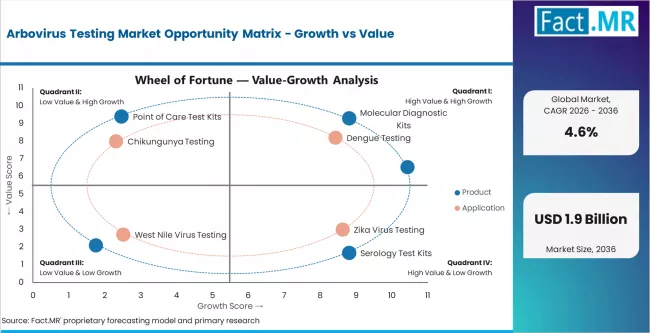
Arbovirus Testing Market Opportunity Matrix Growth Vs Value | Source: Fact.MR
Key Factors Driving Growth
- Rising frequency and geographic spread of arboviral outbreaks is expanding diagnostic testing volumes across endemic and newly affected regions.
- Government-funded disease surveillance and outbreak response programs are creating sustained institutional procurement demand for testing kits and platforms.
- Adoption of molecular diagnostic methods over conventional serological testing is improving detection accuracy and speed in hospital and laboratory settings.
Key Market Constraints
- Limited laboratory infrastructure in rural and resource-constrained settings restricts access to molecular diagnostic testing for arboviral infections.
- Cross-reactivity between arboviral antibodies complicates serological testing accuracy and increases the need for confirmatory molecular testing.
- Seasonal and outbreak-driven demand creates uneven procurement patterns that affect supply chain planning for diagnostic manufacturers.
Key Opportunity Areas
- Development of multiplex panels that detect multiple arboviruses simultaneously creates higher-value testing opportunities for hospitals and reference laboratories.
- Expansion of rapid point-of-care testing devices suitable for field use opens new demand channels in endemic regions with limited laboratory access.
- Integration of digital reporting and disease surveillance platforms with testing workflows creates recurring service revenue opportunities for diagnostic companies.
Segment-wise Analysis of the Arbovirus Testing Market
- Molecular Diagnostic Kits holds 46% of the product type segment in 2026, supported by established demand patterns and broad applicability across primary end-use categories.
- Dengue Testing represents 52% of the application segment in 2026, with institutional procurement and clinical requirements acting as the primary demand channels.
- Hospitals accounts for 60% of the end use segment in 2026, reflecting sustained demand from primary use cases.
The arbovirus testing market is segmented by product, application, end use, technology, formulation, distribution channel, and region. By product, the market covers Molecular Diagnostic Kits, Serology Test Kits, Point of Care Test Kits, Next Generation Sequencing Kits, Viral Culture Systems. By application, the market covers Dengue Testing, Zika Virus Testing, Chikungunya Testing, West Nile Virus Testing. By end use, the market covers Hospitals, Diagnostic Laboratories, Research Institutes, Public Health Agencies. By technology, the market covers Molecular Diagnostics, Immunodiagnostics, Next Generation Sequencing, Rapid Diagnostic Technology. By formulation, the market covers Liquid Reagent Kits, Lyophilized Kits, Ready to Use Kits, Control and Calibration Kits. By distribution channel, the market covers Direct Sales, Distributors, Online Sales.
Which Product Type Segment Dominates the Arbovirus Testing Market?
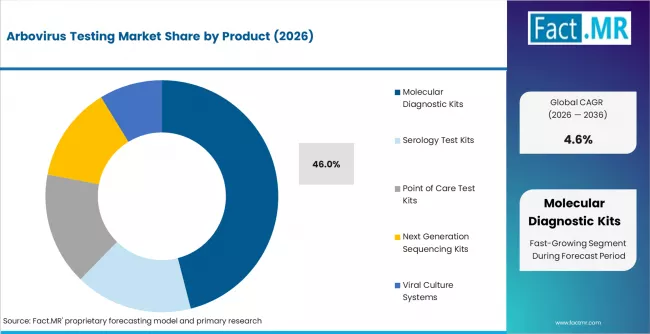
Arbovirus Testing Market Analysis By Product | Source: Fact.MR
Molecular Diagnostic Kits is expected to account for approximately 46% of the product type segment in 2026. This leadership position reflects sustained demand from core use cases, established procurement patterns, and broad applicability across primary end-use categories. The segment benefits from strong institutional adoption and consistent demand from both developed and emerging markets.
Other segments in this category include Serology Test Kits, Point of Care Test Kits, Next Generation Sequencing Kits, Viral Culture Systems, each serving specific end-use requirements and contributing to overall market diversification. Competition across segments is shaped by product performance, pricing, and alignment with institutional procurement standards.
Which Application Segment Dominates the Arbovirus Testing Market?
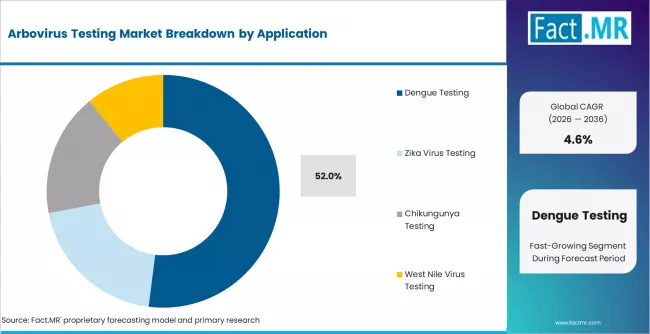
Arbovirus Testing Market Analysis By Application | Source: Fact.MR
Dengue Testing is expected to account for approximately 52% of the application segment in 2026. This leadership position reflects sustained demand from core use cases, established procurement patterns, and broad applicability across primary end-use categories. The segment benefits from strong institutional adoption and consistent demand from both developed and emerging markets.
Other segments in this category include Zika Virus Testing, Chikungunya Testing, West Nile Virus Testing, each serving specific end-use requirements and contributing to overall market diversification. Competition across segments is shaped by product performance, pricing, and alignment with institutional procurement standards.
Which Product Trend is Shaping the Next Phase of Growth in the Arbovirus Testing Market?
Point-of-care arbovirus testing devices are emerging as the fastest-growing product segment in the diagnostics space. Their adoption is projected to rise as healthcare systems in endemic regions shift toward decentralized testing models that deliver results at the point of patient contact. This is particularly relevant in outbreak settings and rural clinics where sending samples to centralized laboratories creates delays that affect treatment decisions and disease containment efforts.
The shift toward point-of-care testing reflects a broader change in how public health systems approach arboviral disease management. Agencies increasingly need rapid, field-deployable diagnostics that can be used by trained health workers without specialized laboratory equipment. As a result, portable testing cartridges and lateral flow devices are moving from supplementary tools into primary screening instruments, especially in regions where mobile health infrastructure and community-based surveillance programs are expanding.
Regional Outlook Across Key Markets
.webp "Top Country Growth Comparison Arbovirus Testing Market Cagr (2026 2036)")
Top Country Growth Comparison Arbovirus Testing Market Cagr (2026 2036) | Source: Fact.MR
- China leads growth at 5.3%, supported by expanding healthcare infrastructure, rising disease burden, and growing institutional investment in diagnostic and treatment capabilities.
- India follows at 5.1%, driven by government-funded healthcare programs, increasing clinical awareness, and growing adoption of advanced products and services.
- Mature markets including the USA and Germany show steady growth, supported by established healthcare systems, replacement demand, and regulatory-driven product upgrades.
CAGR Table
| Country | CAGR (%) |
|---|---|
| China | 5.3% |
| India | 5.1% |
| Brazil | 4.9% |
| USA | 4.6% |
| Germany | 4.4% |
| UK | 4.3% |
| Japan | 4.1% |
Source: Fact.MR analysis. Updated May 11, 2026
Source: Fact MR (FMR) analysis, based on proprietary forecasting model and primary research.
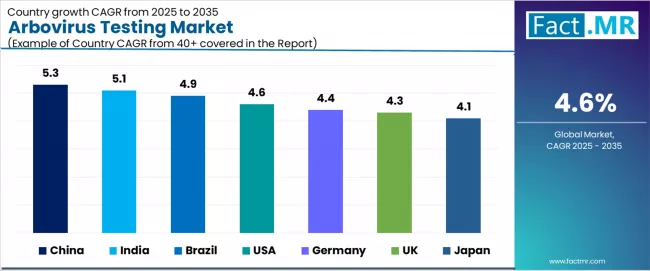
Arbovirus Testing Market Cagr Analysis By Country | Source: Fact.MR
Market Outlook for Arbovirus Testing in China
The China arbovirus testing market is projected to grow at a CAGR of 5.3% through 2036. Demand is supported by strong domestic manufacturing capabilities, government-funded healthcare modernization programs, and rising clinical adoption across urban and rural facilities.
- Healthcare infrastructure expansion supports sustained institutional procurement.
- Clinical awareness and adoption rates continue to improve across key facilities.
- Government-funded programs and regulatory frameworks support market development.
Demand Trends in Arbovirus Testing in India
The India arbovirus testing market is projected to grow at a CAGR of 5.1% through 2036. Demand is supported by expanding healthcare infrastructure, rising disease prevalence, and growing institutional investment in diagnostic and treatment capabilities.
- Healthcare infrastructure expansion supports sustained institutional procurement.
- Clinical awareness and adoption rates continue to improve across key facilities.
- Government-funded programs and regulatory frameworks support market development.
Growth Assessment for Arbovirus Testing in Brazil
The Brazil arbovirus testing market is projected to grow at a CAGR of 4.9% through 2036. Demand is supported by government-backed healthcare programs, rising clinical awareness, and growing adoption of advanced products across public and private healthcare facilities.
- Healthcare infrastructure expansion supports sustained institutional procurement.
- Clinical awareness and adoption rates continue to improve across key facilities.
- Government-funded programs and regulatory frameworks support market development.
Market Analysis of Arbovirus Testing in USA

Arbovirus Testing Market Country Value Analysis | Source: Fact.MR
The USA arbovirus testing market is projected to grow at a CAGR of 4.6% through 2036. Demand is supported by established healthcare systems, high institutional spending, and strong clinical adoption of premium products and technologies.
- Healthcare infrastructure expansion supports sustained institutional procurement.
- Clinical awareness and adoption rates continue to improve across key facilities.
- Government-funded programs and regulatory frameworks support market development.
Opportunity Outlook for Arbovirus Testing in Germany
The Germany arbovirus testing market is projected to grow at a CAGR of 4.4% through 2036. Demand is supported by advanced healthcare infrastructure, strict regulatory standards, and sustained institutional demand for high-quality clinical products.
- Healthcare infrastructure expansion supports sustained institutional procurement.
- Clinical awareness and adoption rates continue to improve across key facilities.
- Government-funded programs and regulatory frameworks support market development.
Competitive Benchmarking and Company Positioning
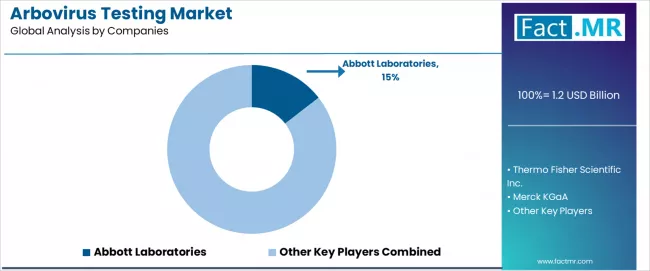
Arbovirus Testing Market Analysis By Company | Source: Fact.MR
Arbovirus Testing Market Analysis By Company
- F. Hoffmann-La Roche Ltd, Abbott Laboratories, Thermo Fisher Scientific Inc. hold strong positions in the global arbovirus testing market through broad product portfolios, strong brand recognition, and established distribution networks.
- Merck KGaA, Siemens Healthineers AG, QIAGEN participate meaningfully across specific product categories, price tiers, and regional markets, with competition shaped by product quality, clinical performance, and channel positioning.
- Product differentiation is increasingly tied to technology integration, service quality, and the ability to meet evolving regulatory and clinical standards across multiple geographies.
The competitive landscape is moderately fragmented, with a mix of global leaders, regional specialists, and technology-focused companies. Leading players compete through product breadth, clinical evidence, distribution reach, and service capabilities. Companies positioned to combine product quality with strong post-sale support and regulatory compliance are best placed to deepen customer relationships and improve margins.
Strategic priorities across the market include expanding product portfolios, strengthening digital and service capabilities, improving supply chain resilience, and widening geographic reach through both direct sales and distribution partnerships.
Key Companies in the Arbovirus Testing Market
F. Hoffmann-La Roche Ltd, Abbott Laboratories, Thermo Fisher Scientific Inc., Merck KGaA are among the leading players in the arbovirus testing market, supported by strong brand visibility and broad product portfolios. Siemens Healthineers AG, QIAGEN, EUROIMMUN AG, Agilent Technologies, Inc. hold established positions across specific segments and regional markets. NovaTec Immundiagnostica GmbH, Bio-Rad Laboratories, Inc. continue to compete through focused product offerings and niche strength in specialized applications.
Recent Industry Developments
- F. Hoffmann-La Roche Ltd - Product Portfolio Expansion (January 2026)
- F. Hoffmann-La Roche Ltd expanded its product portfolio with new offerings targeting growing demand segments. The launch strengthens the company's position in key application areas and supports ongoing market share growth.
- Abbott Laboratories - Market Expansion / Geographic Growth (2025)
- Abbott Laboratories broadened its geographic presence through expanded distribution partnerships and market entry initiatives. The expansion supports growing demand across emerging markets.
- Thermo Fisher Scientific Inc. - Technology Enhancement (2025)
- Thermo Fisher Scientific Inc. introduced technology improvements across its product line, targeting performance upgrades and regulatory compliance enhancements. The development supports the company's competitive positioning in premium market segments.
Leading Companies Shaping the Arbovirus Testing Market
- F. Hoffmann-La Roche Ltd
- Abbott Laboratories
- Thermo Fisher Scientific Inc.
- Merck KGaA
- Siemens Healthineers AG
- QIAGEN
- EUROIMMUN AG
- Agilent Technologies, Inc.
- NovaTec Immundiagnostica GmbH
- Bio-Rad Laboratories, Inc.
Sources and Research References
- F. Hoffmann-La Roche Ltd. Product portfolio and corporate development updates.
- Abbott Laboratories. Product launches and market expansion announcements.
- Thermo Fisher Scientific Inc.. Technology and product development updates.
- World Health Organization. Global disease prevalence and healthcare infrastructure data.
- Primary interviews with manufacturers, distributors, healthcare providers, and end users.
- Industry association publications, regulatory databases, and government healthcare reports.
This bibliography is provided for reader reference and is not exhaustive. The full report contains the complete reference list and detailed citations.
Key Questions This Report Addresses
- What is the current and future size of the Arbovirus Testing Market?
- How fast is the Arbovirus Testing Market expected to grow between 2026 and 2036?
- Which product type is likely to lead the market by 2026?
- Which application segment is expected to account for the highest demand by 2026?
- What factors are driving demand globally?
- Which countries are projected to show the fastest growth through 2036?
- Who are the key companies active in the Arbovirus Testing Market?
- How does Fact.MR estimate and validate the market forecast?
- What are the key constraints and challenges in this market?
- How is technology adoption influencing market growth?
Arbovirus Testing Market Definition
The arbovirus testing market covers diagnostic products, reagent systems, and testing platforms used to detect infections caused by arthropod-borne viruses, including dengue, Zika, chikungunya, and West Nile virus. It includes molecular diagnostic kits, serology test kits, point-of-care devices, next-generation sequencing panels, and viral culture systems used across hospitals, diagnostic laboratories, public health agencies, and research institutes.
Arbovirus Testing Market Inclusions
- The scope covers global and regional market size and forecasts for 2026 to 2036 across key segmentation categories and regions.
- It includes regional demand analysis across major geographies, based on factors such as disease prevalence, healthcare spending, regulatory frameworks, and institutional procurement patterns.
- The report includes pricing and cost analysis across product tiers, covering material costs, manufacturing, and distribution margins.
- It covers technology trends, market drivers and constraints, and the competitive landscape, including product portfolios, pricing strategies, geographic reach, and distribution channels of leading players.
Arbovirus Testing Market Exclusions
- The scope excludes products and services outside the defined market boundary that serve different clinical or commercial purposes.
- It excludes non-commercial, research-only, or custom-built systems not available through standard procurement channels.
- The report excludes informal or unbranded products with limited market visibility and non-standardized manufacturing.
- It also excludes adjacent market categories that overlap in application but differ in product classification and regulatory pathway.
Arbovirus Testing Market Research Methodology
- The methodology combines secondary research, primary interviews, and forecast modelling.
- It draws on 120+ secondary sources and benchmarks 65+ company product portfolios.
- Market sizing covers 30+ countries through a demand-side model, supported by top-down validation.
- Key inputs include disease prevalence, healthcare spending, institutional procurement, regulatory environment, and technology adoption rates.
- The model cross-checks demand with shipments, pricing trends, channel mix, and product launches.
- Primary validation includes 25+ interviews across manufacturers, distributors, healthcare providers, and end users.
- Final estimates go through trade-flow checks, sales-pattern review, and sensitivity testing.
Segmentation
Scope of Analysis
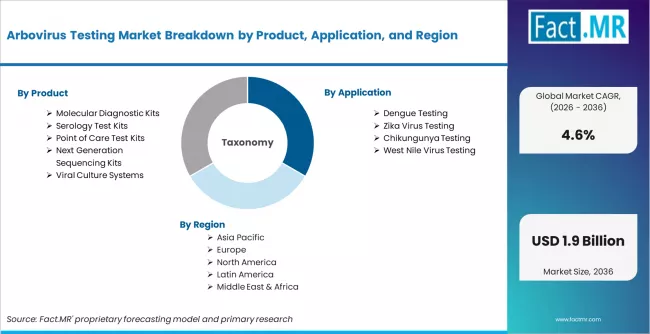
Arbovirus Testing Market Breakdown By Product, Application, And Region | Source: Fact.MR
| Parameter | Details |
|---|---|
| Quantitative Units | USD 1.2 billion to USD 1.89 billion, at a CAGR of 4.6% |
| Market Definition | The Arbovirus Testing Market covers diagnostic products and platforms for detecting arthropod-borne viral infections including dengue, Zika, chikungunya, and West Nile virus. |
| Regions Covered | North America, Latin America, Europe, East Asia, South Asia and Pacific, Middle East and Africa |
| Countries Covered | China, India, Brazil, USA, Germany, UK, Japan, 30 plus countries |
| Key Companies | F. Hoffmann-La Roche Ltd, Abbott Laboratories, Thermo Fisher Scientific Inc., Merck KGaA, Siemens Healthineers AG, QIAGEN, EUROIMMUN AG, Agilent Technologies, Inc., NovaTec Immundiagnostica GmbH, Bio-Rad Laboratories, Inc. |
| Forecast Period | 2026 to 2036 |
| Approach | Hybrid demand-side and top-down methodology built on country-level application demand, product benchmarking, pricing analysis, shipment validation, and primary interviews across manufacturers, distributors, and end users |
Source: Fact.MR analysis. Updated May 11, 2026
Arbovirus Testing Market Segmentation
-
Arbovirus Testing Market Segmented by Product:
- Molecular Diagnostic Kits
- RT PCR Test Kits
- Multiplex Arbovirus Panels
- Real Time PCR Assays
- RT PCR Test Kits
- Serology Test Kits
- IgM IgG Antibody Tests
- ELISA Based Kits
- Rapid Immunoassay Kits
- IgM IgG Antibody Tests
- Point of Care Test Kits
- Rapid Diagnostic Devices
- Lateral Flow Assays
- Portable Testing Cartridges
- Rapid Diagnostic Devices
- Next Generation Sequencing Kits
- Metagenomic Sequencing Panels
- Viral Genome Detection Kits
- Pathogen Surveillance Panels
- Metagenomic Sequencing Panels
- Viral Culture Systems
- Cell Based Assays
- Virus Isolation Kits
- Reference Culture Media
- Cell Based Assays
- Molecular Diagnostic Kits
-
Arbovirus Testing Market Segmented by Application:
- Dengue Testing
- Acute Infection Detection
- Severe Dengue Diagnosis
- Outbreak Monitoring
- Acute Infection Detection
- Zika Virus Testing
- Congenital Infection Screening
- Pregnancy Related Testing
- Neurological Complication Screening
- Congenital Infection Screening
- Chikungunya Testing
- Febrile Illness Diagnosis
- Joint Pain Associated Testing
- Differential Diagnosis Panels
- Febrile Illness Diagnosis
- West Nile Virus Testing
- Neurological Infection Detection
- Encephalitis Diagnosis
- Blood Screening Programs
- Neurological Infection Detection
- Dengue Testing
-
Arbovirus Testing Market Segmented by End Use:
- Hospitals
- Clinical Microbiology Labs
- Emergency Diagnostic Units
- Infectious Disease Departments
- Clinical Microbiology Labs
- Diagnostic Laboratories
- Reference Testing Labs
- Central Public Health Labs
- Specialized Virology Labs
- Reference Testing Labs
- Research Institutes
- Epidemiology Research Centers
- Vaccine Development Labs
- Vector Borne Disease Research
- Epidemiology Research Centers
- Public Health Agencies
- Disease Surveillance Programs
- Outbreak Monitoring Units
- National Health Surveillance Labs
- Disease Surveillance Programs
- Hospitals
-
Arbovirus Testing Market Segmented by Technology:
- Molecular Diagnostics
- RT PCR Technology
- Multiplex PCR Systems
- Quantitative PCR Platforms
- RT PCR Technology
- Immunodiagnostics
- Antibody Detection Technology
- ELISA Systems
- Chemiluminescent Assays
- Antibody Detection Technology
- Next Generation Sequencing
- Pathogen Genomics
- Metagenomic Sequencing
- Viral Genome Mapping
- Pathogen Genomics
- Rapid Diagnostic Technology
- Lateral Flow Technology
- Point of Care Detection
- Portable Diagnostic Devices
- Lateral Flow Technology
- Molecular Diagnostics
-
Arbovirus Testing Market Segmented by Formulation:
- Liquid Reagent Kits
- PCR Master Mix Solutions
- Enzyme Based Reaction Buffers
- Stabilized Nucleic Acid Reagents
- PCR Master Mix Solutions
- Lyophilized Kits
- Freeze Dried Assays
- Stable Diagnostic Panels
- Long Shelf Life Test Kits
- Freeze Dried Assays
- Ready to Use Kits
- Pre Prepared Diagnostic Cartridges
- Point of Care Testing Kits
- Rapid Test Strips
- Pre Prepared Diagnostic Cartridges
- Control and Calibration Kits
- Quality Control Standards
- Positive Negative Controls
- Reference Viral Standards
- Quality Control Standards
- Liquid Reagent Kits
-
Arbovirus Testing Market Segmented by Distribution Channel:
- Direct Sales
- Manufacturer to Hospitals
- Public Health Procurement
- Laboratory Supply Contracts
- Manufacturer to Hospitals
- Distributors
- Diagnostic Equipment Vendors
- Regional Healthcare Distributors
- Laboratory Supply Networks
- Diagnostic Equipment Vendors
- Online Sales
- Digital Diagnostic Platforms
- E Procurement Systems
- Research Supply Portals
- Digital Diagnostic Platforms
- Direct Sales
-
Arbovirus Testing Market by Region:
- North America
- USA
- Canada
- Mexico
- Latin America
- Brazil
- Chile
- Rest of Latin America
- Western Europe
- Germany
- UK
- Italy
- Spain
- France
- Nordic
- BENELUX
- Rest of Western Europe
- Eastern Europe
- Russia
- Poland
- Hungary
- Balkan & Baltic
- Rest of Eastern Europe
- East Asia
- China
- Japan
- South Korea
- South Asia and Pacific
- India
- ASEAN
- Australia & New Zealand
- Rest of South Asia and Pacific
- Middle East & Africa
- Kingdom of Saudi Arabia
- Other GCC Countries
- Turkiye
- South Africa
- Other African Union
- Rest of Middle East & Africa
- North America
Frequently Asked Questions
How big is the arbovirus testing market in 2025?
What will be the size of the arbovirus testing market in 2036?
How much will the arbovirus testing market grow between 2026 and 2036?
Which product type segment leads the market?
Which are the fastest-growing countries?
Who are the key players in the arbovirus testing market?
Who worked on this report


Preview the report firsthand - request a free sample
Free SampleGet the brochure for pricing and purchase details
Download PDF