- Market Value (2025): USD 7.5 Bn
- Estimated Value (2026): USD 8.7 Bn
- Forecast Value (2036): USD 37.7 Bn
- CAGR (2026-2036): 15.8%
What is the Artificial Intelligence Recommendation Software Market forecast to be worth by 2036?
USD 8.7 billion in 2026 to USD 37.7 billion by 2036 at 15.8% CAGR.
- The artificial intelligence recommendation software market crossed a valuation of USD 7.5 billion in 2025.
- Demand is projected to increase from USD 8.7 billion in 2026 to USD 37.7 billion by 2036.
- The market is forecast to record 15.8% CAGR from 2026 to 2036 as retailers place recommendation tools inside repeated customer decisions.
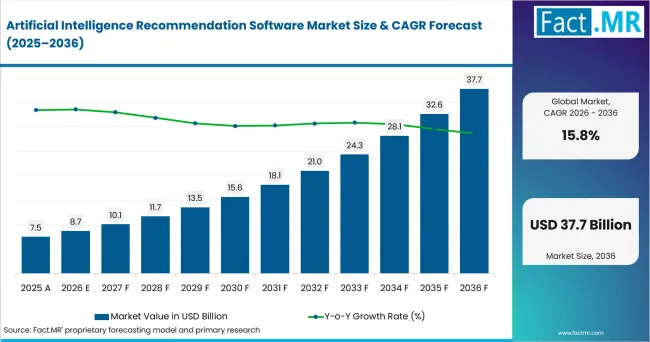
Artificial Intelligence Recommendation Software Market Value Analysis | Source: Fact.MR
What are the defining numbers behind Artificial Intelligence Recommendation Software Market growth?
USD 28.8 billion absolute opportunity by 2036 is led by Personalized Recommendation Engines and Product Recommendation.
- Demand Drivers in the Market
- Digital commerce and media operators need ranking systems that make large product and content catalogs easier to search.
- Commercial teams use recommendations only when stock status and eligibility rules are checked before an item is promoted.
- Customer-experience leaders need consistent decisions across storefronts and loyalty programs so users do not receive conflicting offers.
- Governance teams place more weight on traceable inputs as recommendation systems influence discovery and customer choice.
- Key Segments Analyzed
- By Recommendation Solution: Personalized Recommendation Engines are expected to hold 42% share in 2026 as they carry the core ranking function.
- By Business Function: Product Recommendation is projected to account for 39% share in 2026 with repeated use in cross-selling and merchandising.
- By Application Area: E-commerce is anticipated to capture 41% share in 2026 since recommendations appear across search and cart journeys.
- By End User: Retail & E-commerce Companies are estimated to represent 43% share in 2026 because they control catalog and transaction data.
- By Artificial Intelligence Technology: Deep Learning is forecast to account for 40% share in 2026 as neural models learn user-item patterns at scale.
- Analyst Opinion at Fact.MR
- Shambhu Nath Jha, Principal Consultant at Fact.MR, states, “Recommendation software becomes commercially valuable when the model output can be used and measured inside a live customer journey. Providers gain an advantage when ranking quality works with catalog truth and user controls.”
- Strategic Implications
- Retail and media leaders can define the business objective for each recommendation surface before model selection begins.
- Product teams need separate rules for relevance and merchandising eligibility so unavailable items are not promoted.
- Technology leaders benefit from test design and monitoring targets before a pilot expands into high-volume customer channels.
- Providers can improve buyer confidence by making user controls and business rules visible during evaluation.
The USA leads at 17.1% CAGR through e-commerce scale and cloud platform depth. China follows at 16.6% as mobile commerce keeps interaction data active. The UK reaches 16.0% through mature online retail. Germany records 15.5% with European transparency requirements. Japan posts 14.9% through e-commerce and content ecosystems. India reaches 14.4% as multilingual catalogs widen use cases. Singapore closes the listed range at 13.8% through regional enterprise adoption.
How does the Artificial Intelligence Recommendation Software Market break down by segment?
Personalized Recommendation Engines lead Recommendation Solution at 42% share in 2026. Product Recommendation leads Business Function at 39% share.
Which Recommendation Solution dominates?
Personalized Recommendation Engines hold 42% share in 2026.
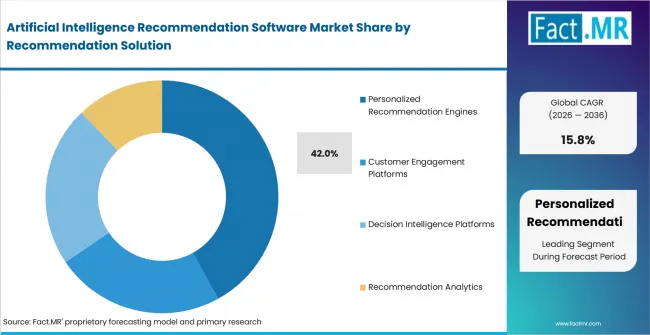
Artificial Intelligence Recommendation Software Market Analysis By Recommendation Solution | Source: Fact.MR
These engines lead recommendation solution because they place ranking inside product discovery and next-best-action workflows. Collaborative filtering uses patterns from similar users. Content-based Recommendation compares user choices with item attributes. Recommendation Analytics measures response and model output.
What leads the Business Function segment?
Product Recommendation accounts for 39% share in 2026.
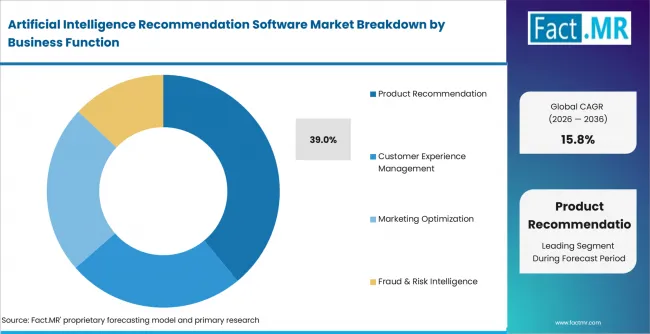
Artificial Intelligence Recommendation Software Market Analysis By Business Function | Source: Fact.MR
Product Recommendation leads the business function segment through repeated use at search and cart stages. Customer Experience Management uses behavior signals to select service prompts. Marketing Optimization applies recommendations to campaigns. Fraud & Risk Intelligence controls offer scoring.
Why does E-commerce lead Application Area demand?
E-commerce holds 41% share in 2026.
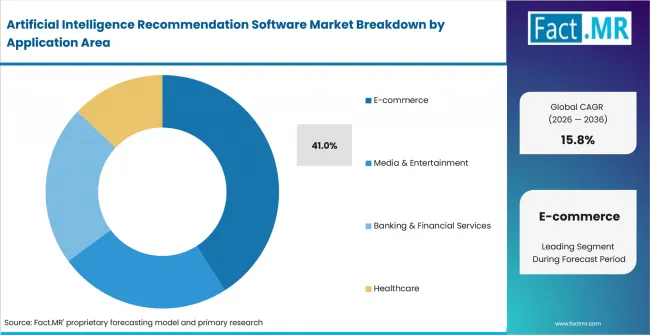
Artificial Intelligence Recommendation Software Market Analysis By Application Area | Source: Fact.MR
Every shopping interaction can change which product appears first. That makes E-commerce the leading Application Area for recommendation software. Marketplaces use these tools across large seller catalogs. Direct-to-consumer retailers use them to guide repeat purchase.
Why do Retail & E-commerce Companies lead End User demand?
Retail & E-commerce Companies lead with 43% share in 2026.
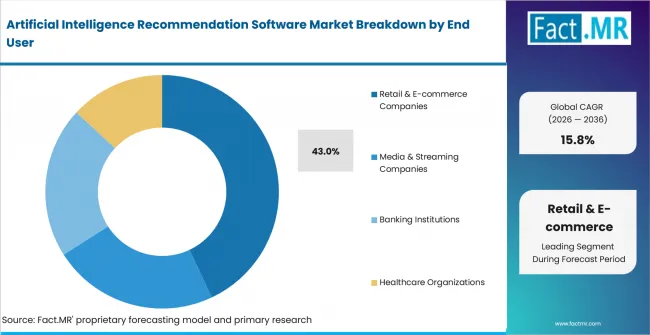
Artificial Intelligence Recommendation Software Market Analysis By End User | Source: Fact.MR
Retail & E-commerce Companies lead End User demand because they control the data needed for live recommendations. Media & Streaming Companies follow through frequent viewing signals. Banking Institutions use propensity models under suitability rules. Healthcare Organizations need narrower use cases.
What supports Deep Learning within Artificial Intelligence Technology?
Deep Learning holds 40% share in 2026.
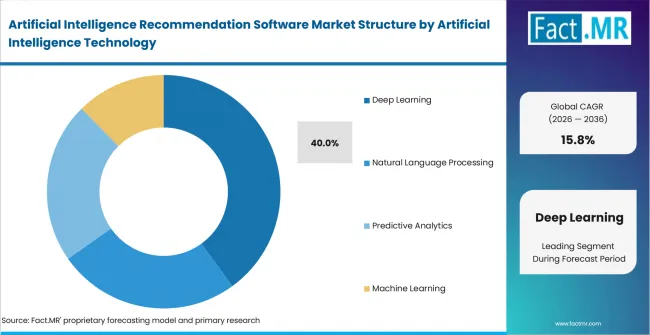
Artificial Intelligence Recommendation Software Market Analysis By Artificial Intelligence Technology | Source: Fact.MR
Deep Learning leads Artificial Intelligence Technology because neural models can read patterns among users and items at scale. Hybrid models combine behavior and content signals when one source is incomplete. Natural Language Processing adds meaning from product text.
What is accelerating Artificial Intelligence Recommendation Software Market adoption, and what is holding it back?
Demand is expected to rise as catalog choice expands and customer context becomes easier to use. Growth may be limited by privacy risk and model reliability concerns.
Drivers Impact Analysis
| DRIVER | (~) % IMPACT ON CAGR | GEOGRAPHIC RELEVANCE | IMPACT TIMELINE |
|---|---|---|---|
| Expanding digital product and content catalogs | +3.8% | Global | Short term (<= 2 years) |
| Real-time personalization across customer journeys | +3.2% | North America, Europe and Asia Pacific | Short term (<= 2 years) |
| Managed recommendation services and reusable frameworks | +2.4% | USA, China, UK, Germany, Japan and Singapore | Medium term (2-4 years) |
| Measurement, transparency and governance requirements | +1.6% | Europe and North America | Long term (>= 4 years) |
Source: Fact.MR analysis. Updated Aug 6, 2026
- Expanding digital choice: Large catalogs are expected to raise the value of repeatable ranking across products and content.
- Cross-channel customer journeys: Buyers are moving beyond a single website widget toward real-time decisions across applications.
- Managed services and frameworks: Cloud services reduce the work required to build training and serving pipelines from the start.
Opportunity Impact Analysis
| OPPORTUNITY | (~) % IMPACT ON CAGR | GEOGRAPHIC RELEVANCE | IMPACT TIMELINE |
|---|---|---|---|
| Next-best action across commerce and loyalty | +2.0% | Global | Short term (<= 2 years) |
| Hybrid recommenders using language signals | +1.5% | USA, China, Japan and Singapore | Medium term (2-4 years) |
| Verticalized systems for banking and healthcare | +1.1% | UK, Germany, India and Singapore | Medium term (2-4 years) |
| Privacy-preserving and controlled personalization | +0.8% | Europe and Japan | Long term (>= 4 years) |
Source: Fact.MR analysis. Updated Aug 6, 2026
- Next-best action: The main opportunity extends beyond item ranking into decisions about offers and loyalty actions.
- Hybrid language and behavior models: Product descriptions and search queries can improve discovery when behavior data is thin.
- Verticalized systems: Banking and healthcare buyers need recommendation tools to respect consent and professional review.
Restraints Impact Analysis
| RESTRAINT | (~) % IMPACT ON CAGR | GEOGRAPHIC RELEVANCE | IMPACT TIMELINE |
|---|---|---|---|
| Privacy, manipulation and transparency risk | -1.8% | Global with Europe emphasis | Short term (<= 2 years) |
| Cold start, data sparsity and model drift | -1.4% | Global | Short term (<= 2 years) |
| Catalog quality and latency constraints | -1.0% | Global enterprises | Medium term (2-4 years) |
| Uncertain incremental value and license sprawl | -0.7% | Global | Long term (>= 4 years) |
Source: Fact.MR analysis. Updated Aug 6, 2026
- Privacy and transparency risk: Recommendation systems influence what users see, so buyers need documented objectives and clear controls.
- Model reliability: New users and new items often lack interaction history. Buyers need fallback rules and retraining schedules.
- Integration and value measurement: A recommendation loses value when it ignores inventory or channel context.
Which countries are scaling Artificial Intelligence Recommendation Software Market fastest?
- The country comparison spans 3.3 percentage points and forms three practical growth bands across the forecast period.
- The USA remains 0.5 percentage point above China through e-commerce scale and cloud platform depth.
- The UK remains 0.5 percentage point above Germany through mature online retail and financial-service channels.
- Germany remains 0.6 percentage point above Japan as European transparency requirements shape buying reviews.
- Japan remains 0.5 percentage point above India through e-commerce growth and content ecosystem depth.
- India remains 0.6 percentage point above Singapore as multilingual catalogs widen use cases.
Comparable CAGRs can create different entry conditions because data readiness and cloud maturity differ by country. Full report coverage includes North America and Europe. Asia Pacific, Central and South America and the Middle East and Africa complete the regional scope.
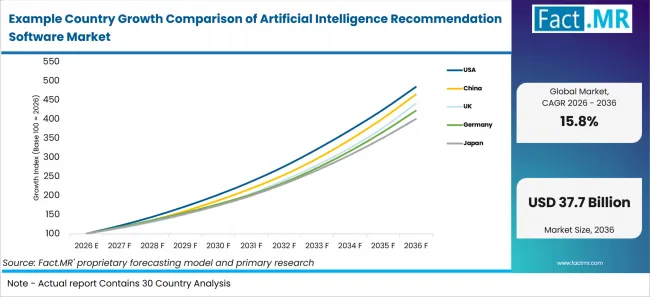
Example Country Growth Comparison Of Artificial Intelligence Recommendation Software Market | Source: Fact.MR
| Country | CAGR (2026-2036) |
|---|---|
| USA | 17.1% |
| UK | 16.0% |
| Germany | 15.5% |
| Japan | 14.9% |
| Singapore | 13.8% |
Source: Fact.MR analysis. Updated Aug 6, 2026
What is driving the USA’s growth through 2036?
17.1% CAGR, supported by e-commerce scale and cloud platform depth.
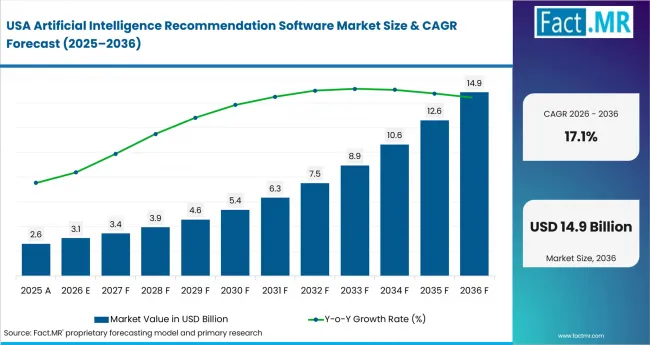
Artificial Intelligence Recommendation Software Market Country Value Analysis | Source: Fact.MR
The USA’s growth reflects a market where large retailers need automated product discovery across broad catalogs. Recommendation tools become more valuable when manual sorting cannot keep pace with changing inventory and customer behavior. Buyers are also expected to place greater emphasis on privacy controls before wider deployment.
What supports the UK outlook?
16.0% CAGR, backed by mature online retail and financial-service channels.
The UK’s growth reflects strong digital activity across retail, banking and media. Recommendation tools can support recurring customer decisions in shopping, content and financial services. Buyers are likely to favor platforms that show measurable improvement in engagement, conversion or retention.
What underpins Germany’s growth?
15.5% CAGR, supported by structured buying reviews and transparency requirements.
Germany’s growth is shaped by buyers that want clearer explanations of how products or content are ranked. Retailers are expected to prefer systems with visible user controls and stronger governance features. Approval may remain careful where transparency and data handling are central to procurement.
How is Japan developing recommendation software adoption?
14.9% CAGR, driven by e-commerce and content ecosystem depth.
Japan’s growth reflects demand from retail and marketplace operators that need accurate discovery across large product and media libraries. Language-sensitive recommendations remain important for customer relevance. Buyers are expected to place added value on service reliability and stable system performance during vendor selection.
How does Singapore support regional adoption?
13.8% CAGR, backed by regional headquarters and structured digital governance.
Singapore’s growth reflects its role as a testing base for wider regional deployment. Enterprises can evaluate recommendation tools in a concentrated market before extending them across Asia. Shared cloud governance and coordinated technology policies can support faster rollout decisions.
Who leads the Artificial Intelligence Recommendation Software Market?
Amazon Web Services and Google Cloud hold strong positions through cloud-based recommendation infrastructure, while Microsoft and Oracle extend the market through enterprise data and application ecosystems.
Amazon Web Services provides machine learning services that support recommendation development and deployment at scale. Google Cloud adds data analytics and AI capabilities for ranking and personalization workflows. Microsoft strengthens enterprise adoption through Azure-based AI tools and connected business applications. Oracle contributes customer-data and commerce capabilities for targeted recommendations. Salesforce and Adobe deepen personalization across marketing, sales and digital experience platforms. Algolia supports search-led discovery, while SAP and SAS add analytics and customer intelligence. Dynamic Yield and Bloomreach broaden the field through real-time personalization and commerce-focused recommendation software.
Which companies are the key providers?
Key companies include Amazon Web Services, Inc. and Google LLC – Google Cloud Microsoft Corporation and Oracle Corporation broaden the provider set. Salesforce, Inc. and Adobe Inc. add personalization depth. Algolia, Inc., SAP SE and SAS Institute Inc. complete the software group. Dynamic Yield Ltd. and Bloomreach, Inc. support model infrastructure.
- Amazon Web Services, Inc.
- Google LLC – Google Cloud
- Microsoft Corporation
- Oracle Corporation
- Salesforce, Inc.
- Adobe Inc.
- Algolia, Inc.
- SAP SE
- SAS Institute Inc.
- Dynamic Yield Ltd.
- Bloomreach, Inc.
Bibliography
- Adobe. (2025). Personalized Interactions | Adobe Target. Adobe Experience Cloud.
- Amazon Web Services. (2025, April 10). Generate user-personalized communication with Amazon Personalize and Amazon Bedrock. AWS Machine Learning Blog.
- IBM. (2024, August 5). AI personalization. IBM Think.
- Microsoft. (2026). Product recommendations overview. Microsoft Learn.
- U.S. Census Bureau. (2026, May 18). Quarterly Retail E-Commerce Sales, First Quarter 2026. U.S. Department of Commerce.
This Report Answers
- The report provides strategic intelligence on Artificial Intelligence Recommendation Software across Recommendation Solution and Business Function choices.
- Segment analysis covers Personalized Recommendation Engines and Product Recommendation as the share leaders within the 2026 market structure.
- Application analysis evaluates E-commerce and Media & Entertainment. Banking & Financial Services and Healthcare complete the application view.
- Country outlook evaluates the USA and China alongside the UK and Germany. Japan, India and Singapore complete the growth comparison.
- Competitive analysis profiles Amazon Web Services, Inc. and Google LLC – Google Cloud Microsoft Corporation and Oracle Corporation complete the main provider comparison. Salesforce, Inc. adds personalization coverage.
What does the Artificial Intelligence Recommendation Software Market cover?
- Key Takeaways
- Market Size and CAGR
- Top Growth Driver
- Fastest Growing Segment
- Leading Region
- Key Companies
- Emerging Opportunities
- Executive Summary
- Global Market Outlook
- Demand-side Trends
- Supply-side Trends
- Technology Roadmap Analysis
- Analysis and Recommendations
- Analyst Perspective (What is happening? Why now? What should investors know?)
- Key Questions Answered
- How large is the market?
- What is the CAGR?
- What are key trends?
- Which region dominates?
- Who are the leaders?
- Market Overview
- Market Coverage / Taxonomy
- Market Definition / Scope / Limitations
- Research Methodology
- Chapter Orientation
- Analytical Lens and Working Hypotheses
- Market Structure, Signals, and Trend Drivers
- Benchmarking and Cross-market Comparability
- Market Sizing, Forecasting, and Opportunity Mapping
- Research Design and Evidence Framework
- Desk Research Programme (Secondary Evidence)
- Expert Input and Fieldwork (Primary Evidence)
- Tooling, Models, and Reference Databases
- Data Engineering and Model Build
- Quality Assurance and Audit Trail
- Market Background
- Market Dynamics (Drivers, Restraints, Opportunity, Trends)
- Scenario Forecast (Optimistic, Likely, Conservative)
- Impact Analysis
- AI Impact
- Sustainability Impact
- Regulatory Impact
- Technology Impact
- Consumer / Buyer Analysis
- Purchase Drivers
- Adoption Barriers
- Buyer Journey
- Opportunity Map Analysis
- Product Life Cycle Analysis
- Supply Chain Analysis
- Investment Feasibility Matrix
- Value Chain Analysis
- PESTLE and Porter's Analysis
- Regulatory Landscape
- Regional Parent Market Outlook
- Production and Consumption Statistics
- Import and Export Statistics
- Global Market Analysis and Forecast, 2021 to 2036
- Historical Market Size Value (USD Billion) Analysis, 2021 to 2025
- Current and Future Market Size Value (USD Billion) Projections, 2026 to 2036
- Y-o-Y Growth Trend Analysis
- Absolute $ Opportunity Analysis
- Global Market Pricing Analysis, 2021 to 2036
- Global Market Analysis and Forecast, By Recommendation Solution, 2021 to 2036
- Introduction / Key Findings
- Historical Market Size Value (USD Billion) Analysis By Recommendation Solution, 2021 to 2025
- Current and Future Market Size Value (USD Billion) Analysis and Forecast By Recommendation Solution, 2026 to 2036
- Personalized Recommendation Engines
- Collaborative Filtering Solutions
- Content-based Recommendation
- Customer Engagement Platforms
- Content Personalization
- Real-time Content Delivery
- Decision Intelligence Platforms
- Next-best Action Engines
- Customer Propensity Models
- Recommendation Analytics
- Performance Analytics
- Model Performance Monitoring
- Personalized Recommendation Engines
- Y-o-Y Growth Trend Analysis By Recommendation Solution, 2021 to 2025
- Absolute $ Opportunity Analysis By Recommendation Solution, 2026 to 2036
- Global Market Analysis and Forecast, By Business Function, 2021 to 2036
- Introduction / Key Findings
- Historical Market Size Value (USD Billion) Analysis By Business Function, 2021 to 2025
- Current and Future Market Size Value (USD Billion) Analysis and Forecast By Business Function, 2026 to 2036
- Product Recommendation
- Cross-selling & Upselling
- Personalized Merchandising
- Customer Experience Management
- User Behavior Analytics
- Customer Journey Optimization
- Marketing Optimization
- Campaign Personalization
- Loyalty Management
- Fraud & Risk Intelligence
- Risk Scoring
- Anomaly Detection
- Product Recommendation
- Y-o-Y Growth Trend Analysis By Business Function, 2021 to 2025
- Absolute $ Opportunity Analysis By Business Function, 2026 to 2036
- Global Market Analysis and Forecast, By Application Area, 2021 to 2036
- Introduction / Key Findings
- Historical Market Size Value (USD Billion) Analysis By Application Area, 2021 to 2025
- Current and Future Market Size Value (USD Billion) Analysis and Forecast By Application Area, 2026 to 2036
- E-commerce
- Online Marketplaces
- Direct-to-Consumer Retail
- Media & Entertainment
- Video Streaming Services
- Music Streaming Platforms
- Banking & Financial Services
- Retail Banking
- Wealth Management
- Healthcare
- Hospitals
- Digital Health Platforms
- E-commerce
- Y-o-Y Growth Trend Analysis By Application Area, 2021 to 2025
- Absolute $ Opportunity Analysis By Application Area, 2026 to 2036
- Global Market Analysis and Forecast, By End User, 2021 to 2036
- Introduction / Key Findings
- Historical Market Size Value (USD Billion) Analysis By End User, 2021 to 2025
- Current and Future Market Size Value (USD Billion) Analysis and Forecast By End User, 2026 to 2036
- Retail & E-commerce Companies
- Digital Commerce Platforms
- Retail Chains
- Media & Streaming Companies
- Digital Media Companies
- Content Providers
- Banking Institutions
- Insurance Companies
- Financial Technology Companies
- Healthcare Organizations
- Healthcare Technology Providers
- Research Institutions
- Retail & E-commerce Companies
- Y-o-Y Growth Trend Analysis By End User, 2021 to 2025
- Absolute $ Opportunity Analysis By End User, 2026 to 2036
- Global Market Analysis and Forecast, By Artificial Intelligence Technology, 2021 to 2036
- Introduction / Key Findings
- Historical Market Size Value (USD Billion) Analysis By Artificial Intelligence Technology, 2021 to 2025
- Current and Future Market Size Value (USD Billion) Analysis and Forecast By Artificial Intelligence Technology, 2026 to 2036
- Deep Learning
- Neural Networks
- Hybrid Recommendation Models
- Natural Language Processing
- Large Language Models
- Transformer Models
- Predictive Analytics
- Behavioral Analytics
- Explainable Artificial Intelligence
- Machine Learning
- Real-time Inference Engines
- Reinforcement Learning
- Deep Learning
- Y-o-Y Growth Trend Analysis By Artificial Intelligence Technology, 2021 to 2025
- Absolute $ Opportunity Analysis By Artificial Intelligence Technology, 2026 to 2036
- Global Market Analysis and Forecast, By Region, 2021 to 2036
- Introduction
- Historical Market Size Value (USD Billion) Analysis By Region, 2021 to 2025
- Current Market Size Value (USD Billion) Analysis and Forecast By Region, 2026 to 2036
- North America
- Latin America
- Western Europe
- Eastern Europe
- East Asia
- South Asia and Pacific
- Middle East & Africa
- Market Attractiveness Analysis By Region
- North America Market Analysis and Forecast, By Country, 2021 to 2036
- Historical Market Size Value (USD Billion) Trend Analysis By Market Taxonomy, 2021 to 2025
- Market Size Value (USD Billion) Forecast By Market Taxonomy, 2026 to 2036
- By Country
- USA
- Canada
- By Recommendation Solution
- By Business Function
- By Application Area
- By End User
- By Artificial Intelligence Technology
- By Country
- Market Attractiveness Analysis
- By Country
- By Recommendation Solution
- By Business Function
- By Application Area
- By End User
- By Artificial Intelligence Technology
- Key Takeaways
- Latin America Market Analysis and Forecast, By Country
- Historical Market Size Value (USD Billion) Trend Analysis By Market Taxonomy, 2021 to 2025
- Market Size Value (USD Billion) Forecast By Market Taxonomy, 2026 to 2036
- By Country
- Brazil
- Mexico
- Chile
- Rest of Latin America
- By Recommendation Solution
- By Business Function
- By Application Area
- By End User
- By Artificial Intelligence Technology
- By Country
- Market Attractiveness Analysis
- By Country
- By Recommendation Solution
- By Business Function
- By Application Area
- By End User
- By Artificial Intelligence Technology
- Key Takeaways
- Western Europe Market Analysis and Forecast, By Country
- Historical Market Size Value (USD Billion) Trend Analysis By Market Taxonomy, 2021 to 2025
- Market Size Value (USD Billion) Forecast By Market Taxonomy, 2026 to 2036
- By Country
- Germany
- UK
- Italy
- Spain
- France
- Nordic
- BENELUX
- Rest of Western Europe
- By Recommendation Solution
- By Business Function
- By Application Area
- By End User
- By Artificial Intelligence Technology
- By Country
- Market Attractiveness Analysis
- By Country
- By Recommendation Solution
- By Business Function
- By Application Area
- By End User
- By Artificial Intelligence Technology
- Key Takeaways
- Eastern Europe Market Analysis and Forecast, By Country
- Historical Market Size Value (USD Billion) Trend Analysis By Market Taxonomy, 2021 to 2025
- Market Size Value (USD Billion) Forecast By Market Taxonomy, 2026 to 2036
- By Country
- Russia
- Poland
- Hungary
- Balkan & Baltic
- Rest of Eastern Europe
- By Recommendation Solution
- By Business Function
- By Application Area
- By End User
- By Artificial Intelligence Technology
- By Country
- Market Attractiveness Analysis
- By Country
- By Recommendation Solution
- By Business Function
- By Application Area
- By End User
- By Artificial Intelligence Technology
- Key Takeaways
- East Asia Market Analysis and Forecast, By Country
- Historical Market Size Value (USD Billion) Trend Analysis By Market Taxonomy, 2021 to 2025
- Market Size Value (USD Billion) Forecast By Market Taxonomy, 2026 to 2036
- By Country
- China
- Japan
- South Korea
- By Recommendation Solution
- By Business Function
- By Application Area
- By End User
- By Artificial Intelligence Technology
- By Country
- Market Attractiveness Analysis
- By Country
- By Recommendation Solution
- By Business Function
- By Application Area
- By End User
- By Artificial Intelligence Technology
- Key Takeaways
- South Asia and Pacific Market Analysis and Forecast, By Country
- Historical Market Size Value (USD Billion) Trend Analysis By Market Taxonomy, 2021 to 2025
- Market Size Value (USD Billion) Forecast By Market Taxonomy, 2026 to 2036
- By Country
- India
- ASEAN
- Australia & New Zealand
- Rest of South Asia and Pacific
- By Recommendation Solution
- By Business Function
- By Application Area
- By End User
- By Artificial Intelligence Technology
- By Country
- Market Attractiveness Analysis
- By Country
- By Recommendation Solution
- By Business Function
- By Application Area
- By End User
- By Artificial Intelligence Technology
- Key Takeaways
- Middle East & Africa Market Analysis and Forecast, By Country
- Historical Market Size Value (USD Billion) Trend Analysis By Market Taxonomy, 2021 to 2025
- Market Size Value (USD Billion) Forecast By Market Taxonomy, 2026 to 2036
- By Country
- Kingdom of Saudi Arabia
- Other GCC Countries
- Türkiye
- South Africa
- Other African Union
- Rest of Middle East & Africa
- By Recommendation Solution
- By Business Function
- By Application Area
- By End User
- By Artificial Intelligence Technology
- By Country
- Market Attractiveness Analysis
- By Country
- By Recommendation Solution
- By Business Function
- By Application Area
- By End User
- By Artificial Intelligence Technology
- Key Takeaways
- Key Countries Market Analysis
- USA
- Pricing Analysis
- Market Share Analysis, 2025
- By Recommendation Solution
- By Business Function
- By Application Area
- By End User
- By Artificial Intelligence Technology
- Canada
- Pricing Analysis
- Market Share Analysis, 2025
- By Recommendation Solution
- By Business Function
- By Application Area
- By End User
- By Artificial Intelligence Technology
- Mexico
- Pricing Analysis
- Market Share Analysis, 2025
- By Recommendation Solution
- By Business Function
- By Application Area
- By End User
- By Artificial Intelligence Technology
- Brazil
- Pricing Analysis
- Market Share Analysis, 2025
- By Recommendation Solution
- By Business Function
- By Application Area
- By End User
- By Artificial Intelligence Technology
- Chile
- Pricing Analysis
- Market Share Analysis, 2025
- By Recommendation Solution
- By Business Function
- By Application Area
- By End User
- By Artificial Intelligence Technology
- Germany
- Pricing Analysis
- Market Share Analysis, 2025
- By Recommendation Solution
- By Business Function
- By Application Area
- By End User
- By Artificial Intelligence Technology
- UK
- Pricing Analysis
- Market Share Analysis, 2025
- By Recommendation Solution
- By Business Function
- By Application Area
- By End User
- By Artificial Intelligence Technology
- Italy
- Pricing Analysis
- Market Share Analysis, 2025
- By Recommendation Solution
- By Business Function
- By Application Area
- By End User
- By Artificial Intelligence Technology
- Spain
- Pricing Analysis
- Market Share Analysis, 2025
- By Recommendation Solution
- By Business Function
- By Application Area
- By End User
- By Artificial Intelligence Technology
- France
- Pricing Analysis
- Market Share Analysis, 2025
- By Recommendation Solution
- By Business Function
- By Application Area
- By End User
- By Artificial Intelligence Technology
- India
- Pricing Analysis
- Market Share Analysis, 2025
- By Recommendation Solution
- By Business Function
- By Application Area
- By End User
- By Artificial Intelligence Technology
- ASEAN
- Pricing Analysis
- Market Share Analysis, 2025
- By Recommendation Solution
- By Business Function
- By Application Area
- By End User
- By Artificial Intelligence Technology
- Australia & New Zealand
- Pricing Analysis
- Market Share Analysis, 2025
- By Recommendation Solution
- By Business Function
- By Application Area
- By End User
- By Artificial Intelligence Technology
- China
- Pricing Analysis
- Market Share Analysis, 2025
- By Recommendation Solution
- By Business Function
- By Application Area
- By End User
- By Artificial Intelligence Technology
- Japan
- Pricing Analysis
- Market Share Analysis, 2025
- By Recommendation Solution
- By Business Function
- By Application Area
- By End User
- By Artificial Intelligence Technology
- South Korea
- Pricing Analysis
- Market Share Analysis, 2025
- By Recommendation Solution
- By Business Function
- By Application Area
- By End User
- By Artificial Intelligence Technology
- Russia
- Pricing Analysis
- Market Share Analysis, 2025
- By Recommendation Solution
- By Business Function
- By Application Area
- By End User
- By Artificial Intelligence Technology
- Poland
- Pricing Analysis
- Market Share Analysis, 2025
- By Recommendation Solution
- By Business Function
- By Application Area
- By End User
- By Artificial Intelligence Technology
- Hungary
- Pricing Analysis
- Market Share Analysis, 2025
- By Recommendation Solution
- By Business Function
- By Application Area
- By End User
- By Artificial Intelligence Technology
- Kingdom of Saudi Arabia
- Pricing Analysis
- Market Share Analysis, 2025
- By Recommendation Solution
- By Business Function
- By Application Area
- By End User
- By Artificial Intelligence Technology
- Türkiye
- Pricing Analysis
- Market Share Analysis, 2025
- By Recommendation Solution
- By Business Function
- By Application Area
- By End User
- By Artificial Intelligence Technology
- South Africa
- Pricing Analysis
- Market Share Analysis, 2025
- By Recommendation Solution
- By Business Function
- By Application Area
- By End User
- By Artificial Intelligence Technology
- USA
- Market Structure Analysis
- Competition Dashboard
- Competition Benchmarking
- Market Share Analysis of Top Players
- By Regional
- By Recommendation Solution
- By Business Function
- By Application Area
- By End User
- By Artificial Intelligence Technology
- Emerging Startups
- Innovation Benchmarking
- Competition Analysis
- Competition Deep Dive
- Amazon Web Services, Inc.
- Overview
- Product Portfolio
- Profitability by Market Segments
- Sales Footprint
- Strategy Overview
- Marketing Strategy
- Product Strategy
- Channel Strategy
- Alphabet Inc.
- Microsoft Corporation
- Oracle Corporation
- Salesforce, Inc.
- Adobe Inc.
- International Business Machines Corporation
- SAP SE
- SAS Institute Inc.
- NVIDIA Corporation
- Intel Corporation
- Amazon Web Services, Inc.
- Competition Deep Dive
- Case Studies
- Success Stories
- Recent Developments
- Assumptions & Acronyms Used
Segmentation
What is the report's scope and coverage?
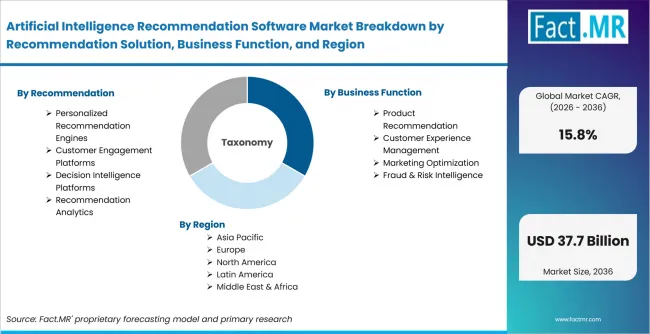
Artificial Intelligence Recommendation Software Market Breakdown By Recommendation Solution, Business Function, And Region | Source: Fact.MR
| Attribute | Details |
|---|---|
| Quantitative Units | USD Billion |
| Market Definition | AI-enabled software and managed services purchased to rank and recommend products or content |
| Recommendation Solution | Personalized Recommendation Engines; Customer Engagement Platforms; Decision Intelligence Platforms; Recommendation Analytics |
| Business Function | Product Recommendation; Customer Experience Management; Marketing Optimization; Fraud & Risk Intelligence |
| Application Area | E-commerce; Media & Entertainment; Banking & Financial Services; Healthcare |
| End User | Retail & E-commerce Companies; Media & Streaming Companies; Banking Institutions; Healthcare Organizations |
| Artificial Intelligence Technology | Deep Learning; Natural Language Processing; Predictive Analytics; Machine Learning |
| Regions Covered | North America; Europe; Asia Pacific; Central and South America; Middle East and Africa |
| Countries Covered | USA; China; UK; Germany; Japan; India; Singapore |
| Key Companies Profiled | Amazon Web Services, Inc.; Google LLC – Google Cloud; Microsoft Corporation; Oracle Corporation; Salesforce, Inc.; Adobe Inc.; Algolia, Inc.; SAP SE; SAS Institute Inc.; Dynamic Yield Ltd.; Bloomreach, Inc. |
| Forecast Period | 2026 to 2036 |
| Approach | Hybrid top-down and bottom-up approach using recommendation software adoption; digital commerce activity; enterprise licensing; cloud consumption; end-user demand; technology use; country growth rates and provider validation |
Source: Fact.MR analysis. Updated Aug 6, 2026
How is the market segmented?
-
By Recommendation Solution:
- Personalized Recommendation Engines
- Collaborative Filtering Solutions
- Content-based Recommendation
- Customer Engagement Platforms
- Content Personalization
- Real-time Content Delivery
- Decision Intelligence Platforms
- Next-best Action Engines
- Customer Propensity Models
- Recommendation Analytics
- Performance Analytics
- Model Performance Monitoring
- Personalized Recommendation Engines
-
By Business Function:
- Product Recommendation
- Cross-selling & Upselling
- Personalized Merchandising
- Customer Experience Management
- User Behavior Analytics
- Customer Journey Optimization
- Marketing Optimization
- Campaign Personalization
- Loyalty Management
- Fraud & Risk Intelligence
- Risk Scoring
- Anomaly Detection
- Product Recommendation
-
By Application Area:
- E-commerce
- Online Marketplaces
- Direct-to-Consumer Retail
- Media & Entertainment
- Video Streaming Services
- Music Streaming Platforms
- Banking & Financial Services
- Retail Banking
- Wealth Management
- Healthcare
- Hospitals
- Digital Health Platforms
- E-commerce
-
By End User:
- Retail & E-commerce Companies
- Digital Commerce Platforms
- Retail Chains
- Media & Streaming Companies
- Digital Media Companies
- Content Providers
- Banking Institutions
- Insurance Companies
- Financial Technology Companies
- Healthcare Organizations
- Healthcare Technology Providers
- Research Institutions
- Retail & E-commerce Companies
-
By Artificial Intelligence Technology:
- Deep Learning
- Neural Networks
- Hybrid Recommendation Models
- Natural Language Processing
- Large Language Models
- Transformer Models
- Predictive Analytics
- Behavioral Analytics
- Explainable Artificial Intelligence
- Machine Learning
- Real-time Inference Engines
- Reinforcement Learning
- Deep Learning
-
By Region:
- North America
- Latin America
- Western Europe
- Eastern Europe
- East Asia
- South Asia and Pacific
- Middle East & Africa
Frequently Asked Questions
How big is the artificial intelligence recommendation software market in 2026?
What is the CAGR of the artificial intelligence recommendation software market from 2026 to 2036?
Which recommendation solution leads the artificial intelligence recommendation software market?
Which end-user segment leads the artificial intelligence recommendation software market?
Who are the leading companies in the artificial intelligence recommendation software market?
Who worked on this report


Preview the report firsthand - request a free sample
Free SampleGet the brochure for pricing and purchase details
Download PDF