- Market Value (2025): USD 16.5 Bn
- Estimated Value (2026): USD 18.6 Bn
- Forecast Value (2036): USD 63.1 Bn
- CAGR (2026-2036): 13.0%
What is the Artificial Intelligence Impact and Future in Modern Warfare Market forecast to be worth by 2036?
USD 18.6 billion in 2026 to USD 63.1 billion by 2036 at 13.0% CAGR.
- The artificial intelligence impact and future in modern warfare market was valued at USD 16.5 billion in 2025.
- Demand is projected to increase from USD 18.6 billion in 2026 to USD 63.1 billion by 2036.
- The market is forecast to record 13.0% CAGR from 2026 to 2036 as defense organizations expand AI-enabled intelligence and autonomous mission support.
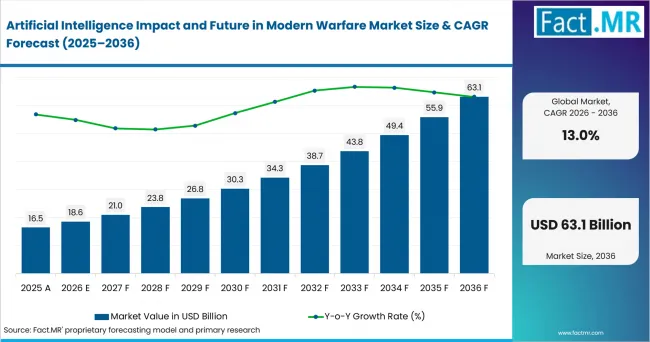
Artificial Intelligence Impact And Future In Modern Warfare Market Value Analysis | Source: Fact.MR
What are the defining numbers behind Artificial Intelligence Impact and Future in Modern Warfare Market growth?
USD 44.2 billion absolute opportunity by 2036, led by Autonomous Combat Systems and Intelligence, Surveillance and Reconnaissance alongside Land Warfare and Computer Vision.
- Demand Drivers in the Market
- Armed forces need faster fusion of imagery and signal data since decision windows are shrinking across multi-domain operations.
- Autonomous and uncrewed systems are expected to reduce personnel exposure during surveillance and contested logistics where autonomous robots support remote operation.
- Command teams need decision-support tools that rank threats and leave a record that operators can review.
- Key Segments Analyzed
- By AI Warfare Solution: Autonomous Combat Systems are expected to hold 39% share in 2026 supported by unmanned platforms and mission autonomy.
- By Combat Function: Intelligence, Surveillance and Reconnaissance is projected to account for 36% share in 2026 as AI improves sensor fusion and monitoring.
- By Defense Domain: Land Warfare is anticipated to capture 34% share in 2026 as ground forces add uncrewed vehicles and tactical surveillance.
- By End User: Defense Forces are estimated to represent 42% share in 2026 owing to direct procurement by national armed forces and special operations units.
- By AI Capability: Computer Vision is forecast to account for 38% share in 2026 through target recognition and video review across electro-optical systems.
- Analyst Opinion at Fact.MR
- Shambhu Nath Jha, Senior Consultant at Fact.MR, states, “Military AI buyers now ask whether a system remains dependable when communications degrade and inputs become unclear. Suppliers that prove assurance and integration together are expected to move faster from trials into funded programs.”
- Strategic Implications
- Defense contractors can strengthen buyer confidence by validating algorithms with mission data and documenting performance under jamming or low-visibility conditions.
- Platform manufacturers benefit from open interfaces that allow AI modules to be updated without rebuilding the vehicle or command system.
- Armed forces gain better control by combining autonomy procurement with operator training and clear override rules for AI-enabled defense networks.
The USA leads at 14.2% CAGR through large military AI programs and joint-force data integration. Israel follows at 13.7% as centralized autonomy development shortens testing cycles. The UK reaches 13.2% through autonomous-system investment and digital targeting. South Korea records 12.8% through defense modernization and robotics capability. Japan posts 12.3%, while Australia reaches 11.9% through AUKUS experimentation. Germany closes the comparison at 11.4% through battlefield digitization and tactical surveillance.
How does the Artificial Intelligence Impact and Future in Modern Warfare Market break down by segment?
Autonomous Combat Systems lead at 39% in 2026. Intelligence, Surveillance and Reconnaissance leads at 36% in 2026.
Which AI Warfare Solution dominates?
Autonomous Combat Systems hold 39% share in 2026.
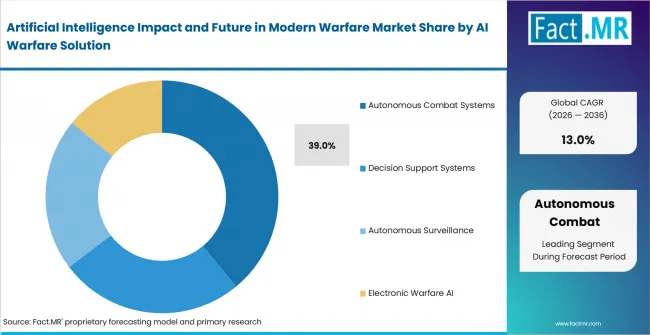
Artificial Intelligence Impact And Future In Modern Warfare Market Analysis By Ai Warfare Solution | Source: Fact.MR
Autonomous Combat Systems are expected to hold 39% share in 2026 as defense buyers expand uncrewed ground systems and air-launched effects. Decision Support Systems remain relevant where commanders need structured recommendations instead of full platform autonomy. Autonomous Surveillance adds value when forces need border and perimeter monitoring over long periods.
What leads the Combat Function segment?
Intelligence, Surveillance and Reconnaissance holds 36% share in 2026.
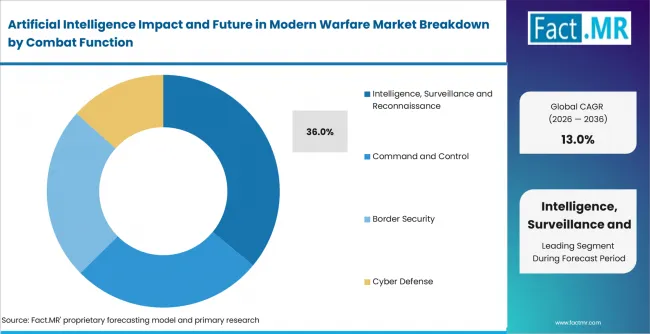
Artificial Intelligence Impact And Future In Modern Warfare Market Analysis By Combat Function | Source: Fact.MR
Intelligence, Surveillance and Reconnaissance is projected to account for 36% share in 2026 since defense teams must process imagery and signals within tactical timelines. AI helps operators detect objects and raise unusual patterns for review. Additional demand comes from surveillance drones that need continuous analysis.
How does Defense Domain shape demand?
Land Warfare holds 34% share in 2026.
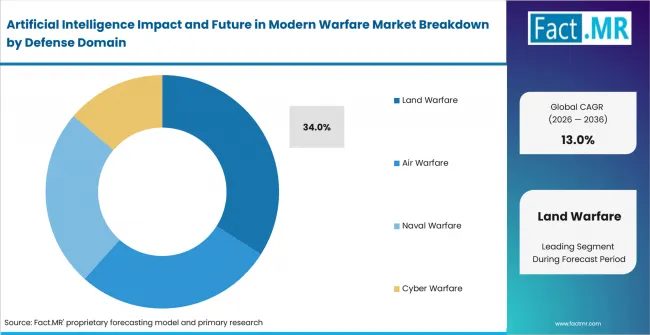
Artificial Intelligence Impact And Future In Modern Warfare Market Analysis By Defense Domain | Source: Fact.MR
Land Warfare is anticipated to capture 34% share in 2026 as armored platforms and tactical units adopt AI for route planning and threat warning. Air Warfare uses AI to reduce pilot workload. Cyber Warfare and electronic warfare need machine learning when attack patterns change quickly.
What supports Defense Forces within End User?
Defense Forces are projected to hold 42% share in 2026.
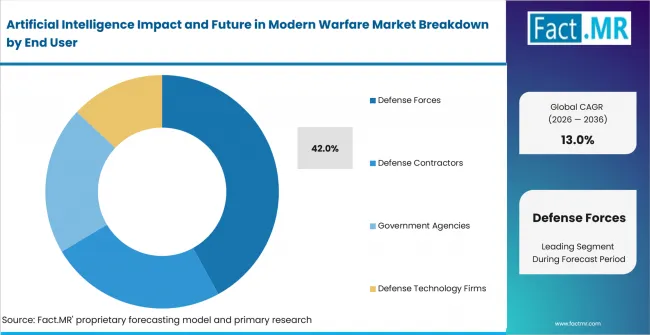
Artificial Intelligence Impact And Future In Modern Warfare Market Analysis By End User | Source: Fact.MR
Defense Forces are estimated to represent 42% share in 2026 owing to direct acquisition by national armed forces and special operations units. Contractors convert mission requirements into fielded systems. Research organizations support testing when buyers need proof before wider use.
Which AI Capability leads?
Computer Vision holds 38% share in 2026.
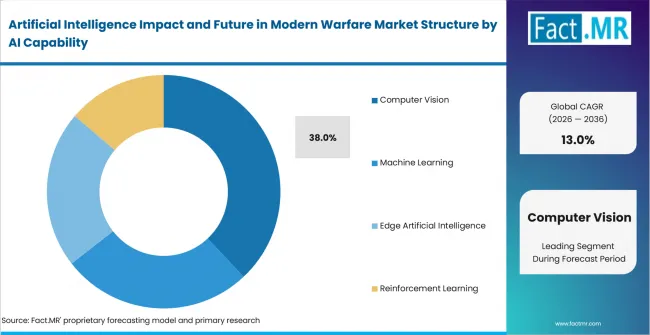
Artificial Intelligence Impact And Future In Modern Warfare Market Analysis By Ai Capability | Source: Fact.MR
Computer Vision is forecast to account for 38% share in 2026 because target recognition and image processing are near-term defense needs. Edge AI gains importance when platforms must process data locally. Local processing helps when battlefield networks and military antennas face disruption.
What is accelerating Artificial Intelligence Impact and Future in Modern Warfare Market adoption, and what is holding it back?
Sensor-data overload and autonomous mission requirements are anticipated to drive demand. Assurance cost and integration work are expected to slow deployment where systems influence targeting or command decisions.
Drivers Impact Analysis
| DRIVER | RELATIVE IMPACT | GEOGRAPHIC RELEVANCE | IMPACT TIMELINE |
|---|---|---|---|
| AI-enabled sensor fusion for faster battlefield awareness | High | USA, Israel, NATO members | Short to medium term |
| Autonomous systems for surveillance and contested logistics | High | USA, UK, Australia, Japan | Medium term |
| Decision support across multi-domain command networks | Medium-high | NATO and Indo-Pacific allies | Medium term |
| Adaptive cyber and electronic-warfare defense | Medium | Global defense organizations | Short to medium term |
| Edge processing where communications are degraded | Medium | Land, air and maritime operations | Medium term |
Source: Fact.MR analysis. Updated Aug 5, 2026
- Sensor-data fusion: Military teams collect more imagery and signals than operators can review in time.
- Autonomy under risk: Uncrewed systems are attractive when reconnaissance or logistics would expose personnel.
- Command support: Multi-domain operations need recommendations that commanders can inspect and override.
Opportunity Impact Analysis
| OPPORTUNITY | RELATIVE IMPACT | GEOGRAPHIC RELEVANCE | IMPACT TIMELINE |
|---|---|---|---|
| Mission-tested autonomous ground and aerial systems | High | USA, Israel, UK, Australia | Medium term |
| Computer-vision modules for ISR modernization | High | Global defense forces | Short to medium term |
| Secure edge AI for disconnected operations | Medium-high | Indo-Pacific and NATO front-line forces | Medium term |
| AI testing, evaluation, verification and validation services | Medium-high | Regulated defense programs | Long term |
| Open-architecture integration for legacy platforms | Medium | Europe, North America, Asia Pacific | Medium term |
Source: Fact.MR analysis. Updated Aug 5, 2026
- Mission-tested autonomy: Realistic exercises help companies prove that systems work under denied navigation and intermittent communications.
- Computer-vision modules: ISR modernization is expected to create demand for verified imagery pipelines and defense data labeling that reflect mission conditions.
- Assurance services: Testing and validation are becoming separate commercial needs. Defense organizations need repeatable checks for reliability, explainability and human control.
Restraints Impact Analysis
| RESTRAINT | RELATIVE IMPACT | GEOGRAPHIC RELEVANCE | IMPACT TIMELINE |
|---|---|---|---|
| Uncertain behavior under adversarial or degraded inputs | High | Global | Short to long term |
| Integration with legacy command and platform architectures | High | Mature defense forces | Medium term |
| Restricted access to representative mission data | Medium-high | Global defense programs | Medium term |
| Legal, ethical and accountability requirements | Medium-high | NATO members and allies | Long term |
| Cybersecurity and model supply-chain exposure | Medium | Global | Short to medium term |
Source: Fact.MR analysis. Updated Aug 5, 2026
- Operational assurance: Military AI depends on data quality and operating conditions. Qualification cost rises when systems support targeting or autonomous action.
- Legacy integration: Secure networks and mission computers often need more work than the algorithm. Interface limits can delay operational use even after a model performs well.
- Data access: Representative mission data is often classified or hard to share across contractors. Limited access can slow training and acceptance testing.
Which countries are scaling Artificial Intelligence Impact and Future in Modern Warfare Market fastest?
- The country comparison forms three growth bands across the forecast period.
- The USA remains 0.5 percentage point above Israel through large defense AI programs and joint-force data integration.
- Israel remains 0.5 percentage point above the UK as AI and autonomy work stays close to operational units.
- The UK remains 0.4 percentage point above South Korea through autonomous-system investment and digital targeting work.
- South Korea remains 0.5 percentage point above Japan as surveillance and command-support needs guide modernization.
- Japan remains 0.4 percentage point above Australia through AI-equipped defense-system research and unmanned capability development.
- Australia remains 0.5 percentage point above Germany owing to AUKUS experimentation and allied interoperability.
Comparable CAGRs create different entry conditions. Procurement scale, platform modernization and autonomy assurance vary by country. Full report coverage includes North America and Europe. Coverage extends to Asia Pacific, Central and South America and the Middle East and Africa.
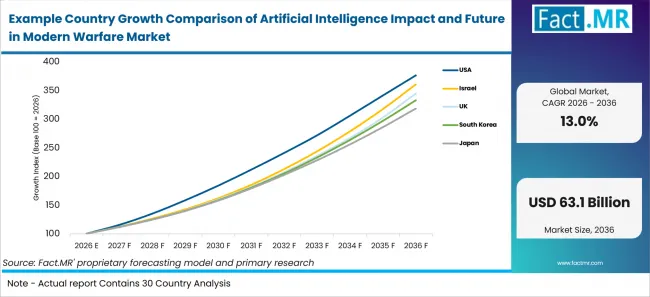
Example Country Growth Comparison Of Artificial Intelligence Impact And Future In Modern Warfare Market | Source: Fact.MR
| Country | CAGR (2026-2036) |
|---|---|
| USA | 14.2% |
| Israel | 13.7% |
| UK | 13.2% |
| South Korea | 12.8% |
| Japan | 12.3% |
| Australia | 11.9% |
| Germany | 11.4% |
Source: Fact.MR analysis. Updated Aug 5, 2026
What is driving the USA's growth through 2036?
14.2% CAGR, driven by military AI acceleration and joint-force data integration.
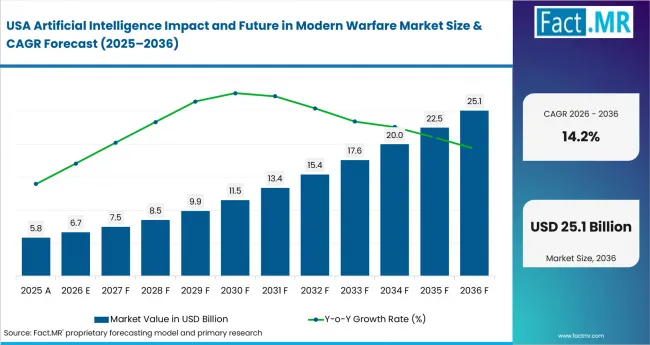
Artificial Intelligence Impact And Future In Modern Warfare Market Country Value Analysis | Source: Fact.MR
The USA enters the forecast period with large defense programs and a deep supplier base. Procurement is expected to move beyond trials as services need AI for intelligence, command support and cyber missions.
How is Israel scaling defense AI demand?
13.7% CAGR, supported by centralized AI and autonomy development.
Israel’s advantage comes from short feedback loops among defense units, technology companies and applied research teams. This structure is expected to shorten testing cycles when tools address urgent battlefield needs.
What supports the UK outlook?
13.2% CAGR, led by autonomous-system investment and digital targeting.
The UK outlook rests on a move toward a more integrated force where AI helps data pass from sensors to decision teams. Buyers are expected to favor systems that improve targeting support without weakening operator control.
How is South Korea developing military AI demand?
12.8% CAGR, shaped by defense modernization and robotics capability.
South Korea is building demand through defense AI cooperation across government and industry. The commercial need is practical validation, since buyers want tools that improve readiness and reduce operator workload.
What underpins Japan’s growth?
12.3% CAGR, attributable to AI-equipped defense-system research and unmanned capability development.
Japan’s path is more cautious because defense AI must fit responsible-use guidance and equipment research rules. Suppliers are expected to win attention when they explain risk controls in plain operational terms.
How is Australia developing military AI demand?
11.9% CAGR, supported by AUKUS experimentation and resilient autonomy trials.
Australia’s role is shaped by allied testing of robotic vehicles in contested settings. Local demand is expected to favor systems that work with partner networks and hold up under electronic interference.
What supports Germany’s outlook?
11.4% CAGR, driven by battlefield digitization and tactical surveillance.
Germany’s adoption is expected to depend on battlefield awareness tools that preserve legal review and human control. Tactical surveillance demand creates room for AI where outputs remain explainable to operators.
Who leads the Artificial Intelligence Impact and Future in Modern Warfare Market?
Lockheed Martin and Northrop Grumman anchor the market through autonomous platforms and advanced sensing, while BAE Systems strengthens mission-command integration.
Thales and L3Harris add secure communications, electronic warfare and multi-domain control. General Dynamics supports defense IT and mission networks. Leonardo, Saab, Elbit Systems and Hensoldt broaden competition through platform integration, surveillance technologies and sensor-led battlefield awareness across modern defense operations.
Which companies are the key providers?
Key companies include Lockheed Martin Corporation; Northrop Grumman Corporation; BAE Systems plc; Thales S.A.; L3Harris Technologies, Inc.; General Dynamics Corporation – GDIT; Leonardo S.p.A.; Saab AB; Elbit Systems Ltd.; Hensoldt AG.
- Lockheed Martin Corporation
- Northrop Grumman Corporation
- BAE Systems plc
- Thales S.A.
- L3Harris Technologies, Inc.
- General Dynamics Corporation – GDIT
- Leonardo S.p.A.
- Saab AB
- Elbit Systems Ltd.
- Hensoldt AG
Bibliography
- Australian Department of Defence. (2024, February 6). AUKUS trials AI in robotic vehicles.
- BAE Systems. (2026, March 18). UK based engineers rapidly developing new way of tackling drone threats.
- Japan Ministry of Defense. (2025, June 6). Press Conference by Defense Minister Nakatani on Friday, June 6, 2025, at 9:09 AM.
- L3Harris Technologies. (2025, February 10). L3Harris launches new technology to control autonomous swarms.
This Report Answers
- The report provides intelligence on military AI across warfare solutions and combat functions.
- Segment analysis covers Autonomous Combat Systems and Intelligence, Surveillance and Reconnaissance within the 2026 structure.
- Regional outlook evaluates the USA and Israel alongside the UK and South Korea. Japan, Australia and Germany complete the listed country view.
- Competitive analysis reviews approved defense technology providers without company-share claims.
- Capability assessment covers Computer Vision and Machine Learning. Edge AI and Reinforcement Learning complete the capability view.
What does the Artificial Intelligence Impact and Future in Modern Warfare Market cover?
AI-enabled autonomous systems and decision support used in military operations. The coverage includes surveillance, electronic warfare and cyber-defense capabilities.
The market covers software and integrated systems where AI is material to the purchased defense function. Coverage includes autonomous combat systems and decision support. It includes electronic-warfare analytics and cyber-defense applications.
What is included in the scope?
Military AI systems used for operational intelligence and command support. Autonomous missions and surveillance are included when they serve defined defense uses. Electronic warfare and cyber defense are included under the same condition.
The scope includes Computer Vision and Machine Learning in defined defense applications. Edge AI and Reinforcement Learning are included when used for military decision support. Integration, testing and mission-support services are included when they support AI-enabled warfare systems.
What is excluded from the scope?
General-purpose AI, civilian robotics and conventional defense equipment without a material AI function are outside the scope.
The scope excludes commercial AI tools not configured for defense missions and civilian surveillance products. Standalone cloud infrastructure and conventional platforms are excluded when sold without AI-enabled perception, autonomy or decision support.
How Was the Analysis Built?
The analysis draws on 120+ sources and 35+ company portfolios. The review covers 25+ countries and more than 20 industry interviews.
- Primary Research: Primary research includes discussions with manufacturers and service providers. It covers technology developers and end users. Procurement teams and subject-matter experts are included in the same interview base.
- Desk Research: Desk research covers government statistics and regulatory publications. It reviews company filings and trade data. Technical studies and company documentation support the desk review.
- Market Sizing and Forecasting: Market estimates combine historical performance and demand indicators. Pricing trends and segment shares are then reconciled. Country-level growth patterns and analyst judgement complete the estimate.
- Data Validation and Update Cycle: Findings are validated by comparing primary interviews with public data. Company activity, regulatory changes and trade patterns are checked before update.
Segmentation
What is the report's scope and coverage?
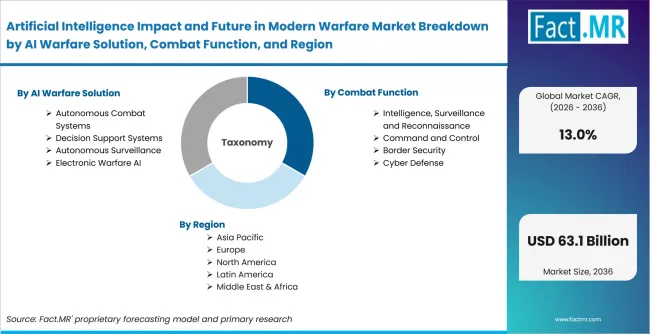
Artificial Intelligence Impact And Future In Modern Warfare Market Breakdown By Ai Warfare Solution, Combat Function, And Region | Source: Fact.MR
| Attribute | Details |
|---|---|
| Quantitative Units | USD Billion |
| Market Definition | AI-enabled warfare systems, mission software, autonomous platforms and analytical capabilities purchased for military operations and national defense missions |
| AI Warfare Solution | Autonomous Combat Systems; Decision Support Systems; Autonomous Surveillance; Electronic Warfare AI |
| Combat Function | Intelligence, Surveillance and Reconnaissance; Command and Control; Border Security; Cyber Defense |
| Defense Domain | Land Warfare; Air Warfare; Naval Warfare; Cyber Warfare |
| End User | Defense Forces; Defense Contractors; Government Agencies; Defense Technology Firms |
| AI Capability | Computer Vision; Machine Learning; Edge AI; Reinforcement Learning |
| Regions Covered | North America; Europe; Asia Pacific; Central and South America; Middle East and Africa |
| Countries Covered | USA; Israel; UK; South Korea; Japan; Australia; Germany |
| Key Companies Profiled | Lockheed Martin Corporation; Northrop Grumman Corporation; BAE Systems plc; Thales S.A.; L3Harris Technologies, Inc.; General Dynamics Corporation – GDIT; Leonardo S.p.A.; Saab AB; Elbit Systems Ltd.; Hensoldt AG |
| Forecast Period | 2026 to 2036 |
| Approach | Hybrid top-down and bottom-up approach using defense procurement activity; platform modernization; AI software attachment; autonomous-system programs; mission-computing integration; supplier validation; country adoption patterns and company portfolio review |
Source: Fact.MR analysis. Updated Aug 5, 2026
How is the market segmented?
-
By AI Warfare Solution:
- Autonomous Combat Systems
- Unmanned Ground Systems
- Autonomous Weapon Platforms
- Decision Support Systems
- Battle Management Software
- AI Mission Planning
- Autonomous Surveillance
- Persistent Surveillance
- Border Monitoring
- Electronic Warfare AI
- Threat Detection
- Signal Intelligence.
- Autonomous Combat Systems
-
By Combat Function:
- Intelligence, Surveillance and Reconnaissance
- Battlefield Intelligence
- Situational Awareness
- Command and Control
- Mission Planning
- Target Prioritization
- Border Security
- Maritime Surveillance
- Coastal Monitoring
- Cyber Defense
- Network Defense
- Cyber Threat Hunting
- Intelligence, Surveillance and Reconnaissance
-
By Defense Domain:
- Land Warfare
- Armored Platforms
- Artillery Systems
- Air Warfare
- Combat Aircraft
- Unmanned Aerial Systems
- Naval Warfare
- Surface Combatants
- Submarines
- Cyber Warfare
- Military Communication Networks
- Critical Defense Infrastructure
- Land Warfare
-
By End User:
- Defense Forces
- National Armed Forces
- Special Operations Units
- Defense Contractors
- System Integrators
- Research Organizations
- Government Agencies
- Homeland Security Agencies
- Coast Guard Organizations
- Defense Technology Firms
- AI Software Developers
- Defense Research Institutes
- Defense Forces
-
By AI Capability:
- Computer Vision
- Target Recognition
- Image Processing
- Machine Learning
- Predictive Analytics
- Deep Learning Models
- Edge AI
- Real-time Edge Processing
- Distributed AI Computing
- Reinforcement Learning
- Adaptive Decision Models
- Autonomous Learning Systems
- Computer Vision
-
By Region:
- North America
- Latin America
- Europe
- East Asia
- South Asia and Oceania
- Middle East and Africa
Frequently Asked Questions
How big is the Artificial Intelligence Impact and Future in Modern Warfare Market in 2026?
What is the CAGR of the Artificial Intelligence Impact and Future in Modern Warfare Market from 2026 to 2036?
Which AI warfare solution leads the Artificial Intelligence Impact and Future in Modern Warfare Market?
Which end-user segment leads the Artificial Intelligence Impact and Future in Modern Warfare Market?
Who are the leading companies in the Artificial Intelligence Impact and Future in Modern Warfare Market?
Who worked on this report


Preview the report firsthand - request a free sample
Free SampleGet the brochure for pricing and purchase details
Download PDF