- Market Value (2025): USD 19.6 Bn
- Estimated Value (2026): USD 23.4 Bn
- Forecast Value (2036): USD 140.8 Bn
- CAGR (2026-2036): 19.6%
What is the Artificial Intelligence Robots Market forecast to be worth by 2036?
USD 23.5 billion in 2026 to USD 140.8 billion by 2036 at a 19.6% CAGR.
- As per the market estimates, the Artificial Intelligence Robots Market was valued at USD 19.6 billion in 2025.
- Demand is projected to grow from USD 23.4 billion in 2026 to USD 140.8 billion by 2036.
- The forecast records a 19.6% CAGR from 2026 to 2036. The market growth is supported by the expected expansion of AI-enabled automation and physical AI applications.
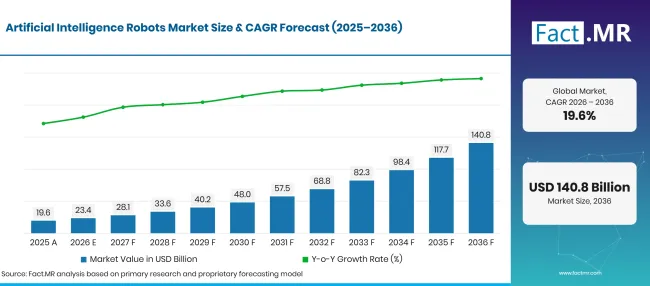
Artificial Intelligence Robots Market Forecast Global | Source: Fact.MR
| Year | Basis | Market Value (USD billion) |
|---|---|---|
| 2025 | Actual | 19.6 |
| 2026 | Estimate | 23.4 |
| 2036 | Forecast | 140.8 |
| CAGR 2026 to 2036 | Forecast period | 19.6% |
Source: Fact.MR analysis. Updated Oct 22, 2026
What are the defining numbers behind Artificial Intelligence Robots Market growth?
USD 117.3 billion absolute opportunity between 2026 and 2036.
- Demand Drivers in the Market
- Industrial automation and factory productivity support the growth of the market over the forecast period. Manufacturers are expanding the use of robots for assembly, inspection, handling and other production tasks. The International Federation of Robotics reported 603,000 industrial robot installations worldwide in 2025 and an operational stock of 5.079 million units [1]. These figures show the scale of industrial automation, rather than installations of AI-enabled robots specifically. [1]
- New physical-AI models and robotics platforms help in the growth of the market. NVIDIA announced new Cosmos and GR00T models and robotics development tools in January 2026 to support robot learning, reasoning and evaluation [2]. These tools can help developers build systems that interpret physical environments and perform tasks with less dependence on fixed programming.
- Humanoid robots for human-facing environments are creating new opportunities for market growth. Fauna Robotics launched its Sprout humanoid platform on January 27, 2026, for developers and researchers exploring applications in retail, entertainment, home services and other environments shared with people. Fauna announced that it had joined Amazon on March 24, 2026 [3] [14].
- AI-enabled industrial robot management: KUKA unveiled its Automation Management Platform at NVIDIA GTC on March 19, 2026. The platform is designed to connect robots, fleets, work cells, software tools and digital twins, supporting coordinated automation across factories and warehouses [4].
- Key Segments Analyzed
- By Robot Type: Industrial robots will account for 58.3% of the market in 2026, reflecting the importance of manufacturing automation and AI-enabled production tasks.
- By Offering: Hardware will account for 62.7% of the market in 2026, covering the physical platforms and components required for sensing, movement and computation.
- By Application: Industrial applications will account for 31.4% of the market in 2026, reflecting the use of robots in production, inspection and material handling.
- Analyst Opinion at Fact.MR
- Shambhu Nath Jha, Principal Consultant at Fact.MR, states, “Artificial intelligence robots are moving beyond fixed, repetitive automation towards systems that can interpret instructions, recognise objects and adapt to changes in their surroundings. Industrial deployment is likely to remain an important commercial base because buyers can measure productivity, quality and safety outcomes. Service and humanoid robots may broaden adoption, but their growth will depend on reliability in real-world settings, integration costs and demonstrable value for customers.”
- Strategic Implications
- Manufacturers must prioritise tasks with measurable productivity or quality benefits before investing in broad robot deployment.
- Hardware suppliers need to focus on reliable sensing, actuation, computing and safety features that support AI-based task execution.
- Software developers must demonstrate how AI models, simulation and robot-learning tools improve task performance beyond conventional automation.
- Service-robot providers need to validate navigation, human interaction and dependable task completion in the environments where their robots will operate.
- Buyers and investors must distinguish commercial deployments and repeat orders from research demonstrations when assessing market opportunity.
Germany is set to record a 22.5% CAGR through 2036. Brazil is set to post 20.6%, followed by the USA at 18.6%. The UK is estimated to advance at 16.7%, while Japan is forecast at 14.7%.
How does the Artificial Intelligence Robots Market break down by segment?
Fact.MR’s segmentation identifies Industrial robots as the leading robot type at 58.3%, Hardware as the leading offering at 62.7%, and Industrial applications as the largest specifically quantified application at 31.4%.
Which Robot Type dominates?
Industrial robots are set to hold 58.3% share in 2026.
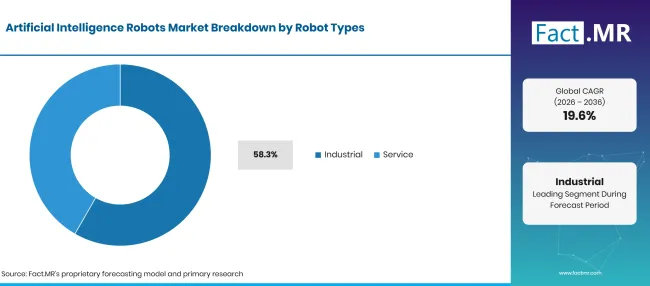
Artificial Intelligence Robots Market Breakdown Robot Types | Source: Fact.MR
| Robot Type | Share (2026) |
|---|---|
| Industrial (Leading segment) | 58.3% |
| Service | 41.7%* |
| Total | 100.0% |
Source: Fact.MR analysis. Updated Oct 22, 2026
Industrial robots are used in manufacturing for material handling, assembly, inspection, welding and other production tasks. AI can add object recognition, adaptive motion, defect identification and task planning to existing automation workflows. The segment’s share reflects the importance of industrial applications within this market definition. Service robots operate in environments beyond conventional production lines. They may support logistics, cleaning, healthcare assistance, customer interaction and selected domestic or public-facing tasks. Their adoption depends on whether they can work safely around people and handle changes in their operating environment.
What leads the Offering segment?
Hardware is set to represent 62.7% share in 2026.
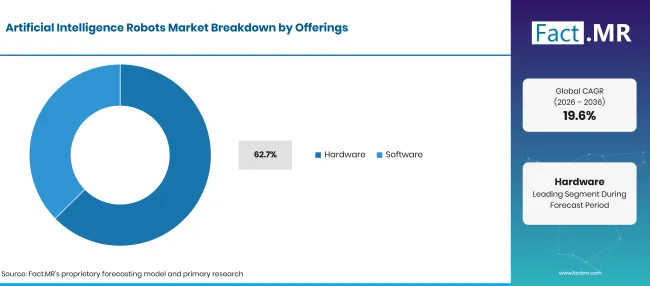
Artificial Intelligence Robots Market Breakdown Offerings | Source: Fact.MR
| Offering | Share (2026) |
|---|---|
| Hardware (Leading segment) | 62.7% |
| Other segments combined | 37.3%* |
| Total | 100.0% |
Source: Fact.MR analysis. Updated Oct 22, 2026
Hardware includes robot arms, mobile platforms, cameras, sensors, actuators, controllers and onboard computing systems. These components provide the physical ability to perceive and interact with the environment. Hardware requirements vary by robot type and task, particularly where robots need precision, mobility or safe operation around people. Software includes AI models, computer vision, task planning, simulation, and robot control and fleet-management tools. NVIDIA’s physical-AI models and Google DeepMind’s embodied-reasoning model illustrate the development of software designed to help robots understand their surroundings and complete tasks. In July 2026, Yaskawa Electric Corporation announced the development of an agentic robot system integrating its MOTOMAN NEXT AI robot with Google DeepMind’s Gemini Robotics ER 1.6 model, enabling robots to interpret instructions, plan tasks, and execute operations autonomously [5].
How does Application shape demand?
Industrial applications are likely to account for 31.4% share in 2026.
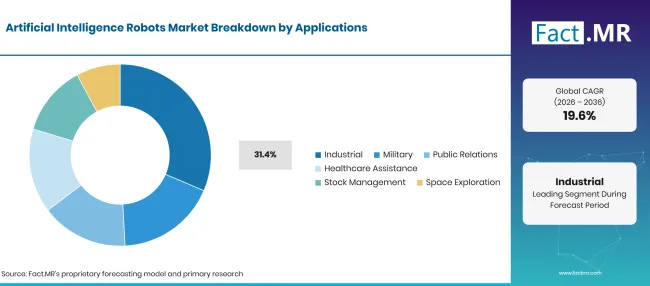
Artificial Intelligence Robots Market Breakdown Applications | Source: Fact.MR
| Application | Share (2026) |
|---|---|
| Industrial (Leading specified segment) | 31.4% |
| Other segments combined | 68.6%* |
| Total | 100.0% |
Source: Fact.MR analysis. Updated Oct 22, 2026
Industrial applications include production, inspection, assembly and material handling. AI can help robots recognise objects, respond to variation and perform selected tasks with less manual reprogramming. Military applications may include logistics, inspection, reconnaissance and robotic systems for hazardous environments. Public relations applications include information delivery, reception, visitor guidance and entertainment. Healthcare assistance covers selected support tasks in clinical or care settings, where safety and workflow integration are essential. Stock management includes warehouse inventory monitoring, picking assistance and goods movement. Space exploration involves robotic systems used for inspection, manipulation and autonomous operation in environments where communication and direct human control may be limited. These applications have different operating requirements, so their market shares should be evaluated separately when detailed data is available.
What is accelerating Artificial Intelligence Robots Market adoption, and what is holding it back?
Physical-AI advances, industrial automation and government-backed adoption initiatives support demand, while high implementation costs, safety requirements and integration challenges may slow deployment.
Drivers Impact Analysis
| DRIVER | (~) % IMPACT ON CAGR | GEOGRAPHIC RELEVANCE | IMPACT TIMELINE |
|---|---|---|---|
| Rising demand for intelligent industrial automation | +1.0% | North America, Europe, Asia | Medium term (2–4 years) |
| Increasing adoption of AI-powered service robots | +0.9% | Global | Short term (≤ 2 years) |
| Advances in machine learning and computer vision | +0.7% | North America, Asia | Medium term (2–4 years) |
| Growing labor shortages and productivity requirements | +0.5% | Europe, Japan, North America | Short term (≤ 2 years) |
| Expansion of collaborative and autonomous robots | +0.4% | Global | Long term (≥ 4 years) |
Source: Fact.MR analysis. Updated Oct 22, 2026
Opportunity Impact Analysis
| OPPORTUNITY | (~) % IMPACT ON CAGR | GEOGRAPHIC RELEVANCE | IMPACT TIMELINE |
|---|---|---|---|
| AI integration with existing robotic systems | +0.8% | Global | Medium term (2–4 years) |
| Development of autonomous mobile robots | +0.6% | North America, Europe, Asia | Medium term (2–4 years) |
| Expansion of AI robots in healthcare and elderly care | +0.5% | Japan, Europe, North America | Long term (≥ 4 years) |
| AI-powered quality inspection and predictive maintenance | +0.4% | Global | Short term (≤ 2 years) |
Source: Fact.MR analysis. Updated Oct 22, 2026
Restraints Impact Analysis
| RESTRAINT | (~) % IMPACT ON CAGR | GEOGRAPHIC RELEVANCE | IMPACT TIMELINE |
|---|---|---|---|
| High initial investment and deployment costs | -0.8% | Global | Short term (≤ 2 years) |
| Integration challenges with legacy systems | -0.6% | Global | Medium term (2–4 years) |
| Shortage of skilled AI and robotics professionals | -0.5% | Emerging markets, Global | Short term (≤ 2 years) |
| Data security, privacy and reliability concerns | -0.4% | North America, Europe, Asia | Medium term (2–4 years) |
Source: Fact.MR analysis. Updated Oct 22, 2026
Which countries are scaling the Artificial Intelligence Robots Market through 2036?
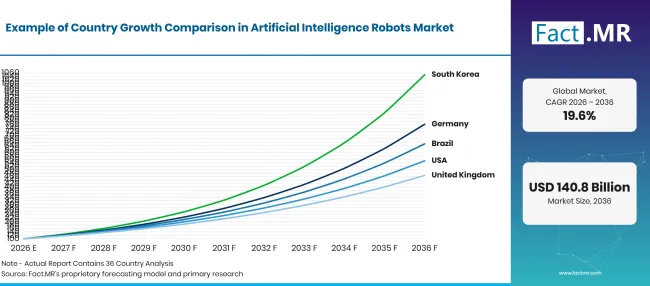
Artificial Intelligence Robots Market Growth Index 1 | Source: Fact.MR
| Country | CAGR (2026–2036) |
|---|---|
| Germany | 22.5% |
| Brazil | 20.6% |
| USA | 18.6% |
| UK | 16.7% |
| Japan | 14.7% |
Source: Fact.MR analysis. Updated Oct 22, 2026
What supports Germany adoption?
22.5% CAGR, supported by Germany’s established industrial automation base.
Germany is a major European market for industrial robots, with applications across automotive production, machinery, electronics and other manufacturing industries. Germany Trade & Invest reported that the country had 449 industrial robots per 10,000 manufacturing employees and 26,982 newly installed robots in 2024 [7]. These indicators support Germany’s strong automation base, although they do not independently establish the AI-robot CAGR.
AI-enabled systems may create opportunities in machine vision, adaptive manufacturing, inspection and coordination between robots and production software. Adoption will depend on demonstrating reliability, integrating with established production systems and delivering measurable operational improvements.
How is Brazil developing AI-robot adoption?
20.6% CAGR, driven by industrial automation activity and potential productivity gains.
Brazil is expanding industrial automation as manufacturers seek to improve production efficiency, assembly precision and operational consistency. Growth in industrial robotics provides a foundation for AI-enabled robots to support handling, inspection, assembly and quality control.
Broader adoption will depend on investment capacity, access to systems integrators, workforce training and the ability to adapt robotic technologies to local production requirements.
What supports United States adoption?
18.6% CAGR, led by industrial robotics, AI infrastructure and physical-AI development.
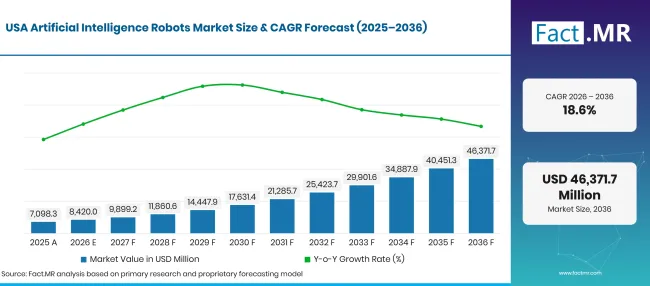
Artificial Intelligence Robots Market Forecast Usa | Source: Fact.MR
The United States recorded approximately 38,500 industrial robot installations in 2025, up 12% year on year, according to the International Federation of Robotics [8]. The country is also home to developers of robotics computing platforms, simulation tools and AI models.
These capabilities could support industrial automation and service robotics, although commercial uptake will depend on system performance, operating costs and integration with existing equipment.
How is the United Kingdom building adoption?
16.7% CAGR, backed by government-backed robotics deployment and skills initiatives.
In January 2026, the UK government announced a £52 million Robotics Adoption Hubs programme to help businesses explore and implement robotics. The programme covers potential uses across manufacturing, farming, healthcare and other sectors [9]. In October 2026, the government announced the rollout of new hubs intended to support robotics adoption across businesses and public services [10].
These initiatives may help reduce barriers related to technical knowledge, evaluation and deployment. Wider market adoption will depend on whether businesses can translate trials into repeatable commercial use cases and justify the cost of implementation.
What supports Japan adoption?
14.7% CAGR, shaped by an established robotics industry and a national AI-robotics strategy.
Japan is a major industrial robot producer and adopter. Japan’s revised AI Robotics Strategy in 2026 aims to accelerate implementation across 18 areas, including food service, food and beverage manufacturing and healthcare, with a target of approximately 10 million robots introduced by 2040 [6]. The policy provides a potential adoption pathway, while the 14.7% market CAGR remains a separate estimate.
Who leads the Artificial Intelligence Robots Market?
Fact.MR finds that iRobot , NVIDIA Corporation, Fauna Robotics, AheadForm, DroidUp, Google DeepMind, Yaskawa Electric, KUKA AG (Midea), Kawasaki Robotics are profiled across the AI robots value chain. The company set spans consumer robotics, AI computing and models, humanoid development and industrial automation. NVIDIA, Google DeepMind, Yaskawa, KUKA and Kawasaki participate in different parts of the AI-enabled robotics ecosystem. Fauna Robotics, AheadForm and DroidUp are relevant to humanoid or embodied-robot development, while iRobot focuses on consumer robots.
NVIDIA and Google DeepMind supply AI platforms and models that can support robotics development. Google DeepMind revealed the introduction of the Gemini Robotics ER 1.6 on April 14, 2026, to improve spatial understanding, task planning and success detection for robotics [11].
Yaskawa, KUKA and Kawasaki supply industrial robot platforms and automation systems. Kawasaki Robotics company announced its RL030N eight-degree-of-freedom platform for physical-AI applications in June 2026 [12]. Fauna Robotics develops humanoid platforms, while AheadForm and DroidUp focus on humanoid and embodied robotics. iRobot develops consumer robots for home use. iRobot Corporation launched the Roomba Mini Robot Vacuum and Mop with AutoEmpty Dock in the UK and Europe on March 10, 2026, expanding its consumer robotics portfolio with a compact cleaning solution designed for smaller spaces. [13].
Commercial competition depends on the application, deployment scale, task reliability and integration requirements. Industrial suppliers compete on precision, uptime, safety and service support. AI-platform developers compete on model capabilities, computing infrastructure and developer tools. Humanoid robotics companies must demonstrate that their systems can perform useful tasks reliably and economically outside controlled demonstrations.
Which companies are the key providers?
Key companies include iRobot, NVIDIA Corporation, Fauna Robotics, AheadForm, DroidUp, Google DeepMind, Yaskawa Electric, KUKA AG and Kawasaki Robotics.
- iRobot
- NVIDIA Corporation
- Fauna Robotics
- AheadForm
- DroidUp
- Google DeepMind
- Yaskawa Electric
- KUKA AG (Midea)
- Kawasaki Robotics
Bibliography
- [1] International Federation of Robotics. (2026, September 24). Five million robots now operate in factories globally.
- [2] NVIDIA Corporation. (2026, January 5). NVIDIA releases new physical AI models as global partners unveil next-generation robots.
- [3] Fauna Robotics. (2026, March 24). Fauna Robotics joins Amazon.
- [4] KUKA Group. (2026, March 19). From lab to factory floor: KUKA unveils KUKA AMP at NVIDIA GTC 2026 as a software bridge to new growth.
- [5] YASKAWA Electric Corporation. (2026, July 15). MOTOMAN NEXT AI Robot’s agentic robot system powered by Gemini Robotics. https://www.yaskawa-global.com/newsrelease/news/179679
- [6] Ministry of Economy, Trade and Industry. (n.d.). Robot policy.
- [7] Germany Trade & Invest. (2025, September 29). Germany is Europe’s leading robotics nation.
- [8] International Federation of Robotics. (2026, June 18). US robot industry returns to double digit growth.
- [9] Department for Science, Innovation and Technology. (2026, January 16). Red tape to be slashed for British robotics and defence innovators.
- [10] Department for Business, Innovation, Science and Trade, & Cabinet Office. (2026, October 9). Brits to benefit from faster recovery from surgeries and better harvests through new backing for robotics.
- [11] Google DeepMind. (2026, April 14). Gemini Robotics-ER 1.6: Powering real-world robotics tasks through enhanced embodied reasoning.
- [12] Kawasaki Robotics. (2026, June 16). Kawasaki Robotics unveils dexterous physical AI robot platform, advanced automation technologies at Automate 2026.
- [13] iRobot Corporation. (2026, March 10). iRobot launches Roomba® Mini robot vacuum & mop + AutoEmpty™ Dock in UK and Europe
- [14] Fauna Robotics. (2026, January 27). The Robot You’re Looking For: Introducing Sprout.
This Report Answers
- The report describes how AI-enabled robots are used across industrial and service environments.
- Segment analysis compares industrial and service robot types, hardware and software offerings, and the listed applications.
- Country analysis discusses Germany, Brazil, the USA, the UK and Japan alongside industrial robotics data and government initiatives.
- The competitive overview profiles companies involved in industrial robotics, consumer robotics, humanoid systems and AI platforms.
- Demand analysis examines physical-AI models, automation, robot learning, humanoid development and adoption barriers.
What does the Artificial Intelligence Robots Market cover?
The market covers physical robots that use AI capabilities to interpret information, make decisions or adapt their actions. It includes industrial robots used in production and inspection, as well as service robots deployed in logistics, healthcare assistance, public-facing environments and other applications listed in the segmentation.
Product coverage includes physical robot hardware and robotics software. Market boundaries should distinguish AI-enabled robots from conventional automation equipment that operates entirely through fixed programming.
What is included in the scope?
Included products are physical robots incorporating AI capabilities relevant to their operation. The scope covers industrial and service robots, associated hardware and software, and the stated application categories. It also includes relevant robotics platforms, embodied-AI models and tools when they are directly associated with robot deployment.
What is excluded from the scope?
The analysis excludes general-purpose AI software without a direct robotics application, conventional robots without meaningful AI capabilities, and standalone automation equipment that does not meet the market definition. Autonomous vehicles, drones and space systems should be included only where the underlying market model explicitly classifies them as AI robots rather than in separate markets. General-purpose computing hardware and software revenue should not be counted unless attributable to the defined robotics market.
How Was the Analysis Built?
The analysis draws on market estimates, company information, public statistical publications, regulatory information, and industry evidence to assess market developments and forecasts.
- Primary Research: Primary research includes discussions with manufacturers, service providers, technology developers, distributors, end users, and subject-matter experts. These conversations examine purchasing priorities, product adoption, operational challenges, approval requirements, competitive positioning, and the factors that influence wider market acceptance.
- Desk Research: Desk research covers government statistics, regulatory publications, company filings, trade data, technical studies, industry associations, standards, public policy, and other authoritative sources. Every source used in the analysis is documented in the bibliography.
- Market Sizing and Forecasting: Market estimates combine historical performance, demand indicators, pricing and volume trends, segment shares, company participation, country-level growth, adoption patterns, investment activity, and barriers to market expansion.
- Data Validation and Update Cycle: Findings are validated by comparing primary interviews with public data, company activity, regulatory changes, trade patterns, and industry developments. Regular updates review new product launches, capacity changes, partnerships, approvals, and shifts in commercial adoption.
Segmentation
What is the report’s scope and coverage?
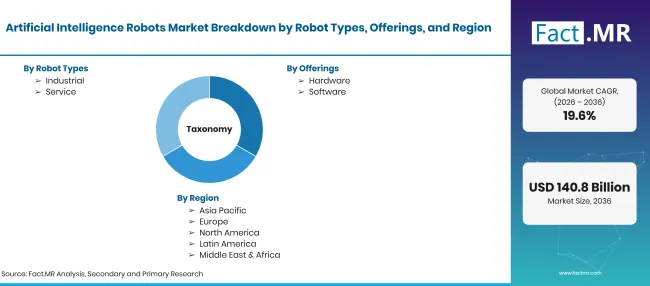
Artificial Intelligence Robots Market Taxonomy | Source: Fact.MR
| Attribute | Details |
|---|---|
| Quantitative Units | USD billion: 2026 valuation, 2036 forecast and CAGR |
| Market Definition | Robots that use AI for perception, task planning, decision-making or interaction with physical environments |
| Robot Type | Industrial; Service |
| Offering | Hardware; Software |
| Application | Industrial; Military; Public Relations; Healthcare Assistance; Stock Management; Space Exploration |
| Regions Covered | North America; Latin America; Western Europe; Eastern Europe; East Asia; South Asia & Pacific; Middle East & Africa |
| Countries Covered | Germany; Brazil; USA; UK; Japan |
| Companies Profiled | iRobot , NVIDIA Corporation, Fauna Robotics, AheadForm, DroidUp, Google DeepMind, Yaskawa Electric, KUKA AG (Midea), Kawasaki Robotics |
| Forecast Period | 2026 to 2036 |
| Approach | Market segmentation and scenario-based analysis supported by public robotics statistics, company announcements and policy sources |
Source: Fact.MR analysis. Updated Oct 22, 2026
How is the market segmented?
-
By Robot Type
- Industrial
- Service
-
By Offering
- Hardware
- Software
-
By Application
- Industrial
- Military
- Public Relations
- Healthcare Assistance
- Stock Management
- Space Exploration
-
By Region
- North America
- Latin America
- Western Europe
- Eastern Europe
- East Asia
- South Asia & Pacific
- Middle East & Africa
Frequently Asked Questions
How big is the Artificial Intelligence Robots Market in 2026?
What is the CAGR from 2026 to 2036?
Which robot type has the largest stated share?
Which offering leads?
Which application has the largest specified share?
Which countries have the highest country growth rates?
Which companies are covered?
Who worked on this report


Preview the report firsthand - request a free sample
Free SampleGet the brochure for pricing and purchase details
Download PDF