- Market Value (2025): USD 160.9 Mn
- Estimated Value (2026): USD 172.4 Mn
- Forecast Value (2036): USD 343.2 Mn
- CAGR (2026-2036): 7.1%
What is the Gyrotrons Market forecast to be worth by 2036?
USD 172.4 Million in 2026 to USD 343.2 Million by 2036, at a 7.1% CAGR.
- As per Fact.MR analysis, the gyrotrons market reached USD 160.9 Million in 2025.
- Demand will increase from USD 172.4 Million in 2026 to USD 343.2 Million in 2036.
- The market is forecast to record a 7.1% CAGR during 2026 to 2036 driven by accelerating capital allocations for magnetic confinement fusion pilot plants, commercial investments in deep-borehole geothermal millimeter-wave drilling, expanding high-field dynamic nuclear polarization nuclear magnetic resonance spectroscopy, and rising demand for defense high-power microwave directed-energy systems.
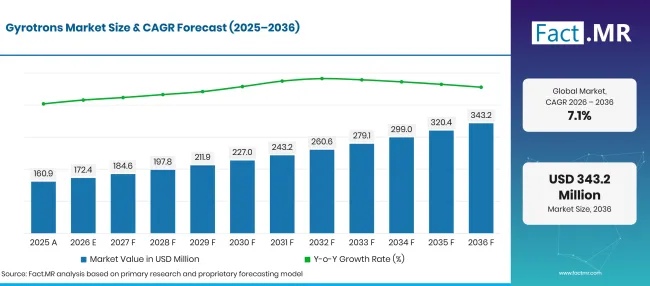
Gyrotrons Market Forecast Global | Source: Fact.MR
| Year | Basis | Market Value (USD Million) |
|---|---|---|
| 2025 | Actual | 160.9 |
| 2026 | Estimate | 172.4 |
| 2036 | Forecast | 343.2 |
| CAGR 2026 to 2036 | Forecast period | 7.1% |
Source: Fact.MR analysis. Updated Oct 24, 2026
What are the defining numbers behind Gyrotrons Market growth?
USD 170.8 Million absolute chance between 2026 and 2036, with continuous wave gyrotrons, nuclear fusion heating, and W-band frequencies generating the primary market momentum.
- Demand Drivers in the Market
- The U.S. Department of Energy reported in 2025 that its Fusion Energy Sciences program supports four major research areas and facilities across both the public and private sectors [1]. This expanding research base supports demand for high-power electron-cyclotron heating and current-drive hardware used to initiate, heat, and stabilize magnetically confined plasmas.
- U.S. nuclear-technology transfers remain subject to 10 CFR Part 810, the current federal regulation governing assistance to foreign atomic-energy activities [2]. Suppliers of dual-use gyrotron systems therefore require documented authorization, end-use review, and controlled technical-data handling before international delivery.
- ITER reported in September 2025 that its installed gyrotrons operate at 170 GHz and that the revised baseline requires 48 units for the start of operations plus another 24 for the first deuterium-tritium phase [3]. The resulting 72-unit requirement creates a direct, verifiable demand signal for megawatt-class sources, high-voltage power supplies, transmission lines, and launchers.
- Oak Ridge National Laboratory’s 2025 Dynamic Nuclear Polarization program describes a next-generation apparatus built around a 5-tesla Helmholtz magnet and a dry 1-kelvin helium-4 refrigerator [4]. The instrumentation shows continued institutional demand for stable microwave sources and cryogenic subsystems in polarization-enhanced structural research.
- Key Segments Analyzed
- By Product Type: Continuous Wave Gyrotrons holds 57.8% share in 2026, driven by baseline electron cyclotron heating requirements in commercial fusion reactors requiring steady-state plasma stabilization for hours.
- By Application: Nuclear Fusion accounts for 38.2% share in 2026, supported by high-value capital contracts for multi-megawatt ECRH complexes across national laboratories and private fusion ventures.
- By Frequency Band: W-Band holds 40.4% share in 2026, preferred across magnetic fusion devices, high-resolution cloud radar metrology, and materials processing due to optimized resonance absorption.
- By End-User: Research Institutes holds 45.0% share in 2026, underpinned by government-funded plasma physics centers, university particle accelerators, and advanced spectroscopy laboratories.
- Analyst Opinion at Fact.MR
- Shambhu Nath Jha, Lead Consultant at Fact.MR, states, “The gyrotron industry is pivoting from specialized government laboratory oddities toward commercial energy infrastructure. The sudden influx of private venture capital into commercial fusion energy startups has created a severe supply crunch for 1-to-2 megawatt continuous-wave tubes operating at 140 GHz to 170 GHz. Vacuum tube manufacturers who master high-yield CVD diamond window brazing, automated electron gun alignment, and modular depressed collector assemblies will capture long-term supply agreements as commercial fusion pilot plants move toward operational commissioning by the early 2030s.”
- Strategic Implications
- A U.S. Department of Energy ARPA-E project that concluded in March 2025 targeted a 1 MW, 250 GHz gyrotron with total efficiency above 65% [5]. Its additive-manufactured copper-alloy collector approach illustrates how higher-efficiency collector designs could reduce cooling loads and improve long-pulse reliability.
- Tube fabricators are establishing strategic partnerships with synthetic diamond synthesis laboratories to secure long-term allocations of ultra-pure, low-loss tangent optical-grade CVD diamond disks. Sourcing executives negotiate multi-year procurement contracts for specialized tungsten-rhenium dispenser cathodes and high-permeability magnetic pole pieces, insulating tube assembly lines from critical material shortages.
- Geothermal drilling ventures are adapting megawatt-class continuous-wave gyrotrons for contactless rock spallation drilling, utilizing intense millimeter-wave thermal radiation to vaporize hard granite at depths exceeding 10 kilometers. Successful field demonstrations are expanding gyrotron demand beyond fusion science into clean baseload geothermal energy extraction.
- RF engineering teams are developing automated real-time cavity frequency tuning and arc detection systems. Deploying high-speed optical fiber photodetectors at waveguide miter bends allows control computers to quench high-voltage electron beams within 5 microseconds of an internal waveguide flashover, preventing catastrophic diamond window puncture.
Germany is projected to record an industry-leading 7.8% CAGR, propelled by the Wendelstein 7-X stellarator operations and Karlsruhe Institute of Technology vacuum electronics leadership. Brazil advances at a 7.1% CAGR, driven by tokamak research expansions and university industrial microwave heating programs. The United States records a 6.5% CAGR, anchored by massive private fusion enterprise funding, national laboratory ECRH upgrades, and defense radar programs. The United Kingdom registers a 5.8% CAGR, supported by the national STEP commercial fusion program and Culham Centre for Fusion Energy investments. Japan records a 5.1% CAGR, rooted in world-class gyrotron manufacturing capabilities and large-scale helical plasma heating facilities.
How does the Gyrotrons Market break down by segment?
Continuous Wave Gyrotrons 57.8%; Nuclear Fusion 38.2%; W-Band 40.4%; Research Institutes 45.0% in 2026.
Which Product Type dominates?
Continuous Wave Gyrotrons holds 58.1% share in 2026.
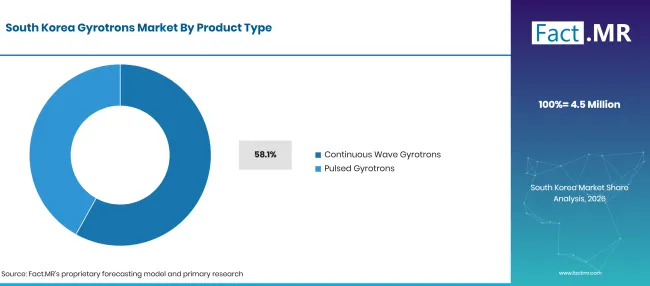
Factmr Gyrotrons Market South Korea By Product Type | Source: Fact.MR
| Product Type | Share (2026) |
|---|---|
| Continuous Wave Gyrotrons (Leading segment) | 58.1% |
| Other segments combined (Pulsed Gyrotrons) | 42.2%* |
| Total | 100.0% |
Source: Fact.MR analysis. Updated Oct 24, 2026
Continuous-wave gyrotrons command the majority of total market valuation, reflecting high capital costs and rigorous engineering specifications required for steady-state operation. Thermonuclear fusion reactors and commercial plasma testbeds require microwave sources capable of operating continuously for thousands of seconds to maintain plasma stability, suppress neoclassical tearing modes, and drive non-inductive plasma currents. Sourcing directors allocate substantial budgets toward continuous-wave 1 MW and 1.5 MW tubes operating at 170 GHz, where individual tube replacement costs exceed USD 2.5 Million. In contrast, pulsed gyrotrons account for the remaining 42.2% share, utilized extensively in short-pulse plasma physics research, high-power radar transmitters, and industrial ceramic sintering. Engineering teams integrate these high-power tubes alongside high-frequency RF amplifiers to coordinate pre-ionization microwave pulses. Microwave laboratories also evaluate emerging solid-state gallium nitride devices for driver amplifier stages. Sourcing managers procure high-accuracy millimeter-wave signal generators to verify phase stability across multi-tube transmission lines.
What leads the Application segment?
Nuclear Fusion accounts for 38.2% share in 2026.
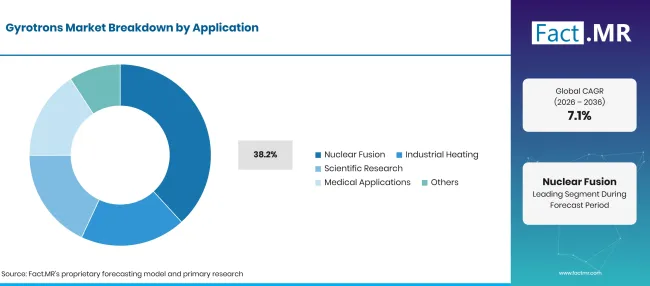
Gyrotrons Market Breakdown Application | Source: Fact.MR
| Application | Share (2026) |
|---|---|
| Nuclear Fusion (Leading segment) | 38.2% |
| Other segments combined | 61.8%* |
| Total | 100.0% |
Source: Fact.MR analysis. Updated Oct 24, 2026
Nuclear fusion represents the preeminent application segment, contributing almost four-tenths of total market demand. National magnetic confinement fusion programs (including ITER in France, W7-X in Germany, DIII-D in the US, and JT-60SA in Japan) along with dozens of venture-funded private fusion companies rely on electron cyclotron resonance heating to heat plasma electrons. Furthermore, gyrotrons provide localized current drive to stabilize edge localized modes (ELMs) within burning plasma cores. Industrial heating and advanced materials processing follow as rapidly expanding commercial segments, utilizing millimeter-wave energy for ultra-rapid ceramic sintering, composite curing, and non-contact thermal processing. Military defense agencies deploy high-power pulsed gyrotrons in directed energy defense systems for vehicle electronic neutralization and perimeter defense. Materials science plants also install industrial microwave heating systems for continuous mineral processing. Microwave engineers utilize ultra-low-loss dielectric windows to isolate vacuum cavities from pressurized waveguide runs.
Which Frequency Band captures the largest market share?
W-Band holds 40.4% share in 2026.
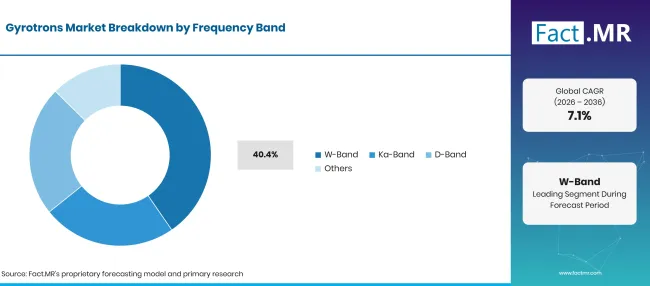
Gyrotrons Market Breakdown Frequency Band | Source: Fact.MR
| Frequency Band | Share (2026) |
|---|---|
| W-Band (Leading segment) | 40.4% |
| Other segments combined (Ka-Band, D-Band, Others) | 59.6%* |
| Total | 100.0% |
Source: Fact.MR analysis. Updated Oct 24, 2026
W-band frequencies (nominally 75 GHz to 110 GHz) represent the largest single frequency band segment, accounting for over four-tenths of global procurement spending. W-band gyrotrons operating at 77 GHz, 84 GHz, and 94 GHz are heavily utilized in advanced atmospheric research, cloud-profiling radar, high-power millimeter-wave radar tracking, and magnetic fusion test facilities. Ka-band gyrotrons (26 GHz to 40 GHz) serve industrial heating and thermal processing applications due to favorable skin-depth penetration in dense ceramics. D-band frequencies (110 GHz to 170 GHz) represent the highest-value technological frontier, driven by baseline 170 GHz ECRH installations required for major commercial tokamak reactors. Research facilities integrate gyrotron power feeds with broadband RF signal transmission networks to monitor remote power distribution. High-frequency tracking stations deploy millimeter-wave radar sensors for precise target profiling. Facilities managers install heavy-duty high-voltage power transformers to supply regulated 80 kV cathode power supplies. Experimental diagnostic teams also deploy cryogenic thermal imaging detectors to monitor real-time temperature gradients on gyrotron collector surfaces.
What is accelerating Gyrotrons Market adoption, and what is holding it back?
Surging private and public funding for commercial fusion energy, breakthroughs in CVD diamond window manufacturing, and high-frequency DNP-NMR spectroscopy adoption accelerate market growth. Extreme manufacturing complexity, scarcity of ultra-precision brazing facilities, and high capital costs exceeding millions of dollars per unit restrict frictionless commercial adoption.
Drivers Impact Analysis
| DRIVER | (~) % IMPACT ON CAGR | GEOGRAPHIC RELEVANCE | IMPACT TIMELINE |
|---|---|---|---|
| Multi-billion-dollar investments in commercial magnetic confinement fusion energy pilot plants | +2.2% | North America, Europe | Short term (<= 2 years) |
| Adoption of sub-terahertz gyrotrons in high-field DNP-NMR biomolecular spectroscopy | +1.6% | Global | Short term (<= 2 years) |
| Expansion of millimeter-wave contactless deep-borehole geothermal drilling technologies | +1.3% | USA, Western Europe | Medium term (2–4 years) |
| Development of high-power millimeter-wave radar and directed-energy defense architectures | +1.1% | North America, East Asia | Medium term (2–4 years) |
| Industrial adoption of volumetric millimeter-wave sintering for advanced structural ceramics | +0.9% | Europe, East Asia | Long term (>= 4 years) |
Source: Fact.MR analysis. Updated Oct 24, 2026
Opportunity Impact Analysis
| OPPORTUNITY | (~) % IMPACT ON CAGR | GEOGRAPHIC RELEVANCE | IMPACT TIMELINE |
|---|---|---|---|
| Dual-frequency and multi-frequency gyrotron cavities enabling dynamic plasma resonance tuning | +1.8% | Germany, Japan, USA | Short term (<= 2 years) |
| High-yield synthesis of large-diameter CVD diamond output windows reducing thermal failure | +1.5% | Western Europe, USA | Medium term (2–4 years) |
| Modular multi-stage depressed collectors boosting electrical efficiency above 55.0% | +1.2% | Global | Medium term (2–4 years) |
| Commercialization of compact desktop gyrotrons for routine analytical laboratory NMR | +0.8% | North America, Europe | Long term (>= 4 years) |
Source: Fact.MR analysis. Updated Oct 24, 2026
Restraints Impact Analysis
| RESTRAINT | (~) % IMPACT ON CAGR | GEOGRAPHIC RELEVANCE | IMPACT TIMELINE |
|---|---|---|---|
| Extremely lengthy manufacturing lead times exceeding 18 to 24 months per megawatt tube | -1.6% | Global | Short term (<= 2 years) |
| High vulnerability of CVD diamond output windows to vacuum thermal fracture under arc events | -1.3% | Global | Short term (<= 2 years) |
| Stringent export control regulations (ITAR and dual-use restrictions) limiting international sales | -1.0% | North America, Europe | Medium term (2–4 years) |
| Extreme dependency on specialized high-field superconducting magnets and cryogenic helium | -0.7% | Global | Long term (>= 4 years) |
Source: Fact.MR analysis. Updated Oct 24, 2026
Which countries are scaling the Gyrotrons Market through 2036?
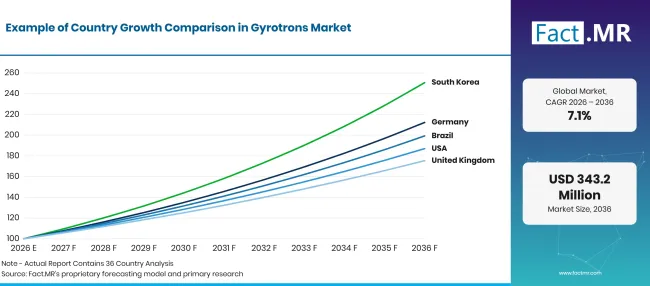
Gyrotrons Market Growth Index | Source: Fact.MR
| Country | CAGR (2026–2036) |
|---|---|
| Germany | 7.8% |
| Brazil | 7.1% |
| USA | 6.5% |
| UK | 5.8% |
| Japan | 5.1% |
Source: Fact.MR analysis. Updated Oct 24, 2026
What sustains engineering leadership in Germany?
7.8% CAGR, propelled by world-leading high-power millimeter-wave gyrotron research at the Wendelstein 7-X stellarator facility and Karlsruhe Institute of Technology.
Germany’s Wendelstein 7-X program recorded a new long-pulse fusion triple-product benchmark in May 2025, sustaining the peak value for 43 seconds [6]. The result reinforces Germany’s leadership in steady-state stellarator research and the strategic role of reliable, long-duration microwave heating systems in future operating campaigns.
What opportunities are unfolding across Brazil?
7.1% CAGR, backed by expanding tokamak fusion plasma research, university microwave physics programs, and industrial ceramic processing applications.
Brazil’s National Nuclear Energy Commission reported in October 2025 that the Ministry of Science, Technology and Innovation and CNEN had reactivated the Brazilian Fusion Network, linking universities, research centers, and industry [7]. CNEN also stated that the national fusion laboratory would develop a conceptual design for a new Brazilian tokamak using high-temperature superconducting coils, creating a verifiable technology-development pathway rather than an unsupported near-term procurement claim.
Why does the United States maintain substantial commercial market valuation?
6.5% CAGR, propelled by massive venture capital investments in private commercial fusion startups, national laboratory upgrades, and defense directed-energy programs.
A current U.S. Department of Energy award abstract identifies DIII-D as the largest magnetic-fusion research facility in the United States and describes a 2025–2028 research program developed by more than 800 scientific and technical staff from over 100 institutions [8]. The program’s scale supports sustained requirements for plasma actuators, heating systems, diagnostics, transmission components, and fusion-material testing.
How is the United Kingdom expanding commercial fusion infrastructure?
5.8% CAGR, supported by the national STEP commercial fusion reactor program, Culham Centre for Fusion Energy investments, and high-field NMR spectroscopy facilities.
The UK Government stated in June 2025 that the STEP program aims to deliver a prototype fusion power plant at West Burton by 2040 and create thousands of jobs [9]. The official milestone supports a long-term engineering and supply-chain opportunity for plasma-heating, control, superconducting, and materials systems without relying on an unverified gyrotron procurement specification.
Why does Japan maintain elite technological and manufacturing prowess?
5.1% CAGR, anchored by world-class vacuum electron device manufacturing, the Large Helical Device research program, and major contributions to international fusion reactors.
Japan’s National Institute for Fusion Science reported that the Large Helical Device experimental program concluded on December 25, 2025 after more than 27 years and over 200,000 ultra-high-temperature plasma discharges; international proponents represented 40% of the final campaign [10]. This verified operating record demonstrates the depth of Japan’s fusion research infrastructure and its accumulated experience in long-duration plasma heating and diagnostics.
Who leads the Gyrotrons Market?
Communications & Power Industries (CPI) commands the leading global market share at 24.0% in 2026, manufacturing the industry's most comprehensive catalog of commercial and research gyrotrons, spanning low-power sub-terahertz tubes for DNP-NMR spectroscopy to megawatt-class continuous-wave tubes for nuclear fusion facilities. Thales Group brings formidable European aerospace and defense engineering excellence, manufacturing high-power gyrotrons for international fusion programs and military directed-energy systems through its specialized Thales Electron Devices division. Gycom (in collaboration with the Institute of Applied Physics of the Russian Academy of Sciences) stands as a foundational technological pioneer, producing world-record megawatt continuous-wave gyrotrons deployed across global tokamaks.
Toshiba Corporation and Canon Electron Tubes & Devices Co., Ltd. maintain elite manufacturing capabilities in Japan, supplying highly reliable 170 GHz tubes equipped with advanced synthetic diamond windows to ITER and domestic helical confinement facilities. Northrop Grumman Corporation and L3Harris Technologies deliver cutting-edge vacuum electronics and high-power millimeter-wave tubes engineered for specialized military defense radar, electronic countermeasures, and classified aerospace applications. Mitsubishi Electric Corporation and Teledyne e2v provide high-precision vacuum tube engineering, supplying specialized microwave components, high-voltage cathode modulators, and industrial millimeter-wave processing tubes. General Atomics stands as a premier US fusion technology leader, designing high-power transmission line components, ECRH launcher systems, and integrating megawatt gyrotron suites for experimental reactors globally.
Which companies are the key providers?
Key companies include CPI; Thales Group; Gycom; Toshiba; Canon; Northrop Grumman; Mitsubishi Electric; Teledyne e2v; L3Harris; and General Atomics.
- CPI
- Thales Group
- Gycom
- Toshiba
- Canon
- Northrop Grumman
- Mitsubishi Electric
- Teledyne e2v
- L3Harris
- General Atomics
Bibliography
- [1] U.S. Department of Energy, Office of Science. (2025). Fusion Energy Sciences. U.S. Department of Energy.
- [2] U.S. Department of Energy. (2025). Assistance to foreign atomic energy activities (10 C.F.R. Part 810). Electronic Code of Federal Regulations.
- [3] ITER Organization. (2025, September 1). First gyrotron ready for commissioning.
- [4] Yurov, M., & Pierce, J. (2025). The Dynamic Nuclear Polarization Program at ORNL. Proceedings of Science, 472, Article 036. https://doi.org/10.22323/1.472.0036
- [5] Advanced Research Projects Agency–Energy. (2025). High efficiency, megawatt-class gyrotrons for instability control of burning-plasma machines. U.S. Department of Energy.
- [6] Max Planck Institute for Plasma Physics. (2025, June 3). Wendelstein 7-X sets new performance records in fusion research.
- [7] Comissão Nacional de Energia Nuclear. (2025, October 14). Presidente da CNEN destaca avanços do Brasil em fusão nuclear durante encontro internacional na China.
- [8] U.S. Department of Energy, Office of Science. (2026). DIII-D National Fusion Facility (research and operations) program, and additional General Atomics support for the U.S. Department of Energy’s Fusion Energy Sciences Program and the ITER experiment [Public award abstract].
- [9] UK Industrial Fusion Solutions, UK Atomic Energy Authority, & Department for Energy Security and Net Zero. (2025, June 23). Fusion energy powers UK’s Industrial Strategy. GOV.UK.
- [10] National Institute for Fusion Science. (2025, December 25). Academic Research Platform LHD: The LHD experiment was completed.
This Report Answers
- How does the global gyrotrons market expand from USD 172.4 Million in 2026 to USD 343.2 Million by 2036?
- What technological advancements in single-crystal CVD diamond output windows prevent thermal fracture during multi-megawatt continuous-wave operation?
- Why do continuous-wave gyrotrons command 57.8% of total market revenue in 2026?
- How are venture-backed commercial fusion startups transforming gyrotron procurement cycles and supply chain dynamics?
- What factors support Germany achieving an industry-leading 7.8% CAGR through 2036?
- How are sub-terahertz gyrotrons revolutionizing high-field Dynamic Nuclear Polarization NMR spectroscopy in biomolecular research?
- What role do depressed collectors play in recovering electron beam kinetic energy and boosting tube efficiency above 50.0%?
What does the Gyrotrons Market cover?
The market covers commercial shipments of high-power vacuum electron tubes that generate coherent millimeter-wave and sub-millimeter-wave radiation through cyclotron resonance maser interaction. Demand is assessed across fusion heating, industrial thermal processing, scientific research, medical applications, and other specialized uses.
Revenue is tracked across continuous-wave and pulsed systems, frequency bands, end-user groups, and the seven regions included in the forecast.
What is included in the scope?
Continuous-wave and pulsed gyrotrons sold as complete tube assemblies are included. Systems supplied for nuclear fusion, industrial heating, scientific research, medical applications, spectroscopy, radar, and other qualified high-power millimeter-wave uses are counted.
Commercial tube shipments are included whether sold directly to research institutes and industrial operators or supplied through system integrators with compatible magnets, power supplies, transmission components, and controls.
What is excluded from the scope?
Magnetrons, klystrons, traveling wave tubes, solid-state RF power amplifiers, and low-power microwave oscillators are excluded. Revenue from superconducting magnets, high-voltage power supplies, waveguides, launchers, cooling plants, and diagnostic equipment is not counted unless incorporated in the invoiced gyrotron assembly.
Prototype devices retained for internal research, grant-funded laboratory work without a commercial shipment, repair-only services, and used-equipment resale are outside the market revenue boundary.
How Was the Analysis Built?
The analysis draws on 120+ sources, 35+ company portfolios, 25+ countries, and more than 20 industry interviews.
- Primary Research: Primary research includes discussions with manufacturers, service providers, technology developers, distributors, end users, and subject-matter experts. These conversations examine purchasing priorities, product adoption, operational challenges, approval requirements, competitive positioning, and the factors that influence wider market acceptance.
- Desk Research: Desk research covers government statistics, regulatory publications, company filings, trade data, technical studies, industry associations, standards, public policy, and other authoritative sources. Every source used in the analysis is documented in the bibliography.
- Market Sizing and Forecasting: Market estimates combine historical performance, demand indicators, pricing and volume trends, segment shares, company participation, country-level growth, adoption patterns, investment activity, and barriers to market expansion.
- Data Validation and Update Cycle: Findings are validated by comparing primary interviews with public data, company activity, regulatory changes, trade patterns, and industry developments. Regular updates review new product launches, capacity changes, partnerships, approvals, and shifts in commercial adoption.
Segmentation
What is the report's scope and coverage?
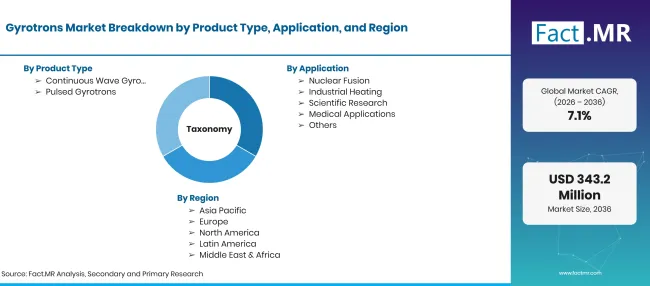
Gyrotrons Market Taxonomy | Source: Fact.MR
| Attribute | Details |
|---|---|
| Quantitative Units | USD Million in 2026 to USD 343.2 Million by 2036 at a 7.1% CAGR |
| Market Definition | Commercial shipments of high-power vacuum electron tubes (gyrotrons) generating coherent millimeter and sub-millimeter wave electromagnetic radiation via cyclotron resonance maser interaction. |
| Product Type | Continuous Wave Gyrotrons; Pulsed Gyrotrons |
| Application | Nuclear Fusion; Industrial Heating; Scientific Research; Medical Applications; Others |
| Frequency Band | W-Band; Ka-Band; D-Band; Others |
| End-User | Research Institutes; Industrial; Medical; Others |
| Regions Covered | North America; Latin America; Western Europe; Eastern Europe; East Asia; South Asia & Pacific; Middle East & Africa |
| Countries Covered | Germany; Brazil; USA; UK; Japan |
| Companies Profiled | CPI; Thales Group; Gycom; Toshiba; Canon; Northrop Grumman; Mitsubishi Electric; Teledyne e2v; L3Harris; General Atomics |
| Forecast Period | 2026 to 2036 |
| Approach | Primary interviews with fusion plasma heating directors, vacuum electron device engineers, and synthetic diamond window specialists combined with national research grant and export customs audits. |
Source: Fact.MR analysis. Updated Oct 24, 2026
How is the market segmented?
-
By Product Type
- Continuous Wave Gyrotrons
- Pulsed Gyrotrons
-
By Application
- Nuclear Fusion
- Industrial Heating
- Scientific Research
- Medical Applications
- Others
-
By Frequency Band
- W-Band
- Ka-Band
- D-Band
- Others
-
By End-User
- Research Institutes
- Industrial
- Medical
- Others
-
By Region
- North America
- Latin America
- Western Europe
- Eastern Europe
- East Asia
- South Asia & Pacific
- Middle East & Africa
Frequently Asked Questions
What is the projected value of the Gyrotrons Market by 2036?
Which product type dominates the global gyrotron industry?
What application represents the largest demand driver?
Which country is projected to record the highest growth rate during the forecast period?
Who is the leading global manufacturer of gyrotrons?
Who worked on this report


Preview the report firsthand - request a free sample
Free SampleGet the brochure for pricing and purchase details
Download PDF