- Market Value (2025): USD 232.3 Mn
- Estimated Value (2026): USD 241.8 Mn
- Forecast Value (2036): USD 361.1 Mn
- CAGR (2026-2036): 4.1%
What is the Atovaquone Market forecast to be worth by 2036?
USD 241.83 million in 2026 to USD 361.08 million by 2036, at a 4.1% CAGR.
- As per Fact.MR analysis, the Atovaquone_Market market was valued at USD 232.3 million in 2025.
- Industry revenue is forecast to rise from USD 241.8 million in 2026 to USD 361.1 million by 2036.
- The 4.1% forecast CAGR reflects continued clinical use in established regimens, selective prophylaxis demand and the availability of generic and branded products.
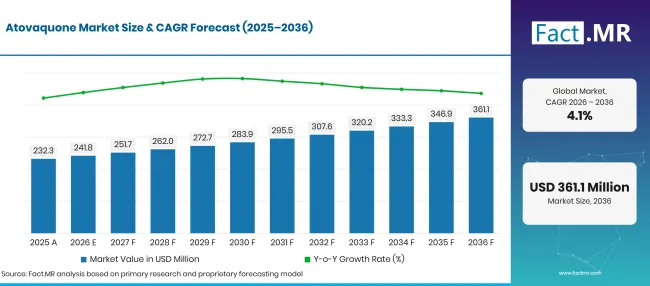
Atovaquone Market Forecast Global | Source: Fact.MR
| Year | Basis | Market Value (USD million) |
|---|---|---|
| 2025 | Historical estimate | 232.3 |
| 2026 | Base-year estimate | 241.8 |
| 2036 | Forecast | 361.1 |
| CAGR 2026–2036 | Forecast growth | 4.1% |
Source: Fact.MR analysis. Updated Oct 26, 2026
What are the defining numbers behind Atovaquone Market growth?
The market is expected to gain USD 119.25 million in annual value from 2026 to 2036.
Tablets hold a 62.4% product share; malaria is the largest assigned application at 43.7%. Hospital pharmacies lead the distribution split at 44.2%, consistent with the importance of clinical oversight in several uses. The CDC identifies atovaquone-proguanil as one malaria treatment and prevention option, while separate guidance specifies atovaquone with azithromycin for babesiosis. These are different regimens and should not be presented as interchangeable. [1] [2]
Demand Drivers in the Market
- Travel medicine supports predictable, if selective, demand for atovaquone-proguanil tablets. Selection depends on the destination, patient factors and recommended start and stop schedules, not simply global malaria case counts. [2]
- Atovaquone with azithromycin is an established option for many patients with babesiosis, supporting a specialized infectious-disease application. Availability of suitable combinations and clinician recognition affect uptake. [1]
- Oral suspension retains a role as an alternative for mild-to-moderate Pneumocystis pneumonia in patients unable to use preferred therapy. Its absorption and administration requirements are important to clinical outcomes. [3]
- Access to generic formulations may improve affordability in some health systems, although drug pricing alone does not determine prescription patterns or distribution contracts.
- Hospitals and specialist pharmacies favor supply continuity because interruptions can complicate treatment of immunocompromised patients or the planning of travel-related prophylaxis.
Key Segments Analyzed
- Product Dominance: Tablets are projected to lead the market with a 62.4% share, primarily driven by demand for atovaquone-proguanil combinations.
- Primary Application: Malaria treatment remains the largest specific application category, accounting for 43.7% of the market.
- Distribution Trends: Hospital pharmacies control 44.2% of distribution, underscoring how higher-acuity cases rely heavily on specialist and hospital dispensing.
- Key End-Users: Hospitals serve as the largest clinical end-user group, representing 48.6% of the market.
Analyst Opinion at Fact.MR
Shambhu Nath Jha, Sr. Consultant at Fact.MR says, “Atovaquone's commercial opportunity remains tied to dependable access and correct regimen selection in established indications, not broad expansion into unrelated infections. Different indications require different formulations and partner drugs. Companies that support reliable supply, clear product information and transparent procurement will be better placed than those that assume disease burden automatically translates into atovaquone prescribing.”
Strategic Implications
- Manufacturers should plan capacity and distribution separately for atovaquone-proguanil tablets and atovaquone oral suspension because the prescribing use cases differ.
- Hospital procurement teams benefit from screening formulation availability alongside tolerability and administration requirements in relevant clinical guidelines. [3]
- API suppliers can prioritize documented quality and sourcing continuity, drawing on capabilities in the wider active pharmaceutical ingredient market without treating that larger market as atovaquone revenue.
- Access strategies should focus on approved indications and credible specialist channels rather than using headline malaria incidence as a forecast proxy. [5]
How does the Atovaquone Market break down by segment?
The market is segmented by dosage form, assigned therapeutic application, dispensing route and clinical end user. The product split distinguishes combination tablet demand from oral-suspension demand; application estimates represent market allocation rather than a recommendation for treatment.
Why do tablet formulations account for most atovaquone revenue?
Tablets accounts for 62.4% of the Product Type segment in 2026.
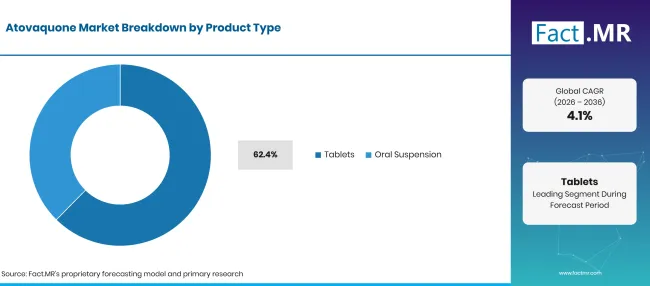
Atovaquone Market Breakdown Product Type | Source: Fact.MR
| Product Type | Share (2026) |
|---|---|
| Tablets | 62.4% |
| Oral Suspension | 37.6% |
Source: Fact.MR analysis. Updated Oct 26, 2026
Tablets represent 62.4% of the 2026 product split. Much of their clinical visibility comes from the fixed combination of atovaquone and proguanil for malaria prophylaxis or treatment where recommended. This tablet market cannot be equated with atovaquone-only tablets for all uses. Oral suspension serves different patient groups, notably as an alternative in selected cases of Pneumocystis pneumonia. Food-dependent absorption and patient tolerability create practical limits to suspension prescribing. [2] [3] The broader anti-infective agents market provides a channel and purchasing context, but its overall antibiotic and antiviral revenues are not included here.
How does malaria remain the leading application without absorbing every case?
Malaria accounts for 43.7% of the Application segment in 2026.
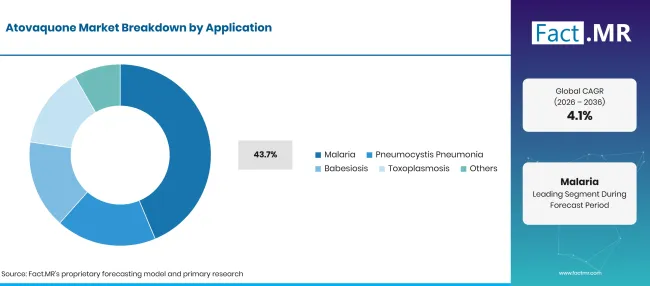
Atovaquone Market Breakdown Application | Source: Fact.MR
| Application | Share (2026) |
|---|---|
| Malaria | 43.7% |
| Pneumocystis Pneumonia | 29.4% |
| Babesiosis | 15.1% |
| Toxoplasmosis | 7.9% |
| Others | 3.9% |
Source: Fact.MR analysis. Updated Oct 26, 2026
Malaria receives 43.7% of 2026 atovaquone market value. The drug's combination with proguanil is one option among several antimalarial approaches, and prescribing differs by travel risk, resistance patterns and local clinical guidance. [2] The artemisinin combination therapy market is relevant to treatment selection but represents other products and is excluded from atovaquone totals. Pneumocystis pneumonia accounts for a meaningful second application because intolerance to preferred treatment can create a need for alternatives. Babesiosis treatment generally uses atovaquone together with azithromycin. Toxoplasmosis-related use is more limited and may involve alternative regimens specified by specialist guidance. [1] [3] [4]
Why are hospital pharmacies the largest channel?
Hospital Pharmacies accounts for 44.2% of the Distribution Channel segment in 2026.
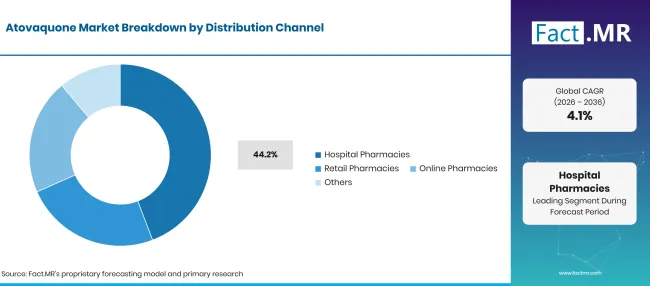
Atovaquone Market Breakdown Distribution Channel | Source: Fact.MR
| Distribution Channel | Share (2026) |
|---|---|
| Hospital Pharmacies | 44.2% |
| Retail Pharmacies | 38.5% |
| Online Pharmacies | 12.7% |
| Others | 4.6% |
Source: Fact.MR analysis. Updated Oct 26, 2026
Hospital pharmacies account for 44.2% of market value, reflecting treatment in immunocompromised patients and the coordination of specialist care. Retail pharmacies serve outpatient malaria prevention and prescribed regimens, where dispensing advice and refill availability matter. Online pharmacies are a smaller but growing channel where local law permits legitimate prescription fulfillment. High-acuity patients can be sensitive to stockouts, so distribution reliability can have more clinical significance than channel convenience. [3]
What explains the strong hospital end-user base?
Hospitals accounts for 48.6% of the End-User segment in 2026.
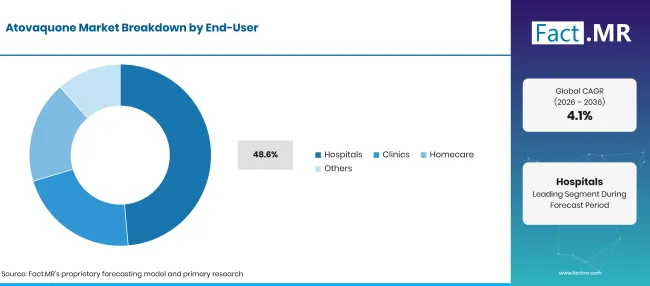
Atovaquone Market Breakdown End User | Source: Fact.MR
| End-User | Share (2026) |
|---|---|
| Hospitals | 48.6% |
| Clinics | 29.3% |
| Homecare | 17.2% |
| Others | 4.9% |
Source: Fact.MR analysis. Updated Oct 26, 2026
Hospitals represent 48.6% of the estimated end-user split. Patients with Pneumocystis pneumonia and other opportunistic infections may require evaluation of interactions, tolerability and alternative regimens before atovaquone is selected. Clinics play a larger role in travel medicine and follow-up, while homecare includes appropriate outpatient therapy after a clinician has established the regimen. This distinction is particularly important for a market where the same active ingredient appears in products with different approved indications. [3] [4]
What is accelerating Atovaquone Market adoption, and what is holding it back?
Atovaquone has a relatively stable clinical base. Growth is therefore sensitive to formulation access, generic price pressure, shifts in alternative regimens and the practical requirements of specialist prescribing.
Drivers Impact Analysis
| DRIVER | (~) % IMPACT ON CAGR | GEOGRAPHIC RELEVANCE | IMPACT TIMELINE |
|---|---|---|---|
| Continued travel prophylaxis prescribing | +0.4% | USA, UK, Germany | 2026–2036 |
| Demand for alternative PCP therapy | +0.3% | North America, Japan | 2026–2034 |
| Established babesiosis combination use | +0.5% | USA, Japan | 2027–2036 |
| More dependable pharmacy supply | +0.3% | Global clinical channels | 2026–2032 |
| Broader availability of approved generics | +0.2% | Europe, Latin America | 2028–2036 |
Source: Fact.MR analysis. Updated Oct 26, 2026
Opportunity Impact Analysis
| OPPORTUNITY | (~) % IMPACT ON CAGR | GEOGRAPHIC RELEVANCE | IMPACT TIMELINE |
|---|---|---|---|
| Improved oral-suspension access | +0.3% | USA, Japan, UK | 2027–2034 |
| Stronger specialty-pharmacy supply agreements | +0.2% | North America, Europe | 2026–2032 |
| Supply resilience in antimalarial procurement | +0.4% | Brazil, Asia | 2027–2036 |
| Better regimen awareness in travel clinics | +0.2% | USA, Western Europe | 2026–2031 |
Source: Fact.MR analysis. Updated Oct 26, 2026
Restraints Impact Analysis
| RESTRAINT | (~) % IMPACT ON CAGR | GEOGRAPHIC RELEVANCE | IMPACT TIMELINE |
|---|---|---|---|
| Substitution by other guideline-supported therapies | -0.6% | Global | 2026–2036 |
| Generic unit-price erosion | -0.5% | USA, Europe | 2026–2036 |
| Administration and absorption limitations | -0.3% | Global outpatient use | 2026–2034 |
| Regulatory and supply interruptions | -0.4% | Latin America, Asia | 2027–2035 |
Source: Fact.MR analysis. Updated Oct 26, 2026
Which countries are scaling the Atovaquone Market through 2036?
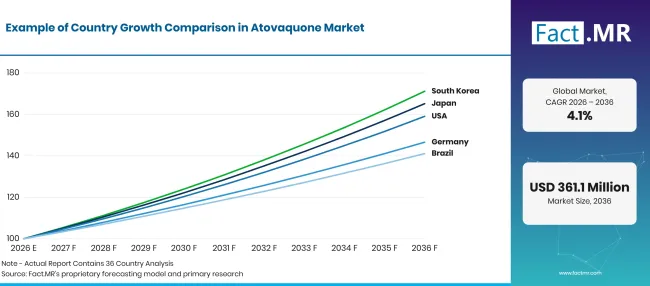
Atovaquone Market Growth Index | Source: Fact.MR
| Country | CAGR (2026–2036) |
|---|---|
| Germany | 3.90% |
| Brazil | 3.50% |
| United States | 4.8% |
| United Kingdom | 2.90% |
| Japan | 5.15% |
Source: Fact.MR analysis. Updated Oct 26, 2026
Why does Germany show restrained atovaquone growth?
3.90% CAGR through 2036. Guideline-led prescribing limits volume swings.
Germany's 3.90% CAGR reflects a mature healthcare environment where clinicians weigh atovaquone against other recommended agents rather than expanding its use to every parasitic infection. Travel medicine provides recurring prophylaxis demand, while hospital use depends on specific indications and patient tolerance. Reliable supply and approved labeling matter more than consumer promotion. The market's growth is likely to come from case mix and distribution continuity, not a change in clinical first-line status.
What shapes atovaquone sales in Brazil?
3.50% CAGR through 2036. Access and treatment economics constrain the market.
The Brazilian market carries a 3.50% CAGR outlook. Clinical demand exists across defined parasitic conditions, but pricing, availability and national treatment practices govern uptake. Malaria-related need does not mean every patient receives atovaquone-proguanil; therapeutic guidelines and local procurement choices remain central. Distribution partners that keep products available for the patients who need them can improve reliability without assuming a major change in treatment mix. The wider mosquito-borne infection testing market relates to case identification but does not measure drug sales.
How does the US market combine travel medicine and specialist care?
4.8% CAGR through 2036. Babesiosis and opportunistic infections support several distinct channels.
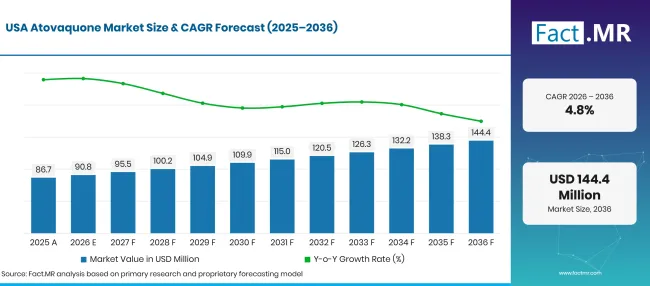
Atovaquone Market Forecast Usa | Source: Fact.MR
US revenue is projected to grow at 4.75%. The CDC recommends atovaquone combined with azithromycin for many patients treated for babesiosis, while NIH guidance supports atovaquone in selected opportunistic-infection scenarios. [1] [3] Retail and travel clinics contribute separately through malaria prophylaxis. Clinical differentiation therefore matters to forecasting: an atovaquone sale for prophylaxis should not be modeled as equivalent to an inpatient oral-suspension course.
What keeps the UK forecast conservative?
2.90% CAGR through 2036. Selective use under specialist guidance results in gradual growth.
The UK is projected to post 2.90% CAGR. Travel-related prescriptions create a recognizable tablet channel, while specialist treatment decisions remain influenced by clinical guidelines and therapeutic alternatives. Procurement pressure can also offset unit-volume gains. The market is unlikely to accelerate purely because clinicians screen more infections; laboratory confirmation and indication-specific prescribing must translate into actual treatment selection before revenue changes.
Why is Japan the fastest-growing market in the five-country view?
5.15% CAGR through 2036. Specialist practice and reliable formulations support measured expansion.
Japan's 5.15% outlook is faster than the other selected countries but still reflects a narrow therapeutic category. Demand is associated with precisely defined patient groups, including selected immunocompromised patients. Regulatory approval boundaries and local prescribing habits influence which product forms can be used. Suppliers that maintain availability and clear administration information may capture the opportunity more effectively than firms attempting broad, nonspecific anti-infective promotion.
Which companies supply Atovaquone Market products?
The atovaquone supply chain includes originator products, fixed-dose combination tablets and generic manufacturers. GlaxoSmithKline is associated with the Malarone brand of atovaquone-proguanil. Generic producers and distributors operate in a market shaped by regulatory dossiers, bioequivalence requirements, pharmacy contracting and reliable access to qualified active ingredient. Participation can vary by country and formulation, so a brand approved in one market should not be assumed to supply every market.
Competition is influenced by dosage-form availability rather than product breadth alone. Oral suspension requires different manufacturing, packaging and distribution considerations from tablets. Hospitals may need continuity for vulnerable patients, while retail channels may emphasize price and dependable dispensing of approved prevention regimens.
Which companies are the key providers?
- GlaxoSmithKline plc
- Teva Pharmaceutical Industries Ltd.
- Viatris Inc.
- Amneal Pharmaceuticals, Inc.
- Lupin Limited
- Sun Pharmaceutical Industries Ltd.
What is the report’s scope and coverage?
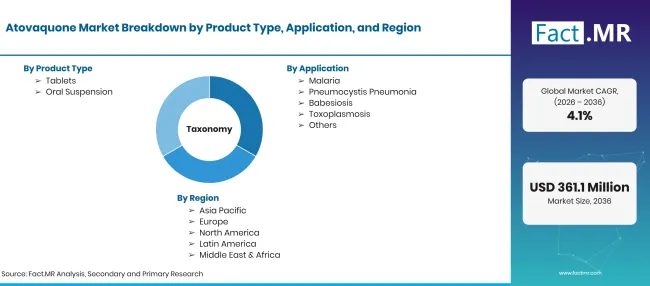
Atovaquone Market Taxonomy | Source: Fact.MR
| Attribute | Details |
|---|---|
| Study title | Atovaquone Market |
| Base year | 2026 |
| Historical reference | 2025 |
| Forecast period | 2026–2036 |
| Base market value | USD 241.83 million |
| Forecast market value | USD 361.08 million |
| Forecast CAGR | 4.1% |
| Segment dimensions | Product Type, Application, Distribution Channel, End-User |
| Country analysis | Germany, Brazil, United States, United Kingdom, Japan |
| Regional coverage | North America, Latin America, Western Europe, Eastern Europe, East Asia, South Asia & Pacific, Middle East & Africa |
Source: Fact.MR analysis. Updated Oct 26, 2026
This Report Answers
- What are the 2025, 2026 and 2036 values of the atovaquone market?
- What forecast CAGR is associated with the drug category?
- How do atovaquone-proguanil tablets differ from oral atovaquone suspension?
- What is the largest assigned clinical application?
- Which distribution channel contributes most revenue?
- How do malaria, babesiosis and opportunistic infections affect market demand?
What does the Atovaquone Market cover?
The study covers global market value for medicines containing atovaquone, including atovaquone-proguanil tablets and relevant atovaquone oral suspension sales. It examines product form, the main assigned clinical use, pharmacy channel, end user and five-country market outlook. Discussion of clinical guidelines explains commercial demand boundaries and is not medical advice.
What is included in the scope?
Atovaquone-containing licensed medicinal formulations within the stated product types; malaria, Pneumocystis pneumonia, babesiosis, toxoplasmosis and other assigned applications; hospital, retail and compliant online pharmacy channels; and relevant clinical purchaser groups.
What is excluded from the scope?
Other antimalarials without atovaquone, standalone azithromycin or proguanil sales, laboratory testing revenue, medicines sold outside the listed dosage-form scope, and disease-care costs unrelated to atovaquone products. Infection prevalence is not counted as medicine revenue.
How Was the Analysis Built?
The analysis draws on 120+ sources, 35+ company portfolios, 25+ countries, and more than 20 industry interviews.
- Primary Research: Primary research includes discussions with manufacturers, service providers, technology developers, distributors, end users, and subject-matter experts. These conversations examine purchasing priorities, product adoption, operational challenges, approval requirements, competitive positioning, and the factors that influence wider market acceptance.
- Desk Research: Desk research covers government statistics, regulatory publications, company filings, trade data, technical studies, industry associations, standards, public policy, and other authoritative sources. Every source used in the analysis is documented in the bibliography.
- Market Sizing and Forecasting: Market estimates combine historical performance, demand indicators, pricing and volume trends, segment shares, company participation, country-level growth, adoption patterns, investment activity, and barriers to market expansion.
- Data Validation and Update Cycle: Findings are validated by comparing primary interviews with public data, company activity, regulatory changes, trade patterns, and industry developments. Regular updates review new product launches, capacity changes, partnerships, approvals, and shifts in commercial adoption.
Segmentation
How is the market segmented?
-
By Product Type
- Tablets
- Oral Suspension
-
By Application
- Malaria
- Pneumocystis Pneumonia
- Babesiosis
- Toxoplasmosis
- Others
-
By Distribution Channel
- Hospital Pharmacies
- Retail Pharmacies
- Online Pharmacies
- Others
-
By End-User
- Hospitals
- Clinics
- Homecare
- Others
-
By Region
- North America
- Latin America
- Western Europe
- Eastern Europe
- East Asia
- South Asia & Pacific
- Middle East & Africa
Bibliography
- [1] Centers for Disease Control and Prevention. (2024, February 13). Clinical care of babesiosis.
- [2] Centers for Disease Control and Prevention. (2025, April 23). Malaria: CDC Yellow Book.
- [3] National Institutes of Health. (2026, May 27). Pneumocystis pneumonia: Adult and adolescent opportunistic infection guidelines.
- [4] National Institutes of Health. (2025, September 9). Toxoplasma gondii encephalitis: Adult and adolescent opportunistic infection guidelines.
- [5] World Health Organization. (2025, December 4). World malaria report 2025.
Frequently Asked Questions
What is the size of the atovaquone market in 2026?
What is the projected market value in 2036?
What is the market CAGR?
Which product type leads?
Which application is largest?
Does atovaquone have the same regimen for all infections?
Who worked on this report


Preview the report firsthand - request a free sample
Free SampleGet the brochure for pricing and purchase details
Download PDF