- Base Value(2025): 1.4 Bn
- Estimated Value(2026): 1.5 Bn
- Forecast Value (2036): 2.3 Bn
- CAGR (2026 - 2036): 4.7%
Mosquito-Borne Infections Testing Market Forecast and Outlook 2026 to 2036
In 2025, the mosquito-borne infections testing market was valued at USD 1.4 billion. Based on Fact.MR analysis, demand for mosquito-borne infections testing is estimated to grow to USD 1.5 billion in 2026 and USD 2.3 billion by 2036. Fact.MR projects a CAGR of 4.7% during the forecast period.
The market is expected to generate an absolute dollar opportunity of USD 0.8 billion between 2026 and 2036. This incremental growth reflects the structural tension between sustained disease burden expansion and reimbursement constraints in endemic low- and middle-income regions where most testing demand originates. The 2024 dengue season recorded over 14.6 million cases across more than 100 countries, according to WHO. However, per test revenue remains low in endemic markets. Public procurement pricing limits margins. National insurance schemes often exclude arboviral diagnostics. Many resource constrained regions still rely on clinical diagnosis without lab confirmation, despite carrying the highest disease burden.
Thomas Schinecker, CEO of Roche noted, "We are setting new standards in diagnostics. Our continued focus on operational and R&D excellence [is reflected in] our strong performance in 2025. We had important breakthroughs and are expanding our product menu for automated antigen testing and integrated lab workflows."
Country growth varies by disease burden and healthcare capacity. China leads at 6.8% CAGR due to expanded surveillance and molecular diagnostics. India follows at 6.2% with national programme support. Germany posts 5.9% from CE mark adoption. Brazil records 5.2% despite high cases. The United States grows at 4.8% with updated CDC guidelines and surveillance expansion.
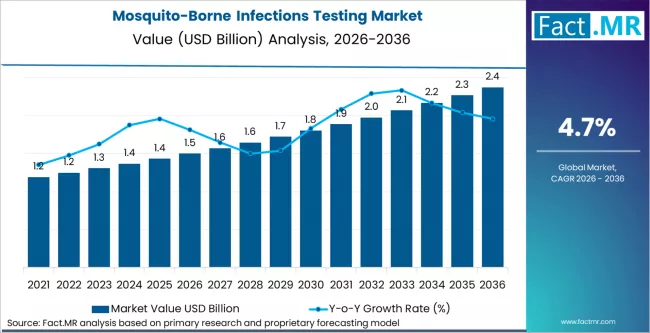
Mosquito Borne Infections Testing Market Market Value Analysis | Source: Fact.MR
Market Definition
The mosquito borne infections testing market includes in vitro diagnostic products and services used to detect infections caused by mosquito transmitted pathogens. These include malaria, dengue, Zika, chikungunya, West Nile, yellow fever, and Japanese encephalitis. Products cover molecular assays, immunoassays, rapid tests, and lab platforms used in hospitals, labs, blood banks, and public health centres for diagnosis and surveillance.
Market Inclusions
The report covers global and regional revenues from 2026 to 2036 by test type, indication, end user, and region. It compares molecular and rapid test pricing, multiplex and singleplex trends, regulatory impact, and national surveillance procurement. It also evaluates point of care versus laboratory testing share across endemic and non-endemic markets.
Market Exclusions
The study excludes vaccines, vector control tools, and therapeutic drugs. It also excludes broad fever panels where mosquito pathogens are minor components. Veterinary tests are excluded unless platforms are used for human diagnostics.
Research Methodology
- Primary Research: Interviews were conducted with hospital lab directors, infectious disease physicians, public health officials, and diagnostic company executives across endemic regions.
- Desk Research: Sources included WHO reports, Roche and Abbott releases, ICMR documents, CDC advisories, ECDC updates, and national procurement data.
- Market Sizing and Forecasting: A hybrid model was used. Top down inputs included WHO incidence data and national budgets. Bottom up inputs included per test pricing and procurement volumes.
- Data Validation and Update Cycle: Findings were cross checked with WHO outbreak data, CDC surveillance, ECDC reports, and company announcements. Forecasts are reviewed annually.
Mosquito-Borne Infections Testing Market Summary
- Market Definition
- Mosquito borne infection testing includes assays used to detect malaria and major arboviral infections across clinical and public health settings worldwide.
- Demand Drivers
- The 2024 dengue season recorded over 14.6 million cases and more than 12,000 deaths, sustaining high testing demand.
- Climate driven mosquito expansion is creating new testing demand in temperate regions.
- WHO strategic funding, Essential Diagnostics List inclusion, and national surveillance programmes are supporting baseline procurement volumes.
- Key Segments Analyzed
- By Test Type: Molecular diagnostics hold about 30% value share due to premium pricing and genotype differentiation capability.
- By Indication: Malaria leads with about 38% share, supported by 282 million global cases and stable RDT procurement.
- By End User: Hospitals and clinics account for about 43% share due to acute fever management needs.
- Analyst Opinion at FACT.MR
- Shambhu Nath Jha, Principal Consultant at Fact.MR, opines, 'CXOs will find this report essential for understanding how the historic 2024 dengue surge and climate-driven geographic expansion of arboviral transmission are reshaping the competitive landscape from single-pathogen RDT supply toward multiplex differential diagnostics capable of co-infection resolution.
- Strategic Implications / Executive Takeaways
- Manufacturers should prioritize multiplex assay development for co circulating pathogens.
- Companies should pursue WHO prequalification to access major public procurement channels.
- Automated platform suppliers should target Europe and high income Asia markets where regulatory standards are rising.
- Methodology
- Market sizing used WHO incidence data, confirmation rates, and per test pricing benchmarks.
- Adoption shares were benchmarked using WHO lists, Global Fund data, and primary interviews.
- Regional projections incorporated WHO burden reports, national budgets, ECDC data, and CDC ArboNET surveillance updates.
Segmental Analysis
Mosquito Borne Infections Testing Market Analysis by Test Type
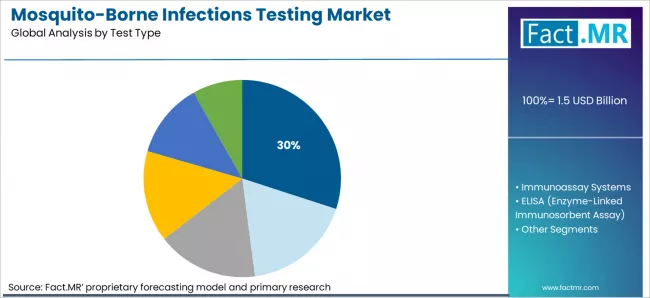
Mosquito Borne Infections Testing Market Analysis By Test Type | Source: Fact.MR
Molecular diagnostics hold about 30.0% value share in 2025. They command premium pricing. RT PCR is required for dengue serotype surveillance and malaria resistance monitoring. Multiplex platforms detect dengue, chikungunya, and Zika from one sample. This supports differential diagnosis in endemic hospitals.
- Roche Elecsys Dengue Panel Automated Platform Launch: Roche received CE mark in October 2025 for Elecsys Dengue Ag on cobas platforms. [1] The test shows 94.90% sensitivity and 99.96% specificity. The panel will expand to include IgM and IgG assays. It offers a complete automated dengue workflow in Europe.
- Abbott Bioline Malaria RDT Sensitivity Investigation: A December 2024 Malaria Journal study found 24% sensitivity for Abbott Bioline P. vivax RDTs in Myanmar. [4] WHO circulated internal guidance. The incident highlights RDT reliability risks and strengthens demand for molecular confirmation.
- QIAGEN QIAstat Dx Syndromic Panel India Launch: QIAGEN launched QIAstat Dx febrile panels in India in January 2024. [5] The system enables simultaneous detection of multiple pathogens. It supports differential diagnosis in high burden hospitals.
Mosquito Borne Infections Testing Market Analysis by Indication
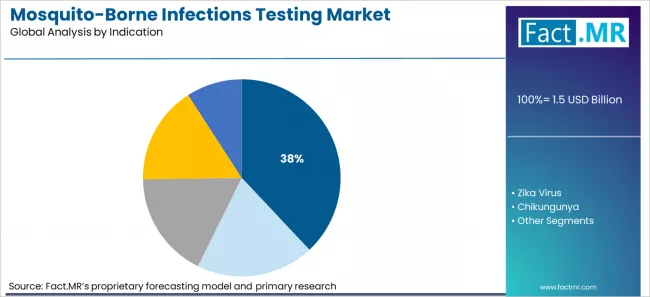
Mosquito Borne Infections Testing Market Analysis By Indication | Source: Fact.MR
Malaria testing holds about 38.0% value share in 2025. It benefits from structured procurement through Global Fund and donor programmes. Laboratory confirmation is institutionalized in endemic regions. Demand is stable and less seasonal than dengue.
- WHO World Malaria Report 2025 and Diagnostics Investment: WHO reported 282 million malaria cases and 610,000 deaths in 2024. [6] Drug resistance in eight African countries requires PCR surveillance. This expands molecular testing beyond RDT use.
- Brazil Dengue Epidemic and NS1 Procurement Surge: Brazil’s 2024 epidemic exceeded 10 million cases. [3] Emergency NS1 and PCR procurement followed. Updated protocols require lab confirmation for hospitalised patients.
- Dengue Geographic Expansion in Europe and Travel Medicine: Germany reported local dengue transmission in 2024. [7] Testing demand rose in hospitals and travel clinics. High income settings favor automated platforms such as Roche Elecsys.
Drivers, Restraints, and Opportunities
Fact.MR estimates the mosquito borne infections testing market reached USD 1.4 billion in 2025. Growth reflects record disease burden and expanding lab infrastructure in endemic regions. Malaria RDT procurement once dominated revenues. Now dengue testing has become an equal driver. WHO reported 282 million malaria cases and 610,000 deaths in 2024.
The key tension lies in geography and pricing. Disease burden is highest in low and middle income countries. These markets sustain low pricing. Malaria RDTs cost below USD 1.00 in Global Fund procurement. In contrast, RT PCR dengue panels cost USD 15 to 50 per test. This creates two market tiers. One is high volume, low ASP public RDT demand.
- WHO Global Strategic Plan for Arboviral Diseases: WHO launched a global plan in October 2024 requiring USD 55 million for dengue and other arboviral diseases. [2] The plan aligns with the Global Vector Control Response. It creates structured procurement commitments for diagnostics. This reduces supplier risk and supports product registration in endemic markets.
- Roche Elecsys Dengue Ag CE Mark and Laboratory Automation Shift: Roche received CE mark in October 2025 for Elecsys Dengue Ag. [1] The test delivers 18 minute results with 94.90% sensitivity and high throughput. It sets a new benchmark in Europe and IVD regulated markets. Automated immunoassays are expected to replace manual ELISA and RDT protocols in hospitals.
- Brazil's Record Dengue Burden and Diagnostic Infrastructure Investment: Brazil reported over 10 million dengue cases and 6,321 deaths in 2024. [3] The Ministry of Health expanded lab confirmation and NS1 procurement. Brazil also launched Wolbito do Brasil in July 2024 for mosquito control. Diagnostics remain central to outbreak monitoring.
Regional Analysis
The mosquito-borne infections testing market is analysed across North America, Europe, Asia Pacific, Latin America, and Middle East and Africa, with each region assessed by disease burden intensity, national diagnostic programme procurement structure, laboratory infrastructure maturity, and private sector testing market development. Country-level coverage includes China, India, Germany, Brazil, and the United States. The full report provides market attractiveness analysis benchmarked against WHO prequalification requirements, national insurance reimbursement coverage for arboviral diagnostics, and outbreak response procurement trigger mechanisms.
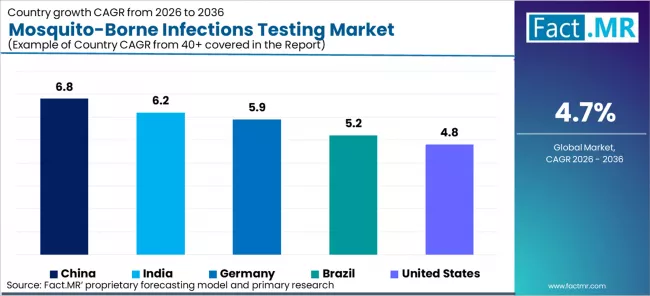
Mosquito Borne Infections Testing Market Cagr Analysis By Country | Source: Fact.MR
| Country | CAGR (2026 to 2036) |
|---|---|
| China | 6.8% |
| India | 6.2% |
| Germany | 5.9% |
| Brazil | 5.2% |
| United States | 4.8% |
Source: Fact.MR analysis. Updated Feb 25, 2026
Source: Fact.MR (FACT.MR) analysis, based on proprietary forecasting model and primary research
Asia Pacific Mosquito-Borne Infections Testing Market Analysis
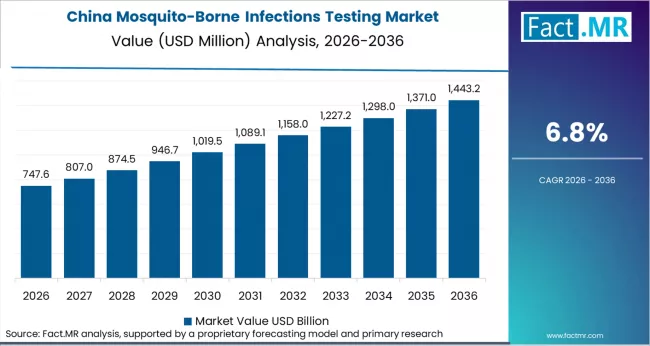
Mosquito Borne Infections Testing Market Country Value Analysis | Source: Fact.MR
Asia Pacific carries the highest disease burden globally. Malaria remains endemic across much of the region. Dengue incidence is rising across Southeast Asia. Private hospital laboratory networks are expanding in India and China. Thermo Fisher, Roche, Abbott, and QIAGEN lead the premium tier. Domestic manufacturers supply high-volume public procurement.
- China: Demand for mosquito-borne infections testing in China is projected to rise at 6.8% CAGR through 2036. Growth is driven by dengue resurgence in Guangdong, Yunnan, and Fujian. CDC-China mandates laboratory confirmation under national reporting rules. China remains malaria free but maintains PCR surveillance for imported cases. The 2024 National Health Commission update expanded RT-PCR capacity at provincial CDCs. Domestic firms such as BGI Genomics and Bioperfectus expanded multiplex PCR registrations in 2024 and 2025.
- India: Demand in India is projected to rise at 6.2% CAGR through 2036. Procurement is supported by the National Vector Borne Disease Control Programme. Government centres distribute malaria RDTs and dengue NS1 kits. ICMR guidelines define approved platforms. Private labs such as Metropolis, SRL, Thyrocare, and Dr. Lal PathLabs expanded testing after record 2024 outbreaks.
FACT.MR covers China, India, Japan, South Korea, Australia and New Zealand, ASEAN, and Rest of Asia Pacific. The report includes procurement data, regulatory timelines, and private lab expansion trends.
Europe Mosquito-Borne Infections Testing Market Analysis
Europe is the regulatory benchmark under EU IVD Regulation. It is also experiencing local dengue transmission. Roche, bioMerieux, and Abbott lead the laboratory market. Roche’s October 2025 Elecsys Dengue Ag CE mark defines the premium automated tier.
- Germany: Demand in Germany is projected to rise at 5.9% CAGR through 2036. Autochthonous dengue cases were confirmed in 2024. Testing now includes patients without travel history. Roche’s CE mark in October 2025 allows easy upgrades on cobas platforms. Updated 2024 clinical guidelines widened NS1 testing indications.
FACT.MR covers Germany, France, United Kingdom, Italy, Spain, Netherlands, Nordics, and Rest of Europe. The report includes EU IVD timelines and surveillance data.
North America Mosquito-Borne Infections Testing Market Analysis
North America is driven by surveillance and travel medicine demand. CDC infrastructure and FDA cleared platforms shape the market. Abbott, Thermo Fisher, Hologic, and QuidelOrtho are key suppliers.
- United States: Demand is projected to rise at 4.8% CAGR through 2036. Puerto Rico extended its dengue emergency through 2025. CDC issued updated testing guidance in March 2025 under HAN-00523. Climate modelling suggests mosquito range expansion. West Nile virus remains the leading domestic infection with 1,791 cases in 2024 and over 2,000 in 2025.
FACT.MR covers the United States, Canada, and Mexico. The report includes CDC guidance and FDA approval timelines.
Latin America Mosquito-Borne Infections Testing Market Analysis
Latin America carries the highest dengue burden globally. Brazil accounts for most 2024 cases. Malaria remains endemic in Amazon regions. Roche, Abbott, and bioMerieux serve the institutional tier. Domestic firms supply RDT volumes.
- Brazil: Demand is projected to rise at 5.2% CAGR through 2036. Brazil recorded over 10 million dengue cases and 6,321 deaths in 2024. ANVISA expanded diagnostic confirmation requirements. Public procurement of NS1 and PCR increased across SUS laboratories. Wolbito do Brasil opened in July 2024 to support vector control. WHO reported Brazil drove most regional dengue cases in 2024.
FACT.MR covers Brazil, Mexico, Colombia, Argentina, Chile, and Rest of Latin America. The report includes SUS pricing benchmarks, ANVISA approvals, and epidemic cycle data.
Competitive Aligners for Market Players
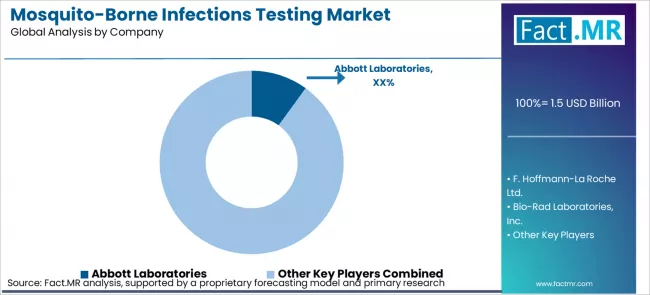
Mosquito Borne Infections Testing Market Analysis By Company | Source: Fact.MR
The global mosquito-borne infections testing market is moderately concentrated in the premium platform segment. It is highly fragmented in rapid diagnostic tests. Abbott, Roche, bioMerieux, Thermo Fisher, QIAGEN, and Siemens dominate molecular and automated immunoassay revenues. These segments command the highest average selling prices. In contrast, more than 20 manufacturers compete in the WHO-prequalified RDT space. Many are based in India, South Korea, and China. In the premium tier, platform integration is the key advantage. Suppliers offering dengue, malaria, and febrile panels on installed automation systems gain stronger customer loyalty.
Vertically integrated platform providers hold structural advantages. Roche benefits from its October 2025 Elecsys Dengue Ag CE mark on the widely installed cobas platform. This enables hospitals to adopt new assays without buying new instruments. Abbott operates across both RDT and automated tiers through SD BIOLINE and ARCHITECT platforms. bioMerieux strengthened its rapid test reach through the GenBody acquisition, expanding beyond its VIDAS base. Buyer behavior is split. Public health agencies use multi-year tenders with limited pricing power. Private hospitals choose platforms that lock in reagent supply for several years.
Recent Developments
- In 2025, Roche received CE mark approval for its fully automated Elecsys Dengue Ag test, a high-throughput immunoassay that detects dengue NS1 antigen with high sensitivity and specificity on cobas e platforms. This launch targets laboratory workflows in Europe and other CE-recognition markets, supporting faster acute dengue diagnosis.
- In June 2025, bioMérieux agreed to acquire Day Zero Diagnostics’ sequencing assets for under USD 25 million, strengthening its rapid infectious disease testing pipeline and advancing next-generation diagnostics for antibiotic-resistant infections.
Key Players
- Abbott Laboratories
- F. Hoffmann-La Roche Ltd.
- Bio-Rad Laboratories, Inc.
- Siemens Healthineers AG
- Qiagen N.V.
- Thermo Fisher Scientific Inc.
- Cepheid (Danaher Corporation)
- DiaSorin S.p.A.
- Hologic, Inc.
- Meridian Bioscience, Inc.
- bioMerieux SA
- QuidelOrtho Corporation
- BD (Becton, Dickinson and Company)
Bibliography
- [1] F. Hoffmann-La Roche Ltd. (2025, October). Roche Receives CE Mark for Novel Automated High-Throughput Elecsys Dengue Ag Test to Diagnose Dengue.
- [2] World Health Organization. (2024, October). WHO Launches Global Strategic Plan to Fight Rising Dengue and Other Aedes-Borne Arboviral Diseases.
- [3] World Health Organization. (2025, December). Dengue: Global Situation, Surveillance and Progress - 2024
- [4] Shoklo Malaria Research Unit / Malaria Journal. (2024, December). The Underperforming Abbott-Bioline Malaria Ag P.f/P.v Rapid Diagnostic Test: A Whiter Shade of Pale.
- [5] QIAGEN N.V. (2024, January). QIAGEN Launches Two Syndromic Testing Panels for QIAstat-Dx Instruments in India Including Gastrointestinal Panel 2 and Meningitis/Encephalitis Panel.
- [6] World Health Organization. (2025, January). World Malaria Report 2025. WHO Global Malaria Programme.
- [7] Robert Koch Institut. (2024). SurvStat - Dengue Virus Infections Including Autochthonous Cases in Germany.
This Report Addresses
- Market intelligence for strategic planning across mosquito-borne infections diagnostic test type economics, multiplex versus singleplex platform adoption, WHO prequalification procurement dynamics, and competitive response to the 2024 record dengue epidemic and climate-driven geographic arboviral expansion reshaping endemic and non-endemic country testing demand.
- Market size and forecast: mosquito-borne infections testing market valued at USD 1.5 billion in 2026, projected to reach USD 2.3 billion by 2036 at a CAGR of 4.7%, with segmentation by test type, indication, end user, and region.
- Growth opportunity mapping across multiplex RT-PCR arboviral panel adoption, automated immunoassay platform expansion for dengue in European and high-income Asia Pacific markets, WHO prequalification pipeline tracking, and private diagnostic laboratory network growth in India, China, and Brazil.
- Segment and regional forecasts: country-level CAGR analysis for China (6.8%), India (6.2%), Germany (5.9%), Brazil (5.2%), and United States (4.8%), with test type, indication, and end user splits by regional healthcare system structure.
- Competition strategy assessment: positioning of Roche, Abbott, bioMerieux, Thermo Fisher, QIAGEN, and Siemens Healthineers covering platform integration strategy, WHO prequalification investment, Roche Elecsys Dengue Ag CE mark competitive implications, and Abbott Bioline RDT quality management response.
- Product and regulatory tracking: EU IVD Regulation CE mark requirements, FDA EUA and 510(k) clearance status for arboviral platforms, WHO prequalification list updates, dengue NS1 inclusion on WHO Essential Diagnostics List, and ICMR and CDC guideline updates for mosquito-borne infection diagnostic protocols.
- Regulatory and policy impact analysis: WHO October 2024 global strategic plan for arboviral diseases USD 55 million investment framework, Brazil Ministry of Health dengue epidemic response procurement requirements, CDC HAN-00523 updated testing recommendations, and India NVBDCP procurement programme evolution.
- Report delivery in Excel data tables, PowerPoint executive summary, and detailed PDF with verified WHO, CDC, ECDC, and company press release sources for executive strategy, investor relations, and product planning teams.
Segmentation
Scope of Report
| Items | Values |
|---|---|
| Quantitative Units | USD 1.5 billion (2026) to USD 2.3 billion (2036), at a CAGR of 4.7% |
| Market Definition | Mosquito-borne infections testing encompasses in-vitro diagnostic assays, rapid tests, molecular platforms, and immunoassay systems used to detect and differentiate Plasmodium malaria parasites, dengue, Zika, chikungunya, West Nile, and other mosquito-transmitted pathogens in clinical, public health, blood safety, and travel medicine settings globally. |
| Test Type Segmentation | Molecular Diagnostics (PCR, RT-PCR, Isothermal Amplification, NGS), Immunoassay Systems (Chemiluminescence, Fluorescence), ELISA, Rapid Tests (RDTs, Lateral Flow Assays), Blot Systems and Evaluation Software, Microspot Array Diagnostics |
| Indication Segmentation | Malaria (P. falciparum, P. vivax, Mixed Species), Zika Virus, Chikungunya, Dengue (NS1 Antigen, IgM/IgG Antibodies), Others (West Nile, Yellow Fever, Japanese Encephalitis) |
| End User Segmentation | Hospitals and Clinics, Private Commercial Laboratories, Academic and Research Centers, Others (Blood Banks, Public Health Laboratories, Travel Medicine Centers) |
| Application Coverage | Acute febrile illness diagnosis, outbreak surveillance and response, blood safety screening, travel medicine return testing, malaria elimination programme confirmatory testing, and arboviral co-infection differential diagnosis |
| Regions Covered | Asia Pacific, Europe, North America, Latin America, Middle East and Africa |
| Countries Covered | China, India, Japan, South Korea, Australia and New Zealand, ASEAN, Rest of Asia Pacific, Germany, France, United Kingdom, Italy, Spain, Netherlands, Nordics, Rest of Europe, United States, Canada, Mexico, Brazil, Colombia, Argentina, Chile, Rest of Latin America, Kingdom of Saudi Arabia, United Arab Emirates, South Africa, Nigeria, Ethiopia, Rest of Middle East and Africa |
| Key Companies Profiled | Abbott Laboratories, F. Hoffmann-La Roche Ltd., Bio-Rad Laboratories Inc., Siemens Healthineers AG, Qiagen N.V., Thermo Fisher Scientific Inc., Cepheid (Danaher), DiaSorin S.p.A., Hologic Inc., Meridian Bioscience Inc., bioMerieux SA, QuidelOrtho Corporation, BD (Becton Dickinson) |
| Forecast Period | 2026 to 2036 |
| Approach | A hybrid top-down and bottom-up modelling approach was used, incorporating WHO global disease burden reports, national diagnostic programme budget allocations, WHO prequalification procurement volume estimates, and per-test ASP benchmarks by assay type and geography. Estimates were validated through primary interviews with clinical laboratory directors, public health procurement officers, and company press release cross-referencing against WHO, CDC, and ECDC surveillance data. |
Source: Fact.MR analysis. Updated Feb 25, 2026
Mosquito-Borne Infections Testing Market by Segment
-
By Test Type :
- Molecular Diagnostics
- PCR (Polymerase Chain Reaction)
- RT-PCR (Real-Time PCR)
- Isothermal Amplification
- Next-Generation Sequencing
- Immunoassay Systems
- Chemiluminescence Immunoassay
- Fluorescence Immunoassay
- ELISA (Enzyme-Linked Immunosorbent Assay)
- Rapid Tests
- Rapid Diagnostic Tests (RDTs)
- Lateral Flow Assays
- Blot Systems and Evaluation Software
- Microspot Array Diagnostics
- Molecular Diagnostics
-
By Indication :
- Malaria
- Plasmodium falciparum
- Plasmodium vivax
- Mixed/Other Species
- Zika Virus
- Chikungunya
- Dengue
- Dengue NS1 Antigen
- Dengue IgM/IgG Antibodies
- Others (West Nile, Yellow Fever, Japanese Encephalitis)
- Malaria
-
By End User :
- Hospitals and Clinics
- Infectious Disease Departments
- Emergency Departments
- Outpatient Clinics
- Private Commercial Laboratories
- Reference Laboratories
- Regional Diagnostic Centers
- Academic and Research Centers
- Universities
- Research Institutes
- Others
- Blood Banks
- Public Health Laboratories
- Travel Medicine Centers
- Hospitals and Clinics
-
By Region :
- North America
- United States
- Canada
- Mexico
- Europe
- Germany
- France
- United Kingdom
- Italy
- Spain
- Netherlands
- Nordics
- Rest of Europe
- Asia Pacific
- China
- India
- Japan
- South Korea
- Australia and New Zealand
- ASEAN
- Rest of Asia Pacific
- Latin America
- Brazil
- Mexico
- Colombia
- Argentina
- Chile
- Rest of Latin America
- Middle East and Africa
- Kingdom of Saudi Arabia
- United Arab Emirates
- South Africa
- Nigeria
- Ethiopia
- Rest of Middle East and Africa
- North America
Frequently Asked Questions
How large is the mosquito-borne infections testing market in 2025?
What will the market size be in 2026?
What is the projected market size by 2036?
What is the expected CAGR for the forecast period 2026 to 2036?
Which test type segment is poised to lead the mosquito-borne infections testing market?
Which indication segment holds the largest market share?
Which country shows the fastest growth rate in the market?
Why is Brazil projected to grow at 5.2%?
What is driving 4.8% growth in the United States?
Who worked on this report


Preview the report firsthand - request a free sample
Free SampleGet the brochure for pricing and purchase details
Download PDF