- Market Value (2025): USD 198.4 Bn
- Estimated Value (2026): USD 208.7 Bn
- Forecast Value (2036): USD 346.0 Bn
- CAGR (2026-2036): 5.2%
What is the Endocrinology Drugs Market forecast to be worth by 2036?
USD 208.7 billion in 2026 to USD 346.0 billion by 2036 at a 5.2% CAGR.
- The valuation of the endocrinology drugs market was USD 198.4 billion in 2025, a base built on insulin, oral diabetes drugs and lifelong hormone replacement.
- Revenue will advance from USD 208.7 billion in 2026 to USD 346.0 billion by 2036 as more adults are diagnosed with type 2 diabetes and stay on combination therapy for longer.
- A 5.2% CAGR reflects steady prescription volume in mature insulin and thyroid lines, lifted by higher-value weekly and incretin-based medicines.
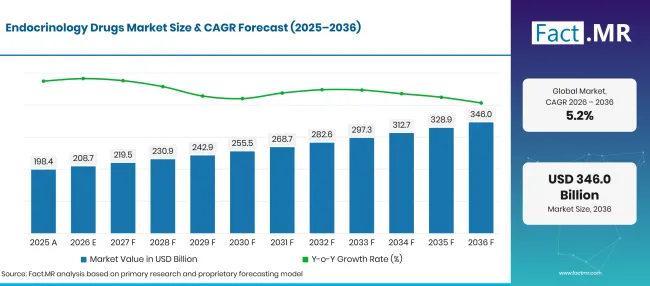
Endocrinology Drugs Market Forecast Global | Source: Fact.MR
| Year | Basis | Market Value (USD billion) |
|---|---|---|
| 2025 | Actual | 198.4 |
| 2026 | Estimate | 208.7 |
| 2036 | Forecast | 346.0 |
| CAGR 2026 to 2036 | Forecast period | 5.2% |
Source: Fact.MR analysis. Updated Nov 3, 2026
What are the defining numbers behind Endocrinology Drugs Market growth?
The 2026 to 2036 period adds USD 137.3 billion in new value, most of it linked to diabetes care delivered through hospital and retail pharmacies.
- Demand Drivers in the Market
- Global health bodies now treat newer diabetes drugs as core medicines. In September 2025 the World Health Organization added semaglutide, dulaglutide, liraglutide and tirzepatide to its Model List of Essential Medicines for adults with type 2 diabetes who also have heart or kidney disease and obesity [1]. Listing guides national formularies and public tenders toward these agents.
- Weekly basal insulin is cutting the injection burden for people with type 2 diabetes. Novo Nordisk announced in March 2026 that the US FDA approved Awiqli (insulin icodec) as the first once-weekly basal insulin for adults with type 2 diabetes [2]. Lilly followed in September 2026 with FDA approval of Onswik (insulin efsitora alfa), which the company reports is also cleared in the EU, Mexico and Japan [3].
- Immune therapy is opening a new treatment window before insulin is needed. Sanofi reported in January 2026 that the European Commission approved Teizeild (teplizumab) to delay stage 3 type 1 diabetes in adults and children aged eight and older with stage 2 disease [4]. Screening of relatives and children will bring more patients to endocrine clinics at an earlier stage.
- Lifelong hormone replacement keeps the base stable. Patients with hypothyroidism, growth hormone deficiency or hypoparathyroidism rarely stop therapy, so each new diagnosis adds years of repeat prescriptions.
- Key Segments Analyzed
- By Drug Type: Insulin will hold 34.2% share in 2026, as people with type 1 diabetes and many with advanced type 2 diabetes need daily or weekly basal cover.
- By Application: Diabetes will account for 42.3% of 2026 value, given the size of the patient pool and the need for continuous glucose control.
- By Distribution Channel: Hospital Pharmacies will capture 38.7% in 2026 since insulin starts, biologic injections and specialist endocrine prescriptions often begin inside institutions.
- Analyst Opinion at Fact.MR
- Shambhu Nath Jha, Principal Consultant at Fact.MR, states, “Diabetes will keep endocrinology prescribing busy through 2036, but the mix of what is prescribed will shift toward weekly insulin and incretin-based combinations. Suppliers that can bring these agents into public formularies at workable prices will widen their patient reach in Latin America and Europe. Thyroid, growth and parathyroid therapies will grow more slowly, yet long-acting formats will protect their value in specialist care.”
- Strategic Implications
- Manufacturers should plan pen and cartridge capacity for weekly insulin early, since hospital formularies need assured supply before they switch patients from daily products.
- Hospital pharmacists should set dose conversion protocols for patients moving from daily to weekly basal insulin, which cuts hypoglycaemia risk during the switch.
- Payers and public health systems should weigh the full cost of care when listing GLP-1 based agents, because heart and kidney benefits can offset part of the drug spend.
- Investors should look at long-acting hormone therapies and early-stage type 1 diabetes treatment, where label expansions can still add value to mature categories.
Germany leads the five-country set at 6.0%, helped by a type 2 diabetes caseload that national researchers expect to nearly double by 2050. Brazil follows at 5.5% as its public system moves patients onto newer insulin analogues. The United States grows at 4.9% from a very large treated base where pricing pressure limits value gains. A 4.4% pace in the United Kingdom reflects strong NHS spending control even as prescription items keep rising. Japan closes the range at 3.9%, where an older population sustains volume but price revisions hold back value.
How does the Endocrinology Drugs Market break down by segment?
Insulin will lead Drug Type at 34.2%; Diabetes will head Application at 42.3%; Hospital Pharmacies will top Distribution Channel at 38.7% in 2026.
Which Drug Type leads?
Insulin holds 34.2% of 2026 sales.
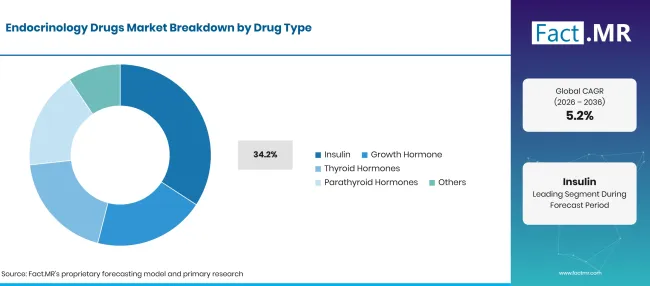
Endocrinology Drugs Market Breakdown Drug Type | Source: Fact.MR
| Drug Type | Share (2026) |
|---|---|
| Insulin (Leading segment) | 34.2% |
| Other segments combined | 65.8%* |
| Total | 100.0% |
Source: Fact.MR analysis. Updated Nov 3, 2026
People with type 1 diabetes cannot live without insulin, and many with type 2 diabetes add it once oral agents stop working. Basal analogues such as glargine, degludec and the new weekly products form the core of this demand. Rapid-acting mealtime insulin and premixed formulations add further volume. Prefilled pens have replaced vials in most high-income markets, which raises value per patient. Growth hormone serves children with growth hormone deficiency and some adults with pituitary disease. Pfizer’s August 2026 prescribing information lists Ngenla (somatrogon) as a weekly growth hormone analog for children aged three and older with growth failure from inadequate growth hormone secretion [5]. Weekly dosing is reshaping the human growth hormone category. Thyroid hormones, chiefly levothyroxine, treat hypothyroidism at low cost per pack. Parathyroid hormone therapy covers hypoparathyroidism and severe osteoporosis. Others include adrenal and pituitary therapies.
What supports Diabetes within Application?
Diabetes takes 42.3% of 2026 revenue.
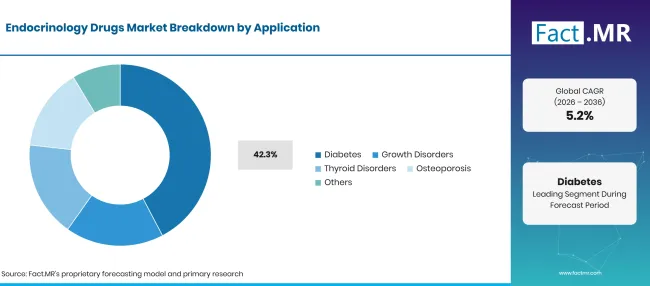
Endocrinology Drugs Market Breakdown Application | Source: Fact.MR
| Application | Share (2026) |
|---|---|
| Diabetes (Leading segment) | 42.3% |
| Other segments combined | 57.7%* |
| Total | 100.0% |
Source: Fact.MR analysis. Updated Nov 3, 2026
Blood glucose control is a daily task for patients, and most need two or more drugs within a few years of diagnosis. Metformin remains the usual first step. Many patients then add one of the SGLT2 inhibitors or an incretin agent before insulin. The wider GLP-1 receptor agonist class now accounts for a growing slice of diabetes spend as clinicians use it for heart and kidney protection too. Growth disorders need long treatment courses that end when children reach adult height. Thyroid disorders affect far more people, though generic levothyroxine keeps value modest. Osteoporosis care draws on parathyroid hormone analogues for patients at very high fracture risk. Others cover adrenal insufficiency, acromegaly and Cushing’s disease.
How does Distribution Channel shape demand?
Hospital Pharmacies capture 38.7% of 2026 value.
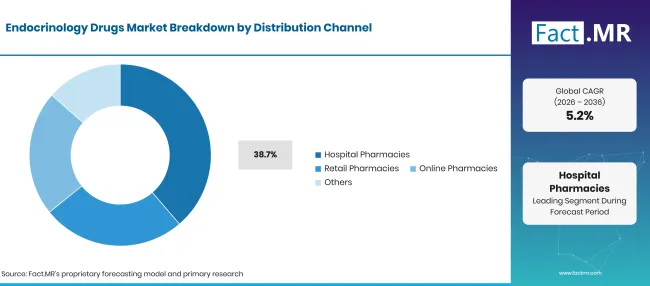
Endocrinology Drugs Market Breakdown Distribution Channel | Source: Fact.MR
| Distribution Channel | Share (2026) |
|---|---|
| Hospital Pharmacies (Leading segment) | 38.7% |
| Other segments combined | 61.3%* |
| Total | 100.0% |
Source: Fact.MR analysis. Updated Nov 3, 2026
Many endocrine treatment journeys begin in hospital clinics, where specialists start insulin, review growth hormone doses and give injectable osteoporosis therapy. Hospital pharmacies also handle newly diagnosed type 1 diabetes in children and inpatient insulin for surgical patients. Specialist-only biologics, such as teplizumab infusions, stay within this channel. Retail pharmacies take over repeat prescriptions once patients are stable on oral agents, pens or thyroid tablets. Online pharmacies serve home delivery of chronic therapies where regulators permit it. Others include specialty distributors and public tender supply.
What is accelerating Endocrinology Drugs Market adoption, and what is holding it back?
More adults are diagnosed with type 2 diabetes each year, and weekly insulin and incretin agents give prescribers more ways to intensify treatment. Hormone replacement for thyroid, growth and parathyroid disorders adds a stable layer of lifelong demand. High prices for newer agents and payer limits on GLP-1 use slow value gains. Biosimilar insulin and generic oral drugs also erode value in mature lines.
Drivers Impact Analysis
| DRIVER | (~) % IMPACT ON CAGR | GEOGRAPHIC RELEVANCE | IMPACT TIMELINE |
|---|---|---|---|
| Rising type 2 diabetes diagnosis | +1.2% | Global | Long term (>=4 years) |
| Uptake of GLP-1 based glucose-lowering agents | +1.0% | North America, Western Europe | Medium term (2-4 years) |
| Launch of once-weekly basal insulin | +0.7% | North America, Western Europe, East Asia | Short term (<=2 years) |
| Lifelong thyroid and growth hormone replacement | +0.5% | Global | Long term (>=4 years) |
Source: Fact.MR analysis. Updated Nov 3, 2026
Opportunity Impact Analysis
| OPPORTUNITY | (~) % IMPACT ON CAGR | GEOGRAPHIC RELEVANCE | IMPACT TIMELINE |
|---|---|---|---|
| Public insulin analogue programmes in emerging markets | +0.7% | Latin America, South Asia & Pacific | Medium term (2-4 years) |
| Immune therapy for early type 1 diabetes | +0.5% | North America, Western Europe | Long term (>=4 years) |
| Weekly growth hormone for children | +0.4% | Global | Medium term (2-4 years) |
| Long-acting parathyroid hormone therapy | +0.2% | North America, Western Europe | Long term (>=4 years) |
Source: Fact.MR analysis. Updated Nov 3, 2026
Restraints Impact Analysis
| RESTRAINT | (~) % IMPACT ON CAGR | GEOGRAPHIC RELEVANCE | IMPACT TIMELINE |
|---|---|---|---|
| High prices of newer diabetes agents | -0.6% | Global | Short term (<=2 years) |
| Biosimilar insulin and generic oral drug erosion | -0.5% | North America, Western Europe | Medium term (2-4 years) |
| Unequal access to endocrinology specialists | -0.4% | Emerging markets | Medium term (2-4 years) |
| Poor adherence to long-term injectable therapy | -0.2% | Global | Long term (>=4 years) |
Source: Fact.MR analysis. Updated Nov 3, 2026
Which countries are scaling the Endocrinology Drugs Market through 2036?
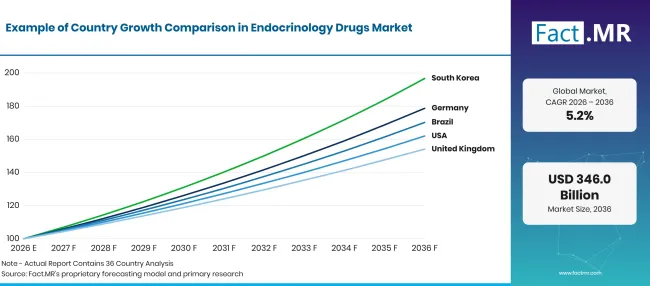
Endocrinology Drugs Market Growth Index | Source: Fact.MR
| Country | CAGR (2026 to 2036) |
|---|---|
| Germany | 6.0% |
| Brazil | 5.5% |
| United States | 4.9% |
| United Kingdom | 4.4% |
| Japan | 3.9% |
Source: Fact.MR analysis. Updated Nov 3, 2026
What supports endocrinology drug adoption in Germany?
6.0% CAGR, driven by a fast-growing type 2 diabetes caseload and broad statutory insurance cover.
A September 2025 Robert Koch Institute study counted 6.05 million people with diagnosed type 2 diabetes in Germany in 2022, a prevalence of 8.6% [6]. Its main scenario projects 11.01 million cases by 2050. Statutory health insurance reimburses insulin, incretin agents and thyroid therapy for nearly all residents. Specialist diabetes practices manage many insulin starts outside hospitals.
How is Brazil developing demand?
5.5% CAGR, as the public health system shifts patients to insulin analogues.
Brazil’s Ministry of Health began a national move to insulin glargine in the Unified Health System (SUS) in July 2026, at a point when NPH insulin still represented 90% of insulin used in the SUS [7]. The ministry planned about 130 training workshops for municipal teams. Federal data released in January 2026 show adult diabetes prevalence rose from 5.5% in 2006 to 12.9% in 2024 [8]. Public purchasing will remain the main route for insulin in Brazil.
What is supporting United States adoption?
4.9% CAGR, backed by a very large treated population and early access to new agents.
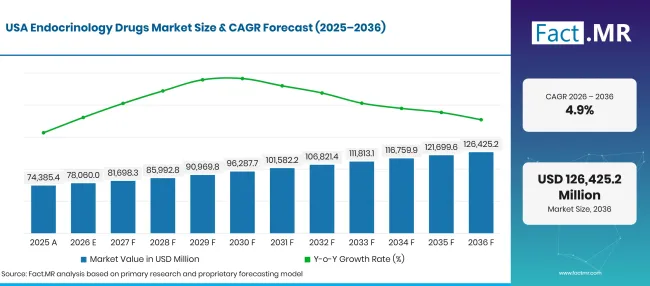
Endocrinology Drugs Market Forecast Usa | Source: Fact.MR
The CDC’s National Diabetes Statistics Report, updated in September 2026, estimates that 40.1 million people in the United States had diagnosed or undiagnosed diabetes in 2023 [9]. The same report counts 115.2 million adults with prediabetes. FDA approvals of two weekly basal insulins in 2026 add new options for this population. Rebates and pharmacy benefit rules shape net prices.
How is the United Kingdom developing demand?
4.4% CAGR, reflecting rising prescription volume under tight NHS budget control.
The NHS Business Services Authority reported in August 2026 that 4.1 million identified patients in England received diabetes prescriptions in 2025/26 [10]. Those prescriptions reached 83 million items at a cost of £2.31 billion. Community pharmacies handle the bulk of repeat dispensing. National guidance decides when GLP-1 based agents and newer insulins enter routine care.
What supports Japan’s adoption?
3.9% CAGR, owing to an ageing population with long-term diabetes and thyroid needs.
Japan’s Ministry of Health, Labour and Welfare released its 2024 National Health and Nutrition Survey in December 2025 [11]. It estimates that about 11 million people are strongly suspected of having diabetes, a figure that has kept rising. An older patient base sustains steady demand for insulin and thyroid hormone. The wider geriatric medicines field shares this ageing driver. Regular national price revisions limit value growth.
Who leads the Endocrinology Drugs Market?
Competition falls into three groups. Novo Nordisk, Eli Lilly and Company and Sanofi form the insulin and incretin core, with deep pen manufacturing and long histories with diabetes clinics. Their latest products show where value is heading: Novo Nordisk’s Awiqli and Lilly’s Onswik both gained FDA approval as weekly basal insulins in 2026 [2] [3].
Lilly’s third-quarter 2026 update also listed an FDA approval for Mounjaro to reduce cardiovascular risk in adults with type 2 diabetes [12]. AstraZeneca and Merck & Co. form an oral therapy group built on SGLT2 and DPP-4 inhibitors, where generic entry will test pricing. Pfizer and AbbVie focus on hormone replacement through growth hormone and levothyroxine brands. Sanofi’s EU approval of Teizeild in early type 1 diabetes shows how immune therapy can extend a portfolio upstream [4]. Through 2036, competitive weight will shift toward firms that can supply weekly injectables at scale and win formulary access.
Which companies are the key providers?
Key companies in the Endocrinology Drugs Market include Novo Nordisk, Eli Lilly and Company, Sanofi, AstraZeneca, Merck & Co., Pfizer and AbbVie.
- Novo Nordisk
- Eli Lilly and Company
- Sanofi
- AstraZeneca
- Merck & Co.
- Pfizer
- AbbVie
Bibliography
- [1] World Health Organization. (2025, September 5). WHO updates list of essential medicines to include key cancer, diabetes treatments.
- [2] Novo Nordisk. (2026, March 27). Awiqli approved in the US, the first and only once-weekly basal insulin treatment for adults with type 2 diabetes.
- [3] Eli Lilly and Company. (2026, September 24). U.S. Food and Drug Administration (FDA) approves Lilly’s Onswik (insulin efsitora alfa-gobe), a once-weekly basal insulin injection treatment for adults living with type 2 diabetes.
- [4] Sanofi. (2026, January 12). Press Release: Sanofi’s Teizeild approved in the EU for patients with stage 2 type 1 diabetes.
- [5] Pfizer. (2026, August). NGENLA (somatrogon-ghla) injection: Highlights of prescribing information.
- [6] Robert Koch Institute. (2025, September 17). Trends in prevalence and number of cases of diagnosed type 2 diabetes in Germany: Projections until 2050.
- [7] Ministry of Health, Brazil. (2026, July 13). Ministério da Saúde detalha processo de transição de insulina glargina para secretários municipais.
- [8] Agência Gov, Government of Brazil. (2026, January 28). Diabetes, hipertensão e obesidade: Saúde investe R$ 340 milhões para estimular prevenção.
- [9] Centers for Disease Control and Prevention. (2026, September 16). National Diabetes Statistics Report.
- [10] NHS Business Services Authority. (2026, August 20). Prescribing for Diabetes: England: 2016/17 to 2025/26.
- [11] Ministry of Health, Labour and Welfare, Japan. (2025, December 2). 令和6年「国民健康・栄養調査」の結果.
- [12] Eli Lilly and Company. (2026, October 29). Lilly reports third-quarter 2026 financial results, raises full-year guidance and highlights regulatory progress across the portfolio.
This Report Answers
- How large will endocrinology drug revenue be in 2026 and 2036, and what pace links the two?
- Why insulin keeps the lead among drug types as weekly products reach pharmacies.
- Which disease areas beyond diabetes add lifelong prescription demand.
- Where hospital, retail and online pharmacies each fit in the patient journey.
- What separates growth in Germany, Brazil, the United States, the United Kingdom and Japan.
- Which supplier groups compete on insulin, oral agents and hormone replacement.
What does the Endocrinology Drugs Market cover?
This study tracks prescription medicines for hormonal disorders, with diabetes, thyroid disease, growth failure and bone metabolism as the main areas. Revenue is counted at the manufacturer level across branded, biosimilar and generic products.
Values are stated in USD billion at constant exchange rates. Country figures follow where the medicine is dispensed, not where it is made.
What is included in the scope?
Human insulin and insulin analogues in vials, cartridges and prefilled pens.
Oral and injectable glucose-lowering drugs prescribed for diabetes, including incretin agents.
Growth hormone, thyroid hormone and parathyroid hormone products for approved endocrine indications.
Immune therapies that delay the onset of type 1 diabetes.
What is excluded from the scope?
Glucose meters, sensors, insulin pumps and empty pen devices sold without a drug.
Statins and other drugs from the lipid metabolism modulators field, unless sold for an endocrine indication.
Dietary supplements, iodine salt and over-the-counter wellness products.
Laboratory testing, consultation fees and hospital service charges.
How Was the Analysis Built?
The analysis draws on 120+ sources, 35+ company portfolios, 25+ countries, and more than 20 industry interviews.
- Primary Research: Primary research includes discussions with manufacturers, service providers, technology developers, distributors, end users, and subject-matter experts. These conversations examine purchasing priorities, product adoption, operational challenges, approval requirements, competitive positioning, and the factors that influence wider market acceptance.
- Desk Research: Desk research covers government statistics, regulatory publications, company filings, trade data, technical studies, industry associations, standards, public policy, and other authoritative sources. Every source used in the analysis is documented in the bibliography.
- Market Sizing and Forecasting: Market estimates combine historical performance, demand indicators, pricing and volume trends, segment shares, company participation, country-level growth, adoption patterns, investment activity, and barriers to market expansion.
- Data Validation and Update Cycle: Findings are validated by comparing primary interviews with public data, company activity, regulatory changes, trade patterns, and industry developments. Regular updates review new product launches, capacity changes, partnerships, approvals, and shifts in commercial adoption.
Segmentation
What is the report’s scope and coverage?
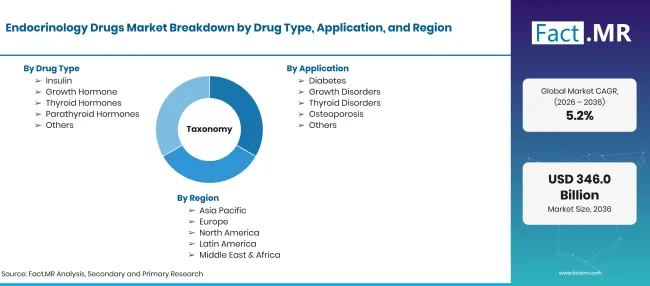
Endocrinology Drugs Market Taxonomy | Source: Fact.MR
| Attribute | Details |
|---|---|
| Quantitative Units | USD billion in 2026 to USD billion by 2036 at CAGR |
| Market Definition | Prescription medicines that replace, mimic or regulate hormones to treat diabetes, thyroid, growth, parathyroid and other endocrine disorders. |
| Drug Type | Insulin; Growth Hormone; Thyroid Hormones; Parathyroid Hormones; Others |
| Application | Diabetes; Growth Disorders; Thyroid Disorders; Osteoporosis; Others |
| Distribution Channel | Hospital Pharmacies; Retail Pharmacies; Online Pharmacies; Others |
| Regions Covered | North America; Latin America; Western Europe; Eastern Europe; East Asia; South Asia & Pacific; Middle East & Africa |
| Countries Covered | Germany; Brazil; United States; United Kingdom; Japan |
| Companies Profiled | Novo Nordisk; Eli Lilly and Company; Sanofi; AstraZeneca; Merck & Co.; Pfizer; AbbVie |
| Forecast Period | 2026 to 2036 |
| Approach | Prescription volume by disease and drug class, valued at manufacturer selling prices and checked against national prescribing statistics. |
Source: Fact.MR analysis. Updated Nov 3, 2026
How is the market segmented?
-
By Drug Type
- Insulin
- Growth Hormone
- Thyroid Hormones
- Parathyroid Hormones
- Others
-
By Application
- Diabetes
- Growth Disorders
- Thyroid Disorders
- Osteoporosis
- Others
-
By Distribution Channel
- Hospital Pharmacies
- Retail Pharmacies
- Online Pharmacies
- Others
-
By Region
- North America
- Latin America
- Western Europe
- Eastern Europe
- East Asia
- South Asia & Pacific
- Middle East & Africa
Frequently Asked Questions
How large is the endocrinology drugs market in 2026?
What growth rate will the endocrinology drugs market record?
Which drug type leads?
Which application leads?
Which distribution channel leads?
Which country will grow quickest?
Who are the main companies?
What holds the market back?
Who worked on this report


Preview the report firsthand - request a free sample
Free SampleGet the brochure for pricing and purchase details
Download PDF