- Market Value (2025): USD 1.79 Bn
- Estimated Value (2026): USD 1.91 Bn
- Forecast Value (2036): USD 3.56 Bn
- CAGR (2026-2036): 6.4%
What is the Automotive Displacement Sensor Market forecast to be worth by 2036?
USD 1.9 billion in 2026 to USD 3.6 billion by 2036, at a 6.42% CAGR.
- As per Fact.MR analysis, the automotive displacement sensor market reached USD 1.79 billion in 2025.
- Demand will increase from USD 1.91 billion in 2026 to USD 3.56 billion in 2036.
- The market is forecast to record a 6.4% CAGR during 2026 to 2036 as chassis electrification, brake-by-wire adoption, and active damping suspension systems expand sensor content per vehicle.
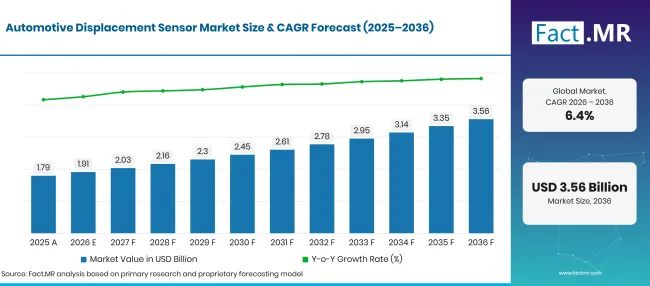
Factmr Automotive Displacement Sensor Market Forecast Global | Source: Fact.MR
| Year | Basis | Market Value (USD billion) |
|---|---|---|
| 2025 | Actual | 1.79 |
| 2026 | Estimate | 1.91 |
| 2036 | Forecast | 3.56 |
| CAGR 2026 to 2036 | Forecast period | 6.4% |
Source: Fact.MR analysis. Updated Oct 19, 2026
What are the defining numbers behind Automotive Displacement Sensor Market growth?
USD 1.7 billion absolute chance between 2026 and 2036, with inductive sensing architectures and passenger car production programs generating the primary revenue stream.
- Demand Drivers in the Market
- Vehicle dynamics engineers are widely adopting active suspension leveling and electronic continuous damping control to elevate ride comfort and aerodynamic efficiency. Advanced sensing evaluations demonstrated that over-coupled resonant inductive coils deliver high linear displacement sensitivity and superior signal-to-noise ratios across wide temperature spans [1]. Suspension designers integrate compact linear displacement transducers into shock absorber struts to monitor road irregularities in real time.
- Brake-by-wire and electromechanical pedal assemblies require redundant, non-contact position sensors to translate driver foot input into digital braking commands. Experimental testing on inductive displacement sensors utilizing dual-excitation coil structures confirmed that multi-channel differential outputs eliminate temperature drift and stray magnetic field interference [2]. Tier-one braking suppliers install dual-redundant inductive sensors inside brake actuators to comply with stringent ISO 26262 functional safety mandates.
- Transmission and electric axle designers specify high-resolution displacement sensors to monitor clutch pack travel, park-lock pawl engagement, and shift fork positions. Research on intelligent self-diagnostic algorithms for vehicular displacement sensors verified that real-time coil impedance monitoring detects internal winding degradation before mechanical sensor failure occurs [3]. Electric drive unit manufacturers utilize compact sensors to verify rotor axial positioning under dynamic acceleration torque.
- Powertrain electrification demands micro-displacement tracking to detect structural deformation and mechanical fatigue across battery pack enclosures and suspension link arms. Structural health monitoring research established that high-frequency displacement sensing can detect microscopic mechanical shifts and joint degradation in vehicular chassis components [4]. Commercial fleet operators deploy real-time displacement telemetry to implement predictive maintenance across heavy electric transport platforms.
- Key Segments Analyzed
- By Type: Inductive holds 35.2% share in 2026, preferred across under-the-hood and chassis environments for its immunity to oil, water, dust, and magnetic interference.
- By Application: Engine Management System accounts for 38.5% share in 2026, driven by continuous electronic throttle valve tracking, turbocharger actuator monitoring, and exhaust gas recirculation valve control.
- By Vehicle Type: Passenger Cars represents 58.6% share in 2026, propelled by high annual vehicle production volumes and rising sensor count in premium and mid-segment passenger models.
- By Sales Channel: OEM and Aftermarket accounts for 100.0% share in 2026, reflecting comprehensive factory-installed systems combined with vehicle lifecycle replacement parts.
- Analyst Opinion at Fact.MR
- Shambhu Nath Jha, Lead Consultant at Fact.MR, states, “The automotive displacement sensor market is experiencing a profound transition from legacy contact potentiometers toward fully integrated, contactless inductive and magnetic sensing silicon. Software-defined vehicles and x-by-wire chassis architectures demand ASIL-D certified position feedback with near-zero latency. Sensor manufacturers that integrate digital bus protocols like SENT and CAN-FD directly into compact, overmolded sensor packages will secure multi-year platform contracts with global automotive OEMs.”
- Strategic Implications
- Sensor manufacturers are transitioning from discrete PCB coil layouts to monolithic silicon-integrated inductive sensing ICs, drastically reducing sensor packaging dimensions. Design validations of ISO 26262 compliant inductive linear position sensors confirmed that integrated coil topologies provide excellent electromagnetic immunity and thermal robustness across automotive operating environments [5].
- Automotive tier-one suppliers are designing multi-axis integrated sensor clusters that measure both linear displacement and tilt angles within a single chassis housing. Engineering teams integrate transportation sensors into connected vehicle diagnostic gateways.
- Electric vehicle manufacturers are adopting contactless inductive sensors in steering columns and pedal modules to eliminate mechanical wear and warranty claims. Sourcing managers evaluate automotive magnetic sensor alternatives for non-contact rotary and linear stroke measurements.
- Foundries and sensor packagers are utilizing high-performance polyamides and fluorosilicone seals to overmold sensor coils, protecting delicate copper windings from corrosive road salt and automatic car wash pressure jets.
Germany is projected to lead global growth at a 7.93% CAGR, while Brazil advances at 7.25%, fueled by advanced chassis engineering and regional vehicle manufacturing expansion. The United States records a 6.55% CAGR, sustained by electric pickup truck platforms and commercial fleet automation. The United Kingdom achieves a 5.87% CAGR, supported by luxury automotive dynamics development and specialty sports car engineering. Japan registers a 5.17% CAGR, driven by hybrid vehicle transmission electronics and miniaturized sensor manufacturing.
How does the Automotive Displacement Sensor Market break down by segment?
Inductive 35.2%; Engine Management System 38.5%; Passenger Cars 58.6%; OEM and Aftermarket 100.0% in 2026.
Which Type dominates?
Inductive holds 35.2% share in 2026.
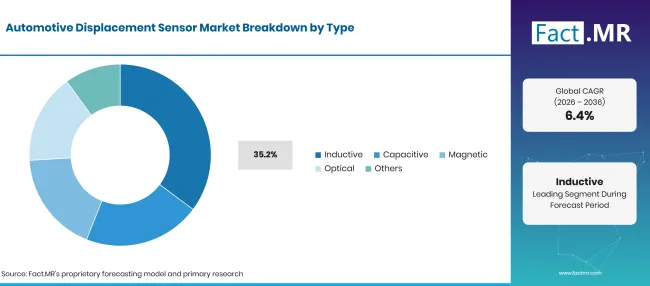
Factmr Automotive Displacement Sensor Market Breakdown Type | Source: Fact.MR
| Type | Share (2026) |
|---|---|
| Inductive (Leading segment) | 35.2% |
| Other segments combined | 64.8%* |
| Total | 100.0% |
Source: Fact.MR analysis. Updated Oct 19, 2026
Inductive displacement sensors command the leading market share due to their exceptional durability, high electromagnetic compatibility, and complete insensitivity to external magnetic fields and mechanical contamination. Automotive engineers deploy inductive sensors for critical throttle body position feedback, clutch actuator travel, and suspension height leveling. Capacitive sensors provide ultra-high micro-displacement resolution in laboratory test benches and specialized cabin climate controls. Magnetic Hall-effect and magnetoresistive sensors capture substantial volume across wheel speed detection and steering angle measurement. Optical sensors are selectively deployed in clean interior steering wheel optical encoders. Sourcing directors regularly benchmark intake air sensors including air flow sensors to optimize air-fuel ratio management. Chassis developers also incorporate precision tilt sensors to enhance electronic vehicle rollover stability systems.
What leads the Application segment?
Engine Management System accounts for 38.5% share in 2026.
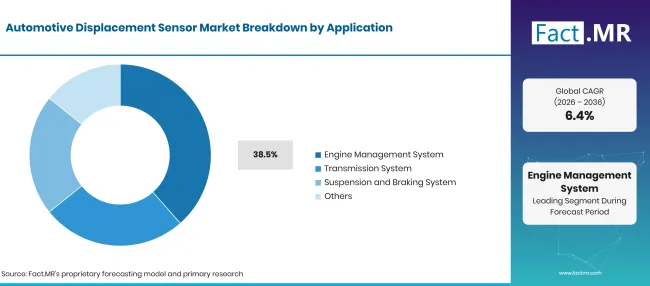
Factmr Automotive Displacement Sensor Market Breakdown Application | Source: Fact.MR
| Application | Share (2026) |
|---|---|
| Engine Management System (Leading segment) | 38.5% |
| Other segments combined | 61.5%* |
| Total | 100.0% |
Source: Fact.MR analysis. Updated Oct 19, 2026
Engine management systems represent the primary application sector, requiring high-precision linear and rotary displacement sensors to modulate electronic throttle plates, variable valve timing phasers, wastegate actuators, and exhaust recirculation valves. Precise valve stroke tracking ensures compliance with stringent international Stage VII and EPA emissions standards while maximizing fuel economy. Transmission systems represent a major application, utilizing linear displacement sensors to verify clutch engagement, dual-clutch transmission shift fork travel, and electric drive disconnect mechanisms. Suspension and braking systems represent the most rapidly expanding sector, driven by active electronic air suspension, active roll stabilization, and integrated brake-by-wire systems. Vehicle engineers install specialized chemical sensors to monitor fluid conditions alongside mechanical position sensors. Emission control teams also install gas sensors to monitor exhaust gas compositions.
How does Vehicle Type shape adoption?
Passenger Cars represents 58.6% share in 2026.
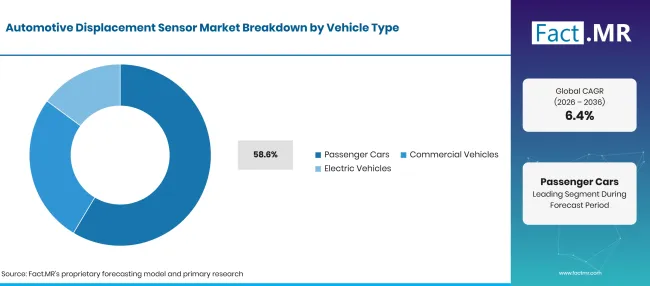
Factmr Automotive Displacement Sensor Market Breakdown Vehicle Type | Source: Fact.MR
| Vehicle Type | Share (2026) |
|---|---|
| Passenger Cars (Leading segment) | 58.6% |
| Other segments combined | 41.4%* |
| Total | 100.0% |
Source: Fact.MR analysis. Updated Oct 19, 2026
Passenger cars account for the largest share of displacement sensor consumption, driven by high global production volumes and the increasing penetration of advanced driver assistance systems and electronic chassis controls. Contemporary luxury and mid-segment passenger sedans and SUVs integrate up to a dozen displacement sensors across their suspension struts, electronic pedals, adaptive headlights, and tailgate actuators. Commercial vehicles, including heavy-duty trucks and urban buses, demand ruggedized displacement sensors to monitor air suspension leveling, fifth-wheel coupling, and pneumatic brake chambers under heavy payloads. Electric vehicles represent the fastest-growing subsegment, requiring specialized linear sensors to monitor high-voltage battery disconnect contacts, thermal expansion, and motor rotor position. Advanced inspection lines utilize 3d profile sensors to inspect stamped chassis components during vehicle assembly. Powertrain engineers procure dedicated automotive powertrain sensors to coordinate motor inverter switching.
What is accelerating Automotive Displacement Sensor Market adoption, and what is holding it back?
Electrification of vehicle chassis systems, adoption of steer-by-wire and brake-by-wire architectures, and expanding active suspension systems drive market growth. High unit development costs for ASIL-D certified sensor ICs, thermal drift calibration complexities in harsh engine compartments, and raw material price volatility for copper windings impede rapid adoption.
Drivers Impact Analysis
| DRIVER | (~) % IMPACT ON CAGR | GEOGRAPHIC RELEVANCE | IMPACT TIMELINE |
|---|---|---|---|
| Adoption of brake-by-wire and electromechanical pedals | +1.3% | Europe, East Asia, USA | Short term (<= 2 years) |
| Active air suspension and dynamic chassis leveling integration | +1.1% | Europe, North America | Short term (<= 2 years) |
| Functional safety requirements demanding redundant contactless sensing | +0.9% | Global | Medium term (2–4 years) |
| Transmission shift-by-wire and electric axle disconnect monitoring | +0.8% | East Asia, Europe | Medium term (2–4 years) |
| Proliferation of automated driving height and aerodynamic adjustments | +0.6% | Global | Long term (>= 4 years) |
Source: Fact.MR analysis. Updated Oct 19, 2026
Opportunity Impact Analysis
| OPPORTUNITY | (~) % IMPACT ON CAGR | GEOGRAPHIC RELEVANCE | IMPACT TIMELINE |
|---|---|---|---|
| Monolithic inductive sensor ICs integrating coils on silicon dies | +1.1% | Europe, USA | Short term (<= 2 years) |
| Real-time battery pack structural deflection and swell monitoring | +0.9% | East Asia, North America | Medium term (2–4 years) |
| Over-the-air sensor calibration and predictive fault telemetry | +0.7% | Global | Medium term (2–4 years) |
| Micro-displacement sensing in active aerodynamic spoiler wings | +0.5% | Europe, Japan | Long term (>= 4 years) |
Source: Fact.MR analysis. Updated Oct 19, 2026
Restraints Impact Analysis
| RESTRAINT | (~) % IMPACT ON CAGR | GEOGRAPHIC RELEVANCE | IMPACT TIMELINE |
|---|---|---|---|
| High cost of achieving ASIL-D dual-die silicon redundancy | -0.9% | Global | Short term (<= 2 years) |
| Extreme thermal cycling causing sensor housing micro-cracking | -0.7% | Global | Short term (<= 2 years) |
| Complex magnetic shielding required for high-voltage EV busbars | -0.6% | North America, Europe | Medium term (2–4 years) |
| Sensor supply chain bottlenecks for automotive-grade microcontrollers | -0.4% | East Asia, USA | Long term (>= 4 years) |
Source: Fact.MR analysis. Updated Oct 19, 2026
Which countries are scaling the Automotive Displacement Sensor Market through 2036?
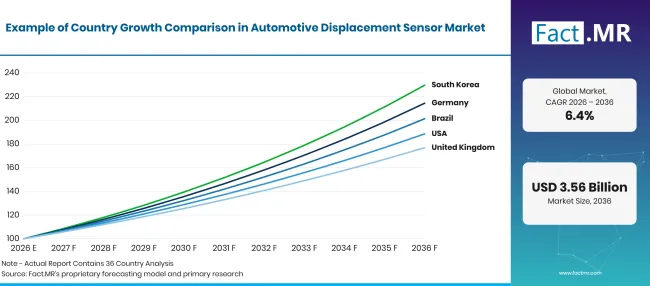
Factmr Automotive Displacement Sensor Market Growth Index | Source: Fact.MR
| Country | CAGR (2026–2036) |
|---|---|
| Germany | 7.93% |
| Brazil | 7.25% |
| USA | 6.55% |
| UK | 5.87% |
| Japan | 5.17% |
Source: Fact.MR analysis. Updated Oct 19, 2026
Why is Germany leading European sensor adoption?
7.93% CAGR, driven by premium automotive engineering, early deployment of active suspension systems, and strict functional safety standards.
German premium automakers and tier-one chassis suppliers in Baden-Württemberg and Bavaria are pioneering the deployment of intelligent active suspension systems that utilize high-speed linear displacement sensors to scan and counteract road bumps. German vehicle dynamics engineers specify inductive displacement sensors across electronic braking pedals and multi-chamber air springs to deliver unparalleled handling precision. Germany's semiconductor suppliers lead the development of automotive-qualified inductive sensing integrated circuits that combine sensing coils, signal processing, and SENT protocol output on a single substrate.
How is Brazil expanding its automotive displacement sensor demand?
7.25% CAGR, propelled by flex-fuel engine management upgrades, regional commercial truck production, and chassis modernization.
Brazil's automotive assembly operations in São Paulo and Paraná are upgrading flex-fuel engine management architectures to satisfy Proconve emissions standards, requiring precise throttle body and intake valve displacement feedback. Commercial truck manufacturers in Brazil install heavy-duty suspension height sensors on commercial tractors and multi-axle trailers to optimize load distribution across rural road networks. Expanding local production of passenger cars equipped with stability control and electronic braking assists drives steady component procurement from regional tier-one electronics distributors.
What factors sustain massive volume procurement across the United States?
6.55% CAGR, supported by electric pickup truck platform development, heavy commercial vehicle production, and autonomous testing programs.
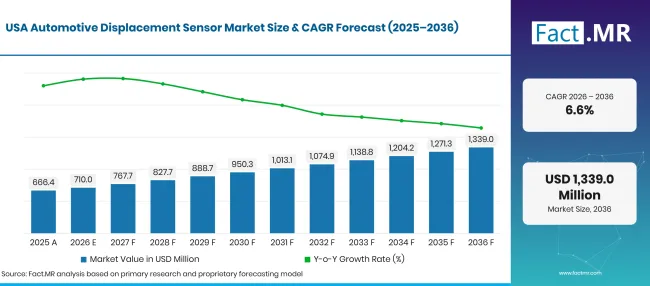
Factmr Automotive Displacement Sensor Market Forecast Usa | Source: Fact.MR
The United States represents a massive market for automotive displacement sensors, fueled by the rapid engineering of electric pickup trucks and commercial utility vehicles that incorporate adaptive air suspensions for towing and off-road clearance. American automotive manufacturers procure multi-channel inductive displacement sensors to ensure brake-by-wire redundancy in high-torque electric platforms. Tier-one suppliers in Michigan and Ohio continuously partner with semiconductor innovators to integrate wireless sensor telemetry and over-the-air diagnostic calibration.
Why does the United Kingdom maintain active sensor development?
5.87% CAGR, backed by luxury automotive chassis development, electric sports car engineering, and motorsport telemetry research.
British luxury sports car builders and high-performance automotive design studios in the West Midlands demand bespoke linear displacement sensors to monitor dynamic suspension travel, ride height aerodynamics, and steering geometry under high-speed cornering loads. UK engineering centers collaborate with specialized sensor innovators to develop ultra-lightweight carbon-composite sensor housings that withstand the demanding vibrations of electrified performance drivetrains.
How does Japan maintain leadership in precision automotive sensors?
5.17% CAGR, steered by hybrid powertrain dominance, miniaturized sensor manufacturing, and advanced robotics assembly.
Japanese automotive giants and electronic component manufacturers excel in the high-volume production of ultra-reliable, compact displacement sensors for hybrid electric powertrains and continuously variable transmissions. Japanese engineering teams emphasize continuous cost reduction and manufacturing perfection, producing millions of inductive and magnetic stroke sensors with near-zero defect rates. Japanese automotive OEMs also deploy displacement sensors in steer-by-wire systems and compact active suspension modules designed for urban mobility vehicles.
Who leads the Automotive Displacement Sensor Market?
Bosch Sensortec GmbH and Robert Bosch maintain global leadership in automotive sensing technology, manufacturing high-precision inductive and microelectromechanical displacement sensors for engine management and chassis dynamics. Honeywell International Inc. delivers ruggedized linear and rotary displacement transducers engineered for heavy-duty commercial vehicles and specialized off-highway equipment. TE Connectivity Ltd. provides an extensive portfolio of non-contact inductive position sensors and sensor packages tailored for harsh automotive chassis environments.
Infineon Technologies AG and STMicroelectronics N.V. design leading-edge magnetic and inductive sensing ICs that combine signal conditioning, digital bus communication, and ASIL-D safety logic. Texas Instruments Incorporated and NXP Semiconductors N.V. supply advanced microcontroller-integrated inductive sensing front-ends for automotive pedal and steering applications. Continental AG, Analog Devices Inc., and Sensata Technologies Holding plc deliver complete sensor assemblies for braking systems, suspension leveling, and transmission gear position tracking. System architects frequently deploy automotive radar sensors alongside chassis position sensors to anticipate road contours. Battery pack engineers also integrate dedicated battery sensor modules to monitor pack health.
Which companies are the key providers?
Key companies include Bosch Sensortec GmbH; Honeywell International Inc.; TE Connectivity Ltd.; Infineon Technologies AG; STMicroelectronics N.V.; Texas Instruments Incorporated; NXP Semiconductors N.V.; Continental AG; Analog Devices Inc.; and Sensata Technologies Holding plc.
- Bosch Sensortec GmbH
- Honeywell International Inc.
- TE Connectivity Ltd.
- Infineon Technologies AG
- STMicroelectronics N.V.
- Texas Instruments Incorporated
- NXP Semiconductors N.V.
- Continental AG
- Analog Devices Inc.
- Sensata Technologies Holding plc
Bibliography
- [1] PMC. (2025, March 14). Displacement sensing in over-coupled resonant inductors for automotive position tracking. PMC11953188.
- [2] PMC. (2025, April 05). Inductive displacement sensor with dual-excitation coils for high-precision stroke measurement. PMC12117565.
- [3] PMC. (2024, May 19). Self-diagnostic methods and degradation monitoring for automotive displacement sensors. PMC11055168.
- [4] PMC. (2025, March 28). Vehicular micro-displacement condition monitoring for chassis structural health tracking. PMC13350874.
- [5] PMC. (2024, January 25). Design and validation of an ISO 26262 compliant inductive linear position sensor for automotive chassis. PMC9824747.
This Report Answers
- The report evaluates technology adoption and cost-performance trade-offs across inductive, magnetic, and capacitive automotive displacement sensors.
- Application assessments detail why active suspension systems and brake-by-wire pedals represent the fastest-growing sensor demand drivers.
- Country-level analysis investigates the automotive engineering initiatives enabling Germany and Brazil to lead regional adoption rates.
- Electromagnetic compatibility evaluations examine how contactless inductive sensors achieve immunity to high-voltage electric vehicle noise.
- Competitive profiling benchmarks ASIL-D safety compliance, silicon integration levels, and tier-one OEM partnerships across top sensor manufacturers.
What does the Automotive Displacement Sensor Market cover?
The market encompasses commercial shipments of electronic displacement and position sensors engineered specifically for integration into automotive systems. It tracks sensors deployed across passenger cars, light commercial vans, heavy commercial trucks, and battery electric vehicles to monitor engine throttles, transmission shift forks, active suspension struts, steering racks, and electronic brake pedals. The analysis evaluates revenue generation across factory OEM assembly lines and the replacement automotive aftermarket.
What is included in the scope?
The scope covers merchant shipments of completed displacement sensor modules, packaged sensor ICs, and custom-coiled inductive transducers sold directly to vehicle manufacturers and tier-one system integrators. Revenues reflect transaction pricing recognized by sensor manufacturers and authorized automotive semiconductor distributors. Integrated electronic control interfaces and digital bus transceivers (SENT, PSI5, CAN) are fully evaluated within the market revenue boundaries.
What is excluded from the scope?
The scope excludes non-automotive industrial displacement sensors used in factory automation, civil infrastructure testing, or aerospace flight controls. Bare unprocessed printed circuit boards, generic discrete resistors, and passive wiring harnesses sold without integrated sensing elements are excluded from sensor totals. Vehicle assembly robotics, chassis dyno test benches, and collision repair tools are outside the scope of this component report.
How Was the Analysis Built?
The analysis draws on 120+ sources, 35+ company portfolios, 25+ countries, and more than 20 industry interviews.
- Primary Research: Primary research includes discussions with manufacturers, service providers, technology developers, distributors, end users, and subject-matter experts. These conversations examine purchasing priorities, product adoption, operational challenges, approval requirements, competitive positioning, and the factors that influence wider market acceptance.
- Desk Research: Desk research covers government statistics, regulatory publications, company filings, trade data, technical studies, industry associations, standards, public policy, and other authoritative sources. Every source used in the analysis is documented in the bibliography.
- Market Sizing and Forecasting: Market estimates combine historical performance, demand indicators, pricing and volume trends, segment shares, company participation, country-level growth, adoption patterns, investment activity, and barriers to market expansion.
- Data Validation and Update Cycle: Findings are validated by comparing primary interviews with public data, company activity, regulatory changes, trade patterns, and industry developments. Regular updates review new product launches, capacity changes, partnerships, approvals, and shifts in commercial adoption.
Segmentation
What is the report’s scope and coverage?
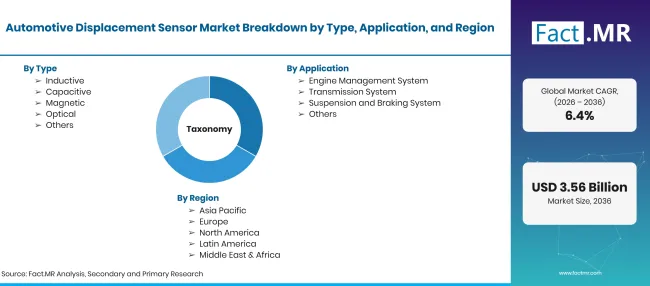
Factmr Automotive Displacement Sensor Market Taxonomy | Source: Fact.MR
| Attribute | Details |
|---|---|
| Quantitative Units | USD billion in 2026 to USD billion by 2036 at 6.42% CAGR |
| Market Definition | Contactless and contact-based vehicular sensing devices including inductive, capacitive, magnetic, and optical sensors designed to measure linear stroke, angular position, and mechanical clearance in automotive systems. |
| Type | Inductive; Capacitive; Magnetic; Optical; Others |
| Application | Engine Management System; Transmission System; Suspension and Braking System; Others |
| Vehicle Type | Passenger Cars; Commercial Vehicles; Electric Vehicles |
| Sales Channel | OEM and Aftermarket |
| Regions Covered | North America; Latin America; Western Europe; Eastern Europe; East Asia; South Asia & Pacific; Middle East & Africa |
| Countries Covered | Germany; Brazil; USA; UK; Japan |
| Companies Profiled | Bosch Sensortec GmbH; Honeywell International Inc.; TE Connectivity Ltd.; Infineon Technologies AG; STMicroelectronics N.V.; Texas Instruments Incorporated; NXP Semiconductors N.V.; Continental AG; Analog Devices Inc.; Sensata Technologies Holding plc |
| Forecast Period | 2026 to 2036 |
| Approach | Primary interviews with automotive tier-one sensor architects, chassis dynamics engineers, powertrain electronics managers, and semiconductor distributors combined with global vehicle production datasets |
Source: Fact.MR analysis. Updated Oct 19, 2026
How is the market segmented?
-
By Type
- Inductive
- Capacitive
- Magnetic
- Optical
- Others
-
By Application
- Engine Management System
- Transmission System
- Suspension and Braking System
- Others
-
By Vehicle Type
- Passenger Cars
- Commercial Vehicles
- Electric Vehicles
-
By Sales Channel
- OEM and Aftermarket
-
By Region
- North America
- Latin America
- Western Europe
- Eastern Europe
- East Asia
- South Asia & Pacific
- Middle East & Africa
Frequently Asked Questions
How big is the automotive displacement sensor market in 2026?
What is the CAGR from 2026 to 2036?
Which type leads?
Which application leads?
Which companies participate in automotive displacement sensors?
Who worked on this report


Preview the report firsthand - request a free sample
Free SampleGet the brochure for pricing and purchase details
Download PDF