- Market Value (2025): USD 210.5 Mn
- Estimated Value (2026): USD 226.7 Mn
- Forecast Value (2036): USD 476.0 Mn
- CAGR (2026-2036): 7.7%
What is the Hexapods Market forecast to be worth by 2036?
USD 226.7 million in 2026 to USD 476.0 million by 2036, at a 7.7% CAGR.
- The hexapods market was valued at USD 210.5 million in 2025.
- Demand is projected to increase from USD 226.7 million in 2026 to USD 476.0 million in 2036.
- The market is projected to grow at a 7.7% CAGR from 2026 to 2036, supported by spending on optical measurement, equipment qualification and precision production.
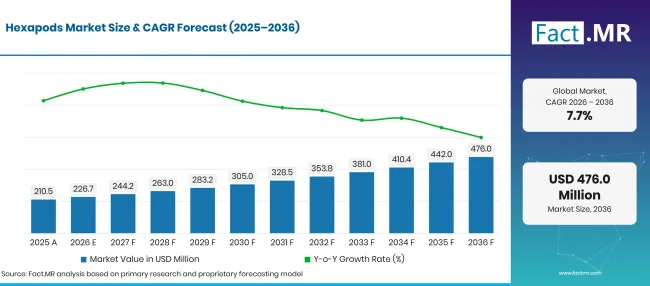
Hexapods Market Forecast Global | Source: Fact.MR
| Year | Basis | Market Value (USD million) |
|---|---|---|
| 2025 | Actual | 210.5 |
| 2026 | Estimate | 226.7 |
| 2036 | Forecast | 476.0 |
| CAGR 2026 to 2036 | Forecast period | 7.7% |
Source: Fact.MR analysis. Updated Oct 27, 2026
What are the defining numbers behind Hexapods Market growth?
Revenue is expected to grow by $249.3 million through 2036, driven by two distinct groups of customers: instrument makers who need precision in tight spaces, and test facilities that need high strength and speed. In both markets, buyers do not simply choose the equipment with the highest technical specs on paper. Instead, they pay a premium for guaranteed reliability, because the cost of equipment failure is far too high. Ultimately, these customers are spending money to minimize risk.
- Demand Drivers in the Market
- A 2026 DLR investigation used an external interferometer to detect positioning inaccuracies in a hexapod used for spacecraft-related experiments. [1] That finding makes an important procurement point: the platform's own feedback is not always sufficient proof of where the payload sits. Customers working at tight tolerances may need an independent reference, adding a measurable demand link to industrial metrology and installation-stage verification.
- NASA compared four motion conditions in a 2026 study of simulated electric-aircraft approaches and landings; two used different hexapod motion envelopes. [4] The study shifts the question for flight simulators away from 'how much motion can the platform produce?' towards 'which motion is relevant to the training task?' Motion fidelity has to be evaluated alongside visuals and control response, rather than bought as an isolated specification.
- At the Canadian Light Source, a vacuum-compatible hexapod and new data-acquisition software expanded a beamline's spectromicroscopy capability. [3] This is a clearer indication of retrofit demand than general claims about precision equipment growth. Existing facilities will purchase positioning hardware when it enables a defined measurement upgrade, and that can make integration with acquisition and motion control software as important as the platform itself.
- Industrial programmes present a tougher test of repeat demand than a successful research demonstration. The actuators, feedback system and duty-cycle settings must work through repeated operations, and a production team must be able to recover from a fault without calling the original developer. Suppliers that turn a one-off qualification into an installation standard have a more credible path to multiple-station orders.
- Key Segments Analyzed
- In 2026, Parallel Hexapods lead the product market by generating 62.4% of total revenue. This strong position is driven by the need for equipment that provides coordinated movement in heavily restricted, tightly integrated spaces.
- Within specific applications, the aerospace sector accounts for 28.3% of revenue. This demand is fueled by alignment, qualification, and simulation programs that all require advanced motion capabilities, even though they test against different operating conditions.
- Looking at the overall customer base, industrial buyers make up the majority at 56.2% of revenue. For these large-scale users, purchasing decisions are primarily driven by the need to ensure consistent, reproducible results across different work shifts and equipment stations.
- Analyst Opinion at Fact.MR
- Shambhu Nath Jha, Lead Consultant, Fact.MR
- For a customer, the true cost of a hexapod becomes clear during setup. Even a highly precise platform falls short if physical parts shift, coordinates are unclear, or the software takes months to figure out. On the flip side, a system that integrates smoothly is worth a higher upfront price because it protects expensive measurement and production processes. A supplier's advantage comes from proving their equipment works in real-world conditions and applying that experience to future projects. While research labs might tolerate complex, custom setups, manufacturers need strict reliability. Ultimately, turning specialized engineering into a consistent, dependable product is much more important than simply pushing for better technical specs on paper.
- Strategic Implications
- Write acceptance tests around the customer's actual payload and working position. Fixture stiffness, cable forces and the reachable motion envelope can change the result materially. An unloaded factory demonstration is a weak substitute for a test that resembles the installed operation.
- Standardise the interface once a configuration has been qualified. Reusing the same control functions and diagnostics across stations cuts recurring integration work and makes failures easier for plant engineers to resolve. That matters to repeat orders more than a long list of optional functions.
- Retrofitting an instrument is a different business from supplying a new machine. Space, vacuum connections and acquisition software are already fixed, and changes can interrupt a valuable facility. Suppliers able to work within those constraints can win technically demanding orders without depending on a major new-build programme.
- Match the service agreement to downtime exposure. Planned maintenance may be acceptable at a research facility; a production station usually needs a known recovery route and replacement parts. For buyers, support obligations belong in the commercial comparison, not in an appendix after the equipment price.
Germany posts the fastest CAGR in the five-country comparison. The United States, by contrast, starts from a substantial established revenue base. Research installations in these markets place a premium on specialist application knowledge, while repeat industrial orders place more weight on commissioning and service consistency. In Brazil, the economics of securing integration support can be the deciding factor.
How does the Hexapods Market break down by segment?
Parallel Hexapods 62.4%; Aerospace 28.3%; Industrial 56.2% in 2026.
Why do parallel hexapods retain the larger commercial position?
The Parallel Hexapods segment leads Product Type with a 62.4% revenue share in 2026.
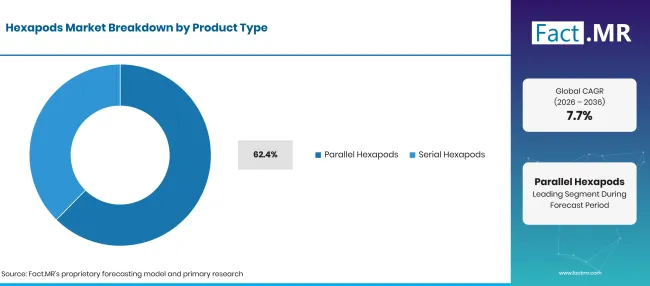
Hexapods Market Breakdown Product Type | Source: Fact.MR
| Product Type | Share (2026) |
|---|---|
| Parallel Hexapods (Leading segment) | 62.4% |
| Other segments combined | 37.6% |
| Total | 100.0% |
Source: Fact.MR analysis. Updated Oct 27, 2026
Parallel Hexapods hold the largest product share because they can perform several positioning adjustments within a single coordinated assembly. That makes them attractive for integrated instruments, but it does not settle the equipment selection. Working-point geometry and usable travel vary sharply between applications, and those differences determine whether a nominally capable model can be installed without extensive redesign. The range within this segment is commercially significant. An optical stage and a loaded test rig do not purchase the same combination of stiffness, speed and access. Buyers therefore seek a demonstrated performance envelope with the intended fixture attached. Suppliers that document those boundaries clearly are better placed to turn a first installation into a repeat order.
What makes aerospace a high-value application for hexapods?
The Aerospace segment leads Application with a 28.3% revenue share in 2026.
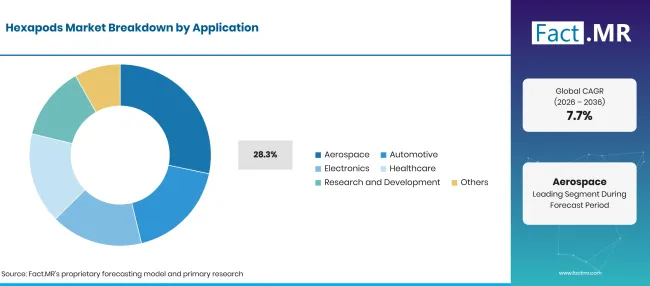
Hexapods Market Breakdown Application | Source: Fact.MR
| Application | Share (2026) |
|---|---|
| Aerospace (Leading segment) | 28.3% |
| Other segments combined | 71.7% |
| Total | 100.0% |
Source: Fact.MR analysis. Updated Oct 27, 2026
Aerospace is the largest application segment because qualification and testing place a high cost on uncertain results. The purchase may support optical alignment, a test facility or motion simulation, but the common requirement is credible, reproducible conditions. Procurement teams are paying for evidence that the equipment can support the specified test, not simply for movement across six axes. Orders can be uneven: test facilities and qualification programmes buy against particular development schedules. Once an installation is accepted, changing the motion platform may trigger another validation process. That gives compatible controls, service continuity and targeted upgrades commercial value between larger equipment purchases.
Why does industrial use create the largest end-user demand?
The Industrial segment leads End-User with a 56.2% revenue share in 2026.
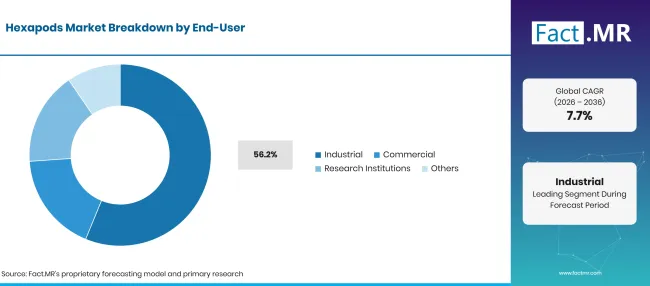
Hexapods Market Breakdown End User | Source: Fact.MR
| End-User | Share (2026) |
|---|---|
| Industrial (Leading segment) | 56.2% |
| Other segments combined | 43.8% |
| Total | 100.0% |
Source: Fact.MR analysis. Updated Oct 27, 2026
Industrial buyers judge a platform through accepted output and lost operating time. Cycle-to-cycle stability, access for maintenance and communications with the surrounding machine matter at least as much as the highest claimed precision. Equipment that requires regular manual intervention is difficult to scale across a production line, even if its peak performance is impressive. Research users are more likely to accommodate operator adjustments as experiments change. A factory usually wants a fixed operating window, known limits and a service procedure that another shift can follow. Suppliers that simplify a research-grade arrangement for production can capture recurring orders without having to redesign the underlying motion system each time.
What determines whether a precision demonstration becomes a repeat installation?
The gap between demonstration and deployment is often filled with unpriced engineering. Reference frames must be agreed, fixtures secured and motions synchronised with the host machine. Each handoff introduces an opportunity for error. Vendors that make these responsibilities explicit early are more likely to meet acceptance dates and preserve the economics of repeat installations.
More capability is not always a better commercial answer. Extra travel and payload capacity can increase size, integration effort and qualification time without improving the actual task. Buyers increasingly have reason to compare the cost of proving a configuration as carefully as the platform price, particularly in existing instruments.
Drivers Impact Analysis
| DRIVER | (~) % IMPACT ON CAGR | GEOGRAPHIC RELEVANCE | IMPACT TIMELINE |
|---|---|---|---|
| Aerospace instrument alignment and qualification work | +0.9% | United States, Germany, United Kingdom | 2026 to 2030 |
| Optical inspection requiring coordinated positioning | +0.6% | Japan, Germany, United States | 2026 to 2032 |
| Repeat industrial deployment of validated positioning modules | +0.8% | Europe, North America, East Asia | 2028 to 2036 |
| Scientific instrument upgrades requiring sample alignment | +0.4% | Europe, Americas, East Asia | 2026 to 2031 |
| Physical motion requirements in simulation systems | +0.3% | United States, Europe, Japan | 2027 to 2033 |
Source: Fact.MR analysis. Updated Oct 27, 2026
Opportunity Impact Analysis
| OPPORTUNITY | (~) % IMPACT ON CAGR | GEOGRAPHIC RELEVANCE | IMPACT TIMELINE |
|---|---|---|---|
| External metrology integrated with platform acceptance | +0.5% | Germany, United States, Japan | 2027 to 2032 |
| Control and software upgrades for existing instruments | +0.3% | Europe, North America | 2026 to 2030 |
| Standardised fixtures for repeat production applications | +0.6% | East Asia, Europe, North America | 2028 to 2036 |
| Local commissioning and service capability | +0.2% | Brazil and other developing industrial markets | 2027 to 2033 |
Source: Fact.MR analysis. Updated Oct 27, 2026
Restraints Impact Analysis
| RESTRAINT | (~) % IMPACT ON CAGR | GEOGRAPHIC RELEVANCE | IMPACT TIMELINE |
|---|---|---|---|
| Lengthy acceptance and qualification of new configurations | -0.7% | Global | 2026 to 2032 |
| Integration expense in established equipment | -0.5% | Europe, North America, Japan | 2026 to 2030 |
| Application limits from payload and available travel | -0.3% | Global | 2026 to 2036 |
| Project scheduling and concentrated capital expenditure | -0.4% | Aerospace and research markets worldwide | 2027 to 2034 |
Source: Fact.MR analysis. Updated Oct 27, 2026
Which countries are scaling the Hexapods Market through 2036?
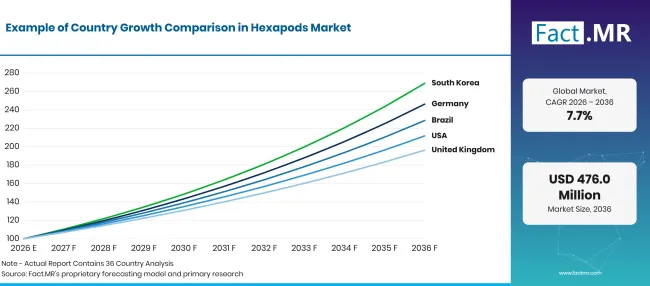
Hexapods Market Growth Index | Source: Fact.MR
| Country | CAGR (2026 to 2036) |
|---|---|
| Germany | 9.4% |
| Brazil | 8.6% |
| United States | 7.8% |
| United Kingdom | 7.0% |
| Japan | 6.2% |
Source: Fact.MR analysis. Updated Oct 27, 2026
How can German suppliers capture value beyond the positioning platform?
In Germany, where the market is projected to grow at a 9.4% CAGR from 2026 to 2036,
suppliers capture value by looking beyond the hardware to address environmental conditions and measurement uncertainty. For example, a German Aerospace Center (DLR) evaluation in air and vacuum found that temperature-related structural shifts were a primary cause of signal noise in its reference instrument. Because of this, German buyers focus on identifying the exact source of a positioning error before investing. They will not pay for higher precision in isolation if the real issue lies in the surrounding environment or fixtures. Instead, suppliers win business by offering concrete tolerances, dependable configurations, and added services like calibration and system testing after installation.
What would make a specialised hexapod investment easier to justify in Brazil?
In Brazil, projected to grow at an 8.6% CAGR from 2026 to 2036,
justifying a specialized hexapod investment depends on having a practical installation and service plan. Growth here is not driven by widespread adoption of the most expensive systems, but by targeted projects with clear testing or production goals. Because the true cost of a system includes fixtures, software, and technical support, these elements often determine whether a purchase stays within budget and becomes a functional asset. Having local support for integration, calibration, and replacement parts makes repeat orders much more attractive. When buyers know how a stalled system will be quickly restarted, they are far more likely to commit to long-term programs rather than one-off trials.
Why does simulator fidelity matter for the United States opportunity?
In the United States, where the market is set to grow at a 7.8% CAGR from 2026 to 2036,
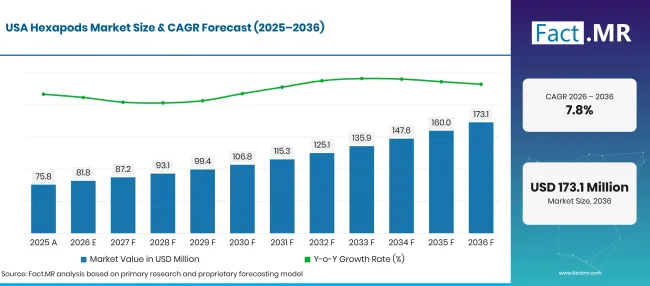
Hexapods Market Forecast Usa | Source: Fact.MR
simulator fidelity is a key driver because physical motion remains vital even as visual technologies advance. A NASA study of eleven pilots showed that simulator motion directly impacted results like landing accuracy and motion sickness. This gives U.S. buyers a practical, task-specific reason to invest in motion accuracy rather than relying on generic hardware specs, as each training program must pinpoint the exact physical cues it needs to replicate. Consequently, the sale goes beyond the motion base itself: the mechanical movement must sync seamlessly with visuals and controls. Suppliers who provide a proven simulator setup that can be reused for future training will see much stronger recurring business than those offering one-off demonstrations.
How does instrument renewal support the United Kingdom market?
In the United Kingdom, which is expected to see a 7.0% CAGR from 2026 to 2036,
market growth is supported by upgrading existing research equipment for specialized alignment tasks. A clear example is the Diamond Light Source facility, which uses a hexapod for offline alignment in an upgraded X-ray instrument. Here, spending is tied to a specific procedure rather than a general desire for higher precision, proving that success depends on the entire alignment process rather than just the platform. For these upgrades, specialized installation is just as important as the hardware. Because the hexapod must fit into existing layouts, access points, and workflows, standard installation packages rarely work. Even if an order only involves a few units, the complex engineering required to integrate them can build lucrative, long-term relationships for specialized suppliers.
Where can Japanese buyers find a repeatable production case?
In Japan, projected to grow at a 6.2% CAGR from 2026 to 2036,
buyers find value when compact positioning systems fit seamlessly into the broader pace of optical, electronics, and precision manufacturing. A faster or more accurate hexapod only pays off if the surrounding measurement, handling, and release steps can keep up, meaning buyers evaluate the entire assembly or inspection cycle rather than an isolated movement demo. Compact designs and reliable, repeatable positioning carry the most weight in this market. A prototype design holds much greater commercial appeal when everyday operators can run and maintain it consistently on the factory floor. This creates a strong opportunity for suppliers who can deliver high precision through standardized, repeatable setups rather than turning every installation into a custom engineering project.
Who leads the Hexapods Market?
There is no single "best" hexapod because every job has different physical limits. An optical lab needs rock-solid stability in a tight space, while a flight simulator needs a wide range of fast, heavy-duty motion. Because of this, suppliers can't win just by quoting the highest resolution on a spec sheet. They have to prove their machine actually works with the buyer's specific payload and software.
The real test of a supplier happens after the sale. Buyers need easy troubleshooting, reliable software updates, and quick access to replacement parts. A supplier doing a complex, custom installation can charge a premium for their engineering expertise. But a factory buying multiple identical machines just wants a standard, repeatable product with solid everyday support. Since the companies below focus on different niches, they should be judged by how well they solve your specific problem, rather than by a generic side-by-side comparison of their brochures.
Which companies are the key providers?
- Physik Instrumente (PI) GmbH & Co. KG
- Aerotech Inc.
- MKS Instruments Inc.
- Thorlabs Inc.
- Mikrolar Inc.
- SmarAct GmbH
- Symétrie
- ALIO Industries
- E2M Technologies B.V.
- FlexHex Robot
Bibliography
- [1] Germano, E., Mandel, O., Sell, A., Weise, D., & Braxmaier, C. (2026). Compact laser interferometer for dynamic nanometer-level ranging. Applied Optics, 65(4), 1174–1180.
- [2] Meng, Q., Wang, H., Garvey, B., Hooper, M., Howell, A., Jones, K., Larkin, P., Majhi, A., Malandain, A., Peach, A., Tran, X., Wilkin, G., Winter, D., & Sawhney, K. (2026). High-precision alignment of an upgraded soft X-ray polarimeter at Diamond Light Source. In Proceedings of the 13th International Conference on Mechanical Engineering Design of Synchrotron Radiation Equipment and Instrumentation (MEDSI 2025) (pp. 75–78). JACoW Publishing.
- [3] Pedersen, T., Dynes, J., LeBlanc, S., & Regier, T. (2026). Optimizing SGM beamline performance: Hexapod and spectroscopy enhancements. In Proceedings of the 13th International Conference on Mechanical Engineering Design of Synchrotron Radiation Equipment and Instrumentation (MEDSI 2025) (pp. 90–92). JACoW Publishing.
- [4] Zaal, P. M. T., Blanken, M. L., Orth, S. P., Penmetcha, S. V., & Slade, P. (2026, January 12–16). Effects of motion fidelity on pilot performance using mixed-reality visuals [Conference paper]. AIAA SciTech Forum 2026, Orlando, FL, United States. NASA Technical Reports Server.
This Report Answers
- Which positioning requirements make Parallel Hexapods the leading product category?
- How do aerospace qualification and simulation needs influence equipment selection?
- Where can instrument upgrades create opportunities beyond new installations?
- How do industrial buyers assess integration, repeatability and service?
- Which commercial priorities distinguish the five profiled country markets?
What does the Hexapods Market cover?
This report examines the global Hexapods Market through its product categories, applications and end users. It considers how accuracy, payload conditions, useful travel and integration influence purchasing decisions. Country analysis covers Germany, Brazil, the United States, the United Kingdom and Japan. The competitive assessment addresses specification, qualification and continued support, while the forecast considers both new installations and opportunities to improve existing equipment. Research and simulation examples illustrate technical use cases without being treated as measurements of market sales.
What is included in the scope?
Included scope comprises sales of hexapod positioning and motion systems within the stated product categories, with dedicated controls forming part of the system offer. Applications cover Aerospace, Automotive, Electronics, Healthcare, Research and Development, and Others. End-user coverage includes Industrial, Commercial, Research Institutions, and Others. The commercial analysis addresses equipment selection, application integration, qualification, replacement and upgrade opportunities where these relate directly to the hexapod system.
What is excluded from the scope?
The report excludes insects and biological research on Hexapoda, six-legged walking robots, and general robotics equipment without a hexapod positioning or motion function. Revenue from entire aircraft, vehicles, semiconductor tools, scientific facilities or simulation services is outside the equipment boundary. Standalone metrology instruments and general-purpose actuators are discussed only as related capabilities; their wider market revenues are not included in the hexapod valuation.
How Was the Analysis Built?
The analysis draws on 120+ sources, 35+ company portfolios, 25+ countries, and more than 20 industry interviews.
- Primary Research: Primary research includes discussions with manufacturers, service providers, technology developers, distributors, end users, and subject-matter experts. These conversations examine purchasing priorities, product adoption, operational challenges, approval requirements, competitive positioning, and the factors that influence wider market acceptance.
- Desk Research: Desk research covers government statistics, regulatory publications, company filings, trade data, technical studies, industry associations, standards, public policy, and other authoritative sources. Every source used in the analysis is documented in the bibliography.
- Market Sizing and Forecasting: Market estimates combine historical performance, demand indicators, pricing and volume trends, segment shares, company participation, country-level growth, adoption patterns, investment activity, and barriers to market expansion.
- Data Validation and Update Cycle: Findings are validated by comparing primary interviews with public data, company activity, regulatory changes, trade patterns, and industry developments. Regular updates review new product launches, capacity changes, partnerships, approvals, and shifts in commercial adoption.
Segmentation
What is the report’s scope and coverage?
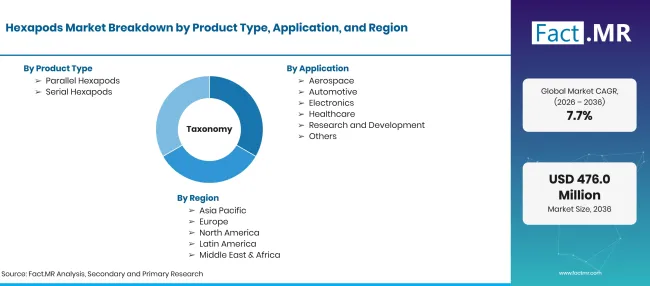
Hexapods Market Taxonomy | Source: Fact.MR
| Attribute | Details |
|---|---|
| Industry Classification | Industrial |
| Quantitative Units | USD million; revenue share and CAGR in percentages |
| Market Definition | The Hexapods Market covers engineered positioning and motion systems sold for industrial, commercial and research applications. It includes platforms used to orient components, instruments or test payloads, together with their dedicated control capability. The scope follows the Product Type, Application and End-User categories and distinguishes the equipment's sales value from the revenue of the larger machines or facilities in which it operates. |
| Product Type | Parallel Hexapods; Serial Hexapods |
| Application | Aerospace; Automotive; Electronics; Healthcare; Research and Development; Others |
| End-User | Industrial; Commercial; Research Institutions; Others |
| Regions Covered | North America; Latin America; Western Europe; Eastern Europe; East Asia; South Asia & Pacific; Middle East & Africa |
| Countries Covered | Germany; Brazil; United States; United Kingdom; Japan |
| Companies Profiled | Physik Instrumente (PI) GmbH & Co. KG; Aerotech Inc.; MKS Instruments Inc.; Thorlabs Inc.; Mikrolar Inc.; SmarAct GmbH; Symétrie; ALIO Industries; E2M Technologies B.V.; FlexHex Robot |
| Forecast Period | 2026 to 2036; base year 2026; historical year 2025 |
| Approach | The analysis considers positioning requirements, equipment integration, qualification cycles and repeat deployment across the application categories, with attention to the relationship between technical capability and the customer's practical operating needs. |
Source: Fact.MR analysis. Updated Oct 27, 2026
How is the market segmented?
-
By Product Type
- Parallel Hexapods
- Serial Hexapods
-
By Application
- Aerospace
- Automotive
- Electronics
- Healthcare
- Research and Development
- Others
-
By End-User
- Industrial
- Commercial
- Research Institutions
- Others
-
By Region
- North America
- Latin America
- Western Europe
- Eastern Europe
- East Asia
- South Asia & Pacific
- Middle East & Africa
Frequently Asked Questions
How large is the hexapods market?
What is the projected growth rate?
Which product category leads the Hexapods Market?
Which application and end-user categories hold the largest shares?
Does this report include six-legged walking robots?
Who worked on this report


Preview the report firsthand - request a free sample
Free SampleGet the brochure for pricing and purchase details
Download PDF