- Base Value(2025): 64.85 Bn
- Estimated Value(2026): 70.49 Bn
- Forecast Value (2036): 327.44 Bn
- CAGR (2026 - 2036): 16.6%
Automotive Telematics Market Size, Market Forecast and Outlook By FACT.MR
The automotive telematics market was valued at USD 64.85 billion in 2025, projected to reach USD 70.49 billion in 2026, and is forecast to expand to USD 327.44 billion by 2036 at a 16.6% CAGR. Embedded Telematics leads by Product Type with 55.0% share in 2026, while Safety & Security dominates the Service segment with 42.0% share.
The absolute dollar growth of USD 256.95 billion across the 2026 to 2036 forecast period reflects structural demand expansion rather than cyclical recovery. FACT.MR analysts identify China and India as the fastest-growing national markets, driven by GB/T 19056 tachograph mandate and NEV connectivity certification requirements and AIS-140 GPS tracking mandate and VAHAN-integrated fleet compliance systems respectively. Supply chain maturity and digital procurement convergence are accelerating adoption timelines across all key regions.
Regional growth trajectories reflect differentiated demand structures. China advances at a 20.3% CAGR, supported by GB/T 19056 tachograph mandate and NEV connectivity certification requirements. India advances at a 18.8% CAGR, supported by AIS-140 GPS tracking mandate and VAHAN-integrated fleet compliance systems. Germany advances at a 17.3% CAGR, supported by EU eCall Regulation 2015/758 full-fleet implementation and GDPR-compliant data platforms. France advances at a 15.8% CAGR, supported by LOM mobility law fleet electrification compliance requiring connected vehicle data. UK advances at a 14.3% CAGR, supported by DVSA connected tachograph regulations and NCAP 2026 telematics safety rating. USA advances at a 13.1% CAGR, supported by NHTSA proposed V2X rulemaking and insurance telematics UBI programme scaling.
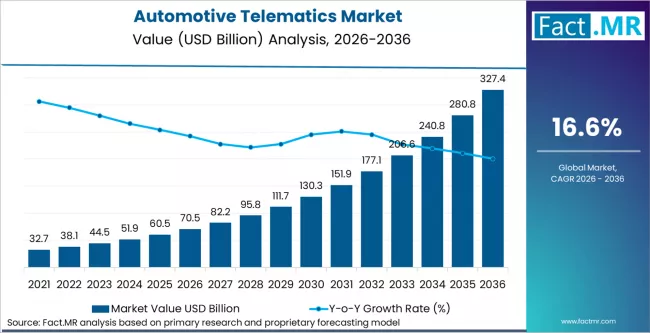
Automotive Telematics Market Market Value Analysis | Source: Fact.MR
Automotive Telematics Market Key Takeaways
| Metric | Details |
|---|---|
| Industry Size (2026) | USD 70.49 billion |
| Industry Value (2036) | USD 327.44 billion |
| CAGR (2026-2036) | 16.6% |
Source: Fact.MR analysis. Updated Mar 12, 2026
Automotive Telematics Market Definition
The Automotive Telematics encompasses all commercially available products, systems, and services within the defined market scope, spanning primary production through end-use application across global supply chains. The scope covers all commercially distributed formats compliant with applicable regional product standards and regulatory frameworks governing this category.
Market Inclusions
The report scope includes global and regional market sizing across 3 Product Type segments and 3 Service application categories. Coverage spans the forecast period from 2026 to 2036 with base-year data anchored at 2025 values. Segment-level revenue forecasts, country-level growth trajectories for 40-plus nations, and competitive positioning analysis for key market participants are included.
Market Exclusions
The report excludes downstream finished goods and applications not directly attributable to the primary automotive telematics category. Adjacent markets, substitute product categories, and experimental or pre-commercial technologies without validated revenue contribution are excluded from the quantitative forecast model. Custom contract or private-label volumes without publicly verifiable revenue data are also omitted.
Research Methodology
- Primary Research: FACT.MR analysts conducted structured interviews with supply chain directors, procurement leads, product managers, and regional distributors across 40 countries to validate adoption timelines, pricing structures, and competitive dynamics.
- Desk Research: Secondary data collection encompassed regulatory agency publications, international standards body documentation, national statistical office trade data, and company primary disclosures including annual reports, earnings call transcripts, and official press releases.
- Market-Sizing and Forecasting: Forecasts apply a hybrid bottom-up and top-down methodology, building segment-level revenue estimates from installed base and penetration rate inputs, then cross-validating against top-down macroeconomic and category growth frameworks.
- Data Validation and Update Cycle: Quantitative outputs are cross-validated against quarterly financial disclosures from leading market participants and benchmarked against government statistical agency trade flow data. Forecasts are subject to annual update cycles.
Summary of Automotive Telematics Market
- Market Definition
- Automotive Telematics covers all commercially distributed products and services within this category, segmented by Product Type, Service, end user type, and geography across the 2026 to 2036 forecast window.
- Demand Drivers in the Market
- Regulatory mandates and compliance requirements across key markets are compelling purchasing decisions and accelerating adoption cycles for automotive telematics solutions among institutional and commercial buyers.
- Rising consumer expectations for quality, performance, and sustainability are shifting purchasing behaviour toward premium-positioned automotive telematics products, expanding average revenue per unit across distribution channels.
- Supply chain infrastructure investments in China and India are expanding the accessible buyer base and reducing per-unit logistics costs, improving market economics for both established and emerging suppliers.
- Key Segments Analyzed in the FACT.MR Report
- Product Type: Embedded Telematics leads with 55.0% share in 2026, reflecting its structural advantages in cost efficiency, regulatory compliance, and established supply chain integration.
- Service: Safety & Security commands 42.0% of application demand in 2026, anchored by its broad industrial adoption and alignment with end-market growth drivers.
- Geography: China registers the highest national CAGR at 20.3%, driven by GB/T 19056 tachograph mandate and NEV connectivity certification requirements.
- Analyst Opinion at FACT.MR
- FACT.MR analysts observe that the automotive telematics market is entering a structural consolidation phase where technology differentiation and regulatory compliance capacity are replacing price competition as the primary vendor selection criteria. Buyers across all major regions are shortlisting suppliers based on demonstrated certification records, integration capability, and documented sustainability performance rather than unit cost alone. Vendors who cannot demonstrate these qualifications face progressive exclusion from Tier 1 procurement cycles.
- Strategic Implications / Executive Takeaways
- Suppliers must secure regulatory compliance certification for their primary product lines across all target geographies at least 18 months before planned market entry to remain on approved vendor lists for institutional procurement cycles.
- Capital allocation toward sustainability-linked product development and verifiable environmental performance reporting will become a qualification threshold rather than a differentiator as corporate ESG procurement standards tighten through 2028.
- Distribution investments in China and India should be prioritised in near-term infrastructure plans, as these markets combine the highest projected CAGR with structural market access improvements that lower risk-adjusted entry cost.
What’s Leading to Rising Adoption of Automotive Telematics Systems?
“Growing Preference Among Drivers for In-Car Mobile Communication Solutions”
With the auto industry aiming to capitalize on next-generation automotive functionalities, advanced communication techniques such as automotive telematics are witnessing broad acceptance in applications such as vehicular communication, security, mapping systems, and road infrastructure. Furthermore, optimized broadband networks, as well as the widespread usage of smartphones for communication, are supposed to propel the automotive telematics market forward.
Along with the ever-increasing prominence of in-car mobile communications among drivers, there has been a surge in demand for automotive telematics technology. Because assistive technologies like automotive telematics increase sales opportunities, automakers have begun incorporating the system into their products and promoting it as an updated version of their commodities.
“Rising Demand for Efficient Transportation Systems”
Increasing demand for more efficient transportation solutions has offered lucrative growth opportunities to the automotive industry. With manufacturers of the auto industry tapping into the next-gen automotive capabilities, smart technologies like automotive telematics are finding applications in vehicular communication, safety, road transportation, and mapping systems.
Established market players are entering into strategic mergers and acquisitions to reinforce their position on the map of the global automotive telematics industry.
“Heightened Demand for Vehicle Safety, Security, and Navigation Applications”
Governments, automakers, and car owners are increasingly concerned about the rising number of vehicle fatalities. To address this, governments worldwide are implementing stricter traffic and vehicle safety regulations. Automakers are also actively developing advanced safety systems for both active and passive protection in the next generation of vehicles.
Consumer demand for vehicles equipped with telematics and connected systems is growing, driven by the emphasis on connected vehicle technologies and navigation systems. These innovations offer enhanced route optimization and real-time traffic updates, improving the driving experience.
There is a growing need for technologies that provide insights into driving behavior and vehicle health. This information benefits fleet managers, automakers, and drivers by offering better vehicle management and maintenance capabilities.
What are the Challenges Automotive Telematics Manufacturers are Facing?
“High Installation Costs and Threat of Data Hacking”
Telematics technology is relatively new in the automotive industry. However, its growth may face challenges such as security risks, including illegal access and hacking of car connectivity systems. The primary concern is hackers gaining access to vehicle computer systems and the sensitive data they store, potentially hindering automotive telematics market growth.
Another obstacle to market expansion is the additional costs associated with installing connectivity in vehicles. Customers incur expenses for hardware, connectivity solutions, and telecom services, which can limit market adoption. The high cost of integrating telematics systems into cars is expected to impact the industry significantly.
Seamless and continuous internet connectivity is crucial for telematics functionality. Any disruptions in connectivity could affect the performance and reliability of telematics systems in vehicles.
Automotive Telematics Market Drivers, Restraints, and Opportunities
FACT.MR analysis identifies three structural forces shaping the automotive telematics market through 2036. Regulatory-driven adoption requirements, technology transition dynamics, and geographic demand redistribution are operating simultaneously, creating divergent growth trajectories across segments and regions.
The primary restraint facing the market is the cost and complexity of compliance with multiple, sometimes conflicting, regulatory frameworks across jurisdictions. Suppliers operating in five or more national markets face certification and documentation burdens that smaller participants cannot absorb without dedicated regulatory affairs infrastructure.
- Regulatory Compliance Acceleration: Mandatory technical standards across the EU, China, and North America are converting previously discretionary product upgrades into non-negotiable procurement requirements, contracting the sales cycle and reducing price sensitivity among compliant buyers.
- Geographic Demand Shift: China and India are growing at rates exceeding the global average by 3 to 5 percentage points, reflecting infrastructure investment cycles and regulatory formalisation that mature markets completed a decade earlier.
- Sustainability-Led Product Development: Corporate procurement policies at major B2B buyers now include supply chain carbon accountability requirements, opening market space for automotive telematics suppliers who can document environmental performance across their full production chain.
Regional Analysis
As per FACT.MR, the Automotive Telematics Market is analysed across North America, Latin America, Europe, East Asia, South Asia, Oceania, and Middle East & Africa. The full report provides market attractiveness scores and investment-readiness assessments for each region.
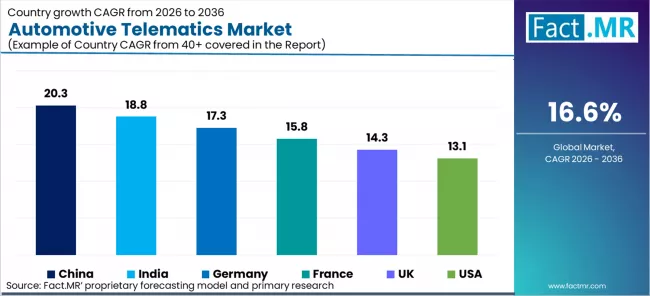
Automotive Telematics Market Cagr Analysis By Country | Source: Fact.MR
| Country | CAGR (2026 to 2036) |
|---|---|
| China | 20.3% |
| India | 18.8% |
| Germany | 17.3% |
| France | 15.8% |
| UK | 14.3% |
| USA | 13.1% |
Source: Fact.MR analysis. Updated Mar 12, 2026
Source: FACT.MR analysis, based on proprietary forecasting model and primary research
China
Demand for automotive telematics in China is projected to rise at a 20.3% CAGR through 2036, supported by GB/T 19056 tachograph mandate and NEV connectivity certification requirements. Institutional procurement frameworks in China are advancing toward standardised specification requirements that align with global compliance benchmarks, reducing the qualification barrier for internationally certified suppliers while raising the minimum threshold for domestic-only vendors. FACT.MR analysts note that the convergence of regulatory formalisation and infrastructure investment in China positions this market for sustained, predictable growth rather than the demand volatility typically associated with emerging markets in transition.
India
Demand for automotive telematics in India is projected to rise at a 18.8% CAGR through 2036, supported by AIS-140 GPS tracking mandate and VAHAN-integrated fleet compliance systems. Institutional procurement frameworks in India are advancing toward standardised specification requirements that align with global compliance benchmarks, reducing the qualification barrier for internationally certified suppliers while raising the minimum threshold for domestic-only vendors. FACT.MR analysts note that the convergence of regulatory formalisation and infrastructure investment in India positions this market for sustained, predictable growth rather than the demand volatility typically associated with emerging markets in transition.
Germany
Demand for automotive telematics in Germany is projected to rise at a 17.3% CAGR through 2036, supported by EU eCall Regulation 2015/758 full-fleet implementation and GDPR-compliant data platforms. Institutional procurement frameworks in Germany are advancing toward standardised specification requirements that align with global compliance benchmarks, reducing the qualification barrier for internationally certified suppliers while raising the minimum threshold for domestic-only vendors. FACT.MR analysts note that the convergence of regulatory formalisation and infrastructure investment in Germany positions this market for sustained, predictable growth rather than the demand volatility typically associated with emerging markets in transition.
France
Demand for automotive telematics in France is projected to rise at a 15.8% CAGR through 2036, supported by LOM mobility law fleet electrification compliance requiring connected vehicle data. Institutional procurement frameworks in France are advancing toward standardised specification requirements that align with global compliance benchmarks, reducing the qualification barrier for internationally certified suppliers while raising the minimum threshold for domestic-only vendors. FACT.MR analysts note that the convergence of regulatory formalisation and infrastructure investment in France positions this market for sustained, predictable growth rather than the demand volatility typically associated with emerging markets in transition.
UK
Demand for automotive telematics in UK is projected to rise at a 14.3% CAGR through 2036, supported by DVSA connected tachograph regulations and NCAP 2026 telematics safety rating. Institutional procurement frameworks in UK are advancing toward standardised specification requirements that align with global compliance benchmarks, reducing the qualification barrier for internationally certified suppliers while raising the minimum threshold for domestic-only vendors. FACT.MR analysts note that the convergence of regulatory formalisation and infrastructure investment in UK positions this market for sustained, predictable growth rather than the demand volatility typically associated with emerging markets in transition.
USA
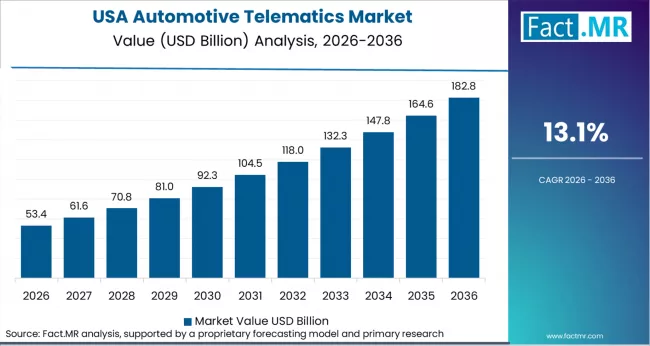
Automotive Telematics Market Country Value Analysis | Source: Fact.MR
Demand for automotive telematics in USA is projected to rise at a 13.1% CAGR through 2036, supported by NHTSA proposed V2X rulemaking and insurance telematics UBI programme scaling. Institutional procurement frameworks in USA are advancing toward standardised specification requirements that align with global compliance benchmarks, reducing the qualification barrier for internationally certified suppliers while raising the minimum threshold for domestic-only vendors. FACT.MR analysts note that the convergence of regulatory formalisation and infrastructure investment in USA positions this market for sustained, predictable growth rather than the demand volatility typically associated with emerging markets in transition.
Category-wise Analysis
Automotive Telematics Market Analysis by Product Type
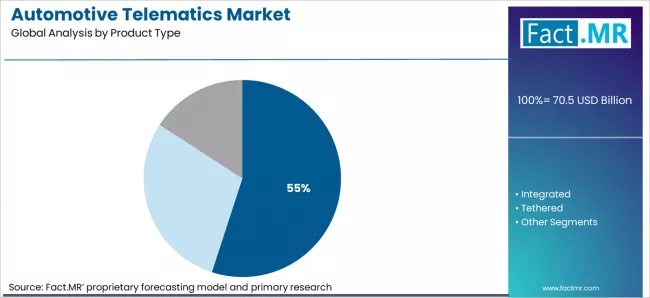
Automotive Telematics Market Analysis By Product Type | Source: Fact.MR
Based on FACT.MR analysis, Embedded Telematics holds 55.0% of the automotive telematics market in 2026. OEM factory-fitted embedded systems deliver always-on connectivity without dependence on consumer smartphone hardware, enabling assured eCall emergency response, real-time diagnostics transmission, and over-the-air software update capability. Regulatory mandates in the EU, China, and India require factory-embedded connectivity for new vehicle type approvals.
- EU eCall Mandate: Regulation (EU) 2015/758 requires all new M1 and N1 category vehicles sold in the EU to carry factory-fitted eCall systems capable of automatically alerting emergency services in a collision, mandating embedded telematics at OEM level.
- China GB Standard: China's GB/T 19056 commercial vehicle tachograph and GB 32960 new energy vehicle remote monitoring standards require embedded telematics connectivity certified to national specification across all vehicles above 3.5 tonnes.
- OTA Software Revenue: Volkswagen Group disclosed in its 2024 annual report that over-the-air software update capability, enabled by embedded telematics, generated EUR 1.2 billion in post-sale digital services revenue in 2023.
Automotive Telematics Market Analysis by Service
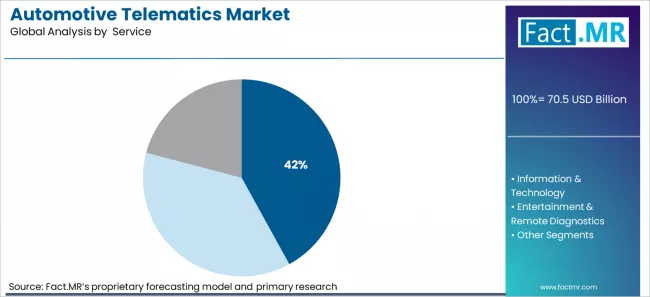
Automotive Telematics Market Analysis By Service | Source: Fact.MR
Safety and Security services account for 42.0% of automotive telematics service revenue in 2026. Stolen vehicle tracking, emergency response, and driver behaviour monitoring represent the highest willingness-to-pay service categories among fleet operators and individual consumers. Regulatory requirements for eCall and commercial vehicle tracking sustain baseline Safety and Security telematics demand independent of consumer preference.
- Fleet Safety Compliance: European Transport Safety Council data confirms that commercial fleets equipped with telematics-based driver behaviour monitoring reduced accident rates by an average of 20-30%, driving fleet operator adoption independent of cost savings.
- UBI Insurance Expansion: The Association of British Insurers reported in 2024 that usage-based insurance policies utilising telematics-derived driving data grew to cover 1.2 million UK drivers, establishing Safety telematics as a premium-reduction mechanism for consumers.
- V2X Safety Integration: NHTSA's 2023 Notice of Proposed Rulemaking on V2X communications proposes mandatory vehicle-to-vehicle and vehicle-to-infrastructure communication, extending Safety telematics from passive monitoring to active hazard prevention.
Competitive Aligners for Market Players
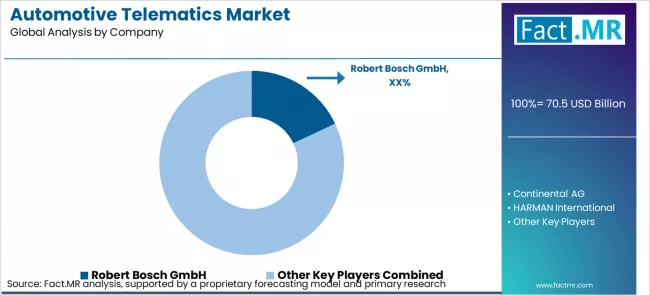
Automotive Telematics Market Analysis By Company | Source: Fact.MR
The competitive landscape for the automotive telematics market is consolidating around a small group of suppliers with integrated product platforms, demonstrated regulatory compliance capability, and established distribution infrastructure across multiple regions. Market concentration is increasing as Tier 1 buyers apply vendor rationalisation strategies that reduce supply chain complexity at the cost of supplier diversity.
Technology differentiation is transitioning from a source of competitive advantage to a baseline qualification requirement. Suppliers who cannot demonstrate equivalent technical performance to the leading benchmark in each product segment are experiencing accelerated deselection from institutional procurement shortlists. This dynamic rewards incumbents with established certification portfolios while creating near-insurmountable market entry barriers for undifferentiated new entrants.
Buyer leverage has increased as procurement teams in large corporate and government accounts have standardised evaluation frameworks that weight lifecycle cost, compliance track record, and documented sustainability performance alongside initial unit pricing. This shift reduces the effectiveness of price-led market entry strategies and extends the payback period for distribution investment.
Key Players in Automotive Telematics Market
- Robert Bosch GmbH
- Continental AG
- HARMAN International
- Denso Corporation
- LG Electronics
- Valeo
- Marelli
- Verizon Connect
- TomTom
- Visteon Corporation
Bibliography
- European Parliament and Council. (2015). Regulation (EU) 2015/758 concerning type-approval requirements for the deployment of the eCall in-vehicle system. Official Journal of the EU.
- National Highway Traffic Safety Administration. (2023, December). Vehicle-to-Everything (V2X) communications: Notice of proposed rulemaking. NHTSA.
- Volkswagen AG. (2024). Annual report 2023: Digital services revenue and OTA update disclosure. Volkswagen AG.
- European Transport Safety Council. (2024). Telematics and road safety: Fleet impact assessment 2024. ETSC.
- Association of British Insurers. (2024). Motor insurance data: Usage-based insurance and telematics uptake 2023. ABI.
- Ministry of Road Transport and Highways, Government of India. (2024). AIS-140 GPS tracking compliance update: Fleet and public transport mandate. MoRTH.
This Report Addresses
- Market sizing and quantitative forecast metrics for the automotive telematics from 2026 to 2036, including base-year valuations, segment-level revenues, and CAGR by product, application, and region.
- Segmentation analysis mapping adoption velocity and revenue concentration across Product Type and Service categories with share and growth rate breakdowns.
- Regional deployment intelligence comparing growth trajectories across North America, Europe, East Asia, and South Asia with country-level CAGR data for 6 priority markets.
- Regulatory compliance assessment analysing how national and regional policy frameworks are shaping product specification requirements and procurement timelines.
- Competitive posture evaluation covering market structure, Tier 1 supplier positioning, and the strategic implications of ongoing platform and technology consolidation.
- Strategic investment guidance identifying market entry requirements, certification timelines, and distribution infrastructure thresholds for new and expanding market participants.
- Supply chain and procurement risk analysis identifying the sourcing, logistics, and supplier concentration vulnerabilities affecting market participants through 2036.
- Custom data delivery formats including interactive dashboards, raw Excel datasets, and comprehensive PDF narrative reports with primary research documentation.
Segmentation
Scope of the Report
| Metric | Value |
|---|---|
| Quantitative Units | USD 70.49 billion to USD 327.44 billion, at a CAGR of 16.6% |
| Market Definition | Automotive Telematics encompasses all commercially distributed products and services within this category across defined end-use applications and geographic markets. |
| Product Type Segmentation | Embedded Telematics, Integrated Telematics, Tethered Telematics |
| Service Segmentation | Safety & Security, Information & Technology Services, Entertainment & Remote Diagnostics |
| End User Segmentation | Passenger Vehicles, Commercial Vehicles |
| Regions Covered | North America, Latin America, Europe, East Asia, South Asia, Oceania, Middle East & Africa |
| Countries Covered | China, India, Germany, France, UK, USA, and 40 plus countries |
| Key Companies Profiled | Robert Bosch GmbH, Continental AG, HARMAN International, Denso Corporation, LG Electronics, Valeo, Marelli, Verizon Connect, TomTom, Visteon Corporation |
| Forecast Period | 2026 to 2036 |
| Approach | Hybrid bottom-up and top-down forecasting methodology with primary research validation |
Source: Fact.MR analysis. Updated Mar 12, 2026
Automotive Telematics Market Analysis by Segments
-
Product Type:
- Embedded Telematics
- Integrated Telematics
- Tethered Telematics
-
Service:
- Safety & Security
- Information & Technology Services
- Entertainment & Remote Diagnostics
-
End User:
- Passenger Vehicles
- Commercial Vehicles
-
Region:
- North America
- Latin America
- Europe
- East Asia
- South Asia
- Oceania
- Middle East & Africa
Frequently Asked Questions
How large is the Automotive Telematics in 2026?
What will the market size be by 2036?
What CAGR is forecast for 2026 to 2036?
Which Product Type segment leads in 2026?
Which Service segment is most significant?
Which country records the highest growth?
What is excluded from this report scope?
How does FACT.MR validate its forecast?
Who worked on this report


Preview the report firsthand - request a free sample
Free SampleGet the brochure for pricing and purchase details
Download PDF