- Base Value(2025): 786 Mn
- Forecast Value (2036): 2846 Mn
- CAGR (2036): 12.3%
Automotive Cybersecurity Middleware Market Forecast 2026 to 2036
In 2025, the global automotive cybersecurity middleware market was valued at USD 786 million. Based on Fact.MR analysis, 2,846 million by 2036. Fact.MR projects a CAGR of 12.3% during the forecast period.
The absolute dollar growth from 2026 to 2036 is projected at approximately USD 1,953 million, driven by rising vehicle connectivity, software-defined vehicle (SDV) adoption, and tightening cybersecurity regulations such as UNECE WP.29 and ISO/SAE 21434. Increasing integration of ADAS, OTA updates, V2X communication, and centralized vehicle computing architectures is strengthening demand for secure middleware platforms that enable real-time threat detection, encryption, authentication, and cross-domain data integrity. Growing OEM investment in connected and autonomous mobility further supports adoption. However, high integration costs, legacy ECU complexity, evolving cyber threats, and regulatory fragmentation remain key constraints.
Among leading countries, the U.S. grows at a CAGR of 11.4%, supported by strong regulatory enforcement and connected vehicle deployment. China records 13.1%, driven by rapid EV production and digital vehicle ecosystems. Germany expands at 12.4%, reflecting compliance leadership and premium vehicle innovation. Japan posts 12.7%, backed by advanced embedded systems. South Korea grows at 12.8%, fueled by smart mobility expansion. Overall, the global Automotive Cybersecurity Middleware market is projected to register a CAGR of 12.3% between 2026 and 2036.
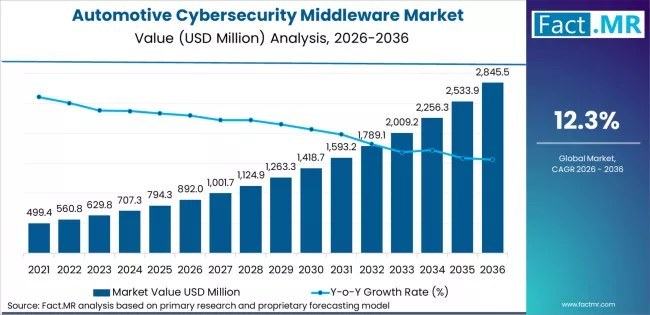
Automotive Cybersecurity Middleware Market Market Value Analysis | Source: Fact.MR
Automotive Cybersecurity Middleware Market Definition
The automotive cybersecurity middleware market comprises software platforms, embedded security frameworks, hardware security modules, and related services that enable secure communication, data processing, and system integrity across connected and software-defined vehicles. Automotive cybersecurity middleware acts as an intermediary software layer between vehicle operating systems, electronic control units (ECUs), domain controllers, cloud platforms, and in-vehicle applications, ensuring secure data exchange, authentication, encryption, and real-time threat monitoring.
Market Inclusions
The market includes automotive cybersecurity middleware software (message-oriented, object request broker, database, and application server middleware), embedded security frameworks, hardware security modules (HSMs), encryption and authentication systems, intrusion detection solutions, OTA security platforms, and related integration and managed security services for passenger and commercial vehicles.
Market Exclusions
The scope excludes general enterprise middleware not designed for automotive use, standalone cybersecurity tools without middleware integration, and conventional automotive software systems that do not include dedicated cybersecurity functionality.
Research Methodology
Primary Research
In-depth interviews were conducted with automotive OEMs, Tier-1 suppliers, cybersecurity solution providers, middleware developers, semiconductor companies, and cloud security vendors across major regions. Discussions with regulatory experts and industry consultants helped validate adoption trends, pricing models, compliance requirements (UNECE WP.29, ISO/SAE 21434), and application-specific demand across infotainment, telematics, ADAS, and powertrain systems.
Desk Research
The study analyzed company annual reports, investor presentations, regulatory frameworks, cybersecurity standards documentation, and automotive technology publications to assess competitive positioning and technological advancements. Public data on connected vehicle penetration, EV growth, ADAS deployment, OTA adoption, and software-defined vehicle trends were evaluated to determine market size, growth outlook, and long-term demand for automotive cybersecurity middleware.
Market‑Sizing and Forecasting
A hybrid approach combining bottom-up revenue analysis of leading automotive cybersecurity middleware providers, embedded security vendors, and integration service firms with top-down benchmarking against the broader automotive cybersecurity and connected vehicle software markets was employed.
Data Validation and Update Cycle
Findings were cross-verified through triangulation of primary interviews, industry publications, regulatory standards (UNECE WP.29, ISO/SAE 21434), and company financial disclosures to ensure consistency and reliability.
Automotive Cybersecurity Middleware Market Summary
Market Definition
The automotive cybersecurity middleware market comprises software platforms, embedded security frameworks, hardware security modules, and related services that enable secure communication, data integrity, and real-time threat protection across connected and software-defined vehicles. It includes message-oriented middleware, object request brokers, database middleware, application server middleware, encryption systems, intrusion detection platforms, and OTA security solutions supporting passenger and commercial vehicles across infotainment, telematics, ADAS, powertrain, and centralized computing environments.
Demand Drivers
- Rapid Growth of Connected and Software-Defined Vehicles: Increasing integration of connected car technologies, centralized computing architectures, and over-the-air (OTA) capabilities is driving demand for secure middleware layers that ensure encrypted communication, authentication, and cross-domain system protection.
- Tightening Cybersecurity Regulations and Compliance Mandates: Global enforcement of standards such as UNECE WP.29 and ISO/SAE 21434 is compelling OEMs and suppliers to adopt structured cybersecurity frameworks and compliant middleware solutions across vehicle platforms.
- Expansion of ADAS, Autonomous Driving, and V2X Ecosystems: Rising deployment of ADAS, vehicle-to-everything (V2X) communication, and cloud-edge integration is increasing system complexity, strengthening the need for scalable middleware platforms capable of real-time threat detection, secure data orchestration, and resilience against evolving cyber threats.
Regional Outlook
- USA: Expected to grow at a CAGR of approximately 11.4%, driven by strong regulatory enforcement under UNECE WP.29 alignment, high connected vehicle penetration, expanding ADAS deployment, and significant OEM investment in software-defined vehicle and cybersecurity platforms.
- China: Anticipated to grow at a CAGR of around 13.1%, supported by rapid EV production, accelerated vehicle digitalization, government-backed automotive cybersecurity initiatives, and increasing deployment of V2X-enabled mobility ecosystems.
- Germany: Projected to expand at a CAGR of approximately 12.4%, reflecting stringent compliance frameworks, leadership in premium and connected vehicle manufacturing, and rising integration of secure middleware within centralized vehicle architectures.
Analyst Opinion
The automotive cybersecurity middleware market is on a steady and strategically critical growth trajectory, driven by the rapid expansion of connected vehicles, software-defined vehicle architectures, and increasing regulatory enforcement of automotive cybersecurity standards. Demand is particularly strong in technologically advanced and compliance-driven economies, where OEMs and suppliers are prioritizing secure OTA updates, ADAS protection, V2X communication security, and centralized vehicle computing resilience to safeguard increasingly complex and data-intensive mobility ecosystems.
Strategic Insights
- Technology Advancement and Security Integration: As competition intensifies, automotive cybersecurity middleware providers are investing in AI-driven intrusion detection, zero-trust architectures, secure OTA frameworks, and scalable service-oriented middleware platforms to enhance real-time threat response, ensure regulatory compliance, and optimize integration across centralized vehicle computing systems.
- Regional Dynamics: North America remains the most mature and innovation-driven market, supported by strong regulatory enforcement, high connected vehicle penetration, advanced ADAS deployment, and substantial OEM investment in software-defined vehicle platforms and automotive cybersecurity infrastructure.
Methodology
North America remains the most dynamic and deployment-driven region in the Automotive Cybersecurity Middleware market, characterized by high connected vehicle penetration, strong regulatory enforcement under UNECE WP.29-aligned frameworks, rapid adoption of software-defined vehicle architectures, and substantial OEM investment in secure OTA, ADAS protection, and V2X cybersecurity integration supported by advanced digital mobility infrastructure.
Segmental Analysis
Automotive Cybersecurity Middleware Market Analysis by Charger Type
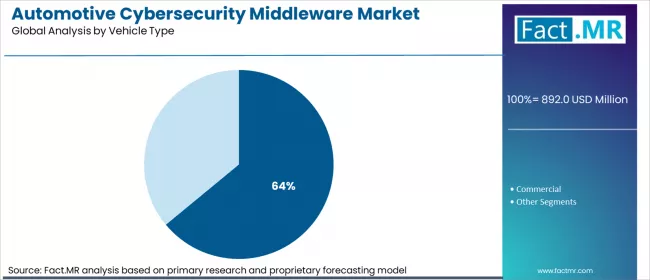
Automotive Cybersecurity Middleware Market Analysis By Vehicle Type | Source: Fact.MR
- Market Overview: Software is projected to account for approximately 63% of the market share by 2026, making it the leading component segment. This dominance is driven by increasing adoption of secure middleware platforms, encryption frameworks, OTA security layers, and real-time intrusion detection systems required to protect connected, software-defined, and ADAS-enabled vehicles, while hardware and services play supporting roles.
- Demand Drivers:
- Expansion of Software-Defined Vehicle (SDV) Architectures: The transition toward centralized computing and domain controllers is increasing reliance on scalable, security-enabled middleware software that ensures secure data orchestration and cross-domain communication.
- Rising Regulatory Compliance Requirements: Enforcement of UNECE WP.29 and ISO/SAE 21434 standards is pushing OEMs to deploy structured cybersecurity software frameworks embedded within vehicle middleware layers.
- Growth in OTA and Connected Services: Increasing deployment of over-the-air updates, telematics, and V2X communication is strengthening demand for secure software platforms capable of authentication, encryption, and real-time threat monitoring across vehicle ecosystems.
Automotive Cybersecurity Middleware Market Analysis by Middleware Type
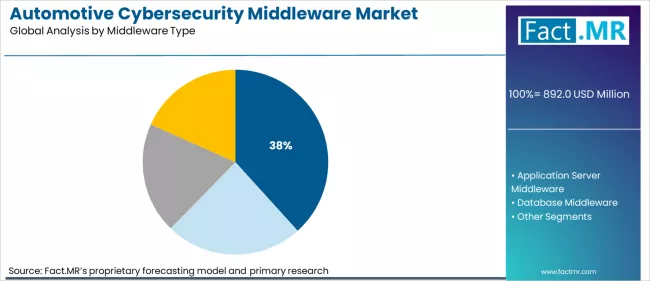
Automotive Cybersecurity Middleware Market Analysis By Middleware Type | Source: Fact.MR
- Market Overview: Message-Oriented Middleware is projected to account for approximately 38% of the market share by 2026, making it the leading middleware type segment. Its dominance is driven by its critical role in enabling secure, real-time, and asynchronous communication between ECUs, domain controllers, cloud platforms, and V2X networks within increasingly complex vehicle architectures.
- Demand Drivers:
- Rising Vehicle Connectivity and Data Traffic: Increasing data exchange across infotainment, telematics, ADAS, and centralized computing systems is driving demand for secure message-based communication frameworks.
- Adoption of Service-Oriented Architectures (SOA): The shift toward software-defined vehicles is strengthening the need for scalable middleware that supports modular services and secure cross-domain interaction.
- Integration of V2X and Cloud-Edge Communication: Growing deployment of V2X ecosystems and OTA updates requires robust, low-latency, and encrypted messaging layers to ensure secure data transmission and system integrity.
Key Dynamics
FMR analysts observe that the automotive cybersecurity middleware market represents a strategically expanding segment within the broader automotive cybersecurity and software-defined vehicle ecosystem, closely linked to rising vehicle connectivity, centralized computing architectures, and regulatory cybersecurity enforcement. Historically, vehicle security relied on perimeter-based protection at the ECU level, however, the shift toward integrated, middleware-driven security frameworks enabling secure OTA updates, V2X communication, and cross-domain data orchestration is accelerating adoption across passenger and commercial vehicle platforms.
The 2026 valuation reflects sustained investment in secure middleware stacks, AI-driven intrusion detection systems, encryption frameworks, and compliance-ready software architectures by OEMs, Tier-1 suppliers, and cybersecurity vendors.
- Regulatory Compliance & Standardization Imperative: Growing enforcement of UNECE WP.29 and ISO/SAE 21434 standards is driving structured cybersecurity implementation, compelling OEMs to embed secure middleware layers that ensure authentication, encryption, logging, and lifecycle risk management.
- Shift Toward Software-Defined & Centralized Vehicle Architectures: The transition to domain and zonal controllers is increasing reliance on scalable middleware platforms capable of securing high-speed data exchange, OTA updates, and service-oriented vehicle functions.
- Rising Cyber Threat Sophistication & Connected Ecosystem Expansion: Increasing attack surfaces created by ADAS, telematics, cloud-edge integration, and V2X communication are strengthening demand for real-time threat detection, anomaly monitoring, and resilient security orchestration across global automotive markets.
Regional Analysis
The market analysis covers key global regions, including South Asia and Pacific, Middle East & Africa, North America, Latin America, Western Europe, and Eastern Europe. It is segmented geographically, with specific market dynamics for each region. The full report provides a detailed market attractiveness analysis.
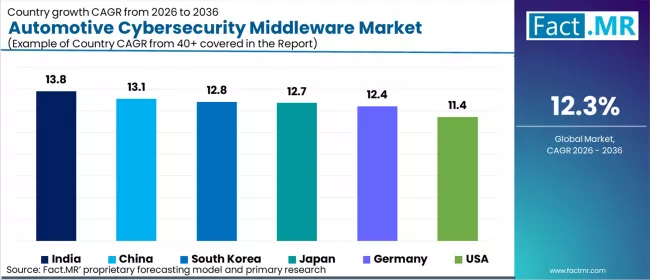
Automotive Cybersecurity Middleware Market Cagr Analysis By Country | Source: Fact.MR
Automotive Cybersecurity Middleware Market CAGR Table
| Country | CAGR (%) |
|---|---|
| U.S. | 11.4% |
| China | 13.1% |
| Germany | 12.4% |
| Japan | 12.7% |
| South Korea | 12.8% |
| India | 13.8% |
| Brazil | 12.8% |
| KSA | 13.1% |
Source: Fact.MR analysis. Updated Feb 25, 2026
Source: Fact.MR (FMR) analysis, based on proprietary forecasting model and primary research.
South Asia and Pacific:
South Asia and Pacific is emerging as a steady-growth region for the Automotive Cybersecurity Middleware market, supported by rapid vehicle digitalization, expanding EV production, increasing ADAS integration, and growing regulatory focus on automotive cybersecurity across China, India, Japan, and South Korea.
- India: Demand for automotive cybersecurity middleware in India is projected to rise at a CAGR of approximately 13.8% through 2036. Growth is driven by expanding connected vehicle adoption, government-backed digital mobility and smart transportation initiatives, increasing EV penetration, and rising awareness of vehicle data protection requirements.
- China: Demand in China is projected to grow at a CAGR of around 13.1% through 2036, supported by large-scale EV production, rapid integration of intelligent cockpit systems, strong state-backed automotive cybersecurity regulations, and expanding V2X-enabled smart mobility ecosystems.
- Japan: Demand in Japan is expected to rise at a CAGR of approximately 12.7% through 2036, driven by advanced embedded system innovation, strong OEM focus on secure vehicle architectures, growing deployment of ADAS technologies, and increasing emphasis on resilient and compliant cybersecurity frameworks.
Middle East & Africa:
The Middle East & Africa represents an emerging growth region for the Automotive Cybersecurity Middleware market, driven by gradual expansion of connected vehicle adoption, smart mobility initiatives, and increasing regulatory attention toward digital vehicle security across Gulf countries and select African economies.
- Saudi Arabia Demand for automotive cybersecurity middleware in Saudi Arabia is projected to rise at a CAGR of approximately 13.1% through 2036. Growth is supported by Vision 2030 digital transformation goals, smart city developments such as NEOM, expanding EV adoption, and rising investment in advanced automotive and mobility infrastructure.
- UAE: Demand in the UAE is expected to grow steadily at a CAGR of around 12.9% through 2036, driven by strong smart mobility strategies, clean transportation initiatives, connected vehicle deployment, and increasing emphasis on secure digital infrastructure within advanced urban ecosystems.
North America:
North America represents a mature yet innovation-driven market for the Automotive Cybersecurity Middleware industry, characterized by high connected vehicle penetration, strong regulatory enforcement, advanced ADAS deployment, and early adoption of software-defined vehicle architectures.
- USA: Demand for automotive cybersecurity middleware in the U.S. is projected to rise at a CAGR of approximately 11.4% through 2036. Growth is primarily driven by stringent regulatory compliance requirements, expanding OTA and V2X integration, increasing investment in centralized vehicle computing platforms, and sustained OEM focus on AI-driven threat detection and secure digital mobility ecosystems rather than solely new hardware deployment.
Latin America:
Latin America represents a developing but opportunity-rich market for the Automotive Cybersecurity Middleware industry, supported by rising connected vehicle penetration, gradual regulatory alignment with global vehicle safety standards, and increasing deployment of telematics and digital mobility platforms across key regional economies.
- Brazil: Demand for automotive cybersecurity middleware in Brazil is projected to rise at a CAGR of approximately 13.2% through 2036. Growth is driven by expanding connected vehicle ecosystems, increasing adoption of ADAS and OTA update platforms, growing focus on data protection compliance, and rising OEM and supplier investment in secure in-vehicle network architectures and cloud-integrated vehicle systems.
Western Europe:
Western Europe represents a technologically advanced and compliance-driven market for the Automotive Cybersecurity Middleware industry, supported by stringent UNECE WP.29 regulations, rapid adoption of software-defined vehicles, and strong OEM investment in secure connected mobility ecosystems.
- Germany: Demand for automotive cybersecurity middleware in Germany is projected to rise at a CAGR of approximately 12.4% through 2036. Growth is driven by strict cybersecurity compliance mandates, high penetration of premium connected vehicles, expanding ADAS and OTA deployment, and increasing integration of centralized vehicle computing architectures across domestic OEM platforms.
Fact.MR analysis of the automotive cybersecurity middleware market across South Asia & Pacific, Middle East & Africa, North America, Latin America, and Western Europe includes country-level assessments covering India, China, Japan, Saudi Arabia, the UAE, Brazil, the U.S., Germany, and the U.K. The report provides detailed insights into regulatory cybersecurity frameworks, vehicle software architecture evolution, OTA security standards, data protection requirements, V2X security integration trends, and competitive positioning strategies shaping middleware deployment decisions and long-term market expansion across these countries.
Competitive Landscape
How Are Key Players Competing in the Automotive Cybersecurity Middleware Market?
The automotive cybersecurity middleware market is being shaped by leading technology providers such as BlackBerry QNX, Elektrobit, Green Hills Software, Wind River, and ETAS, all of whom are focused on strengthening secure in-vehicle software architectures and enabling compliance with evolving global cybersecurity regulations. These companies compete by integrating secure operating systems, hypervisors, intrusion detection and prevention systems (IDPS), secure boot mechanisms, and OTA security frameworks into centralized and domain-based vehicle architectures.
Recent Industry Developments
- Elektrobit Joins SDVerse to Advance Safe, Secure and Future-Ready Software-Defined Mobility, 2025: Elektrobit, a trusted partner in the transition to the software-defined-vehicle (SDV), announced that it has joined SDVerse, the automotive industry’s first B2B marketplace for software. (SDVerse) [1]
- Eclipse S-CORE releases version 0.5-alpha for vehicle middleware-2025: The Eclipse Software Defined Vehicle Working Group has released version 0.5-alpha of S-CORE (Safe Open Vehicle Core), an open-source middleware platform for software-defined vehicles. (Automotive World) [2
Key Players of the Automotive Cybersecurity Middleware Market
- Blackberry QNX
- Elektrobit
- Green Hils Software
- Wind River Software
- ETAS
- Mentor Graphics
- Real Time Innovations
- OpenSynergy
- Rohde & Schwarz
- Sophos
Report Scope
| Metric | Value |
|---|---|
| Quantitative Units | USD 892 million (2026) to USD 2,846 million (2036), at a CAGR of 12.3% |
| Market Definition | The Automotive Cybersecurity Middleware Market includes software platforms, embedded security frameworks, and integration services that enable secure communication, data protection, threat detection, and regulatory compliance within connected, autonomous, and software-defined vehicle architectures across passenger and commercial vehicle segments. |
| By Component Type | Software, Hardware, and Services |
| By Middleware Type | Message-Oriented Middleware, Object Request Brokers, Database Middleware, Application Server Middleware |
| By Vehicle Type | Passenger, Commercial |
| By Application | Infotainment Systems, Telematics & Connectivity, ADAS & Safety Systems, Powertrain & Controls, and Others |
| Regions Covered | North America, Latin America, Western Europe, Eastern Europe, East Asia, South Asia and Pacific , Middle East and Africa |
| Countries Covered | United States, Canada, Mexico, Brazil, Argentina, Germany, France, United Kingdom, Italy, Spain, China, India, Japan, South Korea, ASEAN, ANZ, and 40+ countries |
| Key Companies Profiled | Blackberry QNX, Elektrobit, Green Hils Software, Wind River Software, ETAS, Mentor Graphics, Real Time Innovations, and others |
| Forecast Period | 2026 to 2036 |
| Approach | Hybrid top-down and bottom-up market modeling validated through primary interviews with automotive OEMs, Tier-1 suppliers, cybersecurity middleware providers, embedded software developers, and regulatory experts, supported by benchmarking against connected vehicle revenues, ADAS deployment trends, and software-defined vehicle investment patterns. |
Source: Fact.MR analysis. Updated Feb 25, 2026
Bibliographies
Elektrobit Joins SDVerse to Advance Safe, Secure and Future-Ready Software-Defined Mobility – 2025:
SDVerse. (2025). Elektrobit joins SDVerse to advance safe, secure and future-ready software-defined mobility. SDVerse News Section. SDVerse. [1]
Eclipse S-CORE Releases Version 0.5-Alpha for Vehicle Middleware – 2025:
Automotive World. (2025). Eclipse S-CORE releases version 0.5-alpha for vehicle middleware. Automotive World News Section. Automotive World. [2]
Segmentation
Key Segments
- By Component Type: Software dominates the market, accounting for approximately 63% of total revenue share, driven by increasing demand for secure middleware platforms, encryption frameworks, OTA security solutions, and real-time intrusion detection systems across connected and software-defined vehicles. Hardware security modules and services follow, supported by embedded protection needs and compliance-driven consulting.
- By Middleware Type: Message-Oriented Middleware leads, holding around 38% share, supported by its critical role in enabling secure, real-time communication between ECUs, domain controllers, cloud platforms, and V2X networks within increasingly complex vehicle architectures.
- By Geography: North America dominates the market, supported by strong regulatory enforcement (UNECE WP.29 alignment), high connected vehicle penetration, advanced ADAS deployment, and significant OEM investment in
Automotive Cybersecurity Middleware Market Key Segments
-
By Component Type
- Software
- Hardware
- Services
-
By Midlleware Type
- Message-Oriented Middleware
- Object Request Brokers
- Database Middleware
- Application Server Middleware
-
By Vehicle Type
- Passenger
- Commercial
-
By Application
- Infotainment Systems
- Telematics & Connectivity
- ADAS & Safety Systems
- Powertrain & Controls
- Others
-
Region
- North America
- USA
- Canada
- Mexico
- Western Europe
- Germany
- UK
- France
- Italy
- Spain
- Nordic Countries
- BENELUX
- Rest of Western Europe
- Eastern Europe
- Russia
- Hungary
- Poland
- Balkan & Baltics
- Rest of E. Europe
- East Asia
- China
- Japan
- South Korea
- South Asia and Pacific
- India
- ANZ
- ASEAN
- Latin America
- Brazil
- Argentina
- Rest of Latin America
- Middle East and Africa
- Kingdom of Saudi Arabia
- United Arab Emirates
- South Africa
- Rest of Middle East and Africa
- North America
Frequently Asked Questions
How large is the Automotive Cybersecurity Middleware market currently?
What will be the market size globally by 2036?
What is the expected demand growth between 2026 and 2036?
Which component type is expected to dominate the market?
Which middleware type leads the market?
Which region is expected to show the highest growth rate?
How significant is the growth outlook for Germany?
What is the growth outlook for Japan?
Who worked on this report


Preview the report firsthand - request a free sample
Free SampleGet the brochure for pricing and purchase details
Download PDF