- Base Value(2025): 5.5 Bn
- Estimated Value(2026): 5.8 Bn
- Forecast Value (2036): 9.5 Bn
- CAGR (2026 - 2036): 5.1%
Automotive Tensioner Market Forecast 2026 to 2036
In 2025, the automotive tensioner market was valued at USD 5.5 billion. Based on FMR analysis, demand for automotive tensioners is estimated to grow to USD 5.8 billion in 2026 and USD 9.5 billion by 2036. Fact MR projects a CAGR of 5.1% during the forecast period.
The absolute dollar growth from 2026 to 2036 is USD 3.7 billion. This growth is driven by the increasing demand for advanced automotive systems, the rising production of passenger and commercial vehicles, and the growing emphasis on engine efficiency and performance. Automotive tensioners, which ensure proper tension in the engine's timing and accessory belts, are crucial for maintaining vehicle performance and reducing wear. However, challenges such as fluctuating raw material costs and competition from alternative technologies may impact the market's growth in certain regions.
As Ivo Jurek, Chief Executive Officer of Gates Corporation, noted regarding the company’s focus on innovation in automotive‑related component technologies, ‘Gates is an innovation‑driven company striving to improve our impact on people and the environment, taking into account the materials we use, our manufacturing processes, and the communities where we live and work.’
China leads with a CAGR of 6.9%, driven by its massive automotive production and the demand for high-performance engine components. India follows with 6.4%, supported by increasing automotive production and demand for reliable vehicle components. Germany grows at 5.9%, benefiting from strong demand in the European automotive market, particularly in the production of premium vehicles. Brazil shows growth at 5.4%, fueled by the growing automotive industry in Latin America. The USA grows at 4.8%, reflecting steady demand for automotive tensioners in its large automotive manufacturing sector.
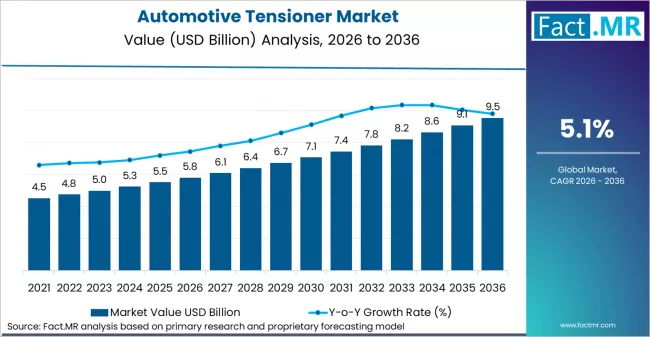
Automotive Tensioner Market Market Value Analysis | Source: Fact.MR
Automotive Tensioner Market
| Metric | Value |
|---|---|
| Estimated Value in (2026E) | USD 5.8 billion |
| Forecast Value in (2036F) | USD 9.5 billion |
| Forecast CAGR (2026 to 2036) | 5.1% |
Source: Fact.MR analysis. Updated Mar 5, 2026
Automotive Tensioner Market Definition
The Automotive Tensioner Market involves the manufacture and sale of tensioning devices used in vehicle engines and accessory drive systems to maintain proper belt or chain tension for reliable power transmission and reduced wear.
Market Inclusions
This report covers global and regional market sizes for automotive tensioners over a defined forecast period, including product types (belt tensioners, chain tensioners), vehicle segments (passenger cars, light commercial vehicles, heavy commercial vehicles), and distribution channels (OEM fitment, aftermarket).
Market Exclusions
The scope excludes unrelated engine components such as belts, pulleys, and idler arms that are not classified as tensioners, and complete powertrain systems where tensioner data is not separately quantified.
Research Methodology
- Primary Research: Interviews were conducted with automotive engineers, component suppliers, and OEM procurement specialists.
- Desk Research: Data was sourced from industry reports, automotive production statistics, and trade association publications.
- Market‑Sizing and Forecasting: A hybrid model combining top‑down vehicle component demand forecasts with bottom‑up shipment and revenue data was used.
- Data Validation and Update Cycle: Findings were validated through expert review and aligned with recent production and trade figures.
Summary of the Automotive Tensioner Market
- Market Definition
- The Automotive Tensioner Market involves the production and sale of tensioning devices used in vehicle engines and accessory drive systems to maintain proper belt or chain tension for reliable power transmission and reduced wear.
- Demand Drivers
- Increased Vehicle Production: Growing global automotive production, especially in emerging markets, drives the demand for automotive tensioners for new vehicle assembly.
- Performance and Engine Efficiency: Automotive tensioners help ensure optimal engine performance by maintaining correct belt tension, which is critical for powertrain efficiency and component longevity.
- Technological Advancements: The rising complexity of modern powertrains, including hybrid and electric vehicles, drives the need for advanced tensioning solutions.
- Key Segments Analyzed
- Sales Channel: OEMs (Original Equipment Manufacturers) dominate the market, expected to account for 50% of the sales channel segment by 2026 due to the integration of tensioners in new vehicle production.
- Type: Timing belt automotive tensioners lead the market, projected to hold 35% of the market share by 2026 due to their crucial role in internal combustion engine applications.
- Geography: China leads with a CAGR of 6.9%, driven by its growing automotive production and demand for high-performance engine components.
- Analyst Opinion at Fact MR
- Shambhu Nath Jha, Principal Consultant at Fact MR, states, "The rising demand for advanced automotive systems, coupled with increasing global vehicle production, drives the automotive tensioner market's steady growth."
- Strategic Implications/Executive Takeaways
- Focus on Advanced Tensioning Solutions: Companies should prioritize developing high-performance tensioners that cater to modern powertrains and hybrid/electric vehicles.
- Leverage OEM Relationships: Given the dominance of OEMs in the market, strengthening ties with vehicle manufacturers and offering tailored solutions will be critical for market penetration.
- Explore Emerging Markets: Regions like China and India present substantial growth opportunities, fueled by rapid industrialization and expanding automotive production.
- Methodology
- Primary Research: Interviews with automotive engineers, component suppliers, and OEM procurement specialists.
- Desk Research: Sourcing from industry reports, automotive production statistics, and trade association publications.
- Market Sizing & Forecasting: A hybrid model combining top-down vehicle component demand forecasts with bottom-up shipment and revenue data.
Segmental Analysis
Automotive Tensioner Market Analysis by Type
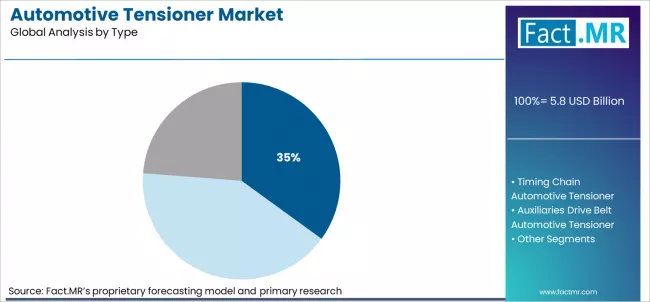
Automotive Tensioner Market Analysis By Type | Source: Fact.MR
- Market Overview: Timing belt automotive tensioners are expected to capture 35% of the market share by 2026. Timing belt tensioners are widely used in internal combustion engine (ICE) applications to maintain the proper tension in the timing belt, ensuring accurate synchronization between the engine’s camshaft and crankshaft. Their reliability in engine performance makes them crucial components in automotive systems.
- Demand Drivers:
- Critical Role in Engine Efficiency: Timing belt tensioners help maintain engine efficiency by ensuring precise timing, which is critical for the performance and longevity of internal combustion engines.
- Prevalence in Conventional Vehicles: As timing belts are more commonly used in traditional internal combustion engine vehicles, the demand for timing belt tensioners remains strong, especially in the automotive replacement market.
- Cost-Effectiveness and Reliability: Timing belt tensioners offer a cost-effective solution compared to timing chain systems, which boosts their popularity in budget-conscious vehicle segments and among OEMs.
Automotive Tensioner Market Analysis by Sales Channel
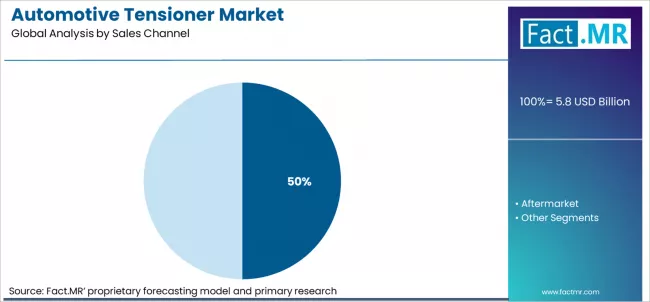
Automotive Tensioner Market Analysis By Sales Channel | Source: Fact.MR
- Market Overview: OEMs are projected to account for 50% of the market share by 2026. OEMs (Original Equipment Manufacturers) are the largest sales channel for automotive tensioners, as these components are essential in the initial assembly of vehicles, ensuring optimal engine performance and longevity.
- Demand Drivers:
- Direct Integration in Vehicle Manufacturing: OEMs are the primary suppliers of automotive tensioners, as these parts are integrated into the vehicles during the manufacturing process. OEMs provide high-quality, reliable tensioners that are designed specifically for the engine systems of the vehicles being produced.
- Growth of Automotive Production: The continued growth in global automotive production, particularly in emerging markets, drives the demand for OEM automotive tensioners as they are essential in the construction of new vehicles.
- Regulatory Standards and Performance Expectations: OEMs are required to meet stringent quality and performance standards, ensuring that automotive tensioners from OEM channels are highly reliable and comply with industry regulations, contributing to their market dominance.
Automotive Tensioner Market Drivers, Restraints, and Opportunities
FMR analysts observe that the automotive tensioner market is a mature, performance‑linked segment driven by demand for reliable belt and chain tension control in internal combustion engines, hybrid powertrains, and accessory drives. Historically, simple spring‑loaded tensioners sufficed; as engine complexity, accessory load, and electrified systems increased, structural demand emerged for precision‑engineered tensioners that ensure efficient power delivery and reduced noise, vibration, and wear. The 2026 valuation reflects this steady demand tied to global vehicle production and ongoing powertrain refinement.
While basic tensioners remain common in cost‑sensitive, legacy applications, advanced hydraulic and electronically controlled tensioners are gaining share because they offer better dynamic response and durability. These higher‑value solutions carry premium pricing, contributing to net market value growth even as unit volumes grow in line with automotive production cycles. The market exists because reliable belt and chain tension control is essential for drivetrain efficiency, accessory performance, and component longevity.
- Powertrain Evolution Demand: Electrification and accessory loads in hybrid and ICE systems drive adoption of advanced tensioners that maintain optimal belt tension and system efficiency.
- Regulatory & Efficiency Standards: Fuel economy and emissions standards push OEMs to deploy tensioners that support reduced friction and improved powertrain efficiency.
- Regional Automotive Trends: In Asia‑Pacific and North America, strong vehicle production and technological upgrades drive higher demand for advanced tensioner solutions.
Regional Analysis
The market analysis covers key global regions, including East Asia, South Asia, Western Europe, North America, and Latin America. It is segmented geographically, with specific market dynamics for each region. The full report provides a detailed market attractiveness analysis.
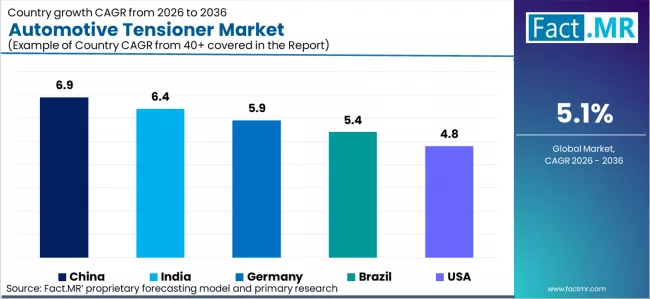
Automotive Tensioner Market Cagr Analysis By Country | Source: Fact.MR
| Country | CAGR (2026-2036) |
|---|---|
| China | 6.9% |
| India | 6.4% |
| Germany | 5.9% |
| Brazil | 5.4% |
| USA | 4.8% |
Source: Fact.MR analysis. Updated Mar 5, 2026
Source: Fact MR (FMR) analysis, based on proprietary forecasting model and primary research.
East Asia:
In East Asia, China is the leading market for automotive tensioners, driven by the rapid expansion of the automotive industry, rising vehicle production, and increasing demand for advanced automotive components.
- China: Demand for automotive tensioners in China is projected to rise at 6.9% CAGR through 2036. China’s booming automotive sector, increased vehicle production, and growing demand for advanced automotive components continue to fuel market growth.
South Asia:
In South Asia, India is a significant market for automotive tensioners, supported by the country’s expanding automotive production, rising vehicle sales, and increasing adoption of modern automotive technologies.
- India: Demand for automotive tensioners in India is projected to rise at 6.4% CAGR through 2036. India’s growing automotive industry, increased vehicle production, and rising demand for high-quality automotive components continue to drive market growth.
Western Europe:
In Western Europe, Germany is a key market for automotive tensioners, driven by the country’s strong automotive manufacturing industry, increasing demand for high-performance vehicle components, and rising adoption of advanced automotive technologies.
- Germany: Demand for automotive tensioners in Germany is projected to rise at 5.9% CAGR through 2036. Germany’s established automotive industry, growing demand for high-quality automotive components, and technological advancements in vehicle performance continue to support market demand.
North America:
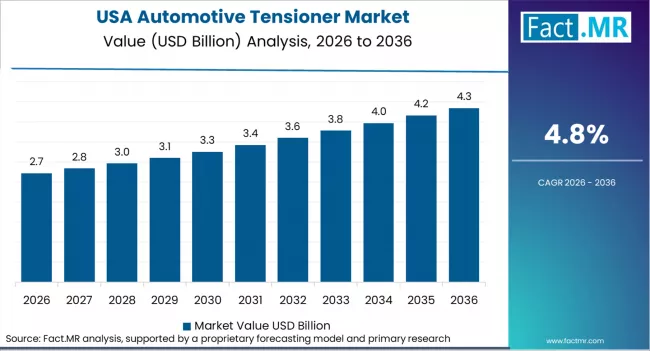
Automotive Tensioner Market Country Value Analysis | Source: Fact.MR
In North America, the USA remains a significant market for automotive tensioners, supported by the country’s large automotive production base, increasing demand for vehicle performance enhancements, and rising adoption of advanced automotive technologies.
- USA: Demand for automotive tensioners in the U.S. is projected to rise at 4.8% CAGR through 2036. The USA’s strong automotive sector, rising demand for performance-enhancing vehicle components, and advancements in automotive technology continue to fuel market growth.
Latin America:
In Latin America, Brazil is the largest market for automotive tensioners, driven by the country’s expanding automotive production, rising vehicle sales, and increasing demand for advanced vehicle components.
- Brazil: Demand for automotive tensioners in Brazil is projected to rise at 5.4% CAGR through 2036. Brazil’s growing automotive industry, increased vehicle production, and rising demand for advanced automotive components continue to contribute to market growth.
Fact MR's analysis of the Automotive Tensioner Market in East Asia, South Asia, Western Europe, North America, and Latin America consists of country-wise assessments that include China, India, Germany, Brazil, and the USA. Readers can find detailed trends, regulatory updates, and company-specific investments shaping the market’s growth in these countries.
What is the Competitive Structure and Buyer Behavior in the Automotive Tensioner Market?
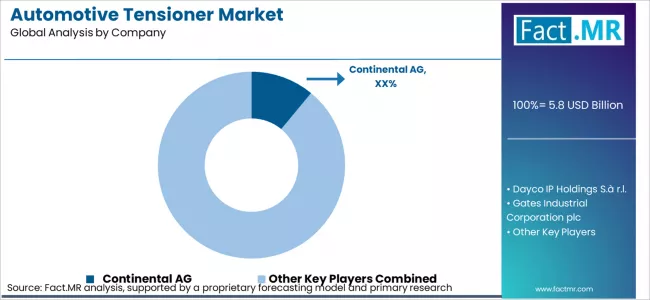
Automotive Tensioner Market Analysis By Company | Source: Fact.MR
The automotive tensioner market is moderately concentrated, with several established global suppliers such as Continental AG, Dayco IP Holdings S.à r.l., Gates Industrial Corporation plc, Litens Automotive Group, Inc., and NTN Corporation capturing a significant share, alongside regional and specialist manufacturers like Mubea Group, Tsubakimoto Chain Co., KMC Automotive, Inc., Pricol Limited, and ABA Automotive Products Pvt. Ltd. The primary competitive variables are product durability, precision performance, compatibility with diverse powertrain platforms, and total cost of ownership. Firms with broad original equipment manufacturer (OEM) relationships, integrated supply chains, and engineering capabilities hold structural advantages, enabling them to support tight automotive quality standards, global production footprints, and just‑in‑time delivery. Large automotive OEMs and tier‑1 integrators exert notable buyer leverage by qualifying multiple suppliers, negotiating long‑term contracts, and specifying stringent performance standards tied to warranty commitments. To manage supplier dependency, these buyers diversify approved vendors and standardize technical specifications, which limits individual suppliers’ pricing power. As a result, competition centers on consistent quality, supply assurance, and technical support rather than pricing alone.
Recent Industry Developments
- Hybrid-Specific Tensioning Launch: In early 2026, Dayco released its newest ELA® (Elastic) serpentine belt and tensioner lineup specifically designed for high-load hybrid pickup trucks and SUVs, offering a patented flat-spring design that reduces accessory bearing wear in start-stop driving modes.
- Next-Gen Powertrain Showcasing: At the SIAT 2026 conference in late January, Schaeffler India debuted its "Euro 7 ready" powertrain technologies, which include advanced tensioning systems designed to maintain precise synchronization for real-time emissions monitoring and reduced friction
Key Players of the Automotive Tensioner Market
- Continental AG
- Dayco IP Holdings S.à r.l.
- Gates Industrial Corporation plc
- Litens Automotive Group, Inc.
- NTN Corporation
- Mubea Group (August Mubea GmbH & Co. KG)
- Tsubakimoto Chain Co.
- KMC Automotive, Inc.
- Pricol Limited
- ABA Automotive Products Pvt. Ltd.
Report Scope
| Metric | Value |
|---|---|
| Quantitative Units | USD 5.8 billion (2026) to USD 9.5 billion (2036), at a CAGR of 5.1% |
| Market Definition | The Automotive Tensioner Market involves the production and application of automotive tensioners used in timing belts, timing chains, and auxiliaries drive belts for various vehicle types. |
| By Type | Timing Belt Automotive Tensioner, Timing Chain Automotive Tensioner, Auxiliaries Drive Belt Automotive Tensioner |
| By Sales Channel | OEMs, Aftermarket |
| By Vehicle Type | Passenger Car (PC), 2-Wheeler, Commercial Vehicle, Light Commercial Vehicle (LCV), Heavy Commercial Vehicle (HCV) |
| Regions Covered | North America, Latin America, Europe, East Asia, South Asia, Oceania, Middle East and Africa |
| Countries Covered | United States, Canada, Mexico, Brazil, Argentina, Germany, France, United Kingdom, Italy, Spain, China, India, Japan, South Korea, Indonesia, Australia, and 40+ countries |
| Key Companies Profiled | Continental AG, Dayco IP Holdings S.à r.l., Gates Industrial Corporation plc, Litens Automotive Group, Inc., NTN Corporation, Mubea Group (August Mubea GmbH & Co. KG), Tsubakimoto Chain Co., KMC Automotive, Inc., Pricol Limited, ABA Automotive Products Pvt. Ltd. |
| Forecast Period | 2026 to 2036 |
| Approach | Hybrid top-down and bottom-up market modeling validated through primary interviews with manufacturers and supported by trade data benchmarking and market research. |
Source: Fact.MR analysis. Updated Mar 5, 2026
Bibliographies
- Gates Industrial Corporation plc. (2023). Innovation in automotive components: The future of tensioners and other powertrain solutions.
- Continental AG. (2023). Automotive tensioners: Enhancing vehicle performance and longevity.
- Dayco IP Holdings S.à r.l. (2023). The critical role of automotive tensioners in powertrain efficiency.
- Mubea Group (August Mubea GmbH & Co. KG). (2023). Advanced automotive tensioner technologies: Meeting the demand for efficient vehicle performance.
- Dayco. (2026). Dayco N.A. launches industry’s longest ELA® serpentine belt. Dayco.
- Schaeffler. (2026). Schaeffler India showcases next-generation technologies at SIAT 2026. Schaeffler.
This report addresses:
- Market intelligence enabling comprehensive assessment of leading countries and product segments across the Automotive Tensioner Market globally.
- Market volume (sales units) estimates and 10-year revenue forecasts from 2026 to 2036, validated through manufacturer shipment data, channel partner surveys, and country-level demand modeling.
- Growth opportunity mapping across product types (Timing Belt Automotive Tensioner, Timing Chain Automotive Tensioner, Auxiliaries Drive Belt Automotive Tensioner), sales channels (OEMs, Aftermarket), vehicle types (Passenger Car, 2-Wheeler, Commercial Vehicle, Light Commercial Vehicle, Heavy Commercial Vehicle), and regions.
- Segment and regional revenue forecasts by product type, sales channel, vehicle type, and geography across 40+ countries.
- Competition strategy analysis covering dealer network structure, recent developments, product portfolio, USPs, and market share analysis.
- Product and regulatory compliance tracking aligned with vehicle safety standards, environmental regulations, and automotive performance guidelines.
- Regulatory impact analysis addressing emission standards, vehicle production regulations, and performance certifications across key markets.
- Report delivery in PDF, Excel, PowerPoint, and interactive dashboard formats for executive, procurement, and operational planning use.
Segmentation
Automotive Tensioner Market Key Segments
-
Type
- Timing Belt Automotive Tensioner
- Timing Chain Automotive Tensioner
- Auxiliaries Drive Belt Automotive Tensioner
-
Sales Channel
- OEMs
- Aftermarket
-
Vehicle Type
- Passenger Car (PC)
- 2-Wheeler
- Commercial Vehicle
- Light Commercial Vehicle (LCV)
- Heavy Commercial Vehicle (HCV)
-
Region
- North America
- USA
- Canada
- Mexico
- Europe
- Germany
- UK
- France
- Italy
- Spain
- Nordic Countries
- BENELUX
- Rest of Europe
- Asia Pacific
- China
- Japan
- South Korea
- India
- Australia
- Rest of Asia Pacific
- Latin America
- Brazil
- Argentina
- Rest of Latin America
- Middle East and Africa
- Kingdom of Saudi Arabia
- United Arab Emirates
- South Africa
- Rest of Middle East and Africa
- Other Regions
- Oceania
- Central Asia
- Other Markets
- North America
Frequently Asked Questions
How large is the demand for Automotive Tensioners in the global market in 2026?
What will be the market size of Automotive Tensioners in the global market by 2036?
What is the expected demand growth for Automotive Tensioners in the global market between 2026 and 2036?
Which sales channel is expected to dominate the market?
Which region is expected to show the highest growth rate for Automotive Tensioners?
How significant is the growth outlook for India in this market?
What is the growth outlook for Germany in the Automotive Tensioners market?
What is the growth forecast for Brazil in the Automotive Tensioners market?
What is the growth forecast for the United States in the Automotive Tensioners market?
Which company is identified as a leading player in the Automotive Tensioner market?
What are Automotive Tensioners used for?
What does the Automotive Tensioner market include in this report?
How is the market forecast developed in this report?
What is meant by the Automotive Tensioner market in this report?
Who worked on this report


Preview the report firsthand - request a free sample
Free SampleGet the brochure for pricing and purchase details
Download PDF