- Market Value (2025): USD 490.4 Bn
- Estimated Value (2026): USD 518.8 Bn
- Forecast Value (2036): USD 911.7 Bn
- CAGR (2026-2036): 5.8%
What is the BGA Solder Spheres Market forecast to be worth by 2036?
USD 518.82 million in 2026 to USD 911.74 million by 2036, at a 5.80% CAGR.
- As per Fact.MR analysis, the BGA solder spheres market reached USD 490.4 million in 2025.
- Demand will increase from USD 518.8 million in 2026 to USD 911.7 million in 2036.
- The market is forecast to grow at 5.8% CAGR from 2026 to 2036. Package miniaturisation and qualified lead-free assembly will support repeat orders, while tighter ball specifications increase the value of process control.
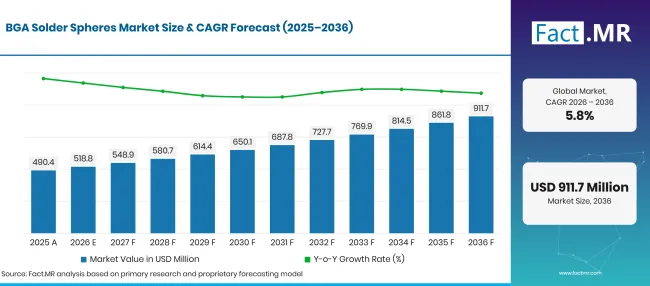
Factmr Bga Solder Spheres Market Forecast Global | Source: Fact.MR
| Year | Basis | Market Value (USD million) |
|---|---|---|
| 2025 | Actual | 490.4 |
| 2026 | Estimate | 518.8 |
| 2036 | Forecast | 911.7 |
| CAGR 2026 to 2036 | Forecast period | 5.8% |
Source: Fact.MR analysis. Updated Oct 16, 2026
What are the defining numbers behind BGA Solder Spheres Market growth?
USD 392.92 million absolute opportunity between 2026 and 2036. Fine-pitch packages create room for higher-value grades, while repeat production orders remain concentrated in established electronics assembly programmes.
- Demand Drivers in the Market
- Smaller package connections leave less room for variation in ball diameter. Senju identifies sphericity and dimensional control as key solder-ball attributes. For an assembly plant, the commercial benefit is fewer placement problems and more consistent solder volume across a package. A low unit price loses its appeal when it raises the cost of rejected assemblies. [8]
- Lead restrictions keep lead-free alloys central to electronics purchasing. The European Commission’s RoHS framework restricts lead in covered equipment, subject to applicable exemptions. Buyers therefore need an alloy declaration that matches the finished product’s compliance requirements. Demand is tied to the approved assembly specification rather than a general claim that every leaded grade must disappear. [1]
- Advanced packaging creates additional qualification work for ball suppliers. Fraunhofer IZM describes balling on modules, wafers and panels using different placement processes. In interposer and fan-out wafer-level packaging, the opportunity depends on which connections actually use solder spheres and the tolerances required at those connections. [2]
- Reliability requirements can support a premium over commodity alloy pricing. Fraunhofer evaluates solder joints under thermal cycling and electromigration conditions. Automotive and industrial customers buying for demanding service conditions have reason to qualify a grade carefully before committing to repeat orders. The relevant test is joint performance in the package, not alloy composition alone. [3]
- Key Segments Analyzed
- By Type: Lead-Free accounts for 67.3% of 2026 revenue. Compliance requirements and established electronics assembly specifications support this position.
- By Application: Consumer Electronics contributes 38.6% in 2026. Large production programmes create recurring orders after package qualification.
- By Distribution Channel: Offline represents 81.4% of 2026 sales, reflecting direct technical engagement and contracted supply.
- Analyst Opinion at Fact.MR
- Shambu Nath Jha, Lead Analyst at Fact.MR says, “The strongest account is a production programme that keeps calling off the same qualified grade. Sphere makers should compete on lot consistency and application support rather than treating every fine-pitch design as an automatic premium sale. Customers pay more when the material solves a measurable assembly problem”
- Strategic Implications
- Sell the process fit as well as the alloy. A customer evaluating liquid flux also needs to know how the selected spheres wet and behave during reflow. Joint trials should settle material compatibility before the purchasing team negotiates a long supply agreement. [2] [3]
- Keep solder-ball revenue separate from die attach materials in customer planning. Both enter semiconductor assembly, but the bond beneath a die and the package’s external connections perform different jobs. Account teams should map the relevant assembly step before proposing an alternative material. [2]
- Offer documented diameter ranges rather than an open-ended customisation promise. Indium lists spheres across a range of sizes and alloys. A clear sampling plan, lot identification and replenishment schedule can make a specialist grade easier for a customer to approve and reorder. [4]
- Give low-alpha grades a specific technical sales case. Mitsubishi Materials offers low-alpha solder for semiconductor applications. These grades should be discussed with customers whose device requirements justify them, rather than added as an unexplained premium to every consumer-electronics order. [5]
Brazil has the fastest projected growth among the five countries. The commercial routes differ: packaging investment creates development work in the United States, while materials qualification and established electronics supply relationships carry more weight in Germany and Japan.
How does the BGA Solder Spheres Market break down by segment?
Lead-Free 67.3%; Consumer Electronics 38.6%; Offline 81.4% in 2026.
Which Type segment leads demand?
The Lead-Free segment holds 67.3% share in 2026.
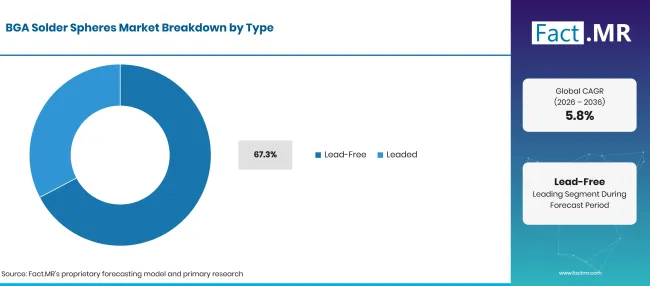
Factmr Bga Solder Spheres Market Breakdown Type | Source: Fact.MR
| Type | Share (2026) |
|---|---|
| Lead-Free (Leading segment) | 67.3% |
| Leaded | 32.7% |
| Total | 100.0% |
Source: Fact.MR analysis. Updated Oct 16, 2026
Lead-free and leaded spheres coexist because assemblies have different compliance and performance requirements. A lead-free designation does not identify a single alloy or guarantee suitability for every reflow profile. Buyers need the composition, diameter range and handling information for the exact grade. Where an exemption applies, the decision to retain a leaded material still belongs to the finished-product specification. [1] [4]
Which Application segment leads demand?
The Consumer Electronics segment holds 38.6% share in 2026.
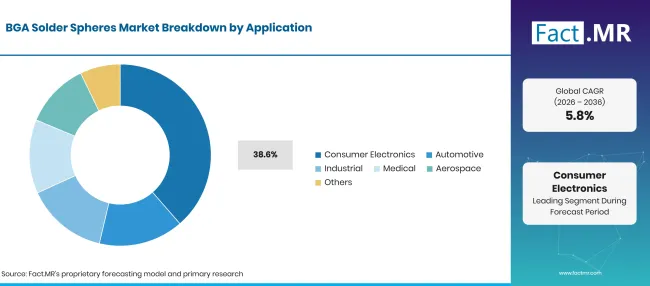
Factmr Bga Solder Spheres Market Breakdown Application | Source: Fact.MR
| Application | Share (2026) |
|---|---|
| Consumer Electronics (Leading segment) | 38.6% |
| Other segments combined | 61.4%* |
| Total | 100.0% |
Source: Fact.MR analysis. Updated Oct 16, 2026
Consumer electronics provides repeat high-volume programmes, but the other applications place different demands on qualification. A medical device and an automotive module cannot share a reliability assumption merely because both contain BGA packages. Customers also compare ball placement with dispensable solder pastes where the assembly design permits either process. The chosen deposition method determines which material receives the order. [3] [2]
Which Distribution Channel segment leads demand?
The Offline segment holds 81.4% share in 2026.
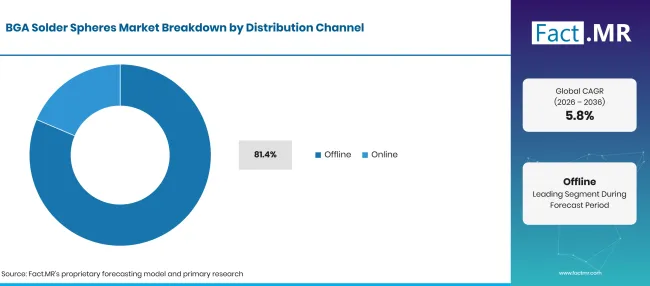
Factmr Bga Solder Spheres Market Breakdown Distribution Channel | Source: Fact.MR
| Distribution Channel | Share (2026) |
|---|---|
| Offline (Leading segment) | 81.4% |
| Online | 18.6% |
| Total | 100.0% |
Source: Fact.MR analysis. Updated Oct 16, 2026
Offline supply is important because approval often starts with engineering discussions and trial quantities. Direct manufacturer support helps resolve alloy and diameter questions before a plant moves into regular production. Online ordering is better suited to an already specified grade or a smaller purchase. The channel itself does not replace batch documentation or an agreed acceptance specification. [4]
What is accelerating BGA Solder Spheres Market adoption, and what is holding it back?
Growth is strongest where a new package enters repeat production or an existing programme adopts a more demanding sphere specification. Long qualification cycles restrain supplier switching. Metal-price movements can change invoiced revenue without an equivalent change in the number of balls shipped.
Drivers Impact Analysis
| DRIVER | (~) % IMPACT ON CAGR | GEOGRAPHIC RELEVANCE | IMPACT TIMELINE |
|---|---|---|---|
| Fine-pitch package production | +1.5% | East Asia, United States | Medium term (2 to 4 years) |
| Qualified lead-free alloy demand | +1.1% | Europe and global exporters | Short term (up to 2 years) |
| Automotive joint-reliability requirements | +0.8% | Germany, Japan, United States | Medium term (2 to 4 years) |
| Wafer- and panel-level balling | +0.7% | Advanced packaging centres | Long term (4 years or more) |
| Repeat orders on approved assembly lines | +0.5% | Global | Short term (up to 2 years) |
Source: Fact.MR analysis. Updated Oct 16, 2026
Opportunity Impact Analysis
| OPPORTUNITY | (~) % IMPACT ON CAGR | GEOGRAPHIC RELEVANCE | IMPACT TIMELINE |
|---|---|---|---|
| Tighter diameter-control grades | +1.0% | Fine-pitch electronics programmes | Medium term (2 to 4 years) |
| Low-alpha product qualification | +0.6% | Japan, East Asia, United States | Long term (4 years or more) |
| Customer-specific alloy sampling | +0.4% | Industrial and specialist assemblers | Short term (up to 2 years) |
| Local technical support for new packaging lines | +0.7% | United States, Brazil | Medium term (2 to 4 years) |
Source: Fact.MR analysis. Updated Oct 16, 2026
Restraints Impact Analysis
| RESTRAINT | (~) % IMPACT ON CAGR | GEOGRAPHIC RELEVANCE | IMPACT TIMELINE |
|---|---|---|---|
| Lengthy package qualification | -0.8% | Global | Medium term (2 to 4 years) |
| Placement defects and rejected lots | -0.7% | High-density assembly lines | Short term (up to 2 years) |
| Metal-cost and selling-price pressure | -0.6% | Global | Short term (up to 2 years) |
| Alternative interconnect processes | -1.0% | Advanced packaging programmes | Long term (4 years or more) |
Source: Fact.MR analysis. Updated Oct 16, 2026
Which countries are scaling the BGA Solder Spheres Market through 2036?
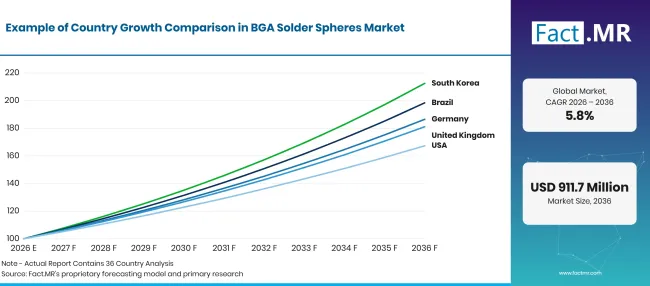
Factmr Bga Solder Spheres Market Growth Index | Source: Fact.MR
| Country | CAGR (2026 to 2036) |
|---|---|
| Germany | 6.4% |
| Brazil | 7.0% |
| United States | 5.2% |
| United Kingdom | 6.1% |
| Japan | 4.1% |
Source: Fact.MR analysis. Updated Oct 16, 2026
Why does Germany reward reliability-led selling?
6.4% CAGR. Qualification work creates opportunities for technically differentiated grades.
Germany’s opportunity is closely connected to package reliability and process development. Fraunhofer IZM offers solder-joint analysis and balling capabilities that address the problems an assembler faces before releasing a design. This favours sphere suppliers able to support trials and explain lot variation. Commercial progress is likely to come through approved automotive, industrial and electronics programmes rather than a rapid switch of all buyers to one alloy. [3] [2]
How can Brazil turn semiconductor policy into material orders?
7.0% CAGR. Local assembly development is the main route to a larger customer base.
Brazil’s 2024 Brasil Semicon law provides a policy framework for semiconductor activity. For solder-sphere companies, the useful question is which supported projects include packaging or assembly operations that consume the material. Technical distributors can help local customers source samples and maintain qualified stock. The growth opportunity depends on operating lines and repeat purchases; incentives by themselves do not establish sphere volumes. [7]
What matters most in the United States?
5.2% CAGR. Advanced-packaging investment opens a qualification window.
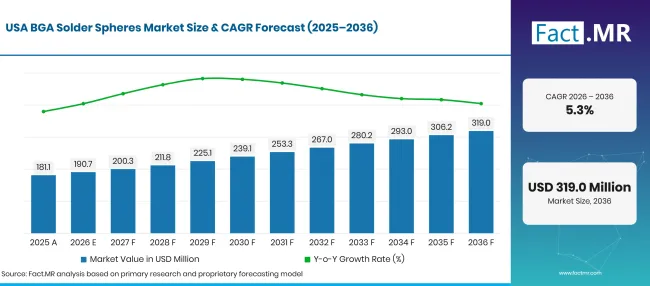
Factmr Bga Solder Spheres Market Forecast Usa | Source: Fact.MR
In January 2025, the U.S. Commerce Department announced $1.4 billion in final advanced-packaging awards. New facilities and process development create occasions for sphere suppliers to enter customer evaluations. The strongest proposals connect an alloy grade to a particular package and placement process. Revenue follows qualification and production ramp-up, so procurement timing matters more than the headline value of the awards. [6]
What shapes purchasing in the United Kingdom?
6.1% CAGR. Documentation and specialist supply support qualified electronics work.
UK RoHS guidance places material compliance within the obligations of businesses supplying covered electrical equipment. Sphere vendors serving these customers need clear declarations and traceable grades. Specialist electronics production can also favour smaller qualified lots rather than the lowest possible bulk price. A distributor with dependable access to the right material can compete effectively when an assembler cannot absorb a long interruption. [9]
Why is Japan a demanding materials market?
4.1% CAGR. Established suppliers raise expectations for grade consistency.
Japan has documented solder-ball expertise through Senju and low-alpha solder capability through Mitsubishi Materials. This gives buyers a technically developed supply base against which to assess new offers. A newcomer needs a specific advantage in alloy performance or service rather than a broad miniaturisation claim. Qualification of demanding semiconductor grades is a more credible route to account growth than undercutting every established sphere specification. [8] [5]
Who leads the BGA Solder Spheres Market?
Senju and Indium illustrate two practical competitive strengths: controlled ball geometry and a documented choice of specialty sizes and alloys. Customers compare these attributes with the supplier’s ability to reproduce the result at the next shipment. Technical support becomes particularly valuable when a customer changes a package layout or encounters a solder-joint problem. [8] [4]
The wider supplier comparison spans solder specialists and semiconductor-materials businesses. The most useful shortlists are grade-specific: alloy, ball size and demonstrated process fit come before corporate scale. Supply agreements are likely to remain concentrated among vendors that can maintain quality through production changes and respond quickly when a lot is questioned.
Which companies are the key providers?
Company coverage includes the solder and semiconductor-material suppliers below. Product availability varies by alloy, diameter and region.
- Senju Metal Industry Co., Ltd.
- Nippon Micrometal Corporation
- Indium Corporation
- DS HiMetal Co., Ltd.
- Shenmao Technology Inc.
- YCTC
- Accurus Scientific Co., Ltd.
- Proterial Ltd.
- MKE
- Nihon Superior Co., Ltd.
Bibliography
- [1] European Commission. (n.d.). Restriction of hazardous substances in electrical and electronic equipment (RoHS).
- [2] Fraunhofer Institute for Reliability and Microintegration IZM. (n.d.-a). Balling for SiP / balling for interposer.
- [3] Fraunhofer Institute for Reliability and Microintegration IZM. (n.d.-b). Soldering.
- [4] Indium Corporation. (n.d.). Specialty solder spheres.
- [5] Mitsubishi Materials Corporation. (n.d.). Low alpha solder / plating chemicals.
- [6] National Institute of Standards and Technology. (2025, January 16). U.S. Department of Commerce announces $1.4 billion in final awards to support the next generation of U.S. semiconductor advanced packaging.
- [7] Presidência da República. (2024, September 11). Lei nº 14.968, de 11 de setembro de 2024.
- [8] Senju Metal Industry Co., Ltd. (n.d.). Solder ball.
- [9] Office for Product Safety and Standards, Department for Business and Trade, & Department for Environment, Food & Rural Affairs. (2025, July 22). Regulations: Restriction of hazardous substances (RoHS). GOV.UK.
This Report Answers
- Which ball specifications justify a premium over standard alloy pricing?
- How do lead-free purchasing requirements coexist with qualified leaded applications?
- Where do packaging investments create a realistic route to repeat sphere orders?
- Why do direct technical supply relationships remain important?
- How do reliability requirements change supplier selection across applications?
What does the BGA Solder Spheres Market cover?
The market covers preformed solder spheres sold for BGA and related package interconnections. Product type distinguishes lead-free from leaded material. Application and distribution-channel views describe where those same sphere sales are used and purchased.
What is included in the scope?
Included products are finished solder spheres supplied to packaging and assembly operations within the listed applications. Specialist grades remain within scope when they are sold as solder spheres. Sales are assessed at the material-product level.
What is excluded from the scope?
Solder paste, flux and bulk solder bar are excluded. Semiconductor packages, assembly equipment and separate testing-service fees do not form part of sphere revenue. Die-attach adhesives and interconnect systems that do not use solder spheres are outside the boundary.
How Was the Analysis Built?
The analysis draws on 120+ sources, 35+ company portfolios, 25+ countries, and more than 20 industry interviews.
- Primary Research: Primary research includes discussions with manufacturers, service providers, technology developers, distributors, end users, and subject-matter experts. These conversations examine purchasing priorities, product adoption, operational challenges, approval requirements, competitive positioning, and the factors that influence wider market acceptance.
- Desk Research: Desk research covers government statistics, regulatory publications, company filings, trade data, technical studies, industry associations, standards, public policy, and other authoritative sources. Every source used in the analysis is documented in the bibliography.
- Market Sizing and Forecasting: Market estimates combine historical performance, demand indicators, pricing and volume trends, segment shares, company participation, country-level growth, adoption patterns, investment activity, and barriers to market expansion.
- Data Validation and Update Cycle: Findings are validated by comparing primary interviews with public data, company activity, regulatory changes, trade patterns, and industry developments. Regular updates review new product launches, capacity changes, partnerships, approvals, and shifts in commercial adoption.
Segmentation
What is the report’s scope and coverage?
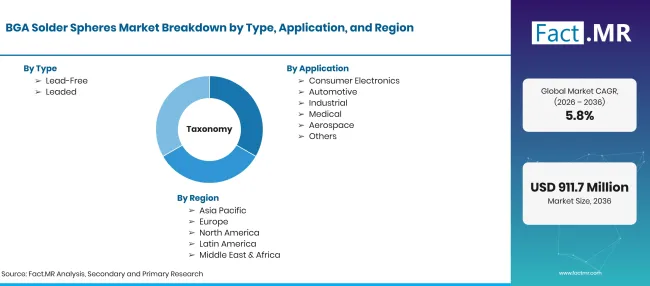
Factmr Bga Solder Spheres Market Taxonomy | Source: Fact.MR
| Attribute | Details |
|---|---|
| Quantitative Units | USD million in 2026 and 2036; CAGR for 2026 to 2036 |
| Market Definition | Preformed solder spheres used to create electrical and mechanical connections in ball-grid-array and related semiconductor package assemblies. |
| Type | Lead-Free; Leaded |
| Application | Consumer Electronics; Automotive; Industrial; Medical; Aerospace; Others |
| Distribution Channel | Offline; Online |
| Regions Covered | North America; Latin America; Western Europe; Eastern Europe; East Asia; South Asia & Pacific; Middle East & Africa |
| Countries Covered | Germany; Brazil; United States; United Kingdom; Japan |
| Companies Profiled | Senju Metal Industry Co., Ltd.; Nippon Micrometal Corporation; Indium Corporation; DS HiMetal Co., Ltd.; Shenmao Technology Inc.; YCTC; Accurus Scientific Co., Ltd.; Proterial Ltd.; MKE; Nihon Superior Co., Ltd. |
| Forecast Period | 2026 to 2036 |
| Approach | Assessment of alloy choice, sphere geometry, assembly qualification, packaging investment and supplier product ranges. |
Source: Fact.MR analysis. Updated Oct 16, 2026
How is the market segmented?
-
By Type
- Lead-Free
- Leaded
-
By Application
- Consumer Electronics
- Automotive
- Industrial
- Medical
- Aerospace
- Others
-
By Distribution Channel
- Offline
- Online
-
By Region
- North America
- Latin America
- Western Europe
- Eastern Europe
- East Asia
- South Asia & Pacific
- Middle East & Africa
Frequently Asked Questions
How big is the BGA solder spheres market in 2026?
What is the CAGR from 2026 to 2036?
Which type segment leads?
Which application segment leads?
What makes a supplier competitive?
Who worked on this report


Preview the report firsthand - request a free sample
Free SampleGet the brochure for pricing and purchase details
Download PDF