- Base Value(2025): 781 Mn
- Estimated Value(2026): 900 Mn
- Forecast Value (2036): 3600 Mn
- CAGR (2026 - 2036): 15.2%
Bidirectional Charging Safety Accessories Market Forecast 2026 to 2036
In 2025, the bidirectional charging safety accessories market was valued at USD 781 million. Based on Future Market Insights’ analysis, demand is estimated to grow to USD 900 million in 2026 and USD 3,600 million by 2036, at a 15.2% CAGR. This represents an absolute dollar growth of USD 2,700 million, a transformational shift as EVs become grid-interactive assets. While home energy resilience needs keep growth steady, expansion is limited by regulatory costs for anti-islanding certifications and feedstock volatility in high-grade copper and semiconductors.
Industry leaders view these safety interfaces as essential for a stable energy future. As Enric Asunción, CEO of Wallbox, noted regarding V2X technology, 'V2X charging has the potential to enable a new energy paradigm by offering cost savings for everyday customers, facilitating the adoption of electric vehicles, and helping build the infrastructure required for a climate resilient future' [1].
Regionally, India leads with a 16.4% CAGR, followed by China (15.6%) and the USA (14.2%). Conversely, Germany (12.8%), the UK (12.1%), and Japan (10.2%) are mature markets driven by replacement demand. A key structural constraint for this group is interoperability lag, as legacy electrical panels require expensive upgrades to safely handle bidirectional power flows.
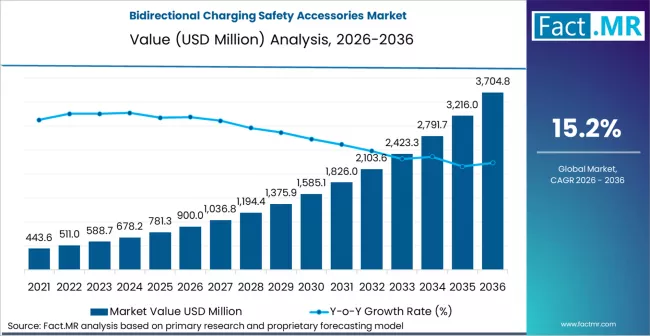
Bidirectional Charging Safety Accessories Market Market Value Analysis | Source: Fact.MR
Bidirectional Charging Safety Accessories Market
This market involves specialized safety hardware, such as isolation switches and surge protectors, designed to manage two-way electricity flow between EVs and external loads. These components perform the primary industrial function of back-feed prevention and grid synchronization, ensuring that discharging power does not cause electrical hazards. The key end-use is in Vehicle-to-Home (V2H) and Vehicle-to-Grid (V2G) setups, where they safely turn an EV into a backup power source for buildings.
What the Report Covers
The report details global and regional market sizes for the 2026 to 2036 forecast period. It segments the industry by product type (isolation switches and protection modules), use case (V2H and V2G), and end-user. Analytical dimensions include regional pricing benchmarks and trade flow analysis, focusing on the adoption of global ISO safety standards.
What the Report Does Not Cover
The scope excludes bidirectional inverters and standard charging cables. It also omits software-only management platforms and large-scale industrial stationary storage (BESS). Niche applications like wireless inductive charging are excluded to focus strictly on mechanical and electrical safety hardware for the bidirectional interface.
- Primary Research: We interviewed electrical safety engineers and grid operators to assess hardware failure rates and regulatory compliance needs.
- Desk Research: Analysts reviewed international safety standards, municipal building codes, and manufacturer technical specifications for electrical components.
- Market-Sizing and Forecasting: A hybrid model was used, combining top-down grid-modernization budgets with bottom-up sales data from specialized safety hardware manufacturers.
Data Validation and Update Cycle
Outputs are cross-verified against testing lab certifications and updated semi-annually to reflect evolving bidirectional charging regulations.
Bidirectional Charging Safety Accessories Market Definition:
The market includes safety hardware designed for bidirectional charging systems, ensuring safe electricity flow between electric vehicles (EVs) and external loads. Key products include isolation switches, ground fault modules, and connector interlocks, primarily used in Vehicle-to-Home (V2H) and Vehicle-to-Grid (V2G) systems.
Demand Drivers in the Market:
- Grid Integration: The shift from unidirectional to bidirectional charging systems is driving the demand for advanced safety accessories.
- Home Energy Resilience: Increased adoption of V2H and V2G systems for home energy backup fuels the need for safety solutions.
- Regulatory Compliance: Stricter regulations, such as IEC 61851 and UL 9741, are pushing manufacturers toward certified safety components.
Key Segments Analyzed in the Report:
- Safety Accessory Type: Isolation/Transfer Switch Hardware, Ground Fault and RCD Modules, Connector Interlocks, Other.
- Use Case: Vehicle-to-Home (V2H) (51% of market share by 2026), Vehicle-to-Load (V2L), Vehicle-to-Grid (V2G), Other.
- Power Rating: Up to 3.6 kW, 3.6-11 kW (47% market share by 2026), Above 11 kW, Other.
- Sales Channel: OEM/Charger Bundled, Electrical Distributors, Online D2C, Other.
Analyst Opinion at FMI:
The market is transitioning into a critical infrastructure component for grid stability, where bidirectional charging systems demand advanced safety features to ensure seamless energy exchange between EVs and the grid.
Strategic Implications/Executive Takeaways:
- Product Innovation: Focus on developing advanced safety features like fault detection and grid synchronization.
- Regulatory Alignment: Stay ahead of evolving standards and safety certifications.
- Regional Focus: Strong growth in regions with advanced V2G and V2H infrastructure, such as Europe, Japan, and the USA.
Methodology:
Validated through primary research with electrical safety engineers and grid operators. Forecasts combine grid modernization budgets and sales data from specialized safety hardware manufacturers, with semi-annual updates.
Segmental Analysis
Bidirectional Charging Safety Accessories Market Analysis by Use Case
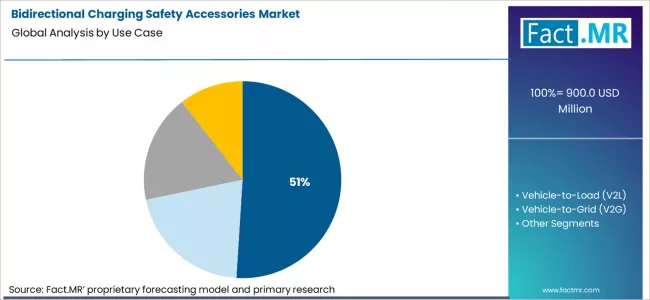
Bidirectional Charging Safety Accessories Market Analysis By Use Case | Source: Fact.MR
- Market Overview: Vehicle-to-Home (V2H) is expected to account for 51% of the bidirectional charging safety accessories market by 2026. V2H enables electric vehicles (EVs) to supply power to homes, allowing for enhanced energy flexibility and reducing dependence on the grid. This use case is gaining traction, especially with the increasing adoption of home-based renewable energy systems and electric vehicles.
- Demand Drivers:
- Energy Independence: As consumers seek more sustainable and cost-effective energy solutions, V2H allows EV owners to leverage their vehicles as backup power sources during outages or peak demand times, boosting the demand for associated safety accessories.
- Growing Residential EV Adoption: The increasing number of EVs in residential settings is fueling the demand for safe and reliable V2H systems, which require safety accessories to prevent electrical hazards and ensure efficient energy transfer between vehicles and homes.
- Smart Home Integration: V2H systems are increasingly integrated with home energy management systems, driving the need for specialized safety solutions that protect both the vehicle and home electrical infrastructure.
Bidirectional Charging Safety Accessories Market Analysis by Power Rating
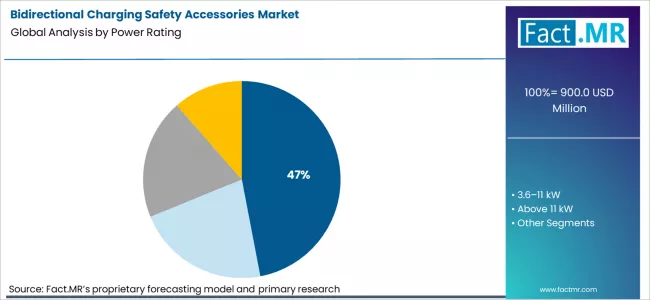
Bidirectional Charging Safety Accessories Market Analysis By Power Rating | Source: Fact.MR
- Market Overview: The 3.6-11 kW power rating range is anticipated to capture 47% of the market share by 2026. This range offers an ideal balance of power output and efficiency for both residential and small commercial applications, making it the most widely adopted for bidirectional charging systems.
- Demand Drivers:
- Optimized Performance for Residential Use: The 3.6-11 kW range provides adequate power for home charging and energy transfer needs, while still being affordable and manageable in terms of infrastructure requirements. This makes it a popular choice for homeowners seeking to use their EVs for backup power or grid support.
- Cost-Effective Solutions: The mid-range power rating offers an appealing combination of lower upfront costs and sufficient power for most household energy needs, encouraging widespread adoption of bidirectional charging systems.
- Flexibility in Power Use: This power range accommodates both personal and small business needs, allowing for scalable solutions that can meet the growing demand for energy flexibility and backup power solutions.
Bidirectional Charging Safety Accessories Market Drivers, Restraints, and Opportunities
FMR analysts observe that the bidirectional charging safety accessories market is in a growth‑transition phase, shaped by the broader emergence of vehicle‑to‑grid (V2G) and vehicle‑to‑home (V2H) technologies. Historically, EV charging focused on unidirectional energy flow, with minimal safety accessory demand; as bidirectional charging gains traction, the need for specialized safety accessories (isolation monitors, protective relays, smart disconnects) has emerged. The 2026 valuation reflects early scaling of safety accessory adoption tied to pilot programs and initial deployments of bidirectional systems rather than mature mainstream sales.
While demand for basic safety accessories remains modest, there is rising uptake of advanced protective devices designed to support dynamic power flow, grid interaction, and user safety. Although volumes for high‑end units are lower, their significantly higher price points drive net value growth in the market. The structural reality exists because bidirectional charging deployments are still limited geographically and by regulatory frameworks, meaning safety accessories are growing faster than the underlying bidirectional charger base itself.
- Grid Integration Requirements: As V2G/V2H systems expand, operators require enhanced safety accessories to manage dynamic power transfer and protect infrastructure, driving demand beyond basic protective devices.
- Regulatory Safety Standards: Standards such as UL 9741 in the U.S. and IEC 61851‑23/24 internationally are pushing manufacturers toward certified safety components, raising average unit prices even as deployment remains early stage.
- Regional Deployment Differences: In markets such as Europe and Japan where policy incentives support V2G pilots, demand for advanced safety accessories is stronger, while in many other regions adoption remains tied to slower regulatory development.
Regional Analysis
The global bidirectional charging safety accessories market is segmented into North America, Europe, and Asia-Pacific, with primary focus on regions integrating Vehicle-to-Grid (V2G) and Vehicle-to-Home (V2H) capabilities. The full report offers market attractiveness analysis.
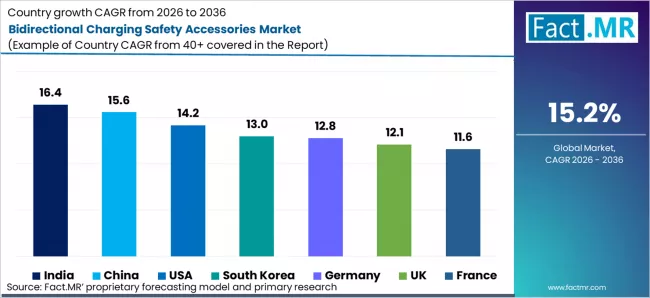
Bidirectional Charging Safety Accessories Market Cagr Analysis By Country | Source: Fact.MR
| Country | CAGR (%) |
|---|---|
| India | 16.4% |
| China | 15.6% |
| USA | 14.2% |
| Germany | 12.8% |
| UK | 12.1% |
| France | 11.6% |
| South Korea | 13.0% |
| Japan | 10.2% |
Source: Fact.MR analysis. Updated Feb 14, 2026
Source: Fact MR (FMR) analysis, based on proprietary forecasting model and primary research
The region acts as the global bidirectional grid-balancing laboratory, where stringent anti-islanding protocols and interoperability standards are currently being refined to ensure safe power export from EVs to the domestic and national grids. Key regional players include Wallbox N.V., which leads with its Quasar bidirectional hardware featuring integrated DC protection, and Fermata Energy, a prominent North American provider of V2X bidirectional charging platforms. Indra Renewable Technologies also maintains a strong competitive position in the UK and European markets through its V2H-pioneer technology.
North America Bidirectional Charging Safety Accessories Market Analysis
- United States: Demand for bidirectional charging safety accessories in the United States is projected to rise at 14.2% CAGR through 2034. Market drivers include revised federal guidance and specialized safety certifications; for instance, the Federal Highway Administration (FHWA) revised NEVI Formula Program guidance in August 2025 to prioritize project resilience and grid integration safety. Moreover, UL Solutions updated its UL 9741 standard for bidirectional EVSE in late 2024, enforcing stricter compliance for grid-support functions to prevent hazardous back-feeding during power outages.
Asia Pacific Bidirectional Charging Safety Accessories Market Analysis
- India: Demand for bidirectional charging safety accessories in India is projected to rise at 16.4% CAGR through 2034. Growth is heavily influenced by the Ministry of Heavy Industries notifying the PM E-DRIVE Scheme in September 2024, which earmarks ₹2,000 crore for public charging infrastructure, including advanced V2G-ready hubs. Additionally, the Bureau of Indian Standards (BIS) finalized IS 17017 (Part 31) in early 2024, specifically addressing the protection requirements for AC or DC EV supply equipment where safety relies on electrical separation, a critical factor for bidirectional safety.
- China: Demand for bidirectional charging safety accessories in China is projected to rise at 15.6% CAGR through 2034. The market expansion is driven by new mandatory discharge standards; specifically, the National Technical Committee of Auto Standardization implemented GB/T 18487.4-2025 in November 2025, which mandates rigorous discharge safety and communication requirements for EVs. Furthermore, the Ministry of Industry and Information Technology (MIIT) updated its GB38031-2025 safety standard in April 2025, adding short-circuit tests after 300 fast-charging cycles to ensure battery stability during bidirectional energy flow.
- South Korea: Demand for bidirectional charging safety accessories in South Korea is projected to rise at 13.0% CAGR through 2034. Growth is fueled by a massive overhaul of battery safety oversight; the Ministry of Land, Infrastructure, and Transport launched a pilot program for EV Battery Safety Certification in December 2024, requiring certification for all bidirectional-capable management systems. In addition, the Ministry of Environment finalized the 2025 Hydrogen and Electric Vehicle Subsidy Guidelines in January 2025, prioritizing infrastructure with enhanced thermal and electrical safety monitors.
- Japan: Demand for bidirectional charging safety accessories in Japan is projected to rise at 10.2% CAGR through 2034. Market demand is sustained by disaster-resilience strategies and digital transformation goals; the Ministry of Economy, Trade and Industry (METI) formulated the Mobility Digital Transformation (DX) Strategy in May 2024 to accelerate V2G deployment. Furthermore, the Japanese Standards Association (JSA) updated its guidelines for V2H and V2L equipment in mid-2025 to include enhanced grounding and anti-islanding safety requirements for residential backup systems.
Europe Bidirectional Charging Safety Accessories Market Analysis
- Germany: Demand for bidirectional charging safety accessories in Germany is projected to rise at 12.8% CAGR through 2034. Growth is catalyzed by recent legislative breakthroughs; the German Parliament adopted an amendment to the Energy Industry Act (EnWG) in November 2025 to abolish double grid fees for bidirectional charging, effective 2026. Additionally, the Federal Network Agency (BNetzA) finalized the MiSpeL technical framework in early 2026, providing the standardized technical foundation for V2G hardware without the need for secondary meters.
- United Kingdom: Demand for bidirectional charging safety accessories in the UK is projected to rise at 12.1% CAGR through 2034. The market is propelled by new grid-support regulations; the Department for Transport (DfT) fully implemented the Public Charge Point Regulations in November 2024, requiring all new public chargers over 8kW to support smart data sharing. Furthermore, the Office for Zero Emission Vehicles (OZEV) expanded its V2X Innovation Programme in 2024 to support the commercialization of safety-critical hardware for domestic vehicle-to-everything applications.
- France: Demand for bidirectional charging safety accessories in France is projected to rise at 11.6% CAGR through 2034. Key growth factors include ecological subsidies and updated performance scores; the French Ministry for the Ecological Transition extended the Advenir Program in December 2023, offering specific bonuses for smart, bidirectional-capable charging points. Moreover, AVERE-France published updated quality and security standards for bidirectional stations in April 2025, aligning with EU Regulation 2023/1804 (AFIR) regarding safe grid-interactive infrastructure.
How Are Key Players Competing in the Bidirectional Charging Safety Accessories Market?
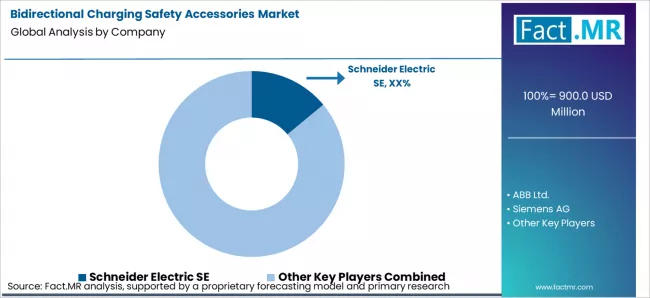
Bidirectional Charging Safety Accessories Market Analysis By Company | Source: Fact.MR
The bidirectional charging safety accessories market is growing rapidly, with key players like Schneider Electric SE, ABB Ltd., and Siemens AG focusing on providing solutions that ensure safe and efficient energy flow between electric vehicles (EVs) and the grid. These companies prioritize safety, integrating protective features in their accessories to prevent overloads, short circuits, and other electrical hazards. Eaton Corporation plc and Legrand SA are also innovating with advanced power management systems, offering smart, reliable charging solutions for both residential and commercial users. Wallbox N.V., Enphase Energy, Inc., and Generac Holdings Inc. are addressing the growing demand for home-based energy storage and vehicle-to-grid (V2G) solutions, while Tesla, Inc. continues to enhance its charging ecosystem with added safety features for bidirectional charging.
Recent Industry Developments
- Safety Standard - ANSI/UL 9741 (Electric Vehicle Power Export Equipment) First Edition (Sep 29, 2023): UL published ANSI/UL 9741 to define safety and performance requirements for bidirectional EV power export equipment, shaping compliant safety accessory designs (islanding protection, interconnection, export control). [2]
- Certification - Fermata Energy FE-20 first UL 9741 + UL 1741 SA certified V2G system (Oct 11, 2023): UL Solutions announced Fermata Energy’s FE-20 as the first bidirectional/V2G charging system certified to UL 9741 and UL 1741 SA, validating grid-interactive safety behavior. [3]
- Certification - Wallbox Quasar 2 UL compliance for the U.S. market (Jan 13, 2024): Wallbox announced that Quasar 2 received a UL Solutions certificate of compliance (UL Mark) for the U.S., supporting safer bidirectional charging deployments that rely on compliant protection and isolation accessories. [4]
Key Players of the Bidirectional Charging Safety Accessories Market
- Schneider Electric SE
- ABB Ltd.
- Siemens AG
- Eaton Corporation plc
- Legrand SA
- Delta Electronics, Inc.
- Wallbox N.V.
- Enphase Energy, Inc.
- Generac Holdings Inc.
- Tesla, Inc.
Report Scope
| Metric | Value |
|---|---|
| Quantitative Units | USD 900 million (2026) to USD 3,600 million (2036), at a CAGR of 15.2% |
| Market Definition | The Bidirectional Charging Safety Accessories Market includes products designed to ensure the safe operation of bidirectional charging systems, protecting both vehicles and infrastructure. |
| By Safety Accessory Type | Isolation/Transfer Switch Hardware, Ground Fault and RCD Modules, Connector Interlocks, Other |
| By Use Case | Vehicle-to-Home (V2H), Vehicle-to-Load (V2L), Vehicle-to-Grid (V2G), Other |
| By Power Rating | Up to 3.6 kW, 3.6-11 kW, Above 11 kW, Other |
| By Sales Channel | OEM/Charger Bundled, Electrical Distributors, Online D2C, Other |
| Regions Covered | North America, Latin America, Europe, East Asia, South Asia, Oceania, Middle East and Africa |
| Countries Covered | United States, Canada, Mexico, Brazil, Argentina, Germany, France, United Kingdom, Italy, Spain, China, India, Japan, South Korea, Indonesia, Australia, and 40+ countries |
| Key Companies Profiled | Schneider Electric SE, ABB Ltd., Siemens AG, Eaton Corporation plc, Legrand SA, Delta Electronics, Inc., Wallbox N.V., Enphase Energy, Inc., Generac Holdings Inc., Tesla, Inc. |
| Forecast Period | 2026 to 2036 |
| Approach | Hybrid top-down and bottom-up market modeling validated through primary interviews with manufacturers and supported by trade data benchmarking and market research. |
Source: Fact.MR analysis. Updated Feb 14, 2026
Bibliographies
- Enric Asunción Statement: Asunción, E. (2025, November 13). V2X charging enabling a new energy paradigm. Wallbox. [1]
- Safety Standard - ANSI/UL 9741 (Electric Vehicle Power Export Equipment) First Edition: UL Solutions. (2023, September 29). ANSI/UL 9741 (Electric vehicle power export equipment) first edition. UL Solutions. [2]
- Certification - Fermata Energy FE-20 First UL 9741 + UL 1741 SA Certified V2G System: UL Solutions. (2023, October 11). Fermata Energy FE-20 first UL 9741 + UL 1741 SA certified V2G system. UL Solutions. [3]
- Certification - Wallbox Quasar 2 UL Compliance for the U.S. Market: Wallbox. (2024, January 13). Wallbox Quasar 2 UL compliance for the U.S. market. Wallbox. [4]
Segmentation
Bidirectional Charging Safety Accessories Market Key Segments
-
By Safety Accessory Type :
- Isolation/Transfer Switch Hardware
- Ground Fault and RCD Modules
- Connector Interlocks
- Other
-
By Use Case :
- Vehicle-to-Home (V2H)
- Vehicle-to-Load (V2L)
- Vehicle-to-Grid (V2G)
- Other
-
By Power Rating :
- Up to 3.6 kW
- 3.6-11 kW
- Above 11 kW
- Other
-
By Sales Channel :
- OEM/Charger Bundled
- Electrical Distributors
- Online D2C
- Other
-
Region :
- North America
- USA
- Canada
- Mexico
- Europe
- Germany
- UK
- France
- Italy
- Spain
- Nordic Countries
- BENELUX
- Rest of Europe
- Asia Pacific
- China
- Japan
- South Korea
- India
- Australia
- Rest of Asia Pacific
- Latin America
- Brazil
- Argentina
- Rest of Latin America
- Middle East and Africa
- Kingdom of Saudi Arabia
- United Arab Emirates
- South Africa
- Rest of Middle East and Africa
- Other Regions
- Oceania
- Central Asia
- Other Markets
- North America
Frequently Asked Questions
How large is the demand for Bidirectional Charging Safety Accessories in the global market in 2026?
What will be the market size of Bidirectional Charging Safety Accessories in the global market by 2036?
What is the expected demand growth for Bidirectional Charging Safety Accessories in the global market between 2026 and 2036?
Which region is expected to show the highest growth rate for Bidirectional Charging Safety Accessories?
How significant is the growth outlook for China in this market?
What is the growth outlook for the United States in this report?
Which European markets are highlighted in this analysis?
What is the growth forecast for France in the Bidirectional Charging Safety Accessories market?
How does South Korea perform in this market?
What is the expected growth rate for Japan in the forecast period?
What is the leading use case for Bidirectional Charging Safety Accessories?
Which company is identified as a leading player in the Bidirectional Charging Safety Accessories market?
What are Bidirectional Charging Safety Accessories used for?
What does the Bidirectional Charging Safety Accessories market include in this report?
How is the market forecast developed in this report?
What is meant by the Bidirectional Charging Safety Accessories market in this report?
Who worked on this report


Preview the report firsthand - request a free sample
Free SampleGet the brochure for pricing and purchase details
Download PDF