Bio-Based Ethyl Acrylate Market (2026 - 2036)
Bio-Based Ethyl Acrylate Market is segmented by Grade (Technical Grade, High Purity Grade, and Polymer Grade), Application (Coatings, Adhesives, Textiles, and Others), End-Use Industry (Paints and Coatings, Adhesives and Sealants, Textiles, and Others), and Region. Forecast for 2026 to 2036.
Core Findings
Bio-Based Ethyl Acrylate Market Forecast and Outlook 2026 to 2036
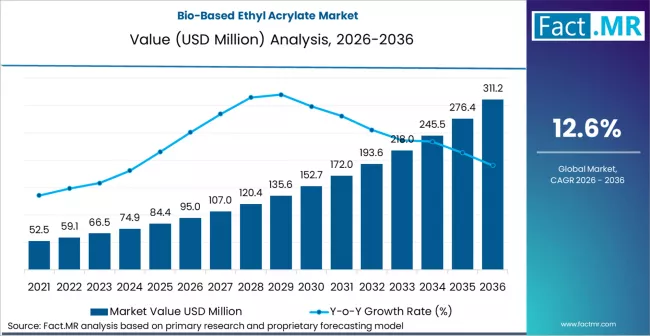
In 2025, the bio-based ethyl acrylate market was valued at USD 84 million. Based on Fact.MR analysis, demand for bio-based ethyl acrylate is estimated to reach USD 95 million in 2026 and USD 310 million by 2036. Fact.MR projects a CAGR of 12.6% during the forecast period. Market expansion reflects gradual penetration of bio-derived monomers into coatings, adhesive formulations, and textile finishing systems where performance equivalence with conventional ethyl acrylate has been demonstrated.
The market adds approximately USD 226 million in absolute value over the forecast window, indicating scale-driven growth rather than niche demand. Early-period growth is supported by technical grade adoption in coatings, where bio-based ethyl acrylate is blended into acrylic emulsions without altering curing behavior. Mid-period expansion aligns with higher uptake in adhesives and textile applications, supported by improved bio-feedstock consistency. In later years, value growth is influenced by broader polymer-grade qualification and long-term supply agreements as producers stabilize fermentation and bio-ethanol routes.
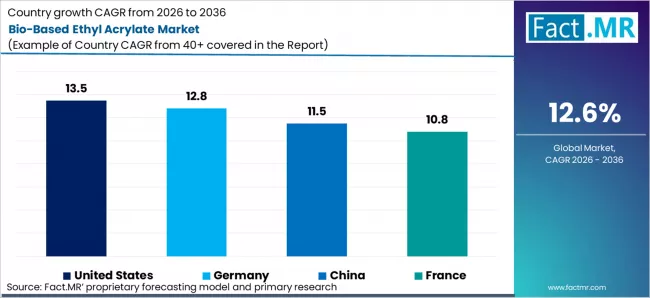
The United States leads growth at 13.5% CAGR, supported by bio-based chemical investments and coatings manufacturing capacity. Germany follows at 12.8%, driven by industrial coatings and adhesive producers evaluating low-carbon raw materials. China records 11.5%, reflecting expanding acrylic polymer demand and pilot bio-monomer integration, while France posts 10.8%, supported by specialty coatings and textile finishing applications.
Bio Based Ethyl Acrylate Market Definition
The bio based ethyl acrylate market covers the production and sale of ethyl acrylate manufactured from renewable feedstocks rather than fossil based raw materials. Bio based ethyl acrylate is used as a chemical intermediate in the manufacture of paints, coatings, adhesives, textiles, and polymer emulsions. It functions as a monomer that contributes flexibility and adhesion properties in polymer formulations. Chemical safety, industrial handling, and environmental compliance for acrylate substances are regulated under frameworks administered by the US Environmental Protection Agency and chemical oversight programs managed by the European Chemicals.
Bio Based Ethyl Acrylate Market Inclusions
The report covers global and regional market size estimates in volume and value terms with a forecast period from 2026 to 2036. Segmentation includes production pathway through bio based routes, application across paints, coatings, adhesives, and textile finishes, and end use industries including construction, packaging, automotive, and consumer goods manufacturing. The scope also includes regional demand patterns, pricing benchmarks, and international trade flows for bio based acrylate intermediates.
Bio Based Ethyl Acrylate Market Exclusions
The scope excludes fossil based ethyl acrylate produced entirely from petrochemical routes. Downstream finished paints, coatings, adhesives, and polymer products are not included. Other acrylate monomers such as methyl acrylate and butyl acrylate are excluded unless traded specifically as ethyl acrylate. Laboratory scale research batches, pilot production without commercial output, processing equipment, and contract manufacturing services are also outside the scope.
Bio Based Ethyl Acrylate Market Research Methodology
- Primary Research: Primary research involved interviews with bio chemical producers, fermentation technology providers, polymer manufacturers, and raw material suppliers.
- Desk Research: Desk research used chemical safety and substance documentation issued by the US Environmental Protection Agency and the European Chemicals Agency, along with company annual reports and regulatory filings.
- Market Sizing and Forecasting: Market sizing applied a hybrid top down and bottom up model using reported production capacities, feedstock availability, conversion yields, and downstream polymer demand indicators.
- Data Validation and Update Cycle: Outputs were cross checked against regulatory registrations, trade statistics, company disclosures, and publicly available chemical production data, with updates applied when verified public sources issue revisions.
Summary of Bio-Based Ethyl Acrylate Market
-
Market definition
- The bio-based ethyl acrylate market covers ethyl acrylate produced from renewable feedstocks and used as a monomer in coatings, adhesives, textiles, and acrylic polymer formulations requiring flexibility and adhesion performance.
-
Demand drivers
- Adoption is driven by substitution feasibility within existing acrylic value chains, where bio-based ethyl acrylate can be integrated into polymerization and formulation processes without altering curing behavior or end-use performance. Compliance with chemical reporting and safety frameworks, including acrylate substance oversight, [1] influences producer qualification and commercialization pathways.
-
Market growth dynamics
- Growth reflects scale-up of bio-based production routes rather than niche demand, supported by gradual penetration into coatings and adhesive formulations where performance parity with petro-based ethyl acrylate has been demonstrated. Emission and chemical use considerations in surface coatings applications, governed by air and chemical management guidance, shape downstream demand patterns. [2]
-
Key segments analyzed
- Technical grade bio-based ethyl acrylate leads with about 58% share due to lower purification requirements and compatibility with high-volume polymer and formulation operations. Coatings account for roughly 38% of demand, reflecting consistent consumption in architectural and industrial finishes using acrylic emulsions.
-
Regional insights
- The United States, Germany, China, and France show higher growth linked to coatings manufacturing capacity, specialty polymer demand, and evaluation of renewable monomers within established chemical infrastructure.
-
Analyst opinion at Fact.MR
- Shambhu Nath Jha, Principal Consultant at Fact.MR, opines, “CXOs will find this report useful for assessing how feedstock economics, polymer-grade qualification, and long-term supply agreements are influencing adoption of bio-based ethyl acrylate across coatings and adhesive value chains.”
-
Strategic implications
- Producers should prioritize drop-in compatibility with existing acrylic systems, secure bio-feedstock sourcing, and align output grades with coatings and adhesive formulation requirements to support sustained scale-up.
Segmental Analysis
Bio-Based Ethyl Acrylate Market Analysis by Grade
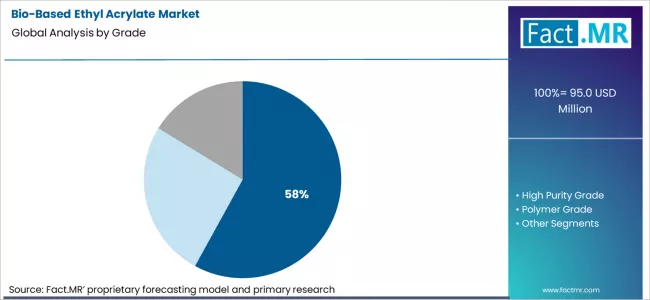
Based on Fact.MR analysis, consumption of technical grade bio-based ethyl acrylate is estimated to hold 58% share of the global market. Fact.MR analysts note this grade leads because it meets performance needs for bulk polymerization and formulation without incurring purification costs required for higher purity streams. As per Fact.MR, technical grade material addresses producer priorities for throughput, cost control, and compatibility with existing esterification and recovery equipment across coatings, adhesives, and intermediate manufacturing operations worldwide, serving large volume plants and contract supply programs in major regions today for producers globally.
- Chemical oversight: Industrial production and reporting of acrylate monomers fall under national chemical data and safety frameworks.[3]
- Manufacturing economics: Fact.MR analysts note technical grade output supports higher volumes at lower processing intensity.
- Process fit: Technical grade material aligns with existing polymerization and formulation lines.
Bio-Based Ethyl Acrylate Market Analysis by Application
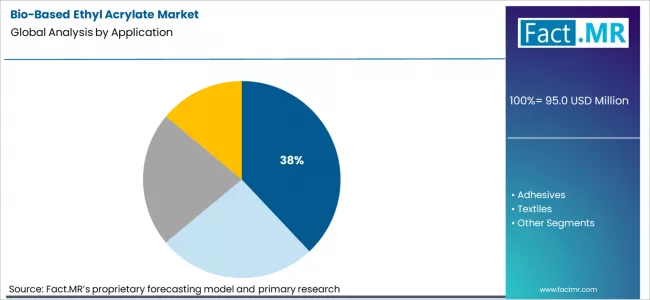
Based on Fact.MR analysis, consumption of bio-based ethyl acrylate in coatings applications is estimated to hold 38% share of the global market. Fact.MR analysts note coatings lead due to demand for film formation, adhesion, and weather resistance in architectural and industrial finishes. As per Fact.MR, this application addresses formulators needs for consistent monomer quality, scalable supply, and compatibility with acrylic emulsions used in paints, sealants, and protective systems across construction and manufacturing end uses, for large portfolios and long production runs worldwide today serving OEM specifications broadly across regions globally.
- Regulatory context: Coatings formulations are influenced by government regulations covering emissions and chemical use in surface coatings.[4]
- Formulation demand: Fact.MR analysts note coatings represent the largest volume outlet for ethyl acrylate.
- Performance needs: Acrylic-based coatings rely on stable monomer inputs for consistency.
Bio-Based Ethyl Acrylate Market Drivers, Restraints, And Opportunities
Fact.MR analysis indicates that the bio-based ethyl acrylate market exists as a bio-derived chemical intermediate segment within polymers, coatings, adhesives, and elastomers value chains. As per Fact.MR assessment, ethyl acrylate produced from renewable feedstocks serves as a precursor for acrylate polymers used in paints, pressure-sensitive adhesives, and textile finishes, where regulatory and compliance frameworks such as inclusion in the U.S. Environmental Protection Agency (EPA) Toxic Substances Control Act (TSCA) inventory determine reporting, use, and distribution obligations for chemicals manufactured or imported into the United States. Fact.MR analysts observe that the current market size reflects early-stage commercial capacity for bio-based ethyl acrylate relative to established petrochemical supply, shaped by feedstock access, production economics, and formulators’ adoption criteria.
Fact.MR is of the opinion that the market is undergoing a transition as industry stakeholders increasingly explore sustainable polymer precursors amid evolving procurement and environmental criteria. Based on Fact.MR assessment, conventional petrochemical ethyl acrylate continues to account for the majority of volume demand because of integrated refining complexes and cost advantages, while bio-based alternatives grow where sustainability performance expectations are specified. Bio-based ethyl acrylate typically carries higher per-unit pricing because of renewable feedstock sourcing, fermentation or catalytic pathways, and purification requirements, which can contribute to realised market value growth even where shipment volume expansion is moderate. Fact.MR analysis suggests that this interplay between cost dynamics and sustainability preferences will influence near-term market behaviour.
- Chemical registration compliance: Fact.MR analysts note that inclusion in frameworks such as the U.S. EPA TSCA inventory influences how manufacturers list, report, and manage bio-based ethyl acrylate in regulated markets, affecting production strategies and market entry.
- Sustainability procurement criteria: Based on Fact.MR assessment, increasing emphasis on renewable feedstocks and reduced carbon footprint supports adoption of bio-based ethyl acrylate in polymer and coating supply chains where specification of sustainable intermediates is required.
- EU chemical regulatory influence: Fact.MR opines that compliance with European Union chemical frameworks such as EU REACH affects registration, safety data requirements, and importer responsibilities for bio-based ethyl acrylate in European markets.
Regional Analysis
Based on regional assessment, the bio based ethyl acrylate sector is analyzed across North America, Europe, East Asia, and other major chemical manufacturing regions, spanning more than 40 countries. Regional performance varies according to adoption of bio-based monomers, investment in renewable feedstock processing, and demand from coatings, adhesives, and specialty polymer applications. The analysis also presents a comparative market attractiveness evaluation grounded in region-specific demand trends.
Bio Based Ethyl Acrylate Market CAGR Analysis by Country (2026-2036)
| Country | CAGR |
|---|---|
| United States | 13.5% |
| Germany | 12.8% |
| China | 11.5% |
| France | 10.8% |
Source: Fact.MR analysis, based on proprietary forecasting models and primary research.
Asia Pacific Bio-Based Ethyl Acrylate Market Analysis
Asia Pacific operates as a scale up and downstream integration driven region for bio based ethyl acrylate supported by fermentation derived feedstocks and strong coatings adhesives demand. Market activity centers on integration with acrylic polymer production pressure sensitive adhesives and waterborne coatings applications. Adoption is concentrated in China where producers align renewable intermediates with existing petrochemical infrastructure. Growth reflects pilot to commercial transitions capacity additions and demand from packaging construction and automotive coatings sectors across industrial clusters regionwide.
- China: Demand for bio-based ethyl acrylate in China is projected to rise at 11.5% CAGR through 2036. Adoption is linked to integration with acrylic polymer manufacturing and expansion of waterborne coatings and adhesive production, as per Fact.MR.
Fact.MR’s analysis of the Bio-Based Ethyl Acrylate Market in Asia Pacific consists of country-wise assessment that includes China. Readers can find polymer integration trends and downstream coatings demand references.
North America Bio-Based Ethyl Acrylate Market Analysis
North America functions as a commercialization focused region for bio based ethyl acrylate supported by biotechnology development and established acrylic polymer markets. Market activity emphasizes process optimization technology licensing and alignment with adhesives sealants and coatings producers. Adoption is concentrated in the United States where renewable monomers integrate into existing acrylic value chains. Growth reflects private investment customer qualification and demand from packaging construction and specialty coatings manufacturers operating within mature chemical infrastructure nationwide.
- United States: Demand for bio-based ethyl acrylate in the United States is projected to rise at 13.5% CAGR through 2036. Activity reflects integration with specialty acrylic polymers and expansion of renewable content in adhesives and coatings applications, according to Fact.MR.
Fact.MR’s analysis of the Bio-Based Ethyl Acrylate Market in North America consists of country-wise assessment that includes the United States. Readers can find commercialization pathways, application development trends, and polymer demand insights.
Europe Bio-Based Ethyl Acrylate Market Analysis
Europe operates as a regulation aligned and innovation driven region for bio based ethyl acrylate shaped by renewable chemical policies and established coatings industries. Market activity focuses on demonstration to commercial scaling and integration within adhesives sealants and architectural coatings. Adoption is centered in Germany and France where producers align with environmental frameworks and specialty polymer manufacturing networks. Growth reflects research collaboration capacity expansion and gradual substitution of fossil derived intermediates within Western European chemical clusters and export oriented supply chains.
- Germany: Demand for bio-based ethyl acrylate in Germany is projected to rise at 12.8% CAGR through 2036. Usage reflects integration into specialty polymer and coatings production aligned with renewable chemical initiatives, as per Fact.MR.
- France: Demand for bio-based ethyl acrylate in France is projected to rise at 10.8% CAGR through 2036. Adoption is linked to coatings and adhesive manufacturing with increasing incorporation of renewable monomers, according to Fact.MR.
Fact.MR’s analysis of the Bio-Based Ethyl Acrylate Market in Europe consists of country-wise assessment that includes Germany and France. Readers can find regulatory alignment, polymer integration trends, and commercialization insights.
Competitive Landscape of Bio-Based Ethyl Acrylate Market
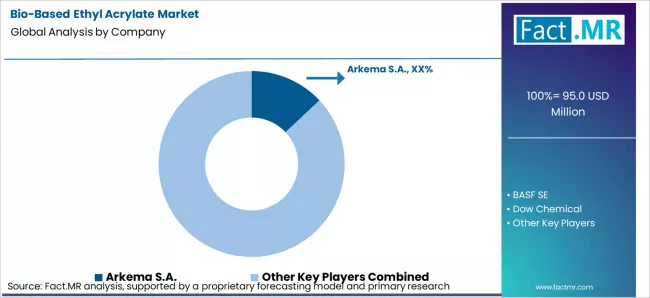
As per Fact.MR analysis, the 2026 bio-based ethyl acrylate market is defined by validated production efficiency, feedstock versatility, and regulatory compliance, which determine competitive advantage. Arkema S.A. and BASF SE lead with large-scale bio-based production platforms and optimized fermentation pathways, which strengthen adoption in adhesives, coatings, and specialty polymer applications. Dow Chemical and Evonik Industries focus on high-purity bio-based monomers with documented conversion efficiency, which improves consistency for downstream polymerization processes. Mitsubishi Chemical emphasizes flexible feedstock utilization and validated process scalability, which enhances regional supply continuity and compliance with multi-region regulations. Other smaller players provide specialty ethyl acrylate derivatives with verified performance, which address niche industrial and functional applications. Across the market, validated production performance, feedstock flexibility, and adherence to regulatory and sustainability standards form enduring competitive moats, reducing reliance on pricing or isolated technological claims while supporting long-term industrial adoption.
Recent Industry Developments
- Arkema’s Full Bio-Ethanol Conversion (2025): Arkema successfully transitioned its Carling facility in France to produce ethyl acrylate exclusively from sustainably sourced bio-ethanol. This development yields a product with 40% bio-carbon content and a 30% reduction in carbon footprint. It serves as a seamless "drop-in" for the global paints and coatings market. [5]
- BASF’s Rheovis® Line Transition (June 2025): BASF completed the transition of its entire Rheovis® range to bio-based ethyl acrylate at its Ludwigshafen (Germany) and Bradford (UK) sites. The new modifiers feature a 14C-traceable biogenic content of up to 35%, helping formulators achieve green transitions in aqueous systems without sacrificing technical performance or quality.[6]
Key Players in Bio-Based Ethyl Acrylate Market
- Arkema S.A.
- BASF SE
- Dow Chemical
- Evonik Industries
- Mitsubishi Chemical
- Others
Scope of the Report
| Metric | Value |
|---|---|
| Quantitative Units | USD 95 million (2026) to USD 310 million (2036), CAGR 12.6% |
| Market Definition | The bio-based ethyl acrylate market covers ethyl acrylate manufactured from renewable feedstocks instead of fossil sources. It is used as a monomer and chemical intermediate in coatings, adhesives, textiles, and polymer emulsions, contributing flexibility, adhesion, and film formation properties. Industrial handling and compliance follow US EPA and European Chemicals Agency guidance. |
| Grade Segmentation | Technical Grade, High Purity Grade, Polymer Grade |
| Application Segmentation | Coatings, Adhesives, Textiles, Others |
| End-Use Industry Segmentation | Paints & Coatings, Adhesives & Sealants, Textiles, Others |
| Regions Covered | Asia Pacific, Europe, North America, Latin America, Middle East & Africa |
| Countries Covered | India, China, Japan, South Korea, Indonesia, Australia & New Zealand, ASEAN, Rest of Asia Pacific, Germany, Italy, France, United Kingdom, Spain, Benelux, Nordics, Central & Eastern Europe, Rest of Europe, United States, Canada, Mexico, Brazil, Argentina, Chile, Rest of Latin America, Kingdom of Saudi Arabia, United Arab Emirates, South Africa, Turkey, Rest of Middle East & Africa |
| Key Companies Profiled | Arkema S.A., BASF SE, Dow Chemical, Evonik Industries, Mitsubishi Chemical, Others |
| Forecast Period | 2026 to 2036 |
| Approach | Hybrid top-down and bottom-up modeling validated through interviews with biochemical producers, polymer manufacturers, and raw material suppliers. Market sizing supported by renewable feedstock availability, production capacity, conversion yields, and downstream polymer demand indicators. |
Bio-Based Ethyl Acrylate Market Analysis by Segments
-
By Grade :
- Technical Grade
- High Purity Grade
- Polymer Grade
-
By Application :
- Coatings
- Adhesives
- Textiles
- Others
-
By End-Use Industry :
- Paints & Coatings
- Adhesives & Sealants
- Textiles
- Others
-
Region :
- Asia Pacific
- India
- China
- Japan
- South Korea
- Indonesia
- Australia & New Zealand
- ASEAN
- Rest of Asia Pacific
- Europe
- Germany
- Italy
- France
- United Kingdom
- Spain
- Benelux
- Nordics
- Central & Eastern Europe
- Rest of Europe
- North America
- United States
- Canada
- Mexico
- Latin America
- Brazil
- Argentina
- Chile
- Rest of Latin America
- Middle East & Africa
- Kingdom of Saudi Arabia
- United Arab Emirates
- South Africa
- Turkey
- Rest of Middle East & Africa
- Asia Pacific
Bibliography
- [1] U.S. Environmental Protection Agency. (2024). Chemical Data Reporting under the Toxic Substances Control Act. U.S. Environmental Protection Agency.
- [2] U.S. Environmental Protection Agency. (2024). Air emissions and chemical use considerations for surface coatings. U.S. Environmental Protection Agency.
- [3] U.S. Environmental Protection Agency. (2024). Chemical Data Reporting (CDR): Industrial chemical reporting requirements. U.S. Environmental Protection Agency.
- [4] U.S. Environmental Protection Agency. (2024). Regulatory guidance on emissions from coatings and surface treatment applications. U.S. Environmental Protection Agency.
- [5] Arkema S.A. (2025). Arkema launches ethyl acrylate produced entirely from bioethanol at the Carling site [Press release]. Arkema.
- [6] BASF SE. (2025). BASF’s Rheovis® range transitions to bio-based ethyl acrylate [Press release]. BASF SE.
Table of Content
- Executive Summary
- Global Market Outlook
- Demand to side Trends
- Supply to side Trends
- Technology Roadmap Analysis
- Analysis and Recommendations
- Market Overview
- Market Coverage / Taxonomy
- Market Definition / Scope / Limitations
- Research Methodology
- Chapter Orientation
- Analytical Lens and Working Hypotheses
- Market Structure, Signals, and Trend Drivers
- Benchmarking and Cross-market Comparability
- Market Sizing, Forecasting, and Opportunity Mapping
- Research Design and Evidence Framework
- Desk Research Programme (Secondary Evidence)
- Company Annual and Sustainability Reports
- Peer-reviewed Journals and Academic Literature
- Corporate Websites, Product Literature, and Technical Notes
- Earnings Decks and Investor Briefings
- Statutory Filings and Regulatory Disclosures
- Technical White Papers and Standards Notes
- Trade Journals, Industry Magazines, and Analyst Briefs
- Conference Proceedings, Webinars, and Seminar Materials
- Government Statistics Portals and Public Data Releases
- Press Releases and Reputable Media Coverage
- Specialist Newsletters and Curated Briefings
- Sector Databases and Reference Repositories
- FMR Internal Proprietary Databases and Historical Market Datasets
- Subscription Datasets and Paid Sources
- Social Channels, Communities, and Digital Listening Inputs
- Additional Desk Sources
- Expert Input and Fieldwork (Primary Evidence)
- Primary Modes
- Qualitative Interviews and Expert Elicitation
- Quantitative Surveys and Structured Data Capture
- Blended Approach
- Why Primary Evidence is Used
- Field Techniques
- Interviews
- Surveys
- Focus Groups
- Observational and In-context Research
- Social and Community Interactions
- Stakeholder Universe Engaged
- C-suite Leaders
- Board Members
- Presidents and Vice Presidents
- R&D and Innovation Heads
- Technical Specialists
- Domain Subject-matter Experts
- Scientists
- Physicians and Other Healthcare Professionals
- Governance, Ethics, and Data Stewardship
- Research Ethics
- Data Integrity and Handling
- Primary Modes
- Tooling, Models, and Reference Databases
- Desk Research Programme (Secondary Evidence)
- Data Engineering and Model Build
- Data Acquisition and Ingestion
- Cleaning, Normalisation, and Verification
- Synthesis, Triangulation, and Analysis
- Quality Assurance and Audit Trail
- Market Background
- Market Dynamics
- Drivers
- Restraints
- Opportunity
- Trends
- Scenario Forecast
- Demand in Optimistic Scenario
- Demand in Likely Scenario
- Demand in Conservative Scenario
- Opportunity Map Analysis
- Product Life Cycle Analysis
- Supply Chain Analysis
- Investment Feasibility Matrix
- Value Chain Analysis
- PESTLE and Porter’s Analysis
- Regulatory Landscape
- Regional Parent Market Outlook
- Production and Consumption Statistics
- Import and Export Statistics
- Market Dynamics
- Global Market Analysis 2021 to 2025 and Forecast, 2026 to 2036
- Historical Market Size Value (USD Million) Analysis, 2021 to 2025
- Current and Future Market Size Value (USD Million) Projections, 2026 to 2036
- Y to o to Y Growth Trend Analysis
- Absolute $ Opportunity Analysis
- Global Market Pricing Analysis 2021 to 2025 and Forecast 2026 to 2036
- Global Market Analysis 2021 to 2025 and Forecast 2026 to 2036, By Grade
- Introduction / Key Findings
- Historical Market Size Value (USD Million) Analysis By Grade , 2021 to 2025
- Current and Future Market Size Value (USD Million) Analysis and Forecast By Grade , 2026 to 2036
- Technical Grade
- High Purity Grade
- Polymer Grade
- Technical Grade
- Y to o to Y Growth Trend Analysis By Grade , 2021 to 2025
- Absolute $ Opportunity Analysis By Grade , 2026 to 2036
- Global Market Analysis 2021 to 2025 and Forecast 2026 to 2036, By Application
- Introduction / Key Findings
- Historical Market Size Value (USD Million) Analysis By Application, 2021 to 2025
- Current and Future Market Size Value (USD Million) Analysis and Forecast By Application, 2026 to 2036
- Coatings
- Adhesives
- Textiles
- Others
- Coatings
- Y to o to Y Growth Trend Analysis By Application, 2021 to 2025
- Absolute $ Opportunity Analysis By Application, 2026 to 2036
- Global Market Analysis 2021 to 2025 and Forecast 2026 to 2036, By Region
- Introduction
- Historical Market Size Value (USD Million) Analysis By Region, 2021 to 2025
- Current Market Size Value (USD Million) Analysis and Forecast By Region, 2026 to 2036
- North America
- Latin America
- Western Europe
- Eastern Europe
- East Asia
- South Asia and Pacific
- Middle East & Africa
- Market Attractiveness Analysis By Region
- North America Market Analysis 2021 to 2025 and Forecast 2026 to 2036, By Country
- Historical Market Size Value (USD Million) Trend Analysis By Market Taxonomy, 2021 to 2025
- Market Size Value (USD Million) Forecast By Market Taxonomy, 2026 to 2036
- By Country
- USA
- Canada
- Mexico
- By Grade
- By Application
- By Country
- Market Attractiveness Analysis
- By Country
- By Grade
- By Application
- Key Takeaways
- Latin America Market Analysis 2021 to 2025 and Forecast 2026 to 2036, By Country
- Historical Market Size Value (USD Million) Trend Analysis By Market Taxonomy, 2021 to 2025
- Market Size Value (USD Million) Forecast By Market Taxonomy, 2026 to 2036
- By Country
- Brazil
- Chile
- Rest of Latin America
- By Grade
- By Application
- By Country
- Market Attractiveness Analysis
- By Country
- By Grade
- By Application
- Key Takeaways
- Western Europe Market Analysis 2021 to 2025 and Forecast 2026 to 2036, By Country
- Historical Market Size Value (USD Million) Trend Analysis By Market Taxonomy, 2021 to 2025
- Market Size Value (USD Million) Forecast By Market Taxonomy, 2026 to 2036
- By Country
- Germany
- UK
- Italy
- Spain
- France
- Nordic
- BENELUX
- Rest of Western Europe
- By Grade
- By Application
- By Country
- Market Attractiveness Analysis
- By Country
- By Grade
- By Application
- Key Takeaways
- Eastern Europe Market Analysis 2021 to 2025 and Forecast 2026 to 2036, By Country
- Historical Market Size Value (USD Million) Trend Analysis By Market Taxonomy, 2021 to 2025
- Market Size Value (USD Million) Forecast By Market Taxonomy, 2026 to 2036
- By Country
- Russia
- Poland
- Hungary
- Balkan & Baltic
- Rest of Eastern Europe
- By Grade
- By Application
- By Country
- Market Attractiveness Analysis
- By Country
- By Grade
- By Application
- Key Takeaways
- East Asia Market Analysis 2021 to 2025 and Forecast 2026 to 2036, By Country
- Historical Market Size Value (USD Million) Trend Analysis By Market Taxonomy, 2021 to 2025
- Market Size Value (USD Million) Forecast By Market Taxonomy, 2026 to 2036
- By Country
- China
- Japan
- South Korea
- By Grade
- By Application
- By Country
- Market Attractiveness Analysis
- By Country
- By Grade
- By Application
- Key Takeaways
- South Asia and Pacific Market Analysis 2021 to 2025 and Forecast 2026 to 2036, By Country
- Historical Market Size Value (USD Million) Trend Analysis By Market Taxonomy, 2021 to 2025
- Market Size Value (USD Million) Forecast By Market Taxonomy, 2026 to 2036
- By Country
- India
- ASEAN
- Australia & New Zealand
- Rest of South Asia and Pacific
- By Grade
- By Application
- By Country
- Market Attractiveness Analysis
- By Country
- By Grade
- By Application
- Key Takeaways
- Middle East & Africa Market Analysis 2021 to 2025 and Forecast 2026 to 2036, By Country
- Historical Market Size Value (USD Million) Trend Analysis By Market Taxonomy, 2021 to 2025
- Market Size Value (USD Million) Forecast By Market Taxonomy, 2026 to 2036
- By Country
- Kingdom of Saudi Arabia
- Other GCC Countries
- Turkiye
- South Africa
- Other African Union
- Rest of Middle East & Africa
- By Grade
- By Application
- By Country
- Market Attractiveness Analysis
- By Country
- By Grade
- By Application
- Key Takeaways
- Key Countries Market Analysis
- USA
- Pricing Analysis
- Market Share Analysis, 2025
- By Grade
- By Application
- Canada
- Pricing Analysis
- Market Share Analysis, 2025
- By Grade
- By Application
- Mexico
- Pricing Analysis
- Market Share Analysis, 2025
- By Grade
- By Application
- Brazil
- Pricing Analysis
- Market Share Analysis, 2025
- By Grade
- By Application
- Chile
- Pricing Analysis
- Market Share Analysis, 2025
- By Grade
- By Application
- Germany
- Pricing Analysis
- Market Share Analysis, 2025
- By Grade
- By Application
- UK
- Pricing Analysis
- Market Share Analysis, 2025
- By Grade
- By Application
- Italy
- Pricing Analysis
- Market Share Analysis, 2025
- By Grade
- By Application
- Spain
- Pricing Analysis
- Market Share Analysis, 2025
- By Grade
- By Application
- France
- Pricing Analysis
- Market Share Analysis, 2025
- By Grade
- By Application
- India
- Pricing Analysis
- Market Share Analysis, 2025
- By Grade
- By Application
- ASEAN
- Pricing Analysis
- Market Share Analysis, 2025
- By Grade
- By Application
- Australia & New Zealand
- Pricing Analysis
- Market Share Analysis, 2025
- By Grade
- By Application
- China
- Pricing Analysis
- Market Share Analysis, 2025
- By Grade
- By Application
- Japan
- Pricing Analysis
- Market Share Analysis, 2025
- By Grade
- By Application
- South Korea
- Pricing Analysis
- Market Share Analysis, 2025
- By Grade
- By Application
- Russia
- Pricing Analysis
- Market Share Analysis, 2025
- By Grade
- By Application
- Poland
- Pricing Analysis
- Market Share Analysis, 2025
- By Grade
- By Application
- Hungary
- Pricing Analysis
- Market Share Analysis, 2025
- By Grade
- By Application
- Kingdom of Saudi Arabia
- Pricing Analysis
- Market Share Analysis, 2025
- By Grade
- By Application
- Turkiye
- Pricing Analysis
- Market Share Analysis, 2025
- By Grade
- By Application
- South Africa
- Pricing Analysis
- Market Share Analysis, 2025
- By Grade
- By Application
- USA
- Market Structure Analysis
- Competition Dashboard
- Competition Benchmarking
- Market Share Analysis of Top Players
- By Regional
- By Grade
- By Application
- Competition Analysis
- Competition Deep Dive
- Arkema S.A.
- Overview
- Product Portfolio
- Profitability by Market Segments (Product/Age /Sales Channel/Region)
- Sales Footprint
- Strategy Overview
- Marketing Strategy
- Product Strategy
- Channel Strategy
- BASF SE
- Dow Chemical
- Evonik Industries
- Mitsubishi Chemical
- Others
- Arkema S.A.
- Competition Deep Dive
- Assumptions & Acronyms Used
List Of Table
- Table 1: Global Market Value (USD Million) Forecast by Region, 2021 to 2036
- Table 2: Global Market Value (USD Million) Forecast by Grade, 2021 to 2036
- Table 3: Global Market Value (USD Million) Forecast by Application, 2021 to 2036
- Table 4: North America Market Value (USD Million) Forecast by Country, 2021 to 2036
- Table 5: North America Market Value (USD Million) Forecast by Grade, 2021 to 2036
- Table 6: North America Market Value (USD Million) Forecast by Application, 2021 to 2036
- Table 7: Latin America Market Value (USD Million) Forecast by Country, 2021 to 2036
- Table 8: Latin America Market Value (USD Million) Forecast by Grade, 2021 to 2036
- Table 9: Latin America Market Value (USD Million) Forecast by Application, 2021 to 2036
- Table 10: Western Europe Market Value (USD Million) Forecast by Country, 2021 to 2036
- Table 11: Western Europe Market Value (USD Million) Forecast by Grade, 2021 to 2036
- Table 12: Western Europe Market Value (USD Million) Forecast by Application, 2021 to 2036
- Table 13: Eastern Europe Market Value (USD Million) Forecast by Country, 2021 to 2036
- Table 14: Eastern Europe Market Value (USD Million) Forecast by Grade, 2021 to 2036
- Table 15: Eastern Europe Market Value (USD Million) Forecast by Application, 2021 to 2036
- Table 16: East Asia Market Value (USD Million) Forecast by Country, 2021 to 2036
- Table 17: East Asia Market Value (USD Million) Forecast by Grade, 2021 to 2036
- Table 18: East Asia Market Value (USD Million) Forecast by Application, 2021 to 2036
- Table 19: South Asia and Pacific Market Value (USD Million) Forecast by Country, 2021 to 2036
- Table 20: South Asia and Pacific Market Value (USD Million) Forecast by Grade, 2021 to 2036
- Table 21: South Asia and Pacific Market Value (USD Million) Forecast by Application, 2021 to 2036
- Table 22: Middle East & Africa Market Value (USD Million) Forecast by Country, 2021 to 2036
- Table 23: Middle East & Africa Market Value (USD Million) Forecast by Grade, 2021 to 2036
- Table 24: Middle East & Africa Market Value (USD Million) Forecast by Application, 2021 to 2036
List Of Figures
- Figure 1: Global Market Pricing Analysis
- Figure 2: Global Market Value (USD Million) Forecast 2021-2036
- Figure 3: Global Market Value Share and BPS Analysis by Grade, 2026 and 2036
- Figure 4: Global Market Y to o to Y Growth Comparison by Grade, 2026 to 2036
- Figure 5: Global Market Attractiveness Analysis by Grade
- Figure 6: Global Market Value Share and BPS Analysis by Application, 2026 and 2036
- Figure 7: Global Market Y to o to Y Growth Comparison by Application, 2026 to 2036
- Figure 8: Global Market Attractiveness Analysis by Application
- Figure 9: Global Market Value (USD Million) Share and BPS Analysis by Region, 2026 and 2036
- Figure 10: Global Market Y to o to Y Growth Comparison by Region, 2026 to 2036
- Figure 11: Global Market Attractiveness Analysis by Region
- Figure 12: North America Market Incremental Dollar Opportunity, 2026 to 2036
- Figure 13: Latin America Market Incremental Dollar Opportunity, 2026 to 2036
- Figure 14: Western Europe Market Incremental Dollar Opportunity, 2026 to 2036
- Figure 15: Eastern Europe Market Incremental Dollar Opportunity, 2026 to 2036
- Figure 16: East Asia Market Incremental Dollar Opportunity, 2026 to 2036
- Figure 17: South Asia and Pacific Market Incremental Dollar Opportunity, 2026 to 2036
- Figure 18: Middle East & Africa Market Incremental Dollar Opportunity, 2026 to 2036
- Figure 19: North America Market Value Share and BPS Analysis by Country, 2026 and 2036
- Figure 20: North America Market Value Share and BPS Analysis by Grade, 2026 and 2036
- Figure 21: North America Market Y to o to Y Growth Comparison by Grade, 2026 to 2036
- Figure 22: North America Market Attractiveness Analysis by Grade
- Figure 23: North America Market Value Share and BPS Analysis by Application, 2026 and 2036
- Figure 24: North America Market Y to o to Y Growth Comparison by Application, 2026 to 2036
- Figure 25: North America Market Attractiveness Analysis by Application
- Figure 26: Latin America Market Value Share and BPS Analysis by Country, 2026 and 2036
- Figure 27: Latin America Market Value Share and BPS Analysis by Grade, 2026 and 2036
- Figure 28: Latin America Market Y to o to Y Growth Comparison by Grade, 2026 to 2036
- Figure 29: Latin America Market Attractiveness Analysis by Grade
- Figure 30: Latin America Market Value Share and BPS Analysis by Application, 2026 and 2036
- Figure 31: Latin America Market Y to o to Y Growth Comparison by Application, 2026 to 2036
- Figure 32: Latin America Market Attractiveness Analysis by Application
- Figure 33: Western Europe Market Value Share and BPS Analysis by Country, 2026 and 2036
- Figure 34: Western Europe Market Value Share and BPS Analysis by Grade, 2026 and 2036
- Figure 35: Western Europe Market Y to o to Y Growth Comparison by Grade, 2026 to 2036
- Figure 36: Western Europe Market Attractiveness Analysis by Grade
- Figure 37: Western Europe Market Value Share and BPS Analysis by Application, 2026 and 2036
- Figure 38: Western Europe Market Y to o to Y Growth Comparison by Application, 2026 to 2036
- Figure 39: Western Europe Market Attractiveness Analysis by Application
- Figure 40: Eastern Europe Market Value Share and BPS Analysis by Country, 2026 and 2036
- Figure 41: Eastern Europe Market Value Share and BPS Analysis by Grade, 2026 and 2036
- Figure 42: Eastern Europe Market Y to o to Y Growth Comparison by Grade, 2026 to 2036
- Figure 43: Eastern Europe Market Attractiveness Analysis by Grade
- Figure 44: Eastern Europe Market Value Share and BPS Analysis by Application, 2026 and 2036
- Figure 45: Eastern Europe Market Y to o to Y Growth Comparison by Application, 2026 to 2036
- Figure 46: Eastern Europe Market Attractiveness Analysis by Application
- Figure 47: East Asia Market Value Share and BPS Analysis by Country, 2026 and 2036
- Figure 48: East Asia Market Value Share and BPS Analysis by Grade, 2026 and 2036
- Figure 49: East Asia Market Y to o to Y Growth Comparison by Grade, 2026 to 2036
- Figure 50: East Asia Market Attractiveness Analysis by Grade
- Figure 51: East Asia Market Value Share and BPS Analysis by Application, 2026 and 2036
- Figure 52: East Asia Market Y to o to Y Growth Comparison by Application, 2026 to 2036
- Figure 53: East Asia Market Attractiveness Analysis by Application
- Figure 54: South Asia and Pacific Market Value Share and BPS Analysis by Country, 2026 and 2036
- Figure 55: South Asia and Pacific Market Value Share and BPS Analysis by Grade, 2026 and 2036
- Figure 56: South Asia and Pacific Market Y to o to Y Growth Comparison by Grade, 2026 to 2036
- Figure 57: South Asia and Pacific Market Attractiveness Analysis by Grade
- Figure 58: South Asia and Pacific Market Value Share and BPS Analysis by Application, 2026 and 2036
- Figure 59: South Asia and Pacific Market Y to o to Y Growth Comparison by Application, 2026 to 2036
- Figure 60: South Asia and Pacific Market Attractiveness Analysis by Application
- Figure 61: Middle East & Africa Market Value Share and BPS Analysis by Country, 2026 and 2036
- Figure 62: Middle East & Africa Market Value Share and BPS Analysis by Grade, 2026 and 2036
- Figure 63: Middle East & Africa Market Y to o to Y Growth Comparison by Grade, 2026 to 2036
- Figure 64: Middle East & Africa Market Attractiveness Analysis by Grade
- Figure 65: Middle East & Africa Market Value Share and BPS Analysis by Application, 2026 and 2036
- Figure 66: Middle East & Africa Market Y to o to Y Growth Comparison by Application, 2026 to 2036
- Figure 67: Middle East & Africa Market Attractiveness Analysis by Application
- Figure 68: Global Market - Tier Structure Analysis
- Figure 69: Global Market - Company Share AnalysisFigure 1: Global Market Pricing Analysis
- Figure 2: Global Market Value (USD Million) Forecast 2021-2036
- Figure 3: Global Market Value Share and BPS Analysis by Grade, 2026 and 2036
- Figure 4: Global Market Y to o to Y Growth Comparison by Grade, 2026 to 2036
- Figure 5: Global Market Attractiveness Analysis by Grade
- Figure 6: Global Market Value Share and BPS Analysis by Application, 2026 and 2036
- Figure 7: Global Market Y to o to Y Growth Comparison by Application, 2026 to 2036
- Figure 8: Global Market Attractiveness Analysis by Application
- Figure 9: Global Market Value (USD Million) Share and BPS Analysis by Region, 2026 and 2036
- Figure 10: Global Market Y to o to Y Growth Comparison by Region, 2026 to 2036
- Figure 11: Global Market Attractiveness Analysis by Region
- Figure 12: North America Market Incremental Dollar Opportunity, 2026 to 2036
- Figure 13: Latin America Market Incremental Dollar Opportunity, 2026 to 2036
- Figure 14: Western Europe Market Incremental Dollar Opportunity, 2026 to 2036
- Figure 15: Eastern Europe Market Incremental Dollar Opportunity, 2026 to 2036
- Figure 16: East Asia Market Incremental Dollar Opportunity, 2026 to 2036
- Figure 17: South Asia and Pacific Market Incremental Dollar Opportunity, 2026 to 2036
- Figure 18: Middle East & Africa Market Incremental Dollar Opportunity, 2026 to 2036
- Figure 19: North America Market Value Share and BPS Analysis by Country, 2026 and 2036
- Figure 20: North America Market Value Share and BPS Analysis by Grade, 2026 and 2036
- Figure 21: North America Market Y to o to Y Growth Comparison by Grade, 2026 to 2036
- Figure 22: North America Market Attractiveness Analysis by Grade
- Figure 23: North America Market Value Share and BPS Analysis by Application, 2026 and 2036
- Figure 24: North America Market Y to o to Y Growth Comparison by Application, 2026 to 2036
- Figure 25: North America Market Attractiveness Analysis by Application
- Figure 26: Latin America Market Value Share and BPS Analysis by Country, 2026 and 2036
- Figure 27: Latin America Market Value Share and BPS Analysis by Grade, 2026 and 2036
- Figure 28: Latin America Market Y to o to Y Growth Comparison by Grade, 2026 to 2036
- Figure 29: Latin America Market Attractiveness Analysis by Grade
- Figure 30: Latin America Market Value Share and BPS Analysis by Application, 2026 and 2036
- Figure 31: Latin America Market Y to o to Y Growth Comparison by Application, 2026 to 2036
- Figure 32: Latin America Market Attractiveness Analysis by Application
- Figure 33: Western Europe Market Value Share and BPS Analysis by Country, 2026 and 2036
- Figure 34: Western Europe Market Value Share and BPS Analysis by Grade, 2026 and 2036
- Figure 35: Western Europe Market Y to o to Y Growth Comparison by Grade, 2026 to 2036
- Figure 36: Western Europe Market Attractiveness Analysis by Grade
- Figure 37: Western Europe Market Value Share and BPS Analysis by Application, 2026 and 2036
- Figure 38: Western Europe Market Y to o to Y Growth Comparison by Application, 2026 to 2036
- Figure 39: Western Europe Market Attractiveness Analysis by Application
- Figure 40: Eastern Europe Market Value Share and BPS Analysis by Country, 2026 and 2036
- Figure 41: Eastern Europe Market Value Share and BPS Analysis by Grade, 2026 and 2036
- Figure 42: Eastern Europe Market Y to o to Y Growth Comparison by Grade, 2026 to 2036
- Figure 43: Eastern Europe Market Attractiveness Analysis by Grade
- Figure 44: Eastern Europe Market Value Share and BPS Analysis by Application, 2026 and 2036
- Figure 45: Eastern Europe Market Y to o to Y Growth Comparison by Application, 2026 to 2036
- Figure 46: Eastern Europe Market Attractiveness Analysis by Application
- Figure 47: East Asia Market Value Share and BPS Analysis by Country, 2026 and 2036
- Figure 48: East Asia Market Value Share and BPS Analysis by Grade, 2026 and 2036
- Figure 49: East Asia Market Y to o to Y Growth Comparison by Grade, 2026 to 2036
- Figure 50: East Asia Market Attractiveness Analysis by Grade
- Figure 51: East Asia Market Value Share and BPS Analysis by Application, 2026 and 2036
- Figure 52: East Asia Market Y to o to Y Growth Comparison by Application, 2026 to 2036
- Figure 53: East Asia Market Attractiveness Analysis by Application
- Figure 54: South Asia and Pacific Market Value Share and BPS Analysis by Country, 2026 and 2036
- Figure 55: South Asia and Pacific Market Value Share and BPS Analysis by Grade, 2026 and 2036
- Figure 56: South Asia and Pacific Market Y to o to Y Growth Comparison by Grade, 2026 to 2036
- Figure 57: South Asia and Pacific Market Attractiveness Analysis by Grade
- Figure 58: South Asia and Pacific Market Value Share and BPS Analysis by Application, 2026 and 2036
- Figure 59: South Asia and Pacific Market Y to o to Y Growth Comparison by Application, 2026 to 2036
- Figure 60: South Asia and Pacific Market Attractiveness Analysis by Application
- Figure 61: Middle East & Africa Market Value Share and BPS Analysis by Country, 2026 and 2036
- Figure 62: Middle East & Africa Market Value Share and BPS Analysis by Grade, 2026 and 2036
- Figure 63: Middle East & Africa Market Y to o to Y Growth Comparison by Grade, 2026 to 2036
- Figure 64: Middle East & Africa Market Attractiveness Analysis by Grade
- Figure 65: Middle East & Africa Market Value Share and BPS Analysis by Application, 2026 and 2036
- Figure 66: Middle East & Africa Market Y to o to Y Growth Comparison by Application, 2026 to 2036
- Figure 67: Middle East & Africa Market Attractiveness Analysis by Application
- Figure 68: Global Market - Tier Structure Analysis
- Figure 69: Global Market - Company Share Analysis
- FAQs -
How large is the bio-based ethyl acrylate market in 2026?
The bio-based ethyl acrylate market is valued at USD 95 million in 2026 according to Fact.MR analysis.
What will the global bio-based ethyl acrylate market size be by 2036?
By 2036, the market is projected to reach USD 310 million.
What is the expected CAGR of the bio-based ethyl acrylate market during 2026–2036?
The market is expected to grow at a CAGR of 12.6% over the forecast period.
How much absolute value is the market expected to add over the forecast window?
The market is expected to add approximately USD 226 million in absolute value between 2026 and 2036.
What is driving growth in the bio-based ethyl acrylate market?
Growth is driven by gradual substitution of bio-derived monomers in coatings, adhesives, and textiles where performance parity with petro-based ethyl acrylate has been demonstrated.
Which grade segment leads demand in the bio-based ethyl acrylate market?
Technical grade leads the market with about 58% share.
Why does technical grade bio-based ethyl acrylate dominate consumption?
Technical grade is preferred due to lower purification requirements and compatibility with high-volume polymerization and formulation processes.
Which application segment accounts for the largest share of demand?
Coatings account for roughly 38% of total market demand.
Why are coatings the primary application for bio-based ethyl acrylate?
Coatings require consistent monomer quality for film formation, adhesion, and weather resistance in acrylic emulsions.
How significant are adhesives in mid-period market expansion?
Adhesives contribute to mid-period growth as bio-based ethyl acrylate adoption increases with improved feedstock consistency.
What role do textiles play in market growth?
Textile finishing applications support growth through gradual integration of bio-based acrylates into existing polymer systems.
Which country is expected to see the fastest growth in this market?
The United States is projected to grow at a CAGR of 13.5% through 2036.
What factors support strong growth in the United States?
Growth is supported by bio-based chemical investments and a large coatings manufacturing base.
How does Germany compare in terms of growth outlook?
Germany is expected to grow at a CAGR of 12.8%, driven by industrial coatings and adhesive producers evaluating low-carbon raw materials.
What is the projected growth rate for China?
China is projected to grow at a CAGR of 11.5% during the forecast period.
What is supporting adoption of bio-based ethyl acrylate in China?
Adoption is supported by expanding acrylic polymer demand and pilot integration of bio-based monomers.
How fast is the bio-based ethyl acrylate market expected to grow in France?
France is projected to grow at a CAGR of 10.8% through 2036.
Why is polymer-grade qualification important in later years?
Polymer-grade qualification enables broader adoption and supports long-term supply agreements as production routes stabilize.
How does price parity with petro-based ethyl acrylate influence adoption?
Adoption depends heavily on achieving price parity while maintaining compatibility with existing polymerization processes.
What are the key priorities for buyers evaluating bio-based ethyl acrylate?
Buyers prioritize drop-in compatibility, stable supply, and proven performance equivalence with conventional ethyl acrylate.