- Market Value (2025): USD 596.5 Mn
- Estimated Value (2026): USD 680.0 Mn
- Forecast Value (2036): USD 2521.0 Mn
- CAGR (2026-2036): 14.0%
What is the Bio Processing Aids Market forecast to be worth by 2036?
USD 680.0 million in 2026 to USD 2521.0 million by 2036 at a 14.0% CAGR.
- The bio processing aids market was valued at USD 596.5 million in 2025.
- Demand is projected to increase from USD 680.0 million in 2026 to USD 2521.0 million by 2036.
- The market is forecast to record a 14.0% CAGR from 2026 to 2036 as processors and beverage makers prioritize conversion efficiency.
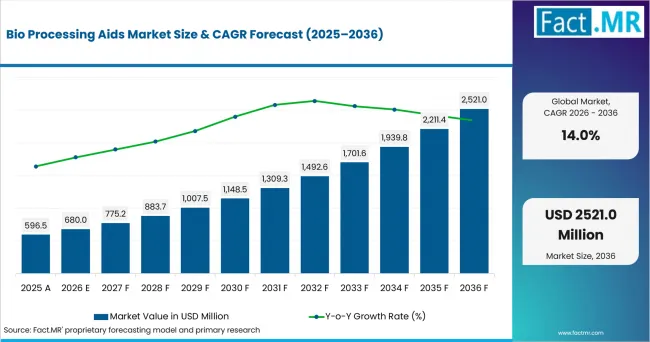
Bio Processing Aids Market Value Analysis | Source: Fact.MR
What are the defining numbers behind Bio Processing Aids Market growth?
USD 1841.0 million absolute opportunity by 2036, led by enzymatic aids, microbial sources and food processing applications.
- Demand Drivers in the Market
- Oilseed processors need enzyme-based degumming aids because small recovery gains change plant economics across high-volume runs.
- Beverage plants need clarification support that shortens settling time and protects product clarity during storage.
- USDA Economic Research Service reported in June 2026 that total U.S. food spending reached USD 2.51 trillion in 2025, indicating the large scale of economic activity across the U.S. food system.
- Industrial bioprocessing teams need stable microbial aids due to tighter batch reproducibility requirements in fermentation and downstream separation.
- Key Segments Analyzed
- By Type: Enzymatic aids are expected to hold 34.0% share in 2026, supported by hydrolysis, degumming and conversion use cases.
- By Source: Microbial sources are projected to account for 42.0% share in 2026, owing to scalable fermentation and repeatable activity.
- By Function: Yield improvement is anticipated to capture 36.0% share in 2026, reinforced by processor focus on higher usable output.
- By Application: Food processing is estimated to represent 39.0% share in 2026, driven by large installed capacity across oils and bakery.
- Analyst Opinion at Fact.MR
- Shambhu Nath Jha, Principal Consultant at Fact.MR, states, "Bio processing aids are gaining buyer attention because they influence plant yield without becoming the consumer-facing ingredient. Demand is expected to move toward suppliers that document activity curves and application limits with practical plant trials. Suppliers with enzyme know-how, regulatory support and troubleshooting depth have a clearer route into repeat purchasing."
- Strategic Implications
- Enzyme suppliers should publish application-specific dosing guidance so processors can compare yield gains before line trials begin.
- Contract manufacturers should track batch losses by processing step to identify where fermentation and filtration aids create measurable payback.
- Distributors should build technical support capacity in beverages, oils and starch processing where plant staff need rapid trial interpretation.
The USA is forecast to record 15.4% CAGR through 2036, led by large food processing and beverage manufacturing demand. Germany is projected to post 14.7% CAGR through enzyme use in plant-based foods and industrial fermentation. Japan is anticipated to advance at 13.7% CAGR as food export programs and quality-led processing support adoption. France is estimated to hold 13.2% CAGR, supported by its agri-food manufacturing base. Brazil is expected to reach 12.6% CAGR, shaped by grain, meat and agribusiness export processing.
How does the Bio Processing Aids Market break down by segment?
Enzymatic aids lead Type at 34.0%; Microbial leads Source at 42.0%.
Which Type dominates?
Enzymatic aids are expected to hold 34.0% share in 2026.
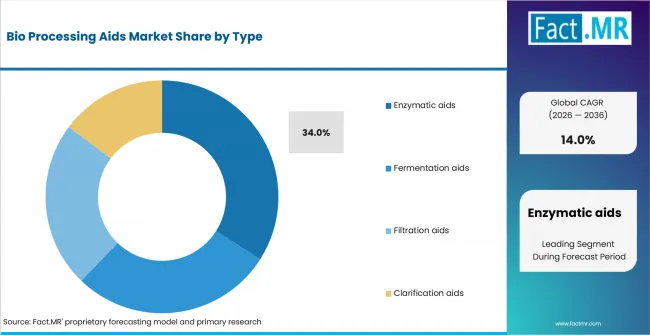
Bio Processing Aids Market Analysis By Type | Source: Fact.MR
Enzymatic aids lead the type segment because they change specific process steps without becoming the main product. Processors use them to break down starch, proteins or phospholipids under controlled conditions. Fermentation aids support culture performance, while filtration and clarification aids help remove solids or haze. FSANZ approved Application A1305 in April 2026 to permit alpha-amylase as a processing aid in starch processing to produce starch hydrolysates and in the production of potable alcohol.
What leads the Source segment?
Microbial sources are projected to account for 42.0% share in 2026.
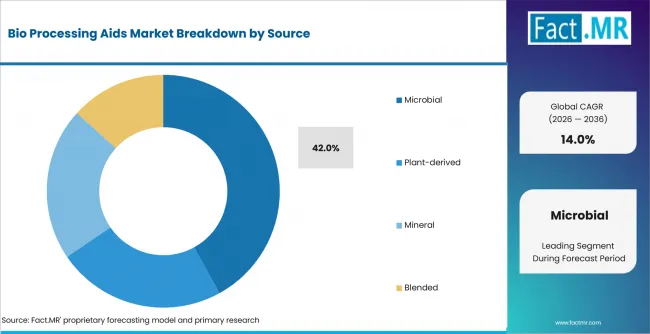
Bio Processing Aids Market Analysis By Source | Source: Fact.MR
Microbial sources lead because fermentation allows scale, quality control and tailored activity profiles. Plant-derived aids remain relevant where brands prefer botanical positioning. Mineral aids retain a place in filtration and clarification where cost and inert behavior guide selection. Blended aids are used when processors combine biological activity with filtration or clarification support.
How does Function shape demand?
Yield improvement is anticipated to capture 36.0% share in 2026.
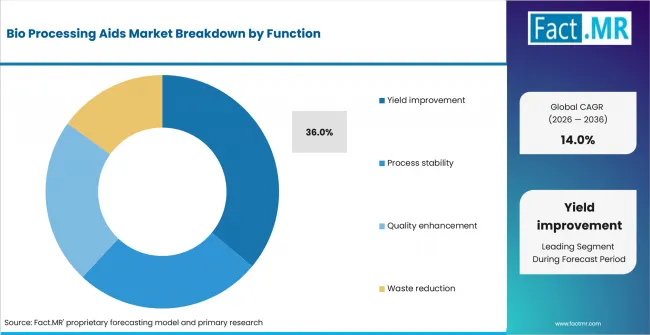
Bio Processing Aids Market Analysis By Function | Source: Fact.MR
Yield improvement leads because every processing-aid trial must show a plant-level benefit. Better extraction, shorter hold time and cleaner separation reduce the amount of raw material lost before packaging. Process stability follows when enzymes or fermentation aids keep batch behavior within a narrower range. Eurostat reported in October 2025 that EU food and beverage manufacturing created 24 kg of food waste per inhabitant in 2023.
What supports demand for food processing within Application?
Food processing is estimated to represent 39.0% share in 2026.
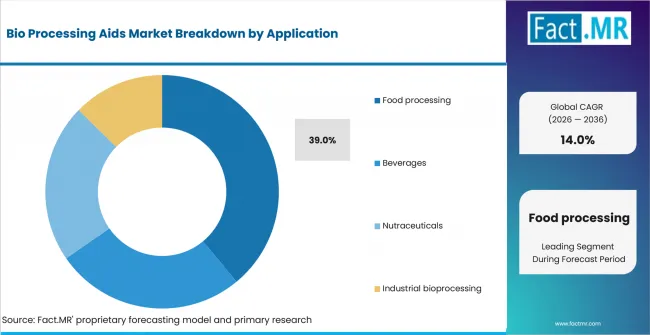
Bio Processing Aids Market Analysis By Application | Source: Fact.MR
Food processing leads the application segment because aids are used across oils, bakery, starches and dairy. Beverages form a separate use area because haze control and filtration performance are central to product acceptance. Nutraceuticals use enzyme and fermentation aids where purity targets are tighter. Industrial bioprocessing adds demand where separation quality affects the value of downstream output.
What is accelerating Bio Processing Aids Market adoption, and what is holding it back?
Yield recovery drives it; approval and validation burden restrains it.
Drivers Impact Analysis
| DRIVER | (~) % IMPACT ON CAGR | GEOGRAPHIC RELEVANCE | IMPACT TIMELINE |
|---|---|---|---|
| Yield recovery in food processing | +1.7% | Global | Short term (<= 2 years) |
| Microbial enzyme scalability | +1.2% | North America, Europe, East Asia | Medium term (2-4 years) |
| Food waste reduction pressure | +0.9% | Europe, Japan, USA | Medium term (2-4 years) |
| Beverage and bakery quality control | +0.7% | USA, Germany, France, Japan | Long term (>= 4 years) |
| Industrial bioprocessing transfer | +0.5% | Global | Long term (>= 4 years) |
Source: Fact.MR analysis. Updated Aug 28, 2026
- Yield recovery in food processing: Processing aids support plant economics by improving conversion efficiency and reducing material losses during operations such as oil extraction, starch processing and separation.
- Microbial enzyme scalability: Microbial sources provide a practical route to consistent enzyme activity at industrial scale. Their controlled production and functional specificity support wider use across food-processing applications.
- Food waste reduction pressure: Manufacturers are increasingly focused on reducing processing losses and improving raw-material utilization. Processing aids can support higher recovery, better separation and more efficient use of food inputs.
- Beverage and bakery quality control: Clarification, dough handling, texture and shelf-life performance influence product consistency and consumer acceptance. Processing aids help manufacturers manage these attributes while maintaining reliable production conditions.
- Industrial bioprocessing transfer: Fermentation expertise developed for enzymes, cultures and downstream separation is increasingly applicable across food and adjacent industrial processes. Manufacturers can adapt established bioprocessing methods where process stability, repeatability and production efficiency are important.
Opportunity Impact Analysis
| OPPORTUNITY | (~) % IMPACT ON CAGR | GEOGRAPHIC RELEVANCE | IMPACT TIMELINE |
|---|---|---|---|
| Drop-in enzymatic oil aids | +1.0% | USA, Brazil, Europe | Medium term (2-4 years) |
| Protein modification for plant-based foods | +0.8% | Germany, USA, France | Long term (>= 4 years) |
| Regulatory-ready aid dossiers | +0.6% | Europe, Japan, USA | Short term (<= 2 years) |
| Distributor technical-service bundles | +0.5% | Brazil, France, Japan | Medium term (2-4 years) |
Source: Fact.MR analysis. Updated Aug 28, 2026
- Drop-in enzymatic oil aids: Oil processors favor processing aids that operate within existing process conditions and require minimal equipment or workflow changes. Solutions that improve degumming efficiency while protecting oil yield can offer a clearer route to plant-level adoption.
- Protein modification for dairy and plant proteins: Enzyme-based processing aids support coagulation, texture development and protein functionality across dairy and plant-based applications. Suppliers can strengthen adoption through application support tailored to different protein substrates and processing conditions.
- Regulatory-ready aid dossiers: Food enzyme qualification depends on clear documentation covering source organisms, enzyme activity, intended use and safety requirements. Suppliers that prepare comprehensive regulatory and technical dossiers can simplify customer evaluation and reduce uncertainty during commercialization.
- Distributor technical-service bundles: Regional processors may require hands-on support for enzyme selection, trial design, dosing and troubleshooting. Distributors that combine product supply with technical services can expand adoption among processors that lack dedicated enzyme expertise.
Restraints Impact Analysis
| RESTRAINT | (~) % IMPACT ON CAGR | GEOGRAPHIC RELEVANCE | IMPACT TIMELINE |
|---|---|---|---|
| Approval and safety dossier burden | -0.6% | Europe, Japan, USA | Short term (<= 2 years) |
| Batch variability and trial cost | -0.4% | Global | Medium term (2-4 years) |
| Price sensitivity in commodity foods | -0.3% | Brazil, USA, France | Medium term (2-4 years) |
| Limited plant-level technical skills | -0.2% | SME processors | Long term (>= 4 years) |
Source: Fact.MR analysis. Updated Aug 28, 2026
- Approval and safety dossier burden: Food enzyme and processing-aid reviews require clear documentation covering the source organism, intended use, functional activity and safety profile. Detailed regulatory requirements can extend qualification timelines before a processing aid is adopted commercially.
- Batch variability and trial cost: Processing aids can perform differently as raw-material characteristics change by season, supplier or production batch. Manufacturers may therefore require multiple plant trials before approving a new aid for oils, beverages, proteins or other processing applications.
- Price sensitivity in commodity foods: Commodity food processors typically apply strict payback requirements to specialty processing aids. Adoption depends on whether improvements in yield, throughput, quality or waste reduction offset the additional formulation and operating costs.
- Limited plant-level technical skills: Smaller processing facilities may have limited in-house expertise in enzymes, fermentation or specialized process control. Products that require careful pH, temperature or dosing management can therefore depend on supplier training, field support and distributor technical assistance.
Which countries are scaling the Bio Processing Aids Market through 2036?
- The country comparison spans 2.8 percentage points and forms two practical growth bands across the forecast period.
- The USA remains 0.7 percentage point above Germany through large food manufacturing output and process-efficiency investment.
- Germany remains 1.0 percentage point above Japan as fermentation skills and plant-based processing support wider enzyme trials.
- Japan remains 0.5 percentage point above France through food export growth and quality-led production requirements.
- France remains 0.6 percentage point above Brazil due to its agri-food manufacturing base and beverage production capability.
- Brazil closes the displayed range as export-oriented agribusiness uses processing aids across grain, meat and beverage chains.
Comparable CAGRs create different entry conditions due to food manufacturing scale, documentation expectations, export intensity and plant-level technical support. Full report coverage includes North America, Latin America, Western Europe, Eastern Europe, East Asia, South Asia & Pacific, Middle East & Africa.
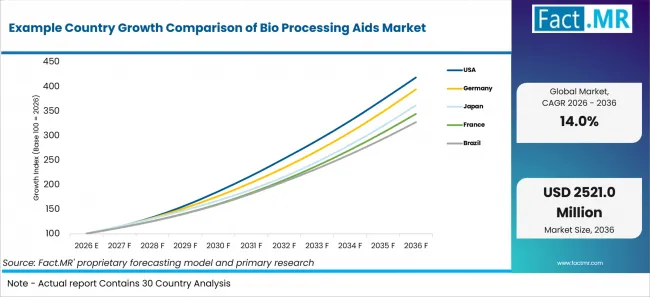
Example Country Growth Comparison Of Bio Processing Aids Market | Source: Fact.MR
| Country | CAGR (2026-2036) |
|---|---|
| United States | 15.4% |
| Germany | 14.7% |
| Japan | 13.7% |
| France | 13.2% |
| Brazil | 12.6% |
Source: Fact.MR analysis. Updated Aug 28, 2026
What supports USA adoption?
15.4% CAGR through 2036, driven by food manufacturing scale and yield recovery needs.
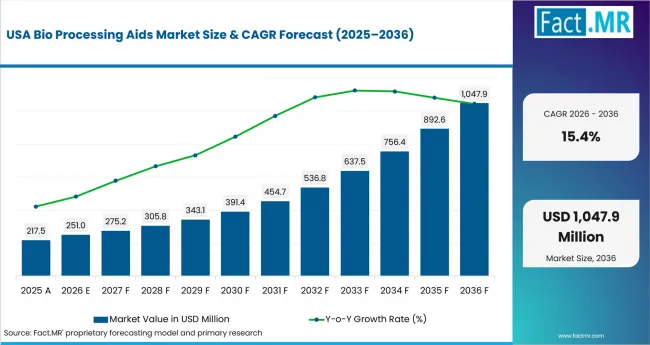
Bio Processing Aids Market Country Value Analysis | Source: Fact.MR
U.S. processors evaluate bio processing aids by yield proof and fit with existing plant controls. The USA is forecast to record 15.4% CAGR from 2026 to 2036. U.S. Census Bureau data accessed through FRED recorded the not-seasonally-adjusted value of food-product manufacturers’ shipments at USD 91.154 billion in June 2026. Product developers that pair dosing data with plant-trial support are expected to earn faster approval.
How is Germany scaling demand?
14.7% CAGR through 2036, supported by enzyme use in plant-based foods and industrial fermentation.
Germany links enzyme demand to plant-based foods, beverages and fermentation-led manufacturing. Germany is projected to post 14.7% CAGR through 2036. Destatis reported in May 2026 that 124,900 tonnes of meat substitutes were produced in 2025.
How does Japan perform?
13.7% CAGR through 2036, led by food exports and quality-led processing requirements.
Japanese food makers treat processing consistency as a quality requirement for export products and premium domestic lines. Japan is anticipated to advance at 13.7% CAGR through 2036. MAFF reported 2025 exports of agricultural, forestry, fishery and food products at JPY 1,700.5 billion, up 12.8%.
What supports France growth?
13.2% CAGR through 2036, supported by agri-food manufacturing and beverage processing depth.
France gives processing-aid suppliers access to dairy, beverages, grain products and specialty foods. France is estimated to hold 13.2% CAGR through 2036. The French agriculture ministry's 2026 key-indicators publication reports 2023 structural data showing EUR 246.3 billion in turnover across 22,917 agri-food enterprises.
What underpins Brazil growth?
12.6% CAGR through 2036, shaped by agribusiness exports and food product processing.
Brazil’s export-oriented agribusiness creates processing-aid demand across oilseeds, meat and beverage chains. Brazil is expected to reach 12.6% CAGR through 2036. Brazil's Ministry of Agriculture and Livestock reported on January 8, 2026 that 2025 agribusiness exports reached USD 169.2 billion, with a USD 149.07 billion surplus. Regional distribution and practical troubleshooting are anticipated to shape adoption outside major processing hubs.
Who leads the Bio Processing Aids Market?
Novonesis and IFF as leading direct enzyme providers in the assessed company set, while Kerry Group and dsm-firmenich strengthen fermentation and food ingredient capability.
Novonesis is active through food enzymes and biosolutions used in oils, baking and fermentation-linked processing. IFF competes through enzyme solutions for bakery and industrial food production, where freshness and dough performance affect processor selection. dsm-firmenich adds food enzymes, cultures and dairy processing capabilities through its Taste, Texture & Health portfolio.
Kerry Group is relevant through biotechnology, enzyme and fermentation capabilities strengthened by its Biotechnology Centre in Leipzig, inaugurated in September 2025. Amano Enzyme and AB Enzymes add specialist capabilities across food-grade enzyme applications, plant-based foods and processing aids. Competitive positioning is likely to depend on demonstrated processing benefits, enzyme-performance consistency, technical documentation and application support during formulation and production trials.
Which companies are the key providers?
Key companies include Novonesis, IFF, dsm-firmenich, Kerry Group, Amano Enzyme, and AB Enzymes.
- Novonesis
- IFF
- dsm-firmenich
- Kerry Group
- Amano Enzyme
- AB Enzymes
Bibliography
- U.S. Bureau of Labor Statistics. (2026, August 12). Consumer Price Index—July 2026.
- Federal Statistical Office (Destatis). (2026, May 18). Nach jahrelangem Anstieg: Fleischersatz-Produktion sinkt 2025 um 1,2 % gegenüber dem Vorjahr [After years of increases: Meat substitute production falls by 1.2% in 2025 compared with the previous year].
- dsm-firmenich. (2025, March 20). dsm-firmenich launches Maxiren®EVO: A revolutionary coagulant enzyme for enhanced cheese texture, taste, yield, and functionality.
- Eurostat. (2025, October 16). 130 kg of food wasted per person annually in the EU.
- Eurostat. (2026, August 24). EU industrial production rebounds in 2025.
- Food Standards Australia New Zealand. (2025, March 26). A1328 - Aminopeptidase from Trichoderma reesei as a processing aid.
- Food Standards Australia New Zealand. (2026, January 8). A1305 - Alpha-amylase from Bacillus licheniformis (containing the gene for alpha-amylase from the gene variant ANZ105) as a processing aid.
- IFF. (2025, August 13). IFF launches POWERFRESH® ACE 2000, a bread fresh-keeping solution that ‘aces’ the shelf-life test.
- Kerry Group plc. (2025, September 24). Kerry establishes new biotechnology centre in Leipzig.
- Ministère de l’Agriculture, de l’Agro-alimentaire et de la Souveraineté alimentaire. (2026, February 20). Industries agroalimentaires : les chiffres et indicateurs clés 2026.
- Ministério da Agricultura e Pecuária. (2026, January 8). Agronegócio brasileiro fecha 2025 com recorde em exportações de US$ 169 bilhões e superávit de US$ 149,07 bilhões [Brazilian agribusiness closes 2025 with record exports of US$169 billion and a US$149.07 billion surplus].
- Novonesis. (2025, November 26). Novonesis launches thermostable solution to increase oil yield in water degumming without adding complexity.
- U.S. Census Bureau. (2026, August 4). Monthly full report on manufacturers’ shipments, inventories, & orders.
- Zeballos, E., & Sinclair, W. (2026, June 11). Total U.S. food spending reached $2.51 trillion in 2025. U.S. Department of Agriculture, Economic Research Service.
This Report Answers
- The report explains bio processing aids across type, source, function and application.
- Segment analysis identifies enzymatic aids, microbial sources, yield improvement and food processing as the lead subsegments.
- Country analysis examines the USA, Germany, Japan, France and Brazil through market-specific processing conditions.
- Competitive analysis reviews Novonesis, IFF, dsm-firmenich, Kerry Group, Amano Enzyme and AB Enzymes.
- Application analysis assesses food processing, beverages, nutraceuticals and industrial bioprocessing demand.
What does the Bio Processing Aids Market cover?
Enzymatic, fermentation, filtration and clarification aids used for process improvement.
The Bio Processing Aids Market covers process inputs used during manufacturing to improve conversion, separation, clarity or product quality. It connects with adjacent food enzymes and specialty enzymes categories when the product is used as a technical processing aid.
The assessment differs from broad food additives coverage because the focus is the manufacturing step rather than the visible finished-product ingredient. Adjacent fermented ingredients are included only when they function as aids during processing.
What is included in the scope?
Bio processing aids used in food, beverage, nutraceutical and industrial bioprocessing plants.
The scope includes enzymatic aids, fermentation aids, filtration aids and clarification aids used during production. It includes microbial, plant-derived, mineral and blended sources, together with functions such as yield improvement and process stability. Application coverage connects with food processing ingredients and industrial enzymes where aids support process efficiency.
The scope also covers beverage clarification, nutraceutical processing and industrial bioprocessing when the aid supports a defined manufacturing function. It overlaps with food fungal enzymes and clean label enzymes where manufacturers use enzyme activity to support process performance.
What is excluded from the scope?
Finished food ingredients and raw fermentation chemicals are outside the scope.
Finished ingredients added mainly for nutrition, flavor, color or consumer-visible formulation claims are outside the scope. Broad fermentation chemicals are also outside scope when sold as bulk intermediates without a processing-aid function.
Equipment, general plant automation and packaging materials are outside scope unless the aid is sold with a validated processing function. This boundary separates processing aids from finished plant-based ingredient systems such as enzymatic protein texturizers.
How Was the Analysis Built?
The analysis draws on 120+ sources, 35+ company portfolios, 25+ countries, and more than 20 industry interviews.
- Primary Research: Primary research includes discussions with manufacturers, service providers, technology developers, distributors, end users, and subject-matter experts. These conversations examine purchasing priorities, product adoption, operational challenges, approval requirements, competitive positioning, and the factors that influence wider market acceptance.
- Desk Research: Desk research covers government statistics, regulatory publications, company filings, trade data, technical studies, industry associations, standards, public policy, and other authoritative sources. Every source used in the analysis is documented in the bibliography.
- Market Sizing and Forecasting: Market estimates combine historical performance, demand indicators, pricing and volume trends, segment shares, company participation, country-level growth, adoption patterns, investment activity, and barriers to market expansion.
- Data Validation and Update Cycle: Findings are validated by comparing primary interviews with public data, company activity, regulatory changes, trade patterns, and industry developments. Regular updates review new product launches, capacity changes, partnerships, approvals, and shifts in commercial adoption.
Segmentation
What is the report’s scope and coverage?
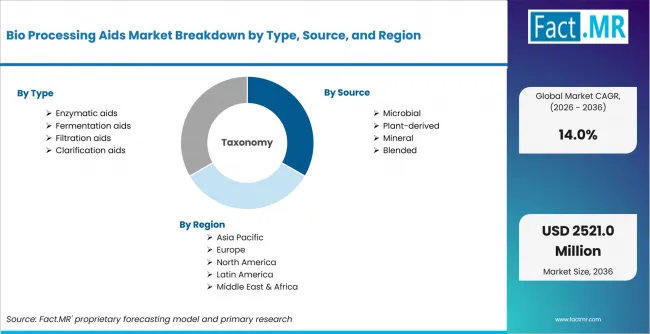
Bio Processing Aids Market Breakdown By Type, Source, And Region | Source: Fact.MR
| Attribute | Details |
|---|---|
| Quantitative Units | USD million |
| Market Definition | Processing aids used during food, beverage, nutraceutical and industrial bioprocessing to improve yield, process stability, quality or waste reduction. |
| Type | Enzymatic aids; Fermentation aids; Filtration aids; Clarification aids |
| Source | Microbial; Plant-derived; Mineral; Blended |
| Function | Yield improvement; Process stability; Quality enhancement; Waste reduction |
| Application | Food processing; Beverages; Nutraceuticals; Industrial bioprocessing |
| Regions Covered | North America; Latin America; Western Europe; Eastern Europe; East Asia; South Asia & Pacific; Middle East & Africa |
| Countries Covered | United States; Germany; Japan; France; Brazil |
| Key Companies Profiled | Novonesis; IFF; dsm-firmenich; Kerry Group; Amano Enzyme; AB Enzymes |
| Forecast Period | 2026 to 2036 |
| Approach | Hybrid top-down and bottom-up approach using processing-aid demand, application mix, segment shares, country growth and provider portfolio review. |
Source: Fact.MR analysis. Updated Aug 28, 2026
How is the market segmented?
-
By Type:
- Enzymatic aids
- Fermentation aids
- Filtration aids
- Clarification aids
-
By Source:
- Microbial
- Plant-derived
- Mineral
- Blended
-
By Function:
- Yield improvement
- Process stability
- Quality enhancement
- Waste reduction
-
By Application:
- Food processing
- Beverages
- Nutraceuticals
- Industrial bioprocessing
-
By Region:
- North America
- Latin America
- Western Europe
- Eastern Europe
- East Asia
- South Asia & Pacific
- Middle East & Africa
Frequently Asked Questions
How big is the bio processing aids market in 2026?
What is the CAGR of the bio processing aids market from 2026 to 2036?
Which type leads the bio processing aids market?
Which source leads the bio processing aids market?
Who are the leading companies in the bio processing aids market?
Who worked on this report


Preview the report firsthand - request a free sample
Free SampleGet the brochure for pricing and purchase details
Download PDF