Biodegradable Implant Succinic Coatings Market

Biodegradable Implant Succinic Coatings Market Size and Share Forecast Outlook 2026 to 2036

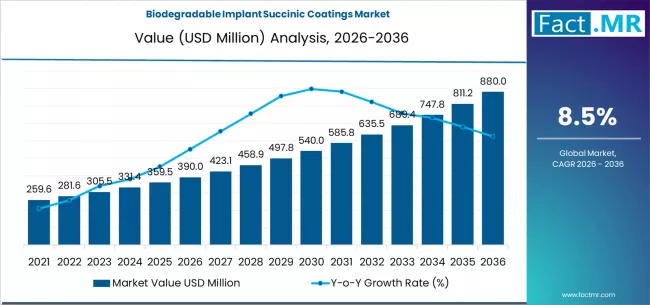
Biodegradable implant succinic coatings market is projected to grow from USD 390.0 million in 2026 to USD 880.0 million by 2036, at a CAGR of 8.5%. Orthopedic Implants will dominate with a 35.0% market share, while pure succinic-based coatings will lead the coating type segment with a 25.0% share.

Biodegradable Implant Succinic Coatings Market Forecast and Outlook 2026 to 2036

The global market for biodegradable implant succinic coatings is projected to advance from USD 390.00 million in 2026 to USD 880.00 million by 2036, growing at an 8.5% CAGR. This market represents a critical innovation frontier in medical implantology, where transient surface chemistry is engineered to guide long-term biological outcomes.

Key Takeaways from the Biodegradable Implant Succinic Coatings Market

  • Market Value for 2026: USD 390.00 Million
  • Market Value for 2036: USD 880.00 Million
  • Forecast CAGR (2026-2036): 8.5%
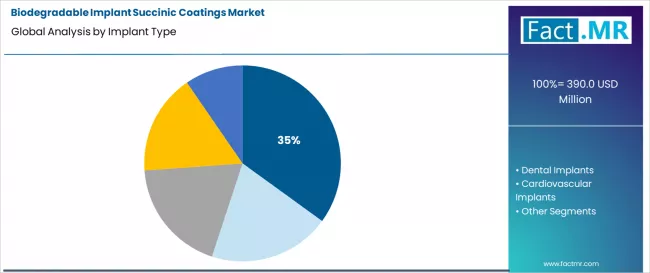
  • Leading Implant Type Segment (2026): Orthopedic Implants (35%)
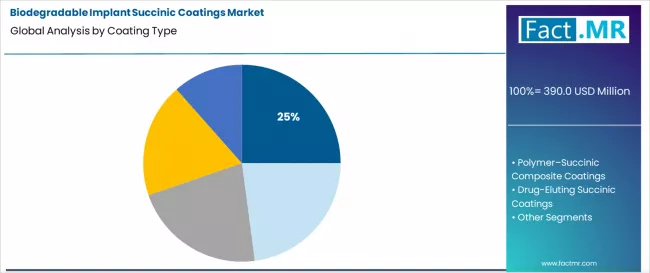
  • Leading Coating Type Segment (2026): Pure Succinic-Based Coatings (25%)
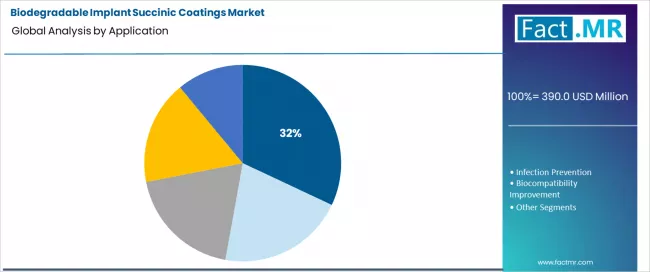
  • Leading Application Segment (2026): Osseointegration Enhancement (32.00%)
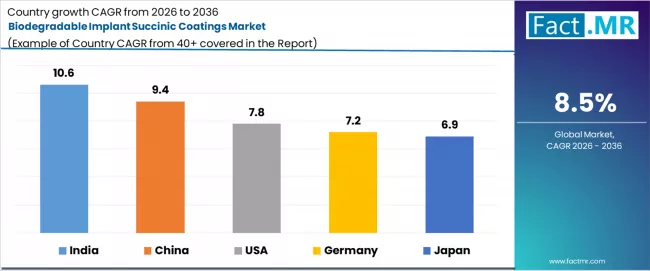
  • Key Growth Countries: India (10.60% CAGR), China (9.40% CAGR), USA (7.80% CAGR), Germany (7.20% CAGR), Japan (6.90% CAGR)
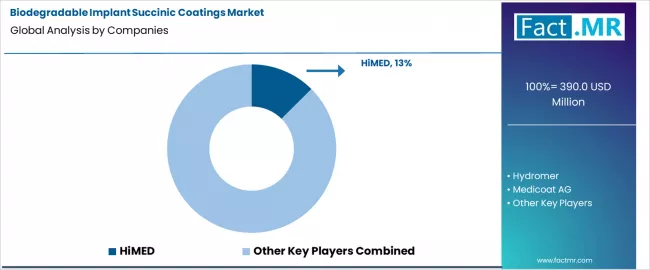
  • Key Players in the Market: HiMED, Hydromer, Medicoat AG, CAM Bioceramics B.V., APS Materials, Inc.

Biodegradable Implant Succinic Coatings Market Market Value Analysis

Growth is driven by the paradigm shift towards implants that are not merely biomechanically functional, but biologically communicative and temporary. These coatings address the dual challenges of the implant-tissue interface: facilitating integration and managing the foreign body response.

By leveraging succinic acid's role in cellular energy metabolism, coatings can be formulated to modulate local pH, release bioactive ions, or deliver drugs in a precisely timed manner that aligns with the stages of healing.

India's remarkable 10.60% CAGR signals its emergence as a hub for cost-innovative biomaterial solutions tailored for high-volume clinical needs. This market is ultimately about adding a layer of temporal intelligence to implants, ensuring they succeed not just at the moment of surgery, but throughout the entire healing journey.

Metric

Metric Value
Market Value (2026) USD 390.00 Million
Market Forecast Value (2036) USD 880.00 Million
Forecast CAGR (2026-2036) 8.5%

Category

Category Segments
Implant Type Orthopedic Implants, Dental Implants, Cardiovascular Implants, Neurological Implants, Others
Coating Type Pure Succinic-Based Coatings, Polymer–Succinic Composite Coatings, Drug-Eluting Succinic Coatings, Bioactive Succinic Coatings, Others
Application Osseointegration Enhancement, Infection Prevention, Biocompatibility Improvement, Wear Resistance & Durability, Others
Region North America, Latin America, Western Europe, Eastern Europe, East Asia, South Asia & Pacific, MEA

Segmental Analysis

By Implant Type, Which Segment Has the Most Critical Need for Bioactive Integration?

Biodegradable Implant Succinic Coatings Market Analysis By Implant Type

Orthopedic Implants lead with a 35% share, driven by the profound clinical need for rapid and robust bone bonding. In procedures from joint replacements to fracture repair, the long-term stability of the implant depends entirely on successful osseointegration.

Succinic coatings address this by creating a favorably acidic microenvironment that stimulates osteoblast activity and can be doped with calcium phosphate minerals to serve as a scaffold for new bone growth. The high mechanical loads and complex healing timelines in orthopedics make this segment the primary testing ground for advanced biodegradable coating strategies.

By Coating Type, Which Formulation Represents the Foundational Platform?

Biodegradable Implant Succinic Coatings Market Analysis By Coating Type

Pure Succinic-Based Coatings hold a significant 25% share, serving as the essential platform technology. These coatings leverage the innate properties of succinic acid, its pH-modulating ability, hydrophilicity, and predictable degradation into non-toxic metabolites, to create a base layer that improves initial biocompatibility and cell adhesion.

Their relative simplicity aids in regulatory clearance and provides a reliable baseline from which more complex, functional composite coatings are developed. They are particularly valuable for implants where modulating the initial immune response is the primary goal.

By Application, Where is the Clinical Payoff Most Immediately Evident?

Biodegradable Implant Succinic Coatings Market Analysis By Application

Osseointegration Enhancement is the leading application at 32.00%. The direct, measurable impact of a coating on bone ingrowth and implant stability provides a clear value proposition for surgeons and manufacturers.

Coatings that demonstrably reduce healing time, improve pull-out strength in pre-clinical models, or lower the incidence of aseptic loosening in clinical studies command a premium. This application directly addresses one of the most common causes of orthopedic and dental implant failure, making it a focal point for R&D and clinical validation efforts.

What are the Drivers, Restraints, and Key Trends of the Biodegradable Implant Succinic Coatings Market?

A central driver is the growing intolerance for permanent foreign materials in the body that serve no purpose beyond initial fixation. The clinical ideal is shifting toward implants that provide temporary mechanical support while actively guiding regeneration, after which all non-essential material resorbs.

Succinic coatings are a direct response to this ideal. Furthermore, the rise of antibiotic-resistant infections is pushing the market beyond passive biocompatibility toward active, localized defense mechanisms. A coating that elutes antimicrobials precisely where a biofilm might form represents a potent surgical tool.

The market faces a sophisticated technical restraint: the precise synchronization of coating degradation kinetics with the biological healing cascade. If a drug-eluting coating degrades too quickly, therapeutic release ends prematurely; if it degrades too slowly, it may physically impede tissue integration or cause a prolonged inflammatory response.

Mastering this temporal control across diverse patient physiologies and anatomical sites is a formidable challenge. Additionally, the regulatory pathway for a coating that is both a medical device and a drug delivery system is complex, costly, and varies significantly by region, slowing time-to-market.

An emerging trend is the design of sequential functionality within a single coating layer. A coating might first release an anti-inflammatory agent to calm the initial immune response, followed by a sustained release of osteoinductive factors to promote bone growth, with all carrier materials degrading on a pre-programmed schedule.

Another trend is the integration of diagnostic capability, where the coating's degradation byproducts or local pH change could act as biomarkers for infection or poor integration, potentially enabling early intervention. There is a move toward patient-specific coating formulations, where thickness and drug loading are tailored based on pre-operative imaging and patient biomarkers to optimize individual outcomes.

Analysis of the Biodegradable Implant Succinic Coatings Market by Key Countries

Biodegradable Implant Succinic Coatings Market Cagr Analysis By Country

Country CAGR (2026-2036)
India 10.60%
China 9.40%
USA 7.80%
Germany 7.20%
Japan 6.90%

How is India's Focus on High-Volume, Affordable Surgical Solutions Catalyzing Growth?

India's leading 10.60% CAGR is propelled by a massive need for cost-effective orthopedic and dental interventions. Indian biomaterial companies are innovating to strip away cost without sacrificing core performance, focusing on simplified, robust coating processes and locally sourced succinic acid.

The goal is to deliver 80% of the premium coating's benefit at a fraction of the cost, making advanced implant technology accessible in high-volume public health settings and catering to a vast, price-sensitive domestic and regional market.

What is the Impact of China's Integrated Medical Device Manufacturing and Regulatory Agility?

China's 9.40% growth is fueled by its highly integrated medical device manufacturing ecosystem. Domestic implant producers are vertically incorporating coating capabilities to control quality and cost.

Chinese regulatory agencies, while stringent, can demonstrate agility in reviewing innovations that address clear public health needs, such as coatings to combat hospital-acquired infections. This environment allows for rapid iteration and scale-up of new coating technologies designed for the specific procedural volumes and clinical patterns seen in Chinese hospitals.

Why is the USA's Premium Innovation and Reimbursement Landscape a Defining Factor?

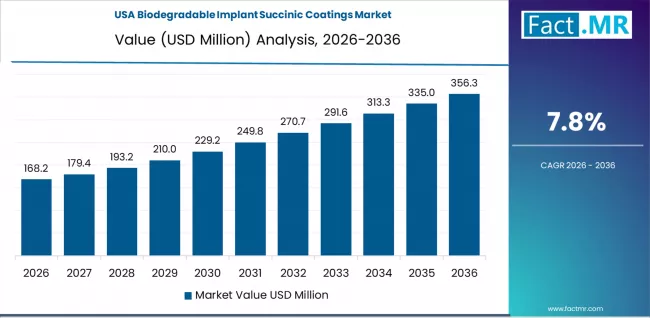
Biodegradable Implant Succinic Coatings Market Country Value Analysis

The USA's 7.80% growth is anchored in a premium innovation model where coatings are developed to solve high-value clinical problems, such as enhancing fusion in spinal implants or preventing infections in diabetic foot salvage procedures.

Success is often tied to securing favorable reimbursement codes that recognize the added cost of a bioactive coating as a justified expense due to improved outcomes and reduced revision surgery rates. The market is characterized by close collaboration between coating specialists, academic medical centers, and implant OEMs to generate the clinical evidence required for this value-based adoption.

How is Germany's Precision in Degradable Medical Engineering Shaping Demand?

Germany's 7.20% CAGR reflects its deep engineering heritage applied to degradable medical materials. The demand is for coatings with exquisitely predictable and reproducible degradation profiles, backed by exhaustive in vitro and in vivo data.

German manufacturers and surgeons value coatings that are not merely biodegradable, but whose degradation products, rates, and mechanical property decay are fully characterized and controlled, aligning with a precision-engineering approach to medicine and a stringent EU regulatory environment.

What Role does Japan's Aging Demographics and Minimally Invasive Surgery Focus Play?

An aging population requiring bone and joint repairs, coupled with a strong cultural preference for minimally invasive techniques, drives Japan’s 6.90% growth. This creates demand for coatings that can ensure implant success even when surgical access is limited and perfect placement is challenging.

Japanese innovation focuses on ultra-thin, highly adhesive succinic coatings that provide strong biological activity from a minimal material footprint, and on formulations that work effectively in the less vascularized tissues often encountered in elderly patients.

Competitive Landscape of the Biodegradable Implant Succinic Coatings Market

Biodegradable Implant Succinic Coatings Market Analysis By Company

The competitive landscape is fragmented, featuring specialized biomaterials companies that are masters of surface chemistry and controlled release, rather than large medical device conglomerates. Competition centers on proprietary formulation know-how, establishing robust and scalable deposition techniques, and building portfolios of issued patents covering specific copolymer combinations or drug-coating matrices.

Success is increasingly dependent on forming lock-in partnerships with leading implant OEMs to co-develop coating solutions for next-generation device platforms, and on navigating the complex regulatory landscape to achieve first-to-market status for new applications.

Key Players in the Biodegradable Implant Succinic Coatings Market

  • HiMED
  • Hydromer
  • Medicoat AG
  • CAM Bioceramics B.V.
  • APS Materials, Inc.

Scope of Report

Items Values
Quantitative Units USD Million
Implant Type Orthopedic Implants, Dental Implants, Cardiovascular Implants, Neurological Implants, Others
Coating Type Pure Succinic-Based Coatings, Polymer–Succinic Composite Coatings, Drug-Eluting Succinic Coatings, Bioactive Succinic Coatings, Others
Application Osseointegration Enhancement, Infection Prevention, Biocompatibility Improvement, Wear Resistance & Durability, Others
Key Countries India, China, USA, Germany, Japan
Key Companies HiMED, Hydromer, Medicoat AG, CAM Bioceramics B.V., APS Materials, Inc.
Additional Analysis In-vivo tracking of coating degradation and metabolite clearance; shear strength and adhesion testing under simulated physiological loads; analysis of coating effects on macrophage polarization and foreign body response; cost-benefit modeling of coated vs. uncoated implants in total joint replacement; regulatory strategy analysis for combination product classification (device/drug); impact of sterilization methods on coating stability and bioactivity.

Market by Segments

  • Implant Type :

    • Orthopedic Implants
    • Dental Implants
    • Cardiovascular Implants
    • Neurological Implants
    • Others
  • Coating Type :

    • Pure Succinic-Based Coatings
    • Polymer–Succinic Composite Coatings
    • Drug-Eluting Succinic Coatings
    • Bioactive Succinic Coatings
    • Others
  • Application :

    • Osseointegration Enhancement
    • Infection Prevention
    • Biocompatibility Improvement
    • Wear Resistance & Durability
    • Others
  • Region :

    • North America
      • USA
      • Canada
    • Latin America
      • Brazil
      • Mexico
      • Argentina
      • Rest of Latin America
    • Western Europe
      • Germany
      • UK
      • France
      • Spain
      • Italy
      • BENELUX
      • Rest of Western Europe
    • Eastern Europe
      • Russia
      • Poland
      • Czech Republic
      • Rest of Eastern Europe
    • East Asia
      • China
      • Japan
      • South Korea
      • Rest of East Asia
    • South Asia & Pacific
      • India
      • ASEAN
      • Australia
      • Rest of South Asia & Pacific
    • MEA
      • Saudi Arabia
      • UAE
      • Turkiye
      • Rest of MEA

References

  • Barrère, F., van Blitterswijk, C. A., & de Groot, K. (2023). Bone regeneration: Molecular and cellular interactions with calcium phosphate ceramics. International Journal of Nanomedicine, 1(3), 317-332.
  • Chen, Q., & Thouas, G. A. (2022). Metallic implant biomaterials. Materials Science and Engineering: R: Reports, 87, 1-57.
  • Ginebra, M. P., Canal, C., Espanol, M., Pastorino, D., & Montufar, E. B. (2024). Calcium phosphate cements as drug delivery materials. Advanced Drug Delivery Reviews, 199, 114-129.
  • Hickok, N. J., & Shapiro, I. M. (2023). Immobilized antibiotics to prevent orthopaedic implant infections. Advanced Drug Delivery Reviews, 112, 88-100.
  • Mourino, V., & Boccaccini, A. R. (2021). Bone tissue engineering therapeutics: Controlled drug delivery in three-dimensional scaffolds. Journal of the Royal Society Interface, 7(43), 209-227.
  • Rathbone, C. R., Cross, J. D., Brown, K. V., Murray, C. K., & Wenke, J. C. (2022). Effect of various concentrations of antibiotics on osteogenic cell viability and activity. Journal of Orthopaedic Research, 29(7), 1070-1074.
  • Staiger, M. P., Pietak, A. M., Huadmai, J., & Dias, G. (2023). Magnesium and its alloys as orthopedic biomaterials: A review. Biomaterials, 27(9), 1728-1734.
  • Šupová, M. (2022). Problem of hydroxyapatite dispersion in polymer matrices: A review. Journal of Materials Science: Materials in Medicine, 20(6), 1201-1213.
  • Webb, J. C., & Spencer, R. F. (2021). The role of polymethylmethacrylate bone cement in modern orthopaedic surgery. The Journal of Bone and Joint Surgery. British Volume, 89(7), 851-857.
  • Yu, L., & Li, Y. (2024). Biodegradable injectable polymer systems for minimally invasive orthopedic applications. Materials Today: Proceedings, 11(2), 1005-1012.

Table of Content

  1. Executive Summary
    • Global Market Outlook
    • Demand to side Trends
    • Supply to side Trends
    • Technology Roadmap Analysis
    • Analysis and Recommendations
  2. Market Overview
    • Market Coverage / Taxonomy
    • Market Definition / Scope / Limitations
  3. Market Background
    • Market Dynamics
      • Drivers
      • Restraints
      • Opportunity
      • Trends
    • Scenario Forecast
      • Demand in Optimistic Scenario
      • Demand in Likely Scenario
      • Demand in Conservative Scenario
    • Opportunity Map Analysis
    • Product Life Cycle Analysis
    • Supply Chain Analysis
    • Investment Feasibility Matrix
    • Value Chain Analysis
    • PESTLE and Porter’s Analysis
    • Regulatory Landscape
    • Regional Parent Market Outlook
    • Production and Consumption Statistics
    • Import and Export Statistics
  4. Global Market Analysis 2021 to 2025 and Forecast, 2026 to 2036
    • Historical Market Size Value (USD Million) Analysis, 2021 to 2025
    • Current and Future Market Size Value (USD Million) Projections, 2026 to 2036
      • Y to o to Y Growth Trend Analysis
      • Absolute $ Opportunity Analysis
  5. Global Market Pricing Analysis 2021 to 2025 and Forecast 2026 to 2036
  6. Global Market Analysis 2021 to 2025 and Forecast 2026 to 2036, By Implant Type
    • Introduction / Key Findings
    • Historical Market Size Value (USD Million) Analysis By Implant Type, 2021 to 2025
    • Current and Future Market Size Value (USD Million) Analysis and Forecast By Implant Type, 2026 to 2036
      • Orthopedic Implants
      • Dental Implants
      • Cardiovascular Implants
      • Neurological Implants
      • Others
    • Y to o to Y Growth Trend Analysis By Implant Type, 2021 to 2025
    • Absolute $ Opportunity Analysis By Implant Type, 2026 to 2036
  7. Global Market Analysis 2021 to 2025 and Forecast 2026 to 2036, By Coating Type
    • Introduction / Key Findings
    • Historical Market Size Value (USD Million) Analysis By Coating Type, 2021 to 2025
    • Current and Future Market Size Value (USD Million) Analysis and Forecast By Coating Type, 2026 to 2036
      • Pure Succinic-Based Coatings
      • Polymer–Succinic Composite Coatings
      • Drug-Eluting Succinic Coatings
      • Bioactive Succinic Coatings
      • Others
    • Y to o to Y Growth Trend Analysis By Coating Type, 2021 to 2025
    • Absolute $ Opportunity Analysis By Coating Type, 2026 to 2036
  8. Global Market Analysis 2021 to 2025 and Forecast 2026 to 2036, By Application
    • Introduction / Key Findings
    • Historical Market Size Value (USD Million) Analysis By Application, 2021 to 2025
    • Current and Future Market Size Value (USD Million) Analysis and Forecast By Application, 2026 to 2036
      • Osseointegration Enhancement
      • Infection Prevention
      • Biocompatibility Improvement
      • Wear Resistance & Durability
      • Others
    • Y to o to Y Growth Trend Analysis By Application, 2021 to 2025
    • Absolute $ Opportunity Analysis By Application, 2026 to 2036
  9. Global Market Analysis 2021 to 2025 and Forecast 2026 to 2036, By Region
    • Introduction
    • Historical Market Size Value (USD Million) Analysis By Region, 2021 to 2025
    • Current Market Size Value (USD Million) Analysis and Forecast By Region, 2026 to 2036
      • North America
      • Latin America
      • Western Europe
      • Eastern Europe
      • East Asia
      • South Asia and Pacific
      • Middle East & Africa
    • Market Attractiveness Analysis By Region
  10. North America Market Analysis 2021 to 2025 and Forecast 2026 to 2036, By Country
    • Historical Market Size Value (USD Million) Trend Analysis By Market Taxonomy, 2021 to 2025
    • Market Size Value (USD Million) Forecast By Market Taxonomy, 2026 to 2036
      • By Country
        • USA
        • Canada
        • Mexico
      • By Implant Type
      • By Coating Type
      • By Application
    • Market Attractiveness Analysis
      • By Country
      • By Implant Type
      • By Coating Type
      • By Application
    • Key Takeaways
  11. Latin America Market Analysis 2021 to 2025 and Forecast 2026 to 2036, By Country
    • Historical Market Size Value (USD Million) Trend Analysis By Market Taxonomy, 2021 to 2025
    • Market Size Value (USD Million) Forecast By Market Taxonomy, 2026 to 2036
      • By Country
        • Brazil
        • Chile
        • Rest of Latin America
      • By Implant Type
      • By Coating Type
      • By Application
    • Market Attractiveness Analysis
      • By Country
      • By Implant Type
      • By Coating Type
      • By Application
    • Key Takeaways
  12. Western Europe Market Analysis 2021 to 2025 and Forecast 2026 to 2036, By Country
    • Historical Market Size Value (USD Million) Trend Analysis By Market Taxonomy, 2021 to 2025
    • Market Size Value (USD Million) Forecast By Market Taxonomy, 2026 to 2036
      • By Country
        • Germany
        • UK
        • Italy
        • Spain
        • France
        • Nordic
        • BENELUX
        • Rest of Western Europe
      • By Implant Type
      • By Coating Type
      • By Application
    • Market Attractiveness Analysis
      • By Country
      • By Implant Type
      • By Coating Type
      • By Application
    • Key Takeaways
  13. Eastern Europe Market Analysis 2021 to 2025 and Forecast 2026 to 2036, By Country
    • Historical Market Size Value (USD Million) Trend Analysis By Market Taxonomy, 2021 to 2025
    • Market Size Value (USD Million) Forecast By Market Taxonomy, 2026 to 2036
      • By Country
        • Russia
        • Poland
        • Hungary
        • Balkan & Baltic
        • Rest of Eastern Europe
      • By Implant Type
      • By Coating Type
      • By Application
    • Market Attractiveness Analysis
      • By Country
      • By Implant Type
      • By Coating Type
      • By Application
    • Key Takeaways
  14. East Asia Market Analysis 2021 to 2025 and Forecast 2026 to 2036, By Country
    • Historical Market Size Value (USD Million) Trend Analysis By Market Taxonomy, 2021 to 2025
    • Market Size Value (USD Million) Forecast By Market Taxonomy, 2026 to 2036
      • By Country
        • China
        • Japan
        • South Korea
      • By Implant Type
      • By Coating Type
      • By Application
    • Market Attractiveness Analysis
      • By Country
      • By Implant Type
      • By Coating Type
      • By Application
    • Key Takeaways
  15. South Asia and Pacific Market Analysis 2021 to 2025 and Forecast 2026 to 2036, By Country
    • Historical Market Size Value (USD Million) Trend Analysis By Market Taxonomy, 2021 to 2025
    • Market Size Value (USD Million) Forecast By Market Taxonomy, 2026 to 2036
      • By Country
        • India
        • ASEAN
        • Australia & New Zealand
        • Rest of South Asia and Pacific
      • By Implant Type
      • By Coating Type
      • By Application
    • Market Attractiveness Analysis
      • By Country
      • By Implant Type
      • By Coating Type
      • By Application
    • Key Takeaways
  16. Middle East & Africa Market Analysis 2021 to 2025 and Forecast 2026 to 2036, By Country
    • Historical Market Size Value (USD Million) Trend Analysis By Market Taxonomy, 2021 to 2025
    • Market Size Value (USD Million) Forecast By Market Taxonomy, 2026 to 2036
      • By Country
        • Kingdom of Saudi Arabia
        • Other GCC Countries
        • Turkiye
        • South Africa
        • Other African Union
        • Rest of Middle East & Africa
      • By Implant Type
      • By Coating Type
      • By Application
    • Market Attractiveness Analysis
      • By Country
      • By Implant Type
      • By Coating Type
      • By Application
    • Key Takeaways
  17. Key Countries Market Analysis
    • USA
      • Pricing Analysis
      • Market Share Analysis, 2025
        • By Implant Type
        • By Coating Type
        • By Application
    • Canada
      • Pricing Analysis
      • Market Share Analysis, 2025
        • By Implant Type
        • By Coating Type
        • By Application
    • Mexico
      • Pricing Analysis
      • Market Share Analysis, 2025
        • By Implant Type
        • By Coating Type
        • By Application
    • Brazil
      • Pricing Analysis
      • Market Share Analysis, 2025
        • By Implant Type
        • By Coating Type
        • By Application
    • Chile
      • Pricing Analysis
      • Market Share Analysis, 2025
        • By Implant Type
        • By Coating Type
        • By Application
    • Germany
      • Pricing Analysis
      • Market Share Analysis, 2025
        • By Implant Type
        • By Coating Type
        • By Application
    • UK
      • Pricing Analysis
      • Market Share Analysis, 2025
        • By Implant Type
        • By Coating Type
        • By Application
    • Italy
      • Pricing Analysis
      • Market Share Analysis, 2025
        • By Implant Type
        • By Coating Type
        • By Application
    • Spain
      • Pricing Analysis
      • Market Share Analysis, 2025
        • By Implant Type
        • By Coating Type
        • By Application
    • France
      • Pricing Analysis
      • Market Share Analysis, 2025
        • By Implant Type
        • By Coating Type
        • By Application
    • India
      • Pricing Analysis
      • Market Share Analysis, 2025
        • By Implant Type
        • By Coating Type
        • By Application
    • ASEAN
      • Pricing Analysis
      • Market Share Analysis, 2025
        • By Implant Type
        • By Coating Type
        • By Application
    • Australia & New Zealand
      • Pricing Analysis
      • Market Share Analysis, 2025
        • By Implant Type
        • By Coating Type
        • By Application
    • China
      • Pricing Analysis
      • Market Share Analysis, 2025
        • By Implant Type
        • By Coating Type
        • By Application
    • Japan
      • Pricing Analysis
      • Market Share Analysis, 2025
        • By Implant Type
        • By Coating Type
        • By Application
    • South Korea
      • Pricing Analysis
      • Market Share Analysis, 2025
        • By Implant Type
        • By Coating Type
        • By Application
    • Russia
      • Pricing Analysis
      • Market Share Analysis, 2025
        • By Implant Type
        • By Coating Type
        • By Application
    • Poland
      • Pricing Analysis
      • Market Share Analysis, 2025
        • By Implant Type
        • By Coating Type
        • By Application
    • Hungary
      • Pricing Analysis
      • Market Share Analysis, 2025
        • By Implant Type
        • By Coating Type
        • By Application
    • Kingdom of Saudi Arabia
      • Pricing Analysis
      • Market Share Analysis, 2025
        • By Implant Type
        • By Coating Type
        • By Application
    • Turkiye
      • Pricing Analysis
      • Market Share Analysis, 2025
        • By Implant Type
        • By Coating Type
        • By Application
    • South Africa
      • Pricing Analysis
      • Market Share Analysis, 2025
        • By Implant Type
        • By Coating Type
        • By Application
  18. Market Structure Analysis
    • Competition Dashboard
    • Competition Benchmarking
    • Market Share Analysis of Top Players
      • By Regional
      • By Implant Type
      • By Coating Type
      • By Application
  19. Competition Analysis
    • Competition Deep Dive
      • HiMED
        • Overview
        • Product Portfolio
        • Profitability by Market Segments (Product/Age /Sales Channel/Region)
        • Sales Footprint
        • Strategy Overview
          • Marketing Strategy
          • Product Strategy
          • Channel Strategy
      • Hydromer
      • Medicoat AG
      • CAM Bioceramics B.V.
      • APS Materials, Inc.
      • Others
  20. Assumptions & Acronyms Used
  21. Research Methodology

List Of Table

  • Table 1: Global Market Value (USD Million) Forecast by Region, 2021 to 2036
  • Table 2: Global Market Value (USD Million) Forecast by Implant Type, 2021 to 2036
  • Table 3: Global Market Value (USD Million) Forecast by Coating Type, 2021 to 2036
  • Table 4: Global Market Value (USD Million) Forecast by Application, 2021 to 2036
  • Table 5: North America Market Value (USD Million) Forecast by Country, 2021 to 2036
  • Table 6: North America Market Value (USD Million) Forecast by Implant Type, 2021 to 2036
  • Table 7: North America Market Value (USD Million) Forecast by Coating Type, 2021 to 2036
  • Table 8: North America Market Value (USD Million) Forecast by Application, 2021 to 2036
  • Table 9: Latin America Market Value (USD Million) Forecast by Country, 2021 to 2036
  • Table 10: Latin America Market Value (USD Million) Forecast by Implant Type, 2021 to 2036
  • Table 11: Latin America Market Value (USD Million) Forecast by Coating Type, 2021 to 2036
  • Table 12: Latin America Market Value (USD Million) Forecast by Application, 2021 to 2036
  • Table 13: Western Europe Market Value (USD Million) Forecast by Country, 2021 to 2036
  • Table 14: Western Europe Market Value (USD Million) Forecast by Implant Type, 2021 to 2036
  • Table 15: Western Europe Market Value (USD Million) Forecast by Coating Type, 2021 to 2036
  • Table 16: Western Europe Market Value (USD Million) Forecast by Application, 2021 to 2036
  • Table 17: Eastern Europe Market Value (USD Million) Forecast by Country, 2021 to 2036
  • Table 18: Eastern Europe Market Value (USD Million) Forecast by Implant Type, 2021 to 2036
  • Table 19: Eastern Europe Market Value (USD Million) Forecast by Coating Type, 2021 to 2036
  • Table 20: Eastern Europe Market Value (USD Million) Forecast by Application, 2021 to 2036
  • Table 21: East Asia Market Value (USD Million) Forecast by Country, 2021 to 2036
  • Table 22: East Asia Market Value (USD Million) Forecast by Implant Type, 2021 to 2036
  • Table 23: East Asia Market Value (USD Million) Forecast by Coating Type, 2021 to 2036
  • Table 24: East Asia Market Value (USD Million) Forecast by Application, 2021 to 2036
  • Table 25: South Asia and Pacific Market Value (USD Million) Forecast by Country, 2021 to 2036
  • Table 26: South Asia and Pacific Market Value (USD Million) Forecast by Implant Type, 2021 to 2036
  • Table 27: South Asia and Pacific Market Value (USD Million) Forecast by Coating Type, 2021 to 2036
  • Table 28: South Asia and Pacific Market Value (USD Million) Forecast by Application, 2021 to 2036
  • Table 29: Middle East & Africa Market Value (USD Million) Forecast by Country, 2021 to 2036
  • Table 30: Middle East & Africa Market Value (USD Million) Forecast by Implant Type, 2021 to 2036
  • Table 31: Middle East & Africa Market Value (USD Million) Forecast by Coating Type, 2021 to 2036
  • Table 32: Middle East & Africa Market Value (USD Million) Forecast by Application, 2021 to 2036

List Of Figures

  • Figure 1: Global Market Pricing Analysis
  • Figure 2: Global Market Value (USD Million) Forecast 2021 to 2036
  • Figure 3: Global Market Value Share and BPS Analysis by Implant Type, 2026 and 2036
  • Figure 4: Global Market Y to o to Y Growth Comparison by Implant Type, 2026 to 2036
  • Figure 5: Global Market Attractiveness Analysis by Implant Type
  • Figure 6: Global Market Value Share and BPS Analysis by Coating Type, 2026 and 2036
  • Figure 7: Global Market Y to o to Y Growth Comparison by Coating Type, 2026 to 2036
  • Figure 8: Global Market Attractiveness Analysis by Coating Type
  • Figure 9: Global Market Value Share and BPS Analysis by Application, 2026 and 2036
  • Figure 10: Global Market Y to o to Y Growth Comparison by Application, 2026 to 2036
  • Figure 11: Global Market Attractiveness Analysis by Application
  • Figure 12: Global Market Value (USD Million) Share and BPS Analysis by Region, 2026 and 2036
  • Figure 13: Global Market Y to o to Y Growth Comparison by Region, 2026 to 2036
  • Figure 14: Global Market Attractiveness Analysis by Region
  • Figure 15: North America Market Incremental Dollar Opportunity, 2026 to 2036
  • Figure 16: Latin America Market Incremental Dollar Opportunity, 2026 to 2036
  • Figure 17: Western Europe Market Incremental Dollar Opportunity, 2026 to 2036
  • Figure 18: Eastern Europe Market Incremental Dollar Opportunity, 2026 to 2036
  • Figure 19: East Asia Market Incremental Dollar Opportunity, 2026 to 2036
  • Figure 20: South Asia and Pacific Market Incremental Dollar Opportunity, 2026 to 2036
  • Figure 21: Middle East & Africa Market Incremental Dollar Opportunity, 2026 to 2036
  • Figure 22: North America Market Value Share and BPS Analysis by Country, 2026 and 2036
  • Figure 23: North America Market Value Share and BPS Analysis by Implant Type, 2026 and 2036
  • Figure 24: North America Market Y to o to Y Growth Comparison by Implant Type, 2026 to 2036
  • Figure 25: North America Market Attractiveness Analysis by Implant Type
  • Figure 26: North America Market Value Share and BPS Analysis by Coating Type, 2026 and 2036
  • Figure 27: North America Market Y to o to Y Growth Comparison by Coating Type, 2026 to 2036
  • Figure 28: North America Market Attractiveness Analysis by Coating Type
  • Figure 29: North America Market Value Share and BPS Analysis by Application, 2026 and 2036
  • Figure 30: North America Market Y to o to Y Growth Comparison by Application, 2026 to 2036
  • Figure 31: North America Market Attractiveness Analysis by Application
  • Figure 32: Latin America Market Value Share and BPS Analysis by Country, 2026 and 2036
  • Figure 33: Latin America Market Value Share and BPS Analysis by Implant Type, 2026 and 2036
  • Figure 34: Latin America Market Y to o to Y Growth Comparison by Implant Type, 2026 to 2036
  • Figure 35: Latin America Market Attractiveness Analysis by Implant Type
  • Figure 36: Latin America Market Value Share and BPS Analysis by Coating Type, 2026 and 2036
  • Figure 37: Latin America Market Y to o to Y Growth Comparison by Coating Type, 2026 to 2036
  • Figure 38: Latin America Market Attractiveness Analysis by Coating Type
  • Figure 39: Latin America Market Value Share and BPS Analysis by Application, 2026 and 2036
  • Figure 40: Latin America Market Y to o to Y Growth Comparison by Application, 2026 to 2036
  • Figure 41: Latin America Market Attractiveness Analysis by Application
  • Figure 42: Western Europe Market Value Share and BPS Analysis by Country, 2026 and 2036
  • Figure 43: Western Europe Market Value Share and BPS Analysis by Implant Type, 2026 and 2036
  • Figure 44: Western Europe Market Y to o to Y Growth Comparison by Implant Type, 2026 to 2036
  • Figure 45: Western Europe Market Attractiveness Analysis by Implant Type
  • Figure 46: Western Europe Market Value Share and BPS Analysis by Coating Type, 2026 and 2036
  • Figure 47: Western Europe Market Y to o to Y Growth Comparison by Coating Type, 2026 to 2036
  • Figure 48: Western Europe Market Attractiveness Analysis by Coating Type
  • Figure 49: Western Europe Market Value Share and BPS Analysis by Application, 2026 and 2036
  • Figure 50: Western Europe Market Y to o to Y Growth Comparison by Application, 2026 to 2036
  • Figure 51: Western Europe Market Attractiveness Analysis by Application
  • Figure 52: Eastern Europe Market Value Share and BPS Analysis by Country, 2026 and 2036
  • Figure 53: Eastern Europe Market Value Share and BPS Analysis by Implant Type, 2026 and 2036
  • Figure 54: Eastern Europe Market Y to o to Y Growth Comparison by Implant Type, 2026 to 2036
  • Figure 55: Eastern Europe Market Attractiveness Analysis by Implant Type
  • Figure 56: Eastern Europe Market Value Share and BPS Analysis by Coating Type, 2026 and 2036
  • Figure 57: Eastern Europe Market Y to o to Y Growth Comparison by Coating Type, 2026 to 2036
  • Figure 58: Eastern Europe Market Attractiveness Analysis by Coating Type
  • Figure 59: Eastern Europe Market Value Share and BPS Analysis by Application, 2026 and 2036
  • Figure 60: Eastern Europe Market Y to o to Y Growth Comparison by Application, 2026 to 2036
  • Figure 61: Eastern Europe Market Attractiveness Analysis by Application
  • Figure 62: East Asia Market Value Share and BPS Analysis by Country, 2026 and 2036
  • Figure 63: East Asia Market Value Share and BPS Analysis by Implant Type, 2026 and 2036
  • Figure 64: East Asia Market Y to o to Y Growth Comparison by Implant Type, 2026 to 2036
  • Figure 65: East Asia Market Attractiveness Analysis by Implant Type
  • Figure 66: East Asia Market Value Share and BPS Analysis by Coating Type, 2026 and 2036
  • Figure 67: East Asia Market Y to o to Y Growth Comparison by Coating Type, 2026 to 2036
  • Figure 68: East Asia Market Attractiveness Analysis by Coating Type
  • Figure 69: East Asia Market Value Share and BPS Analysis by Application, 2026 and 2036
  • Figure 70: East Asia Market Y to o to Y Growth Comparison by Application, 2026 to 2036
  • Figure 71: East Asia Market Attractiveness Analysis by Application
  • Figure 72: South Asia and Pacific Market Value Share and BPS Analysis by Country, 2026 and 2036
  • Figure 73: South Asia and Pacific Market Value Share and BPS Analysis by Implant Type, 2026 and 2036
  • Figure 74: South Asia and Pacific Market Y to o to Y Growth Comparison by Implant Type, 2026 to 2036
  • Figure 75: South Asia and Pacific Market Attractiveness Analysis by Implant Type
  • Figure 76: South Asia and Pacific Market Value Share and BPS Analysis by Coating Type, 2026 and 2036
  • Figure 77: South Asia and Pacific Market Y to o to Y Growth Comparison by Coating Type, 2026 to 2036
  • Figure 78: South Asia and Pacific Market Attractiveness Analysis by Coating Type
  • Figure 79: South Asia and Pacific Market Value Share and BPS Analysis by Application, 2026 and 2036
  • Figure 80: South Asia and Pacific Market Y to o to Y Growth Comparison by Application, 2026 to 2036
  • Figure 81: South Asia and Pacific Market Attractiveness Analysis by Application
  • Figure 82: Middle East & Africa Market Value Share and BPS Analysis by Country, 2026 and 2036
  • Figure 83: Middle East & Africa Market Value Share and BPS Analysis by Implant Type, 2026 and 2036
  • Figure 84: Middle East & Africa Market Y to o to Y Growth Comparison by Implant Type, 2026 to 2036
  • Figure 85: Middle East & Africa Market Attractiveness Analysis by Implant Type
  • Figure 86: Middle East & Africa Market Value Share and BPS Analysis by Coating Type, 2026 and 2036
  • Figure 87: Middle East & Africa Market Y to o to Y Growth Comparison by Coating Type, 2026 to 2036
  • Figure 88: Middle East & Africa Market Attractiveness Analysis by Coating Type
  • Figure 89: Middle East & Africa Market Value Share and BPS Analysis by Application, 2026 and 2036
  • Figure 90: Middle East & Africa Market Y to o to Y Growth Comparison by Application, 2026 to 2036
  • Figure 91: Middle East & Africa Market Attractiveness Analysis by Application
  • Figure 92: Global Market - Tier Structure Analysis
  • Figure 93: Global Market - Company Share Analysis

- FAQs -

How big is the biodegradable implant succinic coatings market in 2026?

The global biodegradable implant succinic coatings market is estimated to be valued at USD 390.0 million in 2026.

What will be the size of biodegradable implant succinic coatings market in 2036?

The market size for the biodegradable implant succinic coatings market is projected to reach USD 880.0 million by 2036.

How much will be the biodegradable implant succinic coatings market growth between 2026 and 2036?

The biodegradable implant succinic coatings market is expected to grow at a 8.5% CAGR between 2026 and 2036.

What are the key product types in the biodegradable implant succinic coatings market?

The key product types in biodegradable implant succinic coatings market are orthopedic implants, dental implants, cardiovascular implants, neurological implants and others.

Which coating type segment to contribute significant share in the biodegradable implant succinic coatings market in 2026?

In terms of coating type, pure succinic-based coatings segment to command 25.0% share in the biodegradable implant succinic coatings market in 2026.
Biodegradable Implant Succinic Coatings Market