- Market Value (2025): USD 377.6 Mn
- Estimated Value (2026): USD 398.6 Mn
- Forecast Value (2036): USD 686.1 Mn
- CAGR (2026-2036): 5.6%
What is the Blood Collection Monitors Market forecast to be worth by 2036?
USD 398.6 million in 2026 to USD 686.1 million by 2036 at a 5.6% CAGR.
- Fact.MR estimates that the blood collection monitors market stood at USD 377.6 million in 2025.
- Sales are projected to move from USD 398.6 million in 2026 to USD 686.1 million by 2036 as blood establishments renew collection equipment.
- A 5.6% CAGR from 2026 to 2036 reflects purchases by hospital blood services and specialist donation centers.
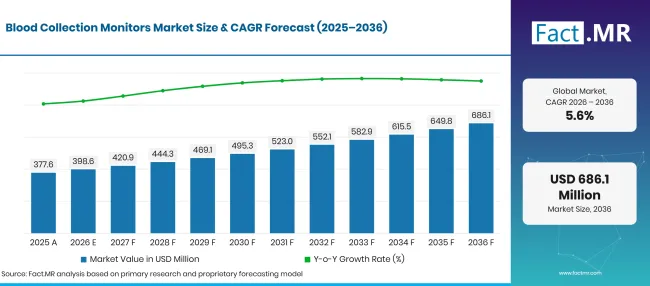
Blood Collection Monitors Market Forecast Global | Source: Fact.MR
| Year | Basis | Market Value (USD million) |
|---|---|---|
| 2025 | Actual | 377.6 |
| 2026 | Estimate | 398.6 |
| 2036 | Forecast | 686.1 |
| CAGR 2026 to 2036 | Forecast period | 5.6% |
Source: Fact.MR analysis. Updated Oct 30, 2026
What are the defining numbers behind Blood Collection Monitors Market growth?
USD 287.5 million absolute opportunity by 2036, led by fixed monitors and healthcare facilities.
- Demand Drivers in the Market
- Blood establishments need reliable collection-volume control because underfilled or overfilled bags interrupt standard processing. A monitor weighs the bag during donation and helps staff react before a collection is completed.
- Collection teams place a premium on consistent mixing and dependable flow alerts. In its June 2026 blood-safety update, the World Health Organization reported approximately 120.4 million blood donations worldwide, providing context for the scale of global blood collection activities [1].
- Mobile donation teams often need battery-powered monitors with stable collection trays. Portable equipment allows collection at temporary venues without the room arrangements used in fixed blood banks.
- Hospital blood-bank managers compare calibration records, cleaning requirements and alarm visibility. Reliable clamping and clear alarms help staff supervise several collection sessions safely.
- Key Segments Analyzed
- By Product Type: Fixed Blood Collection Monitors account for 58.3% of 2026 market value as permanent donation sites keep equipment installed at designated donor stations.
- By Application: Hospitals lead with 42.1% of 2026 demand as collection rooms rely on measurable volumes and routine device checks.
- By End-User: Healthcare Facilities represent 76.8% of 2026 value because hospitals and blood-service facilities operate scheduled collection and quality-control workflows.
- Analyst Opinion at Fact.MR
- Shambhu Nath Jha, Principal Consultant at Fact.MR, states, “Blood collection monitors are judged by how reliably they support routine donation work rather than by features alone. Hospitals and blood centers need accurate volume measurement, dependable mixing, visible alarms, and straightforward calibration. Portable units add another requirement: stable operation during mobile sessions. Suppliers that combine dependable hardware with clear service support, blood-bag compatibility, and simple maintenance procedures are likely to be better positioned as facilities replace aging equipment.”
- Strategic Implications
- Blood centers should assess collection accuracy alongside routine service needs, including the time needed to check calibration and disinfect the weighing tray.
- Device manufacturers can make comparisons easier by publishing clear collection-volume limits, alarm settings and battery specifications for each model.
- Hospital managers should compare monitor compatibility with the blood bags and donor couches already used at their facilities.
- Mobile collection teams need charging arrangements and transport protection that suit the number of planned donation sessions.
Country growth paths differ by collection scale and service organization. The USA is forecast to advance at 7.2% CAGR, followed by Japan at 6.6% and the UK at 5.8%.
How does the Blood Collection Monitors Market break down by segment?
Fixed Blood Collection Monitors 58.3%; Hospitals 42.1%; Healthcare Facilities 76.8% in 2026.
Which Product Type dominates?
Fixed Blood Collection Monitors account for 58.3% of 2026 value.
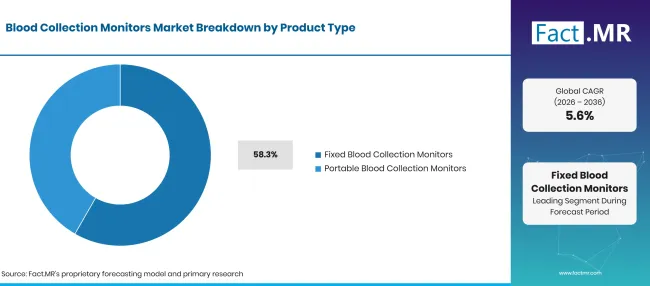
Blood Collection Monitors Market Breakdown Product Type | Source: Fact.MR
| Product Type | Share (2026) |
|---|---|
| Fixed Blood Collection Monitors (Leading segment) | 58.3% |
| Other segments combined | 41.7% |
| Total | 100.0% |
Source: Fact.MR analysis. Updated Oct 30, 2026
Fixed monitors are used at permanent donor stations where electrical supply and bench space are dependable. Staff can retain the same programmed collection settings during routine sessions while checking the instrument at the start of a shift. Portable monitors suit community drives and sites that move equipment between rooms. Delcon describes its HemoTek 2 as a collection monitor with a rocking tray and optional battery pack.
What leads the Application segment?
Hospitals lead with 42.1% of 2026 value.
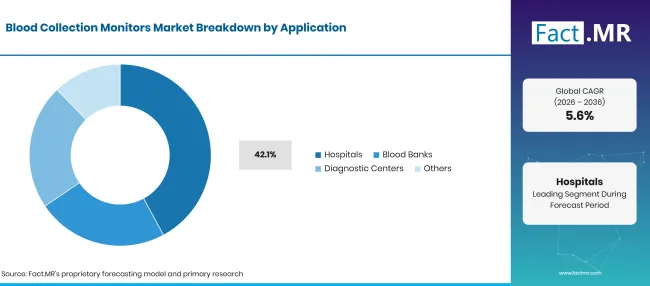
Blood Collection Monitors Market Breakdown Application | Source: Fact.MR
| Application | Share (2026) |
|---|---|
| Hospitals (Leading segment) | 42.1% |
| Other segments combined | 57.9% |
| Total | 100.0% |
Source: Fact.MR analysis. Updated Oct 30, 2026
Hospital collection departments use monitors when staff need an orderly sequence from donor identification to bag sealing. Volume monitoring helps staff end collection at the chosen target while mixing maintains contact between incoming blood and anticoagulant. Blood banks also use this equipment in donation units. Diagnostic centers and other facilities can serve smaller donor programs, depending on their services. The CDC's 2026 survey analysis estimated 11,586,000 whole-blood and apheresis red-cell units collected in the United States during 2023 [2].
How does End-User shape demand?
Healthcare Facilities capture 76.8% of 2026 value.
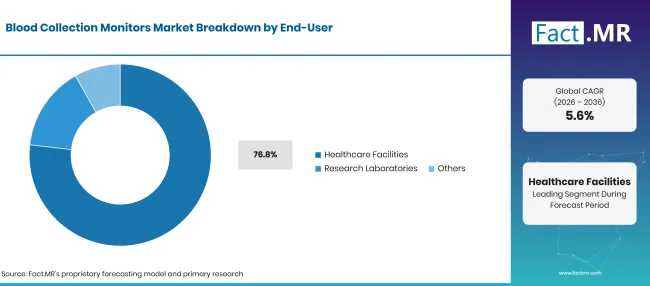
Blood Collection Monitors Market Breakdown End User | Source: Fact.MR
| End-User | Share (2026) |
|---|---|
| Healthcare Facilities (Leading segment) | 76.8% |
| Other segments combined | 23.2% |
| Total | 100.0% |
Source: Fact.MR analysis. Updated Oct 30, 2026
Healthcare facilities include organized donation services with staff training and documented equipment checks. Their work depends on repeatable operation when donors arrive throughout the day. Research laboratories may use collection-related equipment in narrower workflows, but their operating requirements differ from routine donor collection. Buyers commonly compare alarm visibility, weighing accuracy and cleaning procedures before approving a model. Labtop's published monitor specifications describe automatic tare, programmed volume settings and an audible alarm for low flow, which are functions closely tied to daily use.
What is accelerating Blood Collection Monitors Market adoption, and what is holding it back?
Adoption will grow through reliable collection-volume monitoring, mobile donor sessions and replacement of aging fixed equipment. Budget limits, calibration workload, blood-bag compatibility checks and uneven repair coverage will slow how quickly blood centres replace or expand their monitor fleets.
Drivers Impact Analysis
| DRIVER | (~) % IMPACT ON CAGR | GEOGRAPHIC RELEVANCE | IMPACT TIMELINE |
|---|---|---|---|
| Reliable collection-volume monitoring | +1.1% | Global | Short term |
| Routine replacement of fixed equipment | +0.9% | North America and Europe | Medium term |
| Mobile donor sessions | +0.7% | Latin America and Asia | Medium term |
| Traceable alarms and collection records | +0.5% | Global | Medium term |
| Service and calibration support | +0.4% | Global | Long term |
Source: Fact.MR analysis. Updated Oct 30, 2026
Opportunity Impact Analysis
| OPPORTUNITY | (~) % IMPACT ON CAGR | GEOGRAPHIC RELEVANCE | IMPACT TIMELINE |
|---|---|---|---|
| Battery-backed equipment for outreach | +0.7% | Brazil and Japan | Medium term |
| Clearer device and donor data exchange | +0.5% | North America and Europe | Medium term |
| Simple, documented calibration | +0.4% | Global | Short term |
| Replacement packages for blood centers | +0.3% | Global | Long term |
Source: Fact.MR analysis. Updated Oct 30, 2026
Restraints Impact Analysis
| RESTRAINT | (~) % IMPACT ON CAGR | GEOGRAPHIC RELEVANCE | IMPACT TIMELINE |
|---|---|---|---|
| Budget and replacement timing | -0.7% | Global | Short term |
| Training and calibration burden | -0.5% | Global | Medium term |
| Device compatibility checks | -0.4% | Global | Medium term |
| Uneven repair coverage | -0.3% | Emerging markets | Long term |
Source: Fact.MR analysis. Updated Oct 30, 2026
Which countries are scaling the Blood Collection Monitors Market through 2036?
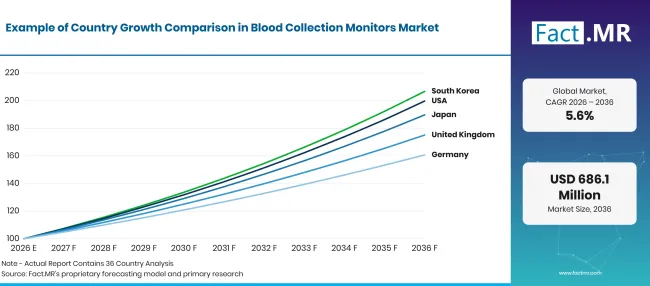
Blood Collection Monitors Market Growth Index | Source: Fact.MR
| Country | CAGR (2026 to 2036) |
|---|---|
| USA | 7.2% |
| Japan | 6.6% |
| UK | 5.8% |
| Germany | 4.9% |
| Brazil | 4.1% |
Source: Fact.MR analysis. Updated Oct 30, 2026
How does the USA support collection monitor sales?
7.2% CAGR, supported by the scale of organized donor services.
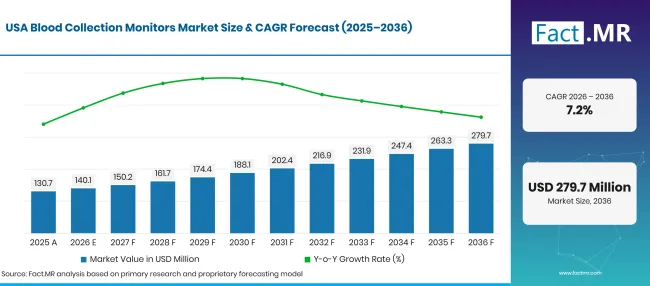
Blood Collection Monitors Market Forecast Usa | Source: Fact.MR
American blood organizations operate both permanent donation rooms and mobile drives, so instrument reliability matters across different working conditions. The American Red Cross stated in its fiscal 2025 annual report, published in 2026, that it collected more than 4.6 million blood donations between July 2024 and June 2025 [5].
What shapes Japan’s monitor demand?
6.6% CAGR, linked to fixed-site and mobile collection needs.
Japan is projected to grow at a 6.6% CAGR through 2036, supported by organized donation services and the replacement of collection devices at established sites. The Japanese Red Cross Society reported in its 2024–2025 annual report, published in 2026, that its network included 275 bloodmobiles as of March 31, 2025 [6].
How is the UK collection network developing?
5.8% CAGR, based on an established donation network.
The UK is anticipated to record a 5.8% CAGR between 2026 and 2036, reflecting organized collection networks and ongoing maintenance of donation equipment. NHS Blood and Transplant data for April 2024 to March 2025 recorded 166,311 people making a first blood donation [3].
What supports Germany’s established blood services?
4.9% CAGR, reflecting equipment renewal at blood establishments.
Germany’s market growth is supported by ongoing equipment replacement across regulated blood establishments. The Paul-Ehrlich-Institut reported 6,908,141 blood donations in 2024 [4], highlighting the scale of collection activity and the need for reliable monitors, calibration, and routine servicing.
How is Brazil approaching collection equipment?
4.1% CAGR, reflecting public blood-service operations.
Brazil’s market growth is supported by public blood services maintaining permanent collection rooms while expanding community donation activity. Portable monitors support outreach sessions, while fixed systems remain important at higher-volume centers. Budget timing, maintenance access, and equipment reliability shape replacement decisions.
Who leads the Blood Collection Monitors Market?
Competition is based on capacity to supply a suitable collection monitor and maintain it after installation. Delcon offers HemoMix 3 and HemoTek 2 electronic monitors with mixing and adjustable alarm functions. Labtop Instruments lists volume programming, automatic tare and motorized clamping among its blood collection monitor features. REMI Elektrotechnik presents its BCM 10 Ultra as a portable mixer for donation rooms and outdoor collection camps. Each manufacturer addresses practical collection needs, but their product configurations and service channels differ.
Equipment selection commonly involves a product demonstration and review of bag compatibility. Hospitals may prefer a stable fixed installation while mobile programs compare run time and transport needs. A company selling blood bags, separators or transfusion systems should be assessed separately from a monitor manufacturer.
Which companies are the key providers?
Key companies include Terumo Blood and Cell Technologies; Fresenius Kabi AG; Delcon S.r.l.; Lmb Technologie GmbH; Bioelettronica S.r.l.; Labtop Instruments Pvt. Ltd.; Genesis BPS; Mitra Industries Pvt. Ltd.; REMI Elektrotechnik Limited; Krew Instruments Pvt. Ltd.
- Terumo Blood and Cell Technologies
- Fresenius Kabi AG
- Delcon S.r.l.
- Lmb Technologie GmbH
- Bioelettronica S.r.l.
- Labtop Instruments Pvt. Ltd.
- Genesis BPS
- Mitra Industries Pvt. Ltd.
- REMI Elektrotechnik Limited
- Krew Instruments Pvt. Ltd.
Bibliography
- [1] World Health Organization. (2026, June 12). Blood safety and availability.
- [2] McDavid, K., Lien, R., Ortiz, J. C., Bradley, T., Luciano, A., Griffin, I., Berger, J., Basavaraju, S. V., & Kracalik, I. (2026). Have we reached a new baseline for blood collection and transfusion in the United States? National Blood Collection and Utilization Survey, 2023. Transfusion, 66(8), 1552–1561.
- [3] NHS Blood and Transplant. (n.d.). Blood donation statistics.
- [4] Paul-Ehrlich-Institut. (2025, December 8). Paul-Ehrlich-Institut publishes 2024 report on supply of blood and blood products.
- [5] American Red Cross. (2025). Fiscal year 2025 annual report.
- [6] Japanese Red Cross Society. (2025). Annual report 2024–2025.
This Report Answers
- How collection monitors measure volume and keep blood mixed during donation.
- How fixed and portable instruments serve different operating locations.
- How hospitals and specialist blood banks assess accuracy and ongoing service.
- How equipment demand differs across the USA, Japan, UK, Germany and Brazil.
- Which directly documented monitor suppliers offer appropriate collection devices.
What does the Blood Collection Monitors Market cover?
The market covers electronic devices that monitor the collection of whole blood from a donor. These instruments can combine weighing, gentle rocking, preset volume control, flow alerts and automatic clamping. Revenue relates to equipment used at collection stations and temporary blood donation locations.
What is included in the scope?
Fixed collection monitors used in permanent donation rooms and portable monitors used during mobile blood drives are included. The scope covers instruments purchased by healthcare facilities and relevant research settings when the equipment is used to monitor blood collection.
What is excluded from the scope?
Blood bags, needles, donor screening tests and blood storage refrigerators are excluded from instrument revenue. Apheresis separators and laboratory analyzers are separate equipment categories. The value of donated blood and subsequent transfusion services is also outside the monitor equipment boundary.
How Was the Analysis Built?
The analysis draws on 120+ sources, 35+ company portfolios, 25+ countries, and more than 20 industry interviews.
- Primary Research: Primary research includes discussions with manufacturers, service providers, technology developers, distributors, end users, and subject-matter experts. These conversations examine purchasing priorities, product adoption, operational challenges, approval requirements, competitive positioning, and the factors that influence wider market acceptance.
- Desk Research: Desk research covers government statistics, regulatory publications, company filings, trade data, technical studies, industry associations, standards, public policy, and other authoritative sources. Every source used in the analysis is documented in the bibliography.
- Market Sizing and Forecasting: Market estimates combine historical performance, demand indicators, pricing and volume trends, segment shares, company participation, country-level growth, adoption patterns, investment activity, and barriers to market expansion.
- Data Validation and Update Cycle: Findings are validated by comparing primary interviews with public data, company activity, regulatory changes, trade patterns, and industry developments. Regular updates review new product launches, capacity changes, partnerships, approvals, and shifts in commercial adoption.
Segmentation
What is the report’s scope and coverage?
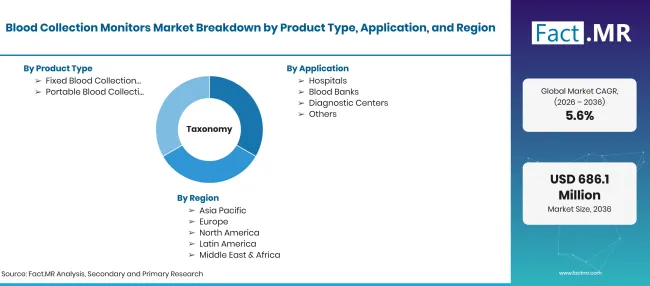
Blood Collection Monitors Market Taxonomy | Source: Fact.MR
| Attribute | Details |
|---|---|
| Quantitative Units | USD million in 2026 to USD million by 2036, at CAGR |
| Market Definition | Electronic weighing and mixing instruments that monitor whole-blood donation volume and flow during collection. |
| Product Type | Fixed Blood Collection Monitors; Portable Blood Collection Monitors |
| Application | Hospitals; Blood Banks; Diagnostic Centers; Others |
| End-User | Healthcare Facilities; Research Laboratories; Others |
| Regions Covered | North America; Latin America; Western Europe; Eastern Europe; East Asia; South Asia & Pacific; Middle East & Africa |
| Countries Covered | USA; Japan; UK; Germany; Brazil |
| Companies Profiled | Terumo Blood and Cell Technologies; Fresenius Kabi AG; Delcon S.r.l.; Lmb Technologie GmbH; Bioelettronica S.r.l.; Labtop Instruments Pvt. Ltd.; Genesis BPS; Mitra Industries Pvt. Ltd.; REMI Elektrotechnik Limited; Krew Instruments Pvt. Ltd. |
| Forecast Period | 2026 to 2036 |
| Approach | Equipment demand examined by collection setting, installed equipment replacement and published blood-service activity. |
Source: Fact.MR analysis. Updated Oct 30, 2026
How is the market segmented?
-
By Product Type
- Fixed Blood Collection Monitors
- Portable Blood Collection Monitors
-
By Application
- Hospitals
- Blood Banks
- Diagnostic Centers
- Others
-
By End-User
- Healthcare Facilities
- Research Laboratories
- Others
-
By Region
- North America
- Latin America
- Western Europe
- Eastern Europe
- East Asia
- South Asia & Pacific
- Middle East & Africa
Frequently Asked Questions
How big is the blood collection monitors market in 2026?
What is the CAGR through 2036?
Which product type has the largest share?
Which application contributes the most?
Which providers sell blood collection monitors?
Who worked on this report


Preview the report firsthand - request a free sample
Free SampleGet the brochure for pricing and purchase details
Download PDF