- Market Value (2025): USD 1.5 Bn
- Estimated Value (2026): USD 1.6 Bn
- Forecast Value (2036): USD 3.8 Bn
- CAGR (2026-2036): 8.9%
What is the X-Ray Irradiation Market forecast to be worth by 2036?
USD 1.6 billion in 2026 to USD 3.8 billion by 2036 at 8.9% CAGR.
- The x-ray irradiation market reached USD 1.5 billion in 2025.
- Demand is projected to increase from USD 1.6 billion in 2026 to USD 3.8 billion by 2036.
- The market is forecast to record 8.9% CAGR from 2026 to 2036 owing to replacement of isotope systems and controlled low-energy x-ray use.
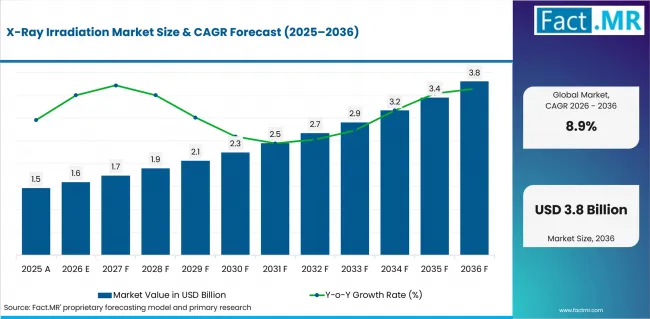
X Ray Irradiation Market Value Analysis | Source: Fact.MR
What are the defining numbers behind X-Ray Irradiation Market growth?
USD 2.2 billion absolute opportunity by 2036.
- Demand Drivers in the Market
- Cabinet x-ray irradiators are expected to lead purchasing where customers need contained shielding and documented operating steps.
- Medical and blood irradiation use is anticipated to support replacement demand since transfusion services need controlled exposure for patient care workflows.
- Hospitals and blood banks are projected to prioritize products that reduce installation uncertainty and fit routine clinical schedules.
- Key Segments Analyzed
- By Product: Cabinet X-ray Irradiators are projected to hold 40.1% share in 2026 since contained units help customers manage shielding and service access.
- By Application: Medical & Blood Irradiation is expected to hold 34.8% share in 2026 as transfusion-related use requires controlled exposure and validation records.
- By End User: Hospitals & Blood Banks are anticipated to account for 33.4% share in 2026 because they carry direct responsibility for safety records and testing.
- By Technology: Low-energy X-ray Systems are estimated to represent 51.9% share in 2026 due to their fit with compact clinical and laboratory settings.
- By Configuration: Standalone Systems are forecast to hold 43.8% share in 2026 with customers valuing simpler placement and defined operating boundaries.
- Analyst Opinion at Fact.MR
- Shambhu Nath Jha, Sr. Consultant at Fact.MR, opines, “X-ray irradiation providers must make the post-installation requirement clear. Purchase approval is expected to depend on documented dose control, service access and the customer’s ability to fit the system into routine clinical or research work.”
- Strategic Implications
- Hospitals and blood banks should compare cabinet systems through shielding and dose records before commercial terms take priority.
- Manufacturers need to show how configuration choices reduce installation friction.
- Investors should separate direct irradiation demand from adjacent imaging exposure.
The USA is anticipated to post an 11.6% CAGR from 2026 to 2036 through hospital and blood bank demand. Germany is forecast at 10.5% through technical review and installation confidence. The UK is estimated at 9.5%, while France is projected at 8.3%. Japan records 7.3% through compact clinical settings, and Canada records 6.2% with service coverage needs.
How does the X-Ray Irradiation Market break down by segment?
Cabinet X-ray Irradiators are expected to lead Product at 40.1% share in 2026. Medical & Blood Irradiation is projected to lead Application at 34.8% share in 2026.
Which product type dominates?
Cabinet X-ray Irradiators are projected to account for 40.1% share in 2026.
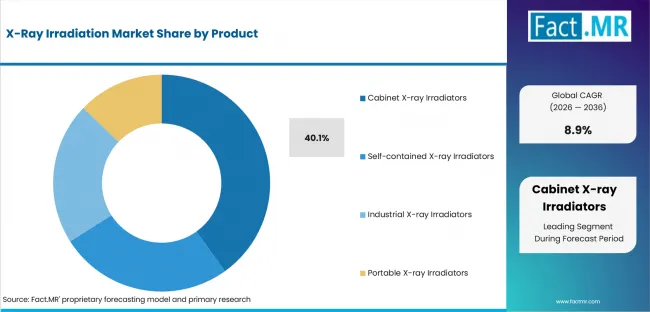
X Ray Irradiation Market Analysis By Product | Source: Fact.MR
Cabinet systems lead because customers need contained radiation exposure and serviceable hardware. Benchtop Irradiators remain useful when sample size changes the purchase case. Shielded Irradiators support customers that compare documentation needs with diagnostic imaging centers.
Why does Medical & Blood Irradiation lead Application?
Medical & Blood Irradiation is expected to hold 34.8% share in 2026.
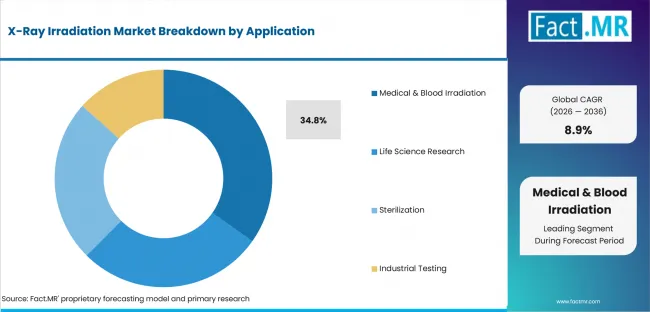
X Ray Irradiation Market Analysis By Application | Source: Fact.MR
Medical and blood irradiation leads when transfusion customers need controlled exposure and repeatable proof. Blood Component Irradiation remains important where clinical risk reduction shapes review. Research and sterilization uses add demand when laboratories need easier validation work.
What supports Hospitals & Blood Banks within End User?
Hospitals & Blood Banks are anticipated to account for 33.4% share in 2026.
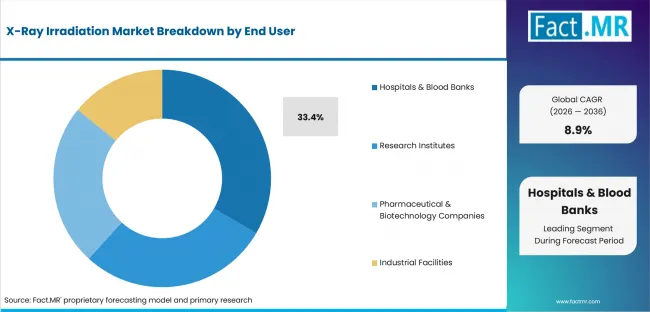
X Ray Irradiation Market Analysis By End User | Source: Fact.MR
Hospitals and blood banks lead because they manage patient care workflows and clear operating procedures. Transfusion Centers use similar proof around service continuity. Research Institutes create added demand where exposure control supports experiments.
How does Technology shape demand?
Low-energy X-ray Systems are estimated to represent 51.9% share in 2026.
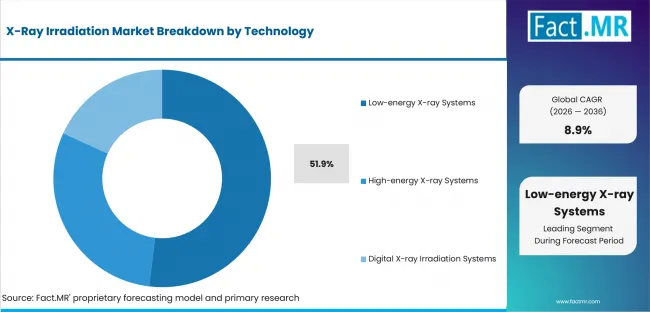
X Ray Irradiation Market Analysis By Technology | Source: Fact.MR
Low-energy systems are favored where compact footprints matter more than beam power. Soft X-ray Systems support laboratory work. Compact X-ray Sources strengthen the comparison with 3D medical imaging devices during equipment planning.
Why do Standalone Systems lead Configuration?
Standalone Systems are forecast to hold 43.8% share in 2026.
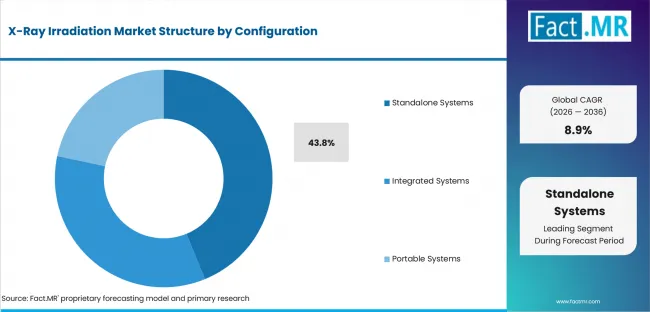
X Ray Irradiation Market Analysis By Configuration | Source: Fact.MR
Standalone systems lead because customers prefer defined operating boundaries and shorter facility planning cycles. Fixed Installation remains important for high-use locations. Portable Systems are expected to grow selectively where security detectors and scanners experience improves confidence.
What is accelerating X-Ray Irradiation Market adoption, and what is holding it back?
Demand is expected to rise as older cabinet systems are replaced with energy-efficient models. Growth may be limited by testing needs and slow installation approvals.
Drivers Impact Analysis
| DRIVER | (~) % IMPACT ON CAGR | GEOGRAPHIC RELEVANCE | IMPACT TIMELINE |
|---|---|---|---|
| Cabinet x-ray irradiator replacement | +2.2% | Canada, USA, Japan | Short term (<= 2 years) |
| Medical and blood irradiation workflows | +1.8% | Canada and Japan | Short term (<= 2 years) |
| Low-energy system fit | +1.5% | USA, UK, Germany | Medium term (2-4 years) |
| Service and validation support | +1.2% | Hospitals and blood banks | Medium term (2-4 years) |
| Research and sterilization use | +0.8% | Clinical and laboratory clusters | Long term (>= 4 years) |
Source: Fact.MR analysis. Updated Jul 30, 2026
- Cabinet x-ray irradiator replacement: Customers are expected to prefer contained systems where shielding and service support are easier to prove.
- Medical and blood irradiation workflows: Transfusion operations place weight on exposure consistency before routine use expands.
- Low-energy system fit: Compact systems are expected to help sites with limited space and narrower exposure requirements.
Opportunity Impact Analysis
| OPPORTUNITY | (~) % IMPACT ON CAGR | GEOGRAPHIC RELEVANCE | IMPACT TIMELINE |
|---|---|---|---|
| Medical and blood irradiation workflow packages | +1.2% | Canada and Japan | Medium term (2-4 years) |
| Provider network expansion | +0.9% | USA and Europe | Medium term (2-4 years) |
| Cabinet x-ray validation support | +0.7% | Hospitals and blood banks | Medium term (2-4 years) |
| Industrial testing and sterilization support | +0.5% | USA, Germany, France | Long term (>= 4 years) |
Source: Fact.MR analysis. Updated Jul 30, 2026
- Medical and blood irradiation workflow packages: Providers are expected to gain share when the offer includes installation guidance and post-sale support.
- Provider network expansion: Regional service depth is expected to improve purchase confidence where customers need faster response after installation.
- Cabinet x-ray validation support: Documentation templates and dose-verification assistance are expected to reduce friction during internal approval.
Restraints Impact Analysis
| RESTRAINT | (~) % IMPACT ON CAGR | GEOGRAPHIC RELEVANCE | IMPACT TIMELINE |
|---|---|---|---|
| Validation and radiation-safety documentation | -1.1% | Global | Short term (<= 2 years) |
| Reimbursement and capital pressure | -0.8% | Hospitals and blood banks | Short term (<= 2 years) |
| Installation approval delays | -0.6% | Canada, UK, Germany | Medium term (2-4 years) |
| Service gaps in smaller locations | -0.5% | Remote and lower-density markets | Medium term (2-4 years) |
Source: Fact.MR analysis. Updated Jul 30, 2026
- Validation and radiation-safety documentation: Approval slows when customers lack internal resources to prove safe operation and dose repeatability.
- Reimbursement and capital pressure: Hospitals are expected to defer replacement when usage frequency does not justify a near-term purchase.
- Installation approval delays: Shielding and operating sign-off can extend the timeline between quotation and commissioning.
Which countries are scaling X-Ray Irradiation Market fastest?
The country comparison is led by the USA at 11.6% CAGR. Germany follows at 10.5%, while the UK is projected at 9.5%. France, Japan and Canada grow at lower listed rates.
- The USA leads through hospital, blood bank and research demand where users review dose records before purchase.
- Germany depends on technical review where operating limits shape confidence before installation.
- The UK holds a measured position through careful equipment review and clear compliance expectations.
- France grows through compliance fit and purchase-review discipline.
- Japan follows through compact clinical settings where reliability and local support can outweigh a wider product menu.
- Canada remains important because broad geographies increase the value of service coverage and cabinet-system uptime.
Comparable CAGRs can create different entry conditions across these countries. Deployment timing depends on customer readiness and service depth.
The full report provides country-level CAGR analysis across North America, Latin America, Europe, East Asia, South Asia, Oceania and the Middle East and Africa.
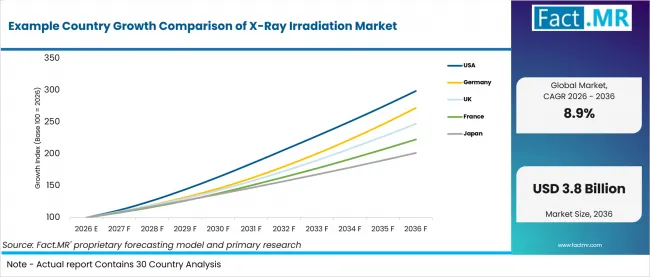
Example Country Growth Comparison Of X Ray Irradiation Market | Source: Fact.MR
| Country | CAGR (2026-2036) |
|---|---|
| Canada | 6.2% |
| Japan | 7.3% |
| USA | 11.6% |
| UK | 9.5% |
| Germany | 10.5% |
| France | 8.3% |
Source: Fact.MR analysis. Updated Jul 30, 2026
What is shaping Canada’s outlook through 2036?
6.2% CAGR, supported by service coverage and cabinet system replacement.
Canada’s growth reflects large-geography customers that need dependable installation support. Cabinet X-ray Irradiators are expected to benefit where users want lower operating uncertainty.
How does Japan perform?
7.3% CAGR, led by reliability needs and compact clinical workflows.
Japan’s growth is shaped by equipment needs in disciplined medical and research settings. Local technical support is expected to influence adoption more than product range.
What supports USA demand?
11.6% CAGR through hospital, blood bank and research use.
USA demand is supported by clinical care and transfusion services. Research users add a route for controlled studies. Customers are expected to compare service access.
How is the UK developing demand?
9.5% CAGR, supported by replacement discipline and compliance review.
The UK’s growth reflects careful purchase review in medical and laboratory settings. Customers are expected to favor documented dose control and service response.
What is shaping Germany’s outlook?
10.5% CAGR, backed by technical review and controlled operating requirements.
Germany’s demand is expected to depend on performance evidence and system reliability. Standalone Systems remain relevant where defined boundaries reduce facility-planning complexity.
How does France perform?
8.3% CAGR, shaped by compliance discipline and channel support.
France’s growth reflects selective purchases by hospitals and professional users. Adoption is projected to stay measured where approval work extends purchasing timelines.
Who leads the X-Ray Irradiation Market?
Precision X-Ray, Inc. show direct relevance where cabinet systems and specimen radiography define the purchase case.
Gilardoni S.p.A. and Kimtron Inc. compete through x-ray equipment portfolios. Rad Source Technologies, Inc. and Xstrahl Ltd. contribute analytical and industrial x-ray expertise.
Through 2036, competition will focus on dose consistency, shielding records and operating simplicity. Radiographic testing and non-destructive inspection will support demand where controlled exposure is essential for safe industrial applications.
Which companies are the key providers?
Key companies include Precision X-Ray, Inc., Gilardoni S.p.A., Kimtron Inc., Rad Source Technologies, Inc., and Xstrahl Ltd..
- Precision X-Ray, Inc.
- Gilardoni S.p.A.
- Kimtron Inc.
- Rad Source Technologies, Inc.
- Xstrahl Ltd.
Bibliography
- Health Canada. (2024, June 5). Safety Code 35: Safety procedures for the installation, use and control of X-ray equipment in large medical radiological facilities.
- U.S. Food and Drug Administration. (2024, December 23). IEC 61674 edition 3.0 2024-07: Medical electrical equipment—Dosimeters with ionization chambers and/or semiconductor detectors as used in X-ray diagnostic imaging.
- U.S. Food and Drug Administration. (2026). Medical devices; radiology devices; classification of blood irradiators regulatory impact analysis: Proposed rule.
This Report Answers
- The report explains product and application choices across clinical, research and industrial use.
- Segment analysis covers 2026 leaders by product and application. End user, technology and configuration views complete the section.
- Country outlook evaluates the USA and Germany. The UK, France, Japan and Canada complete the comparison.
- Competitive analysis profiles the stated provider set and the service factors that shape selection.
What does the X-Ray Irradiation Market cover?
X-ray irradiation systems deliver controlled exposure for blood irradiation and biological research. Sterilization, material testing and selected clinical workflows are also covered.
The X-Ray Irradiation Market covers cabinet and benchtop systems used to irradiate blood components and cells. Floor-standing, shielded and portable systems are included where controlled exposure is the reason for purchase.
What is included in the scope?
X-ray irradiation systems are used across hospitals and blood banks. Research institutes, pharmaceutical companies and industrial facilities are included when they use controlled exposure.
The scope includes Product and Application. Technology and Configuration complete the market view. Coverage spans Cabinet X-ray Irradiators and Medical & Blood Irradiation. Regional coverage includes North America, Latin America, Europe, East Asia, South Asia and Oceania, and the Middle East and Africa.
What is excluded from the scope?
General imaging equipment remains outside the scope of this market.
The scope excludes systems not used for controlled irradiation or configured x-ray dose delivery. General CT, radiography and fluoroscopy equipment are excluded unless tied to irradiation use. Company revenue without a clear connection to irradiation systems or related service activity is also excluded.
How Was the Analysis Built?
The analysis draws on 120+ sources, 35+ company portfolios, 25+ countries, and more than 20 industry interviews.
- Primary Research: Primary research includes discussions with manufacturers, service providers, technology developers, distributors, end users, procurement teams, and subject-matter experts. These conversations examine purchasing priorities, product adoption, operational challenges, approval requirements, competitive positioning, and the factors that influence wider market acceptance.
- Desk Research: Desk research covers government statistics, regulatory publications, company filings, trade data, technical studies, industry associations, standards, public policy, and other authoritative sources. Every source used in the analysis is documented in the bibliography.
- Market Sizing and Forecasting: Market estimates combine historical performance, demand indicators, pricing and volume trends, segment shares, company participation, country-level growth, adoption patterns, investment activity, and barriers to market expansion.
- Data Validation and Update Cycle: Findings are validated by comparing primary interviews with public data, company activity, regulatory changes, trade patterns, and industry developments. Regular updates review new product launches, capacity changes, partnerships, approvals, procurement trends, and shifts in commercial adoption.
Segmentation
What is the report’s scope and coverage?
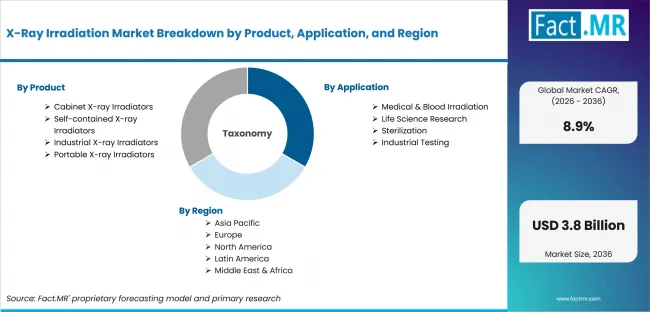
X Ray Irradiation Market Breakdown By Product, Application, And Region | Source: Fact.MR
| Attribute | Details |
|---|---|
| Quantitative Units | USD 1.6 billion in 2026 to USD 3.8 billion by 2036, at an 8.9% CAGR. |
| Market Definition | Equipment and configured systems used to deliver controlled X-ray exposure for blood irradiation, biological research, sterilization, material testing and industrial inspection |
| Product | Cabinet X-ray Irradiators; Benchtop Irradiators; Floor-standing Irradiators; Shielded Irradiators; Self-contained X-ray Irradiators; Biological Irradiators; Blood Irradiators; Preclinical Research Irradiators; Industrial X-ray Irradiators; Material Testing Systems; Sterilization Systems; Non-destructive Testing Systems; Portable X-ray Irradiators; Field Inspection Systems; Mobile Research Systems; Compact Irradiation Units |
| Application | Medical & Blood Irradiation; Blood Component Irradiation; Transfusion Safety; Graft-versus-host Disease Prevention; Life Science Research; Preclinical Research; Cell Biology Research; Genetics Research; Sterilization; Medical Device Sterilization; Pharmaceutical Sterilization; Laboratory Equipment Sterilization; Industrial Testing; Material Analysis; Non-destructive Testing; Quality Inspection |
| End User | Hospitals & Blood Banks; Hospitals; Blood Banks; Transfusion Centers; Research Institutes; Universities; Government Laboratories; Biomedical Research Centers; Pharmaceutical & Biotechnology Companies; Pharmaceutical Manufacturers; Biotechnology Companies; Contract Research Organizations; Industrial Facilities; Manufacturing Plants; Testing Laboratories; Aerospace & Defense Facilities |
| Technology | Low-energy X-ray Systems; Soft X-ray Systems; Research-grade Systems; Compact X-ray Sources; High-energy X-ray Systems; Industrial X-ray Systems; High-power Irradiators; Heavy-duty Inspection Systems; Digital X-ray Irradiation Systems; AI-enabled Control Systems; Automated Dose Monitoring; Remote Operation Systems |
| Configuration | Standalone Systems; Fixed Installation; Laboratory Systems; Hospital Systems; Integrated Systems; Automated Production Line Integration; Robotic Integration; Custom Industrial Systems; Portable Systems; Mobile Units; Field-deployable Systems; Battery-powered Systems |
| Regions Covered | North America; Latin America; Europe; East Asia; South Asia and Oceania; Middle East and Africa |
| Countries Covered | Canada; Japan; USA; UK; Germany; France |
| Key Companies Profiled | Precision X-Ray, Inc.; Gilardoni S.p.A.; Kimtron Inc.; Rad Source Technologies, Inc.; Xstrahl Ltd. |
| Forecast Period | 2026 to 2036 |
| Approach | Hybrid top-down and bottom-up approach using X-ray irradiation demand; cabinet-system replacement; product configuration; medical and blood irradiation workflows; clinical and laboratory use; research and sterilization demand; industrial testing requirements; dose repeatability; shielding documentation; validation needs; installation approval timelines; service access; technology adoption; country growth patterns and company portfolio review |
Source: Fact.MR analysis. Updated Jul 30, 2026
How is the market segmented?
-
By Product:
- Cabinet X-ray Irradiators
- Benchtop Irradiators
- Floor-standing Irradiators
- Shielded Irradiators
- Self-contained X-ray Irradiators
- Biological Irradiators
- Blood Irradiators
- Preclinical Research Irradiators
- Industrial X-ray Irradiators
- Material Testing Systems
- Sterilization Systems
- Non-destructive Testing Systems
- Portable X-ray Irradiators
- Field Inspection Systems
- Mobile Research Systems
- Compact Irradiation Units
- Cabinet X-ray Irradiators
-
By Application:
- Medical & Blood Irradiation
- Blood Component Irradiation
- Transfusion Safety
- Graft-versus-host Disease Prevention
- Life Science Research
- Preclinical Research
- Cell Biology Research
- Genetics Research
- Sterilization
- Medical Device Sterilization
- Pharmaceutical Sterilization
- Laboratory Equipment Sterilization
- Industrial Testing
- Material Analysis
- Non-destructive Testing
- Quality Inspection
- Medical & Blood Irradiation
-
By End User:
- Hospitals & Blood Banks
- Hospitals
- Blood Banks
- Transfusion Centers
- Research Institutes
- Universities
- Government Laboratories
- Biomedical Research Centers
- Pharmaceutical & Biotechnology Companies
- Pharmaceutical Manufacturers
- Biotechnology Companies
- Contract Research Organizations
- Industrial Facilities
- Manufacturing Plants
- Testing Laboratories
- Aerospace & Defense Facilities
- Hospitals & Blood Banks
-
By Technology:
- Low-energy X-ray Systems
- Soft X-ray Systems
- Research-grade Systems
- Compact X-ray Sources
- High-energy X-ray Systems
- Industrial X-ray Systems
- High-power Irradiators
- Heavy-duty Inspection Systems
- Digital X-ray Irradiation Systems
- AI-enabled Control Systems
- Automated Dose Monitoring
- Remote Operation Systems
- Low-energy X-ray Systems
-
By Configuration:
- Standalone Systems
- Fixed Installation
- Laboratory Systems
- Hospital Systems
- Integrated Systems
- Automated Production Line Integration
- Robotic Integration
- Custom Industrial Systems
- Portable Systems
- Mobile Units
- Field-deployable Systems
- Battery-powered Systems
- Standalone Systems
-
By Region:
- North America
- Latin America
- Europe
- East Asia
- South Asia and Oceania
- Middle East and Africa
Frequently Asked Questions
Which Product leads the market?
Which Application leads the market?
Which End User leads the market?
Which Technology category leads the market?
Which Configuration leads the market?
Which country records the highest listed CAGR?
What is the primary driver in this market?
What is the main restraint?
Who worked on this report


Preview the report firsthand - request a free sample
Free SampleGet the brochure for pricing and purchase details
Download PDF