- Base Value(2025): 86.8 Bn
- Estimated Value(2026): 93.7 Bn
- Forecast Value (2036): 202.4 Bn
- CAGR (2026 - 2036): 8.0%
Biobanks Market Analysis and Forecast by Fact.MR
- The global market for biobanks is estimated to be around US$ 93.7 billion in 2026 and has been forecast to expand at a CAGR of 8% to end up at US$ 202.4 billion by 2036.
- Biobanks are organized collections of biological samples and associated data maintained under standardized conditions for clinical research, drug development, diagnostics development, and population health studies. Services span sample collection, processing, storage, retrieval, and data management across tissue, blood, DNA, and other biological specimen types.
- Growth is supported by expanding clinical trial activity, rising pharmaceutical R&D investment in biomarker-driven drug development, growing genomics and precision medicine programs, and increasing regulatory emphasis on biospecimen quality and traceability in research.
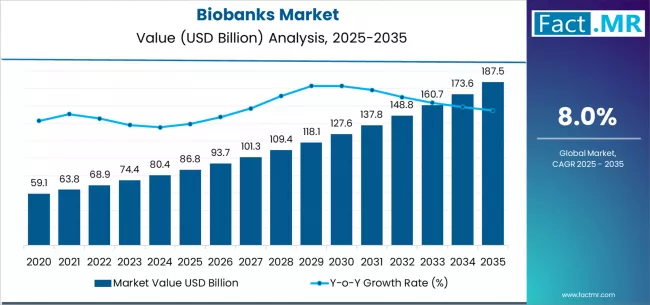
Biobanks Market Market Value Analysis | Source: Fact.MR
Summary of Biobanks Market
- Market Snapshot
- In 2025, the global Biobanks Market was valued at approximately USD 86.8 billion.
- The market is estimated to reach USD 93.7 billion in 2026 and is projected to attain USD 202.4 billion by 2036.
- The biobanks market is likely to expand at a CAGR of 8% during the forecast period.
- The market is anticipated to create an absolute dollar opportunity of USD 108.6 billion between 2026 and 2036.
- Human Biobanking Services accounts for 52% of product share in 2026.
- India (9.3%) and China (8.9%) are the key growth markets during the forecast period.
- Demand and Growth Drivers
- Expanding clinical trial activity across oncology, immunology, and rare disease is increasing demand for biobanked specimens to support biomarker research and patient stratification.
- Rising pharmaceutical R&D investment in precision medicine is driving demand for well-characterized biological sample collections with linked clinical data.
- Growing genomics and multi-omics research programs are increasing specimen processing and storage volumes across academic and commercial biobanks.
- Increasing regulatory emphasis on biospecimen quality, traceability, and consent management is driving investment in biobank infrastructure and information systems.
- Expansion of population-level health studies and national biobanking initiatives is creating large-scale specimen repositories across multiple countries.
- Product and Segment View
- Human Biobanking Services accounts for 52% of product share in 2026, supported by consistent demand across primary applications.
- Clinical Research accounts for 58% of application share in 2026, supported by consistent demand across primary applications.
- Pharmaceutical Companies accounts for 45% of end use share in 2026, supported by consistent demand across primary applications.
- Key segmentation includes:
- Product: Human Biobanking Services, Tissue Biobanking Products, Blood Biobanking Products, Cell Line Biobanking Products
- Application: Clinical Research, Personalized Medicine, Regenerative Medicine, Epidemiological Studies
- End Use: Pharmaceutical Companies, Academic & Research Institutes, Hospitals & Healthcare Providers, Government & Public Health Agencies
- Technology: Sample Storage Technology, Sample Processing Technology, Data Management Technology, Quality Control Technology
- These systems enable:
- Standardized collection, processing, and long-term storage of biological specimens under controlled conditions that preserve sample integrity
- Linked biological and clinical data management that supports biomarker discovery, patient stratification, and translational research workflows
- Specimen retrieval and distribution services that connect biobanked materials with pharmaceutical, diagnostic, and academic research programs
- Geography and Competitive Outlook
- Asia Pacific leads growth with India at 9.3%, China at 8.9%, Japan at 5.9%.
- North America shows steady demand with USA at 7.6%.
- European demand remains steady with UK at 7.1%, Germany at 6.8%.
- Middle East markets include Saudi Arabia at 5.2%.
- Leading participants include Thermo Fisher Scientific, Merck KGaA, Qiagen, Hamilton Company, Tecan Trading AG, Danaher Corporation.
- Analyst Opinion
- Shambhu Nath Jha, Principal Consultant at Fact.MR, says 'The biobanks market is being driven by the pharmaceutical industry shift toward precision medicine and biomarker-driven drug development. Every clinical trial that uses patient stratification or companion diagnostic co-development requires access to well-characterized biospecimens, and that demand is growing as precision approaches extend beyond oncology into immunology, neurology, and rare disease. The competitive landscape spans academic biobanks, commercial biobanking service providers, and pharmaceutical companies building in-house repositories. Commercial biobanks that offer integrated sample storage, data management, and regulatory-compliant retrieval services are capturing the largest share of pharmaceutical sponsor contracts because they reduce the operational complexity of multi-site specimen management.'
Key Growth Drivers, Constraints, and Opportunities
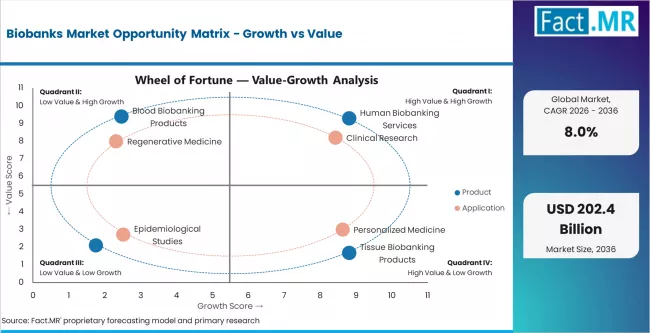
Biobanks Market Opportunity Matrix Growth Vs Value | Source: Fact.MR
Key Factors Driving Growth
- Clinical trial expansion is increasing demand for biobanked specimens to support biomarker research and patient stratification.
- Precision medicine investment is driving demand for well-characterized sample collections with linked clinical data.
- National biobanking initiatives are creating large-scale repositories that support population health and genomics research.
Key Market Constraints
- High infrastructure and operating costs for temperature-controlled specimen storage limit biobank expansion in resource-constrained settings.
- Ethical, consent, and data privacy requirements create regulatory complexity that varies across jurisdictions.
- Specimen quality degradation over long storage periods requires ongoing investment in monitoring and quality management systems.
Key Opportunity Areas
- Integration of genomic and multi-omics data with biobanked specimens creates higher-value research assets for pharmaceutical sponsors.
- Expansion of commercial biobanking services in Asia Pacific creates cost-competitive alternatives for global pharmaceutical research programs.
- Development of virtual biobanking networks that connect distributed specimen repositories improves researcher access without physical sample centralization.
Segment-wise Analysis of the Biobanks Market
- Human Biobanking Services holds 52% of the product segment in 2026.
- Clinical Research represents 58% of the application segment in 2026.
- Pharmaceutical Companies accounts for 45% of the end use segment in 2026.
The biobanks market is segmented by product, application, end use, technology, and region. Human Biobanking Services leads by value in the near term, while emerging categories drive the next growth phase.
Which Product Segment Dominates the Biobanks Market?
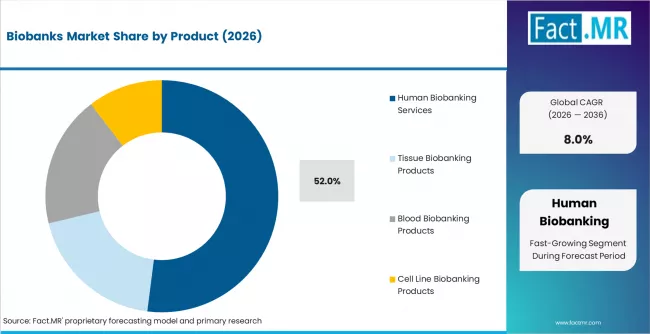
Biobanks Market Analysis By Product | Source: Fact.MR
Human Biobanking Services is expected to account for 52% of the product segment in the global Biobanks Market by 2026. Demand is supported by consistent procurement where established performance requirements sustain the installed base.
The segment is expected to maintain its position as replacement demand and capacity expansion continue. Emerging alternatives are gaining share, but human biobanking services remains the primary category because of buyer familiarity and application suitability.
Which Application Segment Dominates the Biobanks Market?
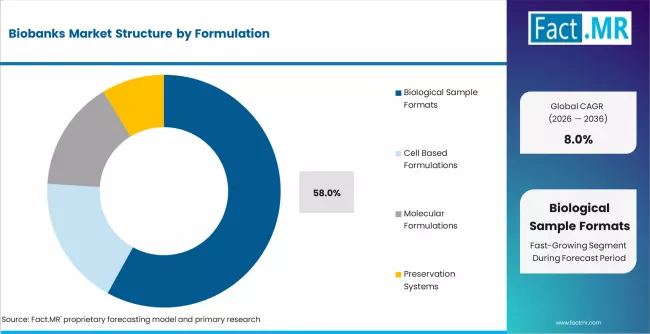
Biobanks Market Analysis By Formulation | Source: Fact.MR
Clinical Research is expected to account for 58% of the application segment in the global Biobanks Market by 2026. Demand is supported by consistent procurement where established performance requirements sustain the installed base.
The segment is expected to maintain its position as replacement demand and capacity expansion continue. Emerging alternatives are gaining share, but clinical research remains the primary category because of buyer familiarity and application suitability.
Which End Use Segment Dominates the Biobanks Market?
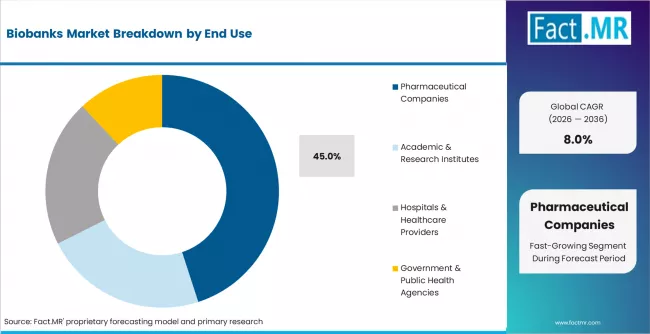
Biobanks Market Analysis By End Use | Source: Fact.MR
Pharmaceutical Companies is expected to account for 45% of the end use segment in the global Biobanks Market by 2026. Demand is supported by consistent procurement where established performance requirements sustain the installed base.
The segment is expected to maintain its position as replacement demand and capacity expansion continue. Emerging alternatives are gaining share, but pharmaceutical companies remains the primary category because of buyer familiarity and application suitability.
Which Product Trend is Shaping the Next Phase of Growth in the Biobanks Market?
Human biobanking services are gaining share as pharmaceutical clinical research demand outpaces other biobanking applications including veterinary and environmental specimen management. The concentration of pharmaceutical R&D spending on human disease creates a structural demand advantage for biobanks specializing in human tissue, blood, and DNA specimen collections with linked clinical and genomic data.
The human biobanking trend reflects the growing value of well-characterized specimen collections in drug development decision-making. Pharmaceutical sponsors are willing to pay premium pricing for biobanked specimens that include matched clinical outcomes, treatment history, and molecular characterization because these data layers reduce the cost and timeline of biomarker validation and patient selection studies. Biobanks that invest in deep specimen annotation and data quality are positioning themselves as higher-value research partners.
Regional Outlook Across Key Markets
.webp "Top Country Growth Comparison Biobanks Market Cagr (2026 2036)")
Top Country Growth Comparison Biobanks Market Cagr (2026 2036) | Source: Fact.MR
- India leads growth at 9.3%, supported by expanding domestic demand.
- The U.S. at 7.6% reflects established demand with technology adoption and upgrade activity.
- Germany at 6.8% reflects steady European demand.
CAGR Table
| Country | CAGR (%) |
|---|---|
| India | 9.3% |
| China | 8.9% |
| USA | 7.6% |
| UK | 7.1% |
| Germany | 6.8% |
| Japan | 5.9% |
| Saudi Arabia | 5.2% |
Source: Fact.MR analysis. Updated May 19, 2026
Source: Fact MR (FMR) analysis, based on proprietary forecasting model and primary research.
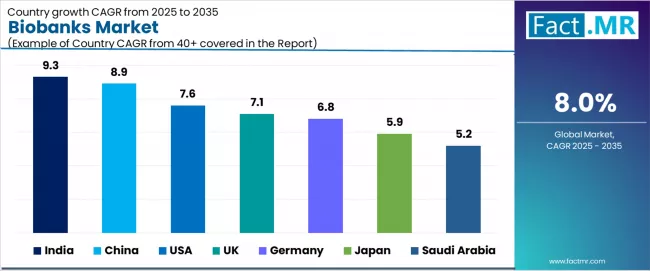
Biobanks Market Cagr Analysis By Country | Source: Fact.MR
Market Outlook for Biobankss in India
The India biobanks market is projected to grow at a CAGR of 9.3% through 2036. Demand is supported by expanding end-use activity and growing adoption of higher-specification products.
- Expanding end-use demand supports procurement across primary applications.
- Infrastructure investment is broadening the installed base.
- Growing performance requirements support mid-range and premium demand.
Demand Trends for Biobankss in China
The China biobanks market is projected to grow at a CAGR of 8.9% through 2036. Demand is supported by expanding end-use activity and growing adoption of higher-specification products.
- Expanding end-use demand supports procurement across primary applications.
- Infrastructure investment is broadening the installed base.
- Growing performance requirements support mid-range and premium demand.
Growth Assessment for Biobankss in USA
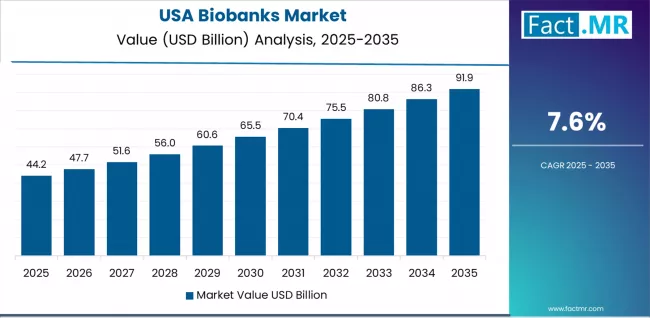
Biobanks Market Country Value Analysis | Source: Fact.MR
The USA biobanks market is projected to grow at a CAGR of 7.6% through 2036. Demand is supported by expanding end-use activity and growing adoption of higher-specification products.
- Expanding end-use demand supports procurement across primary applications.
- Infrastructure investment is broadening the installed base.
- Growing performance requirements support mid-range and premium demand.
Market Growth Outlook for Biobankss in UK
The UK biobanks market is projected to grow at a CAGR of 7.1% through 2036. Demand is supported by expanding end-use activity and growing adoption of higher-specification products.
- Expanding end-use demand supports procurement across primary applications.
- Infrastructure investment is broadening the installed base.
- Growing performance requirements support mid-range and premium demand.
Market Opportunity Outlook for Biobankss in Germany
The Germany biobanks market is projected to grow at a CAGR of 6.8% through 2036. Demand is supported by expanding end-use activity and growing adoption of higher-specification products.
- Expanding end-use demand supports procurement across primary applications.
- Infrastructure investment is broadening the installed base.
- Growing performance requirements support mid-range and premium demand.
Demand Analysis for Biobankss in Japan
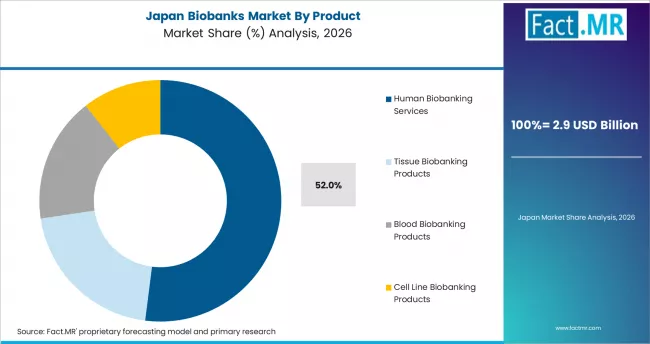
Biobanks Market Japan Market Share Analysis By Product | Source: Fact.MR
The Japan biobanks market is projected to grow at a CAGR of 5.9% through 2036. Demand is supported by expanding end-use activity and growing adoption of higher-specification products.
- Expanding end-use demand supports procurement across primary applications.
- Infrastructure investment is broadening the installed base.
- Growing performance requirements support mid-range and premium demand.
Growth Forecast for Biobankss in Saudi Arabia
The Saudi Arabia biobanks market is projected to grow at a CAGR of 5.2% through 2036. Demand is supported by expanding end-use activity and growing adoption of higher-specification products.
- Expanding end-use demand supports procurement across primary applications.
- Infrastructure investment is broadening the installed base.
- Growing performance requirements support mid-range and premium demand.
Competitive Benchmarking and Company Positioning
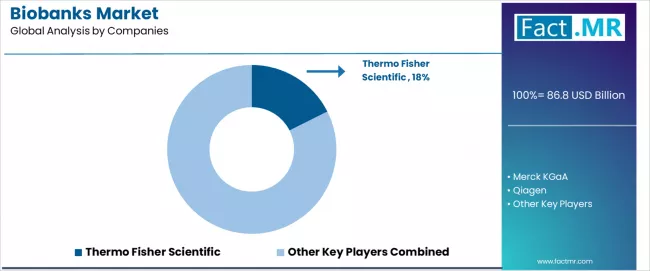
Biobanks Market Analysis By Company | Source: Fact.MR
Biobanks Market Analysis By Company
- Thermo Fisher Scientific, Merck KGaA, Qiagen, Hamilton Company hold strong positions through broad portfolios and established recognition.
- Tecan Trading AG, Danaher Corporation, Becton Dickinson, Charles River Laboratories participate across specific price tiers and regional channels.
- Technology integration and aftermarket service create differentiation in premium categories.
The competitive landscape is moderately fragmented. Thermo Fisher Scientific, Merck KGaA, Qiagen, Hamilton Company compete through product breadth and technical capability.
Strategic priorities include expanding portfolios, strengthening service networks, and widening distribution.
Key Companies in the Biobanks Market
Thermo Fisher Scientific, Merck KGaA, Qiagen, Hamilton Company are among the leading players globally.
Tecan Trading AG, Danaher Corporation, Becton Dickinson, Charles River Laboratories hold established positions across specific segments.
Lonza, Stemcell Technologies compete through focused offerings.
Recent Industry Developments
- Thermo Fisher Scientific – Product Portfolio Expansion (2025)
- Thermo Fisher Scientific expanded its portfolio with new products targeting higher-specification applications.
- Merck KGaA – Technology Upgrade Launch (2026)
- Merck KGaA introduced upgraded technology across core product lines.
- Qiagen – Geographic Expansion (2025)
- Qiagen expanded distribution into high-growth markets.
Leading Companies Shaping the Biobanks Market
- Thermo Fisher Scientific
- Merck KGaA
- Qiagen
- Hamilton Company
- Tecan Trading AG
- Danaher Corporation
- Becton Dickinson
- Charles River Laboratories
- Lonza
- Stemcell Technologies
Sources and Research References
- Thermo Fisher Scientific. Product updates and announcements.
- Merck KGaA. Product updates and announcements.
- Qiagen. Product updates and announcements.
- Industry publications, government databases, and trade statistics.
- Primary interviews with manufacturers, distributors, and end users.
This bibliography is provided for reader reference and is not exhaustive.
Key Questions This Report Addresses
- What is the current and future size of the Biobanks Market?
- How fast is the Biobanks Market expected to grow between 2026 and 2036?
- Which product is likely to lead the market by 2026?
- Which application segment is expected to account for the highest demand by 2026?
- What factors are driving demand for this market globally?
- How is technology evolution influencing market growth and product development?
- Which countries are projected to show the fastest growth through 2036?
- What is driving market expansion in India and China?
- Who are the key companies active in the Biobanks Market?
- How does Fact.MR estimate and validate the market forecast?
Biobanks Market Definition
The biobanks market covers the collection, processing, storage, and management of biological specimens and associated data for clinical research, drug development, and population health applications. It includes human tissue, blood, DNA, and other specimen biobanking services provided by academic, commercial, and governmental organizations.
Biobanks Market Inclusions
- The scope covers global and regional forecasts for 2026 to 2036 across product, application, end use, technology, and region.
- It includes regional demand analysis based on end-use activity, regulatory requirements, and technology adoption.
- The report includes pricing and cost analysis across entry-level, mid-range, and premium categories.
- It covers technology trends, drivers, constraints, and the competitive landscape.
Biobanks Market Exclusions
- The scope excludes pharmaceutical drug products, diagnostic kits, and research reagents produced using biobanked specimens.
- It excludes laboratory equipment, freezers, and storage systems sold independently of biobanking service operations.
- The report excludes clinical trial management services and contract research organization operations beyond specimen management.
- It also excludes agricultural and environmental biobanks not focused on human or animal health research applications.
Biobanks Market Research Methodology
- The methodology combines secondary research, primary interviews, and forecast modelling.
- It draws on 120+ secondary sources and benchmarks 65+ company portfolios.
- Market sizing covers 30+ countries through a demand-side model with top-down validation.
- Key inputs include end-use activity, regulatory requirements, and technology adoption.
- The model cross-checks demand with shipments, pricing, and product launches.
- Primary validation includes 25+ interviews across manufacturers, distributors, and end users.
- Final estimates go through trade-flow checks and sensitivity testing.
Segmentation
Scope of Analysis
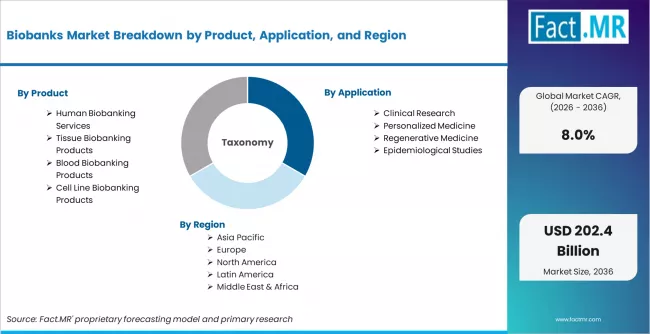
Biobanks Market Breakdown By Product, Application, And Region | Source: Fact.MR
| Parameter | Details |
|---|---|
| Quantitative Units | USD 93.7 billion to USD 202.4 billion, at a CAGR of 8% |
| Market Definition | Collection, processing, storage, and management of biological specimens for clinical research, drug development, and precision medicine applications. |
| Regions Covered | North America, Latin America, Europe, East Asia, South Asia and Pacific, Middle East and Africa |
| Countries Covered | India, China, USA, UK, Germany, Japan, Saudi Arabia, 30 plus countries |
| Key Companies | Thermo Fisher Scientific, Merck KGaA, Qiagen, Hamilton Company, Tecan Trading AG, Danaher Corporation, Becton Dickinson, Charles River Laboratories, Lonza, Stemcell Technologies |
| Forecast Period | 2026 to 2036 |
| Approach | Hybrid demand-side and top-down methodology built on country-level demand, product benchmarking, pricing analysis, and primary interviews |
Source: Fact.MR analysis. Updated May 19, 2026
Biobanks Market Segmentation
-
Biobanks marketSegmented by Product:
- Human Biobanking Services
- Population Biobanks
- Epidemiological Cohort Banks
- Longitudinal Health Biobanks
- Disease Specific Biobanks
- Oncology Sample Banks
- Rare Disease Repositories
- Population Biobanks
- Tissue Biobanking Products
- Solid Tissue Banks
- Tumor Tissue Repositories
- Organ Tissue Storage Banks
- Biopsy Sample Banks
- Histopathology Sample Archives
- Diagnostic Tissue Repositories
- Solid Tissue Banks
- Blood Biobanking Products
- Plasma Banks
- Serum Sample Repositories
- Blood Component Storage Units
- Cord Blood Banks
- Stem Cell Rich Cord Blood
- Neonatal Blood Repositories
- Plasma Banks
- Cell Line Biobanking Products
- Stem Cell Banks
- Induced Pluripotent Stem Cells
- Embryonic Stem Cell Repositories
- Primary Cell Banks
- Patient Derived Cell Lines
- Immortalized Cell Repositories
- Stem Cell Banks
- Human Biobanking Services
-
Biobanks marketSegmented by Application:
- Clinical Research
- Drug Discovery Research
- Target Identification Studies
- Preclinical Testing Programs
- Clinical Trials
- Phase I Sample Storage
- Phase II and III Sample Banks
- Drug Discovery Research
- Personalized Medicine
- Genomic Medicine
- Precision Oncology Research
- Pharmacogenomics Studies
- Biomarker Discovery
- Diagnostic Marker Research
- Predictive Disease Modeling
- Genomic Medicine
- Regenerative Medicine
- Stem Cell Therapy Development
- Tissue Engineering Research
- Cell Therapy Development Programs
- Organ Regeneration Studies
- Bioengineering Applications
- Transplant Research
- Stem Cell Therapy Development
- Epidemiological Studies
- Population Health Research
- Disease Prevalence Studies
- Longitudinal Cohort Studies
- Public Health Research
- Infectious Disease Tracking
- Genetic Variation Studies
- Population Health Research
- Clinical Research
-
Biobanks marketSegmented by End Use:
- Pharmaceutical Companies
- Large Pharma Firms
- Global Drug Developers
- Clinical Trial Sponsors
- Biotech Companies
- Precision Medicine Firms
- Genomics Based Developers
- Large Pharma Firms
- Academic & Research Institutes
- Universities
- Life Science Departments
- Biomedical Research Centers
- Research Hospitals
- Translational Research Units
- Clinical Research Centers
- Universities
- Hospitals & Healthcare Providers
- Tertiary Care Hospitals
- Oncology Hospitals
- Specialty Care Hospitals
- Diagnostic Centers
- Pathology Labs
- Genetic Testing Labs
- Tertiary Care Hospitals
- Government & Public Health Agencies
- National Health Institutes
- Disease Control Agencies
- Public Genomics Programs
- Biorepository Networks
- National Biobank Programs
- Population Health Initiatives
- National Health Institutes
- Pharmaceutical Companies
-
Biobanks marketSegmented by Technology:
- Sample Storage Technology
- Cryogenic Storage Systems
- Liquid Nitrogen Storage
- Ultra Low Temperature Freezers
- Automated Storage Systems
- Robotic Sample Handling Systems
- AI Driven Inventory Systems
- Cryogenic Storage Systems
- Sample Processing Technology
- Automated Sample Processing
- High Throughput Processing Systems
- Microfluidic Processing Systems
- DNA/RNA Extraction Technology
- Automated Extraction Platforms
- High Purity Isolation Systems
- Automated Sample Processing
- Data Management Technology
- Biobank Informatics Platforms
- Cloud Based Biobank Systems
- LIMS Laboratory Systems
- AI Driven Analytics
- Genomic Data Analysis Tools
- Predictive Health Modeling Systems
- Biobank Informatics Platforms
- Quality Control Technology
- Sample Storage Technology
-
Biobanks marketSegmented by Formulation:
- Biological Sample Formats
- Liquid Sample Storage
- Blood Plasma Storage Units
- Serum Sample Vials
- Solid Tissue Preservation
- Formalin Fixed Samples
- Frozen Tissue Blocks
- Liquid Sample Storage
- Cell Based Formulations
- Cell Suspension Systems
- Stem Cell Suspensions
- Primary Cell Cultures
- Cell Pellet Storage
- Cryopreserved Cell Pellets
- Viable Cell Storage Systems
- Cell Suspension Systems
- Molecular Formulations
- DNA/RNA Storage Formats
- Nucleic Acid Stabilized Solutions
- Lyophilized Genetic Material
- Protein Sample Storage
- Biomarker Protein Repositories
- Proteomic Sample Banks
- DNA/RNA Storage Formats
- Preservation Systems
- Biological Sample Formats
-
Biobanks marketSegmented by Distribution Channel:
- Direct Institutional Sales
- Pharmaceutical Partnerships
- Drug Development Companies
- Clinical Trial Sponsors
- Academic Partnerships
- University Research Contracts
- Medical School Collaborations
- Pharmaceutical Partnerships
- Biobank Service Providers
- Commercial Biobanks
- Private Biorepository Companies
- Specialized Sample Banks
- Contract Biobanking Services
- Custom Sample Storage Providers
- Research Service Providers
- Commercial Biobanks
- Government & Public Networks
- National Biobank Programs
- Public Health Repositories
- Population Study Networks
- International Biobank Consortia
- Global Research Networks
- Cross Border Data Sharing Programs
- National Biobank Programs
- Digital & Platform Channels
- Biobank Marketplaces
- Sample Procurement Platforms
- Data Access Portals
- Cloud Biobank Systems
- Remote Sample Management Systems
- Virtual Biorepository Platforms
- Biobank Marketplaces
- Direct Institutional Sales
-
Biobanks marketby Region:
- North America
- USA
- Canada
- Mexico
- Latin America
- Brazil
- Chile
- Rest of Latin America
- Western Europe
- Germany
- UK
- Italy
- Spain
- France
- Nordic
- BENELUX
- Rest of Western Europe
- Eastern Europe
- Russia
- Poland
- Hungary
- Balkan & Baltic
- Rest of Eastern Europe
- East Asia
- China
- Japan
- South Korea
- South Asia and Pacific
- India
- ASEAN
- Australia & New Zealand
- Rest of South Asia and Pacific
- Middle East & Africa
- Kingdom of Saudi Arabia
- Other GCC Countries
- Turkiye
- South Africa
- Other African Union
- Rest of Middle East & Africa
- North America
Frequently Asked Questions
How big is the biobanks market in 2025?
What will be the size of the biobanks market in 2036?
How much will the biobanks market grow between 2026 and 2036?
What are the key products in the biobanks market?
Which segment will contribute the most share in the biobanks market in 2026?
Which countries are growing fastest in the biobanks market?
Who are the key companies in the biobanks market?
Who worked on this report


Preview the report firsthand - request a free sample
Free SampleGet the brochure for pricing and purchase details
Download PDF