- Estimated Value(2026): 1.9 Bn
- Forecast Value (2036): 3.6 Bn
- CAGR (2026 - 2036): 6.6%
Blood Gas Analyzers Market Forecast and Outlook 2026 to 2036
In 2025, the blood gas analyzers market surpassed a valuation of USD 1.8 billion. Based on Fact.MR analysis, demand for blood gas analyzers is estimated to grow to USD 1.9 billion in 2026 and USD 3.6 billion by 2036. FACT.MR projects a CAGR of 6.6% during the forecast period.
The market is projected to create an absolute dollar opportunity of around USD 1.7 billion between 2026 and 2036. This represents a transformational expansion rather than mere incremental replacement, underpinned by aging global populations increasing critical care demand, accelerated ICU infrastructure investment in Asia Pacific, and a structural migration toward decentralized point-of-care diagnostics that raises per-test revenue while expanding addressable deployments. Recurring consumable revenue from sensors and reagents provides a stable financial floor, tempering cyclical capital equipment purchasing volatility.
Francis Van Parys, President & CEO of Radiometer said, "We needed to shift from a predominantly product-centered approach to one that placed patients and clinical decision-makers at the core of our thinking. We are not simply a blood gas testing company, nor solely a point-of-care player. We are a critical enabler of time-sensitive clinical decisions, supporting healthcare systems to operate more efficiently and serve patients more effectively."
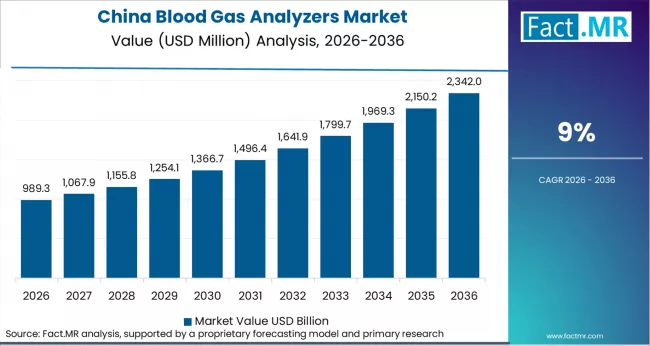
Country-level growth is driven by ICU infrastructure expansion, updated critical care protocols, and broader reimbursement for point-of-care diagnostics. China leads with 9.0% CAGR, supported by the Healthy China 2030 programme, which accelerates ICU construction and mandates blood gas monitoring in tertiary hospitals. India follows at 8.6%, driven by Ayushman Bharat expansion improving diagnostic access across tier-2 and tier-3 cities. Germany grows at 8.4%, supported by strict DIN EN ISO 22870 quality standards that trigger regular analyzer upgrades in accredited hospitals. Brazil records 7.8% CAGR, reflecting rising private hospital investment in emergency and critical care facilities. The United States grows at 6.8%, driven mainly by replacement cycles, consumable demand, and workflow upgrades within a mature installed base.
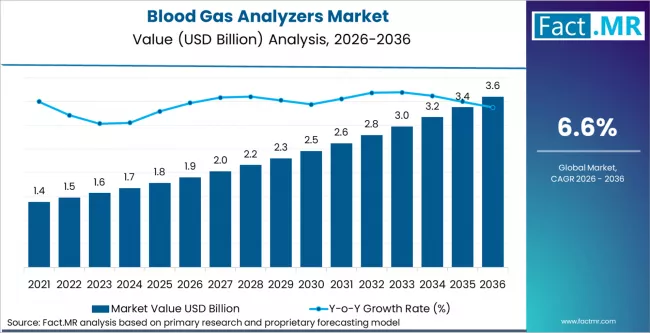
Blood Gas Analyzers Market Market Value Analysis | Source: Fact.MR
| Metric | Value |
|---|---|
| Estimated Value in 2026 | USD 1.9 billion |
| Forecast Value in 2036 | USD 3.6 billion |
| Forecast CAGR (2026 to 2036) | 6.6% |
Source: Fact.MR analysis. Updated Feb 28, 2026
Market Definition
The blood gas analyzers market includes portable and benchtop devices that measure blood oxygen, carbon dioxide, pH, and electrolytes. These systems are used to assess respiratory and metabolic status in acute care settings such as ICUs, emergency rooms, operating theatres, and neonatal units. The market also covers reagent cartridges, calibration fluids, service contracts, and related consumables.
Market Inclusions
This report provides global and regional revenue forecasts from 2026 to 2036. It segments the market by product type (portable and benchtop analyzers) and application (ICUs, emergency departments, laboratories, others). Revenues include capital equipment, consumables, and services. Country-level forecasts cover China, India, Germany, Brazil, and the United States.
Market Exclusions
The scope excludes standalone pulse oximeters, and multi-parameter monitors without direct blood gas measurement. LIS software sold separately from analyzers is not included. Co-oximetry within general chemistry analyzers is excluded unless marketed for blood gas testing. Ventilators and respiratory therapy devices are outside scope.
Research Methodology
- Primary Research: Interviews were conducted with critical care physicians, ICU procurement heads, biomedical engineers, distributors, and payer representatives across North America, Europe, and Asia Pacific.
- Desk Research: Sources reviewed include FDA 510(k) databases, CE marking records, HTA publications, company annual reports, and peer-reviewed journals on point-of-care and critical care testing.
- Market Sizing and Forecasting: A combined top-down and bottom-up approach was used. Top-down inputs included ICU bed counts, admission volumes, and critical care spending. Bottom-up inputs included average selling prices, consumable usage rates, replacement cycles, and adoption insights from interviews.
- Data Validation and Update Cycle: Findings were validated against trade data, procurement tenders, and regulatory timelines. Forecasts are updated annually, with interim revisions for major regulatory or reimbursement changes.
Summary
- Market Definition
- The market includes portable and benchtop blood gas analyzers used in critical care, along with related reagents and consumables.
- Demand Drivers
- Expansion of ICU capacity in China and India is driving new analyzer installations and recurring consumable demand.
- Adoption of point-of-care testing in Europe and North America is accelerating replacement of legacy benchtop systems.
- Rising sepsis and respiratory disease cases are increasing blood gas test frequency and consumable usage.
- Key Segments Analyzed
- By Product Type: Portable analyzers hold an estimated 43.4% share in 2026, driven by bedside and emergency use.
- By Application: Intensive care units’ account for 40.2% share due to high patient acuity and continuous testing needs.
- By Geography: Asia Pacific, led by China and India, shows strongest growth due to hospital infrastructure expansion.
- Analyst Opinion at FACT.MR
- Shambhu Nath Jha, Senior Research Analyst at FACT.MR, opines, 'CXOs in this market will find that portable analyzer market share gains are not cyclical but structural, with hospital protocol changes and accreditation requirements locking in point-of-care deployment as the default model, and that reagent and consumable revenue streams now represent the most defensible source of long-term margin.
- Strategic Implications / Executive Takeaways
- Manufacturers should enhance wireless connectivity and EMR integration, as interoperability increasingly influences procurement decisions.
- Companies targeting Asia Pacific must build local service and reagent supply capabilities to succeed in public tenders.
- Consumable pricing strategies should be optimized as cartridge standardization increases competition and reduces switching barriers.
- Methodology
- Market estimates are based on ICU bed counts, admission volumes, replacement cycles, and consumable attachment rates from primary research.
- Segment shares are validated through regulatory filings, procurement data, and company revenue disclosures.
- Country forecasts are built using health expenditure trends, critical care investments, and point-of-care policy adoption timelines.
Segmental Analysis
Blood Gas Analyzers Market Analysis by Product Type
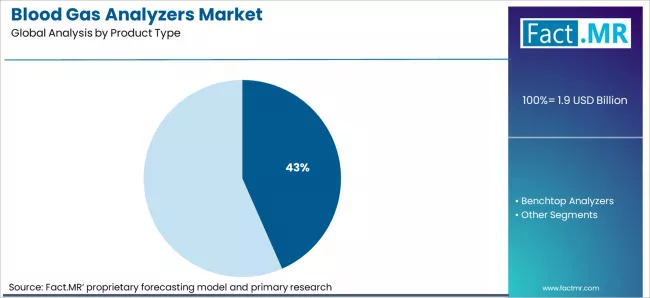
Blood Gas Analyzers Market Analysis By Product Type | Source: Fact.MR
Based on FACT.MR estimates, portable analyzers will hold 43.4% share in 2026. They dominate by eliminating transport delays to central labs, delivering bedside results in under 2 minutes versus 30-45 minutes centrally. Their ability to operate under nursing-led POCT programs reduces workflow dependency on laboratory staff.
- Abbott Point of Care i-STAT Platform Expansion: Abbott’s i-STAT Alinity, launched in 2024, added wireless EMR connectivity and multi-analyte cartridge support. In Q3 2024, Abbott reported 9% year-on-year growth in its Alinity POCT segment, driven by upgrades from legacy i-STAT systems in North America and Europe. [5]
- Radiometer ABL90 FLEX PLUS Product Development: Radiometer expanded the ABL90 FLEX PLUS in 2024 with enhanced co-oximetry measuring 18 parameters from a 65-microlitre sample. Danaher’s 2024 report noted over 12,000 global placements, with Asia Pacific as the fastest-growing region. [6]
- Pre-Hospital and Ambulance Deployment Trend: NHS England’s 2024 emergency care guidelines added blood gas analysis for advanced ambulances. In 2025, the Association of Ambulance Chief Executives recommended portable analyzers with wireless transmission, expanding demand into EMS procurement. [7]
Blood Gas Analyzers Market Analysis by Application
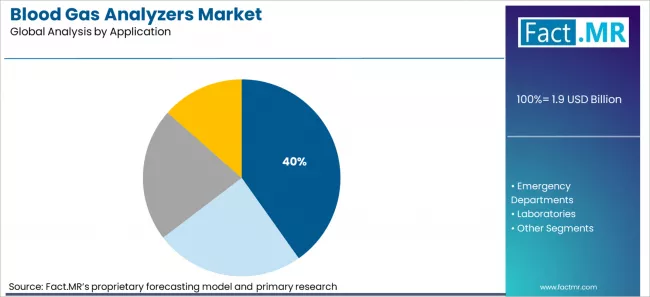
Blood Gas Analyzers Market Analysis By Application | Source: Fact.MR
ICUs are projected to hold 40.2% share in 2026. High patient acuity, mandated monitoring protocols, and frequent testing make ICUs the largest and most predictable consumables revenue channel. Each ICU bed typically generates multiple tests daily.
- Siemens Healthineers RAPID Point 500e ICU Positioning: Siemens launched RAPID Point 500e in 2024 with 60-second results and auto-cleaning cartridges optimized for ICU workflows. In FY2024, Siemens reported approvals in 28 countries, targeting ICU replacement cycles in Germany, France, and the US. [8]
- Roche Diagnostics cobas b 123 Laboratory Integration: Roche’s cobas b 123 received expanded CE-IVD approval in 2024 for additional electrolyte parameters. Roche reported the largest European installed base in combined blood gas testing, with service renewals up 7% year-on-year. [9]
Emergency Department Adoption Acceleration Post-COVID-19: A 2024 Annals of Emergency Medicine study found bedside analyzers reduced door-to-decision time by 38 minutes versus central labs. The American College of Emergency Physicians incorporated this into 2024 guidelines, supporting new ED procurement cycles. [10]
Drivers, Restraints, and Opportunities
FACT.MR analysts note that the blood gas analyzers market has shifted from centralized labs to point-of-care testing over decades, with acceleration post-pandemic. The USD 1.8 billion valuation reflects a replacement cycle for aging benchtop systems alongside rising demand for bedside-capable portable analyzers across developed and emerging markets.
The key tension lies between premium-priced portable systems with advanced connectivity and cost pressures in public hospital procurement. In mature markets, test volumes are shifting from central labs to ICUs and EDs. While portable systems have higher per-test reagent costs, they reduce time-to-result, ventilation duration, and ICU stay, supporting reimbursement justification.
- Regulatory Tailwind from ISO 22870 and CLSI POCT Standards: Accreditation frameworks such as ISO 22870:2016 and CLSI POCT12-A3 are increasingly mandatory in Europe, North America, and Australia. Non-compliant legacy analyzers must be replaced with certified systems. Germany’s DGKL framework explicitly references ISO 22870, directly supporting replacement demand. [2]
- Asia Pacific Greenfield Infrastructure Investment: China’s 14th Five-Year Plan allocated CNY 870 billion to hospital expansion, mandating higher ICU bed ratios. The 2024 ICU Quality Control update requires continuous arterial blood gas monitoring in grade-3 hospitals, driving analyzer installations in new and upgraded ICUs. [3]
- Sepsis Protocol Mandates Driving Consumable Volume: The 2021 Surviving Sepsis Campaign guidelines recommend serial lactate and blood gas testing during early resuscitation. With sepsis accounting for 20% of global hospital deaths, each ICU patient may require 12-15 tests per 72 hours, making sepsis the largest consumables growth driver. [4]
Regional Analysis
The blood gas analyzers market is analysed across North America, Latin America, Europe, East Asia, South Asia, Oceania and Middle East & Africa across 40+ countries. The full report also offers market attractiveness analysis based on regional trends.
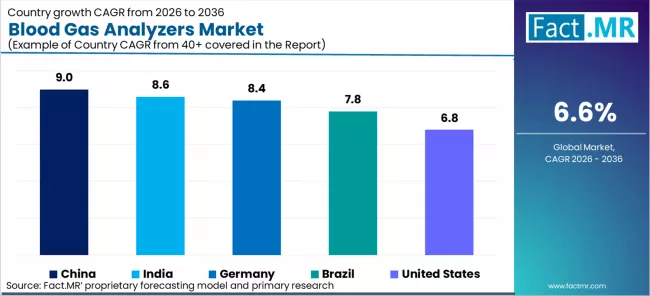
Blood Gas Analyzers Market Cagr Analysis By Country | Source: Fact.MR
| Country | CAGR (2026-2036) |
|---|---|
| China | 9.0% |
| India | 8.6% |
| Germany | 8.4% |
| Brazil | 7.8% |
| United States | 6.8% |
Source: Fact.MR analysis. Updated Feb 28, 2026
Source: Fact.MR (FACT.MR) analysis, based on proprietary forecasting model and primary research
Asia Pacific Blood Gas Analyzers Market Analysis
Blood Gas Analyzers Market Country Value Analysis | Source: Fact.MR
Asia Pacific is the fastest-growing region for blood gas analyzers, driven by ICU expansion and public hospital infrastructure upgrades. Regional players such as Edan Instruments and Sensa Core compete with global firms including Radiometer and Siemens Healthineers. Growth is supported by national critical care mandates and greenfield hospital construction across China and India.
- China: Demand is projected to grow at 9.0% CAGR through 2036. Updated 2024 NHC Grade-3 hospital standards mandate dedicated blood gas monitoring in ICUs and emergency units, creating large-scale procurement cycles. The Thousand-County Hospital Upgrade Programme (2023-2025) further supports installations. Edan secured contracts across 180 county hospitals in 2024 under this expansion.
- India: Demand is projected to grow at 8.6% CAGR through 2036. Expansion of the Ayushman Bharat PM-JAY scheme has increased reimbursement coverage for arterial blood gas testing in critical care. Updated NP-NCD 2024 guidelines also support monitoring in government hospitals. Nova Biomedical expanded tender access in 2025 via a partnership with Poly Medicure under India’s Medical Devices Policy
FACT.MR covers China, India, Japan, South Korea, ASEAN, and Australia & New Zealand, highlighting ICU capacity growth, reimbursement frameworks, and public hospital modernization trends.
Europe Blood Gas Analyzers Market Analysis
Europe represents a regulation-driven replacement market, with ISO 22870 and DIN EN ISO 15189 accreditation standards shaping procurement cycles. Radiometer and Werfen hold strong installed bases, while Siemens Healthineers and Roche leverage bundled diagnostics contracts across hospital systems.
- Germany: Demand is projected to grow at 8.4% CAGR through 2036. Updated 2024 DAkkS guidance reaffirmed ISO 15189 compliance as mandatory for reimbursement, triggering analyzer upgrades. DGKL guidelines recommend ISO 22870-compliant ICU systems, accelerating replacement across 1,200 certified laboratories. Radiometer ABL90 and Siemens RAPIDPoint 500e received updated certifications in 2024.
FACT.MR covers Germany, France, the UK, Italy, Spain, Nordics, and Rest of Europe, focusing on accreditation-driven upgrades and hospital quality compliance trends.
North America Blood Gas Analyzers Market Analysis
North America is the largest revenue market, led by the United States. Growth is primarily replacement-driven, supported by strict POCT quality regulations and ICU turnaround benchmarks. Abbott, Nova Biomedical, and Opti Medical Systems hold strong regional positions.
- United States: Demand is projected to grow at 6.8% CAGR through 2036. CMS 2024 updates reinforced CLIA quality requirements for point-of-care testing. The Joint Commission added ICU turnaround benchmarks under 10 minutes, supporting portable analyzer adoption. Abbott reported a USD 180 million annual upgrade opportunity from i-STAT replacements in 2024.
FACT.MR covers the United States and Canada, emphasizing regulatory compliance, ICU workflow optimization, and installed-base replacement cycles.
Latin America Blood Gas Analyzers Market Analysis
Latin America is an emerging growth region, driven by private hospital expansion and regulatory modernization. Werfen, Roche, and Siemens compete alongside cost-focused Chinese suppliers in public tenders.
- Brazil: Demand is projected to grow at 7.8% CAGR through 2036. Growth is supported by private hospital JCI accreditation efforts and updated 2024 ANVISA laboratory regulations requiring stricter quality documentation. Siemens secured a multi-hospital agreement with Rede D'Or São Luiz covering 47 units in 2024.
FACT.MR covers Brazil, Mexico, Colombia, Argentina, and Rest of Latin America, highlighting private sector investment, accreditation demand, and regulatory upgrades.
Competitive Landscape for Market Players
The global blood gas analyzers market is moderately concentrated, with Radiometer (Danaher), Siemens Healthineers, Abbott Point of Care, Roche Diagnostics, and Werfen accounting for roughly three quarters of total revenue. Competition is centered less on upfront instrument pricing and more on long term consumable contracts. Manufacturers often place analyzers at highly competitive prices to secure recurring reagent and service revenue over the product lifecycle. Integration with hospital EMR systems has also become a key differentiator, as seamless data transfer reduces clinical workload and strengthens customer retention.
Radiometer benefits from strong analytical performance, a broad parameter menu, and a well-established service network in Europe and the United States. Abbott’s i STAT Alinity platform is positioned strongly in portable care settings due to its single use cartridge model, which reduces maintenance complexity. Werfen leverages bundled contracts across diagnostics portfolios to deepen hospital relationships.
In the United States, large GPOs such as Vizient and Premier exert pricing pressure through consolidated purchasing, while European public tenders emphasize service reliability and reagent volume over instrument margins.
Recent Developments
- In February 2026, Danaher Corporation agreed to acquire Masimo Corporation in a $9.9 billion deal, strengthening Danaher’s diagnostics segment alongside its existing Radiometer blood analyzer business. The acquisition is expected to close in the second half of 2026 and will expand Danaher’s footprint in patient monitoring and diagnostic technologies.
- In 2025, Nova Biomedical launched its new Stat Profile Prime Plus blood gas analyzer, expanding its point-of-care testing portfolio and enhancing rapid blood gas and electrolyte testing capabilities in emerging markets.
Key Players
- Radiometer Medical ApS (Danaher Corporation)
- Siemens Healthineers AG
- Abbott Laboratories (Abbott Point of Care)
- Roche Diagnostics GmbH
- Nova Biomedical Corporation
- Werfen SA (Instrumentation Laboratory)
- Opti Medical Systems Inc.
- Accurex Biomedical Pvt. Ltd.
- Edan Instruments Inc.
- Sensa Core Medical Instrumentation Pvt. Ltd.
Bibliography
- Deutsche (2024, Q2). DIN EN ISO 15189:2023
- National Health Commission of the People's Republic of China. (2024, March). Intensive Care Unit Quality Control Indicators (2024 Edition).
- World Health Organization / Global Sepsis Alliance. (2024). Global Report on the Epidemiology and Burden of Sepsis.
- Abbott Laboratories. (2024, October). Q3 2024 Earnings Call Transcript and Investor Presentation. Abbott Investor Relations.
- Danaher Corporation. (2025, February). 2024 Annual Report: Diagnostics Segment - Radiometer Product Line Performance.
- NHS England / Association of Ambulance Chief Executives. (2024-2025). Pre-Hospital Emergency Care Clinical Guidelines Update.
- Siemens Healthineers AG. (2024). FY2024 Annual Results Presentation: RAPIDPoint 500e Global Regulatory Clearances.
- Roche Diagnostics GmbH. (2024). Diagnostics Division Investor Day 2024 Presentation.
This Report Addresses
- Strategic intelligence on blood gas analyzer product development, point-of-care testing adoption, hospital procurement cycles, and competitive positioning across global critical care diagnostics markets.
- Market size and forecast: USD 1.9 billion in 2026, reaching USD 3.6 billion by 2036 at 6.6% CAGR, segmented by product type, application, and region.
- Growth opportunity mapping across portable analyzer adoption, ICU infrastructure expansion in China and India, and emergency department POCT protocol mandates in Europe and North America.
- Country-level forecasts for China (9.0%), India (8.6%), Germany (8.4%), Brazil (7.8%), and the United States (6.8%), with product type and application segment splits.
- Competitive analysis of Radiometer, Siemens Healthineers, Abbott, Roche Diagnostics, Werfen, and Nova Biomedical, covering reagent attachment strategy, EMR integration positioning, and GPO contract dynamics.
- Product tracking including portable analyzer connectivity upgrades, multi-parameter cartridge launches, co-oximetry module expansions, and non-laboratory-setting regulatory approvals.
- Regulatory review covering ISO 22870, DIN EN ISO 15189, FDA CLIA regulations (42 CFR Part 493), ANVISA RDC 302, and China NHC Grade-3 hospital accreditation requirements.
- Delivered in Excel datasets, PowerPoint summary, and detailed report with verified industry, regulatory, and clinical sources from 2024 and 2025.
Segmentation
Scope of Report
| Items | Values |
|---|---|
| Quantitative Units | USD 1.9 billion (2026) to USD 3.6 billion (2036), at a CAGR of 6.6% |
| Market Definition | The blood gas analyzers market includes portable and benchtop instruments that measure partial pressures of oxygen and carbon dioxide, pH, and electrolytes in blood samples for critical care and diagnostic use, along with associated reagent cartridges and consumables. |
| Product Type | Portable Analyzers, Benchtop Analyzers |
| Application | Intensive Care Units, Emergency Departments, Laboratories, Others |
| Regions Covered | Asia Pacific, Europe, North America, Latin America, Middle East and Africa |
| Countries Covered | China, Japan, South Korea, India, Australia and New Zealand, ASEAN, Rest of Asia Pacific, Germany, United Kingdom, France, Italy, Spain, Netherlands, Nordics, Rest of Europe, United States, Canada, Mexico, Brazil, Argentina, Rest of Latin America, Kingdom of Saudi Arabia, United Arab Emirates, South Africa, Turkey, Rest of Middle East and Africa |
| Key Companies Profiled | Radiometer Medical ApS, Siemens Healthineers AG, Abbott Laboratories, Roche Diagnostics GmbH, Nova Biomedical Corporation, Werfen SA, Opti Medical Systems Inc., Accurex Biomedical Pvt. Ltd., Edan Instruments Inc., Sensa Core Medical Instrumentation Pvt. Ltd. |
| Forecast Period | 2026 to 2036 |
| Approach | A hybrid top-down and bottom-up model was applied. Top-down inputs included regional ICU bed counts, hospital admission volumes, and critical care diagnostics expenditure. Bottom-up inputs covered analyzer average selling prices, consumable attachment rates, replacement cycles, and primary interview-derived adoption rates across key geographies. |
Source: Fact.MR analysis. Updated Feb 28, 2026
Blood Gas Analyzers Market by Segment
-
By Product Type :
- Portable Analyzers
- Benchtop Analyzers
-
By Application :
- Intensive Care Units
- Emergency Departments
- Laboratories
- Others
-
By Region :
- North America
- United States
- Canada
- Mexico
- Europe
- Germany
- United Kingdom
- France
- Italy
- Spain
- Netherlands
- Nordics
- Rest of Europe
- Asia Pacific
- China
- Japan
- South Korea
- India
- Australia and New Zealand
- ASEAN
- Rest of Asia Pacific
- Latin America
- Brazil
- Mexico
- Argentina
- Rest of Latin America
- Middle East and Africa
- Kingdom of Saudi Arabia
- United Arab Emirates
- South Africa
- Turkey
- Rest of Middle East and Africa
- North America
Frequently Asked Questions
How large is the blood gas analyzers market in 2025?
What will the market size be in 2026?
What is the projected market size by 2036?
What is the expected CAGR for the forecast period 2026 to 2036?
Which product type segment is poised to lead the blood gas analyzers market?
Which application segment holds the largest share?
Which country shows the fastest growth rate?
How fast is the blood gas analyzers market expected to expand in India?
What is the forecast CAGR for Germany's blood gas analyzers market?
What growth rate is expected for the blood gas analyzers market in the United States?
How is the blood gas analyzers market in Brazil expected to grow?
Who worked on this report


Preview the report firsthand - request a free sample
Free SampleGet the brochure for pricing and purchase details
Download PDF