- Market Value (2025): USD 919.3 Mn
- Estimated Value (2026): USD 980.0 Mn
- Forecast Value (2036): USD 1856.9 Mn
- CAGR (2026-2036): 6.6%
What is the Bloom-Resistant Coating Fats Market forecast to be worth by 2036?
USD 980.0 million in 2026 to USD 1856.9 million by 2036 at a 6.6% CAGR.
- The Bloom-Resistant Coating Fats Market reached USD 919.3 million in 2025.
- Demand is projected to increase from USD 980.0 million in 2026 to USD 1856.9 million by 2036.
- The market is forecast to record 6.6% CAGR from 2026 to 2036 as confectionery and bakery formulators qualify fats for bloom control.
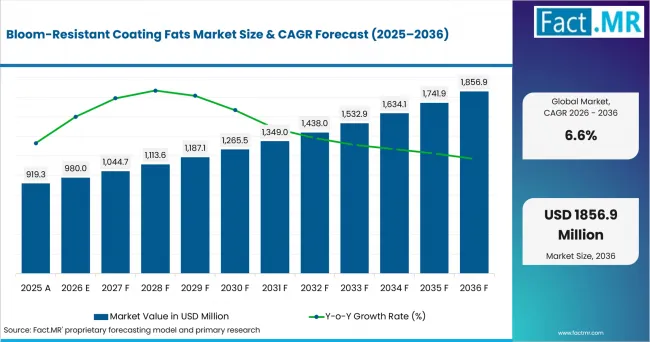
Bloom Resistant Coating Fats Market Value Analysis | Source: Fact.MR
What are the defining numbers behind Bloom-Resistant Coating Fats Market growth?
An absolute opportunity of USD 876.9 million is expected between 2026 and 2036.
- Demand Drivers in the Market
- Compound chocolate manufacturers need fats that crystallize predictably after cooling. Stable crystal networks help coatings retain gloss during storage and reduce whitening on chocolate-style surfaces.
- Indonesia’s Ministry of Agriculture reported in April 2026 that CPO production reached 51.66 million tonnes in 2025. That supply depth supports fraction-based fat systems used in lauric CBS and related coating applications.
- Cocoa-butter volatility keeps compound coating and CBE trials active. Brands are expected to use bloom-resistant systems where they need chocolate-style texture without exposing every recipe to the same cocoa-butter cost base.
- Bakery coatings and wafer fillings need fats that slow oil migration. This gives coating-fat suppliers a role in shelf-life design beyond basic hardstock selection.
- Key Segments Analyzed
- By Coating Fat Type: Lauric CBS is expected to hold 34.00% share in 2026 because fast setting suits compound chocolate coatings.
- By Confectionery Use: Compound chocolate coatings are projected to account for 39.00% share in 2026 due to wider use in coated snacks and molded items.
- By Bloom-control Mechanism: Crystal-network control is anticipated to capture 36.00% share in 2026 since stable crystals protect coating appearance.
- By Melting Profile: Standard body-temperature melt is estimated to represent 43.00% share in 2026 owing to balanced set speed and eating quality.
- Analyst Opinion at Fact.MR
- Shambhu Nath Jha, Principal Consultant at Fact.MR, states, “Bloom resistance is becoming a buying filter for confectionery fats. Manufacturers are expected to favor systems that prove crystal stability before scale-up. Refiners that combine fraction control, application testing and clear technical files are better placed for repeat recipe approvals.”
- Strategic Implications
- Formulators should screen coating fats by crystal behavior before moving to flavor fine-tuning and sensory panels.
- Refiners should connect palm-kernel fractions with application testing for molded products, wafers and compound coatings.
- Brand owners should test cocoa-butter compatibility before changing non-lauric CBR or CBE recipes.
- Distributors should keep technical data sheets current because recipe teams compare melt curve, setting speed and bloom behavior before approval.
Indonesia is projected to record 7.5% CAGR through 2036, supported by palm-oil depth. Malaysia is expected to post 7.1% CAGR owing to specialty-fat refining. The USA is anticipated to advance at 6.6% CAGR because confectionery costs keep compound coating under review. Germany is estimated to reach 6.3% CAGR due to quality-led chocolate standards. The UK is forecast to record 5.7% CAGR through packaged bakery demand.
How does the Bloom-Resistant Coating Fats Market break down by segment?
Lauric CBS leads at 34.00%; compound chocolate coatings lead at 39.00%.
Which Coating Fat Type dominates?
Lauric CBS is expected to hold 34.00% share in 2026.
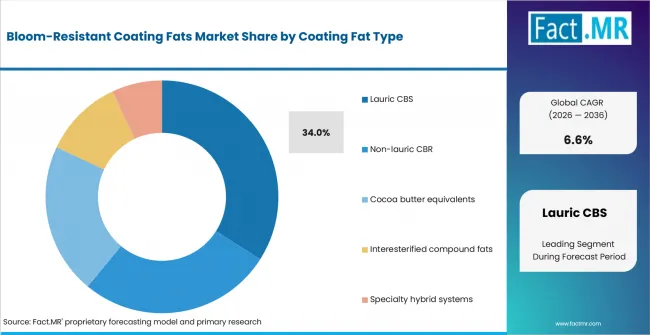
Bloom Resistant Coating Fats Market Analysis By Coating Fat Type | Source: Fact.MR
Lauric CBS is expected to lead because fast crystallization helps compound coatings set cleanly on molded and enrobed products. Non-lauric CBR serves recipes that need closer compatibility with cocoa solids. cocoa butter equivalents gain attention where formulators need cocoa-butter-like behavior with better supply flexibility. Interesterified compound fats and specialty hybrid systems are expected to serve tighter product briefs where melt curve and bloom behavior are specified together.
What leads the Confectionery Use segment?
Compound chocolate coatings are projected to account for 39.00% share in 2026.
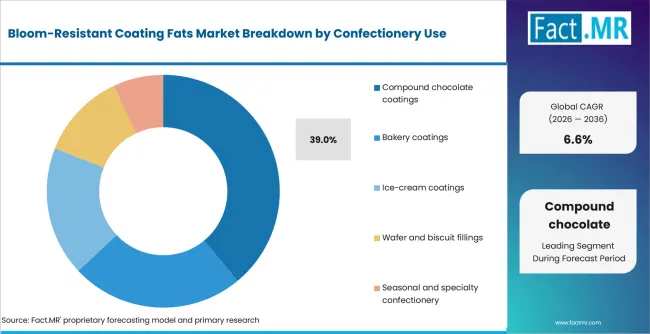
Bloom Resistant Coating Fats Market Analysis By Confectionery Use | Source: Fact.MR
Compound chocolate coatings are projected to lead because they give brands a practical route to coated snacks and molded items. Bakery coatings follow where biscuits and cakes need gloss retention through distribution. Ice-cream coatings require quick setting at low temperature. food coating ingredients provide an adjacent reference point for buyers comparing surface performance across sweet and savory products.
How does Bloom-control Mechanism shape demand?
Crystal-network control is anticipated to hold 36.00% share in 2026.
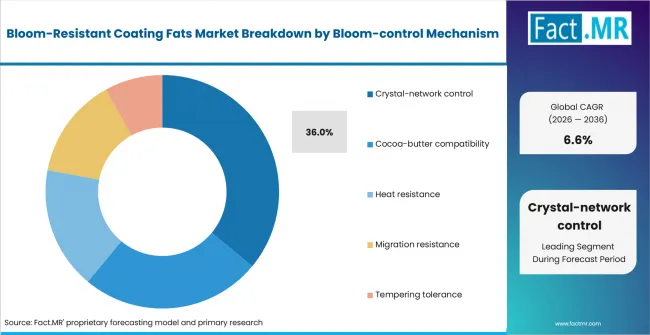
Bloom Resistant Coating Fats Market Analysis By Bloom Control Mechanism | Source: Fact.MR
Crystal-network control is anticipated to lead because fat bloom starts when unstable crystals move toward the surface. Cocoa-butter compatibility serves recipes with cocoa solids. Heat resistance supports warm markets, while migration resistance supports wafers and biscuits.
What supports Standard body-temperature melt within Melting Profile?
Standard body-temperature melt is estimated to represent 43.00% share in 2026.
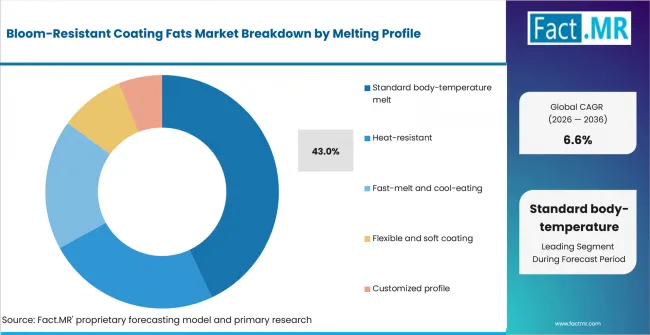
Bloom Resistant Coating Fats Market Analysis By Melting Profile | Source: Fact.MR
Standard body-temperature melt is estimated to lead because mainstream confectionery still depends on familiar mouthfeel. Heat-resistant profiles serve tropical routes where storage temperatures vary. Fast-melt and cool-eating systems suit ice-cream coatings. Flexible and soft coatings support bakery items where bite and fracture need more control. Adjacent heat-stable coating fats show how melt control is becoming a performance filter in coated food formats.
What is accelerating Bloom-Resistant Coating Fats Market adoption, and what is holding it back?
Compound coating reformulation drives it; cocoa-butter compatibility restrains it.
Drivers Impact Analysis
| DRIVER | (~) % IMPACT ON CAGR | GEOGRAPHIC RELEVANCE | IMPACT TIMELINE |
|---|---|---|---|
| Compound chocolate reformulation | +1.5% | Global | Short term (<= 2 years) |
| Palm-kernel fraction availability | +1.2% | Indonesia, Malaysia | Medium term (2-4 years) |
| Warm-climate shelf stability | +0.9% | Southeast Asia, Middle East & Africa | Medium term (2-4 years) |
| Bakery and wafer coatings | +0.8% | North America, Europe | Short term (<= 2 years) |
| Seasonal confectionery quality | +0.6% | Europe, USA | Long term (>= 4 years) |
Source: Fact.MR analysis. Updated Sep 2, 2026
- Compound chocolate reformulation: Cocoa-butter price exposure keeps coating recipes under review as manufacturers seek more stable cost and performance profiles. CBS, CBR, and CBE systems help formulators maintain texture, gloss, snap, and visual quality across compound chocolate applications.
- Palm-kernel fraction availability: Southeast Asian refining and fractionation capacity supports lauric CBS supply for confectionery coatings. Fractionation gives producers access to tailored melting profiles and allows suppliers to serve manufacturers that require consistent performance across different coating and filling applications.
- Warm-climate shelf stability: Tropical distribution conditions increase the need for fats with reliable crystal stability and controlled melting behavior. Coatings that soften, bloom, or lose visual quality during transport can increase returns, making heat stability an important formulation priority.
- Bakery and wafer coatings: Bakery coatings and wafer fillings require fats that control migration while maintaining texture and processing consistency. Specialty coating fats support these applications by balancing melt behavior, structural stability, and compatibility with biscuit, wafer, and filling systems.
- Seasonal confectionery quality: Seasonal confectionery products require fats that maintain gloss, texture, and appearance during extended display and storage periods. Suppliers that provide clear storage-performance data can strengthen qualification and support faster approval across seasonal product launches.
Opportunity Impact Analysis
| OPPORTUNITY | (~) % IMPACT ON CAGR | GEOGRAPHIC RELEVANCE | IMPACT TIMELINE |
|---|---|---|---|
| Customized fat profiles | +1.1% | Global | Medium term (2-4 years) |
| Cocoa-butter compatible systems | +0.9% | Europe, USA | Short term (<= 2 years) |
| Heat-resistant coating formats | +0.7% | Southeast Asia, GCC | Long term (>= 4 years) |
| Technical service for smaller brands | +0.5% | Global | Medium term (2-4 years) |
Source: Fact.MR analysis. Updated Sep 2, 2026
- Customized fat profiles: Formulators are expected to need tailored blends for gloss, snap and controlled melt. Pilot-lab support shortens approval steps between trial batches and production.
- Cocoa-butter compatible systems: Non-lauric CBR is projected to gain use where formulas retain cocoa solids. CBE systems remain relevant where closer phase behavior is needed.
- Heat-resistant coating formats: Warm retail routes are anticipated to expand demand for controlled melt. High-stability frying fats belong to a separate use case but show how food manufacturers compare lipid performance under heat stress.
- Technical service for smaller brands: Smaller confectionery makers are estimated to rely on supplier labs. Recipe translation, bloom testing and scale-up support help limit repeated pilot runs.
Restraints Impact Analysis
| RESTRAINT | (~) % IMPACT ON CAGR | GEOGRAPHIC RELEVANCE | IMPACT TIMELINE |
|---|---|---|---|
| Cocoa-butter compatibility limits | -0.5% | Europe, USA | Short term (<= 2 years) |
| Input-cost sensitivity | -0.4% | Global | Medium term (2-4 years) |
| Qualification time | -0.3% | Global | Medium term (2-4 years) |
| Label and standard constraints | -0.2% | Europe, UK | Long term (>= 4 years) |
Source: Fact.MR analysis. Updated Sep 2, 2026
- Cocoa-butter compatibility limits: Lauric CBS has limited compatibility with formulations containing cocoa butter. Incorrect pairing can create bloom, texture instability, or other quality defects, requiring manufacturers to evaluate fat-system compatibility carefully before wider commercial use.
- Input-cost sensitivity: Cocoa-price volatility and broader production-cost pressure encourage manufacturers to review confectionery-fat systems more closely. Cocoa butter equivalents can provide an alternative route where formulators need to manage cost exposure while maintaining acceptable texture, melting behavior, and product quality.
- Qualification time: Switching a coating fat requires pilot trials, processing checks, and shelf-life validation. Brands need evidence that gloss, snap, texture, and melting behavior remain stable before approving a new fat system for commercial production.
- Label and standard constraints: Chocolate identity and labeling requirements can limit certain substitutions in traditional chocolate formulations. Ingredient teams therefore need clear regulatory and labeling boundaries when shifting toward compound coatings or alternative fat systems.
Which countries are scaling the Bloom-Resistant Coating Fats Market through 2036?
- The country comparison spans 1.73 percentage points and forms two practical growth bands across the forecast period.
- Indonesia remains 0.40 percentage point above Malaysia through palm-linked refining depth and food manufacturing.
- Malaysia remains 0.46 percentage point above the USA as specialty-fat refining supports coating-fat supply.
- The USA remains 0.33 percentage point above Germany through confectionery cost pressure and bakery coating use.
- Germany remains 0.54 percentage point above the UK because quality-led chocolate production raises formulation standards.
- The UK closes the displayed range as packaged bakery and retail channels keep coating performance visible.
Comparable CAGRs create different entry conditions because feedstock access and application-testing depth vary by country. Full coverage includes seven global regions.
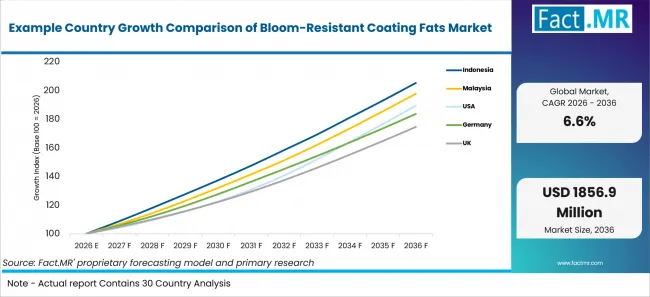
Example Country Growth Comparison Of Bloom Resistant Coating Fats Market | Source: Fact.MR
| Country | CAGR (2026-2036) |
|---|---|
| Indonesia | 7.5% |
| Malaysia | 7.1% |
| USA | 6.6% |
| Germany | 6.3% |
| UK | 5.7% |
Source: Fact.MR analysis. Updated Sep 2, 2026
What is powering Indonesia’s lead?
7.5% CAGR, supported by palm-linked refining depth and food manufacturing.
BPS reported in August 2025 that Indonesia’s manufacturing sector grew 5.68% in Q2 2025, with food and beverages among the industries supporting expansion. This manufacturing base, combined with palm-linked refining depth, supports coating-fat production, application development, and reliable regional supply for confectionery and bakery manufacturers.
How is Malaysia scaling coating-fat demand?
7.1% CAGR, driven by specialty-fat refining and palm-kernel fraction supply.
Department of Statistics Malaysia reported in February 2026 that manufacturing-sector sales reached RM1.97 trillion in 2025, increasing 4.2% from 2024. Strong specialty-fat refining capacity and palm-kernel fraction availability support coating-fat production, while established processing infrastructure helps suppliers serve confectionery manufacturers with tailored melting and texture requirements.
What supports the USA outlook?
6.6% CAGR, backed by confectionery cost pressure and coated bakery demand.
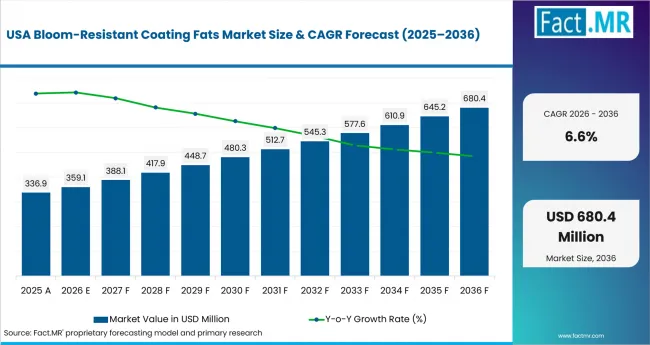
Bloom Resistant Coating Fats Market Country Value Analysis | Source: Fact.MR
USDA Economic Research Service reported in April 2026 that average U.S. food-at-home prices for sugar and sweets increased 5.1% in 2025. Cost pressure encourages confectionery and bakery manufacturers to review coating formulations, supporting demand for specialty fats that balance texture, visual quality, processing performance, and formulation economics.
What underpins Germany’s growth?
6.3% CAGR, supported by chocolate output and formulation discipline.
Destatis reported in December 2025 that Germany produced nearly 1.07 million tonnes of cocoa-containing chocolate products in 2024. This substantial confectionery base supports demand for coating fats with controlled melting, gloss, and texture, while disciplined formulation practices encourage suppliers to provide consistent performance, compatibility, and storage stability.
How does the UK perform?
5.7% CAGR, led by food manufacturing and retail channel requirements.
ONS reported in July 2026 that manufacture of food represented 22.9% of total UK manufacturers’ sales in 2025. The country’s established food-processing base supports demand for coating fats across confectionery and bakery products, while retail requirements reinforce the need for consistent appearance, texture, shelf stability, and formulation efficiency.
Who leads the Bloom-Resistant Coating Fats Market?
Key profiled suppliers with relevant coating-fat and confectionery-fat portfolios include AAK AB, Fuji Oil Co., Ltd., Bunge Global SA, Cargill, Incorporated, Wilmar International Limited and Mewah International Inc..
AAK AB is active through cocoa butter equivalents and confectionery-fat systems for enrobing and molded applications. Fuji Oil Co., Ltd. remains relevant through vegetable oils and fats, industrial chocolate and specialty oils. Bunge Global SA competes through cocoa butter equivalents and lauric coating fats.
Cargill, Incorporated brings application reach across bakery, confectionery and chocolate-style alternatives. Wilmar International Limited supports CBS, CBR, CBE and specialty fats used in coatings. Mewah International Inc. adds palm-based refining and confectionery-oil participation.
Which companies are the key providers?
Key companies include AAK AB, Fuji Oil Co., Ltd., Bunge Global SA, Cargill, Incorporated, Wilmar International Limited and Mewah International Inc..
- AAK AB
- Fuji Oil Co., Ltd.
- Bunge Global SA
- Cargill, Incorporated
- Wilmar International Limited
- Mewah International Inc.
Bibliography
- AAK. (2026, May 28). AAK’s new cocoa butter equivalent overcomes enrobing challenges – even when used at high levels.
- Badan Pusat Statistik. (2025, August 5). Indonesia’s economic growth reaches 5.12 percent in Q2-2025.
- Department of Statistics Malaysia. (2026, February 9). Monthly manufacturing statistics, Malaysia, December 2025.
- Statistisches Bundesamt (Destatis). (2025, December 2). 12,8 Kilo Schokolade pro Kopf wurden 2024 produziert.
- Kementerian Pertanian Republik Indonesia. (2026, April 1). Kementan: Hilirisasi CPO tekan impor solar dan perkuat ekonomi nasional.
- Office for National Statistics. (2026, July 24). UK manufacturers’ sales by product: 2025.
- Sinclair, W., & Stewart, H. (2026, April 30). U.S. food-at-home prices increased 2.3 percent in 2025, compared with 2024. U.S. Department of Agriculture, Economic Research Service.
- Cargill. (2025, March 4). Cargill showcases full range of innovative food solutions at AAHAR 2025.
This Report Answers
- The report explains where bloom-resistant coating fats are used across coating fat type and confectionery use.
- Segment analysis identifies Lauric CBS and compound chocolate coatings as the primary 2026 share positions.
- Country analysis examines Indonesia, Malaysia, the USA, Germany and the UK through feedstock, manufacturing and retail lenses.
- Competitive analysis reviews AAK AB, Fuji Oil Co., Ltd., Bunge Global SA, Cargill, Incorporated, Wilmar International Limited and Mewah International Inc..
- Application analysis assesses how gloss retention, melt behavior and cocoa-butter compatibility shape supplier approval.
- The report also reviews crystal-network control, migration resistance and heat resistance as technical buying filters.
What does the Bloom-Resistant Coating Fats Market cover?
The Bloom-Resistant Coating Fats Market covers specialty fat systems used to reduce visible bloom in compound coatings and bakery coatings. Adjacent industrial chocolate and chocolate ingredients applications are considered where coating-fat performance shapes formulation choices.
The assessment focuses on coating fats where bloom control is a defined product function. Basic edible oils, finished chocolate and broad cocoa ingredients are excluded unless they are part of a coating-fat formulation package.
What is included in the scope?
Bloom-resistant coating fat systems used in confectionery, bakery and frozen coating applications.
The scope includes lauric CBS, non-lauric CBR, cocoa butter equivalents and interesterified systems used in compound chocolate coatings. Related food coating ingredients are considered when fat phase behavior shapes coating performance. Palm and palm-kernel streams are assessed through the palm oil supply link.
What is excluded from the scope?
Commodity edible oils and finished chocolate products are outside the scope.
The scope excludes cocoa beans, cocoa liquor, cocoa powder and bulk edible oils sold without a bloom-control function. Adjacent cocoa-free alternatives are treated separately unless sold as a coating-fat system. Heat-management categories such as high-stability frying fats remain separate when used for frying.
How Was the Analysis Built?
The analysis draws on 120+ sources, 35+ company portfolios, 25+ countries, and more than 20 industry interviews.
- Primary Research: Primary research includes discussions with manufacturers, service providers, technology developers, distributors, end users, and subject-matter experts. These conversations examine purchasing priorities, product adoption, operational challenges, approval requirements, competitive positioning, and the factors that influence wider market acceptance.
- Desk Research: Desk research covers government statistics, regulatory publications, company filings, trade data, technical studies, industry associations, standards, public policy, and other authoritative sources. Every source used in the analysis is documented in the bibliography.
- Market Sizing and Forecasting: Market estimates combine historical performance, demand indicators, pricing and volume trends, segment shares, company participation, country-level growth, adoption patterns, investment activity, and barriers to market expansion.
- Data Validation and Update Cycle: Findings are validated by comparing primary interviews with public data, company activity, regulatory changes, trade patterns, and industry developments. Regular updates review new product launches, capacity changes, partnerships, approvals, and shifts in commercial adoption.
Segmentation
What is the report’s scope and coverage?
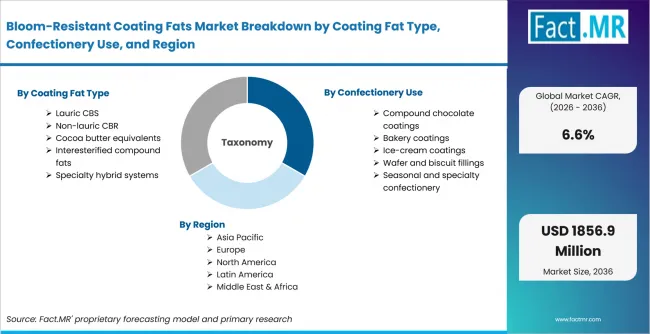
Bloom Resistant Coating Fats Market Breakdown By Coating Fat Type, Confectionery Use, And Region | Source: Fact.MR
| Attribute | Details |
|---|---|
| Quantitative Units | USD million in 2026 to USD million by 2036 at a CAGR |
| Market Definition | Specialty fat systems used to control bloom, melt behavior, gloss and texture in coated confectionery and bakery applications. |
| Coating Fat Type | Lauric CBS; Non-lauric CBR; Cocoa butter equivalents; Interesterified compound fats; Specialty hybrid systems |
| Confectionery Use | Compound chocolate coatings; Bakery coatings; Ice-cream coatings; Wafer and biscuit fillings; Seasonal and specialty confectionery |
| Bloom-control Mechanism | Crystal-network control; Cocoa-butter compatibility; Heat resistance; Migration resistance; Tempering tolerance |
| Melting Profile | Standard body-temperature melt; Heat-resistant; Fast-melt and cool-eating; Flexible and soft coating; Customized profile |
| Regions Covered | North America; Latin America; Western Europe; Eastern Europe; East Asia; South Asia & Pacific; Middle East & Africa |
| Countries Covered | Indonesia; Malaysia; USA; Germany; UK |
| Key Companies Profiled | AAK AB; Fuji Oil Co., Ltd.; Bunge Global SA; Cargill, Incorporated; Wilmar International Limited; Mewah International Inc. |
| Forecast Period | 2026 to 2036 |
| Approach | Hybrid top-down and bottom-up approach using known market values, coating-fat use cases, segment shares, country CAGRs and company portfolio checks. |
Source: Fact.MR analysis. Updated Sep 2, 2026
How is the market segmented?
-
By Coating Fat Type
- Lauric CBS
- Non-lauric CBR
- Cocoa butter equivalents
- Interesterified compound fats
- Specialty hybrid systems
-
By Confectionery Use
- Compound chocolate coatings
- Bakery coatings
- Ice-cream coatings
- Wafer and biscuit fillings
- Seasonal and specialty confectionery
-
By Bloom-control Mechanism
- Crystal-network control
- Cocoa-butter compatibility
- Heat resistance
- Migration resistance
- Tempering tolerance
-
By Melting Profile
- Standard body-temperature melt
- Heat-resistant
- Fast-melt and cool-eating
- Flexible and soft coating
- Customized profile
-
By Region
- North America
- Latin America
- Western Europe
- Eastern Europe
- East Asia
- South Asia & Pacific
- Middle East & Africa
Frequently Asked Questions
How big is the bloom-resistant coating fats market in 2026?
What is the CAGR of the bloom-resistant coating fats market from 2026 to 2036?
Which coating fat type leads the bloom-resistant coating fats market?
Which confectionery use leads the bloom-resistant coating fats market?
Who are the leading companies in the bloom-resistant coating fats market?
Who worked on this report


Preview the report firsthand - request a free sample
Free SampleGet the brochure for pricing and purchase details
Download PDF