- Market Value (2025): USD 3.2 Bn
- Estimated Value (2026): USD 3.5 Bn
- Forecast Value (2036): USD 8.6 Bn
- CAGR (2026-2036): 9.5%
What is the Refillable Personal Care Pouches Market forecast to be worth by 2036?
USD 3.5 billion in 2026 to USD 8.6 billion by 2036 at a 9.5% CAGR.
- As per Fact.MR analysis, the refillable personal care pouches market reached USD 3.2 billion in 2025.
- Demand is projected to increase from USD 3.5 billion in 2026 to USD 8.6 billion by 2036.
- The refillable personal care pouches market is forecast to record 9.5% CAGR from 2026 to 2036.
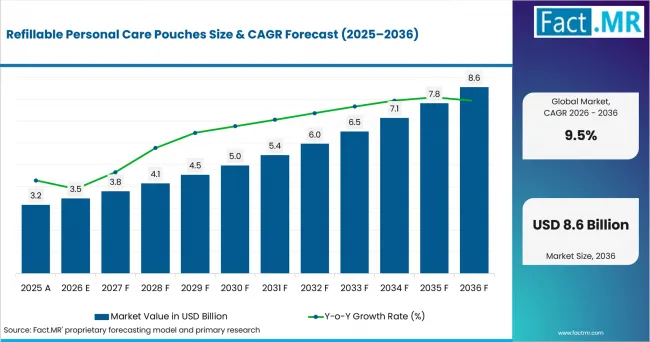
Refillable Personal Care Pouches Value Analysis | Source: Fact.MR
What are the defining numbers behind Refillable Personal Care Pouches Market growth?
An absolute opportunity of USD 5.1088 billion is expected between 2026 and 2036.
- Demand Drivers in the Market
- Personal care brands are using more refill pouches to reduce the need for new plastic bottles. Customers can buy a refill and keep using the same bottle.
- Recycling rules are increasing demand for packs that use less plastic. Refill pouches help reduce packaging while keeping personal care products safe.
- Online shopping is also supporting demand for refill pouches. They are light and easy to store and ship. This makes them useful for products that customers buy often.
- Key Segments Analyzed
- By Pouch Structure: High-barrier multilayer is expected to hold 34.0% share in 2026.
- By Refill Feature: Among other segment the spout and fitment systems are projected to account for 37.0% share in 2026.
- By use: In 2026, the hair care is expected to hold 33.0% share.
- By Fill Volume: Less than 150 mL is forecast to capture 36.0% share in 2026.
- Analyst Opinion at Fact.MR
- Shambhu Nath Jha, Principal Consultant at Fact.MR states, “Demand for refillable personal care pouches will grow as brands are looking for easy to use packs. Pouch material also important to keep the personal care products safe.”
- Strategic Implications
- Pack makers should check pouch strength and leaks before sale. This helps brands choose packs that keep products safe during storage and shipping.
- Film suppliers should use less material while keeping the product safe. Simple pouch designs can also make recycling easier and help brands follow packaging rules.
- Retailers can offer refill packs at a lower price than regular packs. Lower prices can make refills more attractive and support repeat sales.
China is projected to post 10.1% CAGR through 2036 as cosmetics retail activity and online channels support frequent refill formats. The USA is expected to record 9.6% as refill adoption meets e-commerce growth and packaging reduction rules. Japan is expected to reach 9.6% as municipal plastic collection expands. Germany is forecast at 9.4% as packaging recycling rules shape flexible-pack design. France is forecast at 8.9% as recycling pressure increases attention to lower-film refill formats.
How does the Refillable Personal Care Pouches Market break down by segment?
High-barrier multilayer leads Pouch Structure at 34.0%; Spout and fitment systems lead Refill Feature at 37.0%.
Which Pouch Structure leads?
High-barrier multilayer is expected to hold 34.0% share in 2026.
High-barrier packs help keep shampoo and lotion safe. Safe packaging are also important for conditioner and liquid soap. Demand for mono-film packs may grow as recycling rules become stricter. The European Commission confirmed in February 2025 that the Packaging and Packaging Waste Regulation supports reuse and refill while setting stronger recycling rules.
What leads the Refill Feature segment?
Spout and fitment systems are projected to account for 37.0% share in 2026.
Spout and fitment systems are expected to lead because they make refilling simple. Good caps help stop spills and leaks. Easy-pour spouts make refill packs simple to use at home.
How does use shape demand?
Hair care is expected to represent 33.0% share in 2026.
Hair care is anticipated to lead as people mostly use refill packs for shampoo and conditioner. Liquid soap and hand wash are also easy to refill. For skin care products the packs are very important to keep this product safe and fresh.
What supports the less than 150 mL Fill Volume segment?
Less than 150 mL is forecast to capture 36.0% share in 2026.
Packs below 150 mL are popular for travel and trial because they are easy to carry. Packs from 150 to 500 mL work well for daily-use products. Larger packs are useful for families and regular refills.
What is accelerating Refillable Personal Care Pouches Market adoption, and what is holding it back?
Demand for refillable personal care pouches are growing because refill packs use less packaging and are easy to use. Recycling issues and refill costs are the main issues as this can reduce its growth.
Drivers Impact Analysis
| DRIVER | (~) % IMPACT ON CAGR | GEOGRAPHIC RELEVANCE | IMPACT TIMELINE |
|---|---|---|---|
| Shift from single-use rigid packs | +1.4% | Global | Short term (<= 2 years) |
| Recyclability and packaging rules | +1.1% | Europe, North America | Medium term (2-4 years) |
| E-commerce replenishment formats | +0.8% | USA, China | Medium term (2-4 years) |
| Consumer familiarity with refill pouches | +0.7% | Europe, East Asia | Long term (>= 4 years) |
| Spout and mono-material development | +0.5% | Global | Long term (>= 4 years) |
Source: Fact.MR analysis. Updated Sep 28, 2026
Opportunity Impact Analysis
| OPPORTUNITY | (~) % IMPACT ON CAGR | GEOGRAPHIC RELEVANCE | IMPACT TIMELINE |
|---|---|---|---|
| Mono-material refill pouches | +0.9% | Europe, North America | Medium term (2-4 years) |
| Brand-specific refill systems | +0.7% | Global | Short term (<= 2 years) |
| E-commerce refill bundles | +0.5% | USA, China | Medium term (2-4 years) |
| Concentrated personal care formats | +0.4% | Global | Long term (>= 4 years) |
Source: Fact.MR analysis. Updated Sep 28, 2026
Restraints Impact Analysis
| RESTRAINT | (~) % IMPACT ON CAGR | GEOGRAPHIC RELEVANCE | IMPACT TIMELINE |
|---|---|---|---|
| Mixed-material recycling limits | -0.7% | Global | Short term (<= 2 years) |
| Refill price parity with rigid packs | -0.5% | Global | Medium term (2-4 years) |
| Leakage and fitment qualification | -0.4% | Global | Short term (<= 2 years) |
| Collection-system variation | -0.3% | Europe, Asia | Long term (>= 4 years) |
Source: Fact.MR analysis. Updated Sep 28, 2026
Which countries are scaling the Refillable Personal Care Pouches Market through 2036?
- The country comparison spans 1.2 percentage points between China at 10.1% and France at 8.9%.
- China is 0.5 percentage point above the USA as cosmetics sales and online retail support refill refill.
- The USA and Japan both record 9.6%, although their demand mechanisms differ between commerce channels and collection infrastructure.
- Germany sits 0.2 percentage point below the USA and Japan as recycling rules increase packaging design scrutiny.
- France closes the displayed range at 8.9% while national recycling results keeps packaging reduction high on the policy agenda.
Comparable CAGRs can still create different entry conditions. Refill use depends on personal care buying habits and online sales. Local collection rules and pack reduction rules also shape the market. Full coverage includes North America and Latin America. It also covers Western Europe and Eastern Europe. East Asia and South Asia & Pacific are included. Middle East & Africa completes the regional coverage.
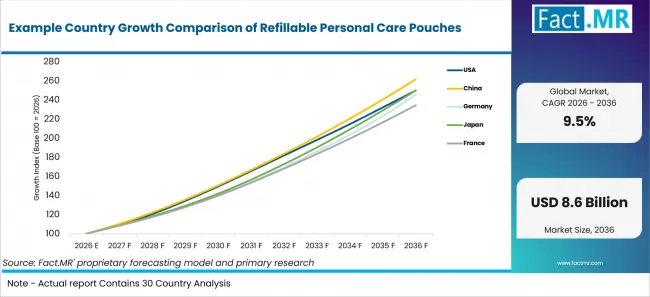
Example Country Growth Comparison Of Refillable Personal Care Pouches | Source: Fact.MR
| Country | CAGR (2026-2036) |
|---|---|
| China | 10.1% |
| United States | 9.6% |
| Japan | 9.6% |
| Germany | 9.4% |
| France | 8.9% |
Source: Fact.MR analysis. Updated Sep 28, 2026
What supports China adoption?
10.1% CAGR, supported by cosmetics retail growth and digital refill.
Sales of refillable personal care pouches is growing in China as beauty products are widely sold in stores and online. China’s National Bureau of Statistics reported 465.3 billion yuan in cosmetics retail sales in 2025, up 5.1% from 2024. Online sales of physical goods reached 13.0923 trillion yuan, making up 26.1% of total consumer retail sales.
What supports USA adoption?
9.6% CAGR, supported by e-commerce scale and packaging source-reduction rules.
Online shopping is common in the United States, which help to sale and delivery of lightweight refill packs. U.S. retail e-commerce sales reached USD 1,233.7 billion in 2025, up 5.4% from 2024, according to the U.S. Census Bureau. In May 2026, California approved permanent rules for SB 54. The law calls for a 25% cut in covered plastic material by 2032 from 2023 levels and includes reuse or refill as part of this goal.
How is Japan developing demand?
9.6% CAGR, supported by plastic collection expansion and repeat-purchase personal care routines.
Refill packs are common in Japan, and many areas also have systems to collect used packaging. Japan’s Ministry of the Environment reported that 1,434 municipalities planned to collect plastic containers and packaging separately in fiscal 2026. This covers 82.4% of municipalities. Collection is expected to reach 773 thousand tonnes in 2026 and 809 thousand tonnes by fiscal 2030.
What is supporting Germany adoption?
9.4% CAGR, supported by monitored packaging recycling and EU-wide design rules.
The strong focus for Germany is to collect and recycle the used packaging. In January 2026, German agencies reported that around 5.5 million tonnes of packaging waste collected through dual systems was recovered in 2024.
How does France perform?
8.9% CAGR, supported by beauty retail activity and pressure to improve plastic packaging recovery.
France has a large beauty products market and their strong focus is on collecting and recycling plastic packaging. In June 2026, the French Ministry for Ecological Transition reported that France pays EUR 1.5 billion each year to the European Union because it does not recycle enough plastic packaging. The ministry also stated that Europe aims to recycle 55% of plastic packaging by 2030.
Who leads the Refillable Personal Care Pouches Market?
SIG, including Scholle IPN, makes pouches for refill packs. Its pouches are easy to pour and close. They can also be used with reusable bottles.
Gualapack makes pouches with spouts. These pouches are easy to use and help stop leaks during storage and shipping. Amcor makes flexible refill packs that help keep products safe. Its packs are also made to be easy to use and recycle.
ProAmpac and Mondi also make refill pouches. They offer different materials and pack sizes for different personal care products. Brands look for pouches that are easy to use and do not leak. They also look at product safety and recycling. The pouch should work well with the reusable bottle.
Which companies are the key providers?
Key companies include SIG (including Scholle IPN); Gualapack; Amcor; ProAmpac; and Mondi.
- SIG (including Scholle IPN)
- Gualapack
- Amcor
- ProAmpac
- Mondi
Bibliography
- European Commission, Directorate-General for Environment. (2025, February 11). New rules enter into force for a more sustainable and competitive packaging economy.
- Eurostat. (2025, October 22). Plastic packaging waste in the EU: 35.3 kg per person.
- U.S. Census Bureau. (2026, March 10). Quarterly retail e-commerce sales: 4th quarter 2025.
- California Department of Resources Recycling and Recovery. (2026, May 1). California approves new plastic and packaging rules that put consumers first.
- National Bureau of Statistics of China. (2026, January 20). Total retail sales of consumer goods in December 2025.
- German Environment Agency. (2026, January 27). Facts against myths: Packaging waste recycling in Germany is working.
- Ministères de la Transition écologique, de l’Aménagement du territoire, des Transports, de la Ville et du Logement. (2026, June 18). Plan plastique : 12 leviers pour réduire, réemployer et recycler les emballages plastiques [Plastic plan: 12 levers to reduce, reuse and recycle plastic packaging].
- Amcor. (2026, June 16). Consumers embrace convenient refill solutions in beauty and personal care, new Amcor research shows.
- Amcor. (2026, September 8). Amcor versatility helps meet increasing refill demands.
This Report Answers
- The report explains how refill personal care pouches are used by pouch structure and refill feature. It also covers use and fill volume.
- Segment analysis identifies the leading subsegments and the packaging functions that support their 2026 shares.
- Country analysis compares the five listed markets and the retail, rule or collection mechanisms shaping refill adoption.
- Competitive analysis reviews active providers across spouted pouches, mono-film structures and beauty or personal care refill formats.
- use analysis looks at pouring and closure needs. It also reviews barrier needs and pack size when brands choose a refill format.
What does the Refillable Personal Care Pouches Market cover?
The market covers flexible pouches used to refill shampoo and conditioner. It also covers hand wash, body wash and related personal care products. The wider refill packaging field gives context for reuse systems while the revenue scope stays limited to personal care pouches.
The analysis includes spouted and recyclable pouch films. film context includes flexible film PCR for personal care packaging and high-recycling mono-film flexible packaging.
What is included in the scope?
The scope includes premade and form-fill-seal pouches, spouts and fitments. Upstream context includes recyclable PU adhesives, packaging adhesives and post-industrial recyclate flexible packaging.
Sealant context includes ethylene acrylic acid copolymers, while refill design context includes clean beauty packaging prototypes.
What is excluded from the scope?
Rigid-only refill packs, ordinary sachets and food uses such as aseptic spouted pouches remain outside this market boundary.
Raw packaging films enter the scope only after conversion into refill pouches. Pumps and rigid bottles remain outside the revenue boundary, while fit is considered when it affects refill-system design.
How Was the Analysis Built?
The analysis draws on 120+ sources, 35+ company portfolios, 25+ countries, and more than 20 industry interviews.
- Primary Research: Primary research includes discussions with manufacturers, service providers, technology developers, distributors, end users, and subject-matter experts. These conversations examine purchasing priorities, product adoption, operational challenges, approval requirements, competitive positioning, and the factors that influence wider market acceptance.
- Desk Research: Desk research covers government statistics, regulatory publications, company filings, trade data, technical studies, industry associations, standards, public policy, and other authoritative sources. Every source used in the analysis is documented in the bibliography.
- Market Sizing and Forecasting: Market estimates combine historical performance, demand indicators, pricing and volume trends, segment shares, company participation, country-level growth, adoption patterns, investment activity, and barriers to market expansion.
- Data Validation and Update Cycle: Findings are validated by comparing primary interviews with public data, company activity, regulatory changes, trade patterns, and industry developments. Regular updates review new product launches, capacity changes, partnerships, approvals, and shifts in commercial adoption.
Segmentation
What is the report’s scope and coverage?
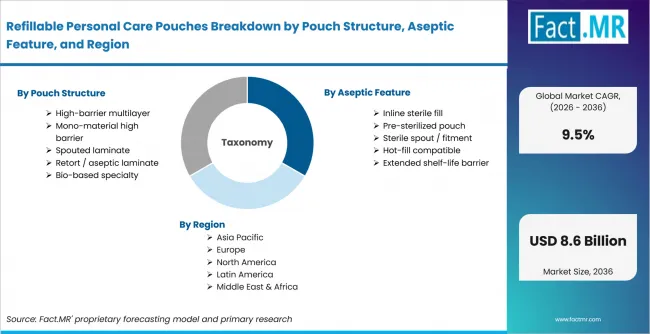
Refillable Personal Care Pouches Breakdown By Pouch Structure, Aseptic Feature, And Region | Source: Fact.MR
| Attribute | Details |
|---|---|
| Quantitative Units | USD billion |
| Market Definition | Flexible refill pouches used to replenish personal care products into a reusable or retained primary container. The scope covers pouch films, fitments and pack formats intended for repeat personal care purchase cycles. |
| Pouch Structure | High-barrier multilayer; Mono-material high barrier; Spouted laminate; Recyclable PE laminate; Bio-based specialty |
| Refill Feature | Spout and fitment system; Tamper-evident cap; No-spill closure; Easy-pour spout; Reclosable screw cap |
| Application | Hair care; Liquid soap and hand wash; Body wash and shower; Skin care; Other personal care |
| Fill Volume | <150 mL; 150-250 mL; 251-500 mL; 501 mL-1 L; >1 L |
| Regions Covered | North America; Latin America; Western Europe; Eastern Europe; East Asia; South Asia & Pacific; Middle East & Africa |
| Countries Covered | United States; China; Germany; Japan; France |
| Key Companies Profiled | SIG; Gualapack; Amcor; ProAmpac; Mondi |
| Forecast Period | 2026 to 2036 |
| Approach | Hybrid top-down and bottom-up approach using personal care refill applications, pouch format participation, segment shares, country growth and provider portfolio review. |
Source: Fact.MR analysis. Updated Sep 28, 2026
How is the market segmented?
-
By Pouch Structure:
- High-barrier multilayer
- Mono-film high barrier
- Spouted laminate
- Recyclable PE laminate
- Bio-based specialty
-
By Refill Feature:
- Spout and fitment system
- Tamper-evident cap
- No-spill closure
- Easy-pour spout
- Reclosable screw cap
-
By Use:
- Hair care
- Liquid soap and hand wash
- Body wash and shower
- Skin care
- Other personal care
-
By Fill Volume:
- <150 mL
- 150-250 mL
- 251-500 mL
- 501 mL-1 L
- >1 L
-
By Region:
- North America
- Latin America
- Western Europe
- Eastern Europe
- East Asia
- South Asia & Pacific
- Middle East & Africa
Frequently Asked Questions
How big is the Refillable Personal Care Pouches Market in 2026?
What is the CAGR of the Refillable Personal Care Pouches Market from 2026 to 2036?
Which pouch structure leads the Refillable Personal Care Pouches Market?
Which refill feature leads the Refillable Personal Care Pouches Market?
Who are the leading companies in the Refillable Personal Care Pouches Market?
Who worked on this report


Preview the report firsthand - request a free sample
Free SampleGet the brochure for pricing and purchase details
Download PDF