- Market Value (2025): USD 100.9 Mn
- Estimated Value (2026): USD 110.0 Mn
- Forecast Value (2036): USD 260.4 Mn
- CAGR (2026-2036): 9.0%
Bolus Delivery Nutrition Systems Market Forecast and Outlook 2026 to 2036
Fact.MR studies the bolus delivery nutrition systems market surpassed a value of USD 100.9 million in 2025 and is projected to grow from USD 110.0 million in 2026 to USD 260.4 million by 2036. Demand for bolus delivery nutrition systems is likely to grow at a CAGR of 9.0% over the forecast period.
Demand for bolus delivery nutrition systems is rising as more tube-fed patients receive meals as separate portions several times a day instead of continuous pump feeding, because bolus feeding fits daily life, frees patients from equipment and resembles normal eating. The key company players of bolus delivery nutrition systems are offering gravity bolus sets, enteral syringes and syringe kits with ENFit connectors, closed-system bolus packs and portable accessories for use at home. For example, in June 2026, ASPEN issued a recommendation on managing a shortage of enteral gravity and pump feeding sets. Similar supply attention is projected to drive sales of bolus delivery nutrition systems.
Key Takeaways from the Bolus Delivery Nutrition Systems Market
- Bolus Delivery Nutrition Systems Market Value (2025): USD 100.9 million
- Bolus Delivery Nutrition Systems Market Value (2026): USD 110.0 million
- Bolus Delivery Nutrition Systems Market Forecast Value (2036): USD 260.4 million
- Bolus Delivery Nutrition Systems Market Forecast CAGR (2026-2036): 9.0%
- Leading Product Type: Gravity bolus set (24.8%)
- Key Market Participants: Cardinal Health, Avanos Medical, Fresenius Kabi, B. Braun, Vygon, Nestlé Health Science
- Key Growth Regions: United States, Netherlands, Japan, France, United Kingdom
In October 2026, the Global Leadership Initiative on Indications for Nutritional Therapy and Support (GLINTS) published a consensus report recommending enteral tube feeding when oral intake cannot meet at least 50% of estimated nutritional requirements, while maintaining oral intake wherever safe and feasible. This reinforces the importance of appropriate enteral feeding options across hospital and community settings. Manufacturing companies of bolus delivery nutrition systems are developing user-friendly syringes, connectors and feeding accessories to simplify administration for patients and caregivers. Similar shifts toward home-based nutritional care is projected to support market growth. Demand for bolus delivery nutrition systems is increasing as home enteral nutrition expands and patients seek greater flexibility in feeding routines.
Bolus Delivery Nutrition Systems Market
| Metric | Value |
|---|---|
| Estimated Value in (2026) | USD 110.0 million |
| Forecast Value in (2036) | USD 260.4 million |
| Forecast CAGR (2026 to 2036) | 9.0% |
Source: Fact.MR analysis. Updated Nov 23, 2026
Source: Fact.MR analysis.
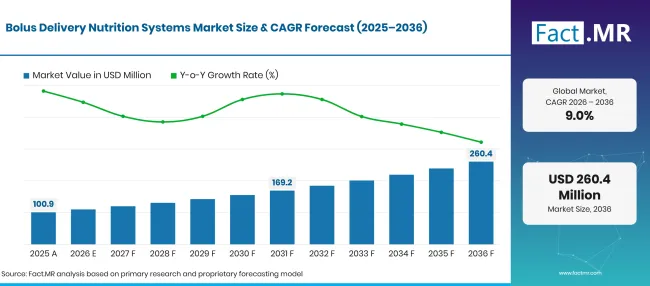
Bolus Delivery Nutrition Systems Forecast Global | Source: Fact.MR
Category
| Category | Segments |
|---|---|
| Product Type | Gravity bolus set, Syringe bolus kit, Closed-system bolus, Portable bolus accessory, Pump-assisted bolus set |
| Patient Group | Adult, Pediatric, Neonatal, Geriatric, Critical care |
| Clinical Use | Acute care, Specialty and rare condition, Nutrition support, Long-term management, Preventive care |
| Purchasing Channel | Pharmacy, Medical nutrition OEM, Hospital, Specialty clinic, Home and community |
| Region | United States; Netherlands; Japan; France; United Kingdom |
Source: Fact.MR analysis. Updated Nov 23, 2026
Source: Fact.MR analysis.
Segmental Analysis
Why do gravity bolus sets lead product demand in the Bolus Delivery Nutrition Systems Market?
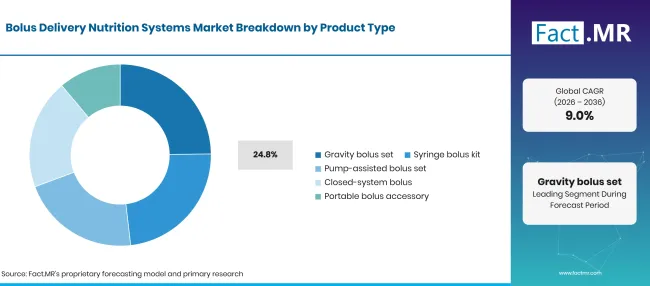
Bolus Delivery Nutrition Systems Breakdown Product Type | Source: Fact.MR
Demand for gravity bolus sets account for 24.8% of the bolus delivery nutrition systems market in 2026, about USD 27.3 million, because a bag or bottle with a roller clamp delivers a meal in fifteen to thirty minutes without a pump, power or programming, and each set is replaced daily. This makes it the lowest-cost routine method. Manufacturing companies of bolus delivery nutrition systems are adding ENFit connectors and anti-free-flow features. Bolus feeding can be administered using a syringe or gravity feeding set, with the flow adjusted to the patient's tolerance. A UK survey across 10 centers found that 41% of adult bolus-fed patients used gravity feeding, compared with 51% using syringes and 8% using pumps. This demonstrates the established role of gravity-based administration in home tube feeding.
How are adults leading patient demand in the Bolus Delivery Nutrition Systems Market?
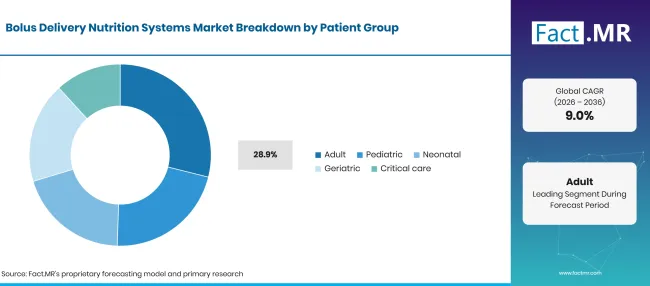
Bolus Delivery Nutrition Systems Breakdown Patient Group | Source: Fact.MR
Adults segment leads with 28.9% of bolus delivery nutrition systems revenue in 2026, about USD 31.8 million, because adults with stroke, neurological disease and head and neck cancer are the largest group of home tube-fed patients and usually tolerate larger feed volumes given as boluses. Many manage their own feeds. The companies manufacturing bolus delivery nutrition systems are making sets easier to handle with weak hands. Similar patient numbers are projected to keep adults the leading patient group. A nationwide Polish study covering 4,586 adult home enteral nutrition patients found that neurological diseases accounted for 54.5% of cases, while cancer represented 33.9%. Bolus administration was the most common feeding method, used by 74.4% of patients. The findings highlight the importance of adult neurological and cancer populations in supporting demand for bolus feeding equipment.
Why does acute care lead clinical demand in the Bolus Delivery Nutrition Systems Market?
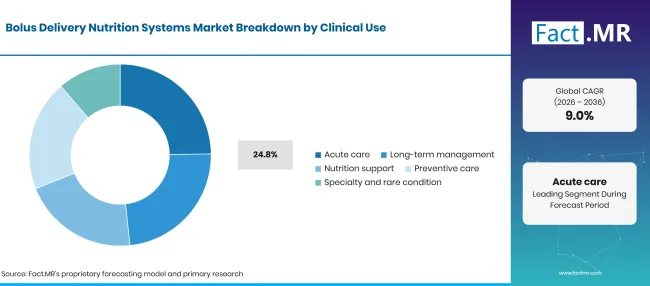
Bolus Delivery Nutrition Systems Breakdown Clinical Use | Source: Fact.MR
Sales of acute care holds 24.8% of bolus delivery nutrition systems revenue in 2026, about USD 27.3 million, as hospitals start tube feeding after surgery, stroke or critical illness and move stable patients from continuous to bolus feeding before discharge, using many single-use sets and syringes along the way. Turnover of supplies is high. According to the World Health Organization, disease-related malnutrition affects 30–50% of hospitalized patients, while its prevalence reaches 38–78% among intensive-care patients. Additionally, around 40% of inpatients experience unintended weight loss, highlighting the need for nutritional interventions during hospital treatment. These clinical needs support demand for enteral nutrition products in acute-care settings, including bolus feeding systems where clinically appropriate.
How are pharmacies leading channel demand in the Bolus Delivery Nutrition Systems Market?
Bolus Delivery Nutrition Systems Breakdown Purchasing Channel | Source: Fact.MR
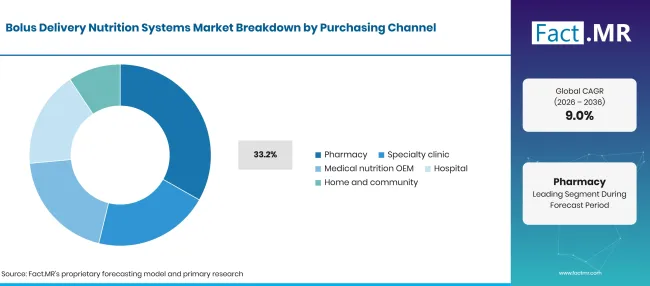
Pharmacies account for 33.2% of bolus delivery nutrition systems revenue in 2026, about USD 36.5 million, because home patients collect or receive monthly supplies of sets, syringes and extension tubes through retail, mail-order and homecare pharmacies under prescription. Repeat orders are regular. Manufacturers of bolus delivery nutrition systems are working with pharmacy and homecare distributors, as in the wider enteral feeding formulas market. An October 2025 NHS North East London guidance note confirms that patients can nominate either a community pharmacy or homecare service pharmacy to dispense their prescribed enteral tube feeds. It also identifies repeat prescriptions and coordination between prescribers, pharmacists and homecare providers as important parts of supply management. This established dispensing pathway supports pharmacy participation in the distribution of enteral nutrition products and related consumables.
Bolus Delivery Nutrition Systems Market-Drivers, Restraints & Trends
Drivers:
Demand for bolus delivery nutrition systems is rising as populations age and more people live at home with feeding tubes. For example, Japan's internal affairs ministry reported in September 2026 that residents aged 65 and over reached a record 36.24 million, or 29.6% of the population. Suppliers of bolus delivery nutrition systems are developing products for older carers. Similar demographic change is projected to drive sales of bolus delivery nutrition systems.
Restraints:
Sales of bolus delivery nutrition systems is constrained by supply disruptions, low reimbursement for disposables and the low price of basic syringes. For example, ASPEN's June 2026 guidance asked providers to conserve gravity and pump feeding sets during a shortage. Similar shortages are projected to limit sales in some periods. The companies manufacturing bolus delivery nutrition systems must build resilient manufacturing.
Opportunity: Closed and Ready-to-Use Bolus Packs
Demand for pre-filled bolus pouches that connect straight to the tube is rising because they cut contamination and preparation time. Manufacturers are pairing formulas with dedicated bolus adapters. Nestlé reported third-quarter 2026 organic growth of 4.0% in October. Similar convenience formats are projected to drive sales of bolus delivery nutrition systems, alongside the enteral medical nutrition market.
Trend: Blended and Plant-Based Feeds Through Bolus
In October 2026, a study in Clinical Nutrition ESPEN noted growing use of food-based formulas for children with medical complexity. Demand for wide-bore sets and syringes that handle thicker feeds is rising. Similar feeding choices are projected to drive sales of bolus delivery nutrition systems. The manufacturing companies of bolus delivery nutrition systems are following the clinical nutrition market.
Bolus Delivery Nutrition Systems Market by Analysis by Key Country
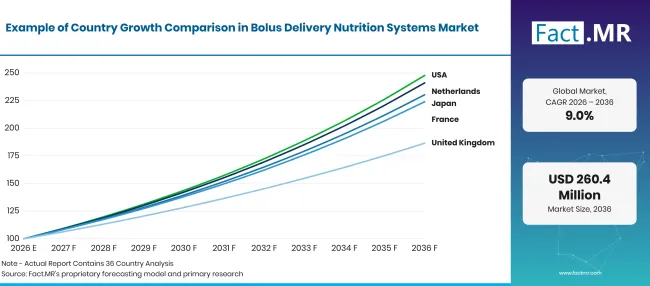
Bolus Delivery Nutrition Systems Growth Index | Source: Fact.MR
| Country | CAGR (2026-2036) |
|---|---|
| United States | 9.5% |
| Netherlands | 9.2% |
| Japan | 8.7% |
| France | 8.4% |
| United Kingdom | 6.4% |
Source: Fact.MR analysis. Updated Nov 23, 2026
Source: Fact.MR analysis.
What is driving bolus delivery nutrition systems demand in the United States?
In June 2026, ASPEN published shortage management recommendations for enteral feeding sets, reflecting how many U.S. patients rely on them at home.
Bolus Delivery Nutrition Systems Forecast Usa | Source: Fact.MR
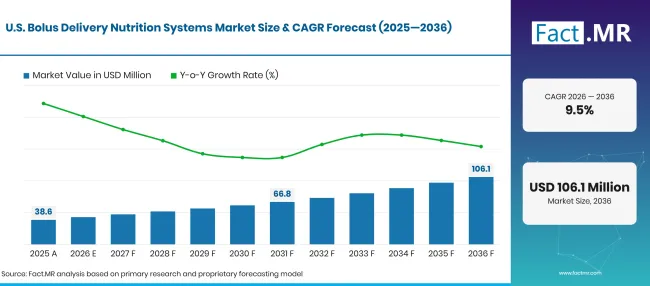
Demand for bolus delivery nutrition systems in the United States is anticipated to record a 9.5% CAGR, the fastest among the five key countries, as home enteral nutrition expands and patients prefer pump-free feeding. Suppliers of bolus delivery nutrition systems, including Cardinal Health and Avanos Medical, are serving home medical equipment providers. Similar home care growth is projected to drive sales in the United States.
How is medical nutrition leadership supporting bolus delivery nutrition systems sales in the Netherlands?
Sales of bolus delivery nutrition systems in the Netherlands are anticipated to record a 9.2% CAGR through 2036, supported by established home enteral nutrition services and strong medical nutrition capabilities.
Danone Nutricia operates its global Research and Innovation Centre in Utrecht, where specialists develop nutritional solutions for patients with specific medical requirements. The country's established network of hospitals, dietitians and homecare providers supports the transition from hospital-based feeding to community care. Manufacturing companies of bolus delivery nutrition systems are focusing on compatible syringes, connectors and feeding accessories to simplify administration. Growing demand for coordinated home nutrition services is expected to support market expansion.
What is shaping bolus delivery nutrition systems demand in Japan?
Demand for bolus delivery nutrition systems in Japan is estimated to increase at an 8.7% CAGR through 2036, supported by population aging and established practices in semi-solid enteral nutrition.
Adults aged 65 and above accounted for a record 29.6% of Japan's population in September 2026, increasing the need for long-term nutritional support. A July 2026 study published in Nutrients examined home semi-solid enteral nutrition among 3,105 patients, with an average age of 79.4 years. These findings highlight the importance of home-based feeding management. Suppliers are developing syringes, connectors and administration accessories compatible with semi-solid and thickened formulas to support elderly care.
How is home care shaping bolus delivery nutrition systems sales in France?
Sales of bolus delivery nutrition systems in France are anticipated to increase at an 8.4% CAGR through 2036, supported by established home enteral nutrition services and reimbursement-supported medical equipment provision.
French homecare providers coordinate feed deliveries, supply administration equipment and train patients and caregivers to manage prescribed feeding routines. Companies such as Vygon supply enteral administration devices, including syringes and feeding accessories, for hospital and community healthcare applications. These services help patients continue nutritional treatment after hospital discharge while maintaining clinical supervision. Manufacturers of bolus delivery nutrition systems are focusing on reliable connections, ease of handling and compatibility with enteral feeding tubes. Expansion of community-based nutritional care is expected to support demand.
Why is growth slower for bolus delivery nutrition systems in the United Kingdom?
Demand for bolus delivery nutrition systems in the United Kingdom is projected to grow at a 6.4% CAGR through 2036, reflecting established home enteral feeding services and cost-conscious procurement practices.
NHS integrated care boards use local prescribing policies and homecare contracts to manage the supply of nutritional feeds, syringes and administration equipment. For example, Norfolk and Waveney ICB's home enteral feeding policy outlines arrangements for feed prescriptions, equipment delivery and supply through contracted providers. NICE guidance also requires individualized feeding plans, caregiver training and multidisciplinary monitoring. Suppliers therefore compete on product compatibility, reliability and contract value rather than convenience alone. These procurement requirements are expected to moderate market growth.
Competitive Landscape for Bolus Delivery Nutrition Systems Market
Competition in the bolus delivery nutrition systems market involves medical device suppliers and nutrition companies. Cardinal Health and Avanos Medical compete with enteral feeding sets, syringes and tubes in North America, Fresenius Kabi and B. Braun compete with enteral delivery systems tied to their nutrition ranges, Vygon competes with neonatal and pediatric enteral devices, and Nestlé Health Science competes with formulas and matching delivery accessories. Buyers select bolus delivery nutrition systems on connector compatibility, ease of use, safety, supply reliability and price.
From 2025 onward, competition shifted toward supply security and home-friendly designs. ASPEN issued shortage guidance for feeding sets in 2026, clinical consensus reaffirmed tube feeding, and aging populations grew. Suppliers that guarantee supply and simplify bolus feeding at home are best placed to grow.
Recent Developments
- In October 2026, a global clinical nutrition consensus report on nutritional therapy was published.
- In September 2026, Japan reported a record 29.6% of its population aged 65 and over.
- In August 2026, Danone Research & Innovation described new tube-feeding formulations.
- In June 2026, ASPEN issued shortage recommendations for enteral gravity and pump feeding sets.
Key Players in Bolus Delivery Nutrition Systems Market
Key companies operating in the market include Cardinal Health, Avanos Medical, Fresenius Kabi, B. Braun, Vygon, and Nestlé Health Science.
- Cardinal Health
- Avanos Medical
- Fresenius Kabi
- B. Braun
- Vygon
- Nestlé Health Science
Bibliography
- American Society for Parenteral and Enteral Nutrition. (2026). New ASPEN recommendations for enteral feeding set shortages: Enteral gravity and pump feeding set shortage management.
- Klek, S., Barazzoni, R., Blaauw, R., Burgos, R., Cardenas, D., Cederholm, T., Compher, C., et al. (2026). Global Leadership Initiative on Indications to Nutritional Therapy and Support (GLINTS): A consensus report from the global clinical nutrition community. Clinical Nutrition, 65, Article 106768. https://doi.org/10.1016/j.clnu.2026.106768
- Matsuoka, M., Shimaya, H., Iwanami, Y., & Iijima, S. (2026). Clinical reality and outcomes of home semi-solid enteral nutrition guidance and management using a medical claims database in Japan: A retrospective cohort study. Nutrients, 18(15), Article 2442. https://doi.org/10.3390/nu18152442
- Nestlé S.A. (2026, October 22). Third-quarter and nine-month 2026 sales.
- Ramuscak, A. V., Martincevic, I., Assad Assiri, H., Carrión Jaramillo, E. S., & Hulst, J. M. (2026). Gastrointestinal response and weight outcomes with a hypercaloric, plant- and food-based formula in pediatric tube-fed patients: A short-term exploratory study. Clinical Nutrition ESPEN, 75, Article 105010. https://doi.org/10.1016/j.clnesp.2026.105010
- Statistics Bureau of Japan. (2026, September 20). Statistical topics No. 149: Elderly people in Japan as seen through statistics.
- Statistics Bureau of Japan. (2026, September 24). Population estimates by age (five-year groups) and sex: September 1, 2026 provisional estimates.
- NHS Norfolk and Waveney Integrated Care Board. (2025, July). Home enteral feeds on prescription: ICB policy.
Segmentation
Scope of Report
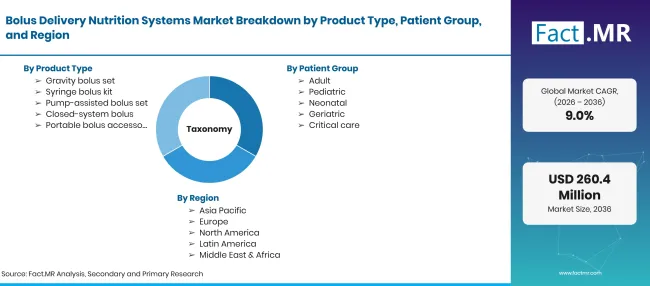
Bolus Delivery Nutrition Systems Taxonomy | Source: Fact.MR
| Items | Values |
|---|---|
| Quantitative Units (2026) | USD 110.0 Million |
| Product Type | Gravity bolus set, Syringe bolus kit, Closed-system bolus, Portable bolus accessory, Pump-assisted bolus set |
| Patient Group | Adult, Pediatric, Neonatal, Geriatric, Critical care |
| Clinical Use | Acute care, Specialty and rare condition, Nutrition support, Long-term management, Preventive care |
| Purchasing Channel | Pharmacy, Medical nutrition OEM, Hospital, Specialty clinic, Home and community |
| Regions Covered | North America, Latin America, Europe, East Asia, South Asia and Pacific, Middle East & Africa |
| Countries Covered | United States, Netherlands, Japan, France, United Kingdom, and other countries |
| Key Companies Profiled | Cardinal Health, Avanos Medical, Fresenius Kabi, B. Braun, Vygon, Nestlé Health Science |
| Additional Attributes | Dollar revenue in the Bolus Delivery Nutrition Systems Market is segmented by product type (gravity bolus set, syringe bolus kit, closed-system bolus, portable accessory, pump-assisted bolus set), patient group, clinical use, purchasing channel and region. |
Source: Fact.MR analysis. Updated Nov 23, 2026
Source: Fact.MR analysis.
Bolus Delivery Nutrition Systems Market by Segments
-
Product Type
- Gravity bolus set
- Syringe bolus kit
- Closed-system bolus
- Portable bolus accessory
- Pump-assisted bolus set
-
Patient Group
- Adult
- Pediatric
- Neonatal
- Geriatric
- Critical care
-
Clinical Use
- Acute care
- Specialty and rare condition
- Nutrition support
- Long-term management
- Preventive care
-
Purchasing Channel
- Pharmacy
- Medical nutrition OEM
- Hospital
- Specialty clinic
- Home and community
-
Region:
- North America
- United States
- Canada
- Mexico
- Europe
- Germany
- United Kingdom
- France
- Italy
- Spain
- Rest of Europe
- Asia Pacific
- China
- India
- Japan
- South Korea
- Australia
- Rest of Asia Pacific
- Latin America
- Brazil
- Mexico
- Argentina
- Rest of Latin America
- Middle East & Africa
- GCC Countries
- South Africa
- Rest of Middle East & Africa
- North America
Frequently Asked Questions
How big is the global Bolus Delivery Nutrition Systems Market in 2026?
What will be the size of the Bolus Delivery Nutrition Systems Market by 2036?
How fast will the Bolus Delivery Nutrition Systems Market grow during the forecast period?
Which product type segment holds the largest share of the Bolus Delivery Nutrition Systems Market?
Who worked on this report


Preview the report firsthand - request a free sample
Free SampleGet the brochure for pricing and purchase details
Download PDF