- Market Value (2025): USD 55.1 Mn
- Estimated Value (2026): USD 60.0 Mn
- Forecast Value (2036): USD 139.5 Mn
- CAGR (2026-2036): 8.8%
Plant-Based Tube-Feeding Formulas Market Forecast and Outlook 2026 to 2036
According to the Fact.MR analysis, the plant-based tube-feeding formulas market was valued at USD 55.1 million in 2025 and is projected to grow from USD 60.0 million in 2026 to USD 139.5 million by 2036. Demand for plant-based tube-feeding formulas is likely to grow at a CAGR of 8.8% over the forecast period.
Demand for plant-based tube-feeding formulas is rising as patients who depend on enteral nutrition, and the dietitians who care for them, look for nutritionally complete feeds based on pea, soy and other plant proteins that avoid dairy allergens and may be better tolerated than standard casein-based formulas. Manufacturers of plant-based tube-feeding formulas are offering ready-to-hang liquids with mixed plant proteins, added fiber and high calorie density for adults and children. For example, in August 2026, Danone Research & Innovation described a new enteral blend composed mostly of soy and pea protein. Similar product development is projected to drive sales of plant-based tube-feeding formulas.
Key Takeaways from the Plant-Based Tube-Feeding Formulas Market
- Plant-Based Tube-Feeding Formulas Market Value (2025): USD 55.1 million
- Plant-Based Tube-Feeding Formulas Market Value (2026): USD 60.0 million
- Plant-Based Tube-Feeding Formulas Market Forecast Value (2036): USD 139.5 million
- Plant-Based Tube-Feeding Formulas Market Forecast CAGR (2026-2036): 8.8%
- Leading Product Type: Mixed plant-protein formula (29.1%)
- Key Market Participants: Nestlé Health Science, Abbott, Danone Nutricia, Fresenius Kabi, Kate Farms
- Key Growth Regions: Denmark, United States, Japan, United Kingdom, Germany
In September 2026, a study published in the European Journal of Clinical Nutrition reported on gastrointestinal tolerance and compliance in community-based adults who switched to tube feeds reformulated with a plant-dominant protein blend for two weeks. Demand for plant-based tube-feeding formulas is growing as clinical evidence accumulates and removes a main barrier to prescribing. Manufacturing companies of plant-based tube-feeding formulas are funding tolerance and outcome studies. Similar evidence is projected to drive sales of plant-based tube-feeding formulas across Europe, North America and Japan.
Plant-Based Tube-Feeding Formulas Market
| Metric | Value |
|---|---|
| Estimated Value in (2026) | USD 60.0 million |
| Forecast Value in (2036) | USD 139.5 million |
| Forecast CAGR (2026 to 2036) | 8.8% |
Source: Fact.MR analysis. Updated Nov 23, 2026
Source: Fact.MR analysis.
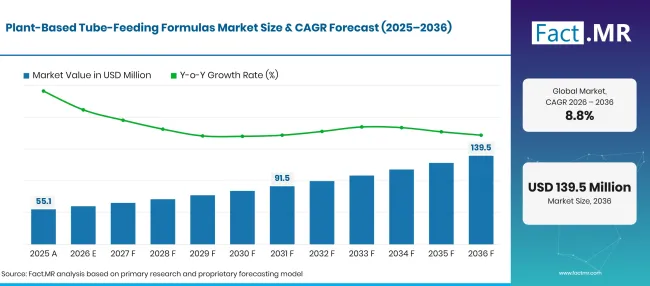
Plant Based Tube Feeding Formulas Forecast Global | Source: Fact.MR
Category
| Category | Segments |
|---|---|
| Product Type | Mixed plant-protein formula, Soy-based enteral formula, High-calorie plant formula, Fiber-enriched plant formula, Pea-based enteral formula |
| Delivery Form | Liquid, Medical device and system, Powder, Tablet and capsule, Specialty controlled-release |
| Clinical Use | Long-term management, Acute care, Specialty and rare condition, Preventive care, Nutrition support |
| Purchasing Channel | Specialty clinic, Pharmacy, Home and community, Medical nutrition OEM, Hospital |
| Region | Denmark; United States; Japan; United Kingdom; Germany |
Source: Fact.MR analysis. Updated Nov 23, 2026
Source: Fact.MR analysis.
Segmental Analysis
Why do mixed plant-protein formulas lead product demand in the Plant-Based Tube-Feeding Formulas Market?
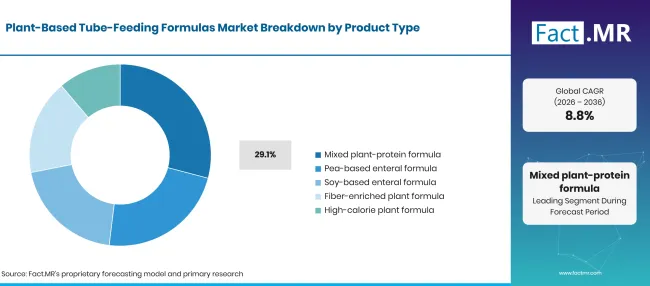
Plant Based Tube Feeding Formulas Breakdown Product Type | Source: Fact.MR
Demand for mixed plant-protein formulas account for 29.1% of the plant-based tube-feeding formulas market in 2026, about USD 17.5 million, because combining pea, soy and other proteins balances the amino acid profile so that the feed meets protein quality requirements as a sole source of nutrition. Blends also flow well through narrow tubes. The key company players of plant-based tube-feeding formulas are optimizing blends for digestibility. Similar nutritional completeness is projected to keep mixed plant-protein formulas the leading product type, supported by the plant protein ingredients market.
How is the liquid form leading demand in the Plant-Based Tube-Feeding Formulas Market?
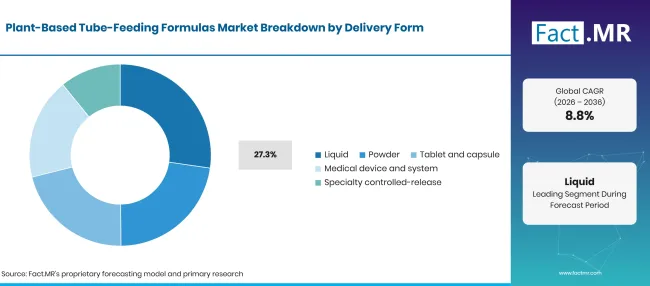
Plant Based Tube Feeding Formulas Breakdown Delivery Form | Source: Fact.MR
Sales of liquid formulas to represent 27.3% of plant-based tube-feeding formulas revenue in 2026, about USD 16.4 million, because sterile, ready-to-use liquids in cartons, pouches or closed-system bottles remove mixing errors and contamination risk and connect directly to feeding sets. Carers and nurses prefer them. Manufacturing companies of plant-based tube-feeding formulas are extending shelf life without separation. Similar safety and convenience are projected to keep liquid the leading delivery form.
Why does long-term management lead clinical demand in the Plant-Based Tube-Feeding Formulas Market?
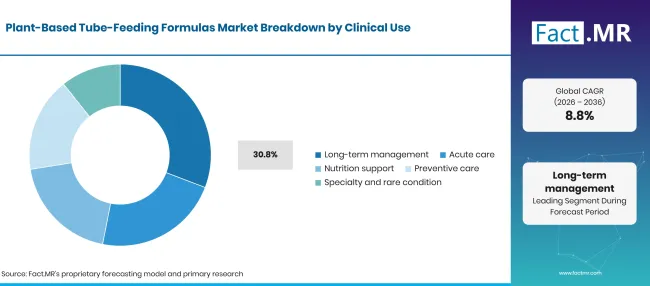
Plant Based Tube Feeding Formulas Breakdown Clinical Use | Source: Fact.MR
Demand for long-term management holds 30.8% of plant-based tube-feeding formulas revenue in 2026, about USD 18.5 million, as people with neurological conditions, head and neck cancer or swallowing disorders are tube fed for months or years, and tolerance, bowel function and personal food values matter most over such periods. Many ask for plant-based or food-based feeds. Manufacturers of plant-based tube-feeding formulas are serving home enteral nutrition patients. Similar chronic use is projected to keep long-term management the leading clinical use.
How are specialty clinics leading channel demand in the Plant-Based Tube-Feeding Formulas Market?
Plant Based Tube Feeding Formulas Breakdown Purchasing Channel | Source: Fact.MR
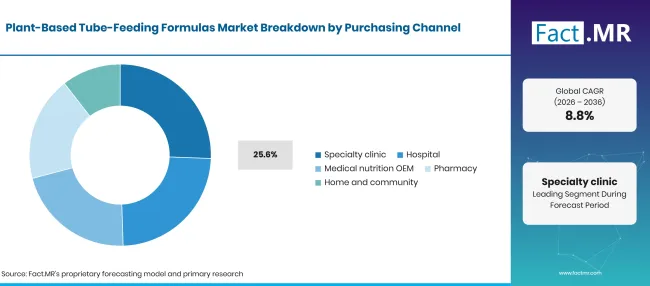
Specialty clinics segment account for 25.6% of plant-based tube-feeding formulas revenue in 2026, about USD 15.4 million, because gastroenterology, pediatric complex-care and nutrition support clinics start patients on specialized formulas and manage follow-up, which shapes what is supplied at home. Dietitians there are early adopters. Suppliers of plant-based tube-feeding formulas are educating clinic teams, within the wider enteral feeding formulas market. Similar prescribing patterns are projected to keep specialty clinics the leading purchasing channel.
Plant-Based Tube-Feeding Formulas Market-Drivers, Restraints & Trends
Drivers:
Demand for plant-based tube-feeding formulas is rising as research in children and adults supports plant- and food-based feeds. For example, in October 2026, Clinical Nutrition ESPEN published an exploratory study of gastrointestinal response and weight outcomes with a hypercaloric, plant- and food-based formula in pediatric tube-fed patients, noting that food-based formulas are increasingly used for children with medical complexity. Manufacturers of plant-based tube-feeding formulas are extending ranges for pediatric use. Similar studies are projected to drive sales of plant-based tube-feeding formulas.
Restraints:
Demand for plant-based tube-feeding formulas is constrained by reimbursement limits, higher prices than standard formulas and pressure on specialized nutrition businesses. For example, Danone said in October 2026 that its Specialized Nutrition division remained under pressure, and Abbott announced plans to separate its nutrition business. Similar business uncertainty is projected to slow some launches. Manufacturing company of plant-based tube-feeding formulas must show clinical and economic value to payers.
Opportunity: Food-Based and Organic Formulas
Demand for feeds made with recognizable food ingredients is rising among home enteral patients and parents. Suppliers are launching organic, plant-based and blended-food products. A global clinical nutrition consensus published in October 2026 reaffirmed tube feeding where oral intake is insufficient. Similar preferences are projected to drive sales of plant-based tube-feeding formulas in the enteral medical nutrition market.
Trend: Plant Proteins for Sustainability Goals
In November 2026, dsm-firmenich reported 5% organic growth in its Health, Nutrition & Care unit for the third quarter. Demand for medical nutrition with a lower environmental footprint is rising as health systems set carbon targets. Similar goals are projected to support sales of plant-based tube-feeding formulas. Suppliers of plant-based tube-feeding formulas are sourcing ingredients such as high-solubility protein isolates.
Plant-Based Tube-Feeding Formulas Market by Analysis by Key Country
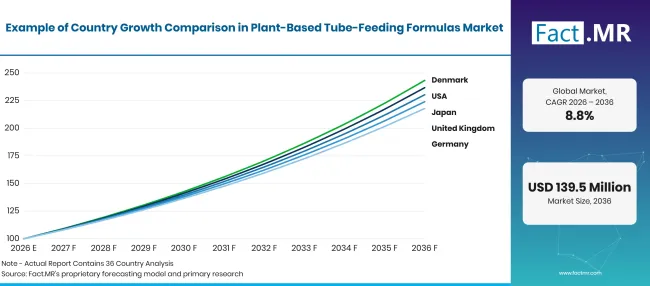
Plant Based Tube Feeding Formulas Growth Index | Source: Fact.MR
| Country | CAGR (2026-2036) |
|---|---|
| Denmark | 9.3% |
| United States | 9.0% |
| Japan | 8.7% |
| United Kingdom | 8.4% |
| Germany | 8.1% |
Source: Fact.MR analysis. Updated Nov 23, 2026
Source: Fact.MR analysis.
What is driving plant-based tube-feeding formulas demand in Denmark?
In 2026, Danish ingredient groups continued to invest in specialized nutrition, with Arla Foods Ingredients upgrading its Danmark Protein site in August, and Danish hospitals follow national sustainability goals for food and medical supplies.
Demand for plant-based tube-feeding formulas in Denmark is projected to grow at a 9.3% CAGR, the fastest among the five key countries, as public procurement favors plant-forward options and home enteral care is well organized. Suppliers of plant-based tube-feeding formulas are serving Danish regions. Similar policy is projected to drive sales in Denmark.
How is patient choice supporting plant-based tube-feeding formulas sales in the United States?
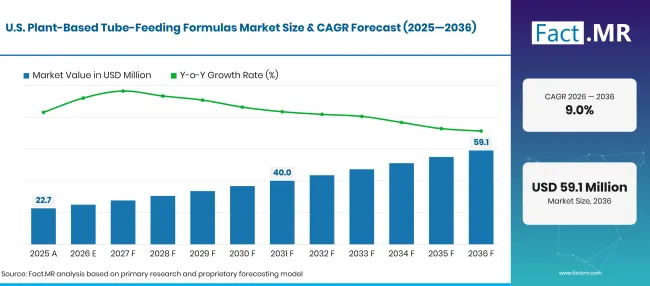
Sales of plant-based tube-feeding formulas in the United States are projected to expand at a 9.0% CAGR through 2036, supported by growing demand for nutrition products that accommodate individual dietary preferences and tolerability needs.
Plant Based Tube Feeding Formulas Forecast Usa | Source: Fact.MR
Families and healthcare professionals are increasingly considering plant-based enteral nutrition for patients who prefer dairy-free formulations or experience difficulties with conventional feeds. Kate Farms, a pioneer in organic plant-based enteral nutrition, has expanded insurance coverage to improve patient access to its products. Additionally, ASPEN issued guidance on feeding set shortages in June 2026, highlighting the importance of reliable supplies for home enteral nutrition. Manufacturers of plant-based tube-feeding formulas are strengthening distribution networks and working with healthcare providers to improve product accessibility. Growing acceptance of home-based nutritional support is expected to sustain demand across the United States.
What is shaping plant-based tube-feeding formulas demand in Japan?
Demand for plant-based tube-feeding formulas in Japan is projected to increase at an 8.7% CAGR through 2036, supported by population aging and the growing need for long-term nutritional management.
According to Japan's Ministry of Internal Affairs and Communications, adults aged 65 and older accounted for a record 29.6% of the population in September 2026, representing approximately 36.24 million people. This demographic shift is increasing demand for specialized nutritional products used in hospitals, nursing facilities and home-care settings. Soy-based formulations offer opportunities for manufacturers to develop plant-based enteral products that accommodate familiar dietary ingredients and specific patient requirements. Suppliers of plant-based tube-feeding formulas are focusing on improving nutritional completeness, digestibility and formulation compatibility for older patients. Continued expansion of elderly care services is expected to support market growth in Japan.
How is community care shaping plant-based tube-feeding formulas sales in the United Kingdom?
Sales of plant-based tube-feeding formulas in the United Kingdom are projected to grow at an 8.4% CAGR through 2036, supported by the expansion of community-based nutritional care and increasing attention to patient preferences.
Home enteral nutrition services are creating opportunities for formulas that accommodate individual dietary requirements while providing adequate protein, energy and micronutrients. A September 2026 tolerance study involving plant-dominant tube feeds in community-based adults receiving long-term nutritional support is adding clinical evidence to this emerging category. Such research can help dietitians assess gastrointestinal tolerance and the suitability of plant-based formulations for patients requiring ongoing tube feeding. Manufacturers of plant-based tube-feeding formulas are strengthening engagement with NHS dietitians and homecare providers to improve product adoption. Growing emphasis on personalized nutritional support is expected to encourage demand across the United Kingdom.
Why is growth slower for plant-based tube-feeding formulas in Germany?
Demand for plant-based tube-feeding formulas in Germany is projected to increase at a relatively moderate 8.1% CAGR through 2036, reflecting established hospital procurement practices and price sensitivity within clinical nutrition.
Conventional dairy-based enteral formulas from established suppliers remain widely integrated into hospital protocols, long-term care facilities and reimbursement arrangements, making product substitution more gradual. Although Germany has Europe's largest plant-based retail food market, consumer acceptance of plant-based foods does not automatically translate into equivalent adoption within medically supervised tube-feeding applications. Healthcare providers prioritize clinical suitability, nutritional completeness, product tolerance and cost when selecting enteral formulas. Suppliers of plant-based tube-feeding formulas, including Fresenius Kabi, are positioned to address emerging demand through specialized nutritional offerings. However, reimbursement considerations, established supplier relationships and clinical evaluation requirements are expected to moderate adoption rates in Germany.
Competitive Landscape for Plant-Based Tube-Feeding Formulas Market
Competition in the plant-based tube-feeding formulas market involves the major medical nutrition companies and a plant-based specialist. Nestlé Health Science, Abbott, Danone Nutricia and Fresenius Kabi compete with plant-based additions to broad enteral ranges and with strong hospital contracts, while Kate Farms competes as the organic plant-based pioneer in the United States. Buyers select plant-based tube-feeding formulas on nutritional completeness, tolerance evidence, reimbursement status, packaging system and price.
From 2025 onward, competition shifted toward clinical evidence. Danone described a soy and pea protein enteral blend in 2026, tolerance studies in adults and children were published, and Abbott announced a nutrition spin-off. Manufacturers that back plant-based feeds with trial data and secure reimbursement are best placed to grow.
Recent Developments
- In October 2026, Abbott announced plans to separate its nutrition business into a public company.
- In October 2026, Clinical Nutrition ESPEN published a study of a plant- and food-based formula in tube-fed children.
- In September 2026, a tolerance study of plant-dominant tube feeds in adults was published.
- In August 2026, Danone Research & Innovation described a tube-feeding blend based mostly on soy and pea protein.
Key Players in Plant-Based Tube-Feeding Formulas Market
Key companies operating in the market include Nestlé Health Science, Abbott, Danone Nutricia, Fresenius Kabi, and Kate Farms.
- Nestlé Health Science
- Abbott
- Danone Nutricia
- Fresenius Kabi
- Kate Farms
Bibliography
- Abbott. (2026, October 21). Abbott announces its intention to separate its global Nutrition business into an independent, publicly traded company.
- American Society for Parenteral and Enteral Nutrition. (2026). 2026 enteral nutrition shortage recommendation: Enteral gravity and pump feeding set shortage management.
- Danone. (2026, October 28). 2026 third quarter sales: Solid performance in Q3; Broad-based growth across categories and geographies.
- Danone Research & Innovation. (2026). Improving enteral nutrition with plant-dominant protein formulas.
- dsm-firmenich. (2026, November). Q3 2026 trading update.
- Fresenius Kabi. (2026, March 18). Innovating in plant-based nutrition.
- Nestlé. (2026, November 12). Nestlé helps simplify tube feeding with new Compleat Bolus Blends.
- Ramuscak, A. V., Martincevic, I., Assiri, H. A., Carrión Jaramillo, E. S., & Hulst, J. M. (2026). Gastrointestinal response and weight outcomes with a hypercaloric, plant- and food-based formula in pediatric tube-fed patients: A short-term exploratory study. Clinical Nutrition ESPEN, 75, 105010.
- Speed, J. (2026, September 21). Japan's elderly population grows to its largest share yet. The Japan Times.
- van den Berg, C. A., van Eijnatten, E. J. M., Top, P., Wojcik, P., Csomor, J., Sels, J., & colleagues. (2026). Gastrointestinal tolerance and compliance during a 2-week intervention of reformulated tube feeds with a plant-dominant protein blend in community-based adult patients on long-term nutritional support. European Journal of Clinical Nutrition.
- van den Berg, C. A., et al. (2025). Plant protein dominant enteral nutrition, containing soy and pea, is non-coagulating after gastric digestion in contrast to casein dominant enteral nutrition. Food Research International.
Segmentation
Scope of Report
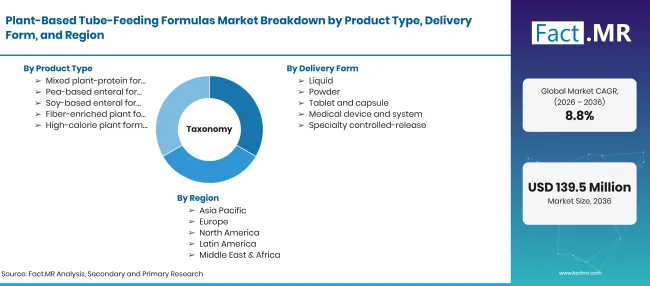
Plant Based Tube Feeding Formulas Taxonomy | Source: Fact.MR
| Items | Values |
|---|---|
| Quantitative Units (2026) | USD 60.0 Million |
| Product Type | Mixed plant-protein formula, Soy-based enteral formula, High-calorie plant formula, Fiber-enriched plant formula, Pea-based enteral formula |
| Delivery Form | Liquid, Medical device and system, Powder, Tablet and capsule, Specialty controlled-release |
| Clinical Use | Long-term management, Acute care, Specialty and rare condition, Preventive care, Nutrition support |
| Purchasing Channel | Specialty clinic, Pharmacy, Home and community, Medical nutrition OEM, Hospital |
| Regions Covered | North America, Latin America, Europe, East Asia, South Asia and Pacific, Middle East & Africa |
| Countries Covered | Denmark, United States, Japan, United Kingdom, Germany, and other countries |
| Key Companies Profiled | Nestlé Health Science, Abbott, Danone Nutricia, Fresenius Kabi, Kate Farms |
| Additional Attributes | Dollar revenue in the Plant-Based Tube-Feeding Formulas Market is segmented by product type (mixed plant-protein, soy-based, high-calorie, fiber-enriched, pea-based formula), delivery form, clinical use, purchasing channel and region. |
Source: Fact.MR analysis. Updated Nov 23, 2026
Source: Fact.MR analysis.
Plant-Based Tube-Feeding Formulas Market by Segments
-
Product Type
- Mixed plant-protein formula
- Soy-based enteral formula
- High-calorie plant formula
- Fiber-enriched plant formula
- Pea-based enteral formula
-
Delivery Form
- Liquid
- Medical device and system
- Powder
- Tablet and capsule
- Specialty controlled-release
-
Clinical Use
- Long-term management
- Acute care
- Specialty and rare condition
- Preventive care
- Nutrition support
-
Purchasing Channel
- Specialty clinic
- Pharmacy
- Home and community
- Medical nutrition OEM
- Hospital
-
Region:
- North America
- United States
- Canada
- Mexico
- Europe
- Germany
- United Kingdom
- France
- Italy
- Spain
- Rest of Europe
- Asia Pacific
- China
- India
- Japan
- South Korea
- Australia
- Rest of Asia Pacific
- Latin America
- Brazil
- Mexico
- Argentina
- Rest of Latin America
- Middle East & Africa
- GCC Countries
- South Africa
- Rest of Middle East & Africa
- North America
Frequently Asked Questions
How big is the global Plant-Based Tube-Feeding Formulas Market in 2026?
What will be the size of the Plant-Based Tube-Feeding Formulas Market by 2036?
How fast will the Plant-Based Tube-Feeding Formulas Market grow during the forecast period?
Which product type segment holds the largest share of the Plant-Based Tube-Feeding Formulas Market?
Who worked on this report


Preview the report firsthand - request a free sample
Free SampleGet the brochure for pricing and purchase details
Download PDF