- Market Value (2025): USD 1.2 Bn
- Estimated Value (2026): USD 1.3 Bn
- Forecast Value (2036): USD 2.5 Bn
- CAGR (2026-2036): 6.8%
What is the Buccal Fat Removal Market forecast to be worth by 2036?
USD 1.3 billion in 2026 to USD 2.5 billion by 2036 at 6.8% CAGR.
- The buccal fat removal market reached USD 1.2 billion in 2025.
- Demand is projected to increase from USD 1.3 billion in 2026 to USD 2.5 billion by 2036.
- The market is forecast to record 6.8% CAGR from 2026 to 2036 as procedure awareness and consultation-led screening support facial contouring decisions.
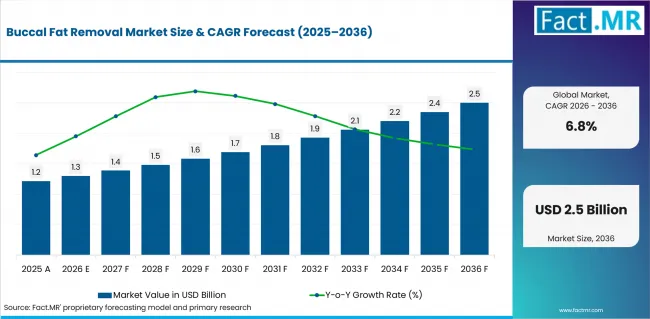
Buccal Fat Removal Market Value Analysis | Source: Fact.MR
What are the defining numbers behind Buccal Fat Removal Market growth?
USD 1.2 billion absolute opportunity is expected by 2036.
- Demand Drivers in the Market
- Traditional buccal fat excision is expected to remain the main procedure route when surgeons need controlled oral access for cheek-fat pad reduction.
- Facial slimming demand is anticipated to rise where patients seek sharper lower-cheek definition after a formal review of facial balance.
- Cosmetic surgery clinics are projected to retain a central role because this procedure needs trained assessment and planned recovery review.
- Key Segments Analyzed
- By Procedure Type: Traditional Buccal Fat Excision is projected to hold 37.0% share in 2026 because it remains the most recognized surgical pathway for cheek-fat pad reduction.
- By Application: Facial Slimming is expected to hold 32.5% share in 2026 as patient interest centers on lower-face definition and cheek contour refinement.
- By End User: Cosmetic Surgery Clinics are anticipated to account for 30.1% share in 2026 because trained surgical settings control screening and recovery review.
- By Distribution Channel: Direct Patient Consultation is estimated to represent 29.7% share in 2026 since suitability depends on face-to-face evaluation.
- By Gender: Female is forecast to hold 42.5% share in 2026 as aesthetic facial contouring demand remains concentrated among female patient groups.
- Analyst Opinion at Fact.MR
- Shambhu Nath Jha, Sr. Consultant at Fact.MR, opines, “Buccal fat removal demand depends on careful candidate selection more than procedure visibility. Clinics that explain facial aging and recovery limits are expected to build stronger patient trust than providers that market the procedure as a quick contouring shortcut.”
- Strategic Implications
- Clinic operators should treat buccal fat removal as a consultation-led service.
- Companies serving cosmetic clinics are expected to strengthen their case through surgeon education and recovery protocols.
- Investors should separate surgical facial contouring demand from broad beauty spending.
Germany is projected at 8.8% CAGR from 2026 to 2036. Brazil is expected to record 8.2% CAGR. Mexico is anticipated to reach 4.8% CAGR. The USA is estimated at 7.5% CAGR. Canada is forecast at 5.5% CAGR, followed by the UK at 6.8% CAGR and Japan at 6.1% CAGR during the same period.
How does the Buccal Fat Removal Market break down by segment?
Traditional Buccal Fat Excision is expected to lead Procedure Type at 37.0% share in 2026. Facial Slimming is projected to lead Application at 32.5% share in 2026.
Which procedure type dominates?
Traditional Buccal Fat Excision is projected to account for 37.0% share in 2026.
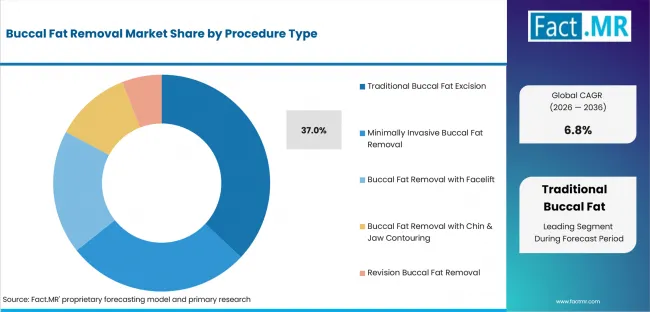
Buccal Fat Removal Market Analysis By Procedure Type | Source: Fact.MR
Traditional Buccal Fat Excision remains the standard route for targeted cheek-fat pad reduction. Other techniques serve conservative removal plans and combined contouring needs.
Why does Facial Slimming lead Application?
Facial Slimming is expected to account for 32.5% share in 2026.
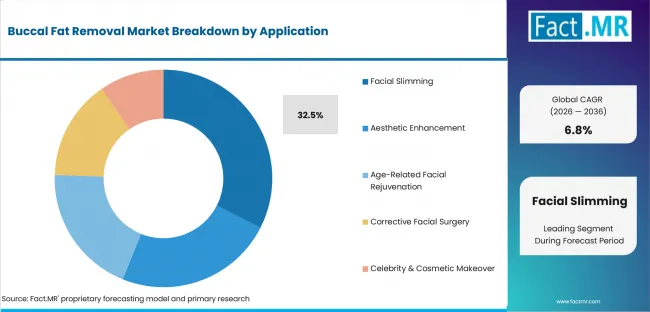
Buccal Fat Removal Market Analysis By Application | Source: Fact.MR
Facial Slimming leads when consultations begin with lower-cheek fullness. Cheek contouring and face reshaping support wider proportion goals.
Why do Cosmetic Surgery Clinics lead End User?
Cosmetic Surgery Clinics are anticipated to hold 30.1% share in 2026.
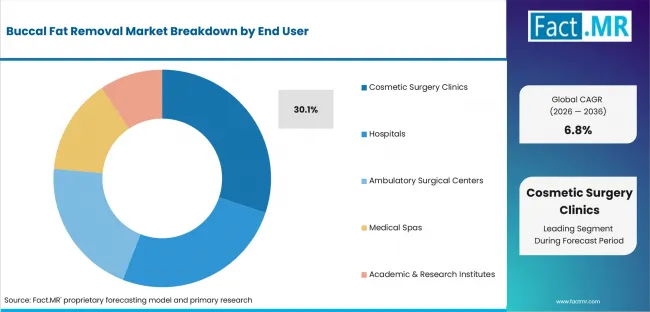
Buccal Fat Removal Market Analysis By End User | Source: Fact.MR
Cosmetic Surgery Clinics lead because the procedure needs trained assessment and recovery review. Hospitals remain involved when broader oversight is preferred.
Why does Direct Patient Consultation lead Distribution Channel?
Direct Patient Consultation is estimated to account for 29.7% share in 2026.
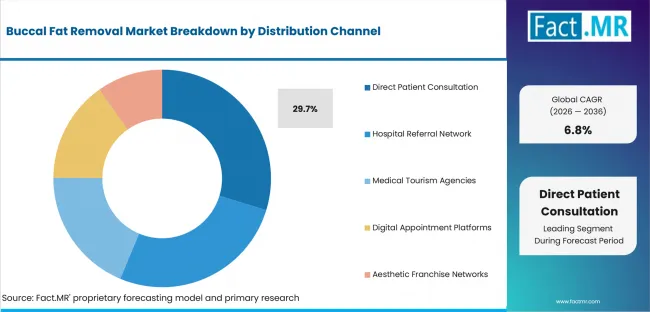
Buccal Fat Removal Market Analysis By Distribution Channel | Source: Fact.MR
Direct Patient Consultation leads because suitability cannot be judged through price inquiry alone. Referrals and clinic visits formalize the decision.
What supports Female within the Gender segment?
Female is forecast to hold 42.5% share in 2026.
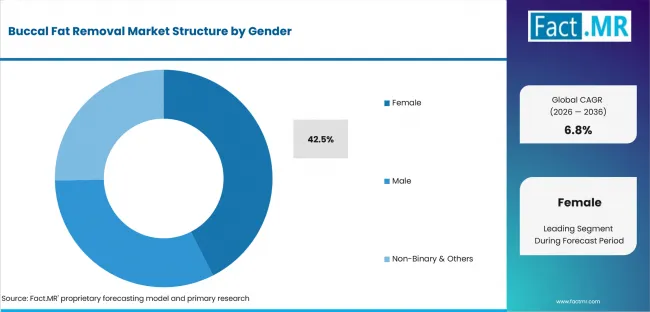
Buccal Fat Removal Market Analysis By Gender | Source: Fact.MR
Female demand leads the listed structure. Male and non-binary demand remain included when contouring supports personal cosmetic goals.
What is accelerating Buccal Fat Removal Market adoption, and what is holding it back?
Demand is expected to rise as more people choose clinic-based facial slimming and contouring treatments. Growth may be limited by concerns about treatment suitability and recovery time.
Drivers Impact Analysis
| DRIVER | (~) % IMPACT ON CAGR | GEOGRAPHIC RELEVANCE | IMPACT TIMELINE |
|---|---|---|---|
| Traditional buccal fat excision planning | +1.8% | Germany, USA, UK | Short term (<= 2 years) |
| Facial slimming consultations | +1.5% | Brazil, Mexico, Canada | Short term (<= 2 years) |
| Clinic-led patient screening | +1.2% | Germany, USA, Japan | Medium term (2-4 years) |
| Direct consultation channels | +0.9% | Brazil, Mexico, Canada | Medium term (2-4 years) |
| Combination facial contouring programs | +0.7% | UK, Germany, Brazil | Long term (>= 4 years) |
Source: Fact.MR analysis. Updated Jul 30, 2026
- Traditional buccal fat excision planning: Surgeons are expected to rely on a familiar intraoral route when patients seek targeted lower-cheek reduction.
- Facial slimming consultations: Clinics are anticipated to gain stronger inquiries where patients ask for defined cheeks before committing to surgery.
- Clinic-led patient screening: Dedicated cosmetic clinics are projected to build trust when they document suitability and recovery responsibilities.
Opportunity Impact Analysis
| OPPORTUNITY | (~) % IMPACT ON CAGR | GEOGRAPHIC RELEVANCE | IMPACT TIMELINE |
|---|---|---|---|
| Conservative contouring protocols | +1.0% | Germany and Japan | Medium term (2-4 years) |
| Medical tourism consultation packages | +0.8% | Brazil and Mexico | Medium term (2-4 years) |
| Recovery and aftercare programs | +0.7% | USA and Canada | Medium term (2-4 years) |
| Multi-procedure facial planning | +0.5% | UK, Germany, Brazil | Long term (>= 4 years) |
Source: Fact.MR analysis. Updated Jul 30, 2026
- Conservative contouring protocols: Providers that define removal limits clearly are expected to reduce patient regret and improve referral quality.
- Medical tourism consultation packages: Clinics are projected to improve conversion when surgeon review is coordinated before travel planning begins.
- Recovery and aftercare programs: Structured follow-up is anticipated to help clinics manage swelling concerns and return-to-work expectations.
Restraints Impact Analysis
| RESTRAINT | (~) % IMPACT ON CAGR | GEOGRAPHIC RELEVANCE | IMPACT TIMELINE |
|---|---|---|---|
| Unsuitable candidate profiles | -1.1% | Global | Short term (<= 2 years) |
| Cost and financing pressure | -0.8% | Brazil, Mexico, Canada | Medium term (2-4 years) |
| Aging-related hollowing concerns | -0.7% | Germany, UK, Japan | Medium term (2-4 years) |
| Recovery expectation gaps | -0.5% | USA and Canada | Long term (>= 4 years) |
Source: Fact.MR analysis. Updated Jul 30, 2026
- Unsuitable candidate profiles: Surgeons are expected to decline patients when cheek volume removal would create a gaunt appearance.
- Cost and financing pressure: Price sensitivity is anticipated to delay decisions when patients compare surgery with non-surgical contouring.
- Aging-related hollowing concerns: Long-term facial volume loss is expected to restrain aggressive removal among patients with narrow faces.
Which countries are scaling Buccal Fat Removal Market fastest?
- Comparable CAGRs create different market conditions across these countries. Procedure adoption depends on surgeon credentials, consultation quality, affordability and recovery support.
- Clinics that provide careful screening and realistic treatment guidance are likely to gain stronger patient trust. Germany leads through specialist clinics and careful patient screening.
- Brazil and Mexico follow with strong facial slimming demand, private clinics and medical tourism. The USA and Canada grow through direct consultations, patient education and follow-up support. The UK remains cautious because consent and subtle results shape decisions.
- Japan records slower growth as patients prefer balanced outcomes. Across all countries, adoption depends on surgeon expertise, affordability, consultation quality and realistic recovery guidance.
The full report provides country-level CAGR analysis across North America, Latin America, Europe, East Asia, South Asia and Oceania, and the Middle East and Africa.
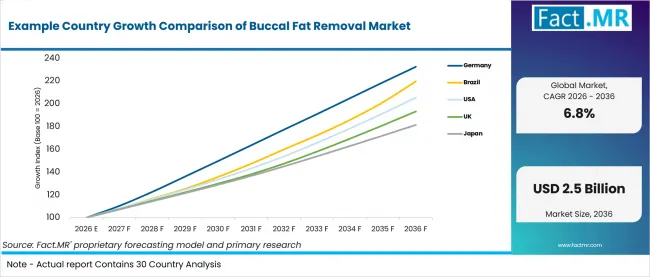
Example Country Growth Comparison Of Buccal Fat Removal Market | Source: Fact.MR
| Country | CAGR (2026-2036) |
|---|---|
| Germany | 8.8% |
| Brazil | 8.2% |
| Mexico | 4.8% |
| USA | 7.5% |
| Canada | 5.5% |
| UK | 6.8% |
| Japan | 6.1% |
Source: Fact.MR analysis. Updated Jul 30, 2026
What supports Germany adoption?
8.8% CAGR, supported by specialist clinics and careful patient screening.
Germany’s growth reflects a structured cosmetic surgery market where clinics emphasize suitability checks, informed consent and conservative fat removal. Surgeons are likely to assess long-term facial balance before recommending treatment.
How is Brazil scaling demand?
8.2% CAGR, driven by facial slimming interest and medical tourism.
Brazil’s expansion is linked to strong demand for facial definition and a well-developed private aesthetic clinic network. Medical tourism creates additional procedure inquiries, especially when clinics coordinate consultations and recovery plans before travel.
What is strengthening Mexico adoption?
4.8% CAGR, backed by private clinic access and cross-border demand.
Mexico benefits from established cosmetic treatment hubs and easier access for international patients. Cross-border consultations and surgeon referrals help build trust before appointments are confirmed. Growth is also supported by medical tourism agencies that organize treatment schedules, although follow-up distance and differences in clinic quality may influence patient decisions.
How does the USA perform?
7.5% CAGR, supported by direct consultation and structured aftercare.
The USA market develops through clinic-led consultations that assess facial proportions, treatment suitability and recovery needs. Patients often compare surgical removal with non-surgical contouring before making a decision.
What supports Canada demand?
5.5% CAGR, led by urban cosmetic clinics and patient education.
Canada’s growth is concentrated in major cities where trained cosmetic surgeons and private clinics provide consultation-based services. Patient education helps explain permanent volume reduction and possible long-term facial changes.
How is the UK market developing?
6.8% CAGR, shaped by cautious treatment planning and documented consent.
The UK follows a selective adoption path because patients and clinics place strong emphasis on subtle results and procedure credibility. Private referrals and detailed consultations help clarify whether cheek-fat removal suits the patient’s facial structure.
What supports Japan adoption?
6.1% CAGR, backed by subtle contouring demand and facial-balance assessment.
Japan’s market is guided by patient preference for natural-looking changes rather than aggressive cheek reduction. Surgeons are expected to prioritize precise assessment and conservative removal to protect long-term facial balance.
Who leads the Buccal Fat Removal Market?
KLS Martin Group, B. Braun SE and Integra LifeSciences strengthen the wider surgical instrument and procedure-support landscape used by cosmetic and oral-surgery providers.
KLS Martin Group supports the market through surgical instruments and specialized operating-room solutions. B. Braun SE contributes a broad portfolio of surgical products used across hospital procedures. Integra LifeSciences adds instruments and technologies for specialist surgical care. Sklar Corporation strengthens the field through reusable surgical instruments. Aspen Surgical Products, Inc. adds operating-room and procedure-focused products. Johnson & Johnson MedTech extends the competitive landscape through established surgical systems and strong hospital relationships.
Which companies are the key providers?
Key companies include KLS Martin Group, B. Braun SE, Sklar Corporation, Integra LifeSciences Holdings Corporation, Aspen Surgical Products, Inc., and Johnson & Johnson MedTech.
- KLS Martin Group
- B. Braun SE
- Sklar Corporation
- Integra LifeSciences Holdings Corporation
- Aspen Surgical Products, Inc.
- Johnson & Johnson MedTech
Bibliography
- Cleveland Clinic. Buccal Fat Removal: What It Is, Recovery & Before & After.
- American Society of Plastic Surgeons. Buccal Fat Removal.
- American Society of Plastic Surgeons. Buccal Fat Removal Risks and Safety.
- American Society of Plastic Surgeons. Buccal Fat Removal Candidates.
- American Society of Plastic Surgeons. 2024 Plastic Surgery Statistics Report.
This Report Answers
- The report provides strategic intelligence on the Buccal Fat Removal Market across Procedure Type and Application choices that shape facial contouring demand.
- Segment analysis covers Traditional Buccal Fat Excision and Facial Slimming as the share leaders within the 2026 market.
- Country outlook evaluates Germany and Brazil alongside Mexico and the USA. Canada, the UK and Japan complete the growth comparison across the profiled markets.
- Competitive analysis profiles the listed aesthetics and clinic-channel companies.
- Channel assessment covers Direct Patient Consultation and referral-based routes. The review separates surgical cheek-fat pad removal from non-invasive aesthetic treatment where patient expectations and risk profiles differ.
What does the Buccal Fat Removal Market cover?
Buccal fat removal covers elective surgical cheek-fat pad reduction for lower-face slimming.
The market includes procedure routes and consultation channels that move patients into professional evaluation.
The market differs from broad face-aesthetic services because value comes from permanent fat-pad removal. Injectable-only correction and skin-care services are excluded unless they route patients into surgical consultation.
What is included in the scope?
The scope includes Procedure Type and Application with End User plus Distribution Channel and Gender across regional demand.
Coverage spans traditional excision and minimally invasive labels. Combination procedures and revision work remain included.
The scope covers buccal fat removal with facelift and jaw contouring when cheek-fat pad reduction is part of the procedure plan. It includes medical tourism agencies and digital appointment platforms when they route patients to surgeon review.
What is excluded from the scope?
General beauty services and unrelated cosmetic products remain outside the scope of this market.
The scope excludes skin-care purchases and non-surgical contouring not tied to buccal fat consultation.
Injectables, threads and device-based treatments are excluded unless they affect patient screening for surgical cheek-fat pad removal. Broad plastic surgery instruments spending is excluded unless the equipment is used in buccal fat removal or related facial contouring procedures.
How Was the Analysis Built?
The analysis draws on 120+ sources, 35+ company portfolios, 25+ countries, and more than 20 industry interviews.
- Primary Research: Primary research includes discussions with manufacturers, service providers, technology developers, distributors, end users, procurement teams, and subject-matter experts. These conversations examine purchasing priorities, product adoption, operational challenges, approval requirements, competitive positioning, and the factors that influence wider market acceptance.
- Desk Research: Desk research covers government statistics, regulatory publications, company filings, trade data, technical studies, industry associations, standards, public policy, and other authoritative sources. Every source used in the analysis is documented in the bibliography.
- Market Sizing and Forecasting: Market estimates combine historical performance, demand indicators, pricing and volume trends, segment shares, company participation, country-level growth, adoption patterns, investment activity, and barriers to market expansion.
- Data Validation and Update Cycle: Findings are validated by comparing primary interviews with public data, company activity, regulatory changes, trade patterns, and industry developments. Regular updates review new product launches, capacity changes, partnerships, approvals, procurement trends, and shifts in commercial adoption.
Segmentation
What is the report's scope and coverage?
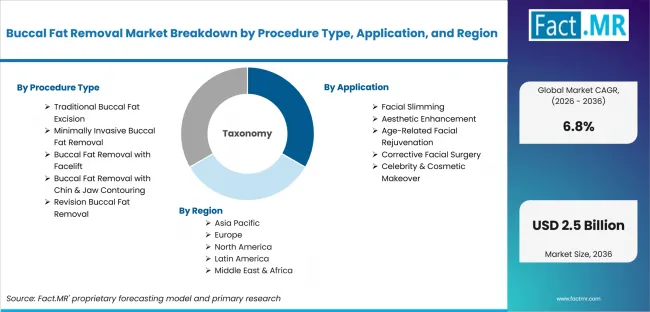
Buccal Fat Removal Market Breakdown By Procedure Type, Application, And Region | Source: Fact.MR
| Attribute | Details |
|---|---|
| Quantitative Units | USD billion in 2026 to USD billion by 2036, at CAGR. |
| Market Definition | Elective surgical cheek-fat pad reduction performed by trained cosmetic or plastic surgery providers where patient suitability, facial balance and recovery guidance determine procedure adoption. |
| Procedure Type | Traditional Buccal Fat Excision; Intraoral Fat Pad Excision; Standard Surgical Technique; Minimally Invasive Buccal Fat Removal; Combination and revision procedures |
| Application | Facial Slimming; Cheek Contouring; Face Reshaping; Aesthetic Enhancement; Facial Definition; Profile Improvement; Rejuvenation and corrective facial applications |
| End User | Cosmetic Surgery Clinics; Private Cosmetic Clinics; Specialty Aesthetic Clinics; Hospitals; Ambulatory Surgical Centers; Medical Spas; Academic and research settings |
| Distribution Channel | Direct Patient Consultation; In-Clinic Consultation; Surgeon Referral; Hospital Referral Network; Medical Tourism Agencies; Digital Appointment Platforms; Aesthetic Franchise Networks |
| Gender | Female; Aged 18-35 Years; Aged Above 35 Years; Male; Non-Binary and Others |
| Regions Covered | North America; Latin America; Europe; East Asia; South Asia and Pacific; Middle East and Africa |
| Countries Covered | Germany; Brazil; Mexico; USA; Canada; UK; Japan |
| Key Companies Profiled | KLS Martin Group; B. Braun SE; Sklar Corporation; Integra LifeSciences Holdings Corporation; Aspen Surgical Products, Inc.; Johnson & Johnson MedTech |
| Forecast Period | 2026 to 2036 |
| Approach | Hybrid top-down and bottom-up approach using cosmetic procedure demand; clinic consultation activity; segment shares; country adoption patterns; patient suitability review; recovery protocols; referral channels and company portfolio review |
Source: Fact.MR analysis. Updated Jul 30, 2026
How is the market segmented?
-
By Procedure Type:
- Traditional Buccal Fat Excision
- Intraoral Fat Pad Excision
- Standard Surgical Technique
- Minimally Invasive Buccal Fat Removal
- Small Incision Technique
- Tissue Preservation Technique
- Buccal Fat Removal with Facelift
- SMAS Facelift Combination
- Mid-Face Lift Combination
- Buccal Fat Removal with Chin & Jaw Contouring
- Genioplasty Combination
- Jawline Enhancement Procedure
- Revision Buccal Fat Removal
- Corrective Fat Reduction
- Asymmetry Correction
- Traditional Buccal Fat Excision
-
By Application:
- Facial Slimming
- Cheek Contouring
- Face Reshaping
- Aesthetic Enhancement
- Facial Definition
- Profile Improvement
- Age-Related Facial Rejuvenation
- Mid-Face Rejuvenation
- Anti-Aging Procedures
- Corrective Facial Surgery
- Facial Asymmetry Correction
- Post-Trauma Reconstruction
- Celebrity & Cosmetic Makeover
- Image Enhancement
- Personal Aesthetic Transformation
- Facial Slimming
-
By End User:
- Cosmetic Surgery Clinics
- Private Cosmetic Clinics
- Specialty Aesthetic Clinics
- Hospitals
- Multi-Specialty Hospitals
- Plastic Surgery Departments
- Ambulatory Surgical Centers
- Day Surgery Centers
- Outpatient Surgical Facilities
- Medical Spas
- Aesthetic Medical Centers
- Premium Cosmetic Centers
- Academic & Research Institutes
- Teaching Hospitals
- Clinical Research Centers
- Cosmetic Surgery Clinics
-
By Distribution Channel:
- Direct Patient Consultation
- In-Clinic Consultation
- Surgeon Referral
- Hospital Referral Network
- Physician Referral
- Medical Network Referral
- Medical Tourism Agencies
- Cross-Border Healthcare Facilitators
- Aesthetic Tourism Providers
- Digital Appointment Platforms
- Online Consultation Platforms
- Telemedicine Booking Services
- Aesthetic Franchise Networks
- Branded Clinic Chains
- Partner Clinics
- Direct Patient Consultation
-
By Gender:
- Female
- Aged 18–35 Years
- Aged Above 35 Years
- Male
- Aesthetic Facial Contouring
- Jawline Enhancement
- Non-Binary & Others
- Gender-Affirming Procedures
- Personal Cosmetic Enhancement
- Female
-
By Region:
- North America
- Latin America
- Europe
- East Asia
- South Asia and Oceania
- Middle East and Africa
Frequently Asked Questions
Which Procedure Type leads the Buccal Fat Removal Market?
Which Application leads the Buccal Fat Removal Market?
Which End User leads the Buccal Fat Removal Market?
Which Distribution Channel leads the Buccal Fat Removal Market?
Which Gender leads the Buccal Fat Removal Market?
Which country records the highest listed CAGR?
What is the primary driver in this market?
What is the main restraint?
Why do Cosmetic Surgery Clinics lead demand?
Who worked on this report


Preview the report firsthand - request a free sample
Free SampleGet the brochure for pricing and purchase details
Download PDF