- Market Value (2025): USD 318.9 Mn
- Estimated Value (2026): USD 360.0 Mn
- Forecast Value (2036): USD 1211.3 Mn
- CAGR (2026-2036): 12.9%
What is the Calamansi-Derived Gelling Agents Market forecast to be worth by 2036?
The Calamansi-Derived Gelling Agents Market is projected to reach USD 1,211.3 million by 2036, from USD 360.0 million in 2026, at a 12.9% CAGR.
- The market stood at USD 318.9 million in 2025.
- Demand is valued at USD 360.0 million in 2026 and is forecast to reach USD 1211.3 million by 2036.
- Growth is projected at 12.9% CAGR from 2026 to 2036. Demand develops as processors convert usable calamansi peel into gelling ingredients that meet repeat production specifications.
What are the defining numbers behind Calamansi-Derived Gelling Agents Market growth?
The absolute opportunity between 2026 and 2036 is USD 851.3 million. The opportunity connects local peel recovery with formulation customers seeking a traceable citrus ingredient. Commercial value accrues to a qualified gelling preparation, rather than to all calamansi fruit or juice sales.
- Demand Drivers in the Market
- Calamansi processors can retain more value from fruit by separating usable peel for ingredient recovery. This requires handling that preserves food suitability and keeps the peel identifiable through extraction.
- Jam and gummy developers seeking distinctive ingredient origins need suppliers that can combine provenance with dependable setting behavior. Their purchasing decisions create a route for calamansi-specific grades within natural texture gums.
- A move from demonstration batches to regular manufacture creates demand for standardized extract. Buyers must be able to use the next delivery without rebuilding the sugar, acid and gelling balance.
- Environmental claims face scrutiny over what they actually describe. The UK Competition and Markets Authority's Green Claims Code makes substantiation relevant to an upcycled-peel proposition. The practical implication is demand for traceable supply, rather than a premium based on an unsupported environmental label.
- Key Segments Analyzed
- Within Gelling Fraction, the Pectin-rich extract segment holds a 46.0% share in 2026. A pectin-focused extract gives formulators a clearer starting point for controlling the setting reaction.
- The High-sugar gel segment leads Gel Type with 31.0% of 2026 revenue. Sweet preserve recipes provide a familiar setting environment for appropriately specified pectin.
- For Application, 33.0% of 2026 revenue comes from the Jams segment. Jam production offers a direct application in which gel strength and spreadability can be evaluated.
- The leading Claim segment is Upcycled peel, accounting for 38.0% in 2026. Peel recovery creates a distinct origin claim when the material can be traced through manufacture.
- Analyst Opinion at Fact.MR
- Shambhu Nath Jha, Senior Consultant, Fact.MR“Calamansi provenance can open the first conversation, but it cannot compensate for a gel that changes from one delivery to the next. The durable business will belong to suppliers that control the peel stream, standardize the extract and give customers a usable setting window.”
- Strategic Implications
- Extraction businesses should preserve batch identity from peel collection to finished ingredient. Combining unidentified citrus streams can undermine the calamansi-specific proposition.
- Confectionery developers should establish the setting window before changing to a new source. A gummy depositor needs enough working time without leaving the finished candy weak or sticky.
- Ingredient marketers should specify the precise environmental claim being made. Recovered peel, reduced waste and lower lifecycle impact are different statements and require different supporting information.
How does the Calamansi-Derived Gelling Agents Market break down by segment?
The market is segmented by Gelling Fraction, Gel Type, Application, and Claim.
Why does the Pectin-rich extract segment lead Gelling Fraction?
The Pectin-rich extract segment holds a 46.0% share of the Gelling Fraction category in 2026.
Concentrating the gelling component makes it easier to relate dose to the finished texture. The extract still needs information on composition and residual color or flavor before it can be compared with another pectin grade.
Fiber-pectin complexes can offer a different texture, but additional insoluble material may change clarity or mouthfeel. EFSA's pectin assessment describes the relationship between molecular characteristics and functional properties. That relationship helps explain why the extraction specification, not simply the fruit name, governs the application.
Why does the High-sugar gel segment lead Gel Type?
The High-sugar gel segment holds a 31.0% share of the Gel Type category in 2026.
An appropriately specified high-methoxyl pectin can form a gel in sweet, acidic formulations. This offers a straightforward starting point for a calamansi extract intended for preserves. It does not mean that every calamansi pectin will have identical setting behavior.
Low-sugar calcium gels require a different formulation balance, while thermoreversible blends depend on the other gelling ingredients present. Customers comparing citrus pectin grades need to identify the gel mechanism before choosing an origin claim.
Why do Jams lead Application?
The Jams segment holds a 33.0% share of the Application category in 2026.
A jam producer can evaluate spreadability and fruit distribution using the actual cooking and filling sequence. This provides concrete acceptance criteria for a new gelling ingredient.
The opportunity is to supply a dependable texture with a distinct citrus origin. Adjacent fruit inclusions can change the solids balance and make uniform setting more difficult. A supplier must therefore test the complete recipe rather than infer performance from a clear laboratory gel.
Why does the Upcycled peel segment lead Claim?
The Upcycled peel segment holds a 38.0% share of the Claim category in 2026.
The claim connects the ingredient to an identifiable processing residue. It is commercially meaningful when buyers can verify what was recovered, how it was segregated and what portion of the finished preparation it represents.
Upcycled origin does not automatically establish a lower environmental footprint or organic eligibility. The CMA's guidance supports careful, substantiated environmental descriptions. Suppliers should make the claim narrow enough to demonstrate while allowing the customer's product team to decide how it fits the finished pack.
What is accelerating Calamansi-Derived Gelling Agents Market adoption, and what is holding it back?
Calamansi gelling agents must move through a supply chain with two distinct tests. The category also competes with pectins from more familiar fruit streams. A buyer can retain an established gelling system if changing origin adds cost or requires extensive redevelopment. Adoption is therefore expected to concentrate first in products where traceable calamansi provenance has a clear commercial purpose.
Drivers Impact Analysis
| Factor | (~) % Impact on CAGR | Geographic Relevance | Impact Timeline |
|---|---|---|---|
| Recovery of segregated calamansi peel | +1.4% | Philippines | 2026 to 2031 |
| Origin-specific jam and gummy development | +1.0% | USA, UK, Japan | 2027 to 2033 |
| Repeatable extract specifications | +0.8% | Global | 2026 to 2032 |
Source: Fact.MR analysis. Updated Sep 10, 2026
A larger peel collection stream does not necessarily create more saleable gelling agent. Recovery needs to preserve functional characteristics and meet the customer's food-quality specification.
Opportunity Impact Analysis
| Factor | (~) % Impact on CAGR | Geographic Relevance | Impact Timeline |
|---|---|---|---|
| Processor partnerships for traceable peel | +0.9% | Philippines | 2026 to 2030 |
| Calcium-responsive reduced-sugar grades | +0.7% | Germany, UK | 2028 to 2034 |
| Application blends for fruit preparations | +0.5% | Europe, Japan | 2027 to 2036 |
Source: Fact.MR analysis. Updated Sep 10, 2026
Coordinated processing arrangements can make batch identity easier to maintain. More specialized grades offer a route to higher-value applications once their setting behavior is demonstrated.
Restraints Impact Analysis
| Factor | (~) % Impact on CAGR | Geographic Relevance | Impact Timeline |
|---|---|---|---|
| Seasonal peel quality and aggregation | -1.0% | Philippines | 2026 to 2036 |
| Bitterness or color in sensitive recipes | -0.7% | Global | 2026 to 2032 |
| Replacement cost versus established pectin | -0.6% | USA, Europe | 2026 to 2034 |
Source: Fact.MR analysis. Updated Sep 10, 2026
Residual flavor may suit one fruit product and spoil another. Purification can improve neutrality but adds processing cost, so suppliers need to select target applications before specifying the extract.
Which countries are scaling the Calamansi-Derived Gelling Agents Market through 2036?
- Philippines: Calamansi-growing and processing communities provide a direct starting point for segregated peel collection and local extraction.
- UK: Upcycled-ingredient positioning can support product development when environmental language is specific and substantiated.
- USA: Jam and gummy producers need a commercially useful texture alongside an ingredient identity that fits the intended food use.
- Japan: Imported preparations must meet relevant additive and quality requirements while fitting products with tightly controlled flavor.
- Germany: Established pectin application expertise raises the standard for introducing a new citrus source into industrial recipes.
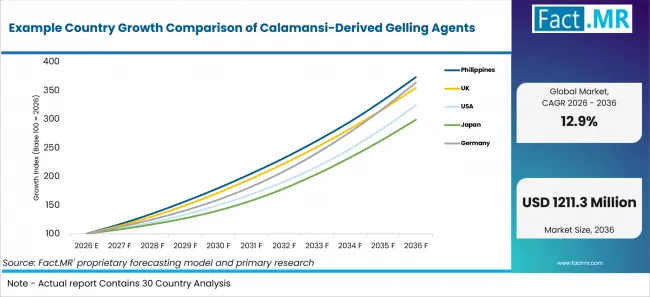
Example Country Growth Comparison Of Calamansi Derived Gelling Agents | Source: Fact.MR
Country CAGR (2026-2036)
| Country | CAGR (2026-2036) |
|---|---|
| Philippines | 14.1% |
| UK | 13.5% |
| USA | 12.5% |
| Japan | 11.6% |
| Germany | 13.8% |
Source: Fact.MR analysis. Updated Sep 10, 2026
What is driving Philippines's growth through 2036?
The Philippines is forecast to grow at 14.1% CAGR through 2036.
The Department of Agriculture's Zamboanga Peninsula office has highlighted calamansi farming in Siay, illustrating a local agricultural base from which processing partnerships can develop. Farming activity supports the supply context; ingredient sales still require a separate recovery and qualification business.
A useful commercial arrangement would keep peel collection close to juice processing, limit deterioration and retain batch identity. Extractors can then supply a defined preparation to jam makers or ingredient distributors. The purchasing mechanism is the conversion of a local residue into a specification that a food manufacturer will reorder.
What is driving UK's growth through 2036?
UK demand is projected to expand at 13.5% CAGR from 2026 to 2036.
The route is especially relevant to brands that want an identifiable recovered ingredient in a preserve or confectionery concept. Its commercial value depends on whether consumers can understand the claim and whether the product delivers the expected texture.
The CMA's Green Claims Code provides a framework for substantiating environmental descriptions. For ingredient buyers, this makes documented peel origin and a precise statement of the recovery process useful during supplier approval. A traceable offer can progress more easily through product development than a broad claim of environmental superiority.
What is driving USA's growth through 2036?
The USA is expected to record 12.5% CAGR through 2036.
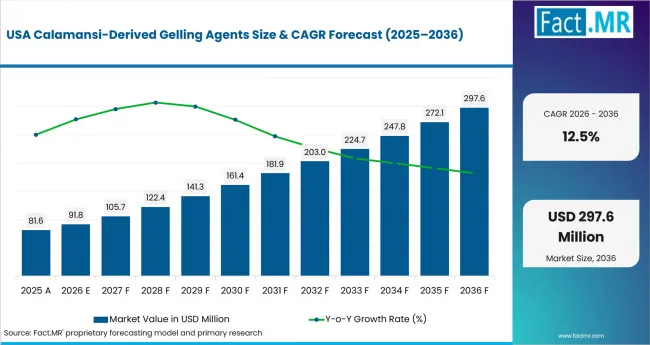
Calamansi Derived Gelling Agents Country Value Analysis | Source: Fact.MR
The FDA's pectin provision provides an ingredient-use framework, but a calamansi preparation must still match the relevant identity, specifications and intended conditions. A citrus name by itself does not settle the regulatory position of an extract or complex blend.
Gummy and jam manufacturers can create repeat demand once a grade meets their setting and sensory criteria. The commercial work includes checking how the preparation behaves during heating, depositing and storage. This gives application-ready material a stronger route to recurring purchases than minimally characterized peel extract.
What is driving Japan's growth through 2036?
Japan's projected CAGR is 11.6% over the forecast period.
The Consumer Affairs Agency sets out the country's food-additive categories and applicable specifications. Suppliers of calamansi gelling preparations need to establish the position of the actual ingredient under that framework.
A further commercial distinction is flavor. A citrus note may be welcome in a tropical fruit preparation but unsuitable in a mild dairy alternative. Importers and formulation teams can therefore sort opportunities by sensory compatibility before committing to wider trials. Clear separation of pectin-rich extracts from more complex citrus fractions helps that process.
What is driving Germany's growth through 2036?
Germany is forecast to advance at 13.8% CAGR through 2036.
Herbstreith & Fox documents specialized pectin applications across confectionery, jams and fruit preparations. This provides a relevant picture of the technical service available to buyers evaluating a new gelling source.
Calamansi ingredients must compete within that established application environment. A supplier may find opportunities in a traceable fruit concept or a specifically engineered low-sugar system, provided the extract is compatible with the customer's equipment. Demonstrating stable batches and sufficient working time before gelation is likely to matter more than changing the fruit origin alone.
Who Leads the Calamansi-Derived Gelling Agents Market?
Key players in the Calamansi-Derived Gelling Agents Market include CP Kelco, Cargill, Herbstreith & Fox, Silvateam, Andre Pectin, and Ceamsa.
Competition draws on broader pectin production and application capabilities. For calamansi-specific ingredients, botanical provenance and gel specification determine commercial qualification. General citrus pectin portfolios span other fruit sources. CP Kelco became part of Tate & Lyle in 2024. [6, 7]
Competition with food stabilizers will be decided by the required texture and acceptable processing cost. Calamansi specialists can differentiate through traceable recovery and formulation service, while customers retain access to other thickening agents when source-specific pectin does not fit the recipe.
Which companies are the key providers?
The key providers are CP Kelco, Cargill, Herbstreith & Fox, Silvateam, Andre Pectin, and Ceamsa.
- CP Kelco
- Cargill
- Herbstreith & Fox
- Silvateam
- Andre Pectin
- Ceamsa
Bibliography
- [1] Competition and Markets Authority. (2021). Green claims code: making environmental claims. UK Government.
- [2] European Food Safety Authority. (2017). Re-evaluation of pectin (E 440i) and amidated pectin (E 440ii) as food additives. EFSA Journal, 15(7), 4866.
- [3] Department of Agriculture, Zamboanga Peninsula. (n.d.). Calamansi production and farm management: calamansi farmers of Siay. Official DA Zamboanga Peninsula publication.
- [4] U.S. Food and Drug Administration. (n.d.). 21 CFR 184.1588: Pectins. Electronic Code of Federal Regulations.
- [5] Consumer Affairs Agency. (n.d.). Food Additives. Government of Japan.
- [6] Herbstreith & Fox. (n.d.). The Specialists for Pectin: food applications and functional pectins. Herbstreith & Fox.
- [7] Tate & Lyle. (n.d.). Corporate information on the integration of CP Kelco. Tate & Lyle.
This Report Answers
- What separates a calamansi gelling preparation from a general citrus pectin?
- Which gelling fractions, gel types, applications and claims lead 2026 revenue?
- How can peel segregation and extraction consistency influence repeat purchases?
- What routes to demand exist in the Philippines, UK, USA, Japan and Germany?
- Which technical and commercial conditions can prevent an origin-specific ingredient from scaling?
What does the Calamansi-Derived Gelling Agents Market cover?
The market covers gelling ingredients made from calamansi and sold for use in food formulations. It includes pectin-rich extracts and more complex citrus preparations where the calamansi component contributes to the commercial gelling function.
What is included in the scope?
Included fractions are pectin-rich extract, fiber-pectin complex, citrus hydrocolloid blend, modified pectin and fermented citrus fraction. Gel categories encompass high-sugar, low-sugar calcium, acid, thermoreversible blend and soft-set systems.
Applications are jams, gummies, fruit preparations, dairy and alternatives, and bakery fillings. Claims examined are upcycled peel, natural citrus, clean-label, regional or tropical source, and organic-compatible. These are commercial positioning categories rather than automatic certifications.
What is excluded from the scope?
Calamansi fruit, juice, flavor oils and ordinary puree are excluded when sold without a gelling-ingredient function. Pectin from other citrus species, unrelated gums and finished jams or gummies do not form part of the calamansi-specific total.
Liquid calamansi pectin recovered from processing residues may also fall within fruit-waste liquid pectins. The two market totals therefore should not be summed without adjusting overlapping ingredient sales.
How Was the Analysis Built?
- Primary Research: Relevant commercial perspectives are those of calamansi processors, extract manufacturers, gummy and preserve technologists, ingredient importers and traceability managers. Core questions concern usable peel supply, gel reproducibility and willingness to qualify a new source.
- Desk Research: Evidence includes pectin scientific assessment, food-additive provisions, government agricultural communication, environmental-claim guidance and manufacturer application information. General citrus evidence is used for chemistry and qualification context, not as proof that every citrus product contains calamansi.
- Market Sizing and Forecasting: The commercial assessment links saleable calamansi gelling preparations with application demand, extract quality, dose and selling value. Fruit and juice revenues remain separate from ingredient revenue, as do claims about the entire pectin industry.
- Data Validation and Update Cycle: Review reconciles market growth and segment distributions, then checks country rates and ingredient boundaries. Company descriptions distinguish broad pectin capabilities from botanical provenance, and claim categories are checked for wording that could imply unsupported certification.
Segmentation
What is the report's scope and coverage?
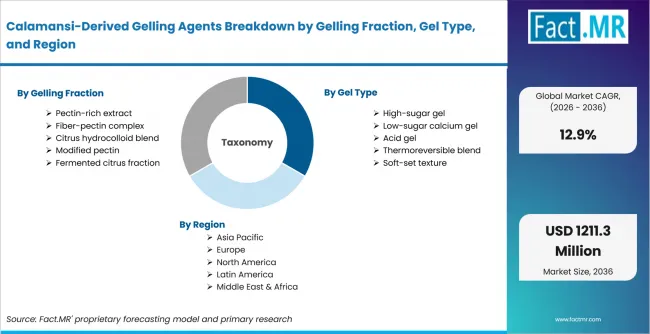
Calamansi Derived Gelling Agents Breakdown By Gelling Fraction, Gel Type, And Region | Source: Fact.MR
| Attribute | Details |
|---|---|
| Quantitative Units | USD million |
| Market Definition | Calamansi-based pectin and related gelling preparations sold into specified food applications. |
| Segments Covered | Gelling Fraction; Gel Type; Application; Claim |
| Regions Covered | Global |
| Countries Covered | Philippines; UK; USA; Japan; Germany |
| Key Companies | CP Kelco, Cargill, Herbstreith & Fox, Silvateam, Andre Pectin, and Ceamsa |
| Historical Period | 2021 to 2025 |
| Base Year | 2025 |
| Forecast Period | 2026 to 2036 |
| Market Value, 2026 | USD 360.0 million |
| Market Value, 2036 | USD 1,211.3 million |
| CAGR, 2026-2036 | 12.9% |
| Absolute Opportunity | USD 851.3 million |
| Approach | Botanically defined ingredient revenue analysis with gel-function, application and provenance assessment. |
Source: Fact.MR analysis. Updated Sep 10, 2026
How is the market segmented?
-
By Gelling Fraction
- Pectin-rich extract
- Fiber-pectin complex
- Citrus hydrocolloid blend
- Modified pectin
- Fermented citrus fraction
-
By Gel Type
- High-sugar gel
- Low-sugar calcium gel
- Acid gel
- Thermoreversible blend
- Soft-set texture
-
By Application
- Jams
- Gummies
- Fruit preparations
- Dairy / alternatives
- Bakery fillings
-
By Claim
- Upcycled peel
- Natural citrus
- Clean-label
- Regional / tropical source
- Organic-compatible
Frequently Asked Questions
What is the Calamansi-Derived Gelling Agents Market value in 2026?
At what CAGR is the market projected to grow?
What is the projected market value by 2036?
Which segment leads the Gelling Fraction category?
Which segment leads the Gel Type category?
Which segment leads the Application category?
Who are the key suppliers?
Who worked on this report


Preview the report firsthand - request a free sample
Free SampleGet the brochure for pricing and purchase details
Download PDF