Calcium Hydroxylapatite Fillers Market (2026 - 2036)
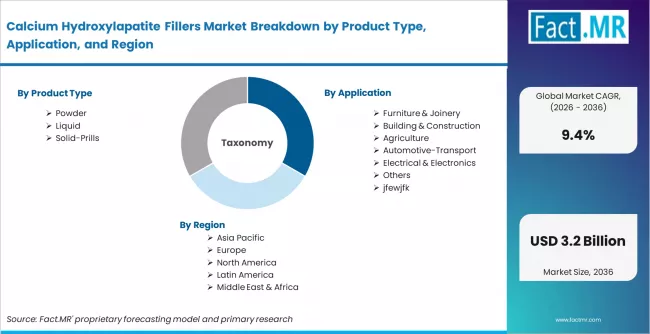
The Calcium Hydroxylapatite Fillers Market is segmented by Product Type (Injectable CaHA Fillers and Microparticle/Other Formats), Application (Facial Wrinkles & Folds, Contouring, and Lipoatrophy & Others), End User (Dermatology Clinics & Aesthetic Centers and Hospitals & Surgical Centers) and Region. Forecast for 2026 to 2036
FACT.MR opines that the calcium hydroxylapatite fillers market is at a premiumisation inflection. Conventional single-indication use is declining. Demand is shifting toward combination aesthetic protocols. High-dilution biostimulator techniques are gaining adoption. These approaches are redefining treatment economics for practitioners and manufacturers.
Calcium Hydroxylapatite Fillers Market Forecast and Outlook By Fact.MR
In 2025, the calcium hydroxylapatite fillers market was valued at USD 1.1 billion. Based on Fact.MR analysis, demand for CaHA fillers is estimated to grow to USD 1.2 billion in 2026 and USD 3.0 billion by 2036. FACT.MR projects a CAGR of 9.4% during the forecast period.
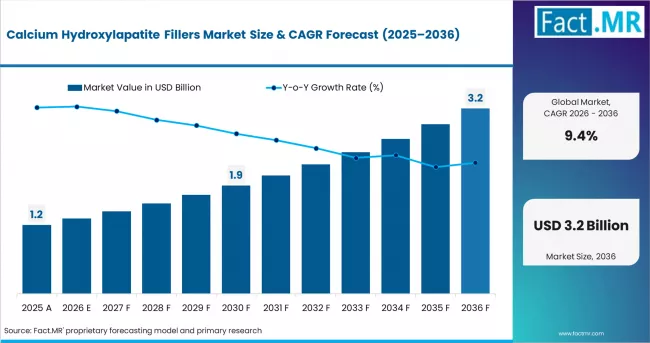
| Metric | Value |
|---|---|
| Estimated Value in 2026 | USD 1.2 billion |
| Forecast Value in 2036 | USD 3.0 billion |
| Forecast CAGR (2026 to 2036) | 9.4% |
Summary of Calcium Hydroxylapatite Fillers Market
- Market Definition
- The market includes injectable CaHA-based aesthetic devices used for facial volumisation, wrinkle correction, and collagen biostimulation across dermatology and surgical settings globally.
- Demand Drivers
- Rising global aesthetic procedure volumes are increasing demand for durable, biocompatible dermal fillers with biostimulatory effects.
- Expanding off-label high-dilution biostimulator protocols are broadening CaHA application beyond conventional wrinkle correction.
- Increasing medical tourism in Asia Pacific is driving clinic-level filler procurement and premiumisation of treatment protocols.
- Key Segments Analyzed
- By Product Type: Injectable CaHA fillers dominate with ~70% share in 2026 due to established clinical adoption and practitioner familiarity.
- By Application: Facial wrinkles and folds lead at ~43% share in 2026, driven by the highest procedure frequency in aesthetic clinics globally.
- By End User: Dermatology clinics and aesthetic centers account for ~60% share in 2026, reflecting practitioner-led outpatient aesthetic demand.
- Analyst Opinion at FACT.MR
- Shambhu Nath Jha, Principal Consultant at Fact.MR, opines, 'CXOs will find CaHA filler markets shifting toward biostimulator protocols where product versatility, dilution compatibility, and clinical outcome evidence define long-term commercial positioning.'
- Strategic Implications
- Invest in clinical evidence generation for biostimulator and combination protocol applications.
- Strengthen distributor and clinic partnerships in high-growth Asia Pacific and India markets.
- Develop practitioner training programmes to expand high-dilution and off-label application adoption.
- Methodology
- Market sizing based on aesthetic procedure volumes and filler unit pricing benchmarks.
- Data validated using 2024–2025 aesthetic device registration and clinical outcome datasets.
- Forecasts incorporate regulatory approval timelines and aesthetic adoption rate modelling
The market is expected to generate an absolute dollar opportunity of USD 1.9 billion over the forecast period. Growth is transformational, driven by expanding aesthetic medicine adoption and biostimulator protocol innovation. However, regulatory approval timelines and premium procedure pricing continue to moderate penetration in price-sensitive markets.
Aesthetic practitioners are increasingly utilising CaHA fillers beyond wrinkle correction, adopting high-dilution injection techniques for skin biostimulation and collagen induction. Long-term supply partnerships between key manufacturers and dermatology clinic chains are reinforcing brand loyalty and limiting competitive switching.
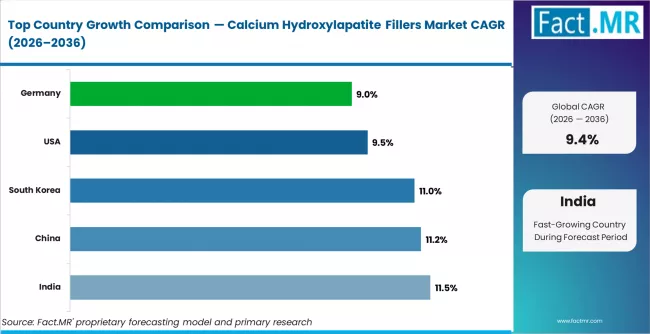
At the country level, India leads with 11.5% CAGR driven by medical tourism expansion and rising disposable income. China follows at 11.2% supported by aesthetics industry liberalisation. South Korea grows at 11.0% underpinned by K-beauty-driven procedure adoption. The United States records 9.5% CAGR on sustained high-volume aesthetic demand. Germany grows at 9.0% anchored by premium clinic infrastructure and regulatory compliance standards.
Segmental Analysis
Calcium Hydroxylapatite Fillers Market Analysis by Product Type
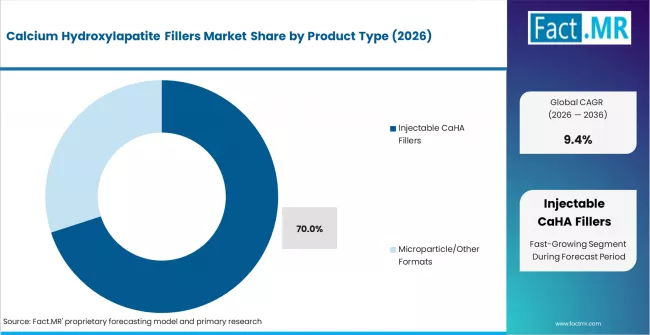
Based on FACT.MR, injectable CaHA fillers hold 70% share in 2026. They dominate due to strong clinical safety and familiarity. They offer multi-application use across procedures.
- Merz Expansion: Merz Pharma expanded Radiesse indications in 2024. New approvals include hands and neck treatments. This broadened application scope. [1]
- AbbVie Development: AbbVie expanded combination strategy in 2025. CaHA is being paired with Botox protocols. Clinics are increasing bundled treatments. [2]
- Industry Trend: Injectable CaHA is becoming a standard biostimulator. Dermatologists are adopting it widely. Demand is growing across clinic networks. [3]
Calcium Hydroxylapatite Fillers Market Analysis by Application
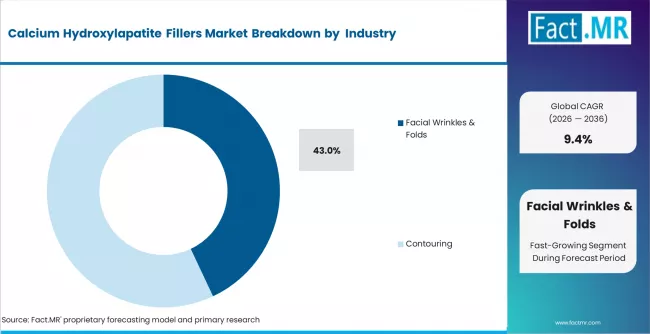
Based on FACT.MR, facial wrinkles and folds hold 43% share in 2026. This segment leads due to high procedure frequency. It is widely adopted in outpatient settings.
- Galderma Investment: Galderma expanded training programmes in 2024. Focus is on wrinkle and fold correction protocols. Coverage includes Europe and Asia. [4]
- Suneva Medical Innovation: Suneva Medical received FDA clearance in 2025. Bellafill gained expanded wrinkle indications. Clinical validation is strengthening. [5]
- Industry Trend: Jawline and chin contouring is the fastest-growing segment. Demand is rising among younger patients. Non-surgical reshaping is gaining preference. [6]
Drivers, Restraints, and Opportunities
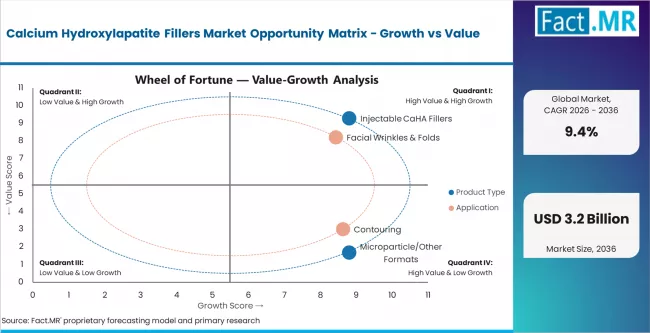
FACT.MR notes the market has shifted from niche use to a multi-application platform. It was valued at USD 1.1 billion in 2025. Premiumisation is visible in mature markets. Emerging economies are driving volume growth.
Standalone volumisation demand is stabilising in the United States and Germany. Growth is shifting toward combination protocols. CaHA is increasingly used with HA fillers and toxins. Biostimulator applications are improving procedure margins. They are expanding addressable demand.
- Biostimulator Protocol Adoption: High-dilution CaHA techniques are gaining traction. A 2024 clinical consensus validated dilution ratios. This expanded use for skin quality improvement. It increased procedure volumes beyond volumisation.
- Regulatory Expansion in Asia Pacific: China’s NMPA updated approval pathways in 2024. These reduced registration timelines for fillers. It enabled faster market entry for global brands. Growth in China is accelerating.
- Medical Tourism and Clinic Chain Growth: India and Southeast Asia are expanding clinic networks. Multi-location chains are standardizing procurement. Medical tourism demand increased in 2025. Institutional filler demand is rising.
Regional Analysis
The calcium hydroxylapatite fillers market is assessed across Asia Pacific, North America, Europe, Latin America, and Middle East and Africa, covering 40+ countries with demand shaped by aesthetic procedure volumes, regulatory approvals, clinic infrastructure, and medical tourism flows. The report provides detailed market attractiveness analysis by region and country.
.webp)
| Country | CAGR (2026–2036) |
|---|---|
| India | 11.5% |
| China | 11.2% |
| South Korea | 11.0% |
| United States | 9.5% |
| Germany | 9.0% |
Source: Fact.MR (FACT.MR) analysis, based on proprietary forecasting model and primary research
Asia Pacific Calcium Hydroxylapatite Fillers Market Analysis
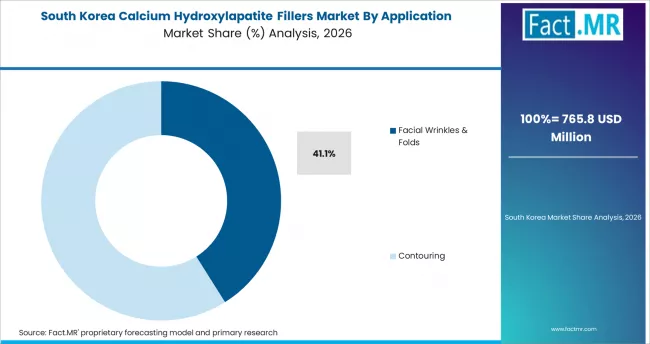
Asia Pacific remains the fastest-growing region. Demand is expanding with rising income and aesthetic awareness. Medical tourism and clinic chain expansion are increasing procedure volumes. Merz Pharma and Galderma lead through strong practitioner training networks. The region is shifting toward combination protocols and collagen bio stimulation techniques.
- India: Structural expansion supports 11.5% CAGR through 2036. Clinic penetration is rising beyond metro cities into tier-2 locations. Government healthcare initiatives in 2024 improved private investment sentiment. Practitioners are standardizing high-dilution protocols for wider applications. Demand is supported by medical tourism and rising middle-income consumers. Growth is driven by accessibility and procedural affordability.
- China: High-volume consumer base supports 11.2% CAGR through 2036. NMPA reforms in 2024 reduced approval timelines for fillers. Domestic clinic chains scaled rapidly across urban markets. Digital platforms and influencers are expanding aesthetic adoption. Product availability and awareness are increasing simultaneously. Growth is driven by scale and faster commercialization cycles.
- South Korea: Innovation ecosystem supports 11.0% CAGR through 2036. Clinics act as global benchmarks for advanced filler techniques. K-beauty investment expanded clinic infrastructure in 2024. Medical tourism continues to bring international patients. Training programmes export Korean protocols globally. Growth is driven by innovation leadership and premium procedure positioning.
Fact.MR’s analysis covers India, China, South Korea, Japan, ASEAN, and ANZ. It includes procedure volumes, approvals, and clinic expansion trends.
North America Calcium Hydroxylapatite Fillers Market Analysis
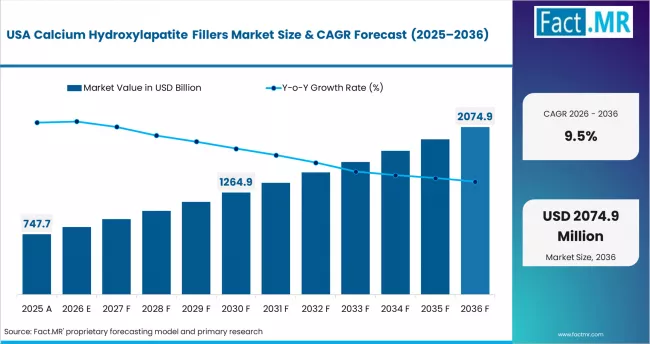
North America is the largest value market. Demand is driven by high procedure penetration and established dermatology infrastructure. Merz Pharma and AbbVie dominate through strong product portfolios and physician engagement. Combination treatments and repeat procedures are increasing.
- United States: Mature yet expanding demand supports 9.5% CAGR through 2036. Procedure volumes continued to rise in 2024. FDA-approved CaHA fillers provide high practitioner confidence. Adoption is increasing among male and ageing demographics. Clinics are offering personalized and combination treatments. Growth is driven by premium pricing and high repeat usage.
Fact.MR’s analysis covers the United States, Canada, and Mexico. It includes procedure data, pricing trends, and practitioner adoption insights.
Europe Calcium Hydroxylapatite Fillers Market Analysis
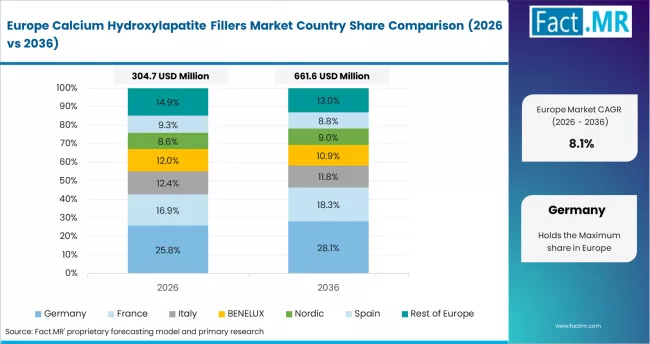
Europe is a compliance-driven market. Demand is shaped by MDR and CE regulatory standards. Clinical validation and safety are key procurement factors. Merz Pharma and Galderma lead practitioner networks across the region.
- Germany: Regulation-led demand supports 9.0% CAGR through 2036. MDR enforcement in 2024 raised compliance and certification requirements. Clinics expanded anti-ageing and contouring procedures. National guidelines standardized CaHA combination protocols. ESG and safety compliance are influencing product selection. Growth is driven by premium procedures and strict regulatory frameworks.
Fact.MR’s analysis covers Germany, France, the UK, Italy, and Spain. It includes regulatory impact, clinic trends, and pricing insights.
Competitive Aligners for Market Players
Competitive Structure and Buyer Dynamics in the Calcium Hydroxylapatite Fillers Market
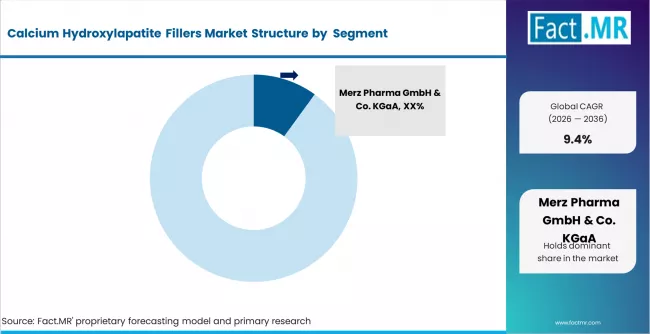
The calcium hydroxylapatite fillers market shows a semi-consolidated structure, where a few established brands hold strong influence over clinical adoption. Merz Pharma leads globally with its Radiesse portfolio, supported by long-term clinical data and broad regulatory acceptance. Most practitioners are familiar with a limited set of trusted brands, while smaller regional companies compete mainly on pricing and distribution reach in emerging markets.
Merz Pharma, AbbVie (through Allergan Aesthetics), and Galderma benefit from deep-rooted physician relationships and structured training programmes. These companies invest heavily in clinical studies and indication expansion, which strengthens their credibility among dermatologists and plastic surgeons. Their ability to continuously generate evidence-backed outcomes makes it difficult for new entrants to compete at the same level. From a practitioner perspective, product choice is rarely based on price alone. Safety profile, consistency in results, and brand familiarity play a central role in decision-making. Once a clinic adopts a specific filler brand and integrates it into treatment protocols, switching becomes less likely. This is due to training familiarity and the need to maintain predictable patient outcomes.
As a result, leading companies enjoy stable, recurring demand from existing practitioner networks. Brand loyalty acts as a strong barrier, especially in premium markets where patient expectations are high. Smaller players continue to find opportunities in cost-sensitive regions, but scaling into high-value segments remains challenging without comparable clinical validation and training ecosystems.
Key Players
- Merz Pharma GmbH & Co. KGaA
- AbbVie Inc. (Allergan Aesthetics)
- Galderma S.A.
- Suneva Medical Inc.
- Teoxane SA
Bibliography (EPA Format)
- [1] Merz Pharma GmbH & Co. KGaA. Radiesse Indication Expansion Regulatory Filing Update. January 2025.
- [2] AbbVie Inc. Allergan Aesthetics Combination Filler Clinical Programme Announcement. March 2025.
- [3] American Society for Dermatologic Surgery. Filler Procedure Volume Survey Report. November 2024.
- [4] Galderma S.A. Southeast Asia and India Distribution Network Expansion Release. January 2025.
- [5] Suneva Medical Inc. Bellafill FDA Expanded Clearance Press Release. February 2025.
- [6] Journal of Cosmetic Dermatology. Clinical Consensus on CaHA High-Dilution Biostimulator Techniques. August 2024.
This Report Addresses
- Market sizing and quantitative forecast metrics detailing global and regional expenditure on calcium hydroxylapatite fillers through 2036.
- Segmentation analysis evaluating adoption patterns across product type, application, and end-user categories and their respective sub-segments.
- Regional deployment intelligence comparing growth trajectories, regulatory environments, and competitive dynamics across North America, Europe, Asia Pacific, Latin America, and Middle East & Africa.
- Regulatory compliance assessment analysing how aesthetic device approvals, CE marking, and indication expansion decisions shape market access and product development.
- Competitive landscape evaluation tracking market structure, supplier positioning, and clinical evidence strategies among leading manufacturers.
- Strategic investment guidance defining the practitioner engagement, geographic expansion, and indication development priorities for market positioning through the forecast period.
- Pricing and protocol trend analysis identifying biostimulator adoption, combination protocol economics, and premium market dynamics affecting per-unit revenues.
- Custom data delivery formats encompassing interactive dashboards, raw Excel datasets, and comprehensive PDF narrative reports.
Calcium Hydroxylapatite Fillers Market Definition
The market includes injectable CaHA fillers used for facial volume, wrinkles, and contouring. These contain microspheres in a gel carrier. They provide immediate volume and long-term collagen stimulation.
Calcium Hydroxylapatite Fillers Market Inclusions
Covers global and regional forecasts from 2026 to 2036. Includes product type, application, and end user. Covers clinics, hospitals, and surgical centres. Includes pricing, regulatory approvals, and protocol trends.
Calcium Hydroxylapatite Fillers Market Exclusions
Excludes hyaluronic acid and other non-CaHA fillers. Omits non-injectable treatments and topical products. Also excludes CaHA use in orthopaedics and bone grafting.
Calcium Hydroxylapatite Fillers Market Research Methodology
- Primary Research: Interviews with aesthetic dermatologists, plastic surgeons, clinic procurement managers, and medical device distributors.
- Desk Research: Analysis of FDA and EMA device registrations, aesthetic society guidelines, and clinical literature from 2024–2025.
- Market-Sizing and Forecasting: Hybrid top-down and bottom-up model using procedure volumes, per-unit pricing, and end-user penetration benchmarks.
- Data Validation and Update Cycle: Validated through company filings, aesthetic association reports, and expert interviews with periodic updates.
Scope of Report

| Attribute | Details |
|---|---|
| Quantitative Units | USD 1.2 billion (2026) to USD 3.0 billion (2036), at a CAGR of 9.4% |
| Market Definition | Injectable aesthetic devices formulated with CaHA microspheres used for facial volumisation, wrinkle correction, contouring, and collagen biostimulation across dermatology and surgical settings globally. |
| Product Type Segmentation | Injectable CaHA Fillers, Microparticle/Other Formats |
| Application Segmentation | Facial Wrinkles & Folds, Contouring (Jawline, Chin), Lipoatrophy & Others |
| End User Segmentation | Dermatology Clinics & Aesthetic Centers, Hospitals & Surgical Centers |
| Application Coverage | Facial volumisation, biostimulator injection protocols, facial contouring, lipoatrophy correction, post-surgical aesthetic rehabilitation. |
| Key Companies | Merz Pharma, AbbVie (Allergan Aesthetics), Galderma, Suneva Medical, Teoxane |
| Forecast Period | 2026 to 2036 |
| Approach | Hybrid top-down and bottom-up model using aesthetic procedure volumes, per-unit filler pricing, end-user penetration benchmarks, regulatory approval data, and primary interviews with dermatologists, surgeons, and clinic procurement managers. |
Calcium Hydroxylapatite Fillers Market by Segments
-
By Product Type:
- Injectable CaHA Fillers
- Microparticle/Other Formats
-
By Application:
- Facial Wrinkles & Folds
- Contouring (Jawline, Chin)
- Lipoatrophy & Others
-
By End User:
- Dermatology Clinics & Aesthetic Centers
- Hospitals & Surgical Centers
-
By Region:
- North America
- United States
- Canada
- Mexico
- Latin America
- Brazil
- Mexico
- Argentina
- Chile
- Rest of Latin America
- Western Europe
- Germany
- United Kingdom
- France
- Italy
- Spain
- Nordic Countries
- BENELUX
- Rest of Western Europe
- Eastern Europe
- Russia
- Poland
- Rest of Eastern Europe
- East Asia
- China
- Japan
- South Korea
- South Asia and Pacific
- India
- ASEAN
- Australia and New Zealand
- Rest of South Asia and Pacific
- Middle East and Africa
- Kingdom of Saudi Arabia
- Other GCC Countries
- Turkey
- South Africa
- Rest of Middle East and Africa
- North America
Table of Content
- Executive Summary
- Global Market Outlook
- Demand to side Trends
- Supply to side Trends
- Technology Roadmap Analysis
- Analysis and Recommendations
- Market Overview
- Market Coverage / Taxonomy
- Market Definition / Scope / Limitations
- Research Methodology
- Chapter Orientation
- Analytical Lens and Working Hypotheses
- Market Structure, Signals, and Trend Drivers
- Benchmarking and Cross-market Comparability
- Market Sizing, Forecasting, and Opportunity Mapping
- Research Design and Evidence Framework
- Desk Research Programme (Secondary Evidence)
- Company Annual and Sustainability Reports
- Peer-reviewed Journals and Academic Literature
- Corporate Websites, Product Literature, and Technical Notes
- Earnings Decks and Investor Briefings
- Statutory Filings and Regulatory Disclosures
- Technical White Papers and Standards Notes
- Trade Journals, Industry Magazines, and Analyst Briefs
- Conference Proceedings, Webinars, and Seminar Materials
- Government Statistics Portals and Public Data Releases
- Press Releases and Reputable Media Coverage
- Specialist Newsletters and Curated Briefings
- Sector Databases and Reference Repositories
- Fact.MR Internal Proprietary Databases and Historical Market Datasets
- Subscription Datasets and Paid Sources
- Social Channels, Communities, and Digital Listening Inputs
- Additional Desk Sources
- Expert Input and Fieldwork (Primary Evidence)
- Primary Modes
- Qualitative Interviews and Expert Elicitation
- Quantitative Surveys and Structured Data Capture
- Blended Approach
- Why Primary Evidence is Used
- Field Techniques
- Interviews
- Surveys
- Focus Groups
- Observational and In-context Research
- Social and Community Interactions
- Stakeholder Universe Engaged
- C-suite Leaders
- Board Members
- Presidents and Vice Presidents
- R&D and Innovation Heads
- Technical Specialists
- Domain Subject-matter Experts
- Scientists
- Physicians and Other Healthcare Professionals
- Governance, Ethics, and Data Stewardship
- Research Ethics
- Data Integrity and Handling
- Primary Modes
- Tooling, Models, and Reference Databases
- Desk Research Programme (Secondary Evidence)
- Data Engineering and Model Build
- Data Acquisition and Ingestion
- Cleaning, Normalisation, and Verification
- Synthesis, Triangulation, and Analysis
- Quality Assurance and Audit Trail
- Market Background
- Market Dynamics
- Drivers
- Restraints
- Opportunity
- Trends
- Scenario Forecast
- Demand in Optimistic Scenario
- Demand in Likely Scenario
- Demand in Conservative Scenario
- Opportunity Map Analysis
- Product Life Cycle Analysis
- Supply Chain Analysis
- Investment Feasibility Matrix
- Value Chain Analysis
- PESTLE and Porter’s Analysis
- Regulatory Landscape
- Regional Parent Market Outlook
- Production and Consumption Statistics
- Import and Export Statistics
- Market Dynamics
- Global Market Analysis 2021 to 2025 and Forecast, 2026 to 2036
- Historical Market Size Value (USD Million) Analysis, 2021 to 2025
- Current and Future Market Size Value (USD Million) Projections, 2026 to 2036
- Y to o to Y Growth Trend Analysis
- Absolute $ Opportunity Analysis
- Global Market Pricing Analysis 2021 to 2025 and Forecast 2026 to 2036
- Global Market Analysis 2021 to 2025 and Forecast 2026 to 2036, By Distribution Channel
- Introduction / Key Findings
- Historical Market Size Value (USD Million) Analysis By Distribution Channel , 2021 to 2025
- Current and Future Market Size Value (USD Million) Analysis and Forecast By Distribution Channel , 2026 to 2036
- Supermarkets and Hypermarkets
- Convenience Stores
- Online Retail
- Foodservice
- Discount Stores
- Supermarkets and Hypermarkets
- Y to o to Y Growth Trend Analysis By Distribution Channel , 2021 to 2025
- Absolute $ Opportunity Analysis By Distribution Channel , 2026 to 2036
- Global Market Analysis 2021 to 2025 and Forecast 2026 to 2036, By Product Type
- Introduction / Key Findings
- Historical Market Size Value (USD Million) Analysis By Product Type, 2021 to 2025
- Current and Future Market Size Value (USD Million) Analysis and Forecast By Product Type, 2026 to 2036
- Ambient Ready to Eat Meals
- Shelf Stable Pasta Meals
- Ambient Ready Rice Meals
- Canned Complete Meals
- Ambient Soup Meals
- Ambient Meal Kits
- Ambient Ready to Eat Meals
- Y to o to Y Growth Trend Analysis By Product Type, 2021 to 2025
- Absolute $ Opportunity Analysis By Product Type, 2026 to 2036
- Global Market Analysis 2021 to 2025 and Forecast 2026 to 2036, By Region
- Introduction
- Historical Market Size Value (USD Million) Analysis By Region, 2021 to 2025
- Current Market Size Value (USD Million) Analysis and Forecast By Region, 2026 to 2036
- North America
- Latin America
- Western Europe
- Eastern Europe
- East Asia
- South Asia and Pacific
- Middle East & Africa
- Market Attractiveness Analysis By Region
- North America Market Analysis 2021 to 2025 and Forecast 2026 to 2036, By Country
- Historical Market Size Value (USD Million) Trend Analysis By Market Taxonomy, 2021 to 2025
- Market Size Value (USD Million) Forecast By Market Taxonomy, 2026 to 2036
- By Country
- USA
- Canada
- Mexico
- By Distribution Channel
- By Product Type
- By Country
- Market Attractiveness Analysis
- By Country
- By Distribution Channel
- By Product Type
- Key Takeaways
- Latin America Market Analysis 2021 to 2025 and Forecast 2026 to 2036, By Country
- Historical Market Size Value (USD Million) Trend Analysis By Market Taxonomy, 2021 to 2025
- Market Size Value (USD Million) Forecast By Market Taxonomy, 2026 to 2036
- By Country
- Brazil
- Chile
- Rest of Latin America
- By Distribution Channel
- By Product Type
- By Country
- Market Attractiveness Analysis
- By Country
- By Distribution Channel
- By Product Type
- Key Takeaways
- Western Europe Market Analysis 2021 to 2025 and Forecast 2026 to 2036, By Country
- Historical Market Size Value (USD Million) Trend Analysis By Market Taxonomy, 2021 to 2025
- Market Size Value (USD Million) Forecast By Market Taxonomy, 2026 to 2036
- By Country
- Germany
- UK
- Italy
- Spain
- France
- Nordic
- BENELUX
- Rest of Western Europe
- By Distribution Channel
- By Product Type
- By Country
- Market Attractiveness Analysis
- By Country
- By Distribution Channel
- By Product Type
- Key Takeaways
- Eastern Europe Market Analysis 2021 to 2025 and Forecast 2026 to 2036, By Country
- Historical Market Size Value (USD Million) Trend Analysis By Market Taxonomy, 2021 to 2025
- Market Size Value (USD Million) Forecast By Market Taxonomy, 2026 to 2036
- By Country
- Russia
- Poland
- Hungary
- Balkan & Baltic
- Rest of Eastern Europe
- By Distribution Channel
- By Product Type
- By Country
- Market Attractiveness Analysis
- By Country
- By Distribution Channel
- By Product Type
- Key Takeaways
- East Asia Market Analysis 2021 to 2025 and Forecast 2026 to 2036, By Country
- Historical Market Size Value (USD Million) Trend Analysis By Market Taxonomy, 2021 to 2025
- Market Size Value (USD Million) Forecast By Market Taxonomy, 2026 to 2036
- By Country
- China
- Japan
- South Korea
- By Distribution Channel
- By Product Type
- By Country
- Market Attractiveness Analysis
- By Country
- By Distribution Channel
- By Product Type
- Key Takeaways
- South Asia and Pacific Market Analysis 2021 to 2025 and Forecast 2026 to 2036, By Country
- Historical Market Size Value (USD Million) Trend Analysis By Market Taxonomy, 2021 to 2025
- Market Size Value (USD Million) Forecast By Market Taxonomy, 2026 to 2036
- By Country
- India
- ASEAN
- Australia & New Zealand
- Rest of South Asia and Pacific
- By Distribution Channel
- By Product Type
- By Country
- Market Attractiveness Analysis
- By Country
- By Distribution Channel
- By Product Type
- Key Takeaways
- Middle East & Africa Market Analysis 2021 to 2025 and Forecast 2026 to 2036, By Country
- Historical Market Size Value (USD Million) Trend Analysis By Market Taxonomy, 2021 to 2025
- Market Size Value (USD Million) Forecast By Market Taxonomy, 2026 to 2036
- By Country
- Kingdom of Saudi Arabia
- Other GCC Countries
- Turkiye
- South Africa
- Other African Union
- Rest of Middle East & Africa
- By Distribution Channel
- By Product Type
- By Country
- Market Attractiveness Analysis
- By Country
- By Distribution Channel
- By Product Type
- Key Takeaways
- Key Countries Market Analysis
- USA
- Pricing Analysis
- Market Share Analysis, 2025
- By Distribution Channel
- By Product Type
- Canada
- Pricing Analysis
- Market Share Analysis, 2025
- By Distribution Channel
- By Product Type
- Mexico
- Pricing Analysis
- Market Share Analysis, 2025
- By Distribution Channel
- By Product Type
- Brazil
- Pricing Analysis
- Market Share Analysis, 2025
- By Distribution Channel
- By Product Type
- Chile
- Pricing Analysis
- Market Share Analysis, 2025
- By Distribution Channel
- By Product Type
- Germany
- Pricing Analysis
- Market Share Analysis, 2025
- By Distribution Channel
- By Product Type
- UK
- Pricing Analysis
- Market Share Analysis, 2025
- By Distribution Channel
- By Product Type
- Italy
- Pricing Analysis
- Market Share Analysis, 2025
- By Distribution Channel
- By Product Type
- Spain
- Pricing Analysis
- Market Share Analysis, 2025
- By Distribution Channel
- By Product Type
- France
- Pricing Analysis
- Market Share Analysis, 2025
- By Distribution Channel
- By Product Type
- India
- Pricing Analysis
- Market Share Analysis, 2025
- By Distribution Channel
- By Product Type
- ASEAN
- Pricing Analysis
- Market Share Analysis, 2025
- By Distribution Channel
- By Product Type
- Australia & New Zealand
- Pricing Analysis
- Market Share Analysis, 2025
- By Distribution Channel
- By Product Type
- China
- Pricing Analysis
- Market Share Analysis, 2025
- By Distribution Channel
- By Product Type
- Japan
- Pricing Analysis
- Market Share Analysis, 2025
- By Distribution Channel
- By Product Type
- South Korea
- Pricing Analysis
- Market Share Analysis, 2025
- By Distribution Channel
- By Product Type
- Russia
- Pricing Analysis
- Market Share Analysis, 2025
- By Distribution Channel
- By Product Type
- Poland
- Pricing Analysis
- Market Share Analysis, 2025
- By Distribution Channel
- By Product Type
- Hungary
- Pricing Analysis
- Market Share Analysis, 2025
- By Distribution Channel
- By Product Type
- Kingdom of Saudi Arabia
- Pricing Analysis
- Market Share Analysis, 2025
- By Distribution Channel
- By Product Type
- Turkiye
- Pricing Analysis
- Market Share Analysis, 2025
- By Distribution Channel
- By Product Type
- South Africa
- Pricing Analysis
- Market Share Analysis, 2025
- By Distribution Channel
- By Product Type
- USA
- Market Structure Analysis
- Competition Dashboard
- Competition Benchmarking
- Market Share Analysis of Top Players
- By Regional
- By Distribution Channel
- By Product Type
- Competition Analysis
- Competition Deep Dive
- Nestle SA
- Overview
- Product Portfolio
- Profitability by Market Segments (Product/Age /Sales Channel/Region)
- Sales Footprint
- Strategy Overview
- Marketing Strategy
- Product Strategy
- Channel Strategy
- Unilever PLC
- Kraft Heinz Company
- Campbell Soup Company
- Hormel Foods Corporation
- Conagra Brands Inc.
- General Mills Inc.
- Premier Foods PLC
- Ajinomoto Co. Inc.
- Mars Incorporated
- Nestle SA
- Competition Deep Dive
- Assumptions & Acronyms Used
List Of Table
- Table 1: Global Market Value (USD Million) Forecast by Region, 2021 to 2036
- Table 2: Global Market Value (USD Million) Forecast by Distribution Channel , 2021 to 2036
- Table 3: Global Market Value (USD Million) Forecast by Product Type, 2021 to 2036
- Table 4: North America Market Value (USD Million) Forecast by Country, 2021 to 2036
- Table 5: North America Market Value (USD Million) Forecast by Distribution Channel , 2021 to 2036
- Table 6: North America Market Value (USD Million) Forecast by Product Type, 2021 to 2036
- Table 7: Latin America Market Value (USD Million) Forecast by Country, 2021 to 2036
- Table 8: Latin America Market Value (USD Million) Forecast by Distribution Channel , 2021 to 2036
- Table 9: Latin America Market Value (USD Million) Forecast by Product Type, 2021 to 2036
- Table 10: Western Europe Market Value (USD Million) Forecast by Country, 2021 to 2036
- Table 11: Western Europe Market Value (USD Million) Forecast by Distribution Channel , 2021 to 2036
- Table 12: Western Europe Market Value (USD Million) Forecast by Product Type, 2021 to 2036
- Table 13: Eastern Europe Market Value (USD Million) Forecast by Country, 2021 to 2036
- Table 14: Eastern Europe Market Value (USD Million) Forecast by Distribution Channel , 2021 to 2036
- Table 15: Eastern Europe Market Value (USD Million) Forecast by Product Type, 2021 to 2036
- Table 16: East Asia Market Value (USD Million) Forecast by Country, 2021 to 2036
- Table 17: East Asia Market Value (USD Million) Forecast by Distribution Channel , 2021 to 2036
- Table 18: East Asia Market Value (USD Million) Forecast by Product Type, 2021 to 2036
- Table 19: South Asia and Pacific Market Value (USD Million) Forecast by Country, 2021 to 2036
- Table 20: South Asia and Pacific Market Value (USD Million) Forecast by Distribution Channel , 2021 to 2036
- Table 21: South Asia and Pacific Market Value (USD Million) Forecast by Product Type, 2021 to 2036
- Table 22: Middle East & Africa Market Value (USD Million) Forecast by Country, 2021 to 2036
- Table 23: Middle East & Africa Market Value (USD Million) Forecast by Distribution Channel , 2021 to 2036
- Table 24: Middle East & Africa Market Value (USD Million) Forecast by Product Type, 2021 to 2036
List Of Figures
- Figure 1: Global Market Pricing Analysis
- Figure 2: Global Market Value (USD Million) Forecast 2021-2036
- Figure 3: Global Market Value Share and BPS Analysis by Distribution Channel, 2026 and 2036
- Figure 4: Global Market Y-o-Y Growth Comparison by Distribution Channel, 2026 to 2036
- Figure 5: Global Market Attractiveness Analysis by Distribution Channel
- Figure 6: Global Market Value Share and BPS Analysis by Product Type, 2026 and 2036
- Figure 7: Global Market Y-o-Y Growth Comparison by Product Type, 2026 to 2036
- Figure 8: Global Market Attractiveness Analysis by Product Type
- Figure 9: Global Market Value (USD Million) Share and BPS Analysis by Region, 2026 and 2036
- Figure 10: Global Market Y-o-Y Growth Comparison by Region, 2026 to 2036
- Figure 11: Global Market Attractiveness Analysis by Region
- Figure 12: North America Market Incremental Dollar Opportunity, 2026 to 2036
- Figure 13: Latin America Market Incremental Dollar Opportunity, 2026 to 2036
- Figure 14: Western Europe Market Incremental Dollar Opportunity, 2026 to 2036
- Figure 15: Eastern Europe Market Incremental Dollar Opportunity, 2026 to 2036
- Figure 16: East Asia Market Incremental Dollar Opportunity, 2026 to 2036
- Figure 17: South Asia and Pacific Market Incremental Dollar Opportunity, 2026 to 2036
- Figure 18: Middle East & Africa Market Incremental Dollar Opportunity, 2026 to 2036
- Figure 19: North America Market Value Share and BPS Analysis by Country, 2026 and 2036
- Figure 20: North America Market Value Share and BPS Analysis by Distribution Channel, 2026 and 2036
- Figure 21: North America Market Y-o-Y Growth Comparison by Distribution Channel, 2026 to 2036
- Figure 22: North America Market Attractiveness Analysis by Distribution Channel
- Figure 23: North America Market Value Share and BPS Analysis by Product Type, 2026 and 2036
- Figure 24: North America Market Y-o-Y Growth Comparison by Product Type, 2026 to 2036
- Figure 25: North America Market Attractiveness Analysis by Product Type
- Figure 26: Latin America Market Value Share and BPS Analysis by Country, 2026 and 2036
- Figure 27: Latin America Market Value Share and BPS Analysis by Distribution Channel, 2026 and 2036
- Figure 28: Latin America Market Y-o-Y Growth Comparison by Distribution Channel, 2026 to 2036
- Figure 29: Latin America Market Attractiveness Analysis by Distribution Channel
- Figure 30: Latin America Market Value Share and BPS Analysis by Product Type, 2026 and 2036
- Figure 31: Latin America Market Y-o-Y Growth Comparison by Product Type, 2026 to 2036
- Figure 32: Latin America Market Attractiveness Analysis by Product Type
- Figure 33: Western Europe Market Value Share and BPS Analysis by Country, 2026 and 2036
- Figure 34: Western Europe Market Value Share and BPS Analysis by Distribution Channel, 2026 and 2036
- Figure 35: Western Europe Market Y-o-Y Growth Comparison by Distribution Channel, 2026 to 2036
- Figure 36: Western Europe Market Attractiveness Analysis by Distribution Channel
- Figure 37: Western Europe Market Value Share and BPS Analysis by Product Type, 2026 and 2036
- Figure 38: Western Europe Market Y-o-Y Growth Comparison by Product Type, 2026 to 2036
- Figure 39: Western Europe Market Attractiveness Analysis by Product Type
- Figure 40: Eastern Europe Market Value Share and BPS Analysis by Country, 2026 and 2036
- Figure 41: Eastern Europe Market Value Share and BPS Analysis by Distribution Channel, 2026 and 2036
- Figure 42: Eastern Europe Market Y-o-Y Growth Comparison by Distribution Channel, 2026 to 2036
- Figure 43: Eastern Europe Market Attractiveness Analysis by Distribution Channel
- Figure 44: Eastern Europe Market Value Share and BPS Analysis by Product Type, 2026 and 2036
- Figure 45: Eastern Europe Market Y-o-Y Growth Comparison by Product Type, 2026 to 2036
- Figure 46: Eastern Europe Market Attractiveness Analysis by Product Type
- Figure 47: East Asia Market Value Share and BPS Analysis by Country, 2026 and 2036
- Figure 48: East Asia Market Value Share and BPS Analysis by Distribution Channel, 2026 and 2036
- Figure 49: East Asia Market Y-o-Y Growth Comparison by Distribution Channel, 2026 to 2036
- Figure 50: East Asia Market Attractiveness Analysis by Distribution Channel
- Figure 51: East Asia Market Value Share and BPS Analysis by Product Type, 2026 and 2036
- Figure 52: East Asia Market Y-o-Y Growth Comparison by Product Type, 2026 to 2036
- Figure 53: East Asia Market Attractiveness Analysis by Product Type
- Figure 54: South Asia and Pacific Market Value Share and BPS Analysis by Country, 2026 and 2036
- Figure 55: South Asia and Pacific Market Value Share and BPS Analysis by Distribution Channel, 2026 and 2036
- Figure 56: South Asia and Pacific Market Y-o-Y Growth Comparison by Distribution Channel, 2026 to 2036
- Figure 57: South Asia and Pacific Market Attractiveness Analysis by Distribution Channel
- Figure 58: South Asia and Pacific Market Value Share and BPS Analysis by Product Type, 2026 and 2036
- Figure 59: South Asia and Pacific Market Y-o-Y Growth Comparison by Product Type, 2026 to 2036
- Figure 60: South Asia and Pacific Market Attractiveness Analysis by Product Type
- Figure 61: Middle East & Africa Market Value Share and BPS Analysis by Country, 2026 and 2036
- Figure 62: Middle East & Africa Market Value Share and BPS Analysis by Distribution Channel, 2026 and 2036
- Figure 63: Middle East & Africa Market Y-o-Y Growth Comparison by Distribution Channel, 2026 to 2036
- Figure 64: Middle East & Africa Market Attractiveness Analysis by Distribution Channel
- Figure 65: Middle East & Africa Market Value Share and BPS Analysis by Product Type, 2026 and 2036
- Figure 66: Middle East & Africa Market Y-o-Y Growth Comparison by Product Type, 2026 to 2036
- Figure 67: Middle East & Africa Market Attractiveness Analysis by Product Type
- Figure 68: Global Market - Tier Structure Analysis
- Figure 69: Global Market - Company Share Analysis
- Frequently Asked Questions -
How large is the calcium hydroxylapatite fillers market in 2026?
The calcium hydroxylapatite fillers market is estimated to be valued at USD 1.2 billion in 2026.
What will the calcium hydroxylapatite fillers market size be by 2036?
The calcium hydroxylapatite fillers market is projected to reach USD 3.0 billion by 2036.
What is the expected CAGR for the calcium hydroxylapatite fillers market between 2026 and 2036?
Which product type segment is poised to lead in 2026?
Injectable CaHA fillers account for approximately 70% of market share in 2026, making them the leading sub-segment within the product type category.
Which country is the fastest-growing market?
India is projected to grow at a CAGR of 11.5% during 2026 to 2036, representing the fastest compound expansion among countries analysed.
What is the scope of this calcium hydroxylapatite fillers market report?
The report covers market sizing, segmentation by product type, application, and end user, regional analysis across 40+ countries, competitive landscape evaluation, and regulatory impact assessment for 2026 to 2036.
What methodology does Fact.MR use for this forecast?
Fact.MR applies a hybrid top-down and bottom-up methodology, cross-validated against primary research interviews, public clinical data, and independent aesthetic industry association publications.
What is driving growth in the CaHA fillers market?
Growth is driven by rising demand for biostimulator-based aesthetic treatments and combination protocols.
Why are CaHA fillers preferred over other dermal fillers?
They offer both immediate volumisation and long-term collagen stimulation.
Which region is growing the fastest in this market?
Asia Pacific leads due to medical tourism, rising income, and clinic expansion.
What is the key application segment for CaHA fillers?
Facial wrinkles and folds remain the most widely treated indication.
Who are the major players in the CaHA fillers market?
Key players include Merz Pharma, AbbVie, and Galderma.
What is the biggest trend shaping the market?
Shift toward high-dilution biostimulator protocols and combination treatments.
How are practitioners adopting CaHA fillers?
They are integrating them into multi-step aesthetic protocols for better outcomes.
What is the future outlook for the market?
The market is expected to grow steadily with increasing premiumisation and clinical innovation.