- Market Value (2025): USD 145.8 Mn
- Estimated Value (2026): USD 160.0 Mn
- Forecast Value (2036): USD 403.8 Mn
- CAGR (2026-2036): 9.7%
Moisture-Loss Prevention Films Market Forecast and Outlook 2026 to 2036
The moisture-loss prevention films market was valued at USD 145.8 million in 2025 and USD 160.0 million in 2026. It will reach USD 403.8 million by 2036, registering a 9.7% CAGR during the 2026–2036 assessment period.
Fruit packers, confectionery makers and snack producers use edible coatings made from waxes, lipids and polysaccharides to control moisture movement and preserve product quality. Fresh produce loses weight and value as moisture evaporates, while excess moisture can make snacks and candies soft. Carnauba wax, obtained from palm leaves in northeastern Brazil, has long been used on citrus fruits; apples and confectionery to limit moisture loss. Such established applications are encouraging wider use of moisture-loss prevention films across food packaging.
Key Takeaways from the Moisture-Loss Prevention Films Market
- Sales of moisture-loss prevention films stood at USD 145.8 million in 2025
- Moisture-Loss Prevention Films Market Value (2026): USD 160.0 million
- Moisture-Loss Prevention Films Market Forecast Value (2036): USD 403.8 million
- Moisture-Loss Prevention Films Market Forecast CAGR (2026-2036): 9.7%
- Leading Moisture barrier base: Wax / lipid (27.9%)
- Key Market Participants: Apeel Sciences, Mori, Sufresca; Xampla; Mantrose-Haeuser; Akorn Technology
- Key Growth Regions: India, Netherlands, United States; China; Brazil
Retailers and exporters are shipping fresh produce over longer distances and holding it longer, increasing the value of moisture barriers. Demand for moisture-loss prevention films is growing as packers replace plastic liners with edible films. Suppliers such as Mantrose-Haeuser and newer firms like Sufresca and Akorn are offering lipid and composite coatings. Similar trade patterns are projected to drive sales of moisture-loss prevention films in exporting countries.
Moisture-Loss Prevention Films Market
| Metric | Value |
|---|---|
| Estimated Value in (2025) | USD 145.8 million |
| Estimated Value in (2026) | USD 160.0 million |
| Forecast Value in (2036) | USD 403.8 million |
| Forecast CAGR (2026 to 2036) | 9.7% |
Source: Fact.MR analysis. Updated Nov 19, 2026
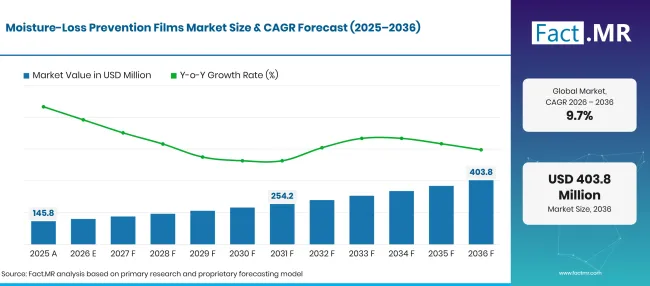
Moisture Loss Prevention Films Forecast Global | Source: Fact.MR
Category
| Category | Segments |
|---|---|
| Moisture barrier base | Wax / lipid, Polysaccharide-lipid, Protein-lipid; Cellulose composite; Multilayer edible |
| Commercial form | Powder, Liquid concentrate, Granulate; Encapsulated bead; Ready-to-use premix |
| Food application | Bakery, Dairy / alternatives, Beverage; Meat / savory; Confectionery / snacks |
| Primary function | Shelf-life, Texture / rheology, Taste / color; Nutritional functionality; Processing stability |
| Region | India; Netherlands; United States; China; Brazil |
Source: Fact.MR analysis. Updated Nov 19, 2026
Segmental Analysis
Why do Wax / lipid bases lead barrier demand in the Moisture-Loss Prevention Films Market?
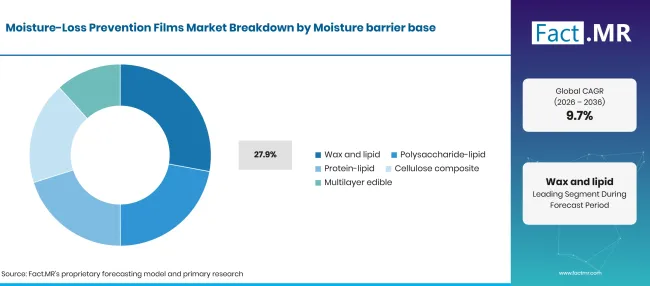
Moisture Loss Prevention Films Breakdown Moisture Barrier Base | Source: Fact.MR
Wax / lipid bases hold 27.9% of market revenue in 2026, valued at USD 44.6 million. Their ability to slow water movement makes them useful for coating fresh produce and protecting food surfaces during storage. Carnauba wax, beeswax and plant-derived oils are common materials in this category. A September 2025 study published in ACS Applied Materials & Interfaces examined carnauba wax combined with biopolymers to improve water-vapor and grease resistance in paper packaging, adding to research interest in wax-based barrier materials.
Why do Ready-to-use premix formats lead commercial-form demand in the Moisture-Loss Prevention Films Market?
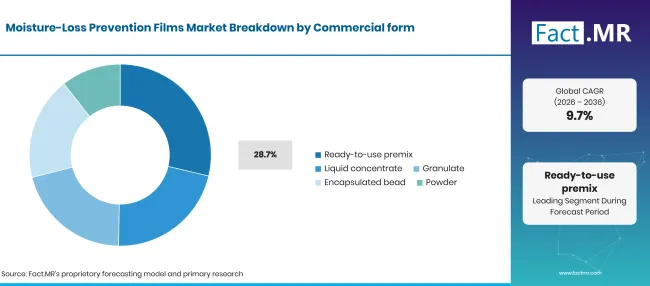
Moisture Loss Prevention Films Breakdown Commercial Form | Source: Fact.MR
Food processors account for a large part of the demand for ready-to-use premixes, which hold 28.7% of market revenue in 2026, equivalent to USD 45.9 million. These formulations reduce preparation steps and help maintain consistency during coating operations. Packhouses, confectionery units and food manufacturers can apply prepared mixtures without handling individual coating ingredients. The Ministry of Food Processing Industries' 2025–26 infrastructure assessment also highlights the importance of coordinated processing and packaging operations in maintaining food quality and shelf life.
Why does Confectionery / snacks lead application demand in the Moisture-Loss Prevention Films Market?
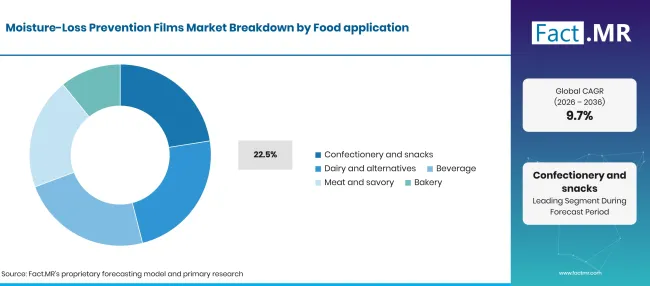
Moisture Loss Prevention Films Breakdown Food Application | Source: Fact.MR
Confectionery / snacks contribute 22.5% of market revenue in 2026, reaching USD 36.0 million. Chocolate-coated products, candies and savoury snacks need surface protection to control moisture movement, preserve crispness and prevent stickiness during storage. Wax-based glazes and edible coatings help maintain these qualities. A 2025 assessment by India's Ministry of Food Processing Industries highlighted the importance of airtight wrapping and moisture barriers in protecting chocolates, dairy-based sweets, biscuits and other confectionery products during storage and transportation.
Why does Shelf-life lead function demand in the Moisture-Loss Prevention Films Market?
Moisture Loss Prevention Films Breakdown Primary Function | Source: Fact.MR
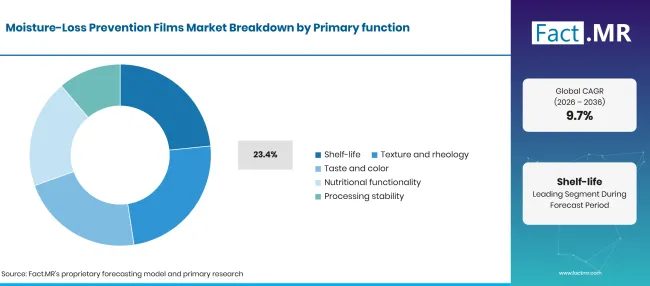
Shelf-life extension accounts for 23.4% of market revenue in 2026, worth USD 37.4 million. Food manufacturers focus on controlling moisture loss because even small changes can affect freshness, weight, texture and saleable quality. India's Ministry of Food Processing Industries reported in December 2025 that post-harvest losses included 7.36 million tonnes of fruits and 11.97 million tonnes of vegetables, highlighting the importance of better preservation. A 2025 ICAR-NISA study also found that coated strawberries retained firmness better during refrigerated storage than untreated fruit.
Moisture-Loss Prevention Films Market-Drivers, Restraints & Trends
Driver: Rising Need to Preserve Fresh Produce During Long-Distance Trade
International fruit and vegetable shipments often spend days or weeks in storage and transit before reaching retailers. During this period, moisture loss can reduce product weight, firmness and selling value; making preservation a commercial concern for exporters. This is creating room for edible barrier technologies that help maintain produce quality without relying entirely on conventional plastic packaging. The expansion of cross-border fresh food trade is opening additional opportunities for moisture-loss prevention films.
Restraint: Consumer Concerns Over Coating Ingredients
Adoption is not straightforward because some consumers question why fresh produce needs an added coating, particularly when its source is unclear. Beeswax and shellac also create problems for vegan product lines, while certain ingredients may raise sensitivity concerns. Different coating materials do not deliver the same shine, permeability or moisture protection, making replacement difficult for food processors. These concerns can increase labelling, testing and reformulation costs.
Trend:Shift Towards Plant-Based Wax Alternatives
Food manufacturers are paying closer attention to the origin of edible coating ingredients as vegan positioning gains importance. Carnauba and candelilla waxes are attracting interest as alternatives to animal-derived coating materials, although their performance varies by food application. In May 2026, FSSAI notified amendments to its Vegan Foods Regulations, including changes to vegan labelling requirements. This adds importance to ingredient transparency and creates room for plant-origin moisture barriers.
Trend: Multilayer Edible Barriers:
Combining lipid-rich materials with polysaccharides is gaining research attention because one coating ingredient rarely delivers every barrier property needed for food preservation. Layered structures can help balance moisture resistance, flexibility and surface protection. A January 2026 study from researchers at the University of Queensland demonstrated transparent, water-resistant edible coatings for banana preservation. Further work on combining edible barriers with existing packaging could open opportunities for longer-lasting, lower-plastic food preservation systems.
Moisture-Loss Prevention Films Market by Analysis by Key Country
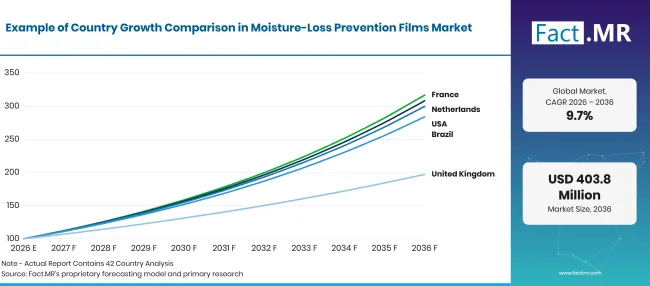
Moisture Loss Prevention Films Growth Index | Source: Fact.MR
| Country | CAGR (2026-2036) |
|---|---|
| India | 12.0% |
| Netherlands | 11.7% |
| United States | 11.6% |
| China | 11.3% |
| Brazil | 11.0% |
Source: Fact.MR analysis. Updated Nov 19, 2026
Why is India the fastest-growing market for moisture-loss prevention films?
Rising investment in food processing and export infrastructure is creating fresh sales opportunities for moisture-loss prevention films in India.
The Ministry of Food Processing Industries reported in January 2026 that processed food exports increased from 13.7% to 20.4% of agricultural exports between 2014–15 and 2024–25. More export-oriented food businesses are looking for ways to preserve freshness during storage and transportation. Sales are gaining ground across fruit packhouses, confectionery production and organised food processing.
What is driving moisture-loss prevention film demand in the Netherlands?
For Dutch food exporters, maintaining produce quality during international shipments is an important commercial concern.
Statistics Netherlands reported in 2026 that fruit exports reached EUR 9.6 billion in 2025, compared with EUR 8.1 billion in 2024. This large export business creates room for edible barriers that help preserve weight, appearance and freshness. Sales of moisture-loss prevention films are gaining support from advanced horticulture, high-volume packing operations and the Netherlands' role as a European fresh produce distribution centre.
What is shaping moisture-loss prevention film sales in the United States?
The scale of fresh food distribution across the United States is keeping interest in moisture-control coatings active.
Moisture Loss Prevention Films Forecast Usa | Source: Fact.MR
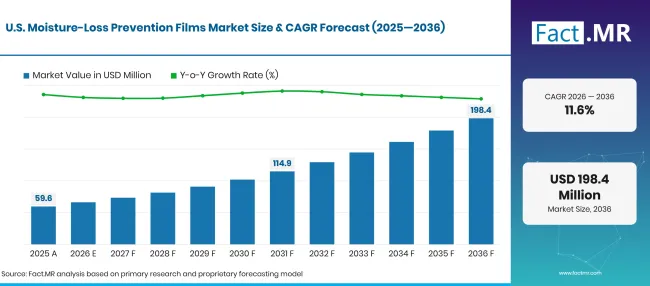
USDA data released in 2026 valued fresh fruit and vegetable exports at USD 12.92 billion for 2025, covering 7.27 million metric tons. Such trade volumes create a need to protect produce through storage, handling and transportation. Sales are being driven by exporters, supermarket supply chains and food processors seeking longer-lasting freshness, lower weight loss and better product condition at retail outlets.
What is shaping moisture-loss prevention film demand in China?
China's emphasis on post-harvest quality is opening new avenues for moisture-loss prevention films.
In August 2025, the country issued GB/T 26908-2025, a standard covering storage and logistics preservation of fresh Chinese jujubes; which took effect in December 2025. Such measures underline the importance of protecting agricultural produce after harvesting. Sales are gaining traction through fruit distribution networks, cold-chain operators and food processors looking to reduce moisture loss during storage and long-distance movement.
Why is moisture-loss prevention film growth slower in Brazil?
Brazil's fruit export business is giving moisture-preservation technologies a wider commercial opening.
CONAB reported that the country exported approximately 1.3 million tonnes of fruit in 2025, up 19.7% from 2024, with export earnings reaching USD 1.56 billion. Mangoes, melons, watermelons; lemons and limes were among the important export categories. Sales of moisture-loss prevention films are being encouraged by longer shipping routes, export quality requirements and the need to maintain fruit appearance and weight before products reach overseas buyers.
Competitive Landscape for Moisture-Loss Prevention Films Market
Competition in the moisture-loss prevention films market is moving beyond traditional wax coatings, with companies exploring plant-derived materials and edible barriers for different food applications. Mantrose-Haeuser serves established fruit and confectionery coating markets, while Apeel Sciences, Akorn Technology; Sufresca; Mori and Xampla are building positions around alternative formulations.
In June 2025, Akorn launched its Natural Advantage coating for cucumbers and peppers, while Xampla partnered with DIC Group in December 2025 to introduce Morro coatings in Asian markets. These moves are bringing greater attention to application performance, ingredient transparency and production costs. Sales opportunities will increasingly depend on commercial adoption and consistent moisture-control results.
Recent Developments
- On June 8, 2026, Akorn Technology commercially launched Akorn Natural Guard; a plant-based post-harvest treatment for mangoes that controls anthracnose and extends shelf life by up to 10 days.
- On June 18, 2025, AgroFresh Solutions and Nabaco signed an exclusive distribution agreement to bring Nabaco's NatuWrap fruit-protection technology to produce packers and processors worldwide.
- On May 28, 2026, TransFRESH Corporation acquired Hazel Technologies to expand its post-harvest freshness business and integrate Hazel's BreatheWay technology into its produce-preservation solutions.
- On November 3, 2025, Hazel Technologies expanded its partnership with QFresh Lab to strengthen post-harvest testing; packaging film development and research for new applications in floral; seafood; meat and coffee markets.
Key Players in Moisture-Loss Prevention Films Market
Key companies operating in the market include Apeel Sciences, Mori, Sufresca, Akorn Technology, Mantrose-Haeuser Co., Inc., AgroFresh Solutions, Inc., Pace International LLC, and Hazel Technologies, Inc.
- Apeel Sciences
- Mori
- Sufresca
- Akorn Technology
- Mantrose-Haeuser Co., Inc.
- AgroFresh Solutions, Inc.
- Pace International LLC
- Hazel Technologies, Inc.
Bibliography
- Agricultural and Processed Food Products Export Development Authority. (2025). Annual administrative report 2024–25. Ministry of Commerce and Industry, Government of India.
- China State Administration for Market Regulation. (2025). GB/T 26908-2025: Technical specifications for storage and logistics preservation of fresh Chinese jujubes. National Standard Information Public Service Platform.
- Companhia Nacional de Abastecimento. (2026, July 28). Comercialização de frutas e de hortaliças nas Ceasas brasileiras totalizam 16,6 milhões de toneladas em 2025.
- Fisher, S. G., Montemayor, M. D., Moran, A.; Uwalaka; C.; & Grunlan; J. C. (2025). Biopolymer and carnauba wax coating for improved paper oxygen barrier, water vapor barrier, and grease resistance. ACS Applied Materials & Interfaces, 17(39), 55307–55317.
- ICAR-National Institute of Secondary Agriculture. (2026). Annual report 2025. Indian Council of Agricultural Research.
- Ministry of Food Processing Industries. (2025, December 12). India strengthens cold-chain infrastructure to reduce post-harvest food losses. Press Information Bureau, Government of India.
- Statistics Netherlands. (2026, January 16). Value of agricultural exports up by over 8 percent in 2025.
- United States Department of Agriculture, Foreign Agricultural Service. (2026). Fruits and vegetables: U.S. fruits and vegetables exports in 2025.
- Weng, Y., Zhu; Y.; Ren; Y.; Oguzlu; H.; Shewan; H.; & Baldelli; A. (2026). Transparent and water-resistant edible coatings for sustainable post-harvest preservation of banana. Sustainable Food Technology, 4, 1953–1966.
Segmentation
Scope of Report
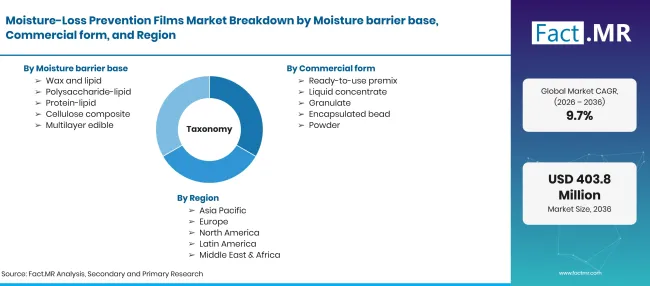
Moisture Loss Prevention Films Taxonomy | Source: Fact.MR
| Items | Values |
|---|---|
| Quantitative Units (2026) | USD 160.0 Million |
| Moisture barrier base | Wax / lipid, Polysaccharide-lipid, Protein-lipid; Cellulose composite; Multilayer edible |
| Commercial form | Powder, Liquid concentrate, Granulate; Encapsulated bead; Ready-to-use premix |
| Food application | Bakery, Dairy / alternatives, Beverage; Meat / savory; Confectionery / snacks |
| Primary function | Shelf-life, Texture / rheology, Taste / color; Nutritional functionality; Processing stability |
| Regions Covered | North America, Latin America, Europe; East Asia; South Asia and Pacific; Middle East & Africa |
| Countries Covered | India, Netherlands, United States; China; Brazil; and other countries |
| Key Companies Profiled | Apeel Sciences, Mori, Sufresca; Xampla; Mantrose-Haeuser; Akorn Technology |
| Additional Attributes | Dollar revenue in the Moisture-Loss Prevention Films Market is segmented by moisture barrier base (wax / lipid, polysaccharide-lipid, protein-lipid; cellulose composite; multilayer edible); commercial form (powder; liquid concentrate; granulate; encapsulated bead; ready-to-use premix); food application (bakery; dairy / alternatives; beverage; meat / savory; confectionery / snacks); primary function (shelf-life; texture / rheology; taste / color; nutritional functionality; processing stability) and region. |
Source: Fact.MR analysis. Updated Nov 19, 2026
Moisture-Loss Prevention Films Market by Segments
-
Moisture barrier base
- Wax / lipid
- Polysaccharide-lipid
- Protein-lipid
- Cellulose composite
- Multilayer edible
-
Commercial form
- Powder
- Liquid concentrate
- Granulate
- Encapsulated bead
- Ready-to-use premix
-
Food application
- Bakery
- Dairy / alternatives
- Beverage
- Meat / savory
- Confectionery / snacks
-
Primary function
- Shelf-life
- Texture / rheology
- Taste / color
- Nutritional functionality
- Processing stability
-
Region:
- North America
- United States
- Canada
- Mexico
- Europe
- Germany
- United Kingdom
- France
- Italy
- Spain
- Rest of Europe
- Asia Pacific
- China
- India
- Japan
- South Korea
- Australia
- Rest of Asia Pacific
- Latin America
- Brazil
- Mexico
- Argentina
- Rest of Latin America
- Middle East & Africa
- GCC Countries
- South Africa
- Rest of Middle East & Africa
- North America
Frequently Asked Questions
How big is the global Moisture-Loss Prevention Films Market in 2026?
What will be the size of the Moisture-Loss Prevention Films Market by 2036?
How fast will the Moisture-Loss Prevention Films Market grow during the forecast period?
Which moisture barrier base segment holds the largest share of the Moisture-Loss Prevention Films Market?
Who worked on this report


Preview the report firsthand - request a free sample
Free SampleGet the brochure for pricing and purchase details
Download PDF