- Base Value(2025): 5.7 Mn
- Estimated Value(2025): 5.7 Mn
- Forecast Value (2035): 14.9 Mn
- CAGR (2025 - 2035): 10.1%
Caprylic Acid Market Forecast and Outlook 2025 to 2035
The global caprylic acid market is projected to reach USD 14.9 million by 2035, recording an absolute increase of USD 9.2 million over the forecast period. The market is valued at USD 5.7 million in 2025 and is set to rise at a CAGR of 10.1% during the assessment period.
The market is expected to grow by 2.6 times during the same period, supported by increasing demand from personal care formulations and expanding applications in food and beverage processing across both developed and emerging consumer markets.
Quick Stats for Caprylic Acid Market
- Caprylic Acid Market Value (2025): USD 5.7 million
- Caprylic Acid Market Forecast Value (2035): USD 14.9 million
- Caprylic Acid Market Forecast CAGR: 10.1%
- Leading Application in Caprylic Acid Market: Personal Care (39.5%)
- Key Growth Regions in Caprylic Acid Market: Asia Pacific, North America, and Europe
- Top Players in Caprylic Acid Market: VVF L.L.C., Oleon NV, Wilmar International Ltd., KLK OLEO, Emery Oleochemicals, P & G Chemicals, PT. Ecogreen Oleochemicals, Temix Oleo Srl, Pacific Oleochemicals Sdn Bhd, Musim Mas Group
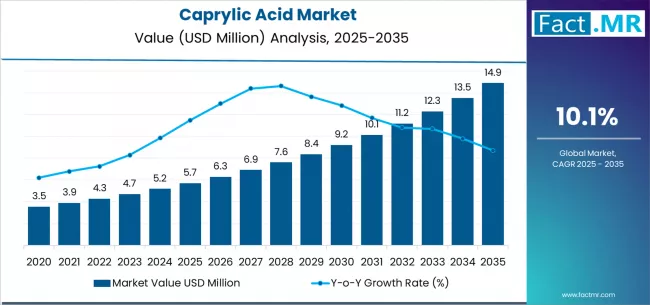
Caprylic Acid Market Market Value Analysis | Source: Fact.MR
Growing application diversity in pharmaceutical manufacturing, industrial chemical synthesis, and nutraceutical supplement production creates expanding opportunities for caprylic acid refinement and specialized purity innovations. Rising consumer awareness in Asia Pacific nations, coupled with expanding natural ingredient adoption through clean label initiatives and organic product formulations, further accelerate market penetration across diverse application segments.
The growing global demand for medium-chain triglycerides, particularly in functional food sectors where health-conscious consumers require natural preservative alternatives and antimicrobial agents, generates sustained requirements for food-grade caprylic acid and pharmaceutical-grade derivatives.
Technical advancements in fractionation technologies demonstrating measurable improvements in purity levels, yield optimization, and cost-effectiveness reinforce manufacturer confidence in caprylic acid economics, while skincare trends toward natural fatty acid ingredients and MCT-based formulations expand addressable market opportunities beyond traditional industrial applications into premium personal care and wellness product segments.
Cosmetic manufacturers and functional food producers increasingly incorporate caprylic acid into product formulations, replacing synthetic preservatives and improving ingredient transparency, creating mainstream adoption channels that extend beyond specialty applications into conventional consumer product environments.
However, raw material price volatility for coconut and palm kernel oil feedstocks and limited production capacity for high-purity grades in certain regions may pose challenges to market expansion. Competition from alternative medium-chain fatty acids and regulatory complexity for pharmaceutical-grade specifications in certain applications also influence adoption patterns, requiring manufacturers to develop diversified sourcing strategies catering to specific operational requirements across different quality standards.
Supply chain complexity during feedstock procurement and the technical requirements for fractionation process optimization and purity validation may limit accessibility among smaller formulators in developing regions with limited infrastructure for advanced fatty acid processing and quality assurance systems.
Caprylic Acid Market Year-over-Year Forecast 2025-2035
Between 2025 and 2030, the caprylic acid market is projected to expand from USD 5.7 million to USD 9.3 million, resulting in a value increase of USD 3.6 million, which represents 39.1% of the total forecast growth for the decade. This phase of development will be shaped by rising demand for natural preservatives and antimicrobial agents, product innovation in pharmaceutical-grade formulations and cosmetic-grade derivatives, as well as expanding integration with clean label food initiatives and natural skincare platforms. Companies are establishing competitive positions through investment in fractionation technology development, high-purity production capabilities, and strategic market expansion across personal care manufacturing facilities, functional food segments, and pharmaceutical ingredient applications.
From 2030 to 2035, the market is forecast to grow from USD 9.3 million to USD 14.9 million, adding another USD 5.6 million, which constitutes 60.9% of the overall ten-year expansion. This period is expected to be characterized by the expansion of specialized caprylic acid derivatives, including esterified forms and customized purity specifications tailored for specific pharmaceutical and cosmetic applications, strategic collaborations between fatty acid producers and end-use manufacturers, and an enhanced focus on sustainable sourcing practices and traceability programs. The growing emphasis on natural ingredient transparency and functional food innovation will drive demand for high-quality caprylic acid solutions across diverse consumer applications.
Caprylic Acid Market Key Takeaways
| Metric | Value |
|---|---|
| Market Value (2025) | USD 5.7 million |
| Market Forecast Value (2035) | USD 14.9 million |
| Forecast CAGR (2025-2035) | 10.1% |
Source: Fact.MR analysis. Updated Dec 3, 2025
Why is the Caprylic Acid Market Experiencing Steady Growth?
The caprylic acid market grows by enabling cosmetic formulators, food manufacturers, and pharmaceutical companies to access natural medium-chain fatty acids that support product performance while meeting consumer demand for clean label ingredients. Personal care brands and food processors face mounting pressure to develop natural formulations with proven antimicrobial properties and functional characteristics, with caprylic acid typically providing 8-carbon chain structure essential for skin penetration enhancement and microbial growth inhibition, making this ingredient essential for competitive positioning in natural skincare, functional foods, and pharmaceutical formulation categories.
The consumer products industry's need for natural preservative alternatives and multifunctional ingredients creates demand for diverse caprylic acid grades that can provide superior antimicrobial activity, maintain predictable performance across different formulation conditions, and ensure regulatory compliance without compromising product efficacy or ingredient transparency.
Government initiatives promoting natural ingredient adoption and clean label food standards drive utilization in personal care manufacturing facilities, food processing plants, and pharmaceutical production operations, where caprylic acid incorporation has a direct impact on product preservation and functional benefits.
The wellness industry's growing focus on MCT supplementation and ketogenic diet support further expands market opportunities, with nutritional research demonstrating measurable health advantages from medium-chain fatty acid consumption, including enhanced energy metabolism and antimicrobial benefits.
Supply chain complexity during coconut oil fractionation and the technical requirements for pharmaceutical-grade purity achievement and regulatory compliance may limit accessibility among smaller formulators and developing regions with limited infrastructure for advanced fatty acid processing and quality control systems.
Segmental Analysis
The market is segmented by application and region. By application, the market is divided into personal care, food & beverages, pharmaceutical, and others. Regionally, the market is divided into Asia Pacific, North America, Europe, Latin America, and Middle East & Africa.
Which is the Dominant Application Area for Caprylic Acid?
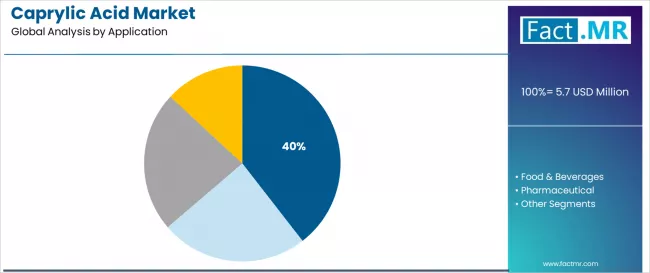
Caprylic Acid Market Analysis By Application | Source: Fact.MR
The personal care segment represents the dominant force in the caprylic acid market, capturing 39.5% of the total market share in 2025. This established application category encompasses solutions featuring skincare formulations with antimicrobial properties (21.0%), haircare products offering scalp health benefits (9.3%), and cosmetic applications providing emollient characteristics (6.2%), including natural preservative systems that enable product stability across all personal care formulation types.
The personal care segment's market leadership stems from its essential role in natural cosmetic ingredient formulations, with caprylic acid capable of meeting diverse functional requirements while maintaining clean label positioning and proven skin compatibility across all cosmetic and personal care applications. Within the personal care segment, skincare applications account for the largest consumption share, driven by anti-acne product formulations and natural moisturizer development across global beauty markets.
Key advantages driving the personal care segment include:
- Natural ingredient positioning with established consumer acceptance that reduces formulation complexity and ensures market appeal
- Multifunctional benefits allowing antimicrobial protection, emollient properties, and skin penetration enhancement without significant formulation modifications
- Proven skin compatibility, delivering reliable performance while maintaining competitiveness against synthetic preservative alternatives
- Premium product positioning enabling straightforward incorporation into natural and organic certified cosmetics across multiple personal care categories
Why does the Food & Beverages Segment Demonstrate Fastest Growth Potential?
The food & beverages segment represents the fastest-growing application category, capturing approximately 32.8% of total market share in 2025. This expanding segment encompasses natural preservative applications for dairy products requiring extended shelf life without synthetic additives, functional beverage formulations incorporating MCT benefits for ketogenic and wellness-focused consumers, and baked goods applications where antimicrobial properties support product quality during distribution. The food & beverages segment's growth momentum stems from clean label movement acceleration and functional food innovation, with caprylic acid offering natural preservation capabilities while supporting nutritional benefit claims across all food processing applications.
Within the food & beverages segment, dairy product preservation represents the largest application area at 15.4% share, driven by cheese manufacturing requirements and cultured dairy applications where natural antimicrobial agents prevent spoilage organisms. Functional beverages account for 7.8% share, serving MCT-enhanced sports nutrition drinks and ketogenic diet support products requiring medium-chain triglyceride content. Baked goods applications maintain 6.1% share, providing mold inhibition and shelf-life extension for bread products and pastries through natural preservative functionality.
Key advantages driving the food & beverages segment include:
- Clean label alignment with consumer demand for natural preservatives that reduces formulation barriers and ensures regulatory compliance
- Functional benefit delivery allowing antimicrobial protection combined with nutritional advantages without excessive processing requirements
- Generally Recognized as Safe (GRAS) status, delivering regulatory acceptance while maintaining competitiveness against alternative preservative systems
- Versatile application compatibility enabling straightforward incorporation across diverse food matrices and processing conditions
What are the Drivers, Restraints, and Key Trends of the Caprylic Acid Market?
The market is driven by three concrete demand factors tied to natural ingredient adoption and functional food innovation. First, increasing consumer preference for natural preservatives and clean label ingredients creates growing demand for caprylic acid alternatives to synthetic antimicrobials, with global natural personal care product sales expanding by 8-10% annually in major consumer markets worldwide, requiring comprehensive natural ingredient supply infrastructure. Second, expanding MCT oil popularity and ketogenic diet adoption drive increased utilization of medium-chain fatty acids, with many sports nutrition and functional food manufacturers implementing MCT-enhanced product lines and wellness-focused formulations by 2030. Third, technological advancements in coconut oil fractionation and palm kernel processing enable more effective caprylic acid production that improves purity levels while reducing manufacturing costs and environmental impact.
Market restraints include feedstock price volatility for coconut and palm kernel oils that can impact caprylic acid production economics, particularly in regions where tropical oil availability faces constraints or commodity price fluctuations affect raw material costs. Limited production capacity for pharmaceutical-grade specifications poses another significant challenge, as high-purity caprylic acid requires specialized fractionation equipment and quality control systems, potentially causing supply limitations for pharmaceutical applications. Competition from alternative medium-chain fatty acids and synthetic preservative systems creates additional market challenges for price-sensitive applications, demanding ongoing investment in cost reduction initiatives and performance differentiation.
Key trends indicate accelerated adoption in MCT supplement formulations, particularly in sports nutrition and ketogenic diet products where medium-chain triglyceride benefits drive comprehensive functional ingredient integration. Technology integration trends toward sustainable palm oil sourcing with RSPO certification requirements, transparent supply chain traceability, and carbon footprint reduction enable enhanced sustainability positioning that addresses environmental concerns and consumer expectations. However, the market thesis could face disruption if significant advances in synthetic antimicrobial alternatives or major shifts in dietary trend preferences reduce reliance on medium-chain fatty acid supplementation.
Analysis of the Caprylic Acid Market by Key Countries
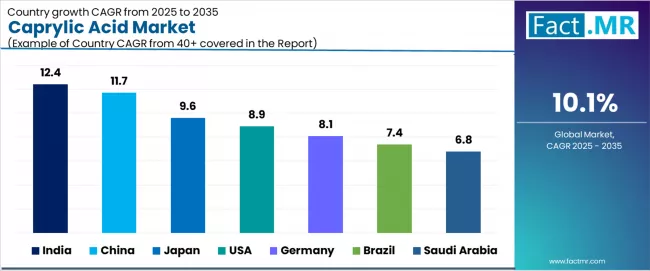
Caprylic Acid Market Cagr Analysis By Country | Source: Fact.MR
| Country | CAGR (2025-2035) |
|---|---|
| India | 12.4% |
| China | 11.7% |
| Japan | 9.6% |
| USA | 8.9% |
| Germany | 8.1% |
| Brazil | 7.4% |
| Saudi Arabia | 6.8% |
Source: Fact.MR analysis. Updated Dec 3, 2025
The caprylic acid market is expanding steadily, with India leading at a 12.4% CAGR through 2035, driven by surge in organic food production and clean label ingredient adoption. China follows at 11.7%, supported by strong e-commerce channel growth in MCT products and cosmetic formulations. Japan records 9.6%, reflecting demand for pharmaceutical-grade fatty acids and functional food ingredients.
USA posts 8.9%, anchored by largest personal care market presence and skincare product innovation. Germany grows at 8.1%, with growth in functional food development and nutraceutical supplement adoption. Brazil advances at 7.4%, emphasizing expanding processed food manufacturing and natural ingredient integration, while Saudi Arabia grows steadily at 6.8%, focusing on increased spending on premium personal care products and cosmetic formulations.
India Leads Global Market Expansion
India demonstrates the strongest growth potential in the caprylic acid market with a CAGR of 12.4% through 2035. The country's leadership position stems from surge in organic food production, accelerating clean label ingredient adoption, and growing natural personal care market enabling mainstream caprylic acid utilization.
Growth is concentrated in major manufacturing regions, including Maharashtra, Gujarat, Tamil Nadu, and Karnataka, where food processing clusters and expanding cosmetic manufacturing operations are implementing natural ingredient sourcing for enhanced product positioning and consumer appeal.
Distribution channels through ingredient suppliers, cosmetic raw material distributors, and pharmaceutical ingredient wholesalers expand deployment across food manufacturers and personal care brands. The country's growing organic certification programs provide market support for natural ingredient adoption, including investment in coconut processing infrastructure and fractionation capabilities.
Key market factors:
- Organic food demand concentrated in urban consumer markets and export-oriented food processing with comprehensive natural ingredient requirements
- Clean label movement through domestic brand reformulation and multinational product localization initiatives
- Comprehensive natural ingredient ecosystem, including established coconut oil processing with proven fractionation capabilities
- Consumer awareness featuring health-conscious purchasing patterns, wellness product adoption, and natural cosmetic preferences
China Emerges as E-Commerce Leader
In major consumer markets including Shanghai, Beijing, Guangzhou, and Shenzhen, the adoption of MCT-containing products and natural cosmetic formulations is accelerating across e-commerce platforms and specialty retail channels, driven by digital commerce growth and health supplement popularity. The market demonstrates strong growth momentum with a CAGR of 11.7% through 2035, linked to e-commerce channel expansion for MCT products, cosmetic formulation innovation, and sustained consumer demand for functional ingredients.
Consumers are adopting caprylic acid-containing supplements and skincare products through online health and beauty platforms, creating opportunities for comprehensive market expansion and product category development. The country's digital commerce infrastructure creates persistent demand for MCT supplements, while increasing emphasis on natural beauty ingredients drives adoption of caprylic acid in cosmetic formulations.
Key development areas:
- E-commerce and health supplement sectors leading caprylic acid-containing product adoption with growing consumer interest
- Digital platform expansion providing improved product accessibility with comprehensive online distribution infrastructure
- International partnerships between Chinese brands and fatty acid suppliers are expanding ingredient availability
- Integration of functional food concepts and comprehensive wellness product positioning
Japan shows Pharmaceutical Focus
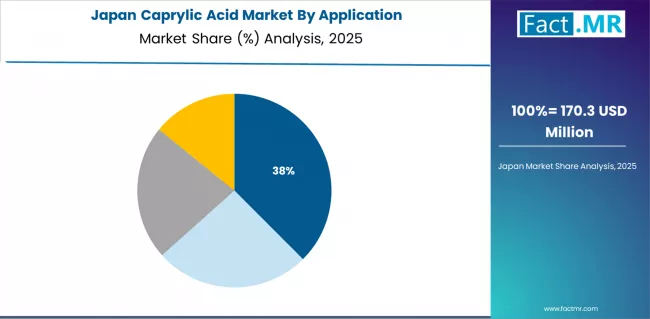
Caprylic Acid Market Japan Market Share Analysis By Application | Source: Fact.MR
Japan's market expansion is driven by pharmaceutical-grade fatty acid demand, including antimicrobial ingredient requirements in Tokyo and Osaka pharmaceutical manufacturing centers, and expanding functional food applications across multiple consumer segments. The country demonstrates promising growth potential with a CAGR of 9.6% through 2035, supported by pharmaceutical manufacturing requirements, functional food innovation culture, and strategic quality standards for ingredient purity.
Japanese pharmaceutical manufacturers require high purity caprylic acid specifications, demanding stringent quality control and regulatory compliance through established ingredient supply relationships. Growing pharmaceutical production and functional food development create substantial opportunities for pharmaceutical grade caprylic acid adoption, particularly in applications where purity specifications have direct impact on therapeutic efficacy and regulatory approval.
Key market characteristics:
- Pharmaceutical and functional food sectors showing consistent demand with substantial quality requirement emphasis
- Quality standards focused on pharmaceutical-grade specifications and comprehensive purity validation programs
- Future projections indicate continued pharmaceutical manufacturing growth and expanded functional ingredient adoption
- Growing emphasis on ingredient traceability and comprehensive quality documentation systems
USA Demonstrates Market Leadership
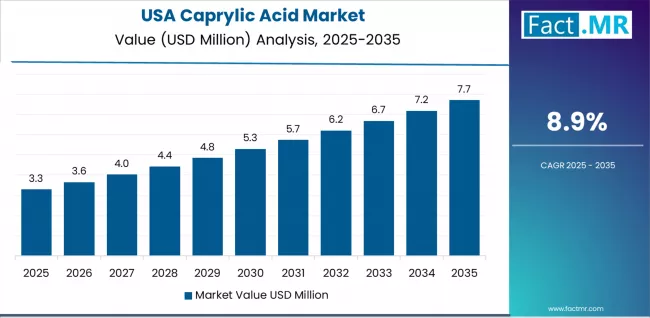
Caprylic Acid Market Country Value Analysis | Source: Fact.MR
USA’s market leads in personal care applications based on integration with natural skincare formulations and clean beauty product development for enhanced consumer appeal. The country shows steady potential with a CAGR of 8.9% through 2035, driven by largest personal care market presence globally, established natural products industry, and ongoing clean beauty movement expansion across major consumer markets, including California, New York, Texas, and Florida regions.
American personal care brands demonstrate sophisticated natural ingredient utilization, particularly in independent beauty brands with established clean formulation principles and natural certification requirements demanding comprehensive ingredient transparency. Technology deployment channels through cosmetic ingredient distributors and specialty chemical suppliers expand coverage across personal care manufacturers and contract formulators.
Leading market segments:
- Natural skincare brands and clean beauty companies driving caprylic acid adoption with emphasis on multifunctional natural ingredients
- Strategic formulation partnerships with ingredient suppliers, achieving optimized performance characteristics and regulatory compliance
- Collaborative programs between personal care brands and fatty acid manufacturers are expanding application development
- Focus on natural preservative systems and comprehensive clean beauty positioning methodologies
Germany Emphasizes Functional Foods
In major consumer regions including Bavaria, North Rhine-Westphalia, and Baden-Württemberg, food manufacturers and nutraceutical companies are implementing comprehensive natural ingredient strategies to optimize product formulations and meet consumer expectations, with documented adoption showing significant growth in functional food applications through natural preservative integration and MCT supplementation.
The market shows steady growth potential with a CAGR of 8.1% through 2035, linked to functional food innovation leadership, nutraceutical supplement development, and ongoing natural ingredient adoption in major regions. German manufacturers adopt caprylic acid for functional benefit delivery and natural preservation that supports clean label positioning demanded by health-conscious consumers and regulatory transparency requirements. The country's sophisticated food industry infrastructure creates persistent demand for natural ingredient solutions and comprehensive functional food development that integrates with existing processing capabilities.
Market development factors:
- Functional food manufacturers and nutraceutical brands leading caprylic acid adoption across Germany
- Industry standards and regulatory frameworks providing guidance for natural ingredient utilization and health claim substantiation
- Strategic relationships between German food companies and ingredient suppliers are expanding natural formulation capabilities
- Emphasis on functional benefit validation and comprehensive scientific substantiation methodologies
Brazil shows Processing Expansion
Brazil's caprylic acid market demonstrates competitive positioning focused on processed food manufacturing expansion and natural ingredient adoption in food preservation applications, with documented utilization in food processing facilities, achieving product quality improvements through natural antimicrobial integration in São Paulo, Minas Gerais, and other manufacturing regions.
The country maintains steady growth momentum with a CAGR of 7.4% through 2035, driven by expanding processed food sector, natural ingredient demand growth, and strategic food industry modernization initiatives. Major food processing operations, including dairy manufacturers and bakery operations, showcase growing adoption of natural preservative systems where caprylic acid supports product quality and comprehensive shelf life management programs.
Key market characteristics:
- Food processing and dairy sectors driving caprylic acid adoption with emphasis on natural preservation and clean label positioning
- Industry modernization enabling natural ingredient integration with comprehensive processing improvements
- Ingredient partnerships between Brazilian food companies and international suppliers are expanding capabilities
- Emphasis on cost-effective natural solutions and practical application methodologies
Saudi Arabia Emphasizes Premium Personal Care
Saudi Arabia's caprylic acid market demonstrates developing landscape, characterized by premium personal care consumption and increasing spending on cosmetic products across major urban centers. The country shows steady growth momentum with a CAGR of 6.8% through 2035, driven by increased consumer spending on premium personal care, growing cosmetic market sophistication, and expanding beauty product retail concentrated in Riyadh, Jeddah, and Eastern Province. Saudi Arabia's emphasis on premium beauty products and international brand preferences creates requirements for high-quality cosmetic ingredients that support comprehensive product formulations and quality standards in personal care operations.
The market benefits from strong international brand presence and consumer willingness to pay premiums for quality products, creating comprehensive retail ecosystems that prioritize ingredient quality and product efficacy. Personal care retail operations in major cities showcase growing natural ingredient adoption where consumer awareness supports premium positioning through ingredient transparency programs.
Key market characteristics:
- Premium personal care consumers and international beauty brands driving caprylic acid-containing product demand with emphasis on quality and efficacy
- Consumer affluence enabling premium product purchases with comprehensive spending on beauty and personal care
- International brand relationships between global cosmetic companies and Saudi retailers are expanding product availability
- Emphasis on luxury positioning and comprehensive beauty product quality methodologies
Europe Market Split by Country
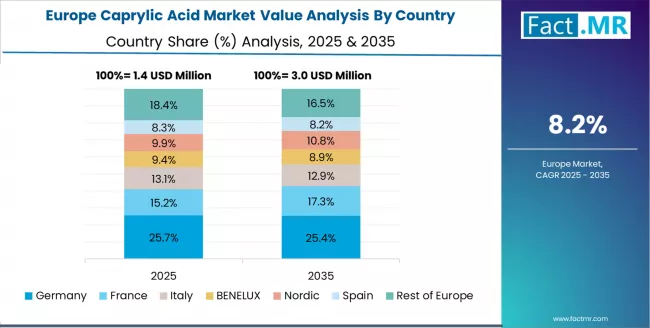
Caprylic Acid Market Europe Country Market Share Analysis, 2025 & 2035 | Source: Fact.MR
The caprylic acid market in Europe is projected to grow from USD 1.3 million in 2025 to USD 3.1 million by 2035, registering a CAGR of 9.1% over the forecast period. Germany is expected to maintain its leadership position with a 29.4% market share in 2025, supported by its advanced functional food industry, comprehensive natural ingredient adoption, and strong emphasis on clean label formulations across major manufacturing centers.
France follows with a 24.6% share in 2025, driven by established cosmetic industry presence and natural personal care product innovation. UK holds a 18.7% share in 2025 through its clean beauty market development and natural skincare brand growth. Italy commands a 14.3% share, while Rest of Europe accounts for 13.0% in 2025.
By 2035, Germany is projected to hold 29.2% share, France 24.8%, UK 18.9%, Italy 14.4%, and Rest of Europe 12.7%, reflecting sustained growth momentum across all major European markets and increasing caprylic acid adoption in diversified natural product applications implementing clean label and functional ingredient programs.
Competitive Landscape of the Caprylic Acid Market
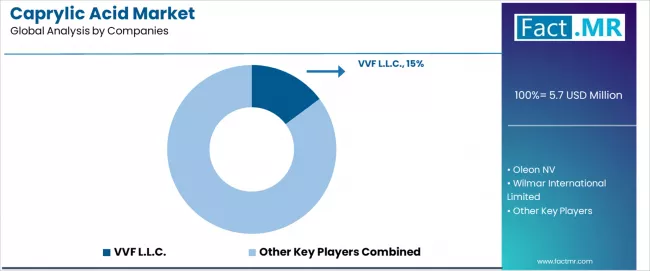
Caprylic Acid Market Analysis By Company | Source: Fact.MR
The caprylic acid market features approximately 20-30 meaningful players with moderate concentration, where the top three companies control roughly 35-45% of global production capacity through established fractionation operations and extensive customer relationships across oleochemical and specialty ingredient sectors.
Market leaders include VVF L.L.C., Oleon NV, and Wilmar International Ltd., which maintain competitive advantages through comprehensive fatty acid portfolios, integrated oleochemical production capabilities, and deep expertise in the tropical oil processing and specialty chemical sectors, creating strong customer relationships among personal care formulators and food ingredient buyers.
These companies leverage established fractionation facilities and ongoing purity optimization initiatives to defend market positions while expanding into pharmaceutical-grade applications and specialty derivative markets. VVF L.L.C. commands a 14.8% market share through integrated coconut oil processing operations and strategic positioning in personal care and food ingredient markets.
Challengers encompass KLK Oleo, Emery Oleochemicals, and P & G Chemicals, which compete through diversified oleochemical portfolios and strong regional presence in key fatty acid markets. Specialty producers, including PT. Ecogreen Oleochemicals, Temix Oleo Srl, and Pacific Oleochemicals Sdn Bhd, focus on specific purity grades or regional markets, offering differentiated capabilities in pharmaceutical-grade production, kosher certification, and technical support services.
Regional players and emerging producers create competitive pressure through sustainable sourcing capabilities and strategic market positioning, particularly in high-growth markets including India and China, where local coconut oil processing provides advantages in cost optimization and supply chain proximity.
Market dynamics favor companies that combine advanced fractionation technologies with comprehensive quality management systems that address the complete value chain from tropical oil sourcing through distillation operations and purity validation. Strategic investments in sustainable palm oil certification and coconut supply chain traceability enable market differentiation and customer confidence enhancement across ingredient portfolios.
Global Caprylic Acid Market - Stakeholder Contribution Framework
Caprylic acid represents a critical medium-chain fatty acid that enables personal care formulators, food manufacturers, and pharmaceutical companies to enhance product performance and natural ingredient positioning without substantial formulation modifications, typically providing antimicrobial functionality and multifunctional benefits while supporting diverse application requirements.
With the market projected to grow from USD 5.7 million in 2025 to USD 14.9 million by 2035 at a 10.1% CAGR, this ingredient offers compelling advantages - natural preservative activity, multifunctional benefits, and clean label compatibility - making it essential for skincare formulations (largest segment), functional food applications (fastest growth), and diverse natural product applications seeking proven medium-chain fatty acid benefits. Scaling production capacity and market development requires coordinated action across sustainable sourcing, quality standards, ingredient manufacturers, brand formulators, and regulatory compliance.
How Governments Could Spur Local Production and Adoption?
- Natural Ingredient Programs: Include medium-chain fatty acid production in agricultural development strategies, providing targeted funding for coconut processing facilities in tropical regions and supporting local oleochemical manufacturers through investment incentives and technology transfer support.
- Quality & Safety Standards: Implement comprehensive ingredient specifications for caprylic acid across food, cosmetic, and pharmaceutical applications, provide access to analytical testing infrastructure, and establish certification programs that ensure quality consistency and regulatory compliance.
- Agricultural Support Initiatives: Create favorable programs for coconut and palm kernel farmers, establish sustainable agricultural practices for tropical oil crops, and develop cooperative structures that facilitate smallholder farmer integration into oleochemical supply chains.
- Research & Development Funding: Fund fractionation technology research for improved purity achievement, cost reduction initiatives, and process optimization. Invest in application development programs that demonstrate caprylic acid benefits and formulation compatibility across diverse end uses.
How Industry Bodies Could Support Market Development?
- Ingredient Standards & Specifications: Define standardized quality requirements for caprylic acid across application categories, establish universal testing protocols for purity and performance metrics, and create grade classifications for food, cosmetic, and pharmaceutical applications that manufacturers can implement.
- Application Development & Technical Guidance: Lead communication initiatives demonstrating caprylic acid benefits, emphasizing proven antimicrobial activity, multifunctional performance, and formulation advantages compared to synthetic alternative ingredients.
- Sustainable Sourcing Guidelines: Develop environmental performance standards for tropical oil feedstock sourcing, comprehensive traceability protocols, and certification frameworks, ensuring responsible production across different geographical regions and supply chain structures.
How Ingredient Manufacturers and Brand Formulators Could Strengthen the Ecosystem?
- Quality & Purity Development: Develop pharmaceutical-grade caprylic acid with enhanced purity specifications, improved consistency characteristics, and application-specific features that enhance performance while maintaining cost competitiveness and regulatory compliance.
- Technical Application Support: Provide comprehensive formulation services integrating stability testing, antimicrobial efficacy validation, regulatory compliance guidance, and performance optimization, enabling formulators to maximize ingredient benefits and product quality.
- Supply Chain Transparency: Offer comprehensive traceability systems including feedstock sourcing documentation, processing facility certifications, and sustainability credentials that help brands communicate ingredient quality and environmental responsibility to consumers through transparent supply chain practices.
Key Players in the Caprylic Acid Market
- VVF L.L.C.
- Oleon NV
- Wilmar International Limited
- KLK Oleo
- Emery Oleochemicals Group
- P&G Chemicals
- PT Ecogreen Oleochemicals
- Temix Oleo Srl
- Pacific Oleochemicals Sdn. Bhd.
- Musim Mas Group
Segmentation
Scope of the Report
| Items | Values |
|---|---|
| Quantitative Units | USD 5.7 Million |
| Application | Personal Care, Food & Beverages, Pharmaceutical, Others |
| Regions Covered | Asia Pacific, North America, Europe, Latin America, Middle East & Africa |
| Country Covered | India, China, Japan, USA, Germany, Brazil, Saudi Arabia, and 40+ countries |
| Key Companies Profiled | VVF L.L.C., Oleon NV, Wilmar International Ltd., KLK OLEO, Emery Oleochemicals, P & G Chemicals, PT. Ecogreen Oleochemicals, Temix Oleo Srl, Pacific Oleochemicals Sdn Bhd, Musim Mas Group |
| Additional Attributes | Dollar sales by application categories, regional adoption trends across Asia Pacific, North America, and Europe, competitive landscape with oleochemical manufacturers and specialty ingredient companies, quality specifications and purity requirements, integration with personal care formulation operations and food ingredient applications. |
Source: Fact.MR analysis. Updated Dec 3, 2025
Caprylic Acid Market by Segments
-
Application :
- Personal Care
- Skincare
- Haircare
- Cosmetics
- Other Personal Care
- Food & Beverages
- Dairy Products
- Beverages
- Baked Goods
- Other Foods
- Pharmaceutical
- Antifungal Medicines
- Gastrointestinal Treatments
- Supplements/Nutraceuticals
- Other Pharmaceutical
- Others
- Personal Care
-
Region :
- Asia Pacific
- China
- Japan
- South Korea
- India
- Australia & New Zealand
- ASEAN
- Rest of Asia Pacific
- North America
- USA
- Canada
- Mexico
- Europe
- Germany
- France
- UK
- Italy
- Rest of Europe
- Latin America
- Brazil
- Rest of Latin America
- Middle East & Africa
- Kingdom of Saudi Arabia
- Other GCC Countries
- Turkey
- South Africa
- Rest of Middle East & Africa
- Asia Pacific
Frequently Asked Questions
How big is the caprylic acid market in 2025?
What will be the size of caprylic acid market in 2035?
How much will be the caprylic acid market growth between 2025 and 2035?
What are the key product types in the caprylic acid market?
Which segment to contribute significant share in the caprylic acid market in 2025?
Who worked on this report


Preview the report firsthand - request a free sample
Free SampleGet the brochure for pricing and purchase details
Download PDF