Cashew Nut Essential Oil Market Size, Share, Growth and Forecast (2026 - 2036)
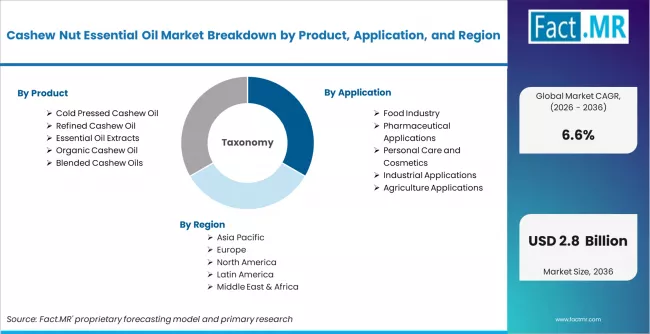
Cashew Nut Essential Oil Market is segmented by Product (Cold Pressed Cashew Oil, Refined Cashew Oil, Essential Oil Extracts, Organic Cashew Oil, Blended Cashew Oils), Application (Food Industry, Pharmaceutical Applications, Personal Care and Cosmetics, Industrial Applications, Agriculture Applications), End Use (Food Manufacturers, Pharmaceutical Companies, Cosmetic Manufacturers, Industrial Manufacturers, Agricultural Sector), and Region, with forecasts covering the period from 2026 to 2036.
According to Fact.MR estimates, the global cashew nut essential oil market market was valued at USD 1.4 billion in 2025. The market is projected to reach USD 1.5 billion in 2026 and is expected to grow to USD 2.8 billion by 2036, expanding at a CAGR of 6.6%. Cold Pressed Cashew Oil is anticipated to account for 36.8% of the product segment in 2026, while Food Industry is expected to remain the leading application with around 41.3% share.
Cashew Nut Essential Oil Market Analysis and Forecast by Fact.MR
The cashew nut essential oil market, valued at USD 1.41 billion in 2025, is expanding at a 6.6% CAGR to reach USD 2.848 billion by 2036. Cashew nut oil is extracted from cashew kernels through cold pressing, solvent extraction, or supercritical fluid methods, delivering a mild-flavoured culinary oil rich in monounsaturated fatty acids and a functional ingredient for pharmaceutical, cosmetic, industrial, and agricultural applications. Growth is shaped by premium culinary oil demand, natural cosmetic ingredient adoption, cashew shell liquid (CNSL) industrial applications, and expanding pharmaceutical excipient use.

Summary of Cashew Nut Essential Oil Market
- Market Snapshot
- The cashew nut essential oil market is valued at USD 1.41 billion in 2025.
- Estimated market value for 2026 is USD 1.503 billion, projected to reach USD 2.848 billion by 2036.
- A CAGR of 6.6% is forecast for the 2026 to 2036 assessment period.
- Incremental opportunity of USD 1.345 billion between 2026 and 2036.
- Cold pressed cashew oil holds 36.8% of the product segment, with food industry capturing 41.3% of application demand.
- India and China are the fastest-growing markets for cashew nut oil consumption.
- Demand and Growth Drivers
- Premium culinary oil demand is growing as consumers seek alternatives to standard cooking oils, with cashew oil's mild flavour, high smoke point (230C), and monounsaturated fat profile positioning it alongside avocado and macadamia oils in premium cooking applications.
- Natural cosmetic ingredient adoption is driving cashew oil use in skin care, hair care, and massage oil formulations, where its emollient properties, vitamin E content, and rapid skin absorption create functional advantages over mineral oil alternatives.
- Cashew nut shell liquid (CNSL), a by-product of cashew processing, is gaining industrial applications in brake pad manufacturing, surface coatings, and resin production, creating a value-added revenue stream alongside kernel oil extraction.
- Pharmaceutical applications for cashew oil as a carrier oil, soft gel capsule fill, and excipient ingredient are expanding as pharmaceutical manufacturers seek natural-origin alternatives to synthetic oils.
- Product and Segment View
- Cold pressed cashew oil holds 36.8% of the product segment, reflecting consumer preference for minimal processing and retained nutritional properties.
- Food industry captures 41.3% of application demand, driven by culinary oil, food manufacturing ingredient, and flavouring applications.
- Direct sales account for 52.4% of distribution channel demand, reflecting the B2B nature of cashew oil trade between processors and end-use manufacturers.
- Key segmentation includes:
- Product: Cold Pressed Cashew Oil, Refined Cashew Oil, Essential Oil Extracts, Organic Cashew Oil, Blended Cashew Oils
- Application: Food Industry, Pharmaceutical Applications, Personal Care and Cosmetics, Industrial Applications, Agriculture Applications
- End Use: Food Manufacturers, Pharmaceutical Companies, Cosmetic Manufacturers, Industrial Manufacturers, Agricultural Sector
- Distribution Channel: Direct Sales, Distributors, Online B2B Platforms, Retail Channels, Export Channels
- Extraction Technology: Cold Press Extraction, Solvent Extraction, Supercritical Fluid Extraction, Steam Distillation
- Purity Level: Medium Purity, Low Purity, High Purity, Ultra High Purity
- Geography and Competitive Outlook
- North America accounts for significant revenue, with the USA generating USD 0.546 billion in 2025.
- East Asia is expanding, with Japan contributing USD 0.071 billion and South Korea contributing USD 0.041 billion in 2025.
- Olam International Limited holds approximately 14.0% of global market share through integrated cashew processing and oil extraction operations.
- V.V.F. Limited, Dheeraj Cashews Processors, and Alwin Exports compete on processing quality, organic certification, and origin traceability.
- Analyst Opinion
- The cashew nut oil market is transitioning from a by-product of cashew kernel processing to a primary value-added product in its own right. Historically, cashew oil extraction was secondary to whole kernel and split kernel sales, with oil produced from broken and undergrade kernels. The current shift treats oil extraction as a deliberate processing objective, with producers investing in cold press technology and quality standardisation to serve premium culinary and cosmetic markets. Companies that achieve food-grade and cosmetic-grade quality certifications will capture the value-added segment.
Key Growth Drivers, Constraints, and Opportunities
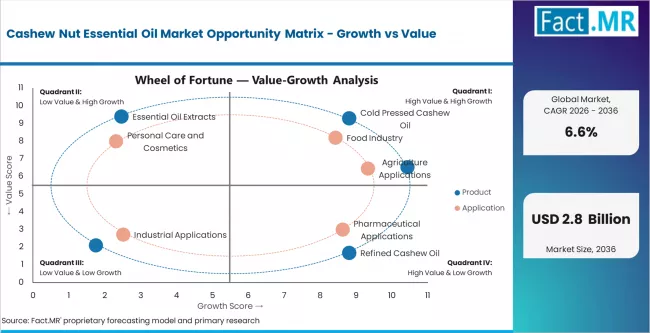
Key Factors Driving Growth
- Global cashew production exceeded 4.2 million tonnes of raw cashew nuts in 2024, per FAO data, with India, Vietnam, Ivory Coast, and Tanzania as primary producers. Cashew oil extraction capacity is scaling as processors invest in value-added product diversification beyond whole kernel sales, particularly for utilising broken and undergrade kernels that command lower prices in the snack nut market.
- The global natural cosmetics market is growing at 8 to 10% annually, per Cosmetics Europe data, creating demand for plant-derived emollient oils. Cashew oil's rapid skin absorption, non-greasy finish, and vitamin E content make it a competitive alternative to argan oil and jojoba oil in cosmetic formulations, with the advantage of more abundant and price-stable supply.
- Industrial CNSL applications in friction materials (brake pads, clutch plates), surface coatings, and bio-based resins are growing as manufacturers seek petrochemical alternatives. CNSL-derived cardanol is a natural phenol that can substitute for petrochemical phenols in polymer production, creating industrial demand that supports the economics of integrated cashew processing.
Key Market Constraints
- Cashew processing yield variability affects oil production economics. Cashew kernel oil content ranges from 40 to 47% depending on variety, growing conditions, and kernel grade, creating batch-to-batch quality inconsistency that complicates standardised product supply.
- Competition from lower-cost vegetable oils (sunflower, canola, palm) in food applications and from established cosmetic oils (jojoba, argan, sweet almond) in personal care applications constrains cashew oil market penetration in price-sensitive segments.
- Seasonal cashew harvesting (typically 2 to 3 months per year in each producing country) creates raw material supply concentration that can lead to price spikes and supply gaps if storage and inventory management are inadequate.
Key Opportunity Areas
- Organic cashew oil is a premium niche commanding 40 to 60% price premiums, with supply constrained by the limited availability of certified organic cashew production. India's organic cashew cultivation is expanding, per APEDA data, creating new supply for the organic oil segment.
- Pharmaceutical-grade cashew oil for soft gel capsule filling, drug delivery systems, and nutraceutical formulations is an emerging high-value application. Pharmaceutical-grade specifications command prices 3 to 5 times above food-grade product.
- Africa-origin cashew oil production (Ivory Coast, Tanzania, Mozambique) is expanding as African processing capacity grows. Historically, 90% of African raw cashews were exported for processing in India and Vietnam, but investment in African processing infrastructure is creating new origin-processed oil supply.
Segment-wise Analysis of the Cashew Nut Essential Oil Market
- Cold pressed cashew oil holds 36.8% of the product segment, reflecting premium positioning for minimally processed oil.
- Food industry captures 41.3% of application demand, driven by culinary and food manufacturing use.
- Medium purity accounts for 35.7% of purity level demand, serving the broadest range of food and cosmetic applications.
Which product type dominates the Cashew Nut Essential Oil Market?
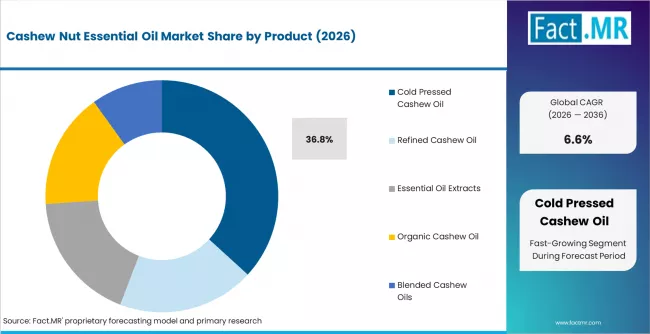
Cold pressed cashew oil controls 36.8% of the product segment. Cold pressing preserves the oil's mild flavour, nutritional properties (vitamin E, oleic acid), and natural colour, making it the preferred extraction method for culinary and premium cosmetic applications. Cold pressed cashew oil commands 30 to 50% price premiums over solvent-extracted equivalents.
Refined cashew oil holds the second-largest share, serving food manufacturing applications where neutral flavour and high smoke point are required. Organic cashew oil is the fastest-growing product type, and essential oil extracts serve niche aromatherapy and fragrance applications.
Which application drives demand in the Cashew Nut Essential Oil Market?
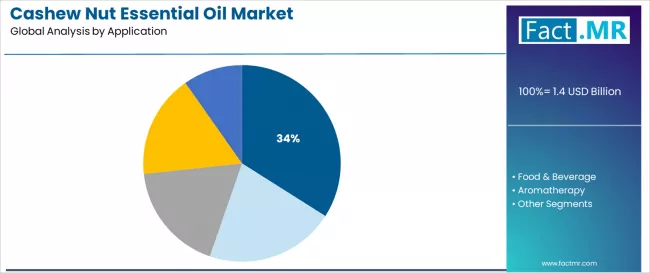
Food industry accounts for 41.3% of application demand. Culinary use as a premium cooking and finishing oil is the primary food application, with cashew oil positioned alongside avocado and walnut oils in health-conscious consumer segments. Food manufacturing uses include salad dressing formulation, snack coating, and bakery ingredient applications.
Personal care and cosmetics hold the second-largest application share, with cashew oil used in moisturisers, hair oils, lip balms, and massage products. Pharmaceutical applications are growing as a high-value niche.
Which extraction technology leads the Cashew Nut Essential Oil Market?
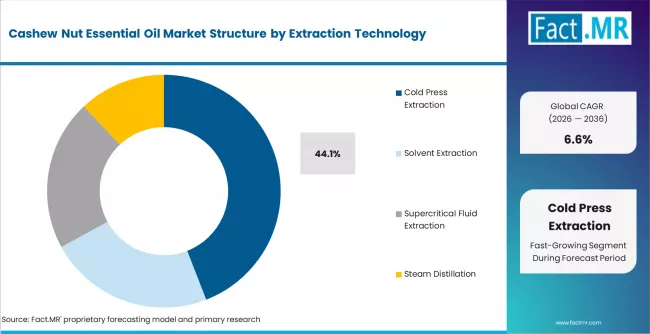
Cold press extraction accounts for 44.1% of extraction technology demand. Mechanical cold pressing at temperatures below 49C preserves heat-sensitive compounds and qualifies for cold-pressed labelling claims valued by premium consumers. Cold press yields are lower (30 to 35% of kernel weight) than solvent extraction (42 to 47%), creating a price-quality trade-off.
Solvent extraction holds the second-largest share, using hexane or ethanol to achieve higher oil yields for industrial and food manufacturing applications. Supercritical fluid extraction serves ultra-high purity pharmaceutical and cosmetic applications.
Which Product Trend is Shaping the Next Phase of Growth in the Cashew Nut Essential Oil Market?
The fastest-growing product trend in the cashew nut oil market is the development of origin-certified, single-source cashew oils that carry geographic and processing traceability documentation. Traditional cashew oil is sold as a generic commodity without origin specification. The emerging trend mirrors the olive oil industry's evolution toward Protected Designation of Origin (PDO) and single-estate positioning, where origin-specific cashew oils from India's Goa and Kerala regions, Vietnam's Binh Phuoc province, and Ivory Coast's Bondoukou region are marketed with distinct flavour profiles and processing credentials.
The commercial significance is substantial. Origin-certified cashew oils command retail premiums of 50 to 100% over generic products, and traceability documentation enables premium positioning in natural cosmetic formulations where supply chain transparency is a consumer purchase driver. Companies that invest in origin-specific supply chains, farm-to-bottle traceability systems, and third-party quality certification will capture premium market positioning.
Regional Outlook Across Key Markets
.webp)
- North America is a major market, with the USA contributing USD 0.546 billion in 2025 revenue.
- East Asia is expanding, with Japan at USD 0.071 billion and South Korea at USD 0.041 billion in 2025.
- South Asia and Pacific is the fastest-growing region, driven by Indian cashew processing expansion.
- Latin America is growing as Brazilian cashew processing capacity expands.
CAGR Table
| Country | CAGR (%) |
|---|---|
| India | 8.3% |
| China | 7.5% |
| USA | 6.7% |
| UK | 6.4% |
| Brazil | 6.1% |
| Germany | 5.9% |
| Japan | 5.8% |
Source: Fact.MR analysis, based on proprietary forecasting model and primary research.
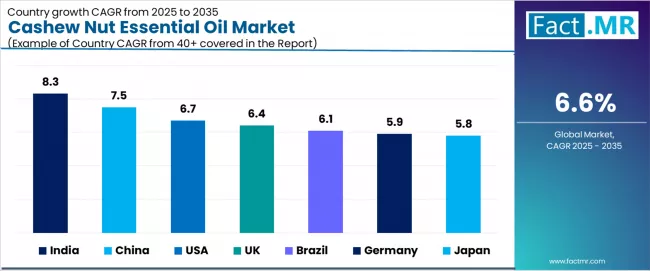
India: cashew processing leadership and oil extraction capacity expansion drive growth
India leads global growth as the world's largest cashew processor and a major cashew oil producer. Indian cashew processing, concentrated in Kerala, Goa, Karnataka, and Maharashtra, is increasingly directing broken and undergrade kernels toward oil extraction as a value-added alternative to low-price kernel sales. Indian cold press equipment manufacturers are scaling production capacity.
- India processed over 1.8 million tonnes of raw cashew nuts in 2024, per Cashew Export Promotion Council of India data, with oil extraction absorbing an increasing share of kernel grades unsuitable for whole nut export.
China: cosmetic industry demand and culinary oil premiumisation drive adoption
China records strong growth driven by demand from the Chinese cosmetic manufacturing industry and growing consumer interest in premium culinary oils. Chinese cosmetic manufacturers are incorporating cashew oil into skin care formulations for the domestic and export markets.
- China's natural cosmetic ingredients market grew 12% in 2024, per CCCMHPIE data, with plant-derived oils among the fastest-growing ingredient categories.
USA: premium culinary oil and natural cosmetic demand sustain consumption
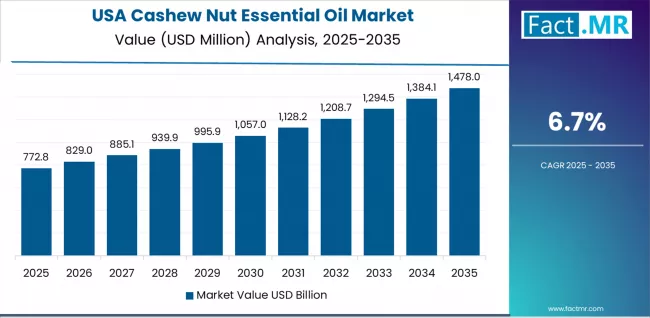
The USA generates USD 0.546 billion in 2025. US demand is driven by premium culinary oil positioning in health food retail and natural cosmetic ingredient sourcing. American consumers are adopting cashew oil as a nut oil alternative for cooking and salad dressing applications.
- US specialty oil retail sales grew 8% in 2024, per USDA data, with nut-based oils including cashew gaining shelf space in natural food channels.
UK: natural beauty market and premium food ingredient demand drive growth
UK growth is driven by the natural beauty product market and premium food ingredient demand. UK cosmetic brands are incorporating cashew oil into clean beauty formulations, and UK food retailers are expanding specialty oil ranges.
- UK natural beauty market sales grew 10% in 2024, per Soil Association data, with plant oil-based products driving ingredient innovation.
Brazil: origin-country production and domestic market development support growth
Brazil's growth reflects its position as a significant cashew producer (primarily in Ceara and Piaui states) with expanding domestic oil extraction capacity. Brazilian cashew processors are investing in cold press technology to capture premium oil markets alongside traditional kernel processing.
- Brazil's cashew production exceeded 150,000 tonnes in 2024, per IBGE data, with value-added processing including oil extraction growing as a share of total output.
Germany: organic ingredient demand and industrial applications sustain the market
Germany's growth is driven by organic cosmetic ingredient demand and industrial CNSL applications. German cosmetic manufacturers require certified organic plant oils, and German industrial companies use CNSL derivatives in friction material and coating applications.
- Germany's organic cosmetic ingredients market grew 9% in 2024, per BDIH data, with new plant oil ingredients gaining formulation share.
Japan: premium cosmetic ingredient and functional food demand drive adoption
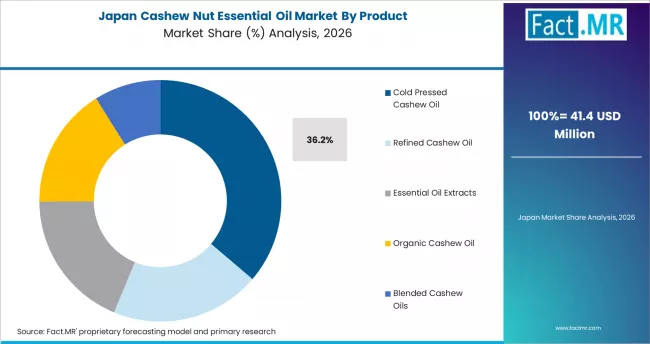
Japan contributes USD 0.071 billion in 2025. Japanese demand is driven by the premium cosmetic ingredient market and consumer interest in functional nut oils. Japanese cosmetic manufacturers value cashew oil's rapid absorption and non-greasy properties for skin care formulations.
- Japan's functional oil market grew 7% in 2024, per JFMA data, with nut-derived oils entering the premium health food channel.
Competitive Benchmarking and Company Positioning
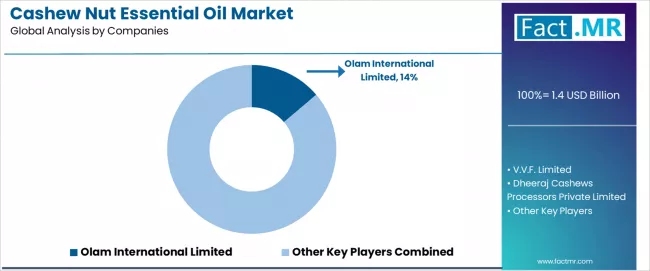
Cashew Nut Essential Oil Market Analysis By Company
- Olam International Limited holds approximately 14.0% of global revenue through integrated cashew processing operations spanning origin-country procurement, kernel processing, and oil extraction across India, Vietnam, and West Africa.
- V.V.F. Limited and Dheeraj Cashews Processors compete on processing quality, organic certification, and established export distribution networks.
- Ajfan Agro Industries, Golden Agro Industries, and Jyothi Cashews serve Indian domestic and export markets with cashew oil products across purity grades.
The competitive structure is moderately concentrated, with Olam holding the largest share at 14.0%. Olam's position is built on vertically integrated cashew operations that span raw nut sourcing from West African and Southeast Asian origins through to finished oil products. This integration provides cost advantages and supply reliability that smaller processors cannot match.
Competition is divided between large integrated processors (Olam, Cargill's cashew operations) that serve global B2B markets and regional Indian processors that supply domestic and regional export markets. Indian processors benefit from proximity to cashew cultivation areas and established processing infrastructure but face increasing competition from Vietnamese and African processors.
Key Companies in the Cashew Nut Essential Oil Market
The cashew nut essential oil competitive field includes Olam International Limited, V.V.F. Limited, Dheeraj Cashews Processors Private Limited, Alwin Exports Pvt. Ltd., Ajfan Agro Industries Private Limited, Golden Agro Industries Limited, Jyothi Cashews and Allied Products Private Limited, The Cashew Company of India, R.G. Agrawal and Company, and KVC Foods (India) Private Limited.
Recent Industry Developments
- Olam International: organic cashew oil certification expansion (2025)
- Olam achieved organic certification for its cashew oil production lines in India and Ivory Coast, enabling supply of certified organic cashew oil to premium cosmetic and food ingredient customers.
- V.V.F. Limited: cold press capacity expansion (2025)
- V.V.F. expanded cold press cashew oil extraction capacity at its Vasai facility in Maharashtra, targeting growing demand from natural cosmetic and pharmaceutical ingredient customers.
- Ajfan Agro: pharmaceutical-grade cashew oil development (2026)
- Ajfan Agro Industries developed a pharmaceutical-grade cashew oil product meeting Indian Pharmacopoeia standards for soft gel capsule filling and drug delivery applications.
- Golden Agro Industries: African origin cashew oil launch (2025)
- Golden Agro launched an origin-certified cashew oil product sourced from Tanzanian cashew cooperatives, targeting the European natural cosmetic ingredient market with full traceability documentation.
Leading Companies Shaping the Cashew Nut Essential Oil Market
-
Global Players
- Olam International Limited
- V.V.F. Limited
- Alwin Exports Pvt. Ltd.
-
Regional Players
- Dheeraj Cashews Processors Private Limited
- Ajfan Agro Industries Private Limited
- Golden Agro Industries Limited
- Jyothi Cashews and Allied Products Private Limited
-
Emerging / Start-up Players
- The Cashew Company of India
- R.G. Agrawal and Company
- KVC Foods (India) Private Limited
Sources and Research References
- Company annual reports from Olam International and V.V.F. Limited.
- FAO cashew production and trade statistics.
- Cashew Export Promotion Council of India processing and export data.
- Cosmetics Europe natural cosmetic ingredient market data.
- APEDA (Agricultural and Processed Food Products Export Development Authority) organic certification data.
- IBGE Brazilian agricultural production statistics.
All cited sources are first-party company filings, government agencies, industry associations, or trade bodies. No syndicated market research reports were used.
Key Questions This Report Addresses
- What is the projected market value for cashew nut essential oil by 2036?
- Which product type holds the largest share?
- What CAGR is forecast from 2026 to 2036?
- How is cold press technology changing cashew oil positioning?
- Which countries are growing fastest?
- What is the competitive structure?
- How are cosmetic applications driving cashew oil demand?
- What role do CNSL industrial applications play in market economics?
- How is origin certification affecting cashew oil pricing?
Cashew Nut Essential Oil Market Definition
The cashew nut essential oil market encompasses the extraction, refining, and sale of oils derived from cashew kernels and cashew nut shells. Products include cold pressed, refined, organic, and blended cashew oils in varying purity levels, serving food, pharmaceutical, cosmetic, industrial, and agricultural applications.
Cashew Nut Essential Oil Market Inclusions
- Cold pressed and refined cashew kernel oil for culinary and food manufacturing applications.
- Cashew oil used as a cosmetic ingredient in skin care, hair care, and massage oil formulations.
- Organic and conventional cashew oil products in all purity grades.
- Cashew nut shell liquid (CNSL) and CNSL derivatives for industrial applications.
Cashew Nut Essential Oil Market Exclusions
- Whole cashew kernels, split cashews, and cashew butter products.
- Cashew-flavoured food products not containing cashew oil as a primary ingredient.
- Synthetic cashew fragrance compounds used in perfumery.
- Cashew tree cultivation, plantation management, and raw nut harvesting.
Cashew Nut Essential Oil Market Research Methodology
- Primary research with cashew processors, oil extraction facilities, food ingredient distributors, and cosmetic formulators across 10 countries.
- Revenue modelling based on cashew processing volumes, oil extraction yields, and processor-reported sales.
- Pricing analysis using B2B oil commodity data, distributor price lists, and cosmetic ingredient procurement records.
- Competitive share estimation through company annual reports, cashew processing industry association data, and trade flow analysis.
- Demand validation through FAO cashew production statistics, cosmetic ingredient trade data, and culinary oil consumption surveys.
Scope of Analysis

| Parameter | Details |
|---|---|
| Report Currency | USD Billion |
| Market Value (2025) | USD 1.41 Billion |
| Forecast Value (2036) | USD 2.848 Billion |
| CAGR (2026 to 2036) | 6.6% |
| Product | Cold Pressed Cashew Oil, Refined Cashew Oil, Essential Oil Extracts, Organic Cashew Oil, Blended Cashew Oils |
| Application | Food Industry, Pharmaceutical Applications, Personal Care and Cosmetics, Industrial Applications, Agriculture Applications |
| End Use | Food Manufacturers, Pharmaceutical Companies, Cosmetic Manufacturers, Industrial Manufacturers, Agricultural Sector |
| Distribution Channel | Direct Sales, Distributors, Online B2B Platforms, Retail Channels, Export Channels |
| Extraction Technology | Cold Press Extraction, Solvent Extraction, Supercritical Fluid Extraction, Steam Distillation |
| Purity Level | Medium Purity, Low Purity, High Purity, Ultra High Purity |
| Regions | North America, Latin America, Europe, East Asia, South Asia and Pacific, Middle East and Africa |
| Countries | India, China, USA, UK, Brazil, Germany, Japan, and 40+ countries |
| Companies | Olam International, V.V.F. Limited, Dheeraj Cashews Processors, Alwin Exports, Ajfan Agro Industries, Golden Agro Industries, Jyothi Cashews, The Cashew Company of India, R.G. Agrawal, KVC Foods |
| Forecast Period | 2026 to 2036 |
| Approach | Top-down and bottom-up with primary and secondary research |
Market Segmentation Analysis
-
Cashew Nut Essential Oil Market Market Segmented by Product:
- Cold Pressed Cashew Oil
- Raw Cold Pressed Oil
- Filtered Cold Pressed Oil
- Refined Cashew Oil
- Food Grade Refined Oil
- Industrial Grade Refined Oil
- Essential Oil Extracts
- Cashew Nut Shell Liquid Extract
- Bioactive Oil Fractions
- Organic Cashew Oil
- Certified Organic Oil
- Natural Unrefined Oil
- Blended Cashew Oils
- Infused Botanical Oils
- Industrial Blends
- Cold Pressed Cashew Oil
-
Cashew Nut Essential Oil Market Market Segmented by Application:
- Food Industry
- Cooking Oil Applications
- Processed Food Manufacturing
- Snack Production
- Pharmaceutical Applications
- Capsule Formulation
- Functional Health Supplements
- Personal Care and Cosmetics
- Skincare Products
- Hair Care Products
- Aromatherapy Products
- Industrial Applications
- Bio Lubricants
- Paint and Coating Additives
- Adhesives and Resins
- Agriculture Applications
- Bio Pesticides
- Plant Protection Formulations
- Food Industry
-
Cashew Nut Essential Oil Market Market Segmented by End Use:
- Food Manufacturers
- Snack Producers
- Food Processing Companies
- Pharmaceutical Companies
- Dietary Supplement Manufacturers
- Capsule Formulators
- Cosmetic Manufacturers
- Skincare Brands
- Personal Care Product Companies
- Industrial Manufacturers
- Lubricant Producers
- Chemical Processing Companies
- Agricultural Sector
- Organic Farming Companies
- Bio Input Manufacturers
- Food Manufacturers
-
Cashew Nut Essential Oil Market Market Segmented by Distribution Channel:
- Direct Sales
- Industrial Supply Contracts
- Bulk Manufacturer Agreements
- Distributors
- Chemical Distributors
- Food Ingredient Distributors
- Online B2B Platforms
- Industrial E Commerce Platforms
- Specialty Ingredient Marketplaces
- Retail Channels
- Health Stores
- Organic Product Stores
- Export Channels
- International Bulk Trade
- Contract Export Supply
- Direct Sales
-
Cashew Nut Essential Oil Market Market Segmented by Extraction Technology:
- Cold Press Extraction
- Mechanical Pressing Systems
- Low Temperature Extraction Units
- Solvent Extraction
- Hexane Based Extraction
- Ethanol Based Extraction
- Supercritical Fluid Extraction
- CO2 Extraction Systems
- Membrane Separation Systems
- Steam Distillation
- Hydro Distillation Methods
- Vacuum Distillation Systems
- Cold Press Extraction
-
Cashew Nut Essential Oil Market Market Segmented by Purity Level:
- Medium Purity
- Food Grade Standard Oils
- High Filtered Oils
- Low Purity
- Industrial Blend Oils
- Refined Mixed Oils
- High Purity
- Cosmetic Grade Oils
- Therapeutic Grade Oils
- Ultra High Purity
- Lab Grade Extracts
- Pharmaceutical Grade Oils
- Medium Purity
-
Cashew Nut Essential Oil Market Market by Region:
- North America
- USA
- Canada
- Mexico
- Latin America
- Brazil
- Chile
- Rest of Latin America
- Western Europe
- Germany
- UK
- Italy
- Spain
- France
- Nordic
- BENELUX
- Rest of Western Europe
- Eastern Europe
- Russia
- Poland
- Hungary
- Balkan & Baltic
- Rest of Eastern Europe
- East Asia
- China
- Japan
- South Korea
- South Asia and Pacific
- India
- ASEAN
- Australia & New Zealand
- Rest of South Asia and Pacific
- Middle East & Africa
- Kingdom of Saudi Arabia
- Other GCC Countries
- Turkiye
- South Africa
- Other African Union
- Rest of Middle East & Africa
- North America
- Frequently Asked Questions -
What is the current market size?
The market is valued at USD 1.41 billion in 2025.
What growth rate is expected?
A 6.6% CAGR from 2026 to 2036.
Which product type leads?
Cold pressed cashew oil holds 36.8% of the product segment.
Which application is largest?
Food industry captures 41.3% of application demand.
Which country is growing fastest?
India leads at the highest CAGR.
What is the incremental opportunity?
USD 1.345 billion between 2026 and 2036.
Which company holds the largest share?
Olam International holds approximately 14.0%.
Table of Content
- Executive Summary
- Global Market Outlook
- Demand to side Trends
- Supply to side Trends
- Technology Roadmap Analysis
- Analysis and Recommendations
- Market Overview
- Market Coverage / Taxonomy
- Market Definition / Scope / Limitations
- Research Methodology
- Chapter Orientation
- Analytical Lens and Working Hypotheses
- Market Structure, Signals, and Trend Drivers
- Benchmarking and Cross-market Comparability
- Market Sizing, Forecasting, and Opportunity Mapping
- Research Design and Evidence Framework
- Desk Research Programme (Secondary Evidence)
- Company Annual and Sustainability Reports
- Peer-reviewed Journals and Academic Literature
- Corporate Websites, Product Literature, and Technical Notes
- Earnings Decks and Investor Briefings
- Statutory Filings and Regulatory Disclosures
- Technical White Papers and Standards Notes
- Trade Journals, Industry Magazines, and Analyst Briefs
- Conference Proceedings, Webinars, and Seminar Materials
- Government Statistics Portals and Public Data Releases
- Press Releases and Reputable Media Coverage
- Specialist Newsletters and Curated Briefings
- Sector Databases and Reference Repositories
- Fact.MR Internal Proprietary Databases and Historical Market Datasets
- Subscription Datasets and Paid Sources
- Social Channels, Communities, and Digital Listening Inputs
- Additional Desk Sources
- Expert Input and Fieldwork (Primary Evidence)
- Primary Modes
- Qualitative Interviews and Expert Elicitation
- Quantitative Surveys and Structured Data Capture
- Blended Approach
- Why Primary Evidence is Used
- Field Techniques
- Interviews
- Surveys
- Focus Groups
- Observational and In-context Research
- Social and Community Interactions
- Stakeholder Universe Engaged
- C-suite Leaders
- Board Members
- Presidents and Vice Presidents
- R&D and Innovation Heads
- Technical Specialists
- Domain Subject-matter Experts
- Scientists
- Physicians and Other Healthcare Professionals
- Governance, Ethics, and Data Stewardship
- Research Ethics
- Data Integrity and Handling
- Primary Modes
- Tooling, Models, and Reference Databases
- Desk Research Programme (Secondary Evidence)
- Data Engineering and Model Build
- Data Acquisition and Ingestion
- Cleaning, Normalisation, and Verification
- Synthesis, Triangulation, and Analysis
- Quality Assurance and Audit Trail
- Market Background
- Market Dynamics
- Drivers
- Restraints
- Opportunity
- Trends
- Scenario Forecast
- Demand in Optimistic Scenario
- Demand in Likely Scenario
- Demand in Conservative Scenario
- Opportunity Map Analysis
- Product Life Cycle Analysis
- Supply Chain Analysis
- Investment Feasibility Matrix
- Value Chain Analysis
- PESTLE and Porter’s Analysis
- Regulatory Landscape
- Regional Parent Market Outlook
- Production and Consumption Statistics
- Import and Export Statistics
- Market Dynamics
- Global Market Analysis 2021 to 2025 and Forecast, 2026 to 2036
- Historical Market Size Value (USD Million) Analysis, 2021 to 2025
- Current and Future Market Size Value (USD Million) Projections, 2026 to 2036
- Y to o to Y Growth Trend Analysis
- Absolute $ Opportunity Analysis
- Global Market Pricing Analysis 2021 to 2025 and Forecast 2026 to 2036
- Global Market Analysis 2021 to 2025 and Forecast 2026 to 2036, By Product
- Introduction / Key Findings
- Historical Market Size Value (USD Million) Analysis By Product , 2021 to 2025
- Current and Future Market Size Value (USD Million) Analysis and Forecast By Product , 2026 to 2036
- Cold Pressed Cashew Oil
- Raw Cold Pressed Oil
- Filtered Cold Pressed Oil
- Refined Cashew Oil
- Food Grade Refined Oil
- Industrial Grade Refined Oil
- Essential Oil Extracts
- Cashew Nut Shell Liquid Extract
- Bioactive Oil Fractions
- Organic Cashew Oil
- Certified Organic Oil
- Natural Unrefined Oil
- Blended Cashew Oils
- Infused Botanical Oils
- Industrial Blends
- Y to o to Y Growth Trend Analysis By Product , 2021 to 2025
- Absolute $ Opportunity Analysis By Product , 2026 to 2036
- Cold Pressed Cashew Oil
- Global Market Analysis 2021 to 2025 and Forecast 2026 to 2036, By Application
- Introduction / Key Findings
- Historical Market Size Value (USD Million) Analysis By Application, 2021 to 2025
- Current and Future Market Size Value (USD Million) Analysis and Forecast By Application, 2026 to 2036
- Food Industry
- Cooking Oil Applications
- Processed Food Manufacturing
- Snack Production
- Pharmaceutical Applications
- Capsule Formulation
- Functional Health Supplements
- Personal Care and Cosmetics
- Skincare Products
- Hair Care Products
- Aromatherapy Products
- Industrial Applications
- Bio Lubricants
- Paint and Coating Additives
- Adhesives and Resins
- Agriculture Applications
- Bio Pesticides
- Plant Protection Formulations
- Food Industry
- Y to o to Y Growth Trend Analysis By Application, 2021 to 2025
- Absolute $ Opportunity Analysis By Application, 2026 to 2036
- Global Market Analysis 2021 to 2025 and Forecast 2026 to 2036, By End Use
- Introduction / Key Findings
- Historical Market Size Value (USD Million) Analysis By End Use, 2021 to 2025
- Current and Future Market Size Value (USD Million) Analysis and Forecast By End Use, 2026 to 2036
- Food Manufacturers
- Snack Producers
- Food Processing Companies
- Pharmaceutical Companies
- Dietary Supplement Manufacturers
- Capsule Formulators
- Cosmetic Manufacturers
- Skincare Brands
- Personal Care Product Companies
- Industrial Manufacturers
- Lubricant Producers
- Chemical Processing Companies
- Agricultural Sector
- Organic Farming Companies
- Bio Input Manufacturers
- Food Manufacturers
- Y to o to Y Growth Trend Analysis By End Use, 2021 to 2025
- Absolute $ Opportunity Analysis By End Use, 2026 to 2036
- Global Market Analysis 2021 to 2025 and Forecast 2026 to 2036, By Distribution Channel
- Introduction / Key Findings
- Historical Market Size Value (USD Million) Analysis By Distribution Channel, 2021 to 2025
- Current and Future Market Size Value (USD Million) Analysis and Forecast By Distribution Channel, 2026 to 2036
- Direct Sales
- Industrial Supply Contracts
- Bulk Manufacturer Agreements
- Distributors
- Chemical Distributors
- Food Ingredient Distributors
- Online B2B Platforms
- Industrial E Commerce Platforms
- Specialty Ingredient Marketplaces
- Retail Channels
- Health Stores
- Organic Product Stores
- Export Channels
- International Bulk Trade
- Contract Export Supply
- Direct Sales
- Y to o to Y Growth Trend Analysis By Distribution Channel, 2021 to 2025
- Absolute $ Opportunity Analysis By Distribution Channel, 2026 to 2036
- Global Market Analysis 2021 to 2025 and Forecast 2026 to 2036, By Extraction Technology
- Introduction / Key Findings
- Historical Market Size Value (USD Million) Analysis By Extraction Technology, 2021 to 2025
- Current and Future Market Size Value (USD Million) Analysis and Forecast By Extraction Technology, 2026 to 2036
- Cold Press Extraction
- Mechanical Pressing Systems
- Low Temperature Extraction Value (USD Million)s
- Solvent Extraction
- Hexane Based Extraction
- Ethanol Based Extraction
- Supercritical Fluid Extraction
- CO2 Extraction Systems
- Membrane Separation Systems
- Steam Distillation
- Hydro Distillation Methods
- Vacuum Distillation Systems
- Cold Press Extraction
- Y to o to Y Growth Trend Analysis By Extraction Technology, 2021 to 2025
- Absolute $ Opportunity Analysis By Extraction Technology, 2026 to 2036
- Global Market Analysis 2021 to 2025 and Forecast 2026 to 2036, By Purity Level
- Introduction / Key Findings
- Historical Market Size Value (USD Million) Analysis By Purity Level, 2021 to 2025
- Current and Future Market Size Value (USD Million) Analysis and Forecast By Purity Level, 2026 to 2036
- Medium Purity
- Food Grade Standard Oils
- High Filtered Oils
- Low Purity
- Industrial Blend Oils
- Refined Mixed Oils
- High Purity
- Cosmetic Grade Oils
- Therapeutic Grade Oils
- Ultra High Purity
- Lab Grade Extracts
- Pharmaceutical Grade Oils
- Medium Purity
- Y to o to Y Growth Trend Analysis By Purity Level, 2021 to 2025
- Absolute $ Opportunity Analysis By Purity Level, 2026 to 2036
- Global Market Analysis 2021 to 2025 and Forecast 2026 to 2036, By Region
- Introduction
- Historical Market Size Value (USD Million) Analysis By Region, 2021 to 2025
- Current Market Size Value (USD Million) Analysis and Forecast By Region, 2026 to 2036
- North America
- Latin America
- Western Europe
- Eastern Europe
- East Asia
- South Asia and Pacific
- Middle East & Africa
- Market Attractiveness Analysis By Region
- North America Market Analysis 2021 to 2025 and Forecast 2026 to 2036, By Country
- Historical Market Size Value (USD Million) Trend Analysis By Market Taxonomy, 2021 to 2025
- Market Size Value (USD Million) Forecast By Market Taxonomy, 2026 to 2036
- By Country
- USA
- Canada
- Mexico
- By Product
- By Application
- By End Use
- By Distribution Channel
- By Extraction Technology
- By Purity Level
- By Country
- Market Attractiveness Analysis
- By Country
- By Product
- By Application
- By End Use
- By Distribution Channel
- By Extraction Technology
- By Purity Level
- Key Takeaways
- Latin America Market Analysis 2021 to 2025 and Forecast 2026 to 2036, By Country
- Historical Market Size Value (USD Million) Trend Analysis By Market Taxonomy, 2021 to 2025
- Market Size Value (USD Million) Forecast By Market Taxonomy, 2026 to 2036
- By Country
- Brazil
- Chile
- Rest of Latin America
- By Product
- By Application
- By End Use
- By Distribution Channel
- By Extraction Technology
- By Purity Level
- By Country
- Market Attractiveness Analysis
- By Country
- By Product
- By Application
- By End Use
- By Distribution Channel
- By Extraction Technology
- By Purity Level
- Key Takeaways
- Western Europe Market Analysis 2021 to 2025 and Forecast 2026 to 2036, By Country
- Historical Market Size Value (USD Million) Trend Analysis By Market Taxonomy, 2021 to 2025
- Market Size Value (USD Million) Forecast By Market Taxonomy, 2026 to 2036
- By Country
- Germany
- UK
- Italy
- Spain
- France
- Nordic
- BENELUX
- Rest of Western Europe
- By Product
- By Application
- By End Use
- By Distribution Channel
- By Extraction Technology
- By Purity Level
- By Country
- Market Attractiveness Analysis
- By Country
- By Product
- By Application
- By End Use
- By Distribution Channel
- By Extraction Technology
- By Purity Level
- Key Takeaways
- Eastern Europe Market Analysis 2021 to 2025 and Forecast 2026 to 2036, By Country
- Historical Market Size Value (USD Million) Trend Analysis By Market Taxonomy, 2021 to 2025
- Market Size Value (USD Million) Forecast By Market Taxonomy, 2026 to 2036
- By Country
- Russia
- Poland
- Hungary
- Balkan & Baltic
- Rest of Eastern Europe
- By Product
- By Application
- By End Use
- By Distribution Channel
- By Extraction Technology
- By Purity Level
- By Country
- Market Attractiveness Analysis
- By Country
- By Product
- By Application
- By End Use
- By Distribution Channel
- By Extraction Technology
- By Purity Level
- Key Takeaways
- East Asia Market Analysis 2021 to 2025 and Forecast 2026 to 2036, By Country
- Historical Market Size Value (USD Million) Trend Analysis By Market Taxonomy, 2021 to 2025
- Market Size Value (USD Million) Forecast By Market Taxonomy, 2026 to 2036
- By Country
- China
- Japan
- South Korea
- By Product
- By Application
- By End Use
- By Distribution Channel
- By Extraction Technology
- By Purity Level
- By Country
- Market Attractiveness Analysis
- By Country
- By Product
- By Application
- By End Use
- By Distribution Channel
- By Extraction Technology
- By Purity Level
- Key Takeaways
- South Asia and Pacific Market Analysis 2021 to 2025 and Forecast 2026 to 2036, By Country
- Historical Market Size Value (USD Million) Trend Analysis By Market Taxonomy, 2021 to 2025
- Market Size Value (USD Million) Forecast By Market Taxonomy, 2026 to 2036
- By Country
- India
- ASEAN
- Australia & New Zealand
- Rest of South Asia and Pacific
- By Product
- By Application
- By End Use
- By Distribution Channel
- By Extraction Technology
- By Purity Level
- By Country
- Market Attractiveness Analysis
- By Country
- By Product
- By Application
- By End Use
- By Distribution Channel
- By Extraction Technology
- By Purity Level
- Key Takeaways
- Middle East & Africa Market Analysis 2021 to 2025 and Forecast 2026 to 2036, By Country
- Historical Market Size Value (USD Million) Trend Analysis By Market Taxonomy, 2021 to 2025
- Market Size Value (USD Million) Forecast By Market Taxonomy, 2026 to 2036
- By Country
- Kingdom of Saudi Arabia
- Other GCC Countries
- Turkiye
- South Africa
- Other African Union
- Rest of Middle East & Africa
- By Product
- By Application
- By End Use
- By Distribution Channel
- By Extraction Technology
- By Purity Level
- By Country
- Market Attractiveness Analysis
- By Country
- By Product
- By Application
- By End Use
- By Distribution Channel
- By Extraction Technology
- By Purity Level
- Key Takeaways
- Key Countries Market Analysis
- USA
- Pricing Analysis
- Market Share Analysis, 2025
- By Product
- By Application
- By End Use
- By Distribution Channel
- By Extraction Technology
- By Purity Level
- Canada
- Pricing Analysis
- Market Share Analysis, 2025
- By Product
- By Application
- By End Use
- By Distribution Channel
- By Extraction Technology
- By Purity Level
- Mexico
- Pricing Analysis
- Market Share Analysis, 2025
- By Product
- By Application
- By End Use
- By Distribution Channel
- By Extraction Technology
- By Purity Level
- Brazil
- Pricing Analysis
- Market Share Analysis, 2025
- By Product
- By Application
- By End Use
- By Distribution Channel
- By Extraction Technology
- By Purity Level
- Chile
- Pricing Analysis
- Market Share Analysis, 2025
- By Product
- By Application
- By End Use
- By Distribution Channel
- By Extraction Technology
- By Purity Level
- Germany
- Pricing Analysis
- Market Share Analysis, 2025
- By Product
- By Application
- By End Use
- By Distribution Channel
- By Extraction Technology
- By Purity Level
- UK
- Pricing Analysis
- Market Share Analysis, 2025
- By Product
- By Application
- By End Use
- By Distribution Channel
- By Extraction Technology
- By Purity Level
- Italy
- Pricing Analysis
- Market Share Analysis, 2025
- By Product
- By Application
- By End Use
- By Distribution Channel
- By Extraction Technology
- By Purity Level
- Spain
- Pricing Analysis
- Market Share Analysis, 2025
- By Product
- By Application
- By End Use
- By Distribution Channel
- By Extraction Technology
- By Purity Level
- France
- Pricing Analysis
- Market Share Analysis, 2025
- By Product
- By Application
- By End Use
- By Distribution Channel
- By Extraction Technology
- By Purity Level
- India
- Pricing Analysis
- Market Share Analysis, 2025
- By Product
- By Application
- By End Use
- By Distribution Channel
- By Extraction Technology
- By Purity Level
- ASEAN
- Pricing Analysis
- Market Share Analysis, 2025
- By Product
- By Application
- By End Use
- By Distribution Channel
- By Extraction Technology
- By Purity Level
- Australia & New Zealand
- Pricing Analysis
- Market Share Analysis, 2025
- By Product
- By Application
- By End Use
- By Distribution Channel
- By Extraction Technology
- By Purity Level
- China
- Pricing Analysis
- Market Share Analysis, 2025
- By Product
- By Application
- By End Use
- By Distribution Channel
- By Extraction Technology
- By Purity Level
- Japan
- Pricing Analysis
- Market Share Analysis, 2025
- By Product
- By Application
- By End Use
- By Distribution Channel
- By Extraction Technology
- By Purity Level
- South Korea
- Pricing Analysis
- Market Share Analysis, 2025
- By Product
- By Application
- By End Use
- By Distribution Channel
- By Extraction Technology
- By Purity Level
- Russia
- Pricing Analysis
- Market Share Analysis, 2025
- By Product
- By Application
- By End Use
- By Distribution Channel
- By Extraction Technology
- By Purity Level
- Poland
- Pricing Analysis
- Market Share Analysis, 2025
- By Product
- By Application
- By End Use
- By Distribution Channel
- By Extraction Technology
- By Purity Level
- Hungary
- Pricing Analysis
- Market Share Analysis, 2025
- By Product
- By Application
- By End Use
- By Distribution Channel
- By Extraction Technology
- By Purity Level
- Kingdom of Saudi Arabia
- Pricing Analysis
- Market Share Analysis, 2025
- By Product
- By Application
- By End Use
- By Distribution Channel
- By Extraction Technology
- By Purity Level
- Turkiye
- Pricing Analysis
- Market Share Analysis, 2025
- By Product
- By Application
- By End Use
- By Distribution Channel
- By Extraction Technology
- By Purity Level
- South Africa
- Pricing Analysis
- Market Share Analysis, 2025
- By Product
- By Application
- By End Use
- By Distribution Channel
- By Extraction Technology
- By Purity Level
- USA
- Market Structure Analysis
- Competition Dashboard
- Competition Benchmarking
- Market Share Analysis of Top Players
- By Regional
- By Product
- By Application
- By End Use
- By Distribution Channel
- By Extraction Technology
- By Purity Level
- Competition Analysis
- Competition Deep Dive
- Olam International Limited
- Overview
- Product Portfolio
- Profitability by Market Segments (Product/Age /Sales Channel/Region)
- Sales Footprint
- Strategy Overview
- Marketing Strategy
- Product Strategy
- Channel Strategy
- V.V.F. Limited
- Dheeraj Cashews Processors Private Limited
- Alwin Exports Pvt. Ltd.
- Ajfan Agro Industries Private Limited
- Golden Agro Industries Limited
- Jyothi Cashews and Allied Products Private Limited
- The Cashew Company of India
- R.G. Agrawal & Company
- KVC Foods (India) Private Limited
- Olam International Limited
- Competition Deep Dive
- Assumptions & Acronyms Used
List Of Table
- Table 1: Global Market Value (USD Million) Forecast by Region, 2021 to 2036
- Table 2: Global Market Value (USD Million) Forecast by Product , 2021 to 2036
- Table 3: Global Market Value (USD Million) Forecast by Application, 2021 to 2036
- Table 4: Global Market Value (USD Million) Forecast by End Use, 2021 to 2036
- Table 5: Global Market Value (USD Million) Forecast by Distribution Channel, 2021 to 2036
- Table 6: Global Market Value (USD Million) Forecast by Extraction Technology, 2021 to 2036
- Table 7: Global Market Value (USD Million) Forecast by Purity Level, 2021 to 2036
- Table 8: North America Market Value (USD Million) Forecast by Country, 2021 to 2036
- Table 9: North America Market Value (USD Million) Forecast by Product , 2021 to 2036
- Table 10: North America Market Value (USD Million) Forecast by Application, 2021 to 2036
- Table 11: North America Market Value (USD Million) Forecast by End Use, 2021 to 2036
- Table 12: North America Market Value (USD Million) Forecast by Distribution Channel, 2021 to 2036
- Table 13: North America Market Value (USD Million) Forecast by Extraction Technology, 2021 to 2036
- Table 14: North America Market Value (USD Million) Forecast by Purity Level, 2021 to 2036
- Table 15: Latin America Market Value (USD Million) Forecast by Country, 2021 to 2036
- Table 16: Latin America Market Value (USD Million) Forecast by Product , 2021 to 2036
- Table 17: Latin America Market Value (USD Million) Forecast by Application, 2021 to 2036
- Table 18: Latin America Market Value (USD Million) Forecast by End Use, 2021 to 2036
- Table 19: Latin America Market Value (USD Million) Forecast by Distribution Channel, 2021 to 2036
- Table 20: Latin America Market Value (USD Million) Forecast by Extraction Technology, 2021 to 2036
- Table 21: Latin America Market Value (USD Million) Forecast by Purity Level, 2021 to 2036
- Table 22: Western Europe Market Value (USD Million) Forecast by Country, 2021 to 2036
- Table 23: Western Europe Market Value (USD Million) Forecast by Product , 2021 to 2036
- Table 24: Western Europe Market Value (USD Million) Forecast by Application, 2021 to 2036
- Table 25: Western Europe Market Value (USD Million) Forecast by End Use, 2021 to 2036
- Table 26: Western Europe Market Value (USD Million) Forecast by Distribution Channel, 2021 to 2036
- Table 27: Western Europe Market Value (USD Million) Forecast by Extraction Technology, 2021 to 2036
- Table 28: Western Europe Market Value (USD Million) Forecast by Purity Level, 2021 to 2036
- Table 29: Eastern Europe Market Value (USD Million) Forecast by Country, 2021 to 2036
- Table 30: Eastern Europe Market Value (USD Million) Forecast by Product , 2021 to 2036
- Table 31: Eastern Europe Market Value (USD Million) Forecast by Application, 2021 to 2036
- Table 32: Eastern Europe Market Value (USD Million) Forecast by End Use, 2021 to 2036
- Table 33: Eastern Europe Market Value (USD Million) Forecast by Distribution Channel, 2021 to 2036
- Table 34: Eastern Europe Market Value (USD Million) Forecast by Extraction Technology, 2021 to 2036
- Table 35: Eastern Europe Market Value (USD Million) Forecast by Purity Level, 2021 to 2036
- Table 36: East Asia Market Value (USD Million) Forecast by Country, 2021 to 2036
- Table 37: East Asia Market Value (USD Million) Forecast by Product , 2021 to 2036
- Table 38: East Asia Market Value (USD Million) Forecast by Application, 2021 to 2036
- Table 39: East Asia Market Value (USD Million) Forecast by End Use, 2021 to 2036
- Table 40: East Asia Market Value (USD Million) Forecast by Distribution Channel, 2021 to 2036
- Table 41: East Asia Market Value (USD Million) Forecast by Extraction Technology, 2021 to 2036
- Table 42: East Asia Market Value (USD Million) Forecast by Purity Level, 2021 to 2036
- Table 43: South Asia and Pacific Market Value (USD Million) Forecast by Country, 2021 to 2036
- Table 44: South Asia and Pacific Market Value (USD Million) Forecast by Product , 2021 to 2036
- Table 45: South Asia and Pacific Market Value (USD Million) Forecast by Application, 2021 to 2036
- Table 46: South Asia and Pacific Market Value (USD Million) Forecast by End Use, 2021 to 2036
- Table 47: South Asia and Pacific Market Value (USD Million) Forecast by Distribution Channel, 2021 to 2036
- Table 48: South Asia and Pacific Market Value (USD Million) Forecast by Extraction Technology, 2021 to 2036
- Table 49: South Asia and Pacific Market Value (USD Million) Forecast by Purity Level, 2021 to 2036
- Table 50: Middle East & Africa Market Value (USD Million) Forecast by Country, 2021 to 2036
- Table 51: Middle East & Africa Market Value (USD Million) Forecast by Product , 2021 to 2036
- Table 52: Middle East & Africa Market Value (USD Million) Forecast by Application, 2021 to 2036
- Table 53: Middle East & Africa Market Value (USD Million) Forecast by End Use, 2021 to 2036
- Table 54: Middle East & Africa Market Value (USD Million) Forecast by Distribution Channel, 2021 to 2036
- Table 55: Middle East & Africa Market Value (USD Million) Forecast by Extraction Technology, 2021 to 2036
- Table 56: Middle East & Africa Market Value (USD Million) Forecast by Purity Level, 2021 to 2036
List Of Figures
- Figure 1: Global Market Pricing Analysis
- Figure 2: Global Market Value (USD Million) Forecast 2021-2036
- Figure 3: Global Market Value Share and BPS Analysis by Product, 2026 and 2036
- Figure 4: Global Market Y-o-Y Growth Comparison by Product,2026 to 2036
- Figure 5: Global Market Attractiveness Analysis by Product
- Figure 6: Global Market Value Share and BPS Analysis by Application, 2026 and 2036
- Figure 7: Global Market Y-o-Y Growth Comparison by Application,2026 to 2036
- Figure 8: Global Market Attractiveness Analysis by Application
- Figure 9: Global Market Value Share and BPS Analysis by End Use, 2026 and 2036
- Figure 10: Global Market Y-o-Y Growth Comparison by End Use,2026 to 2036
- Figure 11: Global Market Attractiveness Analysis by End Use
- Figure 12: Global Market Value Share and BPS Analysis by Distribution Channel, 2026 and 2036
- Figure 13: Global Market Y-o-Y Growth Comparison by Distribution Channel,2026 to 2036
- Figure 14: Global Market Attractiveness Analysis by Distribution Channel
- Figure 15: Global Market Value Share and BPS Analysis by Extraction Technology, 2026 and 2036
- Figure 16: Global Market Y-o-Y Growth Comparison by Extraction Technology,2026 to 2036
- Figure 17: Global Market Attractiveness Analysis by Extraction Technology
- Figure 18: Global Market Value Share and BPS Analysis by Purity Level, 2026 and 2036
- Figure 19: Global Market Y-o-Y Growth Comparison by Purity Level,2026 to 2036
- Figure 20: Global Market Attractiveness Analysis by Purity Level
- Figure 21: Global Market Value (USD Million) Share and BPS Analysis by Region, 2026 and 2036
- Figure 22: Global Market Y-o-Y Growth Comparison by Region,2026 to 2036
- Figure 23: Global Market Attractiveness Analysis by Region
- Figure 24: North America Market Incremental Dollar Opportunity,2026 to 2036
- Figure 25: Latin America Market Incremental Dollar Opportunity,2026 to 2036
- Figure 26: Western Europe Market Incremental Dollar Opportunity,2026 to 2036
- Figure 27: Eastern Europe Market Incremental Dollar Opportunity,2026 to 2036
- Figure 28: East Asia Market Incremental Dollar Opportunity,2026 to 2036
- Figure 29: South Asia and Pacific Market Incremental Dollar Opportunity,2026 to 2036
- Figure 30: Middle East & Africa Market Incremental Dollar Opportunity,2026 to 2036
- Figure 31: North America Market Value Share and BPS Analysis by Country, 2026 and 2036
- Figure 32: North America Market Value Share and BPS Analysis by Product, 2026 and 2036
- Figure 33: North America Market Y-o-Y Growth Comparison by Product,2026 to 2036
- Figure 34: North America Market Attractiveness Analysis by Product
- Figure 35: North America Market Value Share and BPS Analysis by Application, 2026 and 2036
- Figure 36: North America Market Y-o-Y Growth Comparison by Application,2026 to 2036
- Figure 37: North America Market Attractiveness Analysis by Application
- Figure 38: North America Market Value Share and BPS Analysis by End Use, 2026 and 2036
- Figure 39: North America Market Y-o-Y Growth Comparison by End Use,2026 to 2036
- Figure 40: North America Market Attractiveness Analysis by End Use
- Figure 41: North America Market Value Share and BPS Analysis by Distribution Channel, 2026 and 2036
- Figure 42: North America Market Y-o-Y Growth Comparison by Distribution Channel,2026 to 2036
- Figure 43: North America Market Attractiveness Analysis by Distribution Channel
- Figure 44: North America Market Value Share and BPS Analysis by Extraction Technology, 2026 and 2036
- Figure 45: North America Market Y-o-Y Growth Comparison by Extraction Technology,2026 to 2036
- Figure 46: North America Market Attractiveness Analysis by Extraction Technology
- Figure 47: North America Market Value Share and BPS Analysis by Purity Level, 2026 and 2036
- Figure 48: North America Market Y-o-Y Growth Comparison by Purity Level,2026 to 2036
- Figure 49: North America Market Attractiveness Analysis by Purity Level
- Figure 50: Latin America Market Value Share and BPS Analysis by Country, 2026 and 2036
- Figure 51: Latin America Market Value Share and BPS Analysis by Product, 2026 and 2036
- Figure 52: Latin America Market Y-o-Y Growth Comparison by Product,2026 to 2036
- Figure 53: Latin America Market Attractiveness Analysis by Product
- Figure 54: Latin America Market Value Share and BPS Analysis by Application, 2026 and 2036
- Figure 55: Latin America Market Y-o-Y Growth Comparison by Application,2026 to 2036
- Figure 56: Latin America Market Attractiveness Analysis by Application
- Figure 57: Latin America Market Value Share and BPS Analysis by End Use, 2026 and 2036
- Figure 58: Latin America Market Y-o-Y Growth Comparison by End Use,2026 to 2036
- Figure 59: Latin America Market Attractiveness Analysis by End Use
- Figure 60: Latin America Market Value Share and BPS Analysis by Distribution Channel, 2026 and 2036
- Figure 61: Latin America Market Y-o-Y Growth Comparison by Distribution Channel,2026 to 2036
- Figure 62: Latin America Market Attractiveness Analysis by Distribution Channel
- Figure 63: Latin America Market Value Share and BPS Analysis by Extraction Technology, 2026 and 2036
- Figure 64: Latin America Market Y-o-Y Growth Comparison by Extraction Technology,2026 to 2036
- Figure 65: Latin America Market Attractiveness Analysis by Extraction Technology
- Figure 66: Latin America Market Value Share and BPS Analysis by Purity Level, 2026 and 2036
- Figure 67: Latin America Market Y-o-Y Growth Comparison by Purity Level,2026 to 2036
- Figure 68: Latin America Market Attractiveness Analysis by Purity Level
- Figure 69: Western Europe Market Value Share and BPS Analysis by Country, 2026 and 2036
- Figure 70: Western Europe Market Value Share and BPS Analysis by Product, 2026 and 2036
- Figure 71: Western Europe Market Y-o-Y Growth Comparison by Product,2026 to 2036
- Figure 72: Western Europe Market Attractiveness Analysis by Product
- Figure 73: Western Europe Market Value Share and BPS Analysis by Application, 2026 and 2036
- Figure 74: Western Europe Market Y-o-Y Growth Comparison by Application,2026 to 2036
- Figure 75: Western Europe Market Attractiveness Analysis by Application
- Figure 76: Western Europe Market Value Share and BPS Analysis by End Use, 2026 and 2036
- Figure 77: Western Europe Market Y-o-Y Growth Comparison by End Use,2026 to 2036
- Figure 78: Western Europe Market Attractiveness Analysis by End Use
- Figure 79: Western Europe Market Value Share and BPS Analysis by Distribution Channel, 2026 and 2036
- Figure 80: Western Europe Market Y-o-Y Growth Comparison by Distribution Channel,2026 to 2036
- Figure 81: Western Europe Market Attractiveness Analysis by Distribution Channel
- Figure 82: Western Europe Market Value Share and BPS Analysis by Extraction Technology, 2026 and 2036
- Figure 83: Western Europe Market Y-o-Y Growth Comparison by Extraction Technology,2026 to 2036
- Figure 84: Western Europe Market Attractiveness Analysis by Extraction Technology
- Figure 85: Western Europe Market Value Share and BPS Analysis by Purity Level, 2026 and 2036
- Figure 86: Western Europe Market Y-o-Y Growth Comparison by Purity Level,2026 to 2036
- Figure 87: Western Europe Market Attractiveness Analysis by Purity Level
- Figure 88: Eastern Europe Market Value Share and BPS Analysis by Country, 2026 and 2036
- Figure 89: Eastern Europe Market Value Share and BPS Analysis by Product, 2026 and 2036
- Figure 90: Eastern Europe Market Y-o-Y Growth Comparison by Product,2026 to 2036
- Figure 91: Eastern Europe Market Attractiveness Analysis by Product
- Figure 92: Eastern Europe Market Value Share and BPS Analysis by Application, 2026 and 2036
- Figure 93: Eastern Europe Market Y-o-Y Growth Comparison by Application,2026 to 2036
- Figure 94: Eastern Europe Market Attractiveness Analysis by Application
- Figure 95: Eastern Europe Market Value Share and BPS Analysis by End Use, 2026 and 2036
- Figure 96: Eastern Europe Market Y-o-Y Growth Comparison by End Use,2026 to 2036
- Figure 97: Eastern Europe Market Attractiveness Analysis by End Use
- Figure 98: Eastern Europe Market Value Share and BPS Analysis by Distribution Channel, 2026 and 2036
- Figure 99: Eastern Europe Market Y-o-Y Growth Comparison by Distribution Channel,2026 to 2036
- Figure 100: Eastern Europe Market Attractiveness Analysis by Distribution Channel
- Figure 101: Eastern Europe Market Value Share and BPS Analysis by Extraction Technology, 2026 and 2036
- Figure 102: Eastern Europe Market Y-o-Y Growth Comparison by Extraction Technology,2026 to 2036
- Figure 103: Eastern Europe Market Attractiveness Analysis by Extraction Technology
- Figure 104: Eastern Europe Market Value Share and BPS Analysis by Purity Level, 2026 and 2036
- Figure 105: Eastern Europe Market Y-o-Y Growth Comparison by Purity Level,2026 to 2036
- Figure 106: Eastern Europe Market Attractiveness Analysis by Purity Level
- Figure 107: East Asia Market Value Share and BPS Analysis by Country, 2026 and 2036
- Figure 108: East Asia Market Value Share and BPS Analysis by Product, 2026 and 2036
- Figure 109: East Asia Market Y-o-Y Growth Comparison by Product,2026 to 2036
- Figure 110: East Asia Market Attractiveness Analysis by Product
- Figure 111: East Asia Market Value Share and BPS Analysis by Application, 2026 and 2036
- Figure 112: East Asia Market Y-o-Y Growth Comparison by Application,2026 to 2036
- Figure 113: East Asia Market Attractiveness Analysis by Application
- Figure 114: East Asia Market Value Share and BPS Analysis by End Use, 2026 and 2036
- Figure 115: East Asia Market Y-o-Y Growth Comparison by End Use,2026 to 2036
- Figure 116: East Asia Market Attractiveness Analysis by End Use
- Figure 117: East Asia Market Value Share and BPS Analysis by Distribution Channel, 2026 and 2036
- Figure 118: East Asia Market Y-o-Y Growth Comparison by Distribution Channel,2026 to 2036
- Figure 119: East Asia Market Attractiveness Analysis by Distribution Channel
- Figure 120: East Asia Market Value Share and BPS Analysis by Extraction Technology, 2026 and 2036
- Figure 121: East Asia Market Y-o-Y Growth Comparison by Extraction Technology,2026 to 2036
- Figure 122: East Asia Market Attractiveness Analysis by Extraction Technology
- Figure 123: East Asia Market Value Share and BPS Analysis by Purity Level, 2026 and 2036
- Figure 124: East Asia Market Y-o-Y Growth Comparison by Purity Level,2026 to 2036
- Figure 125: East Asia Market Attractiveness Analysis by Purity Level
- Figure 126: South Asia and Pacific Market Value Share and BPS Analysis by Country, 2026 and 2036
- Figure 127: South Asia and Pacific Market Value Share and BPS Analysis by Product, 2026 and 2036
- Figure 128: South Asia and Pacific Market Y-o-Y Growth Comparison by Product,2026 to 2036
- Figure 129: South Asia and Pacific Market Attractiveness Analysis by Product
- Figure 130: South Asia and Pacific Market Value Share and BPS Analysis by Application, 2026 and 2036
- Figure 131: South Asia and Pacific Market Y-o-Y Growth Comparison by Application,2026 to 2036
- Figure 132: South Asia and Pacific Market Attractiveness Analysis by Application
- Figure 133: South Asia and Pacific Market Value Share and BPS Analysis by End Use, 2026 and 2036
- Figure 134: South Asia and Pacific Market Y-o-Y Growth Comparison by End Use,2026 to 2036
- Figure 135: South Asia and Pacific Market Attractiveness Analysis by End Use
- Figure 136: South Asia and Pacific Market Value Share and BPS Analysis by Distribution Channel, 2026 and 2036
- Figure 137: South Asia and Pacific Market Y-o-Y Growth Comparison by Distribution Channel,2026 to 2036
- Figure 138: South Asia and Pacific Market Attractiveness Analysis by Distribution Channel
- Figure 139: South Asia and Pacific Market Value Share and BPS Analysis by Extraction Technology, 2026 and 2036
- Figure 140: South Asia and Pacific Market Y-o-Y Growth Comparison by Extraction Technology,2026 to 2036
- Figure 141: South Asia and Pacific Market Attractiveness Analysis by Extraction Technology
- Figure 142: South Asia and Pacific Market Value Share and BPS Analysis by Purity Level, 2026 and 2036
- Figure 143: South Asia and Pacific Market Y-o-Y Growth Comparison by Purity Level,2026 to 2036
- Figure 144: South Asia and Pacific Market Attractiveness Analysis by Purity Level
- Figure 145: Middle East & Africa Market Value Share and BPS Analysis by Country, 2026 and 2036
- Figure 146: Middle East & Africa Market Value Share and BPS Analysis by Product, 2026 and 2036
- Figure 147: Middle East & Africa Market Y-o-Y Growth Comparison by Product,2026 to 2036
- Figure 148: Middle East & Africa Market Attractiveness Analysis by Product
- Figure 149: Middle East & Africa Market Value Share and BPS Analysis by Application, 2026 and 2036
- Figure 150: Middle East & Africa Market Y-o-Y Growth Comparison by Application,2026 to 2036
- Figure 151: Middle East & Africa Market Attractiveness Analysis by Application
- Figure 152: Middle East & Africa Market Value Share and BPS Analysis by End Use, 2026 and 2036
- Figure 153: Middle East & Africa Market Y-o-Y Growth Comparison by End Use,2026 to 2036
- Figure 154: Middle East & Africa Market Attractiveness Analysis by End Use
- Figure 155: Middle East & Africa Market Value Share and BPS Analysis by Distribution Channel, 2026 and 2036
- Figure 156: Middle East & Africa Market Y-o-Y Growth Comparison by Distribution Channel,2026 to 2036
- Figure 157: Middle East & Africa Market Attractiveness Analysis by Distribution Channel
- Figure 158: Middle East & Africa Market Value Share and BPS Analysis by Extraction Technology, 2026 and 2036
- Figure 159: Middle East & Africa Market Y-o-Y Growth Comparison by Extraction Technology,2026 to 2036
- Figure 160: Middle East & Africa Market Attractiveness Analysis by Extraction Technology
- Figure 161: Middle East & Africa Market Value Share and BPS Analysis by Purity Level, 2026 and 2036
- Figure 162: Middle East & Africa Market Y-o-Y Growth Comparison by Purity Level,2026 to 2036
- Figure 163: Middle East & Africa Market Attractiveness Analysis by Purity Level
- Figure 164: Global Market - Tier Structure Analysis
- Figure 165: Global Market - Company Share Analysis