- Base Value(2026): 2.2 Bn
- Estimated Value(2026): 2.2 Bn
- Forecast Value (2036): 7.7 Bn
- CAGR (2026 - 2036): 13.4%
CellSync Creams Market Forecast and Outlook 2026 to 2036
Valuation of the global CellSync creams market is projected to grow from USD 2.2 billion in 2026 to USD 7.7 billion by 2036, reflecting a compound annual growth rate of 13.4% over the period.
Key Takeaways from CellSync Creams Market
- CellSync Creams Market Value (2026): USD 2.2 billion
- CellSync Creams Market Forecast Value (2036): USD 7.7 billion
- CellSync Creams Market Forecast CAGR: 13.4%
- Leading Product Type in CellSync Creams Market: Cell Renewal Creams (47.5%)
- Leading Active Technology in CellSync Creams Market: Peptide Based (38.6%)
- Key Growth Countries in CellSync Creams Market: China, India, Germany, Brazil, USA, UK, Japan
- Key Players in CellSync Creams Market: SkinMedica, Alastin Skincare, ZO Skin Health, Revision Skincare, Neocutis, PCA Skin, IS Clinical, Dr. Barbara Sturm, Augustinus Bader, Allies Of Skin
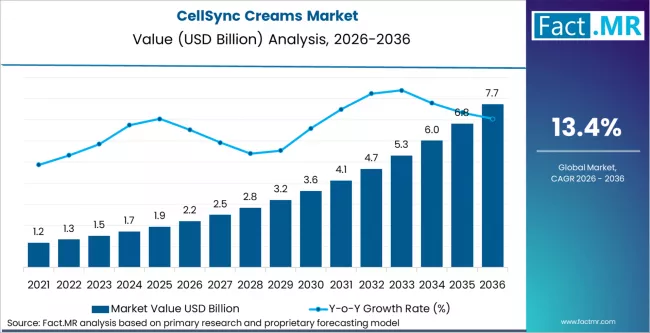
Cellsync Creams Market Market Value Analysis | Source: Fact.MR
Expansion is driven by increasing adoption across China, India, Germany, Brazil, the United States, the United Kingdom, and Japan, where advanced skin regeneration creams are becoming integral to both professional and consumer skincare routines. Product type segmentation identifies cell renewal creams as the largest category, supported by DNA repair creams, anti-aging regeneration creams, and barrier repair creams that address targeted skin concerns such as aging, damage recovery, and moisture retention.
Active technology segmentation shows peptide based formulations leading the market, complemented by stem cell derived, exosome based, and growth factor based creams, each delivering specialized mechanisms for skin repair, rejuvenation, and barrier enhancement. Rising awareness of advanced skincare efficacy and inclusion in premium skincare lines further reinforces market growth across regions.
CellSync Creams Market
| Metric | Value |
|---|---|
| Market Value 2026 | USD 2.2 Billion |
| Market Forecast Value 2036 | USD 7.7 Billion |
| Forecast CAGR 2026 to 2036 | 13.4% |
Source: Fact.MR analysis. Updated Jan 27, 2026
Category
| Category | Segments |
|---|---|
| Product Type | Cell Renewal Creams; DNA Repair Creams; Anti-Aging Regeneration Creams; Barrier Repair Creams; Other |
| Active Technology | Peptide Based; Stem Cell Derived; Exosome Based; Growth Factor Based; Other |
| Skin Type | Dry Skin; Oily Skin; Combination Skin; Sensitive Skin; Normal Skin |
| Application | Anti-Aging; Skin Repair; Barrier Repair; Regeneration; Other |
| Region | North America; Europe; Asia Pacific; Latin America; Middle East & Africa |
Source: Fact.MR analysis. Updated Jan 27, 2026
Segmental Analysis
What Is the Impact of Product Type on the CellSync Creams Market?
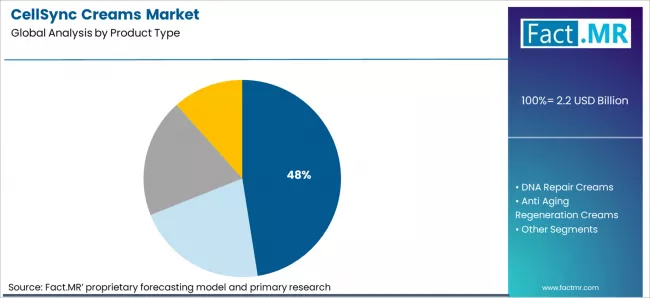
Cellsync Creams Market Analysis By Product Type | Source: Fact.MR
In the CellSync creams market, product type is a critical determinant of adoption and consumer preference. Cell renewal creams hold the leading share at 47.5%, as they are formulated to promote skin turnover, enhance texture, and support repair of visible damage. These creams are widely used in both professional and at-home skincare routines due to their comprehensive benefits for maintaining skin vitality and resilience. Increasing demand for preventive and restorative skincare solutions ensures that cell renewal creams remain the dominant product type in the market.
How Does Active Technology Influence the CellSync Creams Market?
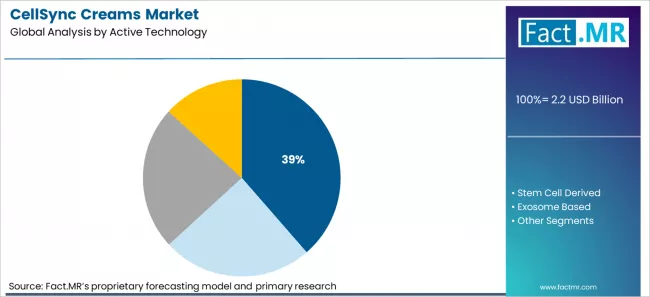
Cellsync Creams Market Analysis By Active Technology | Source: Fact.MR
Active technology significantly affects product performance and differentiation, with peptide based formulations holding a 38.6% share. Peptide technologies stimulate collagen production, enhance cellular repair, and improve overall skin elasticity. Brands continue to focus on peptide incorporation to meet consumer expectations for scientifically validated results. As awareness of advanced skincare technologies grows, peptide based cellSync creams are expected to remain the primary driver of market growth, reinforcing their central role in regeneration-focused skincare strategies.
What are the Drivers, Restraints, and Key Trends in the CellSync Creams Market?
- Drivers: Increasing consumer focus on anti-aging, skin regeneration, barrier repair, and cell renewal is driving demand for CellSync creams. Products leveraging peptide-based, stem cell-derived, exosome-based, and growth factor technologies are widely adopted across professional and consumer skincare segments, offering targeted efficacy and visible improvements in skin health and texture.
- Restraints: High formulation complexity, elevated development costs, and stringent stability requirements limit large-scale production and increase product prices. Maintaining potency and activity of bioactive ingredients across diverse skin types poses additional challenges for manufacturers.
- Trend 1: Emergence of multifunctional creams that integrate peptide, exosome, and growth factor technologies to provide combined anti-aging, regeneration, and barrier repair benefits within single formulations.
- Trend 2: Expansion of professional and e-commerce distribution channels to reach individual consumers and clinical users, supporting wider adoption and improved accessibility in mature and emerging markets.
Analysis of the CellSync Creams Market by Key Country
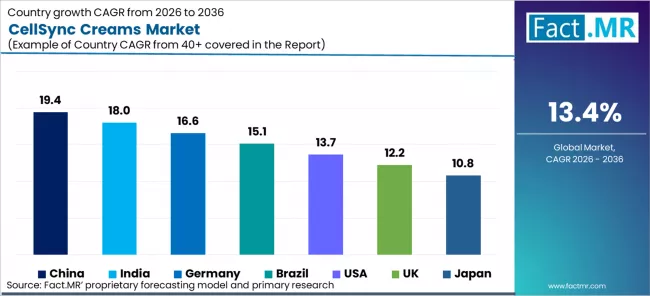
Cellsync Creams Market Cagr Analysis By Country | Source: Fact.MR
| Country | CAGR |
|---|---|
| China | 19.4% |
| India | 18.0% |
| Germany | 16.6% |
| Brazil | 15.1% |
| USA | 13.7% |
| UK | 12.2% |
| Japan | 10.8% |
Source: Fact.MR analysis. Updated Jan 27, 2026
The report covers an in-depth analysis of 7 countries; top-performing countries are highlighted below.
What is the Outlook on the CellSync Creams Market in China?
China market in CellSync creams is projected to grow at a CAGR of 19.4% from 2026 to 2036. Rising demand is driven by consumer adoption of advanced skincare technologies, particularly in cell renewal and barrier repair creams. Peptide-based formulations are gaining traction due to their ability to support skin rejuvenation and improve elasticity. The growing presence of specialty retailers and e-commerce platforms is enhancing accessibility for premium and technologically advanced products.
What is the Demand for CellSync Creams in India?
India market in CellSync creams is expected to grow at a CAGR of 18.0% from 2026 to 2036. Cell renewal creams using peptide-based active technologies are fueling growth as urban consumers seek high-efficacy anti-aging solutions. Online and specialty retail channels support product distribution, while increasing skincare awareness is driving rapid adoption across women and men seeking advanced formulations.
What is the Sales Outlook on CellSync Creams in Germany?
Germany sales of CellSync creams are projected to grow at a CAGR of 16.6% from 2026 to 2036. DNA repair creams incorporating stem cell-derived technologies are increasingly preferred by consumers focused on regenerative and anti-aging benefits. Specialty beauty stores and professional skincare providers continue to drive sales, while demand for scientifically validated formulations supports steady market expansion.
How Are Regeneration-Focused CellSync Creams Driving Growth in Brazil?
Brazil market in CellSync creams is forecast to grow at a CAGR of 15.1% from 2026 to 2036. Anti-aging and regeneration creams, particularly exosome-based formulations, are gaining traction among consumers seeking skin repair and rejuvenation. Pharmacies, specialty stores, and professional aesthetic centers remain primary distribution channels, supporting adoption across urban and semi-urban populations.
Why Does the USA Remain a Significant Market for CellSync Creams?
USA sales of CellSync creams are projected to expand at a CAGR of 13.7% from 2026 to 2036. Barrier repair creams using growth factor-based technologies are driving demand among consumers focused on skin protection and recovery. Specialty skincare providers and online channels support product distribution, while high consumer awareness of advanced skincare solutions sustains growth.
What is Supporting CellSync Creams Adoption in the UK?
UK market in CellSync creams is expected to grow at a CAGR of 12.2% from 2026 to 2036. Consumer interest in anti-aging and regenerative formulations is steadily increasing, supported by both retail and online channels. Premium product positioning and the availability of specialized creams enhance adoption among urban skincare consumers.
How is Market Maturity Affecting CellSync Creams Demand in Japan?
Japan market in CellSync creams is projected to grow at a CAGR of 10.8% from 2026 to 2036. Stable demand exists for advanced regenerative, anti-aging, and repair creams. High consumer expectations for safety, efficacy, and innovation shape the competitive landscape, dominated by both domestic and international skincare brands offering peptide, exosome, and growth factor-based formulations.
How is Competition Structured in the CellSync Creams Market?
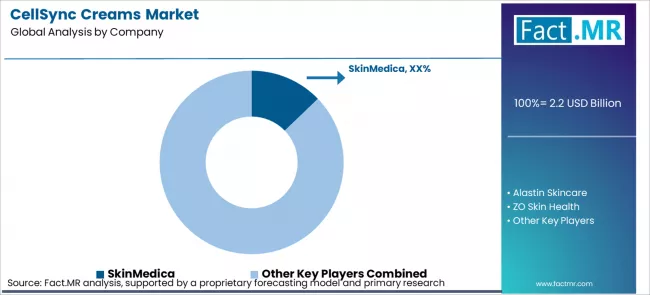
Cellsync Creams Market Analysis By Company | Source: Fact.MR
Competition in the CellSync Creams Market is driven by active technology, formulation efficacy, and multi-functional skin benefits. SkinMedica and Alastin Skincare lead with cell renewal and DNA repair creams, leveraging peptide-based and stem cell-derived technologies to address anti-aging and cellular restoration. ZO Skin Health and Revision Skincare focus on anti-aging regeneration and barrier repair creams formulated with exosome and growth factor-based actives, targeting skin repair, strengthening, and rejuvenation.
Neocutis, PCA Skin, IS Clinical, Dr. Barbara Sturm, Augustinus Bader, and Allies Of Skin differentiate through proprietary delivery systems, targeted applications, and specialized formulations for diverse skin types. Competitive advantage is based on technology innovation, product stability, and demonstrable clinical results. Buyers evaluate brands on efficacy, product versatility, integration into skincare routines, and long-term skin health outcomes. Companies also emphasize global distribution, regulatory compliance, and research-backed validation to maintain strong market positioning.
Key Players in the CellSync Creams Market
- SkinMedica
- Alastin Skincare
- ZO Skin Health
- Revision Skincare
- Neocutis
- PCA Skin
- IS Clinical
- Dr. Barbara Sturm
- Augustinus Bader
- Allies Of Skin
Bibliography
- Food and Drug Administration. (2024). Cosmetic products: Safety and regulations. USA Department of Health and Human Services.
- European Commission. (2023). Regulation (EC) No 1223/2009 on cosmetic products. Publications Office of the European Union.
- National Institutes of Health. (2023). Peptide, stem cell, and exosome technologies in dermatology and regenerative skincare. National Library of Medicine.
- World Health Organization. (2023). Guidelines on bioactive ingredients and advanced skin repair formulations. World Health Organization.
- International Trade Administration. (2024). Global skincare and regenerative cream market trends. USA Department of Commerce.
Segmentation
Scope of the Report
| Items | Values |
|---|---|
| Quantitative Units (2026) | USD 2.2 Billion |
| Product Type | Cell Renewal Creams, DNA Repair Creams, Anti Aging Regeneration Creams, Barrier Repair Creams, Other |
| Active Technology | Peptide Based, Stem Cell Derived, Exosome Based, Growth Factor Based, Other |
| Regions Covered | Asia Pacific, North America, Europe, Latin America, and Middle East & Africa |
| Countries Covered | China, India, Germany, Brazil, USA, UK, Japan, and other countries |
| Key Companies Profiled | SkinMedica, Alastin Skincare, ZO Skin Health, Revision Skincare, Neocutis, PCA Skin, IS Clinical, Dr. Barbara Sturm, Augustinus Bader, Allies Of Skin, and other leading skincare companies |
| Additional Attributes | Dollar revenue by product type, active technology, and region; regional demand trends, competitive landscape, innovations in peptide, stem cell, exosome, and growth factor technologies, premium cream formulation strategies, skin regeneration and anti-aging efficacy studies, and brand positioning analysis |
Source: Fact.MR analysis. Updated Jan 27, 2026
CellSync Creams Market by Segments
-
Product Type :
- Cell Renewal Creams
- DNA Repair Creams
- Anti-Aging Regeneration Creams
- Barrier Repair Creams
-
Active Technology :
- Peptide Based
- Stem Cell Derived
- Exosome Based
- Growth Factor Based
-
Region :
- North America
- USA
- Canada
- Mexico
- Europe
- Germany
- Italy
- UK
- France
- Spain
- Netherlands
- Switzerland
- Rest of Europe
- Asia Pacific
- Japan
- Australia
- South Korea
- China
- India
- Rest of Asia Pacific
- Latin America
- Brazil
- Argentina
- Rest of Latin America
- Middle East and Africa
- United Arab Emirates
- South Africa
- Rest of Middle East and Africa
- North America
Frequently Asked Questions
How big is the cellsync creams market in 2026?
What will be the size of cellsync creams market in 2036?
How much will be the cellsync creams market growth between 2026 and 2036?
What are the key product types in the cellsync creams market?
Which active technology segment to contribute significant share in the cellsync creams market in 2026?
Who worked on this report


Preview the report firsthand - request a free sample
Free SampleGet the brochure for pricing and purchase details
Download PDF