- Market Value (2025): USD 3.0 Bn
- Estimated Value (2026): USD 3.2 Bn
- Forecast Value (2036): USD 6.6 Bn
- CAGR (2026-2036): 7.5%
What is the Cellulose Whitening Alternatives Market forecast to be worth by 2036?
USD 3.2 billion in 2026 to USD 6.6 billion by 2036 at a 7.5% CAGR.
- The Cellulose Whitening Alternatives Market reached USD 3.0 billion in 2025.
- As per Fact.MR analysis, demand is projected to increase from USD 3.2 billion in 2026 to USD 6.6 billion by 2036.
- The market is forecast to record 7.5% CAGR from 2026 to 2036.
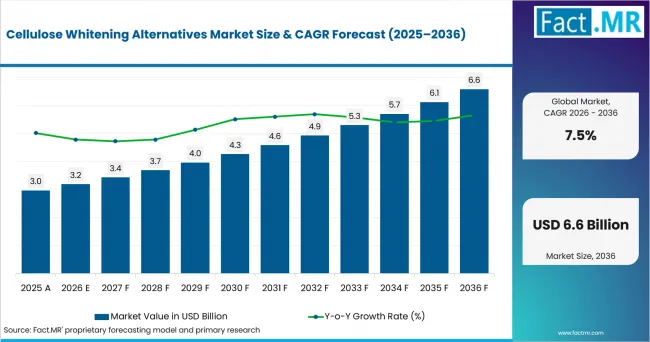
Cellulose Whitening Alternatives Market Value Analysis | Source: Fact.MR
What are the defining numbers behind Cellulose Whitening Alternatives Market growth?
An absolute opportunity of USD 3.3879 billion is expected between 2026 and 2036.
- Demand Drivers in the Market
- Food companies need materials that give products a white look and work with existing production methods. Food-grade cellulose and natural food colors can help control both appearance and product mix. In May 2025, the U.S. FDA approved three food colors from natural sources, showing continued use of new color options [2].
- Tablet and supplement makers need TiO2-free coatings that still give tablets a white appearance. Clear instructions on how much material to use and how to apply it can help companies test different options.
- Paper and packaging companies use cellulose and minerals to improve brightness and coating quality. Surface sizing starch also helps improve paper surfaces using common paper production methods.
- Suppliers can offer materials that provide more than one benefit. Cellulose can give a white look while also helping with binding, flow, or carrying other ingredients. Cassava starch is another option for products that need better texture and a lighter appearance.
- Key Segments Analyzed
- By Whitening Matrix: Microcrystalline cellulose is expected to hold a 39.0% share in 2026 because it gives a white look, is easy to use as a fine powder, and works in food, and personal care products.
- By Replacement Target: Titanium dioxide is anticipated to hold a 36.0% share in 2026 as companies look for other materials that can provide a similar white appearance.
- By Application: Food is anticipated to capture 32.0% share in 2026 because white coatings and mixes are widely used in confectionery, bakery, dairy-style, and other food products where appearance matters.
- By Delivery: Dry powder is expected to hold a 31.0% share in 2026 because it is easy to mix, prepare, and measure during production.
- Analyst Opinion at Fact.MR
- Shambhu Nath Jha, Principal Consultant at Fact.MR, states, “Companies need materials that give a good white look and work well during production. Cellulose-based options can gain more use if they mix well and give the same results on existing production lines. Suppliers also need to provide clear test results and use instructions.”
- Strategic Implications
- Cellulose suppliers should provide whiteness and brightness test results for each use. This helps companies compare products and avoid repeated testing before full production.
- Food and supplement companies should test how much material they need. Using too much can affect texture and drying time. Production tests should also check the white look, speed, and product feel.
- Paper and packaging companies should check recycling and surface quality together. In September 2026, Defra reported that 80.3% of UK paper and cardboard packaging was recycled in 2025 [4]. This makes recycling important when choosing coatings.
- Medicine coating suppliers should clearly list TiO2-free options and explain any changes needed during production.
The USA is expected to grow at 8.4% CAGR through 2036 as food companies change product formulas and look for materials that provide a white appearance. The UK follows at 8.1% as food and packaging production supports the use of cellulose and starch-based materials. Germany is expected to grow at 7.8% as ready-meal and packaging production supports demand for white materials. France reaches 7.5% due to demand from food, medicine, and paper products, while Japan records 6.1% as processed-food exports and medicine production support demand.
How does the Cellulose Whitening Alternatives Market break down by segment?
Microcrystalline cellulose is projected to lead Whitening Matrix at 39.0% share in 2026; while Titanium dioxide leads Replacement Target at 36.0% share.
Which Whitening Matrix dominates?
Microcrystalline cellulose is expected to hold 39.0% share in 2026.
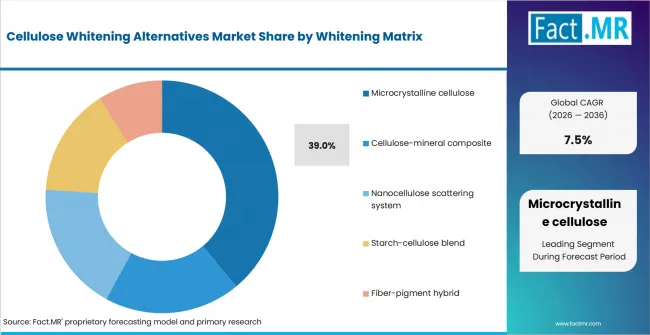
Cellulose Whitening Alternatives Market Analysis By Whitening Matrix | Source: Fact.MR
Microcrystalline cellulose has a natural white look and works well in powder form. Like food-grade cellulose and cellulose derivative excipients, it can improve both product structure and appearance. This makes MCC useful when companies need one material for more than one purpose. Cellulose-mineral and starch-cellulose mixes are used when products need more whiteness or better coating results.
What leads the Replacement Target segment?
Titanium dioxide is projected to account for 36.0% share in 2026.
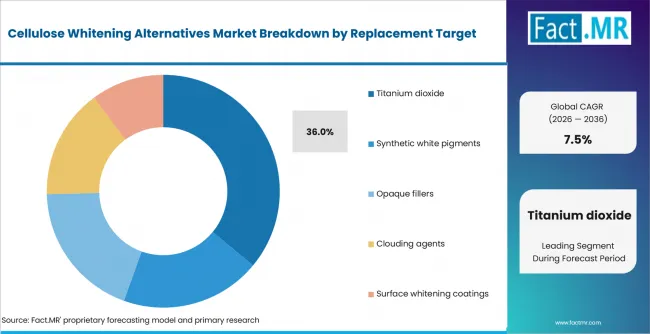
Cellulose Whitening Alternatives Market Analysis By Replacement Target | Source: Fact.MR
Titanium dioxide remains the main material companies want to replace because it provides a strong white appearance. Changes in rules and product formulas are increasing interest in other materials that can give a similar white look at practical amounts. Microfibrillated cellulose fibers provide another option for improving whiteness and product structure. Clouding agents and surface coatings are used for more specific whitening needs.
How does Application shape demand?
Food is anticipated to lead with 32.0% share in 2026.
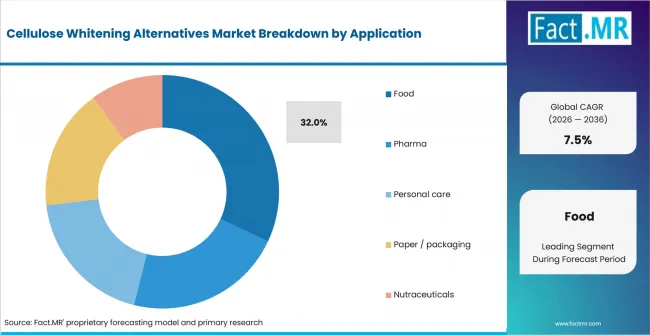
Cellulose Whitening Alternatives Market Analysis By Application | Source: Fact.MR
Food is expected to lead with a 32.0% share in 2026 because many food products need a white appearance. In December 2025, Agreste reported that French food and beverage product sales reached EUR 162 billion in 2024 [7]. Rice starch and functional flour provide other options for controlling product appearance. Medicines, personal care products, paper and packaging, and supplements also use these materials.
What supports Dry powder within Delivery?
Dry powder is estimated to represent 31.0% share in 2026.
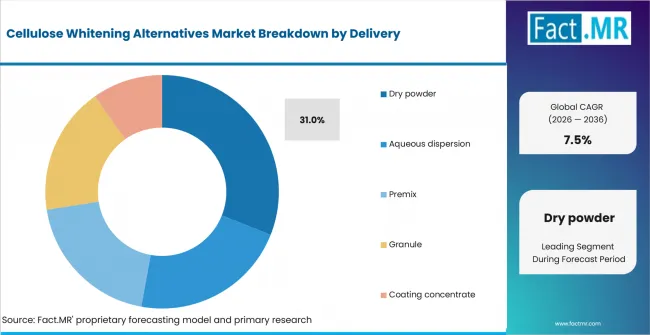
Cellulose Whitening Alternatives Market Analysis By Delivery | Source: Fact.MR
Dry powders work with many production systems and can be mixed with other dry materials before processing. They are also easier to store and transport than liquid mixtures when production already includes mixing or coating. Premixes and coating concentrates reduce mixing work because the materials are already prepared in the right amounts.
What is accelerating Cellulose Whitening Alternatives Market adoption, and what is holding it back?
Changes in product formulas and materials with several uses increase demand. Limited whiteness and the need for larger amounts can slow use in products that need a strong white look.
Drivers Impact Analysis
| DRIVER | (~) % IMPACT ON CAGR | GEOGRAPHIC RELEVANCE | IMPACT TIMELINE |
|---|---|---|---|
| Reformulation away from selected synthetic color systems | +1.4% | North America, Europe | Short term (<= 2 years) |
| Multi-functional use of cellulose in food and pharma | +1.1% | Global | Medium term (2-4 years) |
| Demand for TiO2-free tablet and nutraceutical coatings | +0.9% | Europe, North America | Medium term (2-4 years) |
| Recyclability and material simplification in paper packaging | +0.7% | Europe, Japan | Long term (>= 4 years) |
Source: Fact.MR analysis. Updated Oct 6, 2026
Opportunity Impact Analysis
| OPPORTUNITY | (~) % IMPACT ON CAGR | GEOGRAPHIC RELEVANCE | IMPACT TIMELINE |
|---|---|---|---|
| Cellulose-mineral hybrid systems for higher opacity | +1.0% | Global | Medium term (2-4 years) |
| Ready-to-use TiO2-free coating premixes | +0.8% | Europe, North America | Short term (<= 2 years) |
| Nanocellulose light-scattering systems | +0.6% | Japan, Europe | Long term (>= 4 years) |
Source: Fact.MR analysis. Updated Oct 6, 2026
Restraints Impact Analysis
| RESTRAINT | (~) % IMPACT ON CAGR | GEOGRAPHIC RELEVANCE | IMPACT TIMELINE |
|---|---|---|---|
| Lower opacity per unit dose than TiO2 in some systems | -0.8% | Global | Short term (<= 2 years) |
| Reformulation cost and process changes | -0.6% | North America, Europe | Medium term (2-4 years) |
| Application-specific regulatory and labeling limits | -0.4% | Global | Long term (>= 4 years) |
Source: Fact.MR analysis. Updated Oct 6, 2026
Which countries are scaling the Cellulose Whitening Alternatives Market through 2036?
- The five-country CAGR range spans 2.3 percentage points.
- The USA is 0.3 percentage point above the UK as reformulation work supports option input work.
- The UK is 0.3 percentage point above Germany as food and packaging uses support mix demand.
- Germany is 0.3 percentage point above France as food, packaging and drug uses support functional white systems.
- France is 1.4 percentage points above Japan, supported by its large food output base.
Comparable CAGRs can produce different entry conditions. Food rules and coating practices vary by country. Paper-recycling targets and the scale of local food or drug output create further differences. Full report coverage includes North America, Latin America, Western Europe, Eastern Europe, East Asia, South Asia & Pacific, Middle East & Africa.
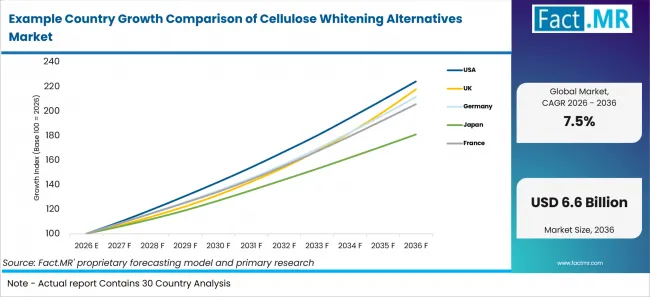
Example Country Growth Comparison Of Cellulose Whitening Alternatives Market | Source: Fact.MR
| Country | CAGR (2026-2036) |
|---|---|
| United States | 8.4% |
| United Kingdom | 8.1% |
| Germany | 7.8% |
| France | 7.5% |
| Japan | 6.1% |
Source: Fact.MR analysis. Updated Oct 6, 2026
What supports USA adoption?
8.4% CAGR, supported by food reformulation and a large processed-food customer base.
The USA has a large packaged food market where a white appearance can affect product design. The U.S. Department of Agriculture, Economic Research Service reported in June 2026 that total U.S. food spending reached USD 2.51 trillion in 2025 [1]. This supports the use of whitening materials across many food products.
What supports the United Kingdom’s growth?
8.1% CAGR, backed by food output and packaging uses.
The UK has a large food industry and strong paper and packaging use, which creates demand for materials that improve whiteness and surface quality. The Office for National Statistics reported in July 2026 that food made up 22.9% of UK manufacturers’ product sales in 2025 [3]. This supports the use of cellulose and starch-based whitening materials in processed foods.
What is supporting Germany’s adoption?
7.8% CAGR, supported by prepared-food output and mix demand.
Germany has a large ready-meal industry where products need a consistent appearance. Destatis reported in January 2026 that Germany produced 1.7 million tonnes of ready meals in 2024 [5]. This supports the use of whitening materials in food and related products.
What supports France demand?
7.5% CAGR, supported by food output and multi-use mix work.
France uses whitening materials in food, medicines, personal care products, and paper. Insee reported in July 2026 that French food, beverage, and tobacco production reached EUR 207 billion in 2025 [6]. This supports demand for materials that help control product appearance across these industries.
How does Japan perform?
6.1% CAGR, supported by drug output and processed-product demand.
Japan has strong demand from medicines and other products that need a consistent white appearance. The Ministry of Health, Labour and Welfare reported in December 2025 that drug production reached JPY 10.2485 trillion in 2024 [8].
Who leads the Cellulose Whitening Alternatives Market?
J. Rettenmaier & Söhne supplies cellulose products in powder and other forms. Omya provides mineral-based materials that improve whiteness, brightness, and opacity. Imerys supplies mineral materials for paper, board, and coatings.
Ashland supplies cellulose-based materials for paper coatings that can improve brightness and opacity. Roquette and Ingredion provide starch-based binders and coating materials for paper and board. These companies offer cellulose, mineral, and starch-based options for different uses.
Buyers compare whiteness, brightness, product quality, ease of use, and supplier support when choosing materials. Test results also help companies choose between cellulose, mineral, and starch-based options.
Which companies are the key providers?
Key companies include J. Rettenmaier & Söhne; Omya; Imerys; Ashland; Roquette; and Ingredion.
- J. Rettenmaier & Söhne
- Omya
- Imerys
- Ashland
- Roquette
- Ingredion
Bibliography
- [1] Zeballos, E., & Sinclair, W. (2026, June 11). Total U.S. food spending reached $2.51 trillion in 2025. U.S. Department of Agriculture, Economic Research Service.
- [2] U.S. Food and Drug Administration. (2025, May 9). FDA approves three food colors from natural sources.
- [3] Office for National Statistics. (2026, July 24). UK manufacturers’ sales by product: 2025.
- [4] Department for Environment, Food & Rural Affairs. (2026, September 23). UK statistics on waste.
- [5] Statistisches Bundesamt (Destatis). (2026, January 14). Produktion von Fertiggerichten binnen fünf Jahren mengenmäßig um 25,6 % gestiegen [Production of ready meals increased by 25.6% in volume within five years].
- [6] Insee. (2026, July 21). Indicateurs macroéconomiques de l'industrie manufacturière : Données annuelles de 2010 à 2025 [Macroeconomic indicators for manufacturing: Annual data from 2010 to 2025].
- [7] Agreste. (2025, December 17). Productions commercialisées des industries agroalimentaires 2024 : léger recul des ventes mais un niveau toujours élevé [Marketed production of the food industries in 2024: Slight decline in sales but still at a high level].
- [8] Ministry of Health, Labour and Welfare of Japan.(2025, December 24). [Publication of the 2024 Pharmaceutical Industry Production Statistics Annual Report].
- [9] Roquette. (2026, October 1). Revolutionizing White Coatings: A Titanium-Free Approach.
This Report Answers
- The report explains use across whitening matrix, replacement target, use and delivery.
- Segment analysis identifies the leading shares and explains why formulators select each format.
- Country analysis compares the USA, UK, Germany, France and Japan using official evidence.
- Competitive analysis reviews active cellulose, mineral and starch-based whitening suppliers.
What does the Cellulose Whitening Alternatives Market cover?
The Cellulose Whitening Alternatives Market covers materials and made systems used to create white appearance or white coverage through cellulose, starch or mineral-cellulose mechanisms. Adjacent demand is visible in food-grade cellulose, food additives and cellulose derivative excipients where texture, carrier and coating functions overlap with whitening needs.
The assessment also considers switch pressure around titanium dioxide, related natural food colors and emerging microfibrillated cellulose fibers where light scattering or fiber-based mix can affect appearance.
What is included in the scope?
The scope includes whitening systems supplied as dry powder, aqueous dispersion, premix, granule or coating concentrate. It includes cellulose, starch-cellulose and fiber-pigment hybrids used in food, pharma, personal care, nutraceutical and paper uses. Adjacent mix references include surface sizing starch, rice starch and cassava starch where starch functionality can overlap with coating and white look needs.
The scope also recognizes mixes that use flour or fiber systems as carriers or bulk white look contributors. The functional flour category provides a related view of how plant-derived powders are selected for process and appearance functions in made foods.
What is excluded from the scope?
The scope excludes titanium dioxide sold as the primary pigment and finished products where the whitening input cannot be separated.
It also excludes pigments and coatings used only in architectural paints, automotive finishes or plastics when they are part of the listed food, drug, personal care, nutraceutical or paper and packaging uses.
How Was the Analysis Built?
The analysis draws on 120+ sources, 35+ company portfolios, 25+ countries, and more than 20 industry interviews.
- Primary Research: Primary research includes discussions with manufacturers, service providers, technology developers, distributors, end users, and subject-matter experts. These conversations examine purchasing priorities, product adoption, operational challenges, approval requirements, competitive positioning, and the factors that influence wider market acceptance.
- Desk Research: Desk research covers government statistics, regulatory publications, company filings, trade data, technical studies, industry associations, standards, public policy, and other authoritative sources. Every source used in the analysis is documented in the bibliography.
- Market Sizing and Forecasting: Market estimates combine historical performance, demand indicators, pricing and volume trends, segment shares, company participation, country-level growth, adoption patterns, investment activity, and barriers to market expansion.
- Data Validation and Update Cycle: Findings are validated by comparing primary interviews with public data, company activity, regulatory changes, trade patterns, and industry developments. Regular updates review new product launches, capacity changes, partnerships, approvals, and shifts in commercial adoption.
Segmentation
What is the report’s scope and coverage?
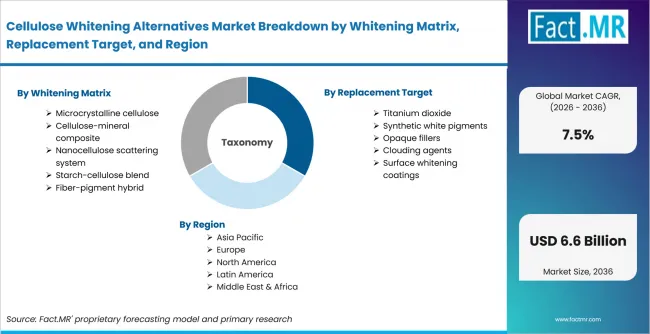
Cellulose Whitening Alternatives Market Breakdown By Whitening Matrix, Replacement Target, And Region | Source: Fact.MR
| Attribute | Details |
|---|---|
| Quantitative Units | USD billion |
| Market Definition | Cellulose-based and cellulose-compatible systems used to create or support white appearance, opacity, light scattering or surface whitening as alternatives to conventional synthetic white pigment systems. |
| Whitening Matrix | Microcrystalline cellulose; Cellulose-mineral composite; Nanocellulose scattering system; Starch-cellulose blend; Fiber-pigment hybrid |
| Replacement Target | Titanium dioxide; Synthetic white pigments; Opaque fillers; Clouding agents; Surface whitening coatings |
| Application | Food; Pharma; Personal care; Paper / packaging; Nutraceuticals |
| Delivery | Dry powder; Aqueous dispersion; Premix; Granule; Coating concentrate |
| Regions Covered | North America; Latin America; Western Europe; Eastern Europe; East Asia; South Asia & Pacific; Middle East & Africa |
| Countries Covered | United States; United Kingdom; Germany; France; Japan |
| Key Companies Profiled | J. Rettenmaier & Söhne; Omya; Imerys; Ashland; Roquette; Ingredion |
| Forecast Period | 2026 to 2036 |
| Approach | Hybrid top-down and bottom-up approach using application demand, whitening-replacement activity, ingredient portfolio review, country manufacturing indicators and supplier validation. |
Source: Fact.MR analysis. Updated Oct 6, 2026
How is the market segmented?
-
By Whitening Matrix:
- Microcrystalline cellulose
- Cellulose-mineral composite
- Nanocellulose scattering system
- Starch-cellulose blend
- Fiber-pigment hybrid
-
By Replacement Target:
- Titanium dioxide
- Synthetic white pigments
- Opaque fillers
- Clouding agents
- Surface whitening coatings
-
By Application:
- Food
- Pharma
- Personal care
- Paper / packaging
- Nutraceuticals
-
By Delivery:
- Dry powder
- Aqueous dispersion
- Premix
- Granule
- Coating concentrate
-
By Region:
- North America
- Latin America
- Western Europe
- Eastern Europe
- East Asia
- South Asia & Pacific
- Middle East & Africa
Frequently Asked Questions
How big is the cellulose whitening alternatives market in 2026?
What is the CAGR of the cellulose whitening alternatives market from 2026 to 2036?
Which whitening matrix leads the cellulose whitening alternatives market?
Which replacement target leads the cellulose whitening alternatives market?
Who are the leading companies in the cellulose whitening alternatives market?
Who worked on this report


Preview the report firsthand - request a free sample
Free SampleGet the brochure for pricing and purchase details
Download PDF