- Market Value (2025): USD 611.1 Mn
- Estimated Value (2026): USD 682.0 Mn
- Forecast Value (2036): USD 2043.7 Mn
- CAGR (2026-2036): 11.6%
What is the Cellulose Titanium Alternatives Market forecast to be worth by 2036?
USD 682.0 million in 2026 to USD 2,043.7 million by 2036 at an 11.6% CAGR.
- The Cellulose Titanium Alternatives Market was valued at USD 611.1 million in 2025.
- Demand is projected to increase from USD 682.0 million in 2026 to USD 2,043.7 million by 2036.
- The market is forecast to record 11.6% CAGR from 2026 to 2036 as product teams grow cellulose, mineral and starch-based white cover systems across food, supplements and beauty uses.
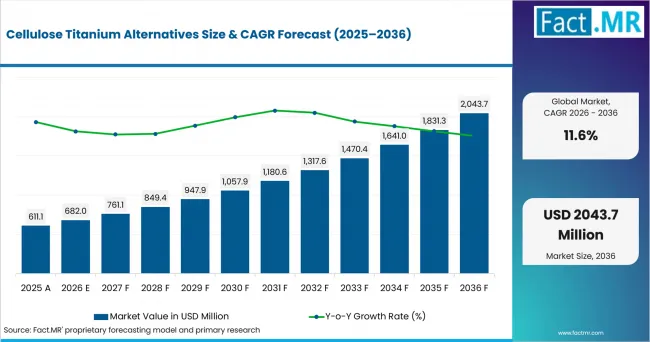
Cellulose Titanium Alternatives Value Analysis | Source: Fact.MR
What are the defining numbers behind Cellulose Titanium Alternatives Market growth?
An absolute opportunity of USD 1,361.7 million is expected between 2026 and 2036.
- Demand Drivers in the Market
- Food makers need white systems that can add opacity and still keep the right feel. The USDA Economic Research Service reported on June 11, 2026 that inflation-adjusted U.S. food spending reached USD 2.51 trillion in 2025, expressed in 2025 dollars.
- Confectionery teams need a white coat that spreads well in coatings and fillings. Mineral-cellulose and starch-cellulose systems can help where shade must stay in step with mouthfeel and flow.
- Supplement makers need powders that give visual cover and still work in a tablet or premix. Cellulose-based excipients can help with compactability and carrier use as well as opacity. Brands can then pick a grade that works with the press and pack.
- Personal-care teams need opaque rheology systems that stay smooth in emulsions and mixes with suspended solids. JRS markets MCC-based cosmetic systems as opaque thickeners and stabilizers. That product role links cellulose with opacity and body in personal-care use.
- Key Segments Analyzed
- By Opacity Platform: Microcrystalline cellulose is expected to hold 34.0% share in 2026 because its brightness, powder handling and multi-use role support broad use.
- By Function: Whitening is projected to account for 31.0% share in 2026 as formulators focus on visual coverage when replacing TiO2-based white systems.
- By Application: Food coatings are anticipated to capture 36.0% share in 2026 owing to the need for a white look, texture control and coating consistency across processed foods.
- By Form: Powder is estimated to represent 29.0% share in 2026 because dry handling simplifies premixing, dosing and use in existing ingredient systems.
- Analyst Opinion at Fact.MR
- Shambhu Nath Jha, Principal Consultant at Fact.MR, states, “The market is about more than a one-for-one pigment swap. Formulators need opacity while they protect texture and line fit. Firms that show clear test results and offer powder or dispersion forms are expected to gain wider approval in food, health and personal-care products.”
- Strategic Implications
- Cellulose suppliers should show opacity next to rheology and mouthfeel. This gives formulators a direct way to compare a multi-use grade with a single-purpose white aid. Plain test charts can show shade and body at the same time.
- Mineral suppliers should position calcium carbonate-cellulose blends by particle control and dispersion fit. The grade must give the needed shade and still flow well in the mix. A stable blend is easier to move from lab work to plant work.
- Starch formulators should build application-specific composite systems for coatings and confectionery. The main task is to keep the right white look and texture in the same coat. A starch blend can be tuned for spread and set. The goal is a neat finish that stays even from batch to batch. The same blend can then be checked on more than one coat.
The USA is forecast to record 12.5% CAGR through 2036 as food, supplement and beauty product teams grow approval of multi-use white systems. China is projected to post 12.3% CAGR as food processing and cosmetics activity widen the buyer base for cellulose, mineral and starch alternatives. Germany is anticipated to advance at 12.3% CAGR owing to food output and demand from pharmacy, beauty and medical-product channels. Japan is estimated to record 11.2% CAGR as food exports and beauty products shipments back product work across look-sensitive products. France is forecast to reach 10.8% CAGR as food output and drug preparation output sustain demand for approved use excipients and whitening systems.
How does the Cellulose Titanium Alternatives Market break down by segment?
Microcrystalline cellulose is projected to lead Opacity Platform at 34.0% share in 2026; while Food coatings lead Application at 36.0% share.
Which Opacity Platform leads?
Microcrystalline cellulose is expected to hold 34.0% share in 2026.
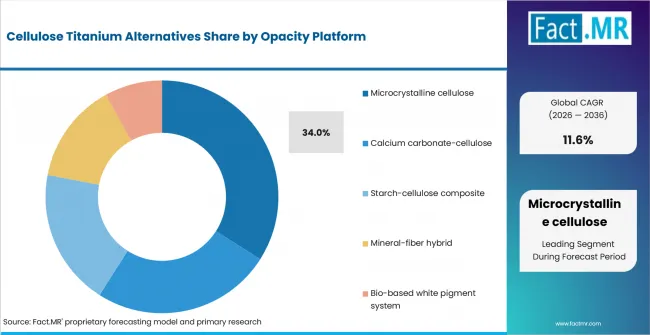
Cellulose Titanium Alternatives Analysis By Opacity Platform | Source: Fact.MR
MCC leads because it can add brightness, body and flow control in food, supplement and personal-care systems. Calcium carbonate-cellulose follows where a team wants mineral whiteness with added structure. Starch-cellulose composites fit products where texture has a large role. JRS lists opacifying as a function of its VIVAPUR MCC food range.
What leads the Function segment?
Whitening is projected to account for 31.0% share in 2026.
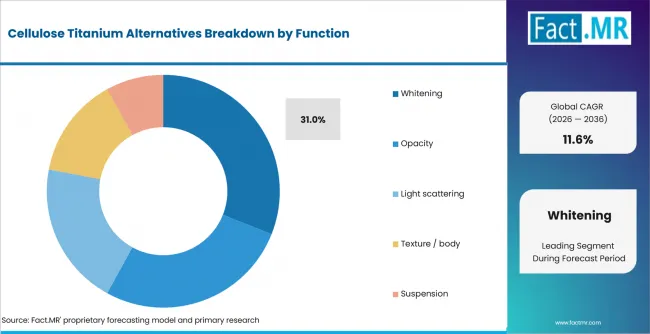
Cellulose Titanium Alternatives Analysis By Function | Source: Fact.MR
Whitening leads because the first need is a clear white or opaque look. Opacity and light scattering stay close to that goal. Texture and body matter when cellulose or starch adds structure. Suspension matters more in liquid or semi-liquid products. Teams can start with a shade target and then check feel, flow and hold.
How does Application shape demand?
Food coatings are anticipated to lead with 36.0% share in 2026.
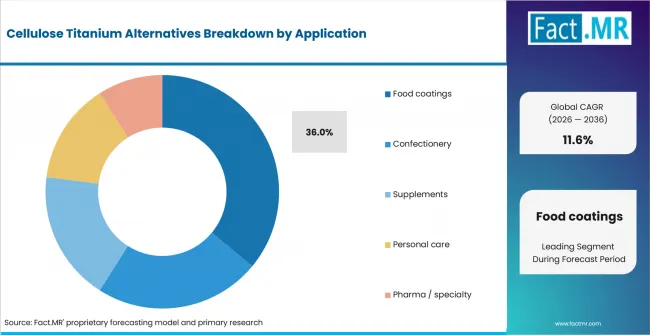
Cellulose Titanium Alternatives Analysis By Application | Source: Fact.MR
Food coatings lead because appearance and texture are checked at the same time on coated foods. China’s National Bureau of Statistics reported on February 28, 2026 that value added in processing food from agricultural and sideline products rose 5.6% in 2025. That scale supports demand for coating ingredients.
What supports Powder within Form?
Powder is estimated to represent 29.0% share in 2026.
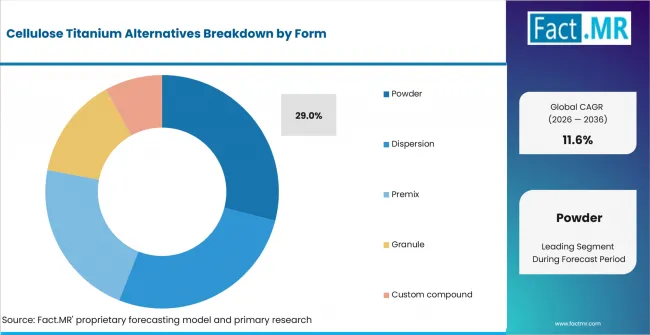
Cellulose Titanium Alternatives Analysis By Form | Source: Fact.MR
Powder leads because it fits dry blending, premixing and set dosing in food, supplement and drug production. Dispersion forms cut the wet-out step when a liquid route is preferred. Premixes make multi-ingredient dosing easier. Custom compounds fit users that need opacity and texture tuned to one product. Dry grades are also easy to weigh, store and move in a plant.
What is accelerating Cellulose Titanium Alternatives Market adoption, and what is holding it back?
Multi-use opacity systems drive adoption; application approval and cost-performance trade-offs restrain it.
Drivers Impact Analysis
| DRIVER | (~) % IMPACT ON CAGR | GEOGRAPHIC RELEVANCE | IMPACT TIMELINE |
|---|---|---|---|
| Food and confectionery reformulation toward titanium alternatives | +1.8% | Global | Short term (<= 2 years) |
| Multifunctional cellulose demand in coatings and solid dosage | +1.4% | North America, Europe, East Asia | Medium term (2-4 years) |
| Expansion of supplement and personal-care formulation activity | +1.1% | North America, East Asia | Medium term (2-4 years) |
| Starch and mineral composite development for opacity plus texture | +0.8% | Europe, Asia | Long term (>= 4 years) |
Source: Fact.MR analysis. Updated Sep 23, 2026
Opportunity Impact Analysis
| OPPORTUNITY | (~) % IMPACT ON CAGR | GEOGRAPHIC RELEVANCE | IMPACT TIMELINE |
|---|---|---|---|
| Application-specific white systems for food coatings | +1.2% | Global | Short term (<= 2 years) |
| Ready-to-use dispersion and premix formats | +0.9% | North America, Europe | Medium term (2-4 years) |
| Pharma and nutraceutical coating systems using qualified excipients | +0.7% | North America, Europe, Japan | Long term (>= 4 years) |
Source: Fact.MR analysis. Updated Sep 23, 2026
Restraints Impact Analysis
| RESTRAINT | (~) % IMPACT ON CAGR | GEOGRAPHIC RELEVANCE | IMPACT TIMELINE |
|---|---|---|---|
| Application-specific qualification requirements | -0.7% | Global | Short term (<= 2 years) |
| Performance gap versus titanium dioxide in high-opacity uses | -0.6% | Global | Medium term (2-4 years) |
| Input-cost variation across cellulose, starch and mineral systems | -0.4% | North America, Europe, East Asia | Medium term (2-4 years) |
Source: Fact.MR analysis. Updated Sep 23, 2026
Which countries are scaling the Cellulose Titanium Alternatives Market through 2036?
- The displayed country range spans 1.7 percentage points, from 12.5% in the USA to 10.8% in France.
- The USA remains 0.2 percentage point above China. Its 12.5% CAGR is tied to a large food and health-product base.
- China and Germany both record 12.3% CAGR. China has scale in food and cosmetics, while Germany has a strong base in processed food and regulated product use.
- Japan follows at 11.2% CAGR. Food exports and cosmetic shipments support work on products where the white look must stay steady.
- France closes the displayed range at 10.8% CAGR. Food output and drug preparation activity give suppliers more than one path into the market.
Similar CAGRs can still lead to different entry needs. Food mix rules, excipient approval, personal-care use and input cost vary by country. Full report coverage includes North America, Latin America, Western Europe, Eastern Europe, East Asia, South Asia & Pacific, Middle East & Africa.
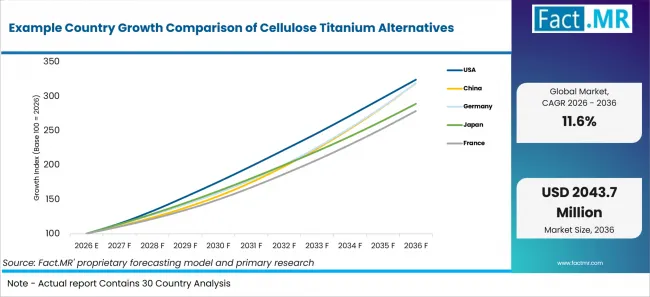
Example Country Growth Comparison Of Cellulose Titanium Alternatives | Source: Fact.MR
| Country | CAGR (2026-2036) |
|---|---|
| USA | 12.5% |
| China | 12.3% |
| Germany | 12.3% |
| Japan | 11.2% |
| France | 10.8% |
Source: Fact.MR analysis. Updated Sep 23, 2026
What supports USA adoption?
12.5% CAGR, driven by food, supplement and personal-care formulation activity.
U.S. formulators work across food, supplements and personal care where opacity must fit texture and process needs. The U.S. Census Bureau reported on September 3, 2026 that Health and Personal Care Stores (NAICS 446) generated an estimated USD 438.9 billion in 2024 revenue. That channel gives supplement and personal-care teams a large sales base for approved white systems. MCC and mineral-cellulose blends are expected to gain attention where opacity can be paired with body or suspension.
How is China scaling demand?
12.3% CAGR, shaped by food processing and cosmetics formulation activity.
China combines high-volume food processing with a large cosmetics base. The National Medical Products Administration reported on December 22, 2025 that China had 2,291,000 filed ordinary cosmetics by the end of October 2025. Personal-care formulators therefore have a large field of products where opaque thickeners and suspension systems can be tested. Starch-cellulose composites are expected to fit food coatings where texture and visual cover are checked together.
What supports Germany adoption?
12.3% CAGR, backed by processed-food output and regulated formulation demand.
Germany has a broad base in processed food and health products. Destatis reported on January 14, 2026 that Germany produced 1.7 million tonnes of ready meals worth EUR 5.9 billion in 2024. That output gives coating and texture systems a clear route into prepared food. Powder and premix forms are expected to fit well because many plants already use dry ingredient lines.
How does Japan perform?
11.2% CAGR, led by food exports and quality-focused formulation requirements.
Japan puts high value on steady quality and product presentation in food and health uses. The Ministry of Agriculture, Forestry and Fisheries reported on February 3, 2026 that Japan’s farm, forest, fishery and food exports reached JPY 1.7005 trillion in 2025, up 12.8%. Export work gives makers a reason to keep coatings and ingredient systems stable across sales markets. MCC and starch systems are expected to fit uses where opacity is paired with texture. Lot-to-lot shade control can help both home and export sales.
What is supporting France adoption?
10.8% CAGR, supported by food manufacturing and specialty formulation activity.
France has a large food-manufacturing base and a well-used specialty ingredient channel. INSEE reported on July 21, 2026 that French food, beverage and tobacco manufacturing recorded EUR 207 billion of production in value in 2025. That base supports coating, confectionery and specialty ingredient use where appearance forms part of the product spec. Cellulose, starch and mineral blends are expected to be assessed when they can pair whiteness with texture or suspension.
Who leads the Cellulose Titanium Alternatives Market?
J. Rettenmaier & Söhne is relevant through its microcrystalline cellulose portfolio. Its VIVAPUR range includes grades positioned for opacifying functions, linking cellulose with whiteness, body and formulation control across food and personal-care applications.
Ashland brings cellulosic ingredient capabilities to food, beverage and nutraceutical formulation. Its distribution arrangement with Tilley Distribution expands access to these ingredients and related technical support in the U.S., giving formulators another route to cellulose-based systems where texture and appearance need to work together.
Seprify, Oterra, Sparxell and Grolman Group complete the profiled supplier set. Their inclusion reflects the broader competitive field spanning cellulose, mineral, starch and alternative white-system approaches used where formulators need opacity, light scattering, texture, body or suspension.
Competition is therefore shaped by more than whiteness alone. Formulators compare opacity with mouthfeel, rheology, suspension, powder handling and dispersion behavior. Supplier strength also depends on application support and the ability to show that a formulation performs consistently in food coatings, supplements, personal care and pharmaceutical uses.
Which companies are the key providers?
Key companies include J. Rettenmaier & Söhne; Seprify; Oterra; Sparxell; Ashland; and Grolman Group.
- J. Rettenmaier & Söhne
- Seprify
- Oterra
- Sparxell
- Ashland
- Grolman Group
Bibliography
- Ashland. (2025, October 6). Ashland announces new U.S. food and beverage ingredient distributor.
- Institut national de la statistique et des études économiques. (2026, July 21). Indicateurs macroéconomiques de l’industrie manufacturière : Données annuelles de 2010 à 2025.
- National Bureau of Statistics of China. (2026, February 28). Statistical communiqué of the People’s Republic of China on the 2025 national economic and social development.
- China Center for Food and Drug International Exchange. (2025, December 22). Policy interpretation of the NMPA’s opinions on deepening the reform of cosmetics regulation and promoting high-quality industry development. National Medical Products Administration.
- Statistisches Bundesamt (Destatis). (2026, January 14). Produktion von Fertiggerichten binnen fünf Jahren mengenmäßig um 25,6 % gestiegen [Production of ready meals increased by 25.6% in volume within five years].
- U.S. Census Bureau. (2026, September 3). Census Bureau releases new Annual Integrated Economic Survey data.
- Zeballos, E., & Sinclair, W. (2026, June 11). Total U.S. food spending reached $2.51 trillion in 2025. U.S. Department of Agriculture, Economic Research Service.
This Report Answers
- The report explains where cellulose, starch and mineral-based opacity systems are used in food, supplements, personal care and pharmaceutical applications.
- Segment analysis identifies the leading opacity platform, function, application and form. It also explains why formulators favor each leading subsegment.
- Country analysis compares the listed markets with official food, cosmetics and production evidence from 2025 onward.
- Competitive analysis reviews the six named providers by their current cellulose, mineral, starch or excipient fit. It assigns no company market shares.
- Application analysis looks at how whiteness, texture, suspension and handling needs shape formulation choice.
What does the Cellulose Titanium Alternatives Market cover?
The Cellulose Titanium Alternatives Market covers ingredient systems used to give whiteness, opacity, light scattering, body or suspension in appearance-sensitive products. Adjacent demand can be compared with opacifying ingredients, food coating ingredients, and food thickening agents where visual and texture functions overlap.
The assessment covers powder, dispersion, premix, granule and custom-compound forms. It focuses on systems that pair a white or opaque effect with body, suspension or coating consistency.
What is included in the scope?
Included applications span dietary supplements, cosmetic chemicals, functional food texture systems, and food stabilizers where cellulose or starch can serve more than one formulation role.
The scope also connects with calcium carbonate, white pigments, and the broader titanium dioxide market when those categories help explain opacity benchmarks and substitution needs.
What is excluded from the scope?
The scope excludes conventional TiO2 sold as the primary white pigment. It also excludes cellulose, starch and mineral ingredients used for unrelated reinforcement, dietary fiber, construction filler or paper bulk where opacity and whitening sit outside the target role.
General pigments are excluded when they provide color without serving as a titanium-replacement white system. Finished foods, cosmetics, supplements and pharmaceutical products remain end-use channels outside the ingredient market.
How Was the Analysis Built?
The analysis draws on 120+ sources, 35+ company portfolios, 25+ countries, and more than 20 industry interviews.
- Primary Research: Primary research includes discussions with manufacturers, service providers, technology developers, distributors, end users, and subject-matter experts. These conversations examine purchasing priorities, product adoption, operational challenges, approval requirements, competitive positioning, and the factors that influence wider market acceptance.
- Desk Research: Desk research covers government statistics, regulatory publications, company filings, trade data, technical studies, industry associations, standards, public policy, and other authoritative sources. Every source used in the analysis is documented in the bibliography.
- Market Sizing and Forecasting: Market estimates combine historical performance, demand indicators, pricing and volume trends, segment shares, company participation, country-level growth, adoption patterns, investment activity, and barriers to market expansion.
- Data Validation and Update Cycle: Findings are validated by comparing primary interviews with public data, company activity, regulatory changes, trade patterns, and industry developments. Regular updates review new product launches, capacity changes, partnerships, approvals, and shifts in commercial adoption.
Segmentation
What is the report’s scope and coverage?
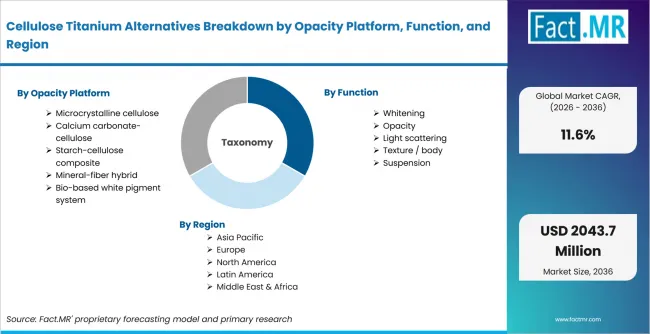
Cellulose Titanium Alternatives Breakdown By Opacity Platform, Function, And Region | Source: Fact.MR
| Attribute | Details |
|---|---|
| Quantitative Units | USD million |
| Market Definition | Formulation systems based on cellulose, starch, minerals or hybrids used to provide whiteness, opacity, light scattering, body or suspension where manufacturers seek alternatives to titanium-based white systems. |
| Opacity Platform | Microcrystalline cellulose; Calcium carbonate-cellulose; Starch-cellulose composite; Mineral-fiber hybrid; Bio-based white pigment system |
| Function | Whitening; Opacity; Light scattering; Texture / body; Suspension |
| Application | Food coatings; Confectionery; Supplements; Personal care; Pharma / specialty |
| Form | Powder; Dispersion; Premix; Granule; Custom compound |
| Regions Covered | North America; Latin America; Western Europe; Eastern Europe; East Asia; South Asia & Pacific; Middle East & Africa |
| Countries Covered | USA; China; Germany; Japan; France |
| Key Companies Profiled | J. Rettenmaier & Söhne; Seprify; Oterra; Sparxell; Ashland; Grolman Group |
| Forecast Period | 2026 to 2036 |
| Approach | Hybrid top-down and bottom-up approach using application demand, formulation adoption, segment shares, country growth, supplier portfolio review and first-hand evidence. |
Source: Fact.MR analysis. Updated Sep 23, 2026
How is the market segmented?
-
By Opacity Platform:
- Microcrystalline cellulose
- Calcium carbonate-cellulose
- Starch-cellulose composite
- Mineral-fiber hybrid
- Bio-based white pigment system
-
By Function:
- Whitening
- Opacity
- Light scattering
- Texture / body
- Suspension
-
By Application:
- Food coatings
- Confectionery
- Supplements
- Personal care
- Pharma / specialty
-
By Form:
- Powder
- Dispersion
- Premix
- Granule
- Custom compound
-
By Region:
- North America
- Latin America
- Western Europe
- Eastern Europe
- East Asia
- South Asia & Pacific
- Middle East & Africa
Frequently Asked Questions
How big is the cellulose titanium alternatives market in 2026?
What is the CAGR of the cellulose titanium alternatives market from 2026 to 2036?
Which opacity platform leads the cellulose titanium alternatives market?
Which application leads the cellulose titanium alternatives market?
Who are the leading companies in the cellulose titanium alternatives market?
Who worked on this report


Preview the report firsthand - request a free sample
Free SampleGet the brochure for pricing and purchase details
Download PDF