Chassis Domain Controller Systems for Next-Gen Vehicles Market
The Chassis Domain Controller Systems for Next-Gen Vehicles Market is analyzed by controller type, including central chassis controller and integrated vehicle dynamics controller, and region, forecast 2026 to 2036.
By Fact.MR Automotive DeskLead analyst:
Shubham PatidarPublished :
15 min read
Fact-checked under the Fact.MR editorial process
Chassis Domain Controller Systems for Next-Gen Vehicles Market Size, Share and Forecast By Fact.MR
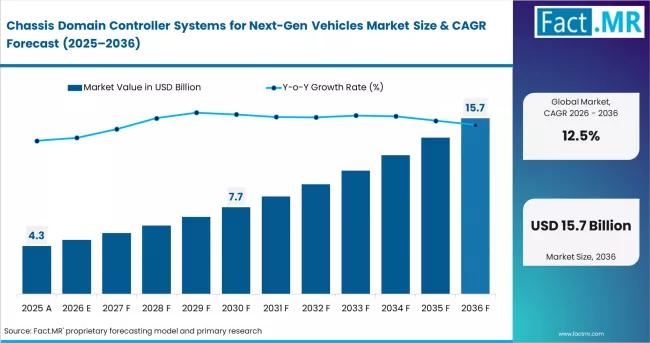
In 2025, the chassis domain controller systems for next-gen vehicles market was valued at USD 3.8 billion. Fact MR analysis indicates demand for chassis domain controller systems is expected to reach USD 4.3 billion in 2026 and USD 13.9 billion by 2036. FMR estimates the market will expand at a CAGR of 12.5% across the forecast period.
Chassis Domain Controller Systems For Next Gen Vehicles Market Market Value Analysis | Source: Fact.MR
Chassis Domain Controller Systems for Next-Gen Vehicles Market
Metric
Details
Industry Size (2026E)
USD 4.3 billion
Industry Value (2036F)
USD 13.9 billion
CAGR (2026 to 2036)
12.5%
Source: Fact.MR analysis. Updated May 5, 2026
Summary of Chassis Domain Controller Systems for Next-Gen Vehicles Market
Market Snapshot
The chassis domain controller systems for next-gen vehicles market refers to centralized electronic control architectures that manage braking, steering, suspension, and vehicle stability functions through unified computing platforms. These systems consolidate multiple control units into integrated processors enabling coordinated vehicle dynamics, improved safety performance, and compatibility with software-defined vehicle architectures and ADAS functions.
Demand Drivers
Increasing transition toward centralized vehicle electronic architectures consolidating braking, steering, and suspension control functions.
Rising integration of advanced driver assistance systems requiring synchronized vehicle motion control capability.
Expansion of electric and autonomous vehicle platforms requiring real-time chassis response optimization.
Growing adoption of brake-by-wire and steer-by-wire technologies supporting software-based vehicle dynamics control.
Increasing requirement for high-speed communication protocols enabling low latency data exchange across safety-critical vehicle subsystems.
Key Segments Analyzed
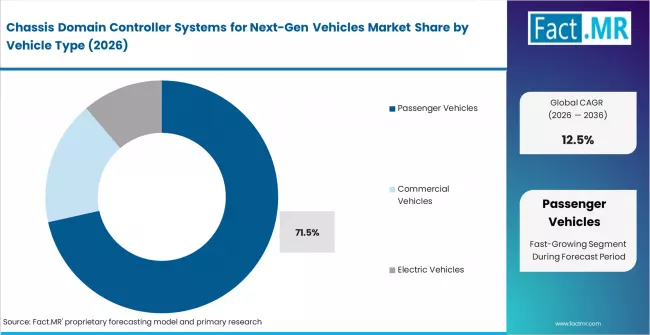
Vehicle Type: Passenger vehicles lead with 71.5% share supported by high integration of electronic stability and motion control systems.
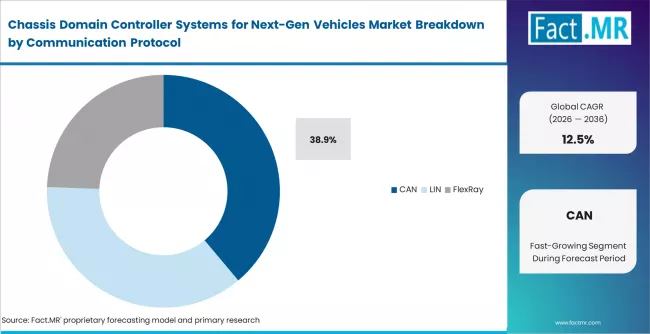
Communication Protocol: CAN accounts for 38.9% share supported by reliability in real-time communication across chassis control networks.
Controller Type: Integrated vehicle dynamics controllers and central chassis controllers demonstrate increasing deployment across next-generation vehicle architectures.
Application: Brake and steering control systems show strong adoption supported by shift toward electronic vehicle motion control platforms.
Geography: China and South Korea show strong growth supported by expansion of software-defined vehicle platform development.
Analyst Opinion at Fact MR
Shambhu Nath Jha, Principal Consultant at Fact MR, states, "Centralized chassis control architectures are enabling coordinated management of braking, steering, and suspension functions as vehicle platforms transition toward software-defined electronic systems. Suppliers capable of supporting functional safety compliance and high-speed communication integration will maintain strong positioning as next-generation vehicle dynamics platforms evolve."
Strategic Implications
Expand development of integrated vehicle dynamics control platforms supporting unified management of chassis subsystems.
Improve compatibility between communication protocols and centralized vehicle computing architecture supporting real-time control response.
Strengthen development of brake-by-wire and steer-by-wire control modules supporting software-based vehicle motion control capability.
Support scalable controller platforms compatible with electric and autonomous vehicle electronic architectures.
Methodology
Based on primary interviews with automotive OEM engineers, electronic control unit suppliers, and vehicle dynamics specialists.
Supported by review of automotive E/E architecture publications, semiconductor documentation, and chassis control system studies.
Market estimation uses hybrid modeling combining supplier revenue benchmarking with evaluation of vehicle production and domain controller adoption trends.
Data validation conducted using technical literature and expert consultation inputs.
A CAGR of 12.5%, with value increasing from USD 4.3 billion to USD 13.9 billion, reflects moderate growth rate volatility influenced by vehicle platform transition cycles and software-defined architecture adoption timelines. Demand is supported by integration of braking, steering, and suspension controls, while variability may arise from semiconductor supply exposure, validation complexity, and evolving vehicle electrical architectures.
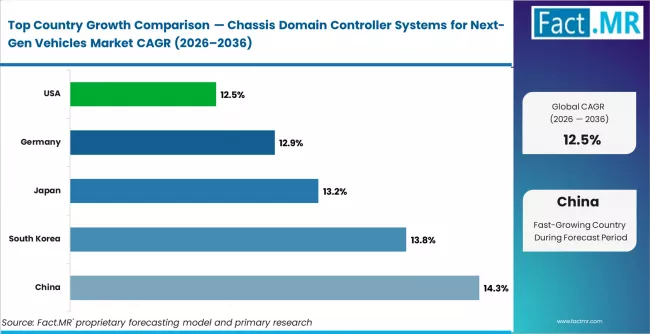
China records the fastest growth at 14.3%, supported by increasing integration of centralized control architectures for braking, steering, and suspension coordination. South Korea follows at 13.8%, driven by expansion of electronic stability and motion control platform development. Japan shows 13.2% growth, linked to advancement of precision vehicle dynamics control technologies for next-generation mobility systems. Germany at 12.9% and the USA at 12.5% represent mature markets where demand is largely replacement-driven due to established adoption of domain-based vehicle electronic control frameworks. A structural constraint across mature markets is functional safety validation complexity, which extends development and certification timelines for integrated chassis control platforms.
Segmental Analysis
Chassis Domain Controller Systems for Next-Gen Vehicles Market Analysis by Vehicle Type
Chassis Domain Controller Systems For Next Gen Vehicles Market Analysis By Vehicle Type | Source: Fact.MR
Market Overview: Passenger vehicles are projected to hold 71.5% share of the chassis domain controller systems for next-gen vehicles market in 2026. Demand concentration reflects increasing deployment of centralized electronic control architectures managing braking systems, steering response, suspension dynamics, and stability control across integrated vehicle platforms. Passenger vehicle manufacturers incorporate chassis domain controllers to support coordinated operation of multiple subsystems enabling improved vehicle handling performance and safety functionality.
Demand Drivers:
Integrated Vehicle Control Requirements: Chassis domain controllers enable coordinated communication between braking, steering, and suspension systems supporting optimized vehicle dynamics performance.
Advanced Driver Assistance Compatibility: Passenger vehicle platforms integrate domain controllers supporting electronic stability control and traction management functionalities within unified processing environments.
System Architecture Consolidation: Automotive manufacturers deploy centralized controllers to reduce electronic control unit complexity across vehicle platform electrical architecture configurations.
Chassis Domain Controller Systems for Next-Gen Vehicles Market Analysis by Communication Protocol
Chassis Domain Controller Systems For Next Gen Vehicles Market Analysis By Communication Protocol | Source: Fact.MR
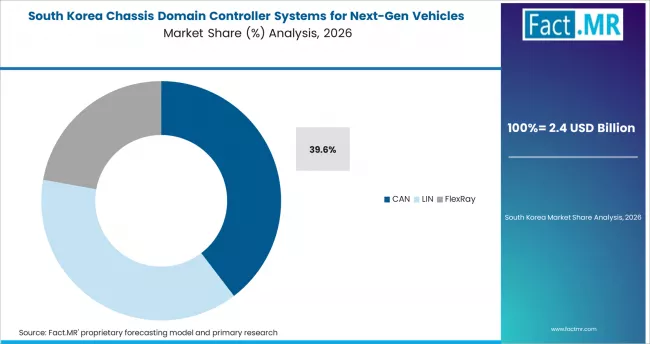
Market Overview: CAN communication protocol is estimated to account for 38.9% share in 2026, supported by its established reliability in enabling real-time communication between vehicle electronic control units managing chassis functions. CAN networks enable deterministic data transmission across safety-critical vehicle subsystems requiring low latency communication performance.
Demand Drivers:
Reliable Data Communication: CAN protocol supports robust message transmission across distributed vehicle electronic control modules operating within safety-critical environments.
Low Latency Requirements: Chassis control applications require rapid data exchange between sensors and control units managing braking and steering responses.
Industry Standard Adoption: Automotive manufacturers continue utilizing CAN-based communication architectures due to compatibility with existing vehicle electronic system integration frameworks.
Drivers, Restraints, and Opportunities
Chassis Domain Controller Systems For Next Gen Vehicles Market Opportunity Matrix Growth Vs Value | Source: Fact.MR
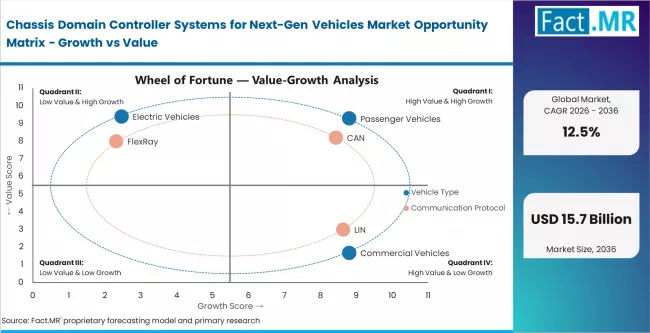
Fact MR analysis indicates the market reflects a high-growth vehicle electronic architecture segment transitioning from distributed chassis control modules toward centralized computing platforms capable of coordinating braking, steering, suspension, and stability functions within a unified processing environment. Market size exists because next-generation vehicles integrate advanced driver assistance systems, torque vectoring, active suspension, and electronic stability control, requiring synchronized real-time computation across multiple sensor inputs and actuator outputs. Historically, chassis functions operated through separate ECUs, while current valuation reflects consolidation into domain controllers that reduce wiring complexity and improve system response speed through centralized processing architectures.
Current dynamics show declining reliance on fragmented chassis control architectures as OEMs adopt domain-based E/E platforms capable of supporting autonomous driving functions and predictive vehicle dynamics control. Chassis domain controllers command higher per-unit pricing due to multicore processors, high-bandwidth communication interfaces, and safety-certified software stacks aligned with software-defined vehicle frameworks. Value growth is supported by increasing sensor density and integration of electronic braking, steer-by-wire, and adaptive suspension systems that require synchronized control algorithms operating within centralized compute hardware environments.
Functional Safety Architecture: ISO 26262 functional safety requirements define validation frameworks for electronic steering, braking, and stability control systems integrated within centralized chassis domain controllers.
Autonomous Vehicle Integration: Europe, China, and the United States lead deployment as higher autonomy levels require real-time coordination between vehicle dynamics control and ADAS sensor fusion systems.
Zonal E/E Transition: Migration toward centralized and zonal electrical architectures increases value per controller as fewer high-performance computing units replace numerous distributed chassis ECUs.
Regional Analysis
The chassis domain controller systems for next-gen vehicles market is assessed across Asia Pacific, Europe, and North America, segmented by country-level demand for centralized control units managing braking, steering, suspension, and vehicle stability functions in software-defined vehicle architectures. Geographic variation reflects electrified platform development, advanced driver assistance integration, and adoption of domain-based electronic control structures. The full report offers market attractiveness analysis.
Top Country Growth Comparison Chassis Domain Controller Systems For Next Gen Vehicles Market Cagr (2026 2036) | Source: Fact.MR
CAGR Table
Country
CAGR (2026-2036)
China
14.3%
South Korea
13.8%
Japan
13.2%
Germany
12.9%
USA
12.5%
Source: Fact.MR analysis. Updated May 5, 2026
Source: Fact MR analysis, based on proprietary forecasting model and primary research
Chassis Domain Controller Systems For Next Gen Vehicles Market Cagr Analysis By Country | Source: Fact.MR
Asia Pacific Chassis Domain Controller Systems for Next-Gen Vehicles Market
Chassis Domain Controller Systems For Next Gen Vehicles Market South Korea Market Share Analysis By Communication Protocol | Source: Fact.MR
Asia Pacific functions as the vehicle control architecture innovation hub supported by rapid development of software-defined vehicle platforms and integration of centralized chassis control technologies. Hyundai Mobis strengthens integrated chassis controller engineering capability. Denso Corporation expands vehicle motion control software portfolio depth. Huawei Intelligent Automotive Solution supports domain-based electronic architecture innovation.
China: China is projected to record 14.3% CAGR in chassis domain controller systems for next-gen vehicles through 2036. Intelligent Connected Vehicle Development Strategy update (Ministry of Industry and Information Technology, January 2023) supports centralized vehicle control architecture adoption. Huawei expanded chassis domain control platform capability (June 2023).
South Korea: South Korea is expected to observe 13.8% CAGR in chassis domain controller systems for next-gen vehicles through 2036. Future Mobility Strategy update (Ministry of Trade, Industry and Energy, February 2023) supports development of integrated vehicle motion control technologies. Hyundai Mobis expanded electronic chassis control investment (May 2023).
Japan: Japan is anticipated to expand at 13.2% CAGR in chassis domain controller systems for next-gen vehicles through 2036. Green Growth Strategy update (Ministry of Economy, Trade and Industry, March 2023) supports next generation vehicle control architecture innovation. Denso Corporation expanded chassis control software engineering capability (April 2023).
Europe Chassis Domain Controller Systems for Next-Gen Vehicles Market
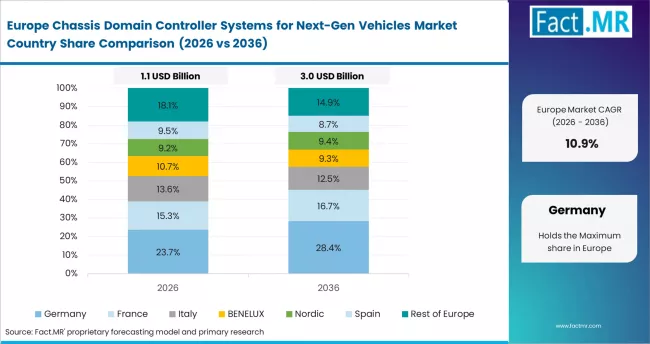
Chassis Domain Controller Systems For Next Gen Vehicles Market Europe Country Market Share Analysis, 2026 & 2036 | Source: Fact.MR
Europe operates as the vehicle dynamics engineering laboratory supported by strong automotive R&D infrastructure and integration of advanced electronic stability and motion control systems. Bosch GmbH strengthens centralized chassis controller engineering capability. Continental AG expands vehicle motion control platform portfolio depth. ZF Friedrichshafen AG supports electronic stability architecture innovation.
Germany: Germany is forecast to grow at 12.9% CAGR in chassis domain controller systems for next-gen vehicles through 2036. EU vehicle safety regulation update (European Commission, January 2023) supports integration of advanced vehicle motion control technologies. Bosch GmbH expanded chassis domain controller development capability (July 2023).
North America Chassis Domain Controller Systems for Next-Gen Vehicles Market
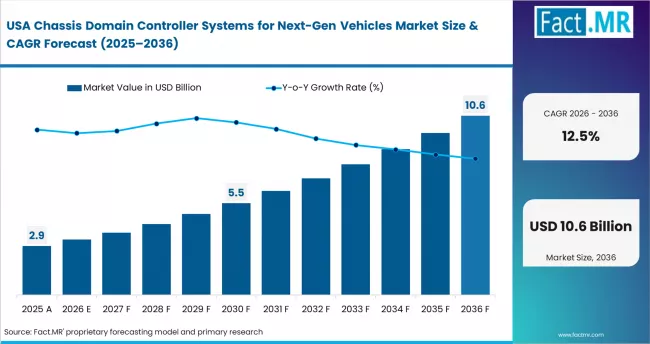
Chassis Domain Controller Systems For Next Gen Vehicles Market Country Value Analysis | Source: Fact.MR
North America functions as the software-defined vehicle commercialization center supported by increasing demand for integrated vehicle control platforms and centralized electronic architecture systems. Aptiv PLC strengthens domain controller engineering capability. BorgWarner Inc. expands vehicle control electronics portfolio depth. Visteon Corporation supports integrated vehicle software platform innovation.
USA: The USA is projected to register 12.5% CAGR in chassis domain controller systems for next-gen vehicles through 2036. U.S. vehicle safety standards update (National Highway Traffic Safety Administration, March 2023) supports adoption of advanced vehicle control systems. Aptiv PLC expanded chassis domain controller production capability (August 2023).
Fact MR's analysis of chassis domain controller systems for next-gen vehicles market in global regions consists of country-wise assessment that includes China, South Korea, Japan, Germany, and USA. Readers can find vehicle control architecture trends, motion control developments, regulatory positioning frameworks, and competitive electronic system innovation insights.
Competitive Landscape
What is the Competitive Structure of the Chassis Domain Controller Systems for Next-Gen Vehicles Market?
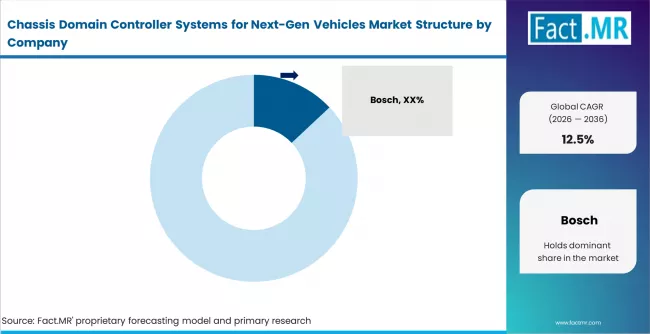
Chassis Domain Controller Systems For Next Gen Vehicles Market Analysis By Company | Source: Fact.MR
The Chassis Domain Controller Systems for Next-Gen Vehicles Market demonstrates a moderately concentrated competitive structure, supported by automotive electronics suppliers and semiconductor companies specializing in centralized vehicle control architecture. Leading companies including Bosch, Continental, ZF Friedrichshafen, Aptiv, Denso, NXP Semiconductors, Infineon Technologies, Magna International, Hyundai Mobis, and Valeo collectively account for nearly 65–75% of global market share, particularly in domain controllers managing braking, steering, suspension, and vehicle dynamics control functions. Competitive positioning is primarily determined by processing capability, real-time control accuracy, functional safety compliance, and compatibility with zonal electrical architectures adopted in software-defined vehicles. High development complexity in safety-certified control software and automotive-grade semiconductor integration creates strong entry barriers, reinforcing the presence of established Tier 1 suppliers and chip manufacturers with proven system engineering capabilities.
Structural advantages are observed among companies possessing integrated portfolios covering sensors, electronic control units, and software platforms aligned with centralized chassis control requirements. Bosch and ZF Friedrichshafen benefit from strong expertise in braking and steering systems, supporting seamless integration of mechanical subsystems with electronic domain controllers. Buyers typically manage supplier dependency through dual sourcing strategies and validation of controller reliability across multiple approved vendors. Procurement decisions often consider compliance with automotive functional safety standards, deterministic control response performance, and compatibility with vehicle communication networks. Pricing power remains relatively balanced, though suppliers retain moderate leverage where platform-specific software validation and system integration complexity create switching constraints for vehicle manufacturers implementing next-generation centralized chassis control architectures.
Key Players of the Chassis Domain Controller Systems for Next-Gen Vehicles Market
Bosch
Continental
ZF Friedrichshafen
Aptiv
Denso
NXP Semiconductors
Infineon Technologies
Magna International
Hyundai Mobis
Valeo
Bibliographies
[1] Ministry of Industry and Information Technology (MIIT), China. (2023). New Energy Vehicle (NEV) Policy - Emission Standards Update.
[2] Ministry of Trade, Industry and Energy (MOTIE), South Korea. (2023). Future Mobility Strategy (Road Transport Research Factsheet).
[3] Ministry of Economy, Trade and Industry (METI), Japan. (2023). Green Growth Strategy Through Achieving Carbon Neutrality in 2050.
[4] Scania Group (EU Regulation). (2023, March). EU's New Safety Regulation for Trucks and Buses (GSR Update).
[5] National Highway Traffic Safety Administration (NHTSA). (2025, February). NHTSA Final Rule: FMVSS No. 305a Electric-Powered Vehicle Safety Standards.
This Report Addresses
Market size estimation and revenue forecast for 2026 to 2036 supported by vehicle production benchmarks and chassis controller integration adoption data.
Growth opportunity evaluation across central chassis controllers, vehicle dynamics controllers, brake by wire, steer by wire, and suspension control modules.
Segment level demand assessment covering passenger, commercial, electric, and autonomous vehicle motion control environments.
Regional adoption analysis identifying demand trends across Asia Pacific, Europe, and North America software defined vehicle platforms.
Competitive benchmarking covering automotive electronics suppliers specializing in vehicle dynamics control processors and centralized chassis control architectures.
Technology evaluation assessing real time control processing capability, functional safety compliance, communication protocol integration, and ADAS compatibility frameworks.
Supply chain assessment identifying dependency on microcontrollers, communication chipsets, automotive Ethernet components, and safety certified software validation cycles.
Deliverables including PDF report, Excel dataset, presentation slides, and forecast models supporting vehicle control architecture strategy and domain controller platform development.
Market Definition of Chassis Domain Controller Systems for Next-Gen Vehicles Market
The chassis domain controller systems for next-gen vehicles market refers to centralized electronic computing platforms that manage vehicle motion control functions such as steering, braking, suspension, and stability systems. These controllers integrate multiple electronic control units into a unified architecture, enabling real-time coordination of chassis dynamics to improve safety, ride comfort, and automated driving performance.
Chassis Domain Controller Systems for Next-Gen Vehicles Market Inclusions
The report covers global and regional market size evaluation and forecast outlook across the defined period. It includes segmentation by controller architecture such as integrated chassis control units, high-performance processors, and software-defined control platforms. Applications include electric vehicles, autonomous vehicles, and advanced driver assistance systems integrating braking, steering, and suspension control functions. Supply chain structure and semiconductor platform integration are analyzed.
Chassis Domain Controller Systems for Next-Gen Vehicles Market Exclusions
The scope excludes standalone braking modules, steering actuators, suspension hardware, and mechanical chassis components not integrated into domain-based computing platforms. Individual sensors and unrelated vehicle electronic modules such as infotainment or body electronics are not included. The analysis focuses strictly on centralized chassis domain computing systems coordinating vehicle dynamics and motion control electronics.
Chassis Domain Controller Systems for Next-Gen Vehicles Market Research Methodology
Primary Research
Interviews were conducted with automotive OEM engineers, electronic control unit suppliers, semiconductor platform providers, and vehicle dynamics specialists involved in chassis control architecture development.
Desk Research
Technical journals, automotive E/E architecture publications, semiconductor documentation, and industry reports were reviewed to identify adoption trends in integrated chassis control computing platforms.
Market-Sizing and Forecasting
A hybrid model combining bottom-up supplier revenue assessment and top-down evaluation of vehicle production volumes and domain controller penetration rates was applied to estimate market size and growth outlook.
Data Validation and Update Cycle
Outputs were validated through triangulation of technical publications, supplier capability disclosures, and expert consultation. Periodic updates reflect developments in software-defined vehicle architecture, chassis-by-wire technologies, and centralized vehicle computing platforms.
Market Breakdown
Segmentation
Report Scope
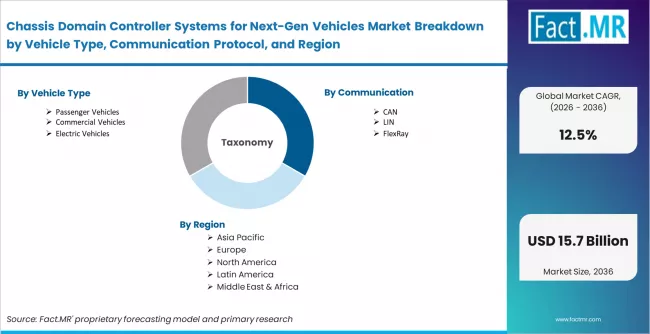
Chassis Domain Controller Systems For Next Gen Vehicles Market Breakdown By Vehicle Type, Communication Protocol, And Region | Source: Fact.MR
Metric
Value
Quantitative Units
USD 4.3 billion (2026) to USD 13.9 billion (2036), at a CAGR of 12.5%
Market Definition
The chassis domain controller systems for next-gen vehicles market includes centralized electronic control units designed to manage vehicle dynamics functions such as braking, steering, suspension, and stability systems. These controllers enable coordinated control logic, real-time data processing, and integration with advanced driver assistance systems to improve vehicle safety, handling performance, and system efficiency across modern vehicle platforms.
Controller Type Segmentation
Central chassis controller, Integrated vehicle dynamics controller, Brake-by-wire controller, Steer-by-wire controller, Suspension control module
Vehicle Type Segmentation
Passenger vehicles, Commercial vehicles, Electric vehicles, Autonomous vehicles
Application Segmentation
Brake control systems, Steering control systems, Suspension control systems, Vehicle stability control, ADAS integration
Communication Protocol Segmentation
CAN, LIN, FlexRay, Automotive Ethernet
Regions Covered
North America, Latin America, Europe, East Asia, South Asia, Oceania, Middle East and Africa
Countries Covered
United States, Canada, Mexico, Brazil, Argentina, Germany, France, United Kingdom, Italy, Spain, China, India, Japan, South Korea, Indonesia, Australia, and 40+ countries
Hybrid top-down and bottom-up market estimation validated through primary interviews with automotive electronic control unit manufacturers, vehicle dynamics engineers, semiconductor suppliers, and OEM architecture developers, supported by vehicle production benchmarking, electronic control integration assessment, and evaluation of adoption trends across centralized chassis control platforms
Source: Fact.MR analysis. Updated May 5, 2026
Chassis Domain Controller Systems for Next Gen Vehicles Market Key Segments
Controller Type:
Central Chassis Controller
Integrated Vehicle Dynamics Controller
Brake By Wire Controller
Steer By Wire Controller
Suspension Control Module
Vehicle Type:
Passenger Vehicles
Commercial Vehicles
Electric Vehicles
Autonomous Vehicles
Application:
Brake Control Systems
Steering Control Systems
Suspension Control Systems
Vehicle Stability Control
ADAS Integration
Communication Protocol:
CAN
LIN
FlexRay
Automotive Ethernet
Region:
North America
USA
Canada
Mexico
Europe
Germany
UK
France
Italy
Spain
Nordic Countries
BENELUX
Rest of Europe
Asia Pacific
China
Japan
South Korea
India
Australia
Rest of Asia Pacific
Latin America
Brazil
Argentina
Rest of Latin America
Middle East and Africa
Kingdom of Saudi Arabia
United Arab Emirates
South Africa
Rest of Middle East and Africa
Other Regions
Oceania
Central Asia
Other Markets
Questions Answered
Frequently Asked Questions
How large is the demand for Chassis Domain Controller Systems for Next Gen Vehicles in the global market in 2026?
Demand for chassis domain controller systems for next gen vehicles in the global market is estimated to be valued at USD 4.3 billion in 2026.
What will be the market size of Chassis Domain Controller Systems for Next Gen Vehicles in the global market by 2036?
Market size for chassis domain controller systems for next gen vehicles is projected to reach USD 13.9 billion by 2036.
What is the expected demand growth for Chassis Domain Controller Systems for Next Gen Vehicles in the global market between 2026 and 2036?
Demand for chassis domain controller systems for next gen vehicles in the global market is expected to grow at a CAGR of 12.5% between 2026 and 2036.
Which Vehicle Type is poised to lead global demand by 2026?
Passenger vehicles are expected to dominate the market, accounting for approximately 71.5% share in 2026 due to integration of centralized chassis control architectures managing steering, braking, and suspension systems.
What is Driving Chassis Domain Controller System Demand in China?
Demand is influenced by expansion of next generation vehicle platforms incorporating centralized electronic control systems for dynamic vehicle stability management.
What is the China Growth Outlook in this Report?
China is projected to expand at a CAGR of 14.3% between 2026 and 2036 reflecting increased deployment of domain based chassis control technologies.
What is Driving Chassis Domain Controller System Demand in South Korea?
Demand is supported by development of advanced automotive electronic architectures integrating multiple chassis control functions into unified computing platforms.
What is the South Korea Growth Outlook in this Report?
South Korea is projected to grow at a CAGR of 13.8% between 2026 and 2036 reflecting continued adoption of centralized vehicle control modules.
What is Driving Chassis Domain Controller System Demand in Japan?
Demand is associated with integration of electronic control platforms supporting vehicle dynamics optimization and stability control functionality.
What is the Japan Growth Outlook in this Report?
Japan is projected to expand at a CAGR of 13.2% between 2026 and 2036 supported by increasing use of domain based control architectures.
What is Driving Chassis Domain Controller System Demand in Germany?
Demand is linked to development of advanced vehicle electronic systems supporting centralized management of braking, suspension, and steering subsystems.
What is the Germany Growth Outlook in this Report?
Germany is projected to grow at a CAGR of 12.9% between 2026 and 2036 reflecting increased integration of domain controller technologies.
What is Driving Chassis Domain Controller System Demand in the United States?
Demand is influenced by adoption of software defined vehicle architectures requiring centralized electronic control of chassis functions.
What is the United States Growth Outlook in this Report?
The United States is projected to expand at a CAGR of 12.5% between 2026 and 2036 reflecting continued use of centralized vehicle control platforms.
Which Companies are Identified as Leading Participants in the Chassis Domain Controller Systems for Next Gen Vehicles Market?
Bosch is identified as a leading manufacturer due to its portfolio of automotive electronic control and domain computing technologies.
What are Chassis Domain Controller Systems for Next Gen Vehicles and What are They Mainly Used For?
Chassis domain controller systems are centralized electronic computing units used to manage braking, steering, suspension, and vehicle stability control functions.
What does Chassis Domain Controller Systems for Next Gen Vehicles Market Mean in this Report?
Chassis domain controller systems for next gen vehicles market refers to global production, distribution, and integration of centralized electronic control architectures used in vehicle dynamics management.
What is Included in the Scope of this Chassis Domain Controller Systems for Next Gen Vehicles Market Report?
Scope includes vehicle type segmentation, domain controller applications, and demand across passenger vehicle electronic architecture platforms.
What is Excluded from the Scope of this Report?
Standalone control units designed for single chassis subsystem operation are excluded unless integrated within domain based control architectures.
What does Market Forecast Mean on this Page?
Market forecast represents a modeled projection developed using defined assumptions to support automotive electronics demand estimation.
How is the Chassis Domain Controller Systems for Next Gen Vehicles Market Forecast Developed in this Report?
Forecast modeling is based on vehicle electrification trends, centralized computing architecture adoption rates, and validation through manufacturer level supply assessment.
What does Data Validation Approach Mean in this Report?
Primary industry inputs, company disclosures, and publicly available automotive electronics statistics are used to verify market sizing assumptions.
.webp "Top Country Growth Comparison Chassis Domain Controller Systems For Next Gen Vehicles Market Cagr (2026 2036)")