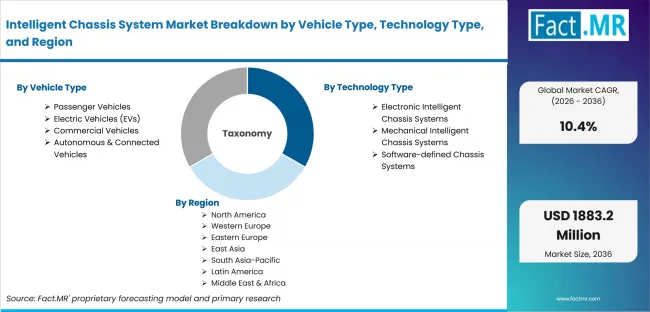
Intelligent Chassis System Market Size, Share, Growth and Forecast (2026 - 2036)

The Global Intelligent Chassis System Market is segmented by System Type, by Vehicle Type, by End User, by Technology Type, and by Region, with forecasts covering the period from 2026 to 2036.

According to market estimates, the global intelligent chassis system market stood at USD 634.2 million in 2025. The market is projected to reach around USD 700.2 million in 2026 and is expected to grow to approximately USD 1,883.2 million by 2036, progressing at a CAGR of 10.4% during the forecast period. Brake Control Systems is anticipated to account for nearly 27.40% share by 2026, driven by increasing demand for enhanced vehicle safety, stability, and advanced braking performance in modern vehicles.
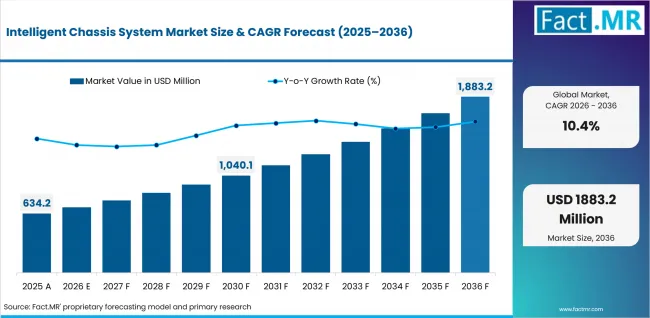
Intelligent Chassis system Market Overview, Growth Outlook, and Forecast by Fact.MR

  • In 2025, the global intelligent chassis system market was valued at approximately USD 634.2 million.
  • Based on Fact.MR analysis, demand for intelligent chassis systems is estimated to grow to around USD 700.2 million in 2026 and USD 1,883.2 million by 2036.
  • The market is projected to expand at a CAGR of 10.4% during the forecast period.

Intelligent Chassis System Market  Value Analysis

Summary of the Intelligent Chassis System Market

  • Market Snapshot
    • In 2025, the global intelligent chassis system market was valued at approximately USD 634.2 million.
    • The market is estimated to reach around USD 700.2 million in 2026 and is projected to attain nearly USD 1,883.2 million by 2036.
    • The Intelligent Chassis system market is expected to expand at a CAGR of 10.4% during the forecast period.
    • The market is anticipated to create an absolute dollar opportunity of approximately USD 1,183.0 million between 2026 and 2036.
    • In terms of system type, Brake Control Systems holds the largest share of approximately 27.40% in 2026, driven by increasing demand for enhanced vehicle safety, braking performance, stability control in modern passenger and electric vehicles.
    • Based on technology type, Electronic Intelligent Chassis Systems represents approximately 51.60% share in 2026, driven by their superior integration with vehicle electronics, and compatibility with autonomous driving architectures compared to mechanical or software-defined chassis systems.
  • Demand and Growth Drivers
    • The growth of the market will be supported by an increase in consumer and regulatory demand for greater vehicle safety, enhanced ride comfort and improved stability control, these are all attributable to a rise in accident prevention awareness, new automated driving capability and increasing concern over vehicle performance.
    • Chassis control technologies have improved through continued innovation, such that the development of responsive, durable and energy efficient intelligent chassis systems is now possible, allowing for longer-term real-time adaptability to any changes in road conditions.
    • In addition to improving driving quality, it also contribute to reducing driver fatigue and improving ride comfort, which automotive companies are increasingly adopting as an alternative to traditional passive chassis products in their autonomous and connected vehicle platforms.
  • Product and Segment View
    • Brake Control Systems holds a 27.40% share, driven by its essential role as the most widely adopted system type in passenger and electric vehicles, and collision avoidance are critical, along with rising regulatory mandates for advanced braking performance and growing demand for automated emergency braking in mass-market and premium vehicles.
    • Mass-market Vehicle Manufacturers accounts for a 34.70% share, supported by increasing production volumes of mid-range vehicles, and the need for scalable intelligent chassis solutions that balance performance with affordability, along with the growing emphasis on safety compliance and driver assistance features in entry‑level and fleet vehicles.
    • Sensors commands a 30.80% share, owing to their critical function in real‑time data collection for suspension, and braking control, enabling precise vehicle dynamics and adaptive responses while maintaining reliability and cost‑efficiency essential for mass adoption across passenger, and electric vehicle platforms.
    • Electronic Intelligent Chassis Systems represents a 51.60% share, driven by their superior integration with vehicle ECUs, real‑time responsiveness, and compatibility with existing electronic architectures, making them the most accessible method for upgrading conventional chassis systems.
  • Geography and Competitive Outlook
    • The North American intelligent chassis market is the largest of all worldwide markets for intelligent chassis systems due to the heavy use of new technologies in the automotive sector along with heightened expectations for safety and comfort features in vehicles, as well as significant investments being made on premium and connected mobility solutions.
    • The European intelligent chassis systems market is the second-largest market and is growing continually due to increasing safety regulations and stricter requirements regarding vehicle design and greater use of intelligent chassis systems as technology continues evolving.
    • The Asia Pacific market represents the market with the highest growth potential in the intelligent chassis systems sector because of large production capacities of automobiles, substantial increases in disposable income, rapid urbanization, and rising demand for smart and connected vehicles that offer high performance.
    • The global Intelligent Chassis system market includes key players such as Robert Bosch GmbH, ZF Friedrichshafen AG, HL Mando, Aptiv PLC, Schaeffler AG, and others.
  • Analyst Opinion
    • Shambhu Nath Jha, Principal Consultant at Fact.MR, says, “The market for intelligent chassis systems is growing rapidly as automakers place greater emphasis on safety, comfort, and driving performance, alongside the ongoing shifts toward electrification and automation. At the same time, the increasing use of advanced sensors and real-time vehicle monitoring is playing a key role in improving overall chassis performance.

Intelligent Chassis System Market — At a Glance

Metric Value
Market Value 2025 USD 634.2 million
Market Value 2026 USD 700.2 million
Market Value 2036 USD 1,883.2 million
Absolute Dollar Opportunity USD 1,183.0 million
CAGR 10.40%
Growth Multiple 3.4x
Key Demand Theme Growing demand for vehicle safety, ride comfort, and stability control, rising adoption of electronic and software-defined chassis systems in electric, autonomous, and connected vehicles, and increasing regulatory mandates for advanced braking, steering, and active suspension systems
Leading System Type Brake Control Systems
System Type Share 27.40%
Leading Vehicle Type Passenger Vehicles
Vehicle Type Share 52.80%
Leading End User Mass-market Vehicle Manufacturers
End User Share 34.70%
Leading Component Sensors
Component Share 30.80%
Leading Technology Type Electronic Intelligent Chassis Systems
Technology Type Share 51.60%
Key Growth Regions Asia‑Pacific, North America, Europe
Fastest Growing Countries South Korea (11.4%), China (10.9%), Germany (10.2%), USA (10.1%), Japan (9.8%)
Key Companies Robert Bosch GmbH, ZF Friedrichshafen AG, HL Mando, Schaeffler AG, Huawei
System Type Segmentation Active Suspension Systems, Steering Systems, Brake Control Systems, Integrated Chassis Control Systems, Ride & Handling Control Systems
Vehicle Type Segmentation Passenger Vehicles, Commercial Vehicles, Electric Vehicles (EVs), Autonomous & Connected Vehicles
End User Segmentation Mass-market Vehicle Manufacturers, Premium & Luxury Vehicle Manufacturers, Sports & Performance Vehicle Manufacturers, Autonomous Mobility Providers, Electric Vehicle Manufacturers, Commercial Fleet Operators
Technology Type Segmentation Mechanical Intelligent Chassis Systems, Electronic Intelligent Chassis Systems, Software-defined Chassis Systems
Region Segmentation North America, Europe, Asia Pacific, Latin America, Middle East & Africa, East Asia

Key Growth Drivers, Constraints, and Opportunities
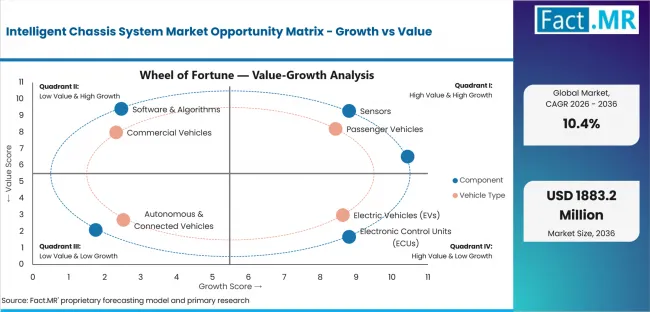
Intelligent Chassis System Market Opportunity Matrix Growth Vs Value

Key Factors Driving Growth

  • Intelligent chassis systems are becoming more popular as automakers increase their attention on vehicle safety, comfort, and performance through adding new technology to improve overall vehicle dynamics and provide better passenger experience.
  • As vehicle electrification, automation, and connected mobility solutions gain popularity, manufacturers are adopting many intelligent chassis technologies for stability, efficiency, and real-time responsiveness.
  • Sophisticated electronic architecture and software-defined vehicles are unleashing the design of high-end automotive platforms that will use intelligent chassis systems, which are gaining popularity due to benefits in safety, flexibility, and precision of driving.
Growth Driver Demand Impact Time Horizon Key Impact Area Fact.MR Insight
Increasing demand for vehicle safety, stability, and driving comfort features High Short–Mid Term Adoption acceleration Rising consumer and OEM focus on advanced safety and enhanced driving experience is significantly increasing demand for intelligent chassis systems
Expansion of applications in electric, premium, and autonomous vehicles High Short–Mid Term Product innovation & scaling Growing adoption of EVs and ADAS-equipped vehicles is driving large-scale integration of intelligent chassis technologies across automotive platforms
Rising focus on vehicle performance optimization and real-time dynamics control High Mid Term Performance enhancement Increasing emphasis on ride handling, stability, and responsiveness is boosting deployment of adaptive chassis control systems
Advancements in automotive electronics, sensors, and software-defined vehicle architecture High Mid–Long Term Technology advancement Continuous improvements in sensor fusion, control algorithms, and domain-centralized architectures are improving system efficiency, precision, and scalability
Growing adoption of connected, autonomous, and software-driven mobility solutions Medium Mid–Long Term Mobility transformation Increasing shift toward smart mobility ecosystems is accelerating integration of intelligent chassis systems in next-generation vehicles

Key Market Constraints

  • The integration and development costs of intelligent chassis systems with state-of-the-art software platforms, as well as advanced sensor technology with intelligent chassis systems, add a significant expense to the overall cost of producing a vehicle.
  • OEMs and consumers currently have limited education and awareness regarding the overall benefits to using intelligent chassis technologies, such as improved driving dynamics and safety, which can hinder the acceptance of intelligent chassis technologies in areas outside of luxury vehicles.
  • Stringent government regulations related to automotive safety, homologation, and continued evolution of global standards for electronic and software-defined vehicle systems may slow the validation and commercial release of intelligent chassis systems by prohibiting or delaying certain aspects of the testing process.

Key Opportunity Areas

  • The need to have increasingly elegant vehicle safety, comfort, and performance options makes the ability to see wide adoption across all types of passenger, electric & premium vehicles.
  • Consumer preference continues to evolve toward more premium, connected, and high-performance mobility solutions, which means there will be a growing number of opportunities for luxury, EV, and autonomous vehicle projects as well.
  • Rapid advances in automotive electronics, software-defined vehicle architectures, and sensor technology have significantly enhanced OEM/customers’ ability to develop the next-generation intelligent chassis.

Segment-wise Analysis of the Intelligent Chassis System Market

  • Brake Control Systems holds a 27.40% share in the system type segment, driven by its essential role as the most widely adopted category in passenger and electric vehicles, with growing demand for vehicle safety, and collision avoidance, along with regulatory mandates for advanced braking performance and automated emergency braking in mass-market and premium vehicles.
  • Sensors accounts for a 30.80% share in the component segment, supported by the increasing need for real‑time data collection in active suspension, steering, and braking systems, enabling precise vehicle dynamics and adaptive responses, while maintaining reliability and cost‑efficiency compared to other components such as ECUs or actuators.
  • Electronic Intelligent Chassis Systems commands a 51.60% share in the technology type segment, driven by its superior integration with vehicle electronics, and compatibility with existing vehicle architectures, enabling mass adoption of advanced driver assistance and autonomous driving features without compromising safety or ride comfort.

The global intelligent chassis system market is segmented by system type, vehicle type, end user, component, technology type, and region.

Which Vehicle Type Segment Dominates the Market?
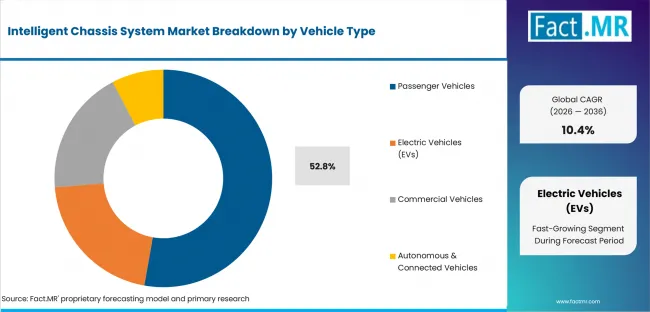
Intelligent Chassis System Market Analysis By Vehicle Type

With a market share greater than 52.80%, passenger vehicles continue to dominate the market and are projected to maintain this position as passenger vehicles continue to account for significant volumes of production, with increased consumer preference for improved comfort and safety continue to drive their leading position.

Which Technology Type Segment Dominates the Market?
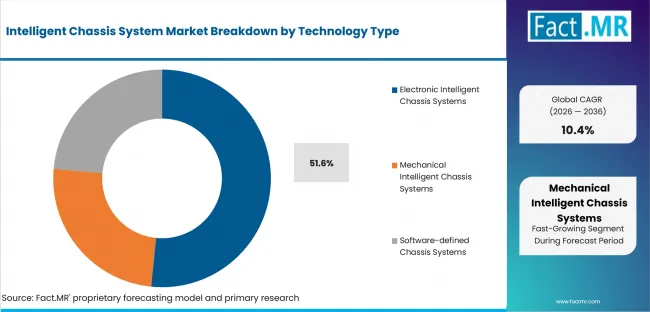
Intelligent Chassis System Market Analysis By Technology Type

Electronic intelligent chassis systems hold a market share of over 51.60% and are expected to maintain their leading position. They are extensively used in passenger, electric, and autonomous vehicles, driven by their advanced real-time control capabilities and seamless integration with vehicle ECUs.

Which System Type Segment Dominates the Market?
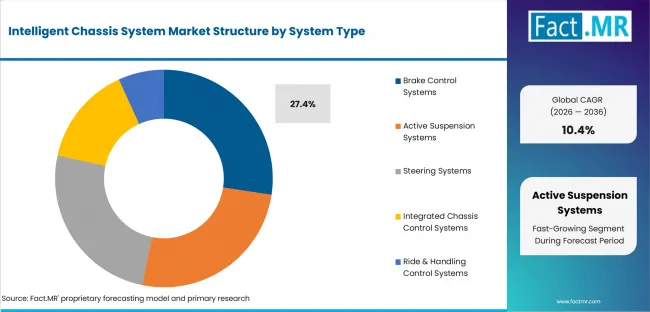
Intelligent Chassis System Market Analysis By System Type

Brake Control Systems represent over 27% of the market total and are expected to continue holding this position. Their use is widespread in passenger vehicles, commercial vehicles, and electric vehicles because they are critical to vehicle safety, stability control, and collision avoidance.

Which End User Segment Dominates the Market?
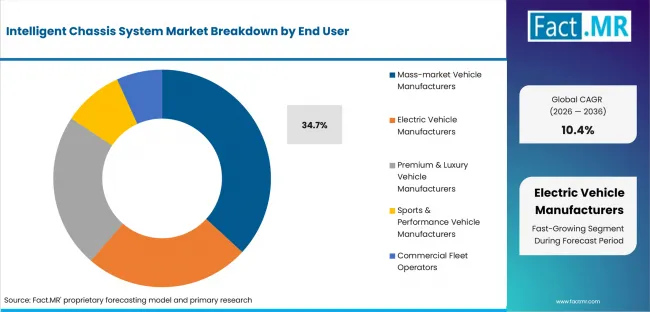
Intelligent Chassis System Market Analysis By End User

Mass-market vehicle manufacturers account for over 34.70% of the market share and are expected to maintain their leading position. They represent the primary target segment within the global automotive industry, supported by their large production volumes, cost-effective adoption of intelligent chassis technologies, and increasing emphasis on complying with safety standards and meeting consumer expectations for comfort and stability.

Regional Outlook Across Key Markets

The market analysis covers key global regions, including South Asia and Pacific, Middle East & Africa, North America, Latin America, Western Europe, and Eastern Europe. It is segmented geographically, with specific market dynamics for each region. The full report provides a detailed market attractiveness analysis.

Top Country Growth Comparison Intelligent Chassis System Market Cagr (2026 2036)

CAGR Table

Country CAGR (%)
China 10.9%
Germany 10.2%
U.S.A 10.1%
Japan 9.8%
South Korea 11.4%
France 11.1%
U.K. 11.3%

Source: Fact.MR (FMR) analysis, based on proprietary forecasting model and primary research.
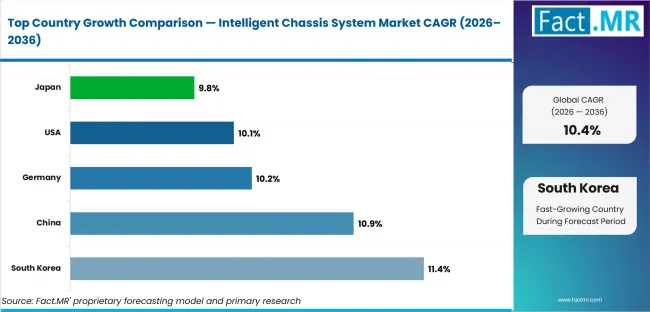
Intelligent Chassis System Market Cagr Analysis By Country

North America – The Intelligent Chassis Hub
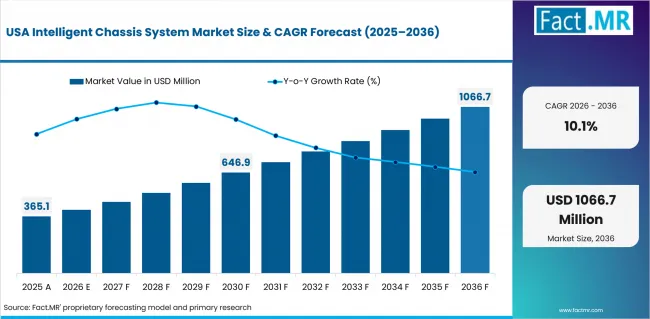
Intelligent Chassis System Market Country Value Analysis

Intelligent chassis systems are gaining momentum due to their role in improving vehicle safety, ride comfort, stability control, and supporting autonomous driving capabilities. Additional applications include adaptive suspension, electronic braking, steer-by-wire systems, and real-time control of vehicle dynamics.

  • U.S.: Demand for intelligent chassis systems in the U.S. is projected to grow at a CAGR of 10.1%, supported by increasing adoption of electric and autonomous vehicles, and growing utilization of electronic braking, active suspension systems in passenger & commercial vehicles.

Western Europe – A Key Growth Region for Intelligent Chassis Systems
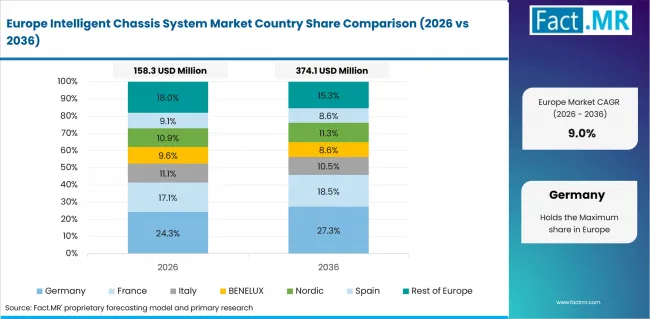
Intelligent Chassis System Market Europe Country Market Share Analysis, 2026 & 2036

In Western Europe, these systems have seen strong adoption driven by strict vehicle safety regulations, widespread integration of autonomous driving features, and high consumer demand for premium and luxury vehicles equipped with advanced suspension, steering, and braking technologies.

  • Germany: Demand for intelligent chassis systems in Germany is projected to grow at a CAGR of 10.2%, supported by the presence of leading premium automotive manufacturers, strong R&D investments in electronic and software-defined chassis technologies.

East Asia – The Engine of Intelligent Chassis Innovation

Intelligent chassis systems have experienced rapid growth in East Asia, driven by the fast pace of vehicle electrification, strong government support for autonomous driving technologies, and well-established local manufacturing capabilities for sensors, ECUs, and actuators.

  • China: Demand for intelligent chassis systems in China is projected to grow at a CAGR of 10.9%, supported by the world's largest electric vehicle market, aggressive safety and ADAS mandates from domestic regulators, and rising deployment of software-defined and electronic chassis systems across local brands such as BYD, NIO, and Xpeng.

South Asia & Pacific – The Emerging Powerhouse for Intelligent Chassis Adoption

In South Asia Pacific, intelligent chassis systems are experiencing fast expansion because of rising automobile output, higher disposable income, a growing desire for safer and more comfortable automobiles, and government initiatives to support electric vehicle use and build them locally.

  • India: Demand for intelligent chassis systems in India is projected to grow at a CAGR of 11.3%, supported by the country's rapidly growing passenger vehicle and electric vehicle market, rising consumer awareness of vehicle safety features, and increasing adoption of electronic stability control.

Latin America – The Untapped Opportunity for Intelligent Chassis Systems

The Latin American marketplace is defined as an evolving region that is projected to see a significant amount of growth in the near future. Increased demand for safer and more comfortable current passenger and commercial vehicles and consumer is becoming more aware of vehicle stability and preventing vehicle collisions. The introduction of intelligent chassis will also become more widely accepted by everyday cars, fleets of electric vehicles and ride hailing service businesses will contribute to this.

  • Brazil: Demand for intelligent chassis systems in Brazil is projected to grow at a steady 11.6% CAGR through 2036, supported by the country's large and growing automotive industry, rising local production of passenger vehicles, and sensor-based suspension technologies for both consumer and commercial use.

Middle East & Africa – The Rising Market for Intelligent Chassis Systems

The Intelligent Chassis Systems Market across the Middle East & Africa will continue to experience development as a result of increased spending on automotive production and infrastructure, higher needs for safe, connected vehicles, improved electronic and software-defined chassis technologies, and increasing passenger vehicle and electric vehicle output in this area.

  • KSA: Demand for intelligent chassis systems in Saudi Arabia is projected to grow at around 11.2% CAGR through 2036, supported by the country's Vision 2030 initiatives promoting industrial diversification, and modernization of transportation infrastructure.

Fact.MR analysis provides a comprehensive regional outlook across North America, Latin America, Western Europe, Eastern Europe, East Asia, South Asia & Pacific, and the Middle East & Africa. It offers detailed country-wise insights, highlighting growth trends, demand patterns, and adoption across key industries in both developed and emerging markets.

Competitive Benchmarking and Company Positioning
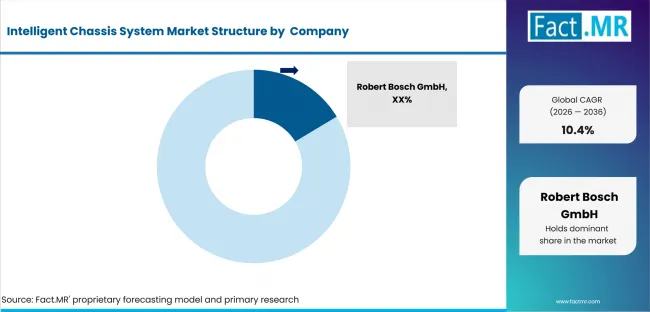
Intelligent Chassis System Market Analysis By Company

Leading Companies Shaping the Intelligent Chassis System Market

Numerous enterprise level organizations are in the intelligent chassis system market, making it a moderately fragmented sector in which top businesses, including Bosch, ZF, Mando, Aptiv, and Huawei, combine to make up approximately 45-50% of the overall market size. The intelligent chassis systems marketplace growth rates will continue to increase due to electricity-committed EV markets, increased required regulatory compliance for advanced safety features within these automakers' product, and increased demand by consumers for better ride comfort and stability across various types of intelligent chassis systems, such as brake control, active suspension, steering, integrated chassis control, and ride and handling controls.

Key Players of the Intelligent Chassis System Market

  • Robert Bosch GmbH
  • ZF Friedrichshafen AG
  • HL Mando
  • Aptiv PLC
  • Schaeffler AG
  • Huawei
  • HOLS Automation
  • Mobil Elektronik GMBH
  • CATL
  • Fraunhofer LBF

Recent Industry Developments

  • Huawei Tuling Intelligent Chassis in market (2026), The Tuling intelligent chassis is built on a digital foundation to enable multi-domain collaborative control, emphasizing intelligent perception and control to provide easier handling. (Huawei) [1]
  • ZF unveils next-gen intelligent chassis sensor (2025): ZF is unveiling the next generation of its intelligent chassis sensor. The upgraded version not only measures wheel height but now also captures acceleration in three dimensions. (ZF) [2]
  • CATL Bedrock Chassis Debuts at IAA (2025): global leader in new energy technology, unveiled its next-generation chassis product CATL Bedrock Chassis at the IAA MOBILITY in Munich, Germany, marking its European debut. (CATL) [3]
  • NIO Presents Three Brands at Auto China 2026 (2025): The technology zone at the booth highlights NIO’s 12 full-stack innovations, featuring mass-produced proprietary technologies such as the NX9031 smart driving chip, the SkyRide Intelligent Chassis, and the 900V high-performance electric drive system. Visitors can experience five new showcases of NIO’s intelligent chassis system, namely SkyRide Dance, Soaring over the Skyline. (Nio) [4]
  • Xiaomi EV to debut 'Jiaolong' smart chassis on new-generation SU7 model (2026): Canadian top-of-bed manufacturer HealthGuard is giving retailers a new way to build the bedding ticket with the launch of its NuGlow collagen pillows. Two models offer a choice between copper infused or lavender-infused specialty foam cores, each engineered for temperature regulation, pressure relief. (Xiaomi) [5]

Sources and Research References

  • [1] “Huawei Tuling intelligent chassis overview”, 2026
  • [2] “ZF unveils next-gen intelligent chassis sensor”, 2025
  • [3] “CATL, a global leader in new energy technology, unveiled its next-generation chassis product”, 2025
  • [4] “The technology zone at the booth highlights NIO’s 12 full-stack innovations, featuring mass-produced proprietary technologies such as the NX9031 smart driving chip, the SkyRide Intelligent Chassis, and the 900V high-performance electric drive system”, 2025ew-generation SU7 model”, 2025

Intelligent Chassis System Market Definition

The intelligent chassis systems market represents a segment of the automotive industry that centers on advanced vehicle technologies combining hardware, sensors, and software to improve vehicle dynamics, safety, and overall driving performance. It includes solutions such as electronic stability control, adaptive suspension, braking systems, and integrated chassis control technologies.

Intelligent Chassis System Market Inclusions

The intelligent chassis systems market covers advanced automotive technologies and components aimed at improving vehicle stability, handling, ride comfort, and safety. It includes systems such as electronic braking, adaptive and active suspension, steering control, and integrated chassis control units. These solutions are built using sophisticated automotive electronics, sensors, and software-based control architectures.

Intelligent Chassis System Market Exclusions

The intelligent chassis systems market does not include conventional mechanical chassis components or basic vehicle structures that lack electronic control, sensor integration, or software-based optimization. Traditional suspension, steering, and braking systems without intelligent or adaptive features are excluded from this market.

Intelligent Chassis System Market Research Methodology

  • Primary Research
    • The report omits all conventional chassis systems that do not involve intelligent, electronically controlled, or software-driven capabilities. Mechanical components without adaptive control, sensor integration, or real-time performance optimization are not considered within the scope of the study.
  • Desk Research
    • This analysis relies on secondary research based upon the review of industry reports, publications from automotive OEMs, supplier websites, technical product catalogs and all other relevant sources covering intelligent chassis systems. The collected information has been taken from reliable sources, including automotive trade literature, trade publications, and established market research databases.
  • Market-Sizing and Forecasting
    • The global intelligent chassis systems market is estimated using both top-down and bottom-up approaches. The top-down method looks at the overall automotive systems market and assesses the portion attributed to advanced chassis technologies, such as electronic control systems, adaptive suspension, braking, and steering solutions.
  • Data Validation and Update Cycle
    • Data on this intelligent chassis systems market was validated by systematically cross verifying the information taken from industry-related reports, OEM filings, supplier databases, technical journals, and other publicly available secondary data sources.

Scope of Analysis

Intelligent Chassis System Market Breakdown By Vehicle Type, Technology Type, And Region

Parameter Details
Quantitative Units USD 634.2 million in 2025 to USD 1,883.2 million in 2036, at a CAGR of 10.4%
Market Definition The Intelligent Chassis Systems Market comprises advanced automotive systems that integrate electronic control units, sensors, actuators, and software to enhance vehicle dynamics, safety, and driving performance. These systems include adaptive suspension, electronic braking, steering control, and integrated chassis management solutions.
Regions Covered North America, Latin America, Western Europe, Eastern Europe, East Asia, South Asia & Pacific, Middle East & Africa
Countries Covered USA, China, Germany, UK, Japan, India, Brazil, KSA, and 30+ countries
Key Companies Robert Bosch GmbH, ZF Friedrichshafen AG, Aptiv PLC, HL Mando, Schaeffler AG, and others
Forecast Period 2026 to 2036
Approach Hybrid demand-side and top-down methodology based on increasing adoption of advanced vehicle safety systems, growing penetration of electric and autonomous vehicles, rising integration of software-defined vehicle architectures, and expanding demand for enhanced driving comfort, stability, and real-time vehicle performance optimization.

Analysis by System Type, by Vehicle Type, by Component, by End User, by Technology Type, and by Region

  • Intelligent Chassis System Market By System Type

    • Active Suspension Systems
      • Adaptive Damping Suspension
      • Air Suspension Systems
      • Electromagnetic Suspension Systems
    • Steering Systems
      • Electric Power Steering (EPS)
      • Rear-wheel Steering Systems
      • Steer-by-wire Systems
    • Brake Control Systems
      • Electronic Brake-by-wire Systems
      • Anti-lock Braking Systems (ABS)
      • Electronic Stability Control (ESC)
    • Integrated Chassis Control Systems
      • Vehicle Dynamics Control
      • Torque Vectoring Systems
      • Integrated Motion Control Platforms
    • Ride & Handling Control Systems
      • Semi-active Ride Control
      • Predictive Chassis Control
  • Intelligent Chassis System Market By Vehicle Type

    • Passenger Vehicles
      • Hatchbacks
      • Sedans
      • SUVs & Crossovers
    • Commercial Vehicles
      • Light Commercial Vehicles (LCVs)
      • Heavy Commercial Vehicles (HCVs)
      • Electric Commercial Vehicles
    • Electric Vehicles (EVs)
      • Battery Electric Vehicles (BEVs)
      • Plug-in Hybrid Electric Vehicles (PHEVs)
      • Fuel Cell Electric Vehicles (FCEVs)
    • Autonomous & Connected Vehicles
      • ADAS-enabled Vehicles
      • Semi-autonomous Vehicles
      • Fully Autonomous Vehicles
  • Intelligent Chassis System Market By End User

    • Mass-market Vehicle Manufacturers
    • Premium & Luxury Vehicle Manufacturers
    • Sports & Performance Vehicle Manufacturers
    • Electric Vehicle Manufacturers
    • Autonomous Mobility Providers
    • Commercial Fleet Operators
  • Intelligent Chassis System Market By Technology Type

    • Mechanical Intelligent Chassis Systems
      • Hydraulic-assisted Systems
      • Pneumatic-assisted Systems
      • Electro-mechanical Systems
    • Electronic Intelligent Chassis Systems
      • Sensor-based Chassis Systems
      • ECU-controlled Chassis Platforms
      • AI-enabled Chassis Systems
    • Software-defined Chassis Systems
      • Centralized Vehicle Control Software
      • OTA-enabled Chassis Platforms
      • Cloud-connected Chassis Systems
  • Intelligent Chassis System Market By Region

    • North America
      • USA
      • Canada
      • Mexico
    • Latin America
      • Brazil
      • Chile
      • Rest of LATAM
    • East Asia
      • China
      • Japan
      • South Korea
    • Western Europe
      • Germany
      • Italy
      • France
      • U.K.
      • Spain
      • BENELUX
      • Nordic
      • Rest of W. Europe
    • Eastern Europe
      • Russia
      • Hungary
      • Poland
      • Balkan & Baltics
      • Rest of E. Europe
    • Middle East and Africa
      • Kingdom of Saudi Arabia
      • United Arab Emirates
      • South Africa
      • Rest of Middle East and Africa

Table of Content

  1. Intelligent Chassis System Market – Executive Summary
  2. Market Overview
    • Market Definition & Introduction
    • Market Taxonomy & Research Scope
  3. Global Intelligent Chassis System Market Demand Analysis 2021-2025 and Forecast, 2026–2036
    • Historical Market Volume (Units) Analysis, 2021-2025
    • Current and Future Market Volume (Units) Projections, 2026–2036
    • Y-o-Y Growth Trend Analysis
  4. Global Intelligent Chassis System Market - Pricing Analysis
    • Product Category and Country-Level Pricing Analysis
    • Region Average Pricing Analysis Benchmark
    • Price Trends and Forecasts
      • Historical price trends
      • Future price forecasts
    • Factors Influencing Pricing
    • Competitive Pricing Strategies
    • Cost Structure Analysis
  5. Global Intelligent Chassis System Market Demand (in Value or Size in US$ Mn) Analysis 2021-2025 and Forecast, 2026–2036
    • Historical Market Value (US$ Mn) Analysis, 2021-2025
    • Current and Future Market Value (US$ Mn) Projections, 2026–2036
      • Y-o-Y Growth Trend Analysis
      • Absolute $ Opportunity Analysis
  6. Market Background and Foundational Data Points
    • Share of intelligent chassis systems in total automotive systems market (%)
    • Annual growth rate of advanced driver assistance systems (ADAS) adoption (%)
    • Penetration rate of electronic stability control (ESC) in global vehicle production (%)
    • Adoption rate of adaptive suspension systems in passenger vehicles (%)
    • Growth rate of electric vehicle (EV) production globally (%)
    • Integration rate of sensor-based automotive systems per vehicle (units per vehicle)
    • Share of premium vehicles equipped with intelligent chassis systems (%)
    • Growth in demand for vehicle safety and control technologies (%)
    • Average number of electronic control units (ECUs) per vehicle
    • R&D spending by automotive OEMs on chassis and vehicle dynamics technologies (USD billion)
    • Growth rate of connected vehicle adoption globally (%)
    • Intelligent Chassis System Market Opportunity Assessment
      • Total Available Market (US$ Mn)
      • Serviceable Addressable Market (US$ Mn)
      • Serviceable Obtainable Market (US$ Mn)
    • Porter’s Five Forces and PESTEL Analysis
    • Investment Feasibility Analysis
    • Macro-Economic Factors & Forecast Factors - Relevance & Impact
    • Industry Value and Supply Chain Analysis
      • List of Key Channel Partners
      • Profit Margin & Operating Margin at Each Node of Supply Chain.
      • Notes on Value Added at Each Node in the Value Chain
      • Factors Influencing Value Chain
    • Market Dynamics
      • Drivers
      • Restraints
      • Opportunity
      • Trend Analysis
    • Key Regulations & Certifications
  7. Intelligent Chassis System Market Analysis 2021-2025 and Forecast 2026–2036, By System Type
    • Introduction / Key Findings
    • Historical Market Size (US$ Mn) & Volume (Units) Trend Analysis By System Type, 2021-2025
    • Current and Future Market Size (US$ Mn) & Volume (Units) Analysis and Forecast By System Type, 2026-2036
      • Active Suspension Systems
        • Adaptive Damping Suspension
        • Air Suspension Systems
        • Electromagnetic Suspension Systems
      • Steering Systems
        • Electric Power Steering (EPS)
        • Rear-wheel Steering Systems
        • Steer-by-wire Systems
      • Brake Control Systems
        • Electronic Brake-by-wire Systems
        • Anti-lock Braking Systems (ABS)
        • Electronic Stability Control (ESC)
      • Integrated Chassis Control Systems
        • Vehicle Dynamics Control
        • Torque Vectoring Systems
        • Integrated Motion Control Platforms
      • Ride & Handling Control Systems
        • Semi-active Ride Control
        • Predictive Chassis Control
    • Market Attractiveness Analysis By System Type
  8. Intelligent Chassis System Market Analysis 2021-2025 and Forecast 2026–2036, By Vehicle Type
    • Introduction / Key Findings
    • Historical Market Size (US$ Mn) & Volume (Units) Trend Analysis By Vehicle Type, 2021-2025
    • Current and Future Market Size (US$ Mn) & Volume (Units) Analysis and Forecast By Vehicle Type, 2026-2036
      • Passenger Vehicles
        • Hatchbacks
        • Sedans
        • SUVs & Crossovers
      • Commercial Vehicles
        • Light Commercial Vehicles (LCVs)
        • Heavy Commercial Vehicles (HCVs)
        • Electric Commercial Vehicles
      • Electric Vehicles (EVs)
        • Battery Electric Vehicles (BEVs)
        • Plug-in Hybrid Electric Vehicles (PHEVs)
        • Fuel Cell Electric Vehicles (FCEVs)
      • Autonomous & Connected Vehicles
        • ADAS-enabled Vehicles
        • Semi-autonomous Vehicles
        • Fully Autonomous Vehicles
    • Market Attractiveness Analysis By Vehicle Type
  9. Intelligent Chassis System Market Analysis 2021-2025 and Forecast 2026–2036, By End User
    • Introduction / Key Findings
    • Historical Market Size (US$ Mn) & Volume (Units) Trend Analysis By End User, 2021-2025
    • Current and Future Market Size (US$ Mn) & Volume (Units) Analysis and Forecast By End User, 2026-2036
      • Mass-market Vehicle Manufacturers
      • Premium & Luxury Vehicle Manufacturers
      • Sports & Performance Vehicle Manufacturers
      • Electric Vehicle Manufacturers
      • Autonomous Mobility Providers
      • Commercial Fleet Operators
    • Market Attractiveness Analysis By End User
  10. Intelligent Chassis System Market Analysis 2021-2025 and Forecast 2026–2036, By Technology Type
    • Introduction / Key Findings
    • Historical Market Size (US$ Mn) & Volume (Units) Trend Analysis By Technology Type, 2021-2025
    • Current and Future Market Size (US$ Mn) & Volume (Units) Analysis and Forecast By Technology Type, 2026-2036
      • Mechanical Intelligent Chassis Systems
        • Hydraulic-assisted Systems
        • Pneumatic-assisted Systems
        • Electro-mechanical Systems
      • Electronic Intelligent Chassis Systems
        • Sensor-based Chassis Systems
        • ECU-controlled Chassis Platforms
        • AI-enabled Chassis Systems
      • Software-defined Chassis Systems
        • Centralized Vehicle Control Software
        • OTA-enabled Chassis Platforms
        • Cloud-connected Chassis Systems
    • Market Attractiveness Analysis By Technology Type
  11. Global Intelligent Chassis System Market Analysis and Forecast, by Region
    • Introduction / Key Findings
    • Historical Market Size (US$ Mn) & Volume (Units) Trend Analysis by Region, 2021-2025
    • Current and Future Market Size (US$ Mn) & Volume (Units) Analysis and Forecast by Region, 2026-2036
      • North America
      • Latin America
      • Western Europe
      • Eastern Europe
      • East Asia
      • South Asia & Pacific
      • Middle East & Africa
    • Market Attractiveness Analysis by Region
  12. North America Intelligent Chassis System Market Analysis and Forecast
    • Introduction / Key Findings
    • Pricing Analysis
    • Historical Market Size (US$ Mn) & Volume (Units) Trend Analysis by Market Taxonomy, 2021-2025
    • Current and Future Market Size (US$ Mn) and Volume (Units) Analysis & Forecast by Market Taxonomy, 2026-2036
    • By Country
      • United States
      • Canada
      • Mexico
    • By Taxonomy
    • Market Attractiveness Analysis By Country & Taxonomy
    • Market Trends
    • Key Market Participants – Intensity Mapping
    • Drivers and Restraints - Impact Analysis
  13. Latin America Intelligent Chassis System Market Analysis and Forecast
    • Introduction / Key Findings
    • Pricing Analysis
    • Historical Market Size (US$ Mn) & Volume (Units) Trend Analysis by Market Taxonomy, 2021-2025
    • Current and Future Market Size (US$ Mn) and Volume (Units) Analysis & Forecast by Market Taxonomy, 2026-2036
    • By Country
      • Brazil
      • Chile
      • Rest of LATAM
    • By Taxonomy
    • Market Attractiveness Analysis By Country & Taxonomy
    • Market Trends
    • Key Market Participants – Intensity Mapping
    • Drivers and Restraints - Impact Analysis
  14. Western Europe Intelligent Chassis System Market Analysis and Forecast
    • Introduction / Key Findings
    • Pricing Analysis
    • Historical Market Size (US$ Mn) & Volume (Units) Trend Analysis by Market Taxonomy, 2021-2025
    • Current and Future Market Size (US$ Mn) and Volume (Units) Analysis & Forecast by Market Taxonomy, 2026-2036
    • By Country
      • Germany
      • Italy
      • France
      • United Kingdom
      • Spain
      • BENELUX
      • Nordics
      • Rest of Western Europe
    • By Taxonomy
    • Market Attractiveness Analysis By Country & Taxonomy
    • Market Trends
    • Key Market Participants – Intensity Mapping
    • Drivers and Restraints - Impact Analysis
  15. Eastern Europe Intelligent Chassis System Market Analysis and Forecast
    • Introduction / Key Findings
    • Pricing Analysis
    • Historical Market Size (US$ Mn) & Volume (Units) Trend Analysis by Market Taxonomy, 2021-2025
    • Current and Future Market Size (US$ Mn) and Volume (Units) Analysis & Forecast by Market Taxonomy, 2026-2036
    • By Country
      • Russia
      • Hungary
      • Poland
      • Balkan & Baltics
      • Rest of Eastern Europe
    • By Taxonomy
    • Market Attractiveness Analysis By Country & Taxonomy
    • Market Trends
    • Key Market Participants – Intensity Mapping
    • Drivers and Restraints - Impact Analysis
  16. East Asia Intelligent Chassis System Market Analysis and Forecast
    • Introduction / Key Findings
    • Pricing Analysis
    • Historical Market Size (US$ Mn) & Volume (Units) Trend Analysis by Market Taxonomy, 2021-2025
    • Current and Future Market Size (US$ Mn) and Volume (Units) Analysis & Forecast by Market Taxonomy, 2026-2036
    • By Country
      • China
      • Japan
      • South Korea
    • By Taxonomy
    • Market Attractiveness Analysis By Country & Taxonomy
    • Market Trends
    • Key Market Participants – Intensity Mapping
    • Drivers and Restraints - Impact Analysis
  17. South Asia & Pacific Intelligent Chassis System Market Analysis and Forecast
    • Introduction / Key Findings
    • Pricing Analysis
    • Historical Market Size (US$ Mn) & Volume (Units) Trend Analysis by Market Taxonomy, 2021-2025
    • Current and Future Market Size (US$ Mn) and Volume (Units) Analysis & Forecast by Market Taxonomy, 2026-2036
    • By Country
      • India
      • ASEAN
      • Australia & New Zealand
      • Rest of South Asia & Pacific
    • By Taxonomy
    • Market Attractiveness Analysis By Country & Taxonomy
    • Market Trends
    • Key Market Participants – Intensity Mapping
    • Drivers and Restraints - Impact Analysis
  18. Middle East & Africa Intelligent Chassis System Market Analysis and Forecast
    • Introduction / Key Findings
    • Pricing Analysis
    • Historical Market Size (US$ Mn) & Volume (Units) Trend Analysis by Market Taxonomy, 2021-2025
    • Current and Future Market Size (US$ Mn) and Volume (Units) Analysis & Forecast by Market Taxonomy, 2026-2036
    • By Country
      • Kingdom of Saudi Arabia
      • Other GCC Countries
      • Turkiye
      • South Africa
      • Other African Union
    • By Taxonomy
    • Market Attractiveness Analysis By Country & Taxonomy
    • Market Trends
    • Key Market Participants – Intensity Mapping
    • Drivers and Restraints - Impact Analysis
  19. Country-level Intelligent Chassis System Market Analysis and Forecast
    • Introduction
    • Market Value Proportion Analysis, By Key Countries
    • Global Vs. Country Growth Comparison
      • United States Intelligent Chassis System Market Analysis
        • Market Size (US$ Mn) & Volume (Units) Analysis by Market Taxonomy, 2021–2036
        • By Vehicle Type
        • By End User
        • By System Type
        • By Technology Type
        • Canada Intelligent Chassis System Market Analysis
        • Mexico Intelligent Chassis System Market Analysis
        • Brazil Intelligent Chassis System Market Analysis
        • Chile Intelligent Chassis System Market Analysis
        • Germany Intelligent Chassis System Market Analysis
        • France Intelligent Chassis System Market Analysis
        • Italy Intelligent Chassis System Market Analysis
        • Spain Intelligent Chassis System Market Analysis
        • United Kingdom Intelligent Chassis System Market Analysis
        • BENELUX Intelligent Chassis System Market Analysis
        • Nordics Intelligent Chassis System Market Analysis
        • Poland Intelligent Chassis System Market Analysis
        • Russia Intelligent Chassis System Market Analysis
        • Hungary Intelligent Chassis System Market Analysis
        • Balkan & Baltics Intelligent Chassis System Market Analysis
        • China Intelligent Chassis System Market Analysis
        • Japan Intelligent Chassis System Market Analysis
        • South Korea Intelligent Chassis System Market Analysis
        • India Intelligent Chassis System Market Analysis
        • ASEAN Intelligent Chassis System Market Analysis
        • ANZ Intelligent Chassis System Market Analysis
        • KSA Intelligent Chassis System Market Analysis
        • Other GCC Countries Intelligent Chassis System Market Analysis
        • South Africa Intelligent Chassis System Market Analysis
        • Turkiye Intelligent Chassis System Market Analysis
        •  
    • Intelligent Chassis System Market Structure Analysis
      • Market Analysis by Tier of Companies
      • Market Concentration
      • Market Share Analysis of Top Players
      • Market Space for New Brands and Dollar Opportunity
      • Market Presence Analysis
        • Regional Footprint of Players
        • Product Footprint by Players
    • Intelligent Chassis System Competition Analysis
      • Competition Dashboard
      • Pricing Analysis by Competition
      • Competition Benchmarking
      • Competition Deep Dive
        • Robert Bosch GmbH
          • Overview
          • Product Portfolio
          • Sales Footprint
          • Key Developments
          • SWOT Analysis
          • Strategy Overview
          • Key Financials
        • ZF Friedrichshafen AG
        • HL Mando
        • Aptiv PLC
        • Schaeffler AG
        • Huawei
        • HOLS Automation
        • Mobil Elektronik GMBH
        • CATL
        • Fraunhofer LBF
        • Other Prominent Players
    • Primary insights
    • Assumptions & Acronyms Used
    • Research Methodology & Data Forms

List Of Table

  • Table 1: Global Market Value (USD Mn) Forecast by Region, 2021 to 2036
  • Table 2: Global Market Volume (Units) Forecast by Region, 2021 to 2036
  • Table 3: Global Market Value (USD Mn) Forecast by System Type, 2021 to 2036
  • Table 4: Global Market Volume (Units) Forecast by System Type, 2021 to 2036
  • Table 5: Global Market Value (USD Mn) Forecast by Vehicle Type, 2021 to 2036
  • Table 6: Global Market Volume (Units) Forecast by Vehicle Type, 2021 to 2036
  • Table 7: Global Market Value (USD Mn) Forecast by Component, 2021 to 2036
  • Table 8: Global Market Volume (Units) Forecast by Component, 2021 to 2036
  • Table 9: Global Market Value (USD Mn) Forecast by End User, 2021 to 2036
  • Table 10: Global Market Volume (Units) Forecast by End User, 2021 to 2036
  • Table 11: Global Market Value (USD Mn) Forecast by Technology Type, 2021 to 2036
  • Table 12: Global Market Volume (Units) Forecast by Technology Type, 2021 to 2036
  • Table 13: North America Market Value (USD Mn) Forecast by Country, 2021 to 2036
  • Table 14: North America Market Volume (Units) Forecast by Country, 2021 to 2036
  • Table 15: North America Market Value (USD Mn) Forecast by System Type, 2021 to 2036
  • Table 16: North America Market Volume (Units) Forecast by System Type, 2021 to 2036
  • Table 17: North America Market Value (USD Mn) Forecast by Vehicle Type, 2021 to 2036
  • Table 18: North America Market Volume (Units) Forecast by Vehicle Type, 2021 to 2036
  • Table 19: North America Market Value (USD Mn) Forecast by Component, 2021 to 2036
  • Table 20: North America Market Volume (Units) Forecast by Component, 2021 to 2036
  • Table 21: North America Market Value (USD Mn) Forecast by End User, 2021 to 2036
  • Table 22: North America Market Volume (Units) Forecast by End User, 2021 to 2036
  • Table 23: North America Market Value (USD Mn) Forecast by Technology Type, 2021 to 2036
  • Table 24: North America Market Volume (Units) Forecast by Technology Type, 2021 to 2036
  • Table 25: Latin America Market Value (USD Mn) Forecast by Country, 2021 to 2036
  • Table 26: Latin America Market Volume (Units) Forecast by Country, 2021 to 2036
  • Table 27: Latin America Market Value (USD Mn) Forecast by System Type, 2021 to 2036
  • Table 28: Latin America Market Volume (Units) Forecast by System Type, 2021 to 2036
  • Table 29: Latin America Market Value (USD Mn) Forecast by Vehicle Type, 2021 to 2036
  • Table 30: Latin America Market Volume (Units) Forecast by Vehicle Type, 2021 to 2036
  • Table 31: Latin America Market Value (USD Mn) Forecast by Component, 2021 to 2036
  • Table 32: Latin America Market Volume (Units) Forecast by Component, 2021 to 2036
  • Table 33: Latin America Market Value (USD Mn) Forecast by End User, 2021 to 2036
  • Table 34: Latin America Market Volume (Units) Forecast by End User, 2021 to 2036
  • Table 35: Latin America Market Value (USD Mn) Forecast by Technology Type, 2021 to 2036
  • Table 36: Latin America Market Volume (Units) Forecast by Technology Type, 2021 to 2036
  • Table 37: Western Europe Market Value (USD Mn) Forecast by Country, 2021 to 2036
  • Table 38: Western Europe Market Volume (Units) Forecast by Country, 2021 to 2036
  • Table 39: Western Europe Market Value (USD Mn) Forecast by System Type, 2021 to 2036
  • Table 40: Western Europe Market Volume (Units) Forecast by System Type, 2021 to 2036
  • Table 41: Western Europe Market Value (USD Mn) Forecast by Vehicle Type, 2021 to 2036
  • Table 42: Western Europe Market Volume (Units) Forecast by Vehicle Type, 2021 to 2036
  • Table 43: Western Europe Market Value (USD Mn) Forecast by Component, 2021 to 2036
  • Table 44: Western Europe Market Volume (Units) Forecast by Component, 2021 to 2036
  • Table 45: Western Europe Market Value (USD Mn) Forecast by End User, 2021 to 2036
  • Table 46: Western Europe Market Volume (Units) Forecast by End User, 2021 to 2036
  • Table 47: Western Europe Market Value (USD Mn) Forecast by Technology Type, 2021 to 2036
  • Table 48: Western Europe Market Volume (Units) Forecast by Technology Type, 2021 to 2036
  • Table 49: Eastern Europe Market Value (USD Mn) Forecast by Country, 2021 to 2036
  • Table 50: Eastern Europe Market Volume (Units) Forecast by Country, 2021 to 2036
  • Table 51: Eastern Europe Market Value (USD Mn) Forecast by System Type, 2021 to 2036
  • Table 52: Eastern Europe Market Volume (Units) Forecast by System Type, 2021 to 2036
  • Table 53: Eastern Europe Market Value (USD Mn) Forecast by Vehicle Type, 2021 to 2036
  • Table 54: Eastern Europe Market Volume (Units) Forecast by Vehicle Type, 2021 to 2036
  • Table 55: Eastern Europe Market Value (USD Mn) Forecast by Component, 2021 to 2036
  • Table 56: Eastern Europe Market Volume (Units) Forecast by Component, 2021 to 2036
  • Table 57: Eastern Europe Market Value (USD Mn) Forecast by End User, 2021 to 2036
  • Table 58: Eastern Europe Market Volume (Units) Forecast by End User, 2021 to 2036
  • Table 59: Eastern Europe Market Value (USD Mn) Forecast by Technology Type, 2021 to 2036
  • Table 60: Eastern Europe Market Volume (Units) Forecast by Technology Type, 2021 to 2036
  • Table 61: East Asia Market Value (USD Mn) Forecast by Country, 2021 to 2036
  • Table 62: East Asia Market Volume (Units) Forecast by Country, 2021 to 2036
  • Table 63: East Asia Market Value (USD Mn) Forecast by System Type, 2021 to 2036
  • Table 64: East Asia Market Volume (Units) Forecast by System Type, 2021 to 2036
  • Table 65: East Asia Market Value (USD Mn) Forecast by Vehicle Type, 2021 to 2036
  • Table 66: East Asia Market Volume (Units) Forecast by Vehicle Type, 2021 to 2036
  • Table 67: East Asia Market Value (USD Mn) Forecast by Component, 2021 to 2036
  • Table 68: East Asia Market Volume (Units) Forecast by Component, 2021 to 2036
  • Table 69: East Asia Market Value (USD Mn) Forecast by End User, 2021 to 2036
  • Table 70: East Asia Market Volume (Units) Forecast by End User, 2021 to 2036
  • Table 71: East Asia Market Value (USD Mn) Forecast by Technology Type, 2021 to 2036
  • Table 72: East Asia Market Volume (Units) Forecast by Technology Type, 2021 to 2036
  • Table 73: South Asia and Pacific Market Value (USD Mn) Forecast by Country, 2021 to 2036
  • Table 74: South Asia and Pacific Market Volume (Units) Forecast by Country, 2021 to 2036
  • Table 75: South Asia and Pacific Market Value (USD Mn) Forecast by System Type, 2021 to 2036
  • Table 76: South Asia and Pacific Market Volume (Units) Forecast by System Type, 2021 to 2036
  • Table 77: South Asia and Pacific Market Value (USD Mn) Forecast by Vehicle Type, 2021 to 2036
  • Table 78: South Asia and Pacific Market Volume (Units) Forecast by Vehicle Type, 2021 to 2036
  • Table 79: South Asia and Pacific Market Value (USD Mn) Forecast by Component, 2021 to 2036
  • Table 80: South Asia and Pacific Market Volume (Units) Forecast by Component, 2021 to 2036
  • Table 81: South Asia and Pacific Market Value (USD Mn) Forecast by End User, 2021 to 2036
  • Table 82: South Asia and Pacific Market Volume (Units) Forecast by End User, 2021 to 2036
  • Table 83: South Asia and Pacific Market Value (USD Mn) Forecast by Technology Type, 2021 to 2036
  • Table 84: South Asia and Pacific Market Volume (Units) Forecast by Technology Type, 2021 to 2036
  • Table 85: Middle East & Africa Market Value (USD Mn) Forecast by Country, 2021 to 2036
  • Table 86: Middle East & Africa Market Volume (Units) Forecast by Country, 2021 to 2036
  • Table 87: Middle East & Africa Market Value (USD Mn) Forecast by System Type, 2021 to 2036
  • Table 88: Middle East & Africa Market Volume (Units) Forecast by System Type, 2021 to 2036
  • Table 89: Middle East & Africa Market Value (USD Mn) Forecast by Vehicle Type, 2021 to 2036
  • Table 90: Middle East & Africa Market Volume (Units) Forecast by Vehicle Type, 2021 to 2036
  • Table 91: Middle East & Africa Market Value (USD Mn) Forecast by Component, 2021 to 2036
  • Table 92: Middle East & Africa Market Volume (Units) Forecast by Component, 2021 to 2036
  • Table 93: Middle East & Africa Market Value (USD Mn) Forecast by End User, 2021 to 2036
  • Table 94: Middle East & Africa Market Volume (Units) Forecast by End User, 2021 to 2036
  • Table 95: Middle East & Africa Market Value (USD Mn) Forecast by Technology Type, 2021 to 2036
  • Table 96: Middle East & Africa Market Volume (Units) Forecast by Technology Type, 2021 to 2036

List Of Figures

  • Figure 1: Global Market Volume (Units) Forecast 2021–2036
  • Figure 2: Global Market Pricing Analysis
  • Figure 3: Global Market Value (USD Mn) Forecast 2021–2036
  • Figure 4: Global Market Value Share and BPS Analysis by System Type, 2026 and 2036
  • Figure 5: Global Market Y-o-Y Growth Comparison by System Type, 2026 to 2036
  • Figure 6: Global Market Attractiveness Analysis by System Type
  • Figure 7: Global Market Value Share and BPS Analysis by Vehicle Type, 2026 and 2036
  • Figure 8: Global Market Y-o-Y Growth Comparison by Vehicle Type, 2026 to 2036
  • Figure 9: Global Market Attractiveness Analysis by Vehicle Type
  • Figure 10: Global Market Value Share and BPS Analysis by Component, 2026 and 2036
  • Figure 11: Global Market Y-o-Y Growth Comparison by Component, 2026 to 2036
  • Figure 12: Global Market Attractiveness Analysis by Component
  • Figure 13: Global Market Value Share and BPS Analysis by End User, 2026 and 2036
  • Figure 14: Global Market Y-o-Y Growth Comparison by End User, 2026 to 2036
  • Figure 15: Global Market Attractiveness Analysis by End User
  • Figure 16: Global Market Value Share and BPS Analysis by Technology Type, 2026 and 2036
  • Figure 17: Global Market Y-o-Y Growth Comparison by Technology Type, 2026 to 2036
  • Figure 18: Global Market Attractiveness Analysis by Technology Type
  • Figure 19: Global Market Value (USD Mn) Share and BPS Analysis by Region, 2026 and 2036
  • Figure 20: Global Market Y-o-Y Growth Comparison by Region, 2026 to 2036
  • Figure 21: Global Market Attractiveness Analysis by Region
  • Figure 22: North America Market Incremental $ Opportunity, 2026 to 2036
  • Figure 23: Latin America Market Incremental $ Opportunity, 2026 to 2036
  • Figure 24: Western Europe Market Incremental $ Opportunity, 2026 to 2036
  • Figure 25: Eastern Europe Market Incremental $ Opportunity, 2026 to 2036
  • Figure 26: East Asia Market Incremental $ Opportunity, 2026 to 2036
  • Figure 27: South Asia and Pacific Market Incremental $ Opportunity, 2026 to 2036
  • Figure 28: Middle East & Africa Market Incremental $ Opportunity, 2026 to 2036
  • Figure 29: North America Market Value Share and BPS Analysis by Country, 2026 and 2036
  • Figure 30: North America Market Value Share and BPS Analysis by System Type, 2026 and 2036
  • Figure 31: North America Market Y-o-Y Growth Comparison by System Type, 2026 to 2036
  • Figure 32: North America Market Attractiveness Analysis by System Type
  • Figure 33: North America Market Value Share and BPS Analysis by Vehicle Type, 2026 and 2036
  • Figure 34: North America Market Y-o-Y Growth Comparison by Vehicle Type, 2026 to 2036
  • Figure 35: North America Market Attractiveness Analysis by Vehicle Type
  • Figure 36: North America Market Value Share and BPS Analysis by Component, 2026 and 2036
  • Figure 37: North America Market Y-o-Y Growth Comparison by Component, 2026 to 2036
  • Figure 38: North America Market Attractiveness Analysis by Component
  • Figure 39: North America Market Value Share and BPS Analysis by End User, 2026 and 2036
  • Figure 40: North America Market Y-o-Y Growth Comparison by End User, 2026 to 2036
  • Figure 41: North America Market Attractiveness Analysis by End User
  • Figure 42: North America Market Value Share and BPS Analysis by Technology Type, 2026 and 2036
  • Figure 43: North America Market Y-o-Y Growth Comparison by Technology Type, 2026 to 2036
  • Figure 44: North America Market Attractiveness Analysis by Technology Type
  • Figure 45: Latin America Market Value Share and BPS Analysis by Country, 2026 and 2036
  • Figure 46: Latin America Market Value Share and BPS Analysis by System Type, 2026 and 2036
  • Figure 47: Latin America Market Y-o-Y Growth Comparison by System Type, 2026 to 2036
  • Figure 48: Latin America Market Attractiveness Analysis by System Type
  • Figure 49: Latin America Market Value Share and BPS Analysis by Vehicle Type, 2026 and 2036
  • Figure 50: Latin America Market Y-o-Y Growth Comparison by Vehicle Type, 2026 to 2036
  • Figure 51: Latin America Market Attractiveness Analysis by Vehicle Type
  • Figure 52: Latin America Market Value Share and BPS Analysis by Component, 2026 and 2036
  • Figure 53: Latin America Market Y-o-Y Growth Comparison by Component, 2026 to 2036
  • Figure 54: Latin America Market Attractiveness Analysis by Component
  • Figure 55: Latin America Market Value Share and BPS Analysis by End User, 2026 and 2036
  • Figure 56: Latin America Market Y-o-Y Growth Comparison by End User, 2026 to 2036
  • Figure 57: Latin America Market Attractiveness Analysis by End User
  • Figure 58: Latin America Market Value Share and BPS Analysis by Technology Type, 2026 and 2036
  • Figure 59: Latin America Market Y-o-Y Growth Comparison by Technology Type, 2026 to 2036
  • Figure 60: Latin America Market Attractiveness Analysis by Technology Type
  • Figure 61: Western Europe Market Value Share and BPS Analysis by Country, 2026 and 2036
  • Figure 62: Western Europe Market Value Share and BPS Analysis by System Type, 2026 and 2036
  • Figure 63: Western Europe Market Y-o-Y Growth Comparison by System Type, 2026 to 2036
  • Figure 64: Western Europe Market Attractiveness Analysis by System Type
  • Figure 65: Western Europe Market Value Share and BPS Analysis by Vehicle Type, 2026 and 2036
  • Figure 66: Western Europe Market Y-o-Y Growth Comparison by Vehicle Type, 2026 to 2036
  • Figure 67: Western Europe Market Attractiveness Analysis by Vehicle Type
  • Figure 68: Western Europe Market Value Share and BPS Analysis by Component, 2026 and 2036
  • Figure 69: Western Europe Market Y-o-Y Growth Comparison by Component, 2026 to 2036
  • Figure 70: Western Europe Market Attractiveness Analysis by Component
  • Figure 71: Western Europe Market Value Share and BPS Analysis by End User, 2026 and 2036
  • Figure 72: Western Europe Market Y-o-Y Growth Comparison by End User, 2026 to 2036
  • Figure 73: Western Europe Market Attractiveness Analysis by End User
  • Figure 74: Western Europe Market Value Share and BPS Analysis by Technology Type, 2026 and 2036
  • Figure 75: Western Europe Market Y-o-Y Growth Comparison by Technology Type, 2026 to 2036
  • Figure 76: Western Europe Market Attractiveness Analysis by Technology Type
  • Figure 77: Eastern Europe Market Value Share and BPS Analysis by Country, 2026 and 2036
  • Figure 78: Eastern Europe Market Value Share and BPS Analysis by System Type, 2026 and 2036
  • Figure 79: Eastern Europe Market Y-o-Y Growth Comparison by System Type, 2026 to 2036
  • Figure 80: Eastern Europe Market Attractiveness Analysis by System Type
  • Figure 81: Eastern Europe Market Value Share and BPS Analysis by Vehicle Type, 2026 and 2036
  • Figure 82: Eastern Europe Market Y-o-Y Growth Comparison by Vehicle Type, 2026 to 2036
  • Figure 83: Eastern Europe Market Attractiveness Analysis by Vehicle Type
  • Figure 84: Eastern Europe Market Value Share and BPS Analysis by Component, 2026 and 2036
  • Figure 85: Eastern Europe Market Y-o-Y Growth Comparison by Component, 2026 to 2036
  • Figure 86: Eastern Europe Market Attractiveness Analysis by Component
  • Figure 87: Eastern Europe Market Value Share and BPS Analysis by End User, 2026 and 2036
  • Figure 88: Eastern Europe Market Y-o-Y Growth Comparison by End User, 2026 to 2036
  • Figure 89: Eastern Europe Market Attractiveness Analysis by End User
  • Figure 90: Eastern Europe Market Value Share and BPS Analysis by Technology Type, 2026 and 2036
  • Figure 91: Eastern Europe Market Y-o-Y Growth Comparison by Technology Type, 2026 to 2036
  • Figure 92: Eastern Europe Market Attractiveness Analysis by Technology Type
  • Figure 93: East Asia Market Value Share and BPS Analysis by Country, 2026 and 2036
  • Figure 94: East Asia Market Value Share and BPS Analysis by System Type, 2026 and 2036
  • Figure 95: East Asia Market Y-o-Y Growth Comparison by System Type, 2026 to 2036
  • Figure 96: East Asia Market Attractiveness Analysis by System Type
  • Figure 97: East Asia Market Value Share and BPS Analysis by Vehicle Type, 2026 and 2036
  • Figure 98: East Asia Market Y-o-Y Growth Comparison by Vehicle Type, 2026 to 2036
  • Figure 99: East Asia Market Attractiveness Analysis by Vehicle Type
  • Figure 100: East Asia Market Value Share and BPS Analysis by Component, 2026 and 2036
  • Figure 101: East Asia Market Y-o-Y Growth Comparison by Component, 2026 to 2036
  • Figure 102: East Asia Market Attractiveness Analysis by Component
  • Figure 103: East Asia Market Value Share and BPS Analysis by End User, 2026 and 2036
  • Figure 104: East Asia Market Y-o-Y Growth Comparison by End User, 2026 to 2036
  • Figure 105: East Asia Market Attractiveness Analysis by End User
  • Figure 106: East Asia Market Value Share and BPS Analysis by Technology Type, 2026 and 2036
  • Figure 107: East Asia Market Y-o-Y Growth Comparison by Technology Type, 2026 to 2036
  • Figure 108: East Asia Market Attractiveness Analysis by Technology Type
  • Figure 109: South Asia and Pacific Market Value Share and BPS Analysis by Country, 2026 and 2036
  • Figure 110: South Asia and Pacific Market Value Share and BPS Analysis by System Type, 2026 and 2036
  • Figure 111: South Asia and Pacific Market Y-o-Y Growth Comparison by System Type, 2026 to 2036
  • Figure 112: South Asia and Pacific Market Attractiveness Analysis by System Type
  • Figure 113: South Asia and Pacific Market Value Share and BPS Analysis by Vehicle Type, 2026 and 2036
  • Figure 114: South Asia and Pacific Market Y-o-Y Growth Comparison by Vehicle Type, 2026 to 2036
  • Figure 115: South Asia and Pacific Market Attractiveness Analysis by Vehicle Type
  • Figure 116: South Asia and Pacific Market Value Share and BPS Analysis by Component, 2026 and 2036
  • Figure 117: South Asia and Pacific Market Y-o-Y Growth Comparison by Component, 2026 to 2036
  • Figure 118: South Asia and Pacific Market Attractiveness Analysis by Component
  • Figure 119: South Asia and Pacific Market Value Share and BPS Analysis by End User, 2026 and 2036
  • Figure 120: South Asia and Pacific Market Y-o-Y Growth Comparison by End User, 2026 to 2036
  • Figure 121: South Asia and Pacific Market Attractiveness Analysis by End User
  • Figure 122: South Asia and Pacific Market Value Share and BPS Analysis by Technology Type, 2026 and 2036
  • Figure 123: South Asia and Pacific Market Y-o-Y Growth Comparison by Technology Type, 2026 to 2036
  • Figure 124: South Asia and Pacific Market Attractiveness Analysis by Technology Type
  • Figure 125: Middle East & Africa Market Value Share and BPS Analysis by Country, 2026 and 2036
  • Figure 126: Middle East & Africa Market Value Share and BPS Analysis by System Type, 2026 and 2036
  • Figure 127: Middle East & Africa Market Y-o-Y Growth Comparison by System Type, 2026 to 2036
  • Figure 128: Middle East & Africa Market Attractiveness Analysis by System Type
  • Figure 129: Middle East & Africa Market Value Share and BPS Analysis by Vehicle Type, 2026 and 2036
  • Figure 130: Middle East & Africa Market Y-o-Y Growth Comparison by Vehicle Type, 2026 to 2036
  • Figure 131: Middle East & Africa Market Attractiveness Analysis by Vehicle Type
  • Figure 132: Middle East & Africa Market Value Share and BPS Analysis by Component, 2026 and 2036
  • Figure 133: Middle East & Africa Market Y-o-Y Growth Comparison by Component, 2026 to 2036
  • Figure 134: Middle East & Africa Market Attractiveness Analysis by Component
  • Figure 135: Middle East & Africa Market Value Share and BPS Analysis by End User, 2026 and 2036
  • Figure 136: Middle East & Africa Market Y-o-Y Growth Comparison by End User, 2026 to 2036
  • Figure 137: Middle East & Africa Market Attractiveness Analysis by End User
  • Figure 138: Middle East & Africa Market Value Share and BPS Analysis by Technology Type, 2026 and 2036
  • Figure 139: Middle East & Africa Market Y-o-Y Growth Comparison by Technology Type, 2026 to 2036
  • Figure 140: Middle East & Africa Market Attractiveness Analysis by Technology Type
  • Figure 141: Global Market – Tier Structure Analysis
  • Figure 142: Global Market – Company Share Analysis

Intelligent Chassis System Market