- Base Value(2025): 5.1 Bn
- Estimated Value(2026): 6.3 Bn
- Forecast Value (2036): 32.8 Bn
- CAGR (2026 - 2036): 17.9%
Body and Comfort Domain Control Unit Platforms Market Forecast By Fact.MR
In 2025, the body and comfort domain control unit platforms market was valued at USD 5.1 billion. Based on Fact.MR analysis, demand for body and comfort DCU platforms is estimated to grow to USD 6.3 billion in 2026 and USD 32.8 billion by 2036. FACT.MR projects a CAGR of 17.9% during the forecast period.
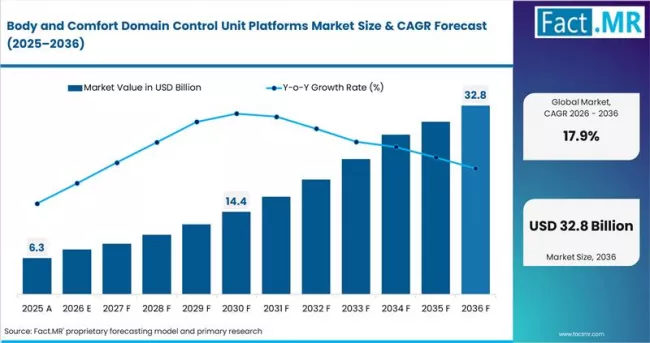
Body And Comfort Domain Control Unit Platforms Market Value Analysis | Source: Fact.MR
| Metric | Value |
|---|---|
| Estimated Value in 2026 | USD 6.3 billion |
| Forecast Value in 2036 | USD 32.8 billion |
| Forecast CAGR (2026 to 2036) | 17.9% |
Source: Fact.MR analysis. Updated May 5, 2026
Summary of Body and Comfort Domain Control Unit Platforms Market
- Market Definition
- The market covers centralized and zonal electronic platforms. These platforms consolidate body and comfort vehicle functions. Lighting, HVAC, seat, and access control are integrated into domain controller architectures. Adoption spans passenger, EV, commercial, and premium vehicles globally.
- Demand Drivers
- Automotive OEMs are consolidating distributed ECU networks into centralized domain controllers to reduce wiring harness weight, cut system complexity, and enable over-the-air software update capability across vehicle lines.
- Accelerating global EV production is creating mandatory platform-level demand for body and comfort domain controllers that integrate with high-voltage architectures and support software-defined vehicle feature monetization.
- Regulatory mandates for vehicle cybersecurity compliance, including UNECE WP.29 and ISO/SAE 21434, are compelling OEMs to adopt domain-level platforms with embedded security management.
- Key Segments Analyzed
- By Platform Type: Body domain control units lead with 40% share in 2026, driven by high adoption across centralized body electronics consolidation programmes in European and Asian OEM platforms.
- By Vehicle Type: Passenger vehicles lead with approximately 65% share in 2026, supported by high production volumes and rapid domain architecture migration across mainstream and premium segments.
- By Architecture: Centralized domain architecture leads with 50% share in 2026, reflecting strong OEM preference for platform-level integration over legacy distributed ECU configurations.
- Analyst Opinion at FACT.MR
- Shambhu Nath Jha, Principal Consultant at Fact.MR, opines, CXOs will find that long-cycle OEM design win capture defines competitive positioning. Component pricing is becoming less critical. Vendors with validated zonal architecture roadmaps are gaining advantage. AUTOSAR-compliant software stacks are becoming essential.
- Strategic Implications
- Secure model-year 2027 and 2028 OEM platform design wins by validating zonal and centralized domain controller architectures against AUTOSAR Adaptive and UNECE WP.29 cybersecurity compliance requirements.
- Invest in semiconductor co-development partnerships with NXP and Infineon to integrate domain controller hardware with automotive-grade SoCs ahead of EV platform procurement cycles in China and India.
- Develop comfort domain controller modules targeting AI-enabled HVAC and seat adjustment features for premium and EV OEMs in South Korea and Germany to capture fastest-growing application sub-segments.
- Methodology
- Market sizing uses OEM production volumes, domain controller content-per-vehicle benchmarks, and Tier-1 supplier revenue data validated against 2024–2025 earnings disclosures.
- Analysis incorporates SAE E/E architecture transition data, UNECE WP.29 regulatory timelines, and EV platform adoption rates across key producing markets.
- Forecasts incorporate domain architecture penetration modelling, semiconductor supply chain assessments, and expert interviews with automotive E/E engineering specialists.
The market is set to generate USD 27.7 billion in absolute opportunity over the forecast period. This is transformational, not incremental. The consolidation of distributed body electronics into centralized domain controllers is the primary structural engine. Transition costs for legacy OEM validation and semiconductor supply constraints moderate near-term ramp velocity.
India leads with 18.8% CAGR through 2036, driven by rapid vehicle electrification and cost-optimized domain controller adoption. South Korea follows at 18.3%, underpinned by Hyundai ecosystem integration and AI-enabled comfort systems expansion. China records 19.5%, the fastest absolute growth, fuelled by the world’s largest EV production base and rapid zonal architecture rollout. The United States posts 17.2%, anchored by the software-defined vehicle transition and a strong OEM-semiconductor ecosystem. Germany records 16.8%, reflecting premium automotive engineering and early centralized E/E architecture adoption. Japan registers 15.9%, with gradual architecture migration supported by Denso and Panasonic Tier-1 supply networks.
Segmental Analysis
Body and Comfort Domain Control Unit Platforms Market Analysis by Platform Type
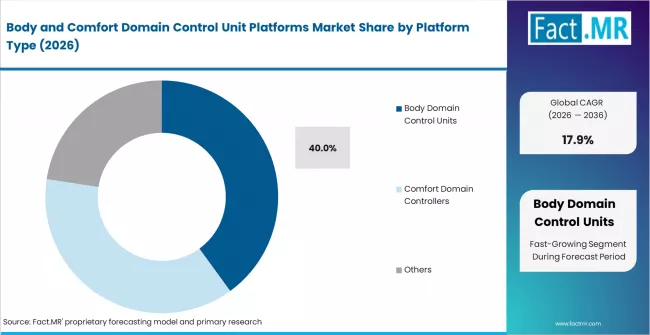
Body And Comfort Domain Control Unit Platforms Market Analysis By Platform Type | Source: Fact.MR
Based on FACT.MR, body domain control units hold 40% share in 2026. They lead due to established adoption in centralized body electronics consolidation across European and Asian OEM platforms. Demand is reinforced by multi-function integration covering lighting, access, and wiper control in a single validated platform.
- Bosch Domain Controller Investment: Robert Bosch disclosed its Body and Comfort Domain Controller platform roadmap expansion in its 2024 Mobility Solutions annual report, with production supply commitments to three European OEMs covering model-year 2027 vehicle programmes. [4]
- Continental CIVINTUS Platform Launch: Continental AG launched its CIVINTUS body and comfort domain controller platform in Q3 2024, targeting centralized zone controller architectures for mid-range and premium passenger vehicles in Europe and China. [5]
- AUTOSAR Adaptive Adoption Trend: The AUTOSAR consortium reported in its 2024 release notes that body and comfort domain controller applications represented the fastest-growing implementation category for AUTOSAR Adaptive Platform, driven by OEM software-defined vehicle programmes. [6]
Body and Comfort Domain Control Unit Platforms Market Analysis by Vehicle Type
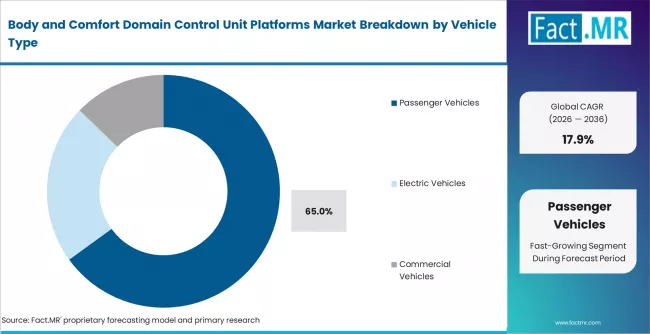
Body And Comfort Domain Control Unit Platforms Market Analysis By Vehicle Type | Source: Fact.MR
Based on FACT.MR, passenger vehicles hold approximately 65% share in 2026. High production volumes and active domain architecture migration across mainstream and premium programmes drive this dominance. Electric vehicles within this segment are the fastest-growing sub-category as EV platforms are natively designed for domain controller integration.
- Aptiv EV Platform Award: Aptiv disclosed a USD 2.8 billion EV body electronics platform supply award from a major North American OEM in its Q4 2024 earnings call, covering domain controller supply for a three-vehicle-line EV programme launching in 2027. [7]
- Magna Comfort System Innovation: Magna International launched an AI-enabled comfort domain controller module in early 2025 targeting premium EV OEMs, incorporating adaptive HVAC and seat adjustment algorithms validated for GM and BMW platform programmes. [8]
- Premium Vehicle Content Growth Trend: McKinsey’s 2024 Automotive Electronics Report estimated that domain controller content per premium vehicle would rise from USD 520 in 2024 to USD 950 by 2028, driven by comfort and body function consolidation in luxury EV programmes. [9]
Drivers, Restraints, and Opportunities
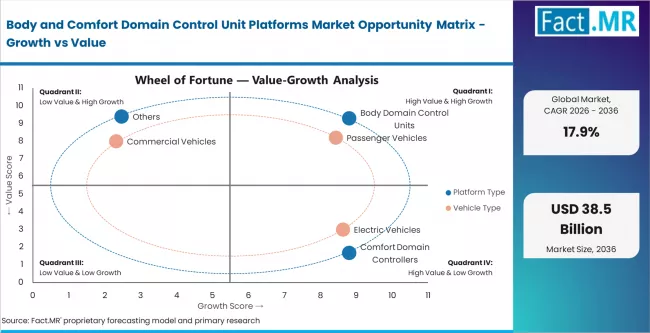
Body And Comfort Domain Control Unit Platforms Market Opportunity Matrix Growth Vs Value | Source: Fact.MR
FACT.MR analysts observe that this market has undergone a structural reset since 2022. The shift from distributed ECUs to domain and zonal architectures is accelerating consolidation. Decades of ECU proliferation are being compressed into a five-to-seven-year cycle.
Legacy distributed ECU demand is declining. OEMs are freezing ECU count in new vehicle programmes. Domain controller value per vehicle is rising sharply. It has increased from under USD 150 to USD 400–600 in centralized platforms. This value shift is driving revenue growth. Margins remain strong in premium and EV platforms but are under pressure in mid-range segments.
- UNECE WP.29 Cybersecurity Mandate: UNECE WP.29 Regulation R155 became mandatory in the EU from July 2024. Domain-level cybersecurity is now required. OEMs are procuring platforms with integrated security stacks. Aptiv and Continental AG are key beneficiaries. [1]
- China EV Architecture Acceleration: Ministry of Industry and Information Technology released its 2024 roadmap update. Domain and zonal architectures are mandated by 2027. BYD and SAIC Motor are accelerating adoption. NXP Semiconductors and Qualcomm expanded automotive SoC supply. [2]
- India Vehicle Electrification Policy Incentive: India’s FAME III framework was announced in 2025. Incentives are linked to advanced electronic architectures. Tata Motors and Mahindra & Mahindra are accelerating domain controller integration. Adoption is increasing among regional Tier-1 suppliers. [3]
Regional Analysis
The body and comfort domain control unit platforms market is assessed across Asia Pacific, North America, Europe, Latin America, and Middle East and Africa, covering 40+ countries segmented by E/E architecture adoption stage, EV production base, and automotive Tier-1 supplier ecosystem maturity. The full report provides market attractiveness analysis by region and country.
.webp "Top Country Growth Comparison Body And Comfort Domain Control Unit Platforms Market Cagr (2026 2036)")
Top Country Growth Comparison Body And Comfort Domain Control Unit Platforms Market Cagr (2026 2036) | Source: Fact.MR
| Country | CAGR (2026 to 2036) |
|---|---|
| China | 19.5% |
| India | 18.8% |
| South Korea | 18.3% |
| United States | 17.2% |
| Germany | 16.8% |
| Japan | 15.9% |
Source: Fact.MR analysis. Updated May 5, 2026
Source: Fact.MR (FACT.MR) analysis, based on proprietary forecasting model and primary research
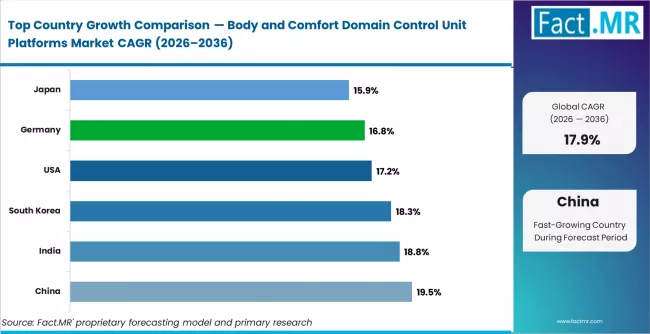
Body And Comfort Domain Control Unit Platforms Market Cagr Analysis By Country | Source: Fact.MR
Asia Pacific Body and Comfort Domain Control Unit Platforms Market Analysis
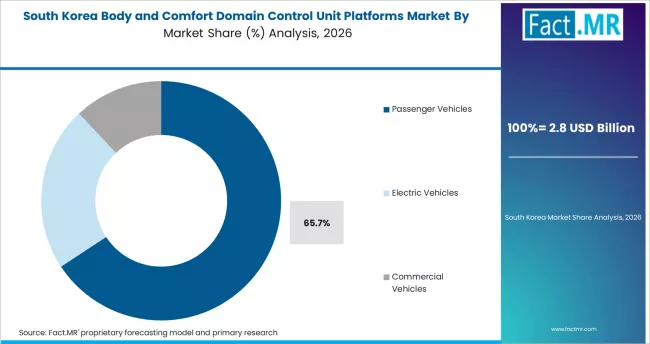
Body And Comfort Domain Control Unit Platforms Market South Korea Market Share Analysis By Vehicle Type | Source: Fact.MR
Asia Pacific is the production and adoption epicentre of body and comfort domain controllers. China EV scale and India electrification momentum drive growth. South Korea adds AI-enabled comfort platform deployment. NXP Semiconductors and Qualcomm supply chips. Robert Bosch and Denso Corporation Lead Tier-1 supply.
- China: Scale-driven EV production supports 19.5% CAGR through 2036. Over 9 million NEVs were produced in 2024. BYD and SAIC Motor adopted zonal architectures in new platforms. Ministry of Industry and Information Technology set 2027 targets for domain adoption. NXP Semiconductors expanded its Shanghai design centre.
- India: Policy-led electrification enables 18.8% CAGR through 2036. FAME III incentives are linked to advanced architectures. Tata Motors and Mahindra & Mahindra are integrating domain controllers. Automotive Mission Plan 2026 supports local electronics sourcing. Bosch India and Minda Industries are expanding local production.
- South Korea: OEM-led platform standardization drives 18.3% CAGR through 2036. Hyundai Motor Group deployed centralized E/E architecture on E-GMP. Kia and Genesis follow the same platform. Continental AG and HL Mando secured supply awards. Government software vehicle initiatives are supporting adoption.
FACT.MR’s Asia Pacific analysis covers China, India, South Korea, Japan, ASEAN, and ANZ. It includes EV platform trends and architecture adoption data.
Europe Body and Comfort Domain Control Unit Platforms Market Analysis
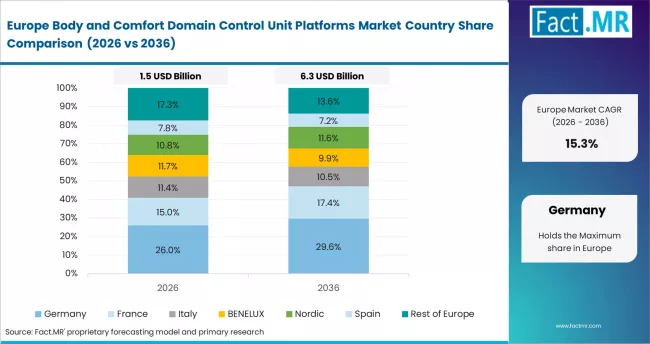
Body And Comfort Domain Control Unit Platforms Market Europe Country Market Share Analysis, 2026 & 2036 | Source: Fact.MR
Europe is the regulatory and engineering benchmark. UNECE WP.29 mandates drive adoption. Continental AG, Robert Bosch, and Aptiv lead supply.
- Germany: Engineering-led OEM programmes support 16.8% CAGR through 2036. Volkswagen Group, BMW, and Mercedes-Benz are centralizing architectures. CARIAD is driving SDV initiatives. Continental AG invested EUR 300 million in Regensburg. UNECE WP.29 R155 enforces cybersecurity compliance.
FACT.MR’s Europe analysis covers Germany, France, United Kingdom, Italy, Spain, Nordic countries, and BENELUX. It includes compliance timelines and OEM programme data.
North America Body and Comfort Domain Control Unit Platforms Market Analysis
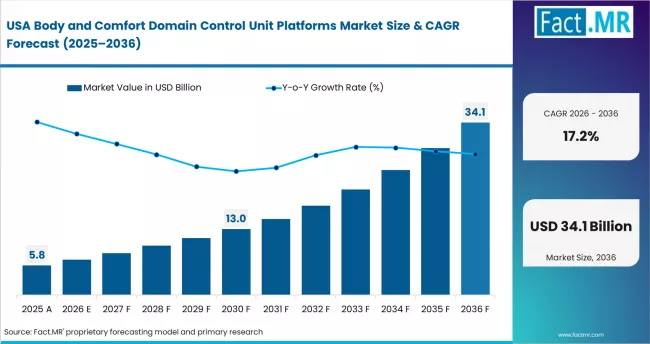
Body And Comfort Domain Control Unit Platforms Market Country Value Analysis | Source: Fact.MR
North America is the software-defined vehicle hub. OEM-led integration drives demand. Aptiv and Magna International hold strong positions.
- United States: Platform-driven OEM transformation supports 17.2% CAGR through 2036. General Motors expanded Ultifi across EV platforms. Ford targets 70% ECU reduction by 2028. National Institute of Standards and Technology updated cybersecurity guidance in 2024. Adoption is driven by SDV transition and security requirements.
FACT.MR’s North America analysis covers United States, Canada, and Mexico. It includes OEM timelines and semiconductor supply assessments.
Competitive Aligners for Market Players
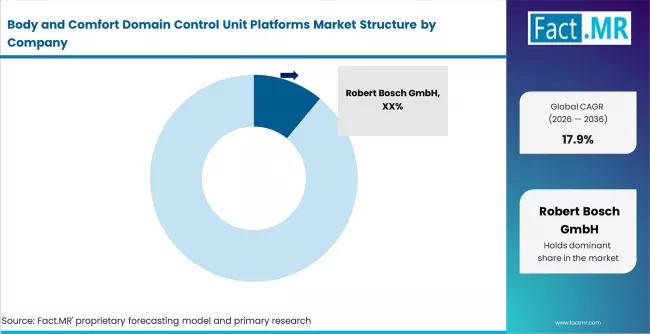
Body And Comfort Domain Control Unit Platforms Market Analysis By Company | Source: Fact.MR
Competition in the body and comfort domain control unit platforms market is shifting toward long-term platform positioning rather than short-term component wins. Suppliers are no longer just selling hardware. They are competing to become embedded technology partners within OEM vehicle architectures that remain in production for five to eight years.
One of the most important aligners is the ability to support centralized and zonal architectures. OEMs are redesigning vehicle electronics to reduce ECU count and improve software control. Vendors that can deliver scalable domain controller platforms aligned with these architectures are gaining early design wins. Companies like Continental AG, Robert Bosch, and Aptiv are investing heavily in this transition.
Another key factor is software capability. AUTOSAR compliance, cybersecurity integration, and over-the-air update readiness are now baseline requirements. The competitive edge comes from how well vendors can integrate software stacks with hardware and enable future upgrades without redesigning the system.
Semiconductor partnerships are also becoming critical. Domain controllers rely on high-performance SoCs, making collaboration with companies like NXP Semiconductors and Qualcomm essential. Vendors that can secure reliable chip supply and co-develop reference architectures are reducing risk for OEM customers. Cost still matters, but it is no longer the primary differentiator. OEMs are prioritizing lifecycle value, system reliability, and integration depth. This is especially true for EV and premium platforms where electronics content is higher.
Regional manufacturing and localization are influencing contracts. Suppliers that can offer local production, engineering support, and compliance with regional regulations are improving their chances of winning large, multi-year OEM programs.
Key Players
- Robert Bosch GmbH
- Continental AG
- Denso Corporation
- Magna International Inc.
- Aptiv PLC
- NXP Semiconductors N.V.
- Infineon Technologies AG
- Qualcomm Incorporated
- HL Mando Corporation
- Minda Industries Limited
Bibliography
- [1] United Nations Economic Commission for Europe. Regulation No. 155 on Cybersecurity and Cybersecurity Management Systems for Motor Vehicles. July 2024. unece.org/transport/vehicle-regulations
- [2] Ministry of Industry and Information Technology, People’s Republic of China. Smart Vehicle Technical Roadmap 2024 Update: Domain and Zonal E/E Architecture Adoption Requirements for New Energy Vehicles. December 2024. miit.gov.cn
- [3] Ministry of Heavy Industries, Government of India. FAME III Scheme Framework Announcement: Production-Linked Incentives for Advanced-Architecture Electric Vehicles. February 2025. heavyindustries.gov.in
- [4] Robert Bosch GmbH. Mobility Solutions Annual Report 2024: Body and Comfort Domain Controller Platform Roadmap and European OEM Supply Programme Disclosure. February 2025. bosch.com/investor-relations
- [5] Continental AG. CIVINTUS Body and Comfort Domain Controller Platform Launch Press Release. September 2024. continental.com/news
- [6] AUTOSAR Consortium. AUTOSAR Adaptive Platform Release 24-11 Notes: Body and Comfort Domain Controller Implementation Adoption Data and Software-Defined Vehicle Programme Update. November 2024. autosar.org/releases
- [7] Aptiv PLC. Q4 2024 Earnings Call Transcript: EV Body Electronics Platform Supply Award Disclosure and Domain Controller Programme Update. February 2025. investors.aptiv.com
- [8] Magna International Inc. Press Release: AI-Enabled Comfort Domain Controller Module Launch for Premium EV OEM Programmes. January 2025. magna.com/news
- [9] McKinsey & Company. Automotive Electronics Content per Vehicle: Domain Controller Growth in Premium and EV Segments 2024–2028. November 2024. mckinsey.com/industries/automotive
This Report Addresses
- Strategic intelligence on body and comfort domain control unit platform demand across passenger, EV, commercial, and premium vehicle segments as automotive E/E architecture transitions accelerate globally.
- Market forecast from USD 6.3 billion in 2026 to USD 32.8 billion by 2036, at 17.9% CAGR, with absolute opportunity of USD 27.7 billion over the forecast period.
- Opportunity mapping across China EV architecture mandates, India FAME III electrification incentives, U.S. software-defined vehicle OEM programmes, and Germany UNECE WP.29 compliance-driven procurement.
- Segment analysis by platform type, vehicle type, and architecture covering body domain controllers, comfort platforms, zonal controllers, and integrated cockpit-body units across centralized and zonal architectures.
- Regional outlook covering Asia Pacific EV-driven adoption, North America software-defined vehicle consolidation, and Europe regulatory compliance-led domain controller procurement.
- Competitive landscape of Bosch, Continental, Aptiv, Magna, Denso, NXP, Infineon, and Qualcomm covering OEM design win positions, platform architecture roadmaps, and long-cycle supply contract structures.
- Regulatory analysis covering UNECE WP.29 R155 cybersecurity mandate timelines, China MIIT smart vehicle technical roadmap, India FAME III electronics incentives, and AUTOSAR Adaptive Platform adoption requirements.
- Report delivery in PDF, Excel, and presentation formats supported by validated OEM production data, Tier-1 supplier revenue disclosures, and automotive E/E engineering expert inputs.
Body and Comfort Domain Control Unit Platforms Market Definition
The market includes software-embedded electronic control platforms. These platforms consolidate body and comfort functions. Functions include lighting, HVAC, seat control, access systems, and ambient features. These are integrated into centralized or zonal domain controllers.
Body and Comfort Domain Control Unit Platforms Market Inclusions
Covers global and regional forecasts from 2026 to 2036 by platform type, vehicle type, and architecture. Includes body domain control units, comfort domain controllers, zonal body controllers, and integrated cockpit-body platforms. Covers centralized, hybrid, and zonal architectures across passenger, EV, commercial, and premium vehicle formats.
Body and Comfort Domain Control Unit Platforms Market Exclusions
Excludes standalone distributed ECUs not integrated into domain controller architectures. Omits powertrain domain controllers, ADAS domain units, and infotainment-only platforms. Body and comfort software licensing without hardware integration is also excluded. Focus remains on domain-level hardware-software controller platforms for body and comfort vehicle functions.
Body and Comfort Domain Control Unit Platforms Market Research Methodology
- Primary Research
- Interviews with automotive E/E architects, Tier-1 supplier product managers, OEM procurement leads, and semiconductor application engineers across Europe, Asia Pacific, and North America.
- Desk Research
- Analysis of Bosch, Continental, Aptiv, and NXP investor disclosures, SAE E/E architecture standards, and automotive electronics industry publications from 2024–2025.
- Market-Sizing and Forecasting
- Hybrid top-down and bottom-up model using OEM production volumes, domain controller content-per-vehicle estimates, architecture penetration rates, and Tier-1 supplier revenue benchmarks.
- Data Validation and Update Cycle
- Validated through OEM annual reports, supplier earnings disclosures, SAE and AUTOSAR standards updates, and expert interviews with periodic forecast revision cycles.
Segmentation
Scope of Report
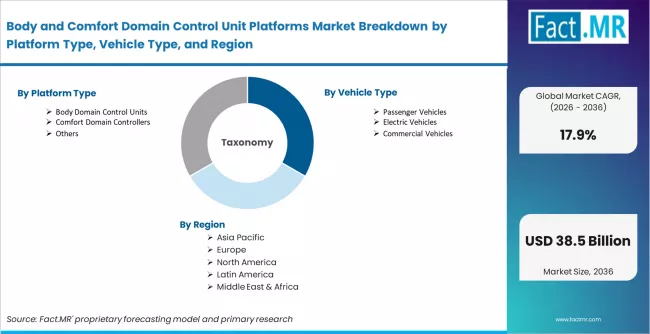
Body And Comfort Domain Control Unit Platforms Market Breakdown By Platform Type, Vehicle Type, And Region | Source: Fact.MR
| Attribute | Details |
|---|---|
| Quantitative Units | USD 6.3 billion (2026) to USD 32.8 billion (2036), at a CAGR of 17.9% |
| Market Definition | Software-embedded electronic control platforms consolidating body and comfort vehicle functions into centralized or zonal domain controller architectures across passenger, EV, commercial, and premium vehicles globally. |
| Platform Type Segmentation | Body Domain Control Units, Comfort Domain Controllers, Zonal Body Controllers, Integrated Cockpit-Body Controllers |
| Vehicle Type Segmentation | Passenger Vehicles, Electric Vehicles, Commercial Vehicles, Premium/Luxury Vehicles |
| Architecture Segmentation | Centralized Domain Architecture, Hybrid Distributed-Domain, Zonal Architecture |
| Application Coverage | Centralized body electronics consolidation, AI-enabled HVAC and seat comfort control, zonal body controller deployment, integrated cockpit-body platform supply for EV and premium vehicle programmes. |
| Regions Covered | North America, Europe, Asia Pacific, Latin America, Middle East and Africa |
| Countries Covered | USA, Canada, Mexico, Germany, UK, France, Italy, Spain, Nordic, BENELUX, China, Japan, South Korea, India, ASEAN, Australia and New Zealand, Brazil, Argentina, Saudi Arabia, GCC, Turkey, South Africa |
| Key Companies Profiled | Robert Bosch, Continental AG, Denso, Magna International, Aptiv, NXP Semiconductors, Infineon Technologies, Qualcomm, HL Mando, Minda Industries |
| Forecast Period | 2026 to 2036 |
| Approach | Hybrid top-down and bottom-up model using OEM production volumes, domain controller content-per-vehicle estimates, architecture penetration rates, Tier-1 supplier revenues, and primary interviews with automotive E/E engineers and OEM procurement leads. |
Source: Fact.MR analysis. Updated May 5, 2026
Body and Comfort Domain Control Unit Platforms Market by Segments
-
By Platform Type:
- Body Domain Control Units
- Comfort Domain Controllers
- Zonal Body Controllers
- Integrated Cockpit-Body Controllers
-
By Vehicle Type:
- Passenger Vehicles
- Electric Vehicles
- Commercial Vehicles
- Premium/Luxury Vehicles
-
By Architecture:
- Centralized Domain Architecture
- Hybrid Distributed-Domain
- Zonal Architecture
-
By Region:
- North America
- United States
- Canada
- Mexico
- Latin America
- Brazil
- Argentina
- Rest of Latin America
- Western Europe
- Germany
- United Kingdom
- France
- Italy
- Spain
- Nordic Countries
- BENELUX
- Rest of Western Europe
- Eastern Europe
- Russia
- Poland
- Rest of Eastern Europe
- East Asia
- China
- Japan
- South Korea
- South Asia and Pacific
- India
- ASEAN
- Australia and New Zealand
- Rest of South Asia and Pacific
- Middle East and Africa
- Kingdom of Saudi Arabia
- Other GCC Countries
- Turkey
- South Africa
- Rest of Middle East and Africa
- North America
Frequently Asked Questions
How large is the body and comfort domain control unit platforms market in 2026?
What will the market size be by 2036?
What is the expected CAGR from 2026 to 2036?
Which platform type segment is poised to lead in 2026?
Which architecture segment holds the largest share?
Which country is the fastest-growing market?
What is driving demand in this market?
Who are the key players in the market?
Who worked on this report


Preview the report firsthand - request a free sample
Free SampleGet the brochure for pricing and purchase details
Download PDF