rPCF Intermediates Market (2026 - 2036)
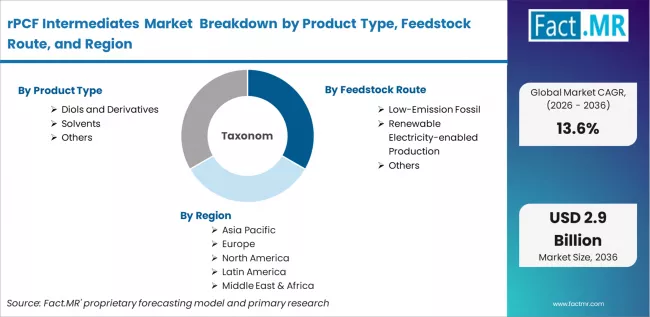
Reduced Product Carbon Footprint (rPCF) intermediates market is segmented by Product Type (Diols and Derivatives, Solvents, Amines, Plasticizer Intermediates, Others), Feedstock Route (Low-emission Fossil Feedstocks, Renewable Electricity-enabled Production, Mass-balanced Renewable Feedstocks, Mass-balanced Circular Feedstocks, Others), End Use Industry (Polyurethanes and Engineering Plastics, Textiles and Apparel, Pharmaceuticals, Electronics, Coatings and Adhesives, Others), and Region. Forecast for 2026 to 2036.
Core Findings
rPCF Intermediates Market Forecast and Outlook By Fact.MR
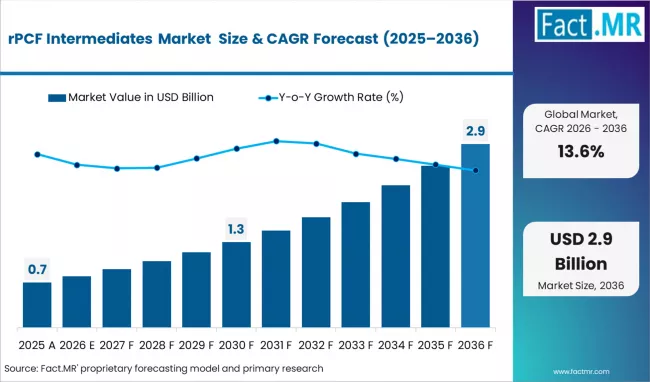
The rPCF intermediates market was valued at USD 0.7 billion in 2025. Fact.MR projects it to reach USD 0.8 billion in 2026 and USD 2.9 billion by 2036, expanding at a CAGR of 13.6%. Diols and Derivatives is forecast to lead product type at 35.7% share in 2026. Low-emission Fossil Feedstocks holds the top feedstock route position at 31.4%, and Polyurethanes and Engineering Plastics leads end use industry at 31.6% in 2026. The commercial proposition here is deceptively simple: same molecule, lower carbon number attached. But executing on that proposition requires a producer to simultaneously manage feedstock sourcing, utility decarbonization, verified accounting methodology, third-party certification, and customer communication in a way that makes the carbon reduction real, auditable, and commercially legible to procurement teams who are still learning how to buy it.
Key Drivers
- Procurement Pressure: Chemical buyers increasingly require lower-carbon raw materials that can fit existing plants and formulations without requalification complexity.
- Verified Accounting: Product carbon footprint methodologies and third-party review are making carbon-differentiated intermediates more commercially legible across procurement cycles.
- Portfolio Expansion: BASF and comparable chemical players are broadening low-PCF and reduced-PCF product offerings across intermediates and downstream specialties.
Key Segments Analyzed in the Report
- Product Type: Diols And Derivatives, Solvents, Amines, Plasticizer Intermediates, And Others
- Feedstock Route: Low-Emission Fossil Feedstocks, Renewable Electricity-Enabled Production, Mass-Balanced Renewable Feedstocks, Mass-Balanced Circular Feedstocks, And Others
- End Use Industry: Polyurethanes And Engineering Plastics, Textiles And Apparel, Pharmaceuticals, Electronics, Coatings And Adhesives, And Others
- Region: North America, Latin America, Europe, Asia Pacific, And Middle East & Africa
Analyst Opinion
Shambhu Nath Jha, Principal Consultant, Fact.MR says rPCF intermediates are commercially powerful because they let customers buy carbon improvement without buying process disruption. The products that scale fastest will be those that keep molecule identity unchanged while making the carbon premium measurable and independently auditable. This is carbon reduction sold as a procurement decision, not a capital project, and that distinction is what makes the market grow faster than most people expect.
rPCF Intermediates Market Definition
The rPCF intermediates market covers chemical intermediates sold with a reduced product carbon footprint claim relative to a producer baseline or regional standard product, usually supported by verified carbon accounting and delivered as drop-in materials for downstream industrial use.
rPCF Intermediates Market Inclusions
- Revenue from chemical intermediates sold with reduced product carbon footprint claims across diols, solvents, amines, plasticizer intermediates, and related chemistries.
- Commercial products produced through lower-emission utilities, low-emission feedstocks, renewable electricity, or verified mass-balance systems that lower cradle-to-gate emissions.
- Demand across North America, Latin America, Europe, Asia Pacific, and the Middle East & Africa.
rPCF Intermediates Market Exclusions
- Standard fossil-based intermediates without a reduced-PCF or equivalent carbon-differentiated claim.
- Voluntary carbon offsets sold separately from the chemical product transaction.
- Downstream finished goods revenue that merely contains low-carbon intermediates.
rPCF Intermediates Market Research Methodology
This study evaluates the rPCF intermediates market across product type, feedstock route, end use industry, and region, using 2025 as the base year and 2026 to 2036 as the forecast period. Market value is expressed in USD billion. Evidence inputs include first-party sustainability portfolios in chemical intermediates, mass-balance certification frameworks, PCF methodology disclosures, and low-carbon product launches led by BASF and comparable chemical producers. Triangulation aligns premium willingness, drop-in substitution rates, verified carbon reductions, and downstream adoption in polyurethane, textile, coating, and engineering applications to derive segment and regional estimates.
Key Drivers, Restraints, and Trends in rPCF Intermediates Market
Drivers
Demand for rPCF intermediates is growing because chemical procurement teams want carbon reduction that does not force a chemistry change. That favors drop-in intermediates with validated footprint advantages. When the molecule performs identically to the standard grade, buyers can decarbonize faster with less formulation and plant risk.
Restraints
The market still depends on verification discipline and pricing tolerance. Customers need confidence that carbon reductions are calculated consistently and are not simply marketing language. At the same time, many downstream buyers will not accept a material premium unless the product supports customer reporting, regulatory readiness, or brand positioning.
Trends
The strongest trend is the shift from generic low-carbon positioning to named product portfolios with clearer claims. Producers are differentiating between low-PCF and reduced-PCF products, expanding specific intermediates, and tying the offer to standards such as ISO 14067 and recognized mass-balance schemes. That is turning carbon intensity into a more tradable product attribute.
Segmental Analysis
rPCF Intermediates Market Analysis by Product Type
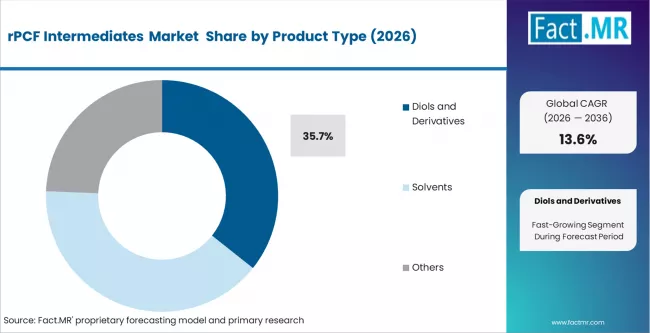
The Diols and Derivatives segment is expected to lead the product type category with a 35.7% share in 2026. Diols and their derivatives lead because they sit in multiple downstream value chains, including polyurethanes, elastic fibers, engineering materials, and solvents. BASF's early rPCF expansion around BDO, THF, PolyTHF, and NMP gives this portion of the portfolio a more concrete commercial base than many other intermediate groups.
rPCF Intermediates Market Analysis by Feedstock Route
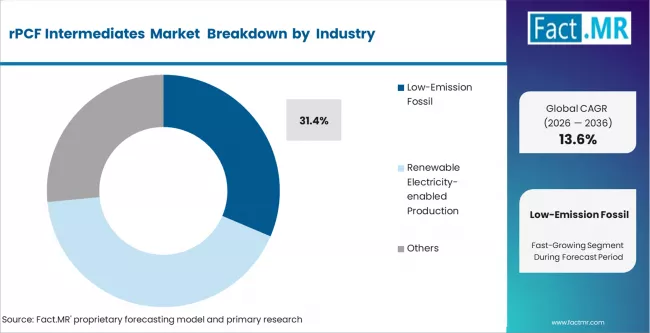
The Low-emission Fossil Feedstocks segment is expected to lead the feedstock route category with a 31.4% share in 2026. This route leads because it is the fastest near-term way to reduce PCF without remaking the whole asset base. It allows producers to lower emissions through utilities, site efficiency, and selected input changes while keeping product identity and large-scale manufacturing continuity intact.
Competitive Aligners for Market Players
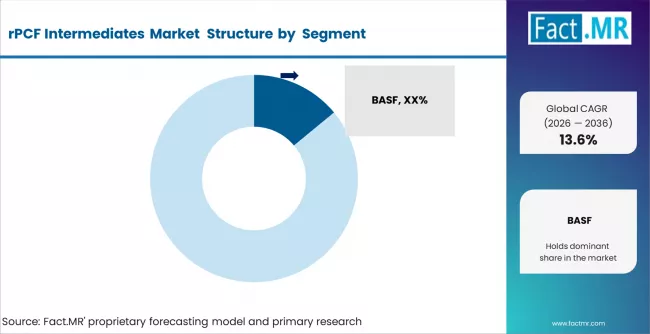
The competitive dynamic in rPCF intermediates is being defined by whoever builds the most credible and transparent product carbon footprint infrastructure first. That means not just having the low-carbon product, but having the ISO 14067-aligned PCF calculation, the third-party audit trail, the customer-facing documentation, and the ability to update those numbers as production processes improve. Producers that can offer that level of carbon transparency as a standard commercial service, rather than as a bespoke request, will capture disproportionate share as procurement teams mature their buying criteria.
BASF's early move to launch named reduced-PCF and low-PCF intermediates with explicit carbon claims attached to specific products such as BDO, THF, PolyTHF, and NMP has set a competitive reference point that others must now respond to. The strategic implication for other large chemical producers is that being a fast follower in product launches is no longer sufficient. Customers are beginning to run competitive PCF comparisons, and a producer without a comparable documented portfolio will find itself excluded from sustainability-linked procurement decisions even if its products are otherwise equivalent.
Smaller specialty producers face a different set of competitive choices. They cannot match the scale or certification infrastructure of a BASF, but they can carve out defensible positions by focusing on intermediates where the PCF reduction is structurally larger because the feedstock or process is fundamentally different. Biobased routes, electrolysis-enabled production, and circular feedstock systems all offer pathways to deeper PCF reductions that large incumbents are slower to commercialize at scale. The window for that differentiation is real but time-limited.
Key Players in rPCF Intermediates Market
- BASF
- Covestro
- Evonik
- Eastman
- Perstorp
- OCI Global
- Arkema
- Röhm
- Mitsubishi Chemical Group
- INEOS
Strategic Outlook by Fact.MR on rPCF Intermediates Market
Fact.MR expects rPCF intermediates to expand fastest in downstream chains where procurement, reporting, and brand owners all care about embedded carbon but cannot accept molecule-level performance trade-offs. The category should deepen as product-specific PCF transparency becomes more routine and buyers begin treating lower-carbon intermediates as a strategic sourcing lever. The carbon accounting infrastructure being built today is the price of admission to tomorrow's procurement conversations.
Scope of the Report

| Metric | Value |
|---|---|
| Market Value | USD 0.7 billion in 2025 to USD 2.9 billion by 2036 |
| CAGR | 13.6% from 2026 to 2036 |
| Base Year | 2025 |
| Forecast Period | 2026 to 2036 |
| Product Type Segmentation | Diols and Derivatives, Solvents, Amines, Plasticizer Intermediates, Others |
| Feedstock Route Segmentation | Low-emission Fossil Feedstocks, Renewable Electricity-enabled Production, Mass-balanced Renewable Feedstocks, Mass-balanced Circular Feedstocks, Others |
| End Use Industry Segmentation | Polyurethanes and Engineering Plastics, Textiles and Apparel, Pharmaceuticals, Electronics, Coatings and Adhesives, Others |
| Regional Coverage | North America, Latin America, Europe, Asia Pacific, and Middle East & Africa |
Bibliography
- BASF. 2026. BASF introduces BDO, THF, PolyTHF and NMP product variants with reduced product carbon footprint.
- BASF. 2025. Reduced PCF Intermediates.
- ISCC. 2025. ISCC PLUS.
- European Commission. 2025. Carbon Border Adjustment Mechanism.
- ISO. 2018. ISO 14067:2018 Greenhouse gases - Carbon footprint of products.
Table of Content
- Executive Summary
- Global Market Outlook
- Demand to side Trends
- Supply to side Trends
- Technology Roadmap Analysis
- Analysis and Recommendations
- Market Overview
- Market Coverage / Taxonomy
- Market Definition / Scope / Limitations
- Research Methodology
- Chapter Orientation
- Analytical Lens and Working Hypotheses
- Market Structure, Signals, and Trend Drivers
- Benchmarking and Cross-market Comparability
- Market Sizing, Forecasting, and Opportunity Mapping
- Research Design and Evidence Framework
- Desk Research Programme (Secondary Evidence)
- Company Annual and Sustainability Reports
- Peer-reviewed Journals and Academic Literature
- Corporate Websites, Product Literature, and Technical Notes
- Earnings Decks and Investor Briefings
- Statutory Filings and Regulatory Disclosures
- Technical White Papers and Standards Notes
- Trade Journals, Industry Magazines, and Analyst Briefs
- Conference Proceedings, Webinars, and Seminar Materials
- Government Statistics Portals and Public Data Releases
- Press Releases and Reputable Media Coverage
- Specialist Newsletters and Curated Briefings
- Sector Databases and Reference Repositories
- Fact.MR Internal Proprietary Databases and Historical Market Datasets
- Subscription Datasets and Paid Sources
- Social Channels, Communities, and Digital Listening Inputs
- Additional Desk Sources
- Expert Input and Fieldwork (Primary Evidence)
- Primary Modes
- Qualitative Interviews and Expert Elicitation
- Quantitative Surveys and Structured Data Capture
- Blended Approach
- Why Primary Evidence is Used
- Field Techniques
- Interviews
- Surveys
- Focus Groups
- Observational and In-context Research
- Social and Community Interactions
- Stakeholder Universe Engaged
- C-suite Leaders
- Board Members
- Presidents and Vice Presidents
- R&D and Innovation Heads
- Technical Specialists
- Domain Subject-matter Experts
- Scientists
- Physicians and Other Healthcare Professionals
- Governance, Ethics, and Data Stewardship
- Research Ethics
- Data Integrity and Handling
- Primary Modes
- Tooling, Models, and Reference Databases
- Desk Research Programme (Secondary Evidence)
- Data Engineering and Model Build
- Data Acquisition and Ingestion
- Cleaning, Normalisation, and Verification
- Synthesis, Triangulation, and Analysis
- Quality Assurance and Audit Trail
- Market Background
- Market Dynamics
- Drivers
- Restraints
- Opportunity
- Trends
- Scenario Forecast
- Demand in Optimistic Scenario
- Demand in Likely Scenario
- Demand in Conservative Scenario
- Opportunity Map Analysis
- Product Life Cycle Analysis
- Supply Chain Analysis
- Investment Feasibility Matrix
- Value Chain Analysis
- PESTLE and Porter’s Analysis
- Regulatory Landscape
- Regional Parent Market Outlook
- Production and Consumption Statistics
- Import and Export Statistics
- Market Dynamics
- Global Market Analysis 2021 to 2025 and Forecast, 2026 to 2036
- Historical Market Size Value (USD Million) Analysis, 2021 to 2025
- Current and Future Market Size Value (USD Million) Projections, 2026 to 2036
- Y to o to Y Growth Trend Analysis
- Absolute $ Opportunity Analysis
- Global Market Pricing Analysis 2021 to 2025 and Forecast 2026 to 2036
- Global Market Analysis 2021 to 2025 and Forecast 2026 to 2036, By Product Type
- Introduction / Key Findings
- Historical Market Size Value (USD Million) Analysis By Product Type, 2021 to 2025
- Current and Future Market Size Value (USD Million) Analysis and Forecast By Product Type, 2026 to 2036
- Diols and Derivatives
- Solvents
- Others
- Diols and Derivatives
- Y to o to Y Growth Trend Analysis By Product Type, 2021 to 2025
- Absolute $ Opportunity Analysis By Product Type, 2026 to 2036
- Global Market Analysis 2021 to 2025 and Forecast 2026 to 2036, By Feedstock Route
- Introduction / Key Findings
- Historical Market Size Value (USD Million) Analysis By Feedstock Route, 2021 to 2025
- Current and Future Market Size Value (USD Million) Analysis and Forecast By Feedstock Route, 2026 to 2036
- Low-Emission Fossil
- Renewable Electricity-enabled Production
- Others
- Low-Emission Fossil
- Y to o to Y Growth Trend Analysis By Feedstock Route, 2021 to 2025
- Absolute $ Opportunity Analysis By Feedstock Route, 2026 to 2036
- Global Market Analysis 2021 to 2025 and Forecast 2026 to 2036, By Region
- Introduction
- Historical Market Size Value (USD Million) Analysis By Region, 2021 to 2025
- Current Market Size Value (USD Million) Analysis and Forecast By Region, 2026 to 2036
- North America
- Latin America
- Western Europe
- Eastern Europe
- East Asia
- South Asia and Pacific
- Middle East & Africa
- Market Attractiveness Analysis By Region
- North America Market Analysis 2021 to 2025 and Forecast 2026 to 2036, By Country
- Historical Market Size Value (USD Million) Trend Analysis By Market Taxonomy, 2021 to 2025
- Market Size Value (USD Million) Forecast By Market Taxonomy, 2026 to 2036
- By Country
- USA
- Canada
- Mexico
- By Product Type
- By Feedstock Route
- By Country
- Market Attractiveness Analysis
- By Country
- By Product Type
- By Feedstock Route
- Key Takeaways
- Latin America Market Analysis 2021 to 2025 and Forecast 2026 to 2036, By Country
- Historical Market Size Value (USD Million) Trend Analysis By Market Taxonomy, 2021 to 2025
- Market Size Value (USD Million) Forecast By Market Taxonomy, 2026 to 2036
- By Country
- Brazil
- Chile
- Rest of Latin America
- By Product Type
- By Feedstock Route
- By Country
- Market Attractiveness Analysis
- By Country
- By Product Type
- By Feedstock Route
- Key Takeaways
- Western Europe Market Analysis 2021 to 2025 and Forecast 2026 to 2036, By Country
- Historical Market Size Value (USD Million) Trend Analysis By Market Taxonomy, 2021 to 2025
- Market Size Value (USD Million) Forecast By Market Taxonomy, 2026 to 2036
- By Country
- Germany
- UK
- Italy
- Spain
- France
- Nordic
- BENELUX
- Rest of Western Europe
- By Product Type
- By Feedstock Route
- By Country
- Market Attractiveness Analysis
- By Country
- By Product Type
- By Feedstock Route
- Key Takeaways
- Eastern Europe Market Analysis 2021 to 2025 and Forecast 2026 to 2036, By Country
- Historical Market Size Value (USD Million) Trend Analysis By Market Taxonomy, 2021 to 2025
- Market Size Value (USD Million) Forecast By Market Taxonomy, 2026 to 2036
- By Country
- Russia
- Poland
- Hungary
- Balkan & Baltic
- Rest of Eastern Europe
- By Product Type
- By Feedstock Route
- By Country
- Market Attractiveness Analysis
- By Country
- By Product Type
- By Feedstock Route
- Key Takeaways
- East Asia Market Analysis 2021 to 2025 and Forecast 2026 to 2036, By Country
- Historical Market Size Value (USD Million) Trend Analysis By Market Taxonomy, 2021 to 2025
- Market Size Value (USD Million) Forecast By Market Taxonomy, 2026 to 2036
- By Country
- China
- Japan
- South Korea
- By Product Type
- By Feedstock Route
- By Country
- Market Attractiveness Analysis
- By Country
- By Product Type
- By Feedstock Route
- Key Takeaways
- South Asia and Pacific Market Analysis 2021 to 2025 and Forecast 2026 to 2036, By Country
- Historical Market Size Value (USD Million) Trend Analysis By Market Taxonomy, 2021 to 2025
- Market Size Value (USD Million) Forecast By Market Taxonomy, 2026 to 2036
- By Country
- India
- ASEAN
- Australia & New Zealand
- Rest of South Asia and Pacific
- By Product Type
- By Feedstock Route
- By Country
- Market Attractiveness Analysis
- By Country
- By Product Type
- By Feedstock Route
- Key Takeaways
- Middle East & Africa Market Analysis 2021 to 2025 and Forecast 2026 to 2036, By Country
- Historical Market Size Value (USD Million) Trend Analysis By Market Taxonomy, 2021 to 2025
- Market Size Value (USD Million) Forecast By Market Taxonomy, 2026 to 2036
- By Country
- Kingdom of Saudi Arabia
- Other GCC Countries
- Turkiye
- South Africa
- Other African Union
- Rest of Middle East & Africa
- By Product Type
- By Feedstock Route
- By Country
- Market Attractiveness Analysis
- By Country
- By Product Type
- By Feedstock Route
- Key Takeaways
- Key Countries Market Analysis
- USA
- Pricing Analysis
- Market Share Analysis, 2025
- By Product Type
- By Feedstock Route
- Canada
- Pricing Analysis
- Market Share Analysis, 2025
- By Product Type
- By Feedstock Route
- Mexico
- Pricing Analysis
- Market Share Analysis, 2025
- By Product Type
- By Feedstock Route
- Brazil
- Pricing Analysis
- Market Share Analysis, 2025
- By Product Type
- By Feedstock Route
- Chile
- Pricing Analysis
- Market Share Analysis, 2025
- By Product Type
- By Feedstock Route
- Germany
- Pricing Analysis
- Market Share Analysis, 2025
- By Product Type
- By Feedstock Route
- UK
- Pricing Analysis
- Market Share Analysis, 2025
- By Product Type
- By Feedstock Route
- Italy
- Pricing Analysis
- Market Share Analysis, 2025
- By Product Type
- By Feedstock Route
- Spain
- Pricing Analysis
- Market Share Analysis, 2025
- By Product Type
- By Feedstock Route
- France
- Pricing Analysis
- Market Share Analysis, 2025
- By Product Type
- By Feedstock Route
- India
- Pricing Analysis
- Market Share Analysis, 2025
- By Product Type
- By Feedstock Route
- ASEAN
- Pricing Analysis
- Market Share Analysis, 2025
- By Product Type
- By Feedstock Route
- Australia & New Zealand
- Pricing Analysis
- Market Share Analysis, 2025
- By Product Type
- By Feedstock Route
- China
- Pricing Analysis
- Market Share Analysis, 2025
- By Product Type
- By Feedstock Route
- Japan
- Pricing Analysis
- Market Share Analysis, 2025
- By Product Type
- By Feedstock Route
- South Korea
- Pricing Analysis
- Market Share Analysis, 2025
- By Product Type
- By Feedstock Route
- Russia
- Pricing Analysis
- Market Share Analysis, 2025
- By Product Type
- By Feedstock Route
- Poland
- Pricing Analysis
- Market Share Analysis, 2025
- By Product Type
- By Feedstock Route
- Hungary
- Pricing Analysis
- Market Share Analysis, 2025
- By Product Type
- By Feedstock Route
- Kingdom of Saudi Arabia
- Pricing Analysis
- Market Share Analysis, 2025
- By Product Type
- By Feedstock Route
- Turkiye
- Pricing Analysis
- Market Share Analysis, 2025
- By Product Type
- By Feedstock Route
- South Africa
- Pricing Analysis
- Market Share Analysis, 2025
- By Product Type
- By Feedstock Route
- USA
- Market Structure Analysis
- Competition Dashboard
- Competition Benchmarking
- Market Share Analysis of Top Players
- By Regional
- By Product Type
- By Feedstock Route
- Competition Analysis
- Competition Deep Dive
- BASF
- Overview
- Product Portfolio
- Profitability by Market Segments (Product/Age /Sales Channel/Region)
- Sales Footprint
- Strategy Overview
- Marketing Strategy
- Product Strategy
- Channel Strategy
- Covestro
- Evonik
- Eastman
- Perstorp
- OCI Global
- Arkema
- BASF
- Competition Deep Dive
- Assumptions & Acronyms Used
List Of Table
- Table 1: Global Market Value (USD Million) Forecast by Region, 2021 to 2036
- Table 2: Global Market Value (USD Million) Forecast by Product Type, 2021 to 2036
- Table 3: Global Market Value (USD Million) Forecast by Feedstock Route, 2021 to 2036
- Table 4: North America Market Value (USD Million) Forecast by Country, 2021 to 2036
- Table 5: North America Market Value (USD Million) Forecast by Product Type, 2021 to 2036
- Table 6: North America Market Value (USD Million) Forecast by Feedstock Route, 2021 to 2036
- Table 7: Latin America Market Value (USD Million) Forecast by Country, 2021 to 2036
- Table 8: Latin America Market Value (USD Million) Forecast by Product Type, 2021 to 2036
- Table 9: Latin America Market Value (USD Million) Forecast by Feedstock Route, 2021 to 2036
- Table 10: Western Europe Market Value (USD Million) Forecast by Country, 2021 to 2036
- Table 11: Western Europe Market Value (USD Million) Forecast by Product Type, 2021 to 2036
- Table 12: Western Europe Market Value (USD Million) Forecast by Feedstock Route, 2021 to 2036
- Table 13: Eastern Europe Market Value (USD Million) Forecast by Country, 2021 to 2036
- Table 14: Eastern Europe Market Value (USD Million) Forecast by Product Type, 2021 to 2036
- Table 15: Eastern Europe Market Value (USD Million) Forecast by Feedstock Route, 2021 to 2036
- Table 16: East Asia Market Value (USD Million) Forecast by Country, 2021 to 2036
- Table 17: East Asia Market Value (USD Million) Forecast by Product Type, 2021 to 2036
- Table 18: East Asia Market Value (USD Million) Forecast by Feedstock Route, 2021 to 2036
- Table 19: South Asia and Pacific Market Value (USD Million) Forecast by Country, 2021 to 2036
- Table 20: South Asia and Pacific Market Value (USD Million) Forecast by Product Type, 2021 to 2036
- Table 21: South Asia and Pacific Market Value (USD Million) Forecast by Feedstock Route, 2021 to 2036
- Table 22: Middle East & Africa Market Value (USD Million) Forecast by Country, 2021 to 2036
- Table 23: Middle East & Africa Market Value (USD Million) Forecast by Product Type, 2021 to 2036
- Table 24: Middle East & Africa Market Value (USD Million) Forecast by Feedstock Route, 2021 to 2036
List Of Figures
- Figure 1: Global Market Pricing Analysis
- Figure 2: Global Market Value (USD Million) Forecast 2021 to 2036
- Figure 3: Global Market Value Share and BPS Analysis by Product Type, 2026 and 2036
- Figure 4: Global Market Y-o-Y Growth Comparison by Product Type, 2026 to 2036
- Figure 5: Global Market Attractiveness Analysis by Product Type
- Figure 6: Global Market Value Share and BPS Analysis by Feedstock Route, 2026 and 2036
- Figure 7: Global Market Y-o-Y Growth Comparison by Feedstock Route, 2026 to 2036
- Figure 8: Global Market Attractiveness Analysis by Feedstock Route
- Figure 9: Global Market Value (USD Million) Share and BPS Analysis by Region, 2026 and 2036
- Figure 10: Global Market Y-o-Y Growth Comparison by Region, 2026 to 2036
- Figure 11: Global Market Attractiveness Analysis by Region
- Figure 12: North America Market Incremental Dollar Opportunity, 2026 to 2036
- Figure 13: Latin America Market Incremental Dollar Opportunity, 2026 to 2036
- Figure 14: Western Europe Market Incremental Dollar Opportunity, 2026 to 2036
- Figure 15: Eastern Europe Market Incremental Dollar Opportunity, 2026 to 2036
- Figure 16: East Asia Market Incremental Dollar Opportunity, 2026 to 2036
- Figure 17: South Asia and Pacific Market Incremental Dollar Opportunity, 2026 to 2036
- Figure 18: Middle East & Africa Market Incremental Dollar Opportunity, 2026 to 2036
- Figure 19: North America Market Value Share and BPS Analysis by Country, 2026 and 2036
- Figure 20: North America Market Value Share and BPS Analysis by Product Type, 2026 and 2036
- Figure 21: North America Market Y-o-Y Growth Comparison by Product Type, 2026 to 2036
- Figure 22: North America Market Attractiveness Analysis by Product Type
- Figure 23: North America Market Value Share and BPS Analysis by Feedstock Route, 2026 and 2036
- Figure 24: North America Market Y-o-Y Growth Comparison by Feedstock Route, 2026 to 2036
- Figure 25: North America Market Attractiveness Analysis by Feedstock Route
- Figure 26: Latin America Market Value Share and BPS Analysis by Country, 2026 and 2036
- Figure 27: Latin America Market Value Share and BPS Analysis by Product Type, 2026 and 2036
- Figure 28: Latin America Market Y-o-Y Growth Comparison by Product Type, 2026 to 2036
- Figure 29: Latin America Market Attractiveness Analysis by Product Type
- Figure 30: Latin America Market Value Share and BPS Analysis by Feedstock Route, 2026 and 2036
- Figure 31: Latin America Market Y-o-Y Growth Comparison by Feedstock Route, 2026 to 2036
- Figure 32: Latin America Market Attractiveness Analysis by Feedstock Route
- Figure 33: Western Europe Market Value Share and BPS Analysis by Country, 2026 and 2036
- Figure 34: Western Europe Market Value Share and BPS Analysis by Product Type, 2026 and 2036
- Figure 35: Western Europe Market Y-o-Y Growth Comparison by Product Type, 2026 to 2036
- Figure 36: Western Europe Market Attractiveness Analysis by Product Type
- Figure 37: Western Europe Market Value Share and BPS Analysis by Feedstock Route, 2026 and 2036
- Figure 38: Western Europe Market Y-o-Y Growth Comparison by Feedstock Route, 2026 to 2036
- Figure 39: Western Europe Market Attractiveness Analysis by Feedstock Route
- Figure 40: Eastern Europe Market Value Share and BPS Analysis by Country, 2026 and 2036
- Figure 41: Eastern Europe Market Value Share and BPS Analysis by Product Type, 2026 and 2036
- Figure 42: Eastern Europe Market Y-o-Y Growth Comparison by Product Type, 2026 to 2036
- Figure 43: Eastern Europe Market Attractiveness Analysis by Product Type
- Figure 44: Eastern Europe Market Value Share and BPS Analysis by Feedstock Route, 2026 and 2036
- Figure 45: Eastern Europe Market Y-o-Y Growth Comparison by Feedstock Route, 2026 to 2036
- Figure 46: Eastern Europe Market Attractiveness Analysis by Feedstock Route
- Figure 47: East Asia Market Value Share and BPS Analysis by Country, 2026 and 2036
- Figure 48: East Asia Market Value Share and BPS Analysis by Product Type, 2026 and 2036
- Figure 49: East Asia Market Y-o-Y Growth Comparison by Product Type, 2026 to 2036
- Figure 50: East Asia Market Attractiveness Analysis by Product Type
- Figure 51: East Asia Market Value Share and BPS Analysis by Feedstock Route, 2026 and 2036
- Figure 52: East Asia Market Y-o-Y Growth Comparison by Feedstock Route, 2026 to 2036
- Figure 53: East Asia Market Attractiveness Analysis by Feedstock Route
- Figure 54: South Asia and Pacific Market Value Share and BPS Analysis by Country, 2026 and 2036
- Figure 55: South Asia and Pacific Market Value Share and BPS Analysis by Product Type, 2026 and 2036
- Figure 56: South Asia and Pacific Market Y-o-Y Growth Comparison by Product Type, 2026 to 2036
- Figure 57: South Asia and Pacific Market Attractiveness Analysis by Product Type
- Figure 58: South Asia and Pacific Market Value Share and BPS Analysis by Feedstock Route, 2026 and 2036
- Figure 59: South Asia and Pacific Market Y-o-Y Growth Comparison by Feedstock Route, 2026 to 2036
- Figure 60: South Asia and Pacific Market Attractiveness Analysis by Feedstock Route
- Figure 61: Middle East & Africa Market Value Share and BPS Analysis by Country, 2026 and 2036
- Figure 62: Middle East & Africa Market Value Share and BPS Analysis by Product Type, 2026 and 2036
- Figure 63: Middle East & Africa Market Y-o-Y Growth Comparison by Product Type, 2026 to 2036
- Figure 64: Middle East & Africa Market Attractiveness Analysis by Product Type
- Figure 65: Middle East & Africa Market Value Share and BPS Analysis by Feedstock Route, 2026 and 2036
- Figure 66: Middle East & Africa Market Y-o-Y Growth Comparison by Feedstock Route, 2026 to 2036
- Figure 67: Middle East & Africa Market Attractiveness Analysis by Feedstock Route
- Figure 68: Global Market - Tier Structure Analysis
- Figure 69: Global Market - Company Share Analysis