Plasmochemical Intermediates Market (2026 - 2036)

The Plasmochemical Intermediates Market is segmented by Product Type (Nanoparticle Intermediates, Specialty Gas Intermediates, and Advanced Ceramics Precursors), Technology (Thermal Plasma Synthesis and Cold (Non-Thermal) Plasma), End Use (Electronics & Semiconductors, Specialty Chemicals, Advanced Ceramics, and Others), and Region. Forecast for 2026 to 2036.

FACT.MR is of the opinion that the plasmochemical intermediates market is nearing a scale-or-commoditise transition. High-value plasma materials face rising pressure from expanding thermal plasma capacity. Electronics-grade gas demand and advanced ceramics sourcing are accelerating investment in thermal plasma systems. Cold plasma offers lower capital intensity and supports new specialty entrants.

Plasmochemical Intermediates Market Forecast and OutlookBy Fact.MR

In 2025, the plasmochemical intermediates market was valued at USD 2.1 billion. Based on Fact.MR analysis, demand for plasmochemical intermediates is estimated to grow to USD 2.3 billion in 2026 and USD 4.6 billion by 2036. FACT.MR projects a CAGR of 8.3% during the forecast period.
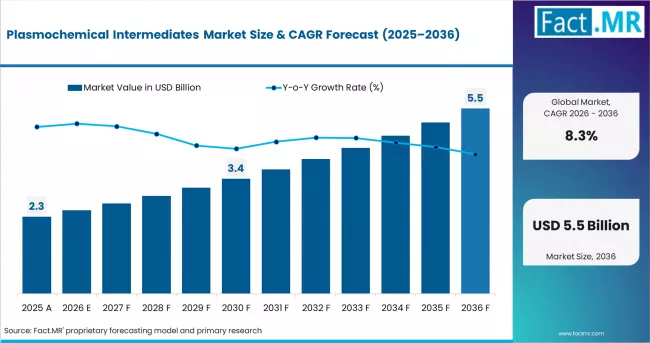
Plasmochemical Intermediates Market Market Value Analysis

Metric Value
Estimated Value in 2026 USD 2.3 billion
Forecast Value in 2036 USD 4.6 billion
Forecast CAGR (2026 to 2036) 8.3%

Summary of the Plasmochemical Intermediates Market

  • Market Definition
    • The market covers plasma-synthesised nanoparticle oxides, specialty gas intermediates, and ceramics precursors supplied to electronics, ceramics, and specialty chemicals globally.
  • Demand Drivers
    • CHIPS Act and Semiconductor Localisation: U.S. CHIPS Act investment is driving demand for electronics-grade plasma intermediates meeting advanced node purity standards.
    • EV Battery Supply Chain Demand: China’s EV battery expansion is increasing demand for nanoparticle oxides for cathode and solid-state electrolyte use.
    • EU Advanced Materials Regulation: EU REACH and Green Deal policies are pushing demand for low-contaminant plasma intermediates with traceability.
  • Key Segments Analyzed
    • By Product Type: Nanoparticle intermediates hold around 42% share in 2026, driven by semiconductor and EV battery demand.
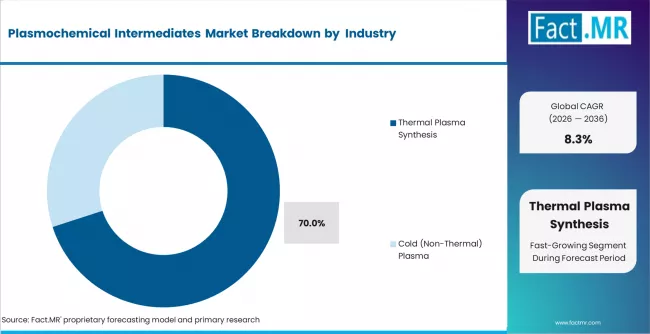
    • By Technology: Thermal plasma holds about 70% share in 2026, led by large-scale production efficiency.
    • By Geography: China leads with 9.5% CAGR through 2036, supported by EV and electronics demand.
  • Analyst Opinion at FACT.MR
    • Shambhu Nath Jha, Principal Consultant at Fact.MR, states that market leadership depends on purity certification, energy efficiency, and alignment with semiconductor and EV supply chains. Traceable processes and application-specific grades support premium positioning.
  • Strategic Implications
    • Producers should improve thermal plasma efficiency and obtain purity certifications to access semiconductor and EV supply chains.
    • Companies should develop ceramics precursor grades aligned with aerospace and energy standards.
    • Manufacturers should build direct supply ties with semiconductor and battery producers in South Korea and Japan.
  • Methodology
    • Market sizing uses shipment volumes by product and region, validated with 2024–2025 data.
    • Analysis includes CHIPS Act, EU Horizon, METI, and industry association inputs.

Forecasts consider plasma capacity expansion, semiconductor cycles, EV growth, and primary interviews.

The market is expected to create an absolute dollar opportunity of USD 2.3 billion between 2026 and 2036. Growth reflects steady structural expansion driven by semiconductor supply chain localisation and EV battery scale-up. Expansion is constrained by high energy intensity of thermal plasma processes and a limited qualified supplier base for electronics-grade intermediates. Substitution risk from chemical vapour deposition and wet-chemistry routes remains present.

Demand is shifting toward high-purity and application-specific plasma intermediates. Semiconductor fabrication and solid-state battery electrodes are key demand areas. Standard nanoparticle output faces margin pressure from scaled Chinese production. Advanced ceramics precursors for aerospace and defence command premium pricing. Procurement frameworks require traceability and certified performance.

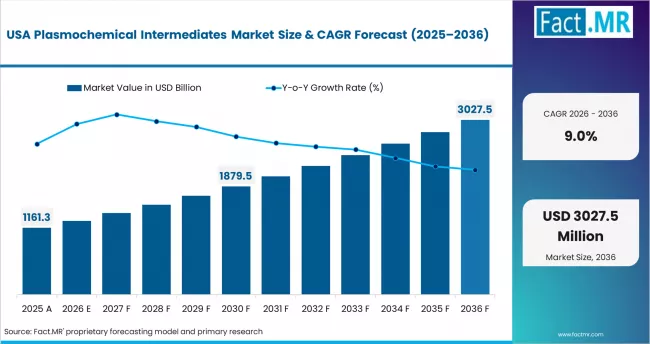
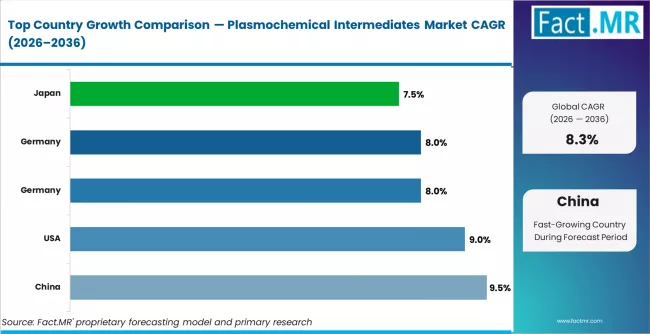
Country growth reflects semiconductor policy depth, industrial gas infrastructure, and advanced materials demand. China leads at 9.5% CAGR, supported by large-scale thermal plasma capacity and domestic EV and electronics demand under Made in China 2025. The United States follows at 9.0%, driven by CHIPS Act investment and DOE-backed plasma R&D. Germany records 8.0%, supported by industrial ceramics demand and Fraunhofer-led research. Japan records 7.5%, backed by strong electronics materials supply networks. South Korea records 8.0%, driven by Samsung and SK Hynix supply chain localization.

Segmental Analysis

Plasmochemical Intermediates Market Analysis by Product Type
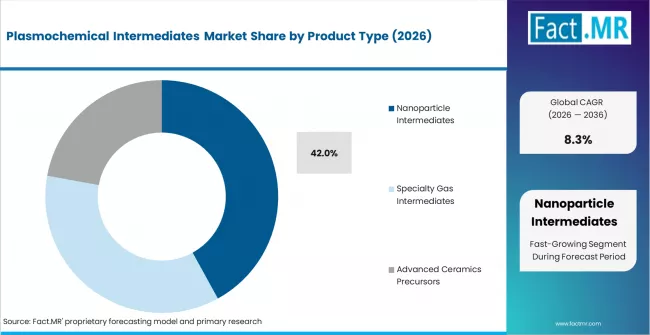
Plasmochemical Intermediates Market Analysis By Product Type

Based on FACT.MR analysis, nanoparticle intermediates hold around 42% share in 2026. These materials dominate due to use in electronics, EV batteries, and coatings. Plasma synthesis offers superior purity and morphology control over wet methods. This supports demand in semiconductor and solid-state battery applications.

  • BASF Intermediates Portfolio Expansion: BASF SE expanded biomass balance intermediates in May 2024. Products include PolyTHF, BDO, and DMAPA. Certification across global sites supports plasma-grade qualification. [1]
  • Linde Specialty Gas On-Site Expansion: Linde plc reported 59 new supply contracts in February 2025. These support nitrogen and oxygen supply for electronics and battery production. Demand is driven by EV and semiconductor growth. [2]
  • Advanced Ceramics Precursor Development: Mitsubishi Chemical Group developed a 1,500°C C/SiC composite in February 2024. This requires high-purity silicon carbide precursors. It supports aerospace and defence demand. [3]

Plasmochemical Intermediates Market Analysis by Technology
Plasmochemical Intermediates Market Analysis By Technology

Thermal plasma synthesis holds about 70% share in 2026. It enables large-scale and continuous production. It supports high-purity nanoparticle and gas intermediate output. Compatibility with industrial gas infrastructure reduces procurement risk.

  • Thermal Plasma Scale Investment: Linde plc signed 64 on-site plant agreements in 2024. These include thermal plasma-compatible gas supply projects. Demand comes from semiconductor and EV sectors.
  • Cold Plasma Application Growth: Plasmatreat GmbH launched the PFW100 Openair-Plasma nozzle in January 2025. It enables high-speed surface treatment. It supports electronics and specialty material processing. [4]
  • Cold Plasma Medical and Specialty Chemistry: Relyon plasma GmbH and Viromed Medical GmbH partnered in December 2024. The focus is cold plasma applications in medical and specialty chemistry. It expands high-value use cases beyond bulk production.

Drivers, Restraints, and Opportunities
Plasmochemical Intermediates Market Opportunity Matrix Growth Vs Value

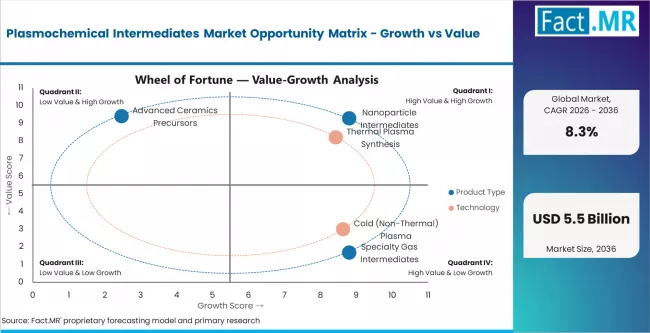
FACT.MR analysts observe the plasmochemical intermediates market is shifting toward structured industrial procurement. The market remains limited by a small base of qualified plasma producers and high thermal plasma capital intensity. Semiconductor policy support in the United States and Europe, along with EV battery demand in China and South Korea, is unlocking new procurement volumes.

Commodity nanoparticle and specialty gas supply faces rising qualification pressure. Plasma-synthesised metal oxides cost 25–50% more than wet-chemistry alternatives. However, high-purity plasma materials with traceability command premiums in semiconductor and battery tenders.

  • CHIPS Act and Semiconductor Materials Qualification: The U.S. CHIPS and Science Act, active from 2024, funds domestic materials qualification. BASF SE expanded its intermediates portfolio in May 2024 with ISCC PLUS-certified materials, supporting semiconductor sourcing requirements.
  • China EV and Advanced Materials Scale-up: China’s 14th Five-Year Plan drives plasma capacity for EV and battery materials through 2025. Linde plc signed 59 long-term supply agreements in 2024, using ECOVAR® technology for plasma-linked gas supply.
  • EU Industrial Strategy and Ceramics Demand: The EU Critical Raw Materials Act, active from 2024, supports domestic ceramics precursor demand. Mitsubishi Chemical Group developed a 1,500°C heat-resistant C/SiC composite in February 2024, validating plasma precursor demand.

Regional Analysis

The plasmochemical intermediates market is assessed across Asia Pacific, Europe, North America, Latin America, and Middle East and Africa. Segmentation reflects thermal plasma capacity investment scale, advanced materials regulatory depth, and electronics and ceramics procurement maturity across 40+ countries. The full report provides market attractiveness analysis by region and country.

Top Country Growth Comparison Plasmochemical Intermediates Market Cagr (2026 2036)

Country CAGR (2026 to 2036)
China 9.5%
United States 9.0%
Germany 8.0%
South Korea 8.0%
Japan 7.5%

Source: Fact.MR (FACT.MR) analysis, based on proprietary forecasting model and primary research
Plasmochemical Intermediates Market Cagr Analysis By Country

Asia Pacific Plasmochemical Intermediates Market Analysis
Plasmochemical Intermediates Market South Korea Market Share Analysis By Technology

Asia Pacific is the global production hub for plasmochemical intermediates. China leads with large-scale thermal plasma capacity. South Korea supports electronics-grade materials supply chains. Mitsubishi Chemical Group, Linde Korea, and Chinese producers shape regional competition. The region serves semiconductor, EV battery, and export-oriented ceramics demand with ongoing capacity expansion.

  • China: China remains the dominant volume centre with demand projected at 9.5% CAGR through 2036. Growth is driven by EV battery scale and plasma capacity targets under the 14th Five-Year Plan. EV production exceeded 9 million units in 2024, supporting structured procurement. Demand centres on cathode nanoparticles and electrolyte precursors.
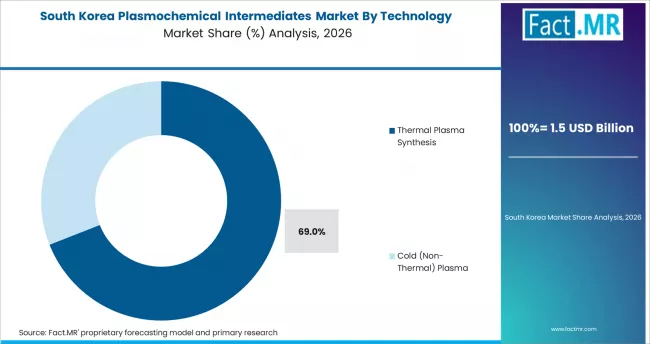
  • South Korea: South Korea reflects technology-driven demand growth at 8.0% CAGR through 2036. Expansion is supported by semiconductor fabs from Samsung and SK Hynix. Linde plc expanded gas supply to Samsung’s Pyeongtaek complex in April 2025. Policy support continues for materials localisation.

FACT.MR analysis covers China, Japan, South Korea, India, ASEAN, and Australia and New Zealand. It includes thermal plasma capacity, semiconductor supply trends, and country-level forecasts.

Europe Plasmochemical Intermediates Market Analysis

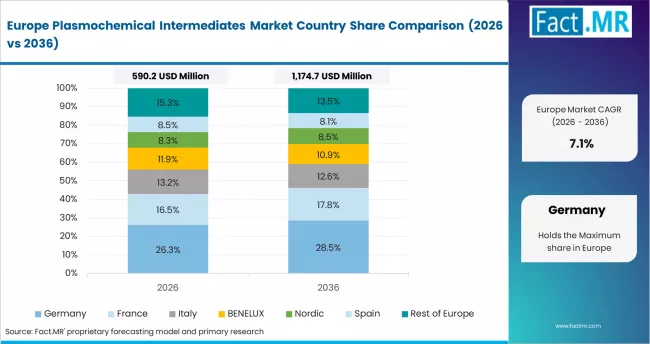
Plasmochemical Intermediates Market Europe Country Market Share Analysis, 2026 & 2036
Europe acts as a regulatory benchmark for traceability and ceramics procurement. EU REACH, Critical Raw Materials Act, and Horizon programmes define qualification standards. BASF SE and Air Liquide support certified intermediate supply. Demand remains linked to automotive, aerospace, and specialty chemicals.

  • Germany: Germany shows policy-aligned demand growth at 8.0% CAGR through 2036. Expansion is supported by ceramics demand and circular economy frameworks. BASF SE certification in May 2024 strengthens supply standards. EU rules mandate traceable plasma-grade inputs.

FACT.MR analysis covers Germany, France, the UK, Italy, Spain, and Rest of Europe. It includes regulatory trends, procurement standards, and demand forecasts.

North America Plasmochemical Intermediates Market Analysis

Plasmochemical Intermediates Market Country Value Analysis
North America represents a semiconductor materials innovation base. The United States leads through CHIPS Act funding and plasma R&D. Dow Inc. and specialty gas firms support supply. Canada contributes through clean technology initiatives.

  • United States: The United States indicates investment-led expansion at 9.0% CAGR through 2036. Growth is driven by semiconductor funding and sourcing mandates. Linde plc signed supply agreements in 2024 supporting electronics and battery sectors. BASF SE supports certified intermediates from U.S. sites.

FACT.MR analysis covers the United States, Canada, and Mexico. It includes CHIPS Act data, supply chain trends, and country-level forecasts.

Competitive Aligners for Market Players
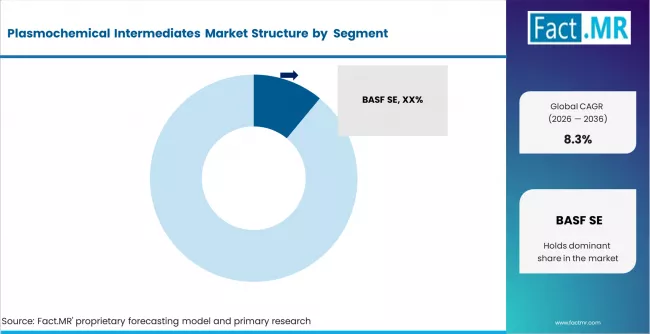
Plasmochemical Intermediates Market Analysis By Company

The plasmochemical intermediates market shows moderate concentration, led by a limited group of global industrial gas companies and specialty chemical producers. Linde plc, Air Liquide, and BASF SE account for a significant share of qualified supply through integrated production systems. Competitive positioning is primarily defined by the ability to meet electronics-grade purity standards and secure application-specific certifications for semiconductor and EV battery supply chains.

Linde plc and Air Liquide benefit from vertically integrated gas infrastructure. This enables reliable on-site supply of plasma-compatible specialty gases under long-term contracts. BASF SE and Dow Inc. leverage integrated chemical production networks to supply plasma-compatible intermediates within broader value chains. Mitsubishi Chemical Group maintains a strong position in advanced ceramics precursors, supported by application expertise in aerospace and high-temperature materials.

Procurement dynamics are shaped by large semiconductor and EV battery manufacturers with strong bargaining power. Buyers typically enforce multi-source qualification and long-term contracts to ensure supply security and performance consistency. Semiconductor fabrication facilities often maintain dual-qualified suppliers for critical intermediates, reducing dependency on single vendors. As a result, pricing power remains constrained despite high entry barriers. Producers are increasingly focusing on technical validation, process traceability, and application engineering support to strengthen differentiation. Certification capabilities and alignment with evolving procurement standards are becoming essential to sustain long-term contracts and capture high-value demand.

Key Players

  • BASF SE
  • Dow Inc.
  • Air Liquide S.A.
  • Linde plc
  • Mitsubishi Chemical Group Corporation
  • Evonik Industries AG
  • Plasmatreat GmbH
  • Relyon plasma GmbH
  • Adtec Plasma Technology Co., Ltd.
  • Advanced Plasma Technologies GmbH

Bibliography

  • [1] BASF SE. (2024). BASF Expands Biomass Balance Portfolio for Selected Chemical Intermediates Including PolyTHF, BDO, THF, and DMAPA with ISCC PLUS and REDcert2 Certification Across Ludwigshafen, Geismar, and Ulsan Production Sites. May 2024. basf.com
  • [2] Linde plc. (2025). Record Wins for Linde's Small On-Site Solutions in 2024 Driven by Electronics and Decarbonization: 59 New Long-Term Agreements for 64 On-Site Plants Serving Electronics, Battery Manufacturing, and Industrial Decarbonisation Applications. February 4, 2025. linde.com
  • [3] Mitsubishi Chemical Group Corporation. (2024). Mitsubishi Chemical Group Develops Carbon Fibre-Based 1,500°C Heat-Resistant Ceramic Matrix Composite (C/SiC) for Aerospace and High-Temperature Industrial Applications. February 13, 2024. mcgc.com
  • [4] Plasmatreat GmbH / Relyon plasma GmbH. (2025/2024). Plasmatreat Launches PFW100 Openair-Plasma Nozzle for High-Speed Surface Treatment (January 2025); Relyon Plasma and Viromed Medical Collaboration on Cold Atmospheric Pressure Plasma Applications (December 2024). plasmatreat.com / relyon-plasma.com
  • [5] Linde plc. (2025). Linde to Expand Supply of Ultra-High-Purity Atmospheric, Process and Specialty Gases to Samsung Semiconductor Complex in Pyeongtaek, South Korea. April 29, 2025. linde.com

This Report Addresses

  • Strategic insights on demand across semiconductor materials, EV battery nanoparticles, ceramics precursors, and specialty gases.
  • Market forecast from USD 2.3 billion in 2026 to USD 4.6 billion by 2036, at 8.3% CAGR.
  • Opportunity mapping across China EV scale-up, U.S. CHIPS Act, Germany ceramics demand, and South Korea localisation.
  • Segment analysis by product type, technology, and end use. Covers nanoparticles, gases, ceramics, thermal, and cold plasma.
  • Regional outlook covering Asia Pacific production, Europe regulatory adoption, and North America commercialisation trends.
  • Competitive analysis of BASF SE, Linde plc, Air Liquide, Dow Inc., and Mitsubishi Chemical Group.
  • Technology tracking on thermal plasma efficiency, cold plasma applications, purity standards, and energy reduction.
  • Report delivery in PDF, Excel, and presentation formats with validated data sources and industry inputs.

Plasmochemical Intermediates Market Definition

The plasmochemical intermediates market covers materials produced using plasma-based processes. It includes nanoparticle metal oxides, carbon nanotubes, specialty reactive gases, and ceramics precursors.

Plasmochemical Intermediates Market Inclusions

Covers global and regional market size from 2026 to 2036. Includes nanoparticle intermediates, specialty gas intermediates, and ceramics precursors. Segments by product type, technology, and end use. Covers pricing trends and key production regions.

Plasmochemical Intermediates Market Exclusions

Excludes finished electronic components and ceramic end-products. Omits downstream industrial gases not linked to plasma synthesis. Excludes CVD precursors unless plasma-derived. Focus remains on plasma-based intermediates and supply chains.

Plasmochemical Intermediates Research Methodology

  • Primary Research: Interviews with plasma reactor operators, specialty gas producers, procurement managers, and ceramics manufacturers across North America, Europe, and Asia Pacific.
  • Desk Research: Uses CHIPS Act data, EU Horizon research outputs, and METI policy documents. Reviews disclosures from BASF, Linde, Air Liquide, Dow, and Mitsubishi Chemical Group.
  • Market Sizing and Forecasting: Applies a hybrid top-down and bottom-up model. Uses shipment volumes, average prices, and end-use demand benchmarks across electronics, ceramics, and specialty chemicals.
  • Data Validation and Update Cycle: Validated using producer revenues, trade statistics, and industrial gas data. Cross-checked with industry bodies. Updated on a rolling basis.

Scope of Report

Plasmochemical Intermediates Market Breakdown By Product Type, Technology, And Region

Attribute Details
Quantitative Units USD 2.3 billion (2026) to USD 4.6 billion (2036), at a CAGR of 8.3%
Market Definition Plasma-synthesised chemical intermediates supplied as nanoparticle metal oxides, specialty reactive gas intermediates, and advanced ceramics precursors for electronics, specialty chemical, and advanced ceramics manufacturing globally.
Product Type Segmentation Nanoparticle Intermediates, Specialty Gas Intermediates, Advanced Ceramics Precursors
Technology Segmentation Thermal Plasma Synthesis, Cold (Non-Thermal) Plasma
End Use Segmentation Electronics & Semiconductors, Specialty Chemicals, Advanced Ceramics, Others
Application Coverage CHIPS Act-compliant semiconductor materials, EV battery cathode nanoparticle supply, aerospace and defence ceramics precursors, and specialty reactive gas intermediate procurement.
Regions Covered North America, Europe, Asia Pacific, Latin America, Middle East and Africa
Countries Covered USA, Canada, Mexico, Germany, UK, France, Italy, Spain, Nordic, BENELUX, Eastern Europe, China, Japan, South Korea, India, ASEAN, Australia and New Zealand, Brazil, Argentina, Chile, Saudi Arabia, GCC, Turkey, South Africa, Rest of MEA
Key Companies Profiled BASF SE, Dow Inc., Air Liquide S.A., Linde plc, Mitsubishi Chemical Group Corporation
Forecast Period 2026 to 2036
Approach Hybrid top-down and bottom-up model using plasma intermediate shipment volumes, specialty gas supply data, average selling prices by grade and geography, and primary interviews with electronics materials procurement managers and plasma technology developers.

Plasmochemical Intermediates Market by Segments

  • By Product Type:

    • Nanoparticle Intermediates
    • Specialty Gas Intermediates
    • Advanced Ceramics Precursors
  • By Technology:

    • Thermal Plasma Synthesis
    • Cold (Non-Thermal) Plasma
  • By End Use:

    • Electronics & Semiconductors
    • Specialty Chemicals
    • Advanced Ceramics
    • Others
  • By Region:

    • North America
      • United States
      • Canada
      • Mexico
    • Latin America
      • Brazil
      • Mexico
      • Argentina
      • Chile
      • Rest of Latin America
    • Western Europe
      • Germany
      • United Kingdom
      • France
      • Italy
      • Spain
      • Nordic Countries
      • BENELUX
      • Rest of Western Europe
    • Eastern Europe
      • Russia
      • Poland
      • Hungary
      • Balkan and Baltic
      • Rest of Eastern Europe
    • East Asia
      • China
      • Japan
      • South Korea
    • South Asia and Pacific
      • India
      • ASEAN
      • Australia and New Zealand
      • Rest of South Asia and Pacific
    • Middle East and Africa
      • Kingdom of Saudi Arabia
      • Other GCC Countries
      • Turkey
      • South Africa
      • Rest of Middle East and Africa

Table of Content

  1. Executive Summary
    • Global Market Outlook
    • Demand to side Trends
    • Supply to side Trends
    • Technology Roadmap Analysis
    • Analysis and Recommendations
  2. Market Overview
    • Market Coverage / Taxonomy
    • Market Definition / Scope / Limitations
  3. Research Methodology
    • Chapter Orientation
    • Analytical Lens and Working Hypotheses
      • Market Structure, Signals, and Trend Drivers
      • Benchmarking and Cross-market Comparability
      • Market Sizing, Forecasting, and Opportunity Mapping
    • Research Design and Evidence Framework
      • Desk Research Programme (Secondary Evidence)
        • Company Annual and Sustainability Reports
        • Peer-reviewed Journals and Academic Literature
        • Corporate Websites, Product Literature, and Technical Notes
        • Earnings Decks and Investor Briefings
        • Statutory Filings and Regulatory Disclosures
        • Technical White Papers and Standards Notes
        • Trade Journals, Industry Magazines, and Analyst Briefs
        • Conference Proceedings, Webinars, and Seminar Materials
        • Government Statistics Portals and Public Data Releases
        • Press Releases and Reputable Media Coverage
        • Specialist Newsletters and Curated Briefings
        • Sector Databases and Reference Repositories
        • Fact.MR Internal Proprietary Databases and Historical Market Datasets
        • Subscription Datasets and Paid Sources
        • Social Channels, Communities, and Digital Listening Inputs
        • Additional Desk Sources
      • Expert Input and Fieldwork (Primary Evidence)
        • Primary Modes
          • Qualitative Interviews and Expert Elicitation
          • Quantitative Surveys and Structured Data Capture
          • Blended Approach
        • Why Primary Evidence is Used
        • Field Techniques
          • Interviews
          • Surveys
          • Focus Groups
          • Observational and In-context Research
          • Social and Community Interactions
        • Stakeholder Universe Engaged
          • C-suite Leaders
          • Board Members
          • Presidents and Vice Presidents
          • R&D and Innovation Heads
          • Technical Specialists
          • Domain Subject-matter Experts
          • Scientists
          • Physicians and Other Healthcare Professionals
        • Governance, Ethics, and Data Stewardship
          • Research Ethics
          • Data Integrity and Handling
      • Tooling, Models, and Reference Databases
    • Data Engineering and Model Build
      • Data Acquisition and Ingestion
      • Cleaning, Normalisation, and Verification
      • Synthesis, Triangulation, and Analysis
    • Quality Assurance and Audit Trail
  4. Market Background
    • Market Dynamics
      • Drivers
      • Restraints
      • Opportunity
      • Trends
    • Scenario Forecast
      • Demand in Optimistic Scenario
      • Demand in Likely Scenario
      • Demand in Conservative Scenario
    • Opportunity Map Analysis
    • Product Life Cycle Analysis
    • Supply Chain Analysis
    • Investment Feasibility Matrix
    • Value Chain Analysis
    • PESTLE and Porter’s Analysis
    • Regulatory Landscape
    • Regional Parent Market Outlook
    • Production and Consumption Statistics
    • Import and Export Statistics
  5. Global Market Analysis 2021 to 2025 and Forecast, 2026 to 2036
    • Historical Market Size Value (USD Million) Analysis, 2021 to 2025
    • Current and Future Market Size Value (USD Million) Projections, 2026 to 2036
      • Y to o to Y Growth Trend Analysis
      • Absolute $ Opportunity Analysis
  6. Global Market Pricing Analysis 2021 to 2025 and Forecast 2026 to 2036
  7. Global Market Analysis 2021 to 2025 and Forecast 2026 to 2036, By Product Type
    • Introduction / Key Findings
    • Historical Market Size Value (USD Million) Analysis By Product Type , 2021 to 2025
    • Current and Future Market Size Value (USD Million) Analysis and Forecast By Product Type , 2026 to 2036
      • Solid Sorbents
      • Liquid Sorbents
      • Hybrid Sorbents
    • Y to o to Y Growth Trend Analysis By Product Type , 2021 to 2025
    • Absolute $ Opportunity Analysis By Product Type , 2026 to 2036
  8. Global Market Analysis 2021 to 2025 and Forecast 2026 to 2036, By Application
    • Introduction / Key Findings
    • Historical Market Size Value (USD Million) Analysis By Application, 2021 to 2025
    • Current and Future Market Size Value (USD Million) Analysis and Forecast By Application, 2026 to 2036
      • Carbon Capture and Storage
      • Carbon Utilization
      • Air Purification
    • Y to o to Y Growth Trend Analysis By Application, 2021 to 2025
    • Absolute $ Opportunity Analysis By Application, 2026 to 2036
  9. Global Market Analysis 2021 to 2025 and Forecast 2026 to 2036, By Region
    • Introduction
    • Historical Market Size Value (USD Million) Analysis By Region, 2021 to 2025
    • Current Market Size Value (USD Million) Analysis and Forecast By Region, 2026 to 2036
      • North America
      • Latin America
      • Western Europe
      • Eastern Europe
      • East Asia
      • South Asia and Pacific
      • Middle East & Africa
    • Market Attractiveness Analysis By Region
  10. North America Market Analysis 2021 to 2025 and Forecast 2026 to 2036, By Country
    • Historical Market Size Value (USD Million) Trend Analysis By Market Taxonomy, 2021 to 2025
    • Market Size Value (USD Million) Forecast By Market Taxonomy, 2026 to 2036
      • By Country
        • USA
        • Canada
        • Mexico
      • By Product Type
      • By Application
    • Market Attractiveness Analysis
      • By Country
      • By Product Type
      • By Application
    • Key Takeaways
  11. Latin America Market Analysis 2021 to 2025 and Forecast 2026 to 2036, By Country
    • Historical Market Size Value (USD Million) Trend Analysis By Market Taxonomy, 2021 to 2025
    • Market Size Value (USD Million) Forecast By Market Taxonomy, 2026 to 2036
      • By Country
        • Brazil
        • Chile
        • Rest of Latin America
      • By Product Type
      • By Application
    • Market Attractiveness Analysis
      • By Country
      • By Product Type
      • By Application
    • Key Takeaways
  12. Western Europe Market Analysis 2021 to 2025 and Forecast 2026 to 2036, By Country
    • Historical Market Size Value (USD Million) Trend Analysis By Market Taxonomy, 2021 to 2025
    • Market Size Value (USD Million) Forecast By Market Taxonomy, 2026 to 2036
      • By Country
        • Germany
        • UK
        • Italy
        • Spain
        • France
        • Nordic
        • BENELUX
        • Rest of Western Europe
      • By Product Type
      • By Application
    • Market Attractiveness Analysis
      • By Country
      • By Product Type
      • By Application
    • Key Takeaways
  13. Eastern Europe Market Analysis 2021 to 2025 and Forecast 2026 to 2036, By Country
    • Historical Market Size Value (USD Million) Trend Analysis By Market Taxonomy, 2021 to 2025
    • Market Size Value (USD Million) Forecast By Market Taxonomy, 2026 to 2036
      • By Country
        • Russia
        • Poland
        • Hungary
        • Balkan & Baltic
        • Rest of Eastern Europe
      • By Product Type
      • By Application
    • Market Attractiveness Analysis
      • By Country
      • By Product Type
      • By Application
    • Key Takeaways
  14. East Asia Market Analysis 2021 to 2025 and Forecast 2026 to 2036, By Country
    • Historical Market Size Value (USD Million) Trend Analysis By Market Taxonomy, 2021 to 2025
    • Market Size Value (USD Million) Forecast By Market Taxonomy, 2026 to 2036
      • By Country
        • China
        • Japan
        • South Korea
      • By Product Type
      • By Application
    • Market Attractiveness Analysis
      • By Country
      • By Product Type
      • By Application
    • Key Takeaways
  15. South Asia and Pacific Market Analysis 2021 to 2025 and Forecast 2026 to 2036, By Country
    • Historical Market Size Value (USD Million) Trend Analysis By Market Taxonomy, 2021 to 2025
    • Market Size Value (USD Million) Forecast By Market Taxonomy, 2026 to 2036
      • By Country
        • India
        • ASEAN
        • Australia & New Zealand
        • Rest of South Asia and Pacific
      • By Product Type
      • By Application
    • Market Attractiveness Analysis
      • By Country
      • By Product Type
      • By Application
    • Key Takeaways
  16. Middle East & Africa Market Analysis 2021 to 2025 and Forecast 2026 to 2036, By Country
    • Historical Market Size Value (USD Million) Trend Analysis By Market Taxonomy, 2021 to 2025
    • Market Size Value (USD Million) Forecast By Market Taxonomy, 2026 to 2036
      • By Country
        • Kingdom of Saudi Arabia
        • Other GCC Countries
        • Turkiye
        • South Africa
        • Other African Union
        • Rest of Middle East & Africa
      • By Product Type
      • By Application
    • Market Attractiveness Analysis
      • By Country
      • By Product Type
      • By Application
    • Key Takeaways
  17. Key Countries Market Analysis
    • USA
      • Pricing Analysis
      • Market Share Analysis, 2025
        • By Product Type
        • By Application
    • Canada
      • Pricing Analysis
      • Market Share Analysis, 2025
        • By Product Type
        • By Application
    • Mexico
      • Pricing Analysis
      • Market Share Analysis, 2025
        • By Product Type
        • By Application
    • Brazil
      • Pricing Analysis
      • Market Share Analysis, 2025
        • By Product Type
        • By Application
    • Chile
      • Pricing Analysis
      • Market Share Analysis, 2025
        • By Product Type
        • By Application
    • Germany
      • Pricing Analysis
      • Market Share Analysis, 2025
        • By Product Type
        • By Application
    • UK
      • Pricing Analysis
      • Market Share Analysis, 2025
        • By Product Type
        • By Application
    • Italy
      • Pricing Analysis
      • Market Share Analysis, 2025
        • By Product Type
        • By Application
    • Spain
      • Pricing Analysis
      • Market Share Analysis, 2025
        • By Product Type
        • By Application
    • France
      • Pricing Analysis
      • Market Share Analysis, 2025
        • By Product Type
        • By Application
    • India
      • Pricing Analysis
      • Market Share Analysis, 2025
        • By Product Type
        • By Application
    • ASEAN
      • Pricing Analysis
      • Market Share Analysis, 2025
        • By Product Type
        • By Application
    • Australia & New Zealand
      • Pricing Analysis
      • Market Share Analysis, 2025
        • By Product Type
        • By Application
    • China
      • Pricing Analysis
      • Market Share Analysis, 2025
        • By Product Type
        • By Application
    • Japan
      • Pricing Analysis
      • Market Share Analysis, 2025
        • By Product Type
        • By Application
    • South Korea
      • Pricing Analysis
      • Market Share Analysis, 2025
        • By Product Type
        • By Application
    • Russia
      • Pricing Analysis
      • Market Share Analysis, 2025
        • By Product Type
        • By Application
    • Poland
      • Pricing Analysis
      • Market Share Analysis, 2025
        • By Product Type
        • By Application
    • Hungary
      • Pricing Analysis
      • Market Share Analysis, 2025
        • By Product Type
        • By Application
    • Kingdom of Saudi Arabia
      • Pricing Analysis
      • Market Share Analysis, 2025
        • By Product Type
        • By Application
    • Turkiye
      • Pricing Analysis
      • Market Share Analysis, 2025
        • By Product Type
        • By Application
    • South Africa
      • Pricing Analysis
      • Market Share Analysis, 2025
        • By Product Type
        • By Application
  18. Market Structure Analysis
    • Competition Dashboard
    • Competition Benchmarking
    • Market Share Analysis of Top Players
      • By Regional
      • By Product Type
      • By Application
  19. Competition Analysis
    • Competition Deep Dive
      • Climeworks
        • Overview
        • Product Portfolio
        • Profitability by Market Segments (Product/Age /Sales Channel/Region)
        • Sales Footprint
        • Strategy Overview
          • Marketing Strategy
          • Product Strategy
          • Channel Strategy
      • Carbon Engineering
      • Global Thermostat
      • Heirloom Carbon Technologies
      • Mission Zero Technologies
      • Carbyon
      • Verdox
  20. Assumptions & Acronyms Used

List Of Table

  • Table 1: Global Market Value (USD Million) Forecast by Region, 2021 to 2036
  • Table 2: Global Market Value (USD Million) Forecast by Product Type , 2021 to 2036
  • Table 3: Global Market Value (USD Million) Forecast by Application, 2021 to 2036
  • Table 4: North America Market Value (USD Million) Forecast by Country, 2021 to 2036
  • Table 5: North America Market Value (USD Million) Forecast by Product Type , 2021 to 2036
  • Table 6: North America Market Value (USD Million) Forecast by Application, 2021 to 2036
  • Table 7: Latin America Market Value (USD Million) Forecast by Country, 2021 to 2036
  • Table 8: Latin America Market Value (USD Million) Forecast by Product Type , 2021 to 2036
  • Table 9: Latin America Market Value (USD Million) Forecast by Application, 2021 to 2036
  • Table 10: Western Europe Market Value (USD Million) Forecast by Country, 2021 to 2036
  • Table 11: Western Europe Market Value (USD Million) Forecast by Product Type , 2021 to 2036
  • Table 12: Western Europe Market Value (USD Million) Forecast by Application, 2021 to 2036
  • Table 13: Eastern Europe Market Value (USD Million) Forecast by Country, 2021 to 2036
  • Table 14: Eastern Europe Market Value (USD Million) Forecast by Product Type , 2021 to 2036
  • Table 15: Eastern Europe Market Value (USD Million) Forecast by Application, 2021 to 2036
  • Table 16: East Asia Market Value (USD Million) Forecast by Country, 2021 to 2036
  • Table 17: East Asia Market Value (USD Million) Forecast by Product Type , 2021 to 2036
  • Table 18: East Asia Market Value (USD Million) Forecast by Application, 2021 to 2036
  • Table 19: South Asia and Pacific Market Value (USD Million) Forecast by Country, 2021 to 2036
  • Table 20: South Asia and Pacific Market Value (USD Million) Forecast by Product Type , 2021 to 2036
  • Table 21: South Asia and Pacific Market Value (USD Million) Forecast by Application, 2021 to 2036
  • Table 22: Middle East & Africa Market Value (USD Million) Forecast by Country, 2021 to 2036
  • Table 23: Middle East & Africa Market Value (USD Million) Forecast by Product Type , 2021 to 2036
  • Table 24: Middle East & Africa Market Value (USD Million) Forecast by Application, 2021 to 2036

List Of Figures

  • Figure 1: Global Market Pricing Analysis
  • Figure 2: Global Market Value (USD Million) Forecast 2021-2036
  • Figure 3: Global Market Value Share and BPS Analysis by Product Type, 2026 and 2036
  • Figure 4: Global Market Y-o-Y Growth Comparison by Product Type, 2026 to 2036
  • Figure 5: Global Market Attractiveness Analysis by Product Type
  • Figure 6: Global Market Value Share and BPS Analysis by Application, 2026 and 2036
  • Figure 7: Global Market Y-o-Y Growth Comparison by Application, 2026 to 2036
  • Figure 8: Global Market Attractiveness Analysis by Application
  • Figure 9: Global Market Value (USD Million) Share and BPS Analysis by Region, 2026 and 2036
  • Figure 10: Global Market Y-o-Y Growth Comparison by Region, 2026 to 2036
  • Figure 11: Global Market Attractiveness Analysis by Region
  • Figure 12: North America Market Incremental Dollar Opportunity, 2026 to 2036
  • Figure 13: Latin America Market Incremental Dollar Opportunity, 2026 to 2036
  • Figure 14: Western Europe Market Incremental Dollar Opportunity, 2026 to 2036
  • Figure 15: Eastern Europe Market Incremental Dollar Opportunity, 2026 to 2036
  • Figure 16: East Asia Market Incremental Dollar Opportunity, 2026 to 2036
  • Figure 17: South Asia and Pacific Market Incremental Dollar Opportunity, 2026 to 2036
  • Figure 18: Middle East & Africa Market Incremental Dollar Opportunity, 2026 to 2036
  • Figure 19: North America Market Value Share and BPS Analysis by Country, 2026 and 2036
  • Figure 20: North America Market Value Share and BPS Analysis by Product Type, 2026 and 2036
  • Figure 21: North America Market Y-o-Y Growth Comparison by Product Type, 2026 to 2036
  • Figure 22: North America Market Attractiveness Analysis by Product Type
  • Figure 23: North America Market Value Share and BPS Analysis by Application, 2026 and 2036
  • Figure 24: North America Market Y-o-Y Growth Comparison by Application, 2026 to 2036
  • Figure 25: North America Market Attractiveness Analysis by Application
  • Figure 26: Latin America Market Value Share and BPS Analysis by Country, 2026 and 2036
  • Figure 27: Latin America Market Value Share and BPS Analysis by Product Type, 2026 and 2036
  • Figure 28: Latin America Market Y-o-Y Growth Comparison by Product Type, 2026 to 2036
  • Figure 29: Latin America Market Attractiveness Analysis by Product Type
  • Figure 30: Latin America Market Value Share and BPS Analysis by Application, 2026 and 2036
  • Figure 31: Latin America Market Y-o-Y Growth Comparison by Application, 2026 to 2036
  • Figure 32: Latin America Market Attractiveness Analysis by Application
  • Figure 33: Western Europe Market Value Share and BPS Analysis by Country, 2026 and 2036
  • Figure 34: Western Europe Market Value Share and BPS Analysis by Product Type, 2026 and 2036
  • Figure 35: Western Europe Market Y-o-Y Growth Comparison by Product Type, 2026 to 2036
  • Figure 36: Western Europe Market Attractiveness Analysis by Product Type
  • Figure 37: Western Europe Market Value Share and BPS Analysis by Application, 2026 and 2036
  • Figure 38: Western Europe Market Y-o-Y Growth Comparison by Application, 2026 to 2036
  • Figure 39: Western Europe Market Attractiveness Analysis by Application
  • Figure 40: Eastern Europe Market Value Share and BPS Analysis by Country, 2026 and 2036
  • Figure 41: Eastern Europe Market Value Share and BPS Analysis by Product Type, 2026 and 2036
  • Figure 42: Eastern Europe Market Y-o-Y Growth Comparison by Product Type, 2026 to 2036
  • Figure 43: Eastern Europe Market Attractiveness Analysis by Product Type
  • Figure 44: Eastern Europe Market Value Share and BPS Analysis by Application, 2026 and 2036
  • Figure 45: Eastern Europe Market Y-o-Y Growth Comparison by Application, 2026 to 2036
  • Figure 46: Eastern Europe Market Attractiveness Analysis by Application
  • Figure 47: East Asia Market Value Share and BPS Analysis by Country, 2026 and 2036
  • Figure 48: East Asia Market Value Share and BPS Analysis by Product Type, 2026 and 2036
  • Figure 49: East Asia Market Y-o-Y Growth Comparison by Product Type, 2026 to 2036
  • Figure 50: East Asia Market Attractiveness Analysis by Product Type
  • Figure 51: East Asia Market Value Share and BPS Analysis by Application, 2026 and 2036
  • Figure 52: East Asia Market Y-o-Y Growth Comparison by Application, 2026 to 2036
  • Figure 53: East Asia Market Attractiveness Analysis by Application
  • Figure 54: South Asia and Pacific Market Value Share and BPS Analysis by Country, 2026 and 2036
  • Figure 55: South Asia and Pacific Market Value Share and BPS Analysis by Product Type, 2026 and 2036
  • Figure 56: South Asia and Pacific Market Y-o-Y Growth Comparison by Product Type, 2026 to 2036
  • Figure 57: South Asia and Pacific Market Attractiveness Analysis by Product Type
  • Figure 58: South Asia and Pacific Market Value Share and BPS Analysis by Application, 2026 and 2036
  • Figure 59: South Asia and Pacific Market Y-o-Y Growth Comparison by Application, 2026 to 2036
  • Figure 60: South Asia and Pacific Market Attractiveness Analysis by Application
  • Figure 61: Middle East & Africa Market Value Share and BPS Analysis by Country, 2026 and 2036
  • Figure 62: Middle East & Africa Market Value Share and BPS Analysis by Product Type, 2026 and 2036
  • Figure 63: Middle East & Africa Market Y-o-Y Growth Comparison by Product Type, 2026 to 2036
  • Figure 64: Middle East & Africa Market Attractiveness Analysis by Product Type
  • Figure 65: Middle East & Africa Market Value Share and BPS Analysis by Application, 2026 and 2036
  • Figure 66: Middle East & Africa Market Y-o-Y Growth Comparison by Application, 2026 to 2036
  • Figure 67: Middle East & Africa Market Attractiveness Analysis by Application
  • Figure 68: Global Market - Tier Structure Analysis
  • Figure 69: Global Market - Company Share Analysis

- Frequently Asked Questions -

How large is the plasmochemical intermediates market in 2025?

The market was valued at USD 2.1 billion in 2025.

What will the market size be in 2026?

The market is estimated to reach USD 2.3 billion in 2026.

What is the projected market size by 2036?

The market is projected to reach USD 4.6 billion by 2036.

What is the expected CAGR of the plasmochemical intermediates market?

The market is expected to grow at a CAGR of 8.3% from 2026 to 2036.

Which product type segment leads the plasmochemical intermediates market?

Nanoparticle Intermediates lead with approximately 42% share in 2026, driven by plasma-synthesised metal oxide demand for semiconductor and EV battery cathode applications.

Which technology segment dominates the market?

Thermal Plasma Synthesis holds approximately 70% share in 2026.

Which country shows the fastest growth?

China leads with a CAGR of 9.5% through 2036, driven by the largest EV battery and electronics manufacturing base globally.

Which end use is poised to lead the market?

Electronics and Semiconductors is the leading end-use segment.

Plasmochemical Intermediates Market