- Base Value(2025): 13.6 Bn
- Estimated Value(2026): 14.3 Bn
- Forecast Value (2036): 23.1 Bn
- CAGR (2026 - 2036): 4.9%
Citrus Flavor Market Forecast and Outlook By Fact.MR
In 2025, the citrus flavor market was valued at USD 13.6 billion. Based on Fact.MR analysis, demand for citrus flavors is estimated to grow to USD 14.3 billion in 2026 and USD 23.1 billion by 2036. FACT.MR projects a CAGR of 4.9% during the forecast period.
During this period, the market is expected to generate USD 9.5 billion in new revenue opportunities. Growth is underpinned by rising beverage demand for clean-label natural citrus profiles, reformulation of processed food products, and expanding functional drink categories. Constraints include orange crop volatility driven by citrus greening disease in Brazil and Florida, cost premiums for natural extracts over synthetic counterparts, and import tariff exposure in emerging market supply chains.
Country growth reflects natural ingredient adoption, food processing expansion, and regulatory environments. India leads at 6.0% CAGR driven by growing packaged beverage consumption and Ayurveda-influenced natural citrus ingredient demand. China follows at 5.7% supported by expanding domestic beverage manufacturing and clean-label food policy. The United States records 5.3% growth through sustained demand for functional citrus beverages and natural flavor reformulation. Brazil expands at 4.8% given its role as the world's largest orange supplier supporting domestic processing growth. Spain posts 4.4% as a mature European market generating replacement and premiumisation demand with structural constraints from EU flavor regulation compliance costs.
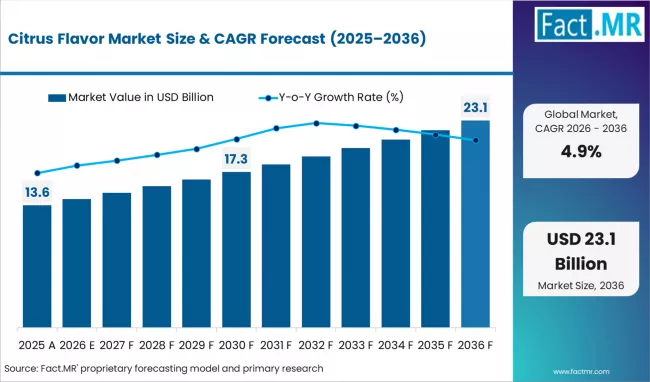
Citrus Flavor Market Market Value Analysis | Source: Fact.MR
| Metric | Value |
|---|---|
| Estimated Value in 2026 | USD 14.3 billion |
| Forecast Value in 2036 | USD 23.1 billion |
| Forecast CAGR (2026 to 2036) | 4.9% |
Source: Fact.MR analysis. Updated Mar 17, 2026
Citrus Flavor Market Definition
The citrus flavor market covers natural and artificial flavoring ingredients derived from or replicating orange, lemon, lime, grapefruit, and other citrus fruit profiles. These flavors serve as essential taste and aroma components in beverages, bakery, confectionery, savory products.
Market Inclusions
Covers global and regional market sizes from 2026 to 2036 by product type, nature, application, and sales channel, including natural extracts, cold-press oils, biofermented citrus profiles, and synthetic aroma chemicals used as citrus flavor ingredients.
Market Exclusions
Excludes fresh citrus fruit trade, citrus juice and concentrate commodities, essential oils sold for non-flavor uses, and downstream finished beverages or food products. Citrus-flavored consumer goods are excluded; only citrus flavor ingredients and compounds are in scope.
Research Methodology
- Primary Research: Interviews with flavor house product managers, food and beverage R&D directors, citrus extract sourcing managers, and specialty ingredient distributors across North America, Europe, and Asia Pacific.
- Desk Research: Sources include FAO citrus crop statistics, EU flavor regulation databases, FDA GRAS filings, IOFI guidelines, company annual reports, and trade association publications.
- Market Sizing and Forecasting: Hybrid top-down and bottom-up model using citrus flavor volume consumption by application, average ingredient pricing by product type and nature, and country-level food processing output data.
- Data Validation and Update Cycle: Outputs validated against flavor company revenue disclosures, crop production data from USDA and FAO, and primary expert interviews with sourcing and procurement professionals.
Summary of Citrus Flavor Market
- Market Definition
- The citrus flavor market encompasses natural and artificial flavoring ingredients replicating orange, lemon, lime, grapefruit, and related citrus profiles used across food, beverage, and pharmaceutical applications.
- Demand Drivers
- Clean-label food and beverage reformulation is increasing demand for natural citrus extracts as brands replace synthetic aroma chemicals to meet consumer transparency expectations.
- Global functional beverage expansion, particularly in energy drinks, immunity shots, and hydration products, is driving high-volume citrus flavor adoption across orange and lemon profiles.
- Rising processed food production in South and Southeast Asia is creating new volume demand for affordable citrus flavor solutions in snacks, confectionery, and instant beverages.
- Key Segments Analyzed
- By Product Type: Orange leads with approximately 71% share in 2026, driven by broad application in beverages, confectionery, and bakery products globally.
- By Application: Beverages dominate with approximately 60% share in 2026, reflecting citrus flavors' centrality in carbonated drinks, juices, sports drinks, and functional beverages.
- By Nature: Natural citrus flavors are gaining share over artificial, with clean-label mandates from major food and beverage brands accelerating formulation shifts.
- By Sales Channel: Supermarkets and hypermarkets lead distribution, while e-retailers are growing as specialty ingredient buyers adopt digital procurement platforms.
- Analyst Opinion at FACT.MR
- Shambhu Nath Jha, Principal Consultant at Fact.MR, opines that CXOs will find this report essential for identifying growth opportunities in natural citrus extract sourcing, biofermentation-derived flavor innovation, and clean-label reformulation strategies across beverage and bakery categories.
- Strategic Implications
- Flavor houses should accelerate biofermentation and cold-press citrus extract capacity investment to address natural ingredient shortfalls driven by orange crop disease.
- Food and beverage brands should prioritise traceable natural citrus supply chains to meet retailer clean-label listing requirements and reduce synthetic reformulation risk.
- Emerging market distributors should develop affordable natural citrus flavor blends to capture growing packaged food and beverage production in India and Southeast Asia.
- Methodology
- Market sizing based on citrus flavor volume consumption by application and ingredient pricing validated with flavor company annual revenue disclosures.
- FAO citrus crop production data, USDA trade statistics, and EU flavor regulation databases supported supply-side and regional analysis.
- Forecasts integrated functional beverage growth trajectories, clean-label reformulation trends, crop productivity risk scenarios, and primary interviews.
Segmental Analysis
Citrus Flavor Market Analysis by Product Type
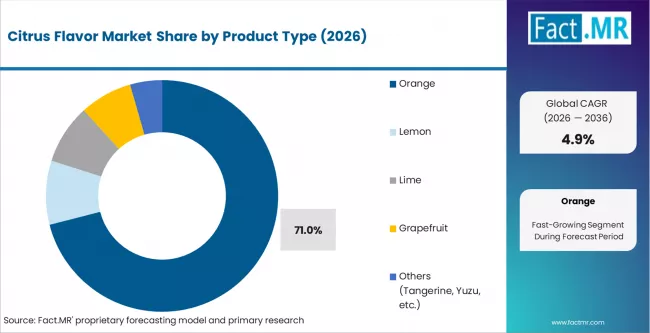
Citrus Flavor Market Analysis By Product Type | Source: Fact.MR
Based on FACT.MR’s citrus flavor market report, orange flavor is expected to account for about 71% of total consumption in 2026. Orange remains dominant due to its universal consumer acceptance and broad use across beverages and confectionery products.
- Givaudan Natural Orange Investment: In February 2025, Givaudan expanded its Zurich citrus extraction facility, increasing cold-pressed orange oil production to support European clean-label beverage reformulations. [5]
- IFF Biofermentation Technology: In October 2024, IFF introduced a biofermentation-based lemon flavor platform designed to deliver consistent aroma profiles independent of seasonal lemon harvest variability. [6]
- Beverage Launch Citrus Trend: Innova Market Insights reported that citrus flavors appeared in 38% of global non-alcoholic beverage launches in 2024, with lime emerging as the fastest-growing citrus flavor variant. [7]
Citrus Flavor Market Analysis by Application
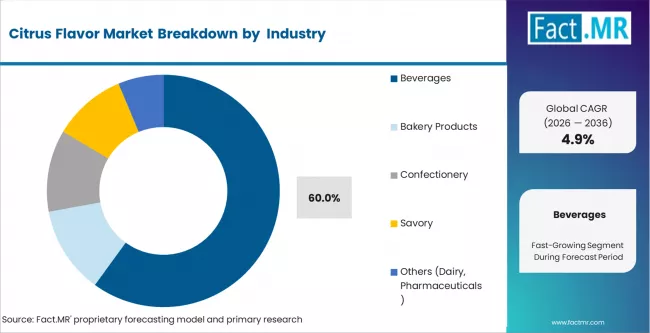
Citrus Flavor Market Analysis By Application | Source: Fact.MR
Based on FACT.MR's citrus flavor market report, beverages account for approximately 60% of citrus flavor consumption in 2026. The segment's dominance reflects citrus flavors' centrality in carbonated soft drinks, energy drinks, sports beverages, and functional hydration products globally.
- Coca-Cola Reformulation Programme: Coca-Cola disclosed in its Q3 2024 earnings call that its Sprite and Fanta reformulation initiative across European markets replaced synthetic citrus flavors with natural extracts in compliance with updated EU retailer listing requirements, increasing procurement from Givaudan and IFF. [8]
- Kerry Group Bakery Application Development: Kerry Group introduced a natural citrus flavor range for bakery applications at iba 2025 in February, targeting lemon and orange profiles for muffins, cookies, and pastries in European and North American markets. [9]
- Confectionery Citrus Adoption: Haribo and Perfetti Van Melle disclosed reformulation of citrus-flavored confectionery lines in 2024 to meet German and Italian clean-label retail policies, using Symrise and Firmenich natural lemon and lime flavor compounds. [10]
Drivers, Restraints, and Opportunities
FACT.MR analysts observe that the citrus flavor market, valued at USD 13.6 billion in 2025, remains strongly supported by the widespread use of citrus profiles in global food and beverage manufacturing. Citrus flavors are widely used in carbonated drinks, confectionery, and bakery products across both premium and mass-market segments.
The market is gradually shifting from low-cost synthetic aroma chemicals to natural extracts and biofermentation-based citrus compounds. As brands increasingly adopt clean-label formulations, demand for natural citrus extracts is rising despite their 30–50% higher pricing compared to synthetic alternatives.
- EU Flavoring Regulation Compliance: The European Commission’s updated Regulation (EC) No 1334/2008 guidance issued in March 2025 tightened permitted levels of certain synthetic citrus flavor chemicals, pushing manufacturers toward natural citrus flavor substitutes and increasing demand for suppliers such as Givaudan and Symrise. [2]
- Functional Beverage Expansion: North America’s functional beverage sector continues to drive citrus flavor demand, with over 65% of new product launches using lemon or lime flavors according to Mintel’s 2025 Beverage Innovation Report. [3]
- India Packaged Beverage Growth: India’s packaged beverage production grew about 11% in FY2024–25 according to FICCI, with citrus flavors dominating new carbonated soft drink and ready-to-drink tea launches. [4]
Regional Analysis
The citrus flavor market is analysed across Asia Pacific, Europe, North America, Latin America, and Middle East and Africa, covering key citrus producing, processing, and consuming countries. The full report offers market attractiveness analysis based on food processing output, clean-label adoption, and beverage market growth trajectories.
.webp "Top Country Growth Comparison Citrus Flavor Market Cagr (2026 2036)")
Top Country Growth Comparison Citrus Flavor Market Cagr (2026 2036) | Source: Fact.MR
| Country | CAGR (2026 to 2036) |
|---|---|
| India | 6.0% |
| China | 5.7% |
| USA | 5.3% |
| Brazil | 4.8% |
| Spain | 4.4% |
Source: Fact.MR analysis. Updated Mar 17, 2026
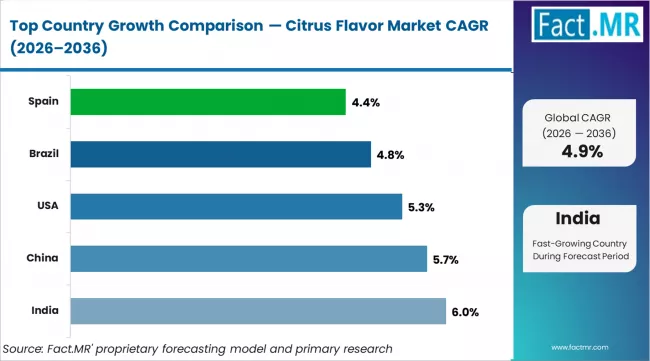
Citrus Flavor Market Cagr Analysis By Country | Source: Fact.MR
Source: Fact.MR (FACT.MR) analysis, based on proprietary forecasting model and primary research
Asia Pacific Citrus Flavor Market Analysis
Asia Pacific is the fastest-growing citrus flavor demand region, driven by packaged beverage expansion, rising middle-class food spending, and growing clean-label adoption among regional food brands. Nongfu Spring, Genki Forest, and major ASEAN beverage manufacturers are key regional demand drivers.
- India: Demand for citrus flavors in India is projected to rise at 6.0% CAGR through 2036. India's packaged beverage sector expanded at approximately 11% in FY2024-25 per FICCI data, with citrus flavors dominating new product launches in carbonated drinks and ready-to-drink teas. The Food Safety and Standards Authority of India issued updated flavor use guidelines in August 2024, encouraging natural citrus extract adoption by domestic manufacturers.
- China: Citrus flavor demand in China is projected to grow at 5.7% CAGR through 2036. China's national standard GB 2760 was updated in December 2024 to restrict certain synthetic aroma chemicals in non-alcoholic beverages, accelerating natural citrus ingredient sourcing by Nongfu Spring and Genki Forest. The domestic sparkling water and functional beverage segment grew approximately 18% in 2024 according to China Beverage Industry Association data, with lemon and lime profiles leading new product launches.
FACT.MR's analysis of the citrus flavor market in Asia Pacific consists of country-wise assessment that includes India, China, Japan, South Korea, ASEAN, and Australia and New Zealand. Readers can find country-level CAGR forecasts, clean-label adoption benchmarks, food processing growth data, and regulatory landscape analysis.
North America Citrus Flavor Market Analysis
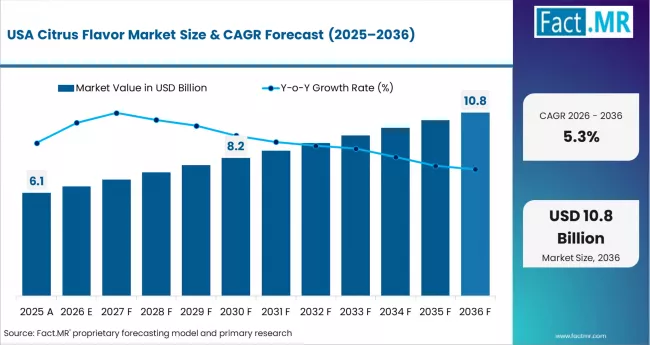
Citrus Flavor Market Country Value Analysis | Source: Fact.MR
North America is the largest single-region revenue contributor for premium natural citrus flavors, supported by deep functional beverage penetration, retailer clean-label mandates, and strong orange and lemon flavor consumption across food and beverage categories. IFF and Givaudan maintain major formulation and production presences in the region.
- United States: Demand for citrus flavors in the United States is projected to rise at 5.3% CAGR through 2036. The FDA updated its GRAS notification review framework for citrus flavor compounds in September 2024, supporting natural extract approvals and creating a more favourable pathway for biofermentation-derived citrus ingredients. Functional beverage brands including Liquid I.V. and Nuun expanded lemon and citrus electrolyte product ranges in 2025, increasing natural citrus flavor procurement volumes.
FACT.MR's analysis of the citrus flavor market in North America consists of country-wise assessment that includes the United States, Canada, and Mexico. Readers can find functional beverage citrus adoption trends, retailer clean-label policy impacts, natural flavor GRAS pathway data, and country-level forecasts.
Latin America Citrus Flavor Market Analysis
Latin America serves as both the world's largest citrus raw material sourcing region and a growing processed food and beverage market. Brazil's dual role as orange supplier and domestic flavor processor creates unique vertical integration dynamics, with Citrosuco holding a structurally influential position.
- Brazil: Citrus flavor demand in Brazil is projected to expand at 4.8% CAGR through 2036. Brazil is the world's largest orange producer, and ABRAFRUTAS reported that domestic processed citrus ingredient output grew 7% in 2024 as local beverage manufacturers increased natural flavor usage. Citrosuco invested in downstream flavor extraction capacity at its Matão facility in Q2 2024, enabling direct supply of natural orange flavor concentrates to Brazilian food manufacturers.
FACT.MR's analysis of the citrus flavor market in Latin America consists of country-wise assessment that includes Brazil, Mexico, Argentina, Chile, and Rest of Latin America. Readers can find orange crop production data, domestic beverage processing trends, and country-level regulatory guidance.
Europe Citrus Flavor Market Analysis
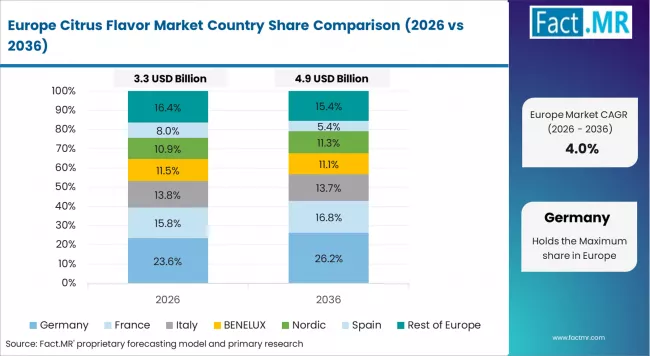
Citrus Flavor Market Europe Country Market Share Analysis, 2026 & 2036 | Source: Fact.MR
Europe is a premium natural citrus flavor market shaped by stringent EU flavor regulation, advanced clean-label adoption among food manufacturers, and strong consumer demand for authentic citrus profiles in bakery, confectionery, and beverage products. Givaudan, Symrise, and Firmenich are the dominant European flavor suppliers.
- Spain: Citrus flavor demand in Spain is projected to rise at 4.4% CAGR through 2036. Spain is Europe's largest citrus producer, and the Spanish Agri-Food Industry Federation (FIAB) reported in January 2025 that domestic natural citrus flavor extraction capacity increased 9% in 2024 as processors invested in cold-press lemon and orange oil production. EU Regulation (EC) No 1334/2008 enforcement tightened permitted synthetic citrus compound levels in March 2025, pushing Spanish food manufacturers toward locally sourced natural extracts.
FACT.MR's analysis of the citrus flavor market in Europe consists of country-wise assessment that includes Germany, France, the United Kingdom, Italy, Spain, and Rest of Europe. Readers can find EU flavor regulation compliance data, natural extract adoption benchmarks, and country-level citrus flavor market forecasts.
Competitive Aligners for Market Players
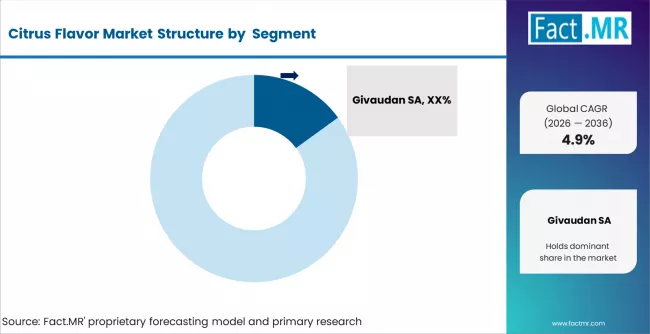
Citrus Flavor Market Analysis By Company | Source: Fact.MR
The global citrus flavor market is moderately concentrated at the premium natural segment level and highly fragmented in synthetic and commodity tiers. The top four flavor houses, Givaudan, IFF, Symrise, and Firmenich, collectively account for an estimated 55-60% of natural citrus flavor revenue, while regional and specialty suppliers serve price-sensitive local food manufacturing demand. The primary competitive variable is sourcing quality and traceability, as clean-label mandates increasingly make supply chain transparency a commercial differentiator alongside price.
Givaudan and IFF hold structural advantages through backward integration into citrus extraction operations and established biofermentation capabilities. Both companies operate proprietary citrus ingredient sourcing networks in Brazil, Spain, and the United States, reducing dependence on commodity spot markets. Symrise benefits from long-term sourcing agreements with Brazilian orange growers and Valencian lemon producers, providing input cost predictability that supports competitive pricing on natural extract contracts.Large food and beverage customers manage supplier dependency by dual-sourcing natural citrus flavors from at least two major houses while maintaining approved supplier lists that include regional specialists for cost leverage. This limits any single flavor company's pricing power on high-volume commodity citrus accounts, though proprietary biofermentation or patented extraction technologies create switching cost advantages in premium segments.
Key Players
- Givaudan SA
- IFF (International Flavors & Fragrances)
- Symrise AG
- Sensient Technologies Corporation
- Takasago International Corporation
- T. Hasegawa USA
- Firmenich
- Kerry Group
- Mane SA
- Citrosuco
- Nongfu Spring
- Genki Forest
- Almarai
- Radnor Hills
- Coca-Cola
Bibliography
- [1] European Commission. (2025). Regulation (EC) No 1334/2008 Implementing Regulation Update: Revised Permitted Use Levels for Synthetic Citrus Aroma Chemicals in Non-Alcoholic Beverages and Confectionery. March 2025. eur-lex.europa.eu
- [2] Mintel Group. (2025). Global Beverage Innovation Report 2025: Citrus Flavor Prevalence in Non-Alcoholic New Product Launches, Functional Beverage Lemon and Lime Profile Growth, North America Data. January 2025. mintel.com
- [3] FICCI Food Processing Division. (2025). India Packaged Beverage Sector Annual Report FY2024-25: Citrus Flavor Demand, Leading Flavor Profiles in New Product Launches, and Natural Ingredient Sourcing Trends. April 2025. ficci.in
- [4] Givaudan SA. (2025). Press Release: Natural Citrus Extraction Capacity Expansion at Zurich Facility, Cold-Press Orange and Lemon Oil Production Investment for European Clean-Label Beverage and Bakery Customers. February 2025. givaudan.com/newsroom
- [5] IFF Inc. (2024). Product Launch Press Release: Biofermentation-Derived Lemon Flavor Platform for Beverage and Confectionery Applications, Natural Certification Compliance and Harvest-Independent Aroma Profile. October 2024. iff.com/news
- [6] Innova Market Insights. (2025). Global Flavor Trends Report 2025: Citrus Flavor Share of Non-Alcoholic Beverage New Product Launches, Lime Profile Growth Rate, and Clean-Label Formulation Benchmarks. January 2025. innovamarketinsights.com
- [7] The Coca-Cola Company. (2024). Q3 2024 Earnings Call Transcript: Sprite and Fanta European Reformulation Initiative, Natural Citrus Flavor Transition for EU Retailer Clean-Label Compliance, Givaudan and IFF Procurement. October 2024. investors.coca-colacompany.com
- [8] Kerry Group plc. (2025). Product Launch Announcement: Natural Citrus Flavor Range for Bakery Applications at iba 2025, Lemon and Orange Profiles for European and North American Muffin, Cookie, and Pastry Markets. February 2025. kerrygroup.com/news
- [9] Symrise AG; Firmenich SA. (2024). Trade Press Interviews: Citrus Confectionery Clean-Label Reformulation for Haribo and Perfetti Van Melle German and Italian Market Product Lines, Natural Lemon and Lime Flavor Supply. Q3 2024. symrise.com; firmenich.com
This Report Addresses
- Strategic intelligence on EU Regulation (EC) No 1334/2008 synthetic aroma chemical restrictions, FSSAI India flavor use guidelines, China GB 2760 updates, FDA GRAS natural flavor pathways, and ANVISA Brazil additive resolutions shaping citrus flavor demand through 2036.
- Market forecast from USD 14.3 billion in 2026 to USD 23.1 billion by 2036 at 4.9% CAGR, segmented by product type, nature, application, and sales channel.
- Growth opportunity mapping across India's packaged beverage expansion, China's clean-label food policy, US functional beverage natural citrus demand, Brazil's orange processing integration, and Spain's EU-compliant natural extract growth.
- Country CAGR outlook for India 6.0%, China 5.7%, USA 5.3%, Brazil 4.8%, and Spain 4.4%, with food processing growth, regulatory drivers, and clean-label adoption benchmarks per country.
- Competitive analysis of Givaudan, IFF, Symrise, Sensient, Firmenich, Kerry Group, Mane SA, Citrosuco, and regional players covering sourcing strategy, biofermentation investment, and key account management.
- Technology tracking covering cold-press natural citrus oil extraction, biofermentation-derived aroma chemicals, spray-dried encapsulated citrus flavors, and microencapsulation for heat-stable bakery applications.
- Regulatory analysis covering EU flavor regulation permitted use updates, China GB 2760 non-alcoholic beverage restrictions, India FSSAI natural flavor guidance, US FDA GRAS citrus compound approvals, and Brazil ANVISA food additive resolutions.
- Report delivered in PDF, Excel datasets, PowerPoint summary, and dashboard formats supported by FAO crop production data, company earnings disclosures, food industry association reports, and primary research interviews.
Segmentation
Scope of Report
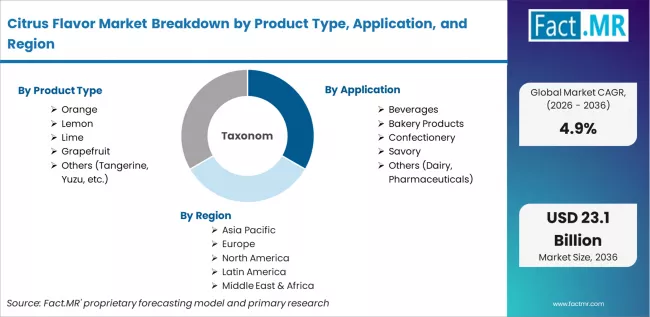
Citrus Flavor Market Breakdown By Product Type, Application, And Region | Source: Fact.MR
| Attribute | Details |
|---|---|
| Quantitative Units | USD 14.3 billion (2026) to USD 23.1 billion (2036), at a CAGR of 4.9% |
| Market Definition | Natural and artificial citrus flavoring ingredients replicating orange, lemon, lime, grapefruit, and related profiles used in food, beverage, and pharmaceutical applications globally. |
| Product Type Segmentation | Orange, Lemon, Lime, Grapefruit, Others (Tangerine, Yuzu, etc.) |
| Nature Segmentation | Natural, Artificial |
| Application Segmentation | Beverages, Bakery Products, Confectionery, Savory, Others (Dairy, Pharmaceuticals) |
| Sales Channel Segmentation | Supermarkets/Hypermarkets, Departmental Stores, E-retailers, Specialty Stores |
| Regions Covered | Asia Pacific, Europe, North America, Latin America, Middle East and Africa |
| Countries Covered | India, China, Japan, South Korea, ASEAN, Australia and New Zealand, Germany, UK, France, Italy, Spain, USA, Canada, Mexico, Brazil, Argentina, Chile, Saudi Arabia, GCC, South Africa |
| Key Companies Profiled | Givaudan SA, IFF, Symrise AG, Sensient Technologies, Takasago, T. Hasegawa, Firmenich, Kerry Group, Mane SA, Citrosuco, Nongfu Spring, Genki Forest, Coca-Cola |
| Forecast Period | 2026 to 2036 |
| Approach | Hybrid top-down and bottom-up model using citrus flavor consumption by application, ingredient pricing by type and nature, crop production data, and primary research. |
Source: Fact.MR analysis. Updated Mar 17, 2026
Citrus Flavor Market by Segments
-
By Product Type:
- Orange
- Lemon
- Lime
- Grapefruit
- Others (Tangerine, Yuzu, etc.)
-
By Nature:
- Natural
- Artificial
-
By Application:
- Beverages
- Bakery Products
- Confectionery
- Savory
- Others (Dairy, Pharmaceuticals)
-
By Sales Channel:
- Supermarkets/Hypermarkets
- Departmental Stores
- E-retailers
- Specialty Stores
-
By Region:
- North America
- United States
- Canada
- Mexico
- Latin America
- Brazil
- Mexico
- Argentina
- Chile
- Rest of Latin America
- Western Europe
- Germany
- United Kingdom
- France
- Italy
- Spain
- Nordic Countries
- BENELUX
- Rest of Western Europe
- East Asia
- China
- Japan
- South Korea
- South Asia and Pacific
- India
- ASEAN
- Australia and New Zealand
- Rest of South Asia and Pacific
- Middle East and Africa
- Kingdom of Saudi Arabia
- Other GCC Countries
- Turkey
- South Africa
- Rest of Middle East and Africa
- North America
Frequently Asked Questions
How large is the citrus flavor market in 2025?
What will the market size be in 2026?
What is the projected market size by 2036?
What is the expected CAGR?
Which product type leads the citrus flavor market?
Which application segment dominates?
Which country shows the fastest growth?
What is the citrus flavor market mainly used for?
Which citrus variants are most popular in products?
Why do beverage companies prefer citrus flavors?
What is a major trend in citrus flavor production?
Why is orange flavor dominant in the market?
What role does clean-label demand play in this market?
Who worked on this report


Preview the report firsthand - request a free sample
Free SampleGet the brochure for pricing and purchase details
Download PDF