- Base Value(2025): 2.1 Bn
- Estimated Value(2026): 2.2 Bn
- Forecast Value (2036): 3.6 Bn
- CAGR (2026 - 2036): 5.0%
Cockpit Alert System Market Forecast and Outlook By Fact.MR
The cockpit alert system market was valued at USD 2.1 billion in 2025 and is projected to reach USD 2.2 billion in 2026 and USD 3.6 billion by 2036, at a CAGR of 5.0%. EICAS and ECAM Platforms is forecast to lead system type at 41.2% share in 2026. Commercial Aircraft holds the top aircraft type position at 46.8%, with Alerting Software leading component type demand at 29.1% in 2026. The evolution of cockpit alerting over the past two decades tells you something important about where this market is going: the problem being solved is no longer detecting the abnormal condition. Modern aircraft systems do that reliably. The unsolved problem is helping the crew respond correctly under stress, time pressure, and competing priorities. That shift in problem definition is driving the move toward contextual, logic-rich alerting systems that do more than flash a light.
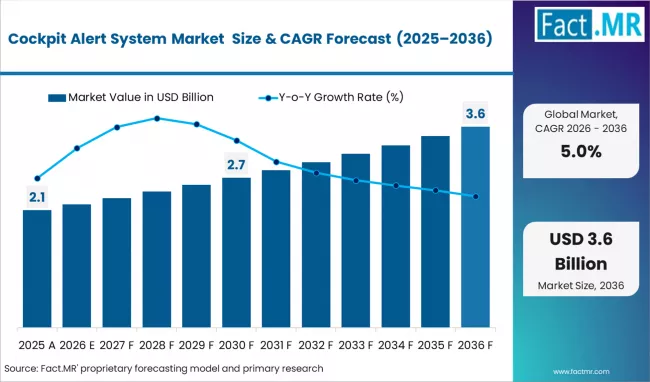
Cockpit Alert System Market Market Value Analysis | Source: Fact.MR
Key Drivers
- Safety Regulation: Flight deck alerting architecture is tightly linked to certification, crew workload reduction, and operational safety requirements across aviation authorities.
- Avionics Modernization: Retrofit and upgrade programs continue to create demand beyond new aircraft production cycles.
- Runway and Situational Awareness: Direct cockpit alerting for runway hazards and abnormal conditions is increasing in operational importance.
Key Segments Analyzed in the Report
- System Type: EICAS And ECAM Platforms, Runway Awareness And Surface Alerting Systems, Terrain And Proximity Alerting Systems, Mission And Crew Advisory Systems, And Others
- Aircraft Type: Commercial Aircraft, Business Jets, Military Aircraft, General Aviation Aircraft, And Others
- Component Type: Displays, Alerting Software, Audio Warning Modules, Sensors And Interface Units, And Others
- Region: North America, Latin America, Europe, Asia Pacific, And Middle East & Africa
Analyst Opinion
Shambhu Nath Jha, Principal Consultant, Fact.MR says cockpit alerting is no longer a simple warning-light market. Value is shifting toward integrated logic that helps the crew prioritize, interpret, and act under time pressure without adding cognitive noise to the flight deck. The avionics companies that understand this are building alerting systems that think about the pilot's mental state as much as the aircraft's physical state.
Cockpit Alert System Market Definition
The cockpit alert system market covers integrated aircraft systems that provide visual, aural, and logic-based warnings, cautions, advisories, and procedural guidance to support pilot awareness, decision-making, and safe flight operations.
Cockpit Alert System Market Inclusions
- Revenue from integrated cockpit alerting platforms, runway and surface alerting solutions, terrain-related alerting, advisory systems, and related cockpit alerting components.
- Original equipment and retrofit demand across commercial, business, military, and general aviation aircraft segments.
- Demand across North America, Latin America, Europe, Asia Pacific, and the Middle East & Africa.
Cockpit Alert System Market Exclusions
- Ground-based air traffic alerting systems that do not provide direct cockpit alert functionality.
- Standalone flight displays without embedded alerting or advisory logic.
- Broad aircraft electronics revenue not attributable to cockpit alert system content.
Cockpit Alert System Market Research Methodology
This study evaluates the cockpit alert system market across system type, aircraft type, component type, and region, using 2025 as the base year and 2026 to 2036 as the forecast period. Market value is expressed in USD billion. Evidence inputs include FAA and EASA alerting guidance, avionics suite capabilities, runway-safety alerting solutions, and first-party product materials from Honeywell, Collins Aerospace, Garmin, and other avionics suppliers. Triangulation aligns aircraft installed base, retrofit intensity, avionics content per cockpit, and safety-upgrade demand to derive segment and regional estimates.
Key Drivers, Restraints, and Trends in Cockpit Alert System Market
Drivers
Cockpit alert system demand is rising because modern flight decks need to present more information without overwhelming crews. Integrated alerting systems improve prioritization and connect abnormal conditions to better action pathways. That makes them central to both certification philosophy and operational safety, especially in complex or high-workload flight environments.
Restraints
The market remains highly regulated and program driven. Certification requirements, long aircraft development cycles, and platform-specific integration make adoption slower than in ordinary electronics markets. Retrofit programs can be delayed by budget pressure, fleet age, and the complexity of avionics integration.
Trends
The most important trend is the shift from basic caution and warning displays to more contextual, software-rich alerting. Runway and surface alerting, smart checklist linkage, and more integrated crew advisory logic are gaining weight. In military and special mission aircraft, cockpit alerting is also becoming part of broader mission-awareness architecture.
Segmental Analysis
Cockpit Alert System Market Analysis by System Type
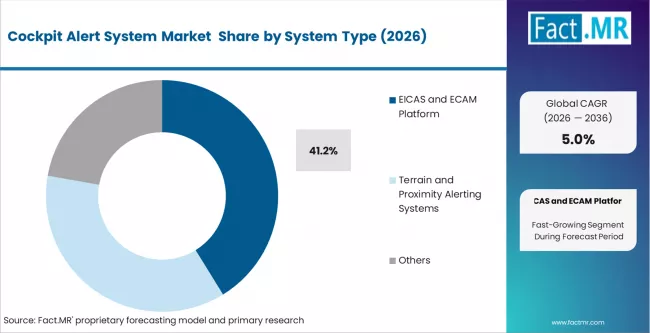
Cockpit Alert System Market Analysis By System Type | Source: Fact.MR
The EICAS and ECAM Platforms segment is expected to lead the system type category with a 41.2% share in 2026. These systems lead because they form the core alerting architecture in many larger aircraft, integrating warnings, cautions, advisories, and system-status messaging into one prioritized logic environment. Their installed base and certification centrality keep them structurally important.
Cockpit Alert System Market Analysis by Aircraft Type
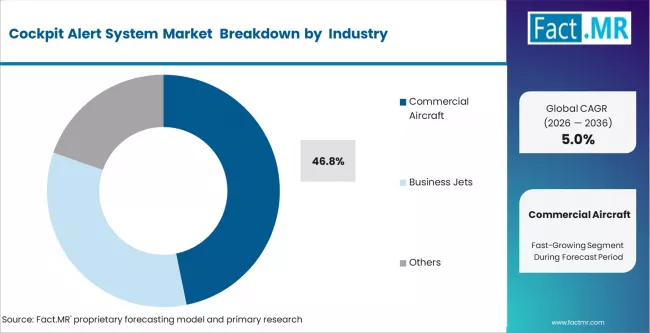
Cockpit Alert System Market Analysis By Aircraft Type | Source: Fact.MR
The Commercial Aircraft segment is expected to lead the aircraft type category with a 46.8% share in 2026. Commercial aircraft lead because they combine large installed fleets, high regulatory scrutiny, heavy avionics content, and long-term retrofit programs. Safety, dispatch reliability, and crew-workload discipline all reinforce demand for robust cockpit alerting architecture in this segment.
Competitive Aligners for Market Players
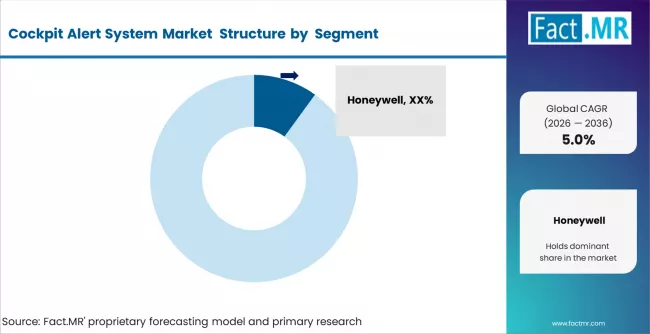
Cockpit Alert System Market Analysis By Company | Source: Fact.MR
Cockpit alert systems are arguably the most trust-dependent product category in the avionics industry. A supplier earns access to the flight deck through a combination of certification heritage, FAA and EASA relationship depth, and a track record of systems that have performed reliably under real operational stress. This is why Honeywell and Collins Aerospace have held leading positions through multiple aircraft generations. Their competitive moat is not product innovation alone. It is decades of certified installations that regulators, airframers, and operators have built operational procedures around.
Software content is the competitive battleground shifting fastest in this market. The physical components of a cockpit alert system, displays, audio modules, and sensors, are largely commoditized at the platform level. What differentiates alert systems today is the logic layer: how intelligently priorities are assigned, how alerts are suppressed or escalated based on flight phase, how crew advisory content adapts to the specific combination of active abnormalities, and how the system integrates with electronic checklists and synoptic pages. Suppliers investing heavily in human factors research and certified software architecture for alert prioritization are building differentiation that hardware upgrades alone cannot replicate.
The retrofit market deserves particular attention from a competitive strategy standpoint. Airlines operating aging fleets with older-generation EICAS or warning systems face a choice between expensive full-suite upgrades and targeted safety-driven retrofits. Suppliers that have packaged focused runway awareness or terrain alerting upgrades as certifiable bolt-on solutions, as Honeywell has done with SURF-A and RAAS, are addressing a real budget-constrained demand segment that a full suite replacement cannot serve. That segmentation of the retrofit market into full upgrades versus targeted safety additions is creating competitive opportunities for suppliers who can certify and support both levels.
Key Players in Cockpit Alert System Market
- Honeywell
- Collins Aerospace
- Thales
- Garmin
- Universal Avionics
- L3Harris Technologies
- BAE Systems
- Elbit Systems
- Safran Electronics and Defense
- Astronautics Corporation of America
Strategic Outlook by Fact.MR on Cockpit Alert System Market
Fact.MR expects cockpit alert systems to see steady medium-term growth driven by avionics modernization, runway-safety enhancements, and next-generation integrated cockpit architectures. Suppliers with strong certification pedigree and software integration capabilities should remain best placed to capture value. The companies that invest today in alert logic sophistication and human factors validation will be the ones designing the flight decks of the next aircraft generation.
Bibliography
- Federal Aviation Administration. (2010). Flightcrew alerting (Advisory Circular 25.1322-1).
- European Union Aviation Safety Agency. (2023). Easy access rules for large aeroplanes (CS-25).
- Honeywell. (n.d.). Surf A cockpit alerting software.
- Honeywell. (n.d.). Runway awareness and advisory system - RAAS.
- Collins Aerospace. (n.d.). Integrated cockpit solutions.
- Garmin. (n.d.). G1000 NXi integrated flight deck
Segmentation
Scope of the Report
| Metric | Value |
|---|---|
| Market Value | USD 2.1 billion in 2025 to USD 3.6 billion by 2036 |
| CAGR | 5.0% from 2026 to 2036 |
| Base Year | 2025 |
| Forecast Period | 2026 to 2036 |
| System Type Segmentation | EICAS and ECAM Platforms, Runway Awareness and Surface Alerting Systems, Terrain and Proximity Alerting Systems, Mission and Crew Advisory Systems, Others |
| Aircraft Type Segmentation | Commercial Aircraft, Business Jets, Military Aircraft, General Aviation Aircraft, Others |
| Component Type Segmentation | Displays, Alerting Software, Audio Warning Modules, Sensors and Interface Units, Others |
| Regional Coverage | North America, Latin America, Europe, Asia Pacific, and Middle East & Africa |
Source: Fact.MR analysis. Updated Mar 16, 2026
Frequently Asked Questions
What is the projected size of the Cockpit Alert System Market by 2036?
What is the CAGR of the Cockpit Alert System Market from 2026 to 2036?
Which system type segment leads the Cockpit Alert System Market?
Which aircraft type segment dominates the Cockpit Alert System Market?
Which component type segment leads the Cockpit Alert System Market?
Who are the key companies in the Cockpit Alert System Market?
What is driving demand in the Cockpit Alert System Market?
Who worked on this report


Preview the report firsthand - request a free sample
Free SampleGet the brochure for pricing and purchase details
Download PDF