The Compostable Medical Pouch Bioplastics Market is analyzed across its key product, application and end-use segments, with the study covering market dynamics, regional trends and demand outlook, forecast 2026 to 2036.
By Fact.MR Healthcare DeskLead analyst:
S.N. JhaPublished :
Updated :
11 min read
Fact-checked under the Fact.MR editorial process
Compostable Medical Pouch Bioplastics Market Forecast and Outlook 2026 to 2036
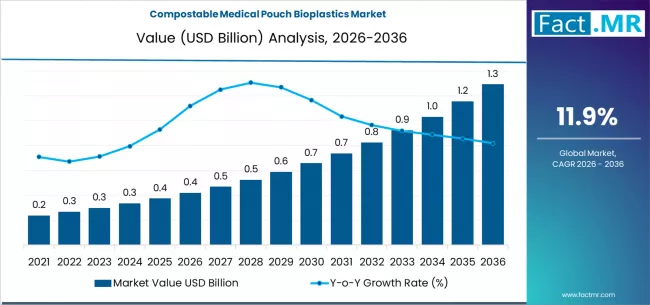
The global market for compostable medical pouch bioplastics is projected to expand from USD 0.42 billion in 2026 to USD 1.29 billion by 2036, advancing at an 11.9% CAGR. This robust growth is propelled by a fundamental redefinition of value in healthcare logistics, where packaging is no longer viewed as a terminal waste product but as an integral component of the clinical waste stream with mandated environmental outcomes.
Compostable Medical Pouch Bioplastics Market Market Value Analysis | Source: Fact.MR
Summary of Compostable Medical Pouch Bioplastics Market
Market Snapshot
Global compostable medical pouch bioplastics market revenue stood at USD 0.42 billion in 2026 and is forecast to reach USD 1.29 billion by 2036.
At a 11.9% CAGR from 2026 to 2036, this market is set to expand ~3.1x in value, adding USD 0.87 billion in absolute opportunity.
Growth is being driven by the increasing shift toward sustainable medical packaging solutions, where compostable materials replace conventional plastics in clinical waste streams.
Compostable bioplastic pouches are evolving into integrated components of healthcare sustainability frameworks, supporting sterilization requirements while minimizing environmental impact.
Demand and Growth Drivers
Rising regulatory pressure on single-use plastic waste in healthcare is driving adoption of compostable bioplastic packaging solutions.
Increasing demand for eco-friendly sterile packaging for medical devices and instruments is accelerating market growth.
Growing focus on circular economy practices within healthcarelogisticsis reinforcing demand for compostable materials.
Advancements in bioplastic formulations such as PLA, PHA, and cellulose-based materials are improving barrier properties and sterilization compatibility.
Expansion of medical device manufacturing and global healthcare infrastructure is further supporting market demand.
Product and Segment View
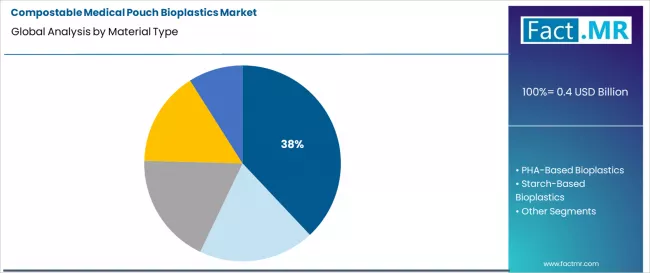
PLA-based bioplastics hold 38% of material segment share in 2026,emergingas the leading segment due to strong biodegradability and performance characteristics.
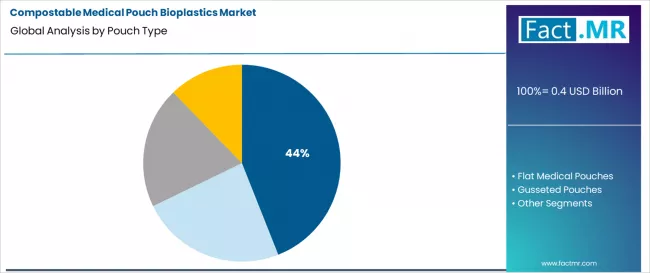
Sterilization pouches account for 44.0% of pouch type share in 2026, positioning this as the dominant segment due to widespread use in medical packaging.
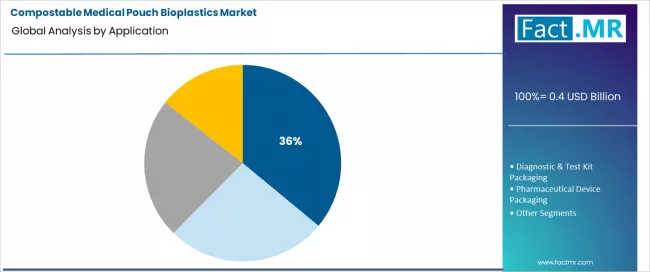
Surgical instrument packaging accounts for 36% of application share in 2026, reflecting high demand for sterile and sustainable packaging solutions.
These bioplastics are widely used across:
Surgical instrument packaging
Diagnostic & test kits
Pharmaceutical devices
Dental and disposable medical supplies
Geography and Competitive Outlook
Growth is supported across Asia Pacific, North America, and Europe, driven by increasing regulatory focus on sustainable packaging.
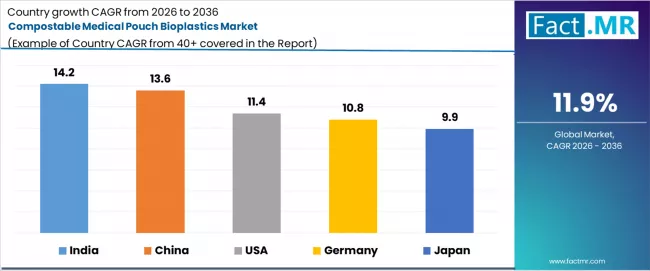
India (14.2% CAGR), China (13.6%), United States (11.4%), Germany (10.8%), and Japan (9.9%) are key growth markets.
Market expansion is closely tied to environmental regulations, healthcare sustainability initiatives, and bioplastics innovation.
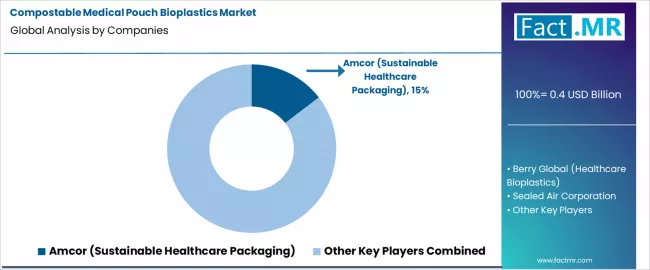
Key companies active in this market include Amcor, Berry Global, Sealed Air Corporation, Mondi Group, and Constantia Flexibles.
Compostable Medical Pouch Bioplastics Market — At a Glance
Attribute
Details
Market Value 2026
USD 0.42 billion
Market Value 2036
USD 1.29 billion
Absolute Dollar Opportunity 2026–2036
USD 0.87 billion
Total Growth 2026–2036
207.1%
CAGR 2026–2036
11.9%
Growth Multiple
~3.1x
Key Demand Theme
Increasing adoption of compostable, sustainable medical packaging solutions replacing conventional plastics
Leading Segment by Material (2026)
PLA-Based Bioplastics
Segment Share (2026)
38%
Leading Segment by Pouch Type (2026)
Sterilization Pouches
Segment Share (2026)
44.0%
Leading Segment by Application (2026)
Surgical Instrument Packaging
Segment Share (2026)
36%
Key Growth Regions
Asia Pacific, North America, Europe
Country CAGRs
India 14.2%, China 13.6%, USA 11.4%, Germany 10.8%, Japan 9.9%
North America, Latin America, Western Europe, Eastern Europe, East Asia, South Asia & Pacific, MEA
Source: Fact.MR analysis. Updated Apr 2, 2026
The transition is driven by stringent new regulations targeting single-use plastics in healthcare, coupled with hospital sustainability initiatives aiming for zero waste to landfill. Performance parity with conventional plastics is now a baseline expectation; the market demands materials that meet exacting standards for sterility maintenance, barrier integrity, and peel strength while undergoing certified compostability in industrial facilities. India's exceptional 14.20% CAGR underscores the potent combination of rapid healthcare infrastructure growth and proactive national bans on single-use plastics, creating a greenfield opportunity for compliant packaging systems. The market's trajectory is defined by the convergence of polymer science and waste management policy, creating a premium segment for materials that ensure clinical safety from shelf to soil without ecological legacy.
Surgical Instrument Packaging, Diagnostic & Test Kit Packaging, Pharmaceutical Device Packaging, Dental & Disposable Medical Supplies
Region
North America, Latin America, Western Europe, Eastern Europe, East Asia, South Asia & Pacific, MEA
Source: Fact.MR analysis. Updated Apr 2, 2026
Segmental Analysis
By Material Type, Which Polymer Offers the Best Balance of Processability and Performance Credentials?
Compostable Medical Pouch Bioplastics Market Analysis By Material Type | Source: Fact.MR
PLA-based bioplastics command a 38% share, serving as the incumbent bridge material. Their dominance is rooted in excellent clarity, stiffness, and the ability to be processed on existing packaging machinery with minor modifications.
The material’s capacity to be engineered into high-barrier multilayer structures, often through lamination or coating, makes it the most viable current solution for critical applications like sterilization packaging where moisture and microbial barrier properties are non-negotiable.
By Pouch Type, Which Format Imposes the Most Stringent Material Requirements?
Compostable Medical Pouch Bioplastics Market Analysis By Pouch Type | Source: Fact.MR
Sterilization pouches are the largest segment at 44.0%. This pouch type is subject to the most rigorous validation protocols, as it must maintain a sterile barrier before use and allow for aseptic presentation during surgery.
Any compostable material used must withstand sterilization methods like steam autoclaving, ethylene oxide, or gamma radiation without compromising seal integrity or functional properties. The high regulatory and performance barrier here creates a concentrated demand for the most advanced, certified bioplastic formulations.
By Application, Where is the Regulatory Push for Sustainable Packaging Most Direct?
Compostable Medical Pouch Bioplastics Market Analysis By Application | Source: Fact.MR
Surgical instrument packaging leads applications with a 36% share. This segment generates a high volume of persistent plastic waste directly within hospital operating rooms, a visible and regulated waste stream.
The shift to compostable alternatives in this space is driven by hospital waste diversion goals and potential cost savings on regulated medical waste handling. The material must not only protect expensive surgical tools but also integrate seamlessly into sterile processing workflows, making performance reliability the critical adoption factor.
What are the Drivers, Restraints, and Key Trends of the Compostable Medical Pouch Bioplastics Market?
The paramount driver is the enactment of extended producer responsibility laws and single-use plastic bans specifically encompassing medical packaging in several jurisdictions. Healthcare systems, as large institutional purchasers, are setting ambitious zero-waste targets, creating top-down demand for compliant solutions.
The growing prevalence of home-based healthcare and self-testing generates packaging waste outside traditional waste streams, increasing the appeal of certified compostable options that consumers can dispose of via organic waste collection.
A significant restraint is the fragmented and often inaccessible industrial composting infrastructure, which is essential for the material to fulfill its end-of-life promise. Without guaranteed access to such facilities, the compostability claim becomes theoretical, risking greenwashing accusations.
The current premium cost of high-performance medical-grade bioplastics compared to conventional plastics pressures hospital procurement budgets, even when total lifecycle costs including waste disposal are considered.
Key trends include the development of tunable biodegradation profiles, where a material’s compostability timeline can be engineered to align with specific waste collection cycles. There is a strong movement toward creating mono-material, fully compostable structures that simplify recycling and composting without requiring layer separation.
Another trend is the integration of smart indicators, such as color-change inks for sterilization validation, directly into the bioplastic substrate. The market is also seeing strategic partnerships between biopolymer producers, packaging converters, and waste management companies to create closed-loop pilot programs that guarantee the packaging’s pathway from clinical use to compost.
Analysis of the Compostable Medical Pouch Bioplastics Market by Key Countries
Compostable Medical Pouch Bioplastics Market Cagr Analysis By Country | Source: Fact.MR
Country
CAGR (2026-2036)
India
14.20%
China
13.60%
USA
11.40%
Germany
10.80%
Japan
9.90%
Source: Fact.MR analysis. Updated Apr 2, 2026
How is India's Regulatory Ban and Healthcare Expansion Creating a Forced Innovation Cycle?
India's leading 14.20% CAGR is a direct result of its stringent national ban on specific single-use plastics, which is increasingly interpreted to include non-critical medical packaging. This regulatory push, combined with massive investments in new healthcare facilities, forces rapid innovation and adoption.
The market prioritizes cost-optimized solutions that meet compliance standards, driving local material innovation and positioning India as a testing ground for scalable, affordable compostable packaging models in emerging economies.
What is the Impact of China's Domestic Bioplastics Production Capacity and Green Policy Goals?
China's 13.60% growth is fueled by its world-leading manufacturing capacity for bioplastics like PLA and PHA. National policies promoting a circular economy provide a framework for adopting these domestically produced materials in the medical sector.
The focus is on creating fully integrated supply chains, from polymer production to pouch conversion, to supply both the vast domestic hospital network and global export markets, leveraging scale to reduce cost premiums.
Why is the USA's Focus on Hospital Sustainability Certifications and Value-Based Procurement a Key Factor?
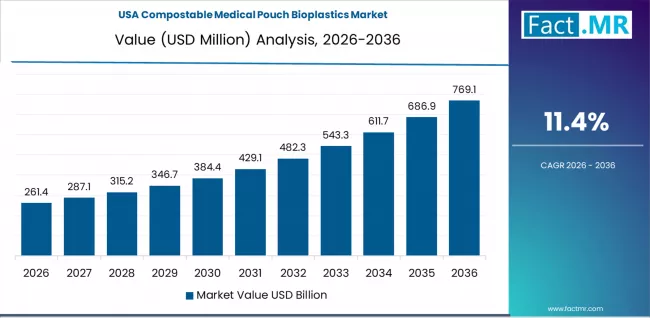
Compostable Medical Pouch Bioplastics Market Country Value Analysis | Source: Fact.MR
The USA's 11.40% growth is driven by the widespread adoption of hospital sustainability certifications and the shift toward value-based procurement that considers total lifecycle cost. Group purchasing organizations are increasingly evaluating supplier environmental, social, and governance credentials, making compostable packaging a strategic differentiator.
The market is characterized by demand for products with third-party certifications and robust data on environmental impact, favoring suppliers who can provide comprehensive sustainability dossiers.
How is Germany's Engineering Rigor and Closed-Loop Waste System Shaping Demand?
Germany's 10.80% CAGR reflects its engineering approach to waste management and high patient safety standards. Demand is for bioplastic materials that not only compost but do so predictably within Germany's efficient organic waste infrastructure without disrupting biogas production processes.
The market emphasizes technical documentation, material traceability, and pouch designs that facilitate efficient sorting and processing within existing high-performance waste systems.
What Role does Japan's Precision Standards and Focus on Elderly Care Play?
Japan's 9.90% growth is influenced by its ultra-high standards for packaging precision and hygiene, coupled with a growing home-care sector for its aging population. This creates demand for compostable pouches that are exceptionally user-friendly for elderly patients at home while maintaining flawless performance for institutional use.
Japanese innovation focuses on material purity, odor control during composting, and pouch designs that enhance accessibility, aligning with societal needs for dignity and convenience in care.
Competitive Landscape of the Compostable Medical Pouch Bioplastics Market
Compostable Medical Pouch Bioplastics Market Analysis By Company | Source: Fact.MR
Global flexible packaging giants leveraging their existing relationships with medical device manufacturers and hospital supply chains define the competitive landscape. Competition centers on securing proprietary access to advanced biopolymer resins, developing validated conversion processes, and achieving critical certifications for both medical safety and compostability.
Success hinges on the ability to provide a complete, drop-in replacement system that includes the pouches, validation protocols for sterile processing departments, and clear end-of-life guidance to healthcare providers.
Company
Determining Strategic Factor
How to Navigate Growth?
Amcor
Integrated Sterilization Validation
Provide pre-validated, certified compostable sterilization pouch systems reduces adoption risk for hospitals and device makers, securing long-term contracts.
Berry Global
Vertical Integration in Biopolymer Sourcing
Control over bioplastic resin production or exclusive partnerships ensures supply chain security and cost advantages for large-volume medical customers.
Sealed Air Corporation
Lifecycle Service Model
Offer a full-service package that includes pouch collection and guaranteed composting through partnered facilities creates a compelling closed-loop value proposition.
Mondi Group
Mono-Material, High-Barrier Innovation
Develop a fully compostable pouch from a single material stream simplifies end-of-life processing and addresses recyclability concerns, offering a future-proof solution.
Constantia Flexibles
Customization for Medical Device OEMs
Specialize in co-developing tailored, compostable primary packaging for specific high-value devices creates sticky, high-margin partnerships with innovators.
Source: Fact.MR analysis. Updated Apr 2, 2026
Key Players in the Compostable Medical Pouch Bioplastics Market
Amcor
Berry Global
Sealed Air Corporation
Mondi Group
Constantia Flexibles
References
Agarwal, S. 2023. Biopolymers for Sustainable Packaging in Healthcare. Royal Society of Chemistry.
European Bioplastics Association. 2024. Fact Sheet on Bioplastics for Medical Applications. Berlin.
Food and Agriculture Organization of the United Nations. 2022. Sustainable Bio-based Materials for a Circular Economy. FAO.
Kale, G., & Kijchavengkul, T. 2023. Compostability of Biopolymer Materials. Journal of Polymers and the Environment.
Medical Device Manufacturers Association. 2024. Guidelines for Sustainable Packaging of Medical Devices. MDMA White Paper.
Rydz, J., & Musioł, M. 2022. Polyhydroxyalkanoates in Medical Packaging. International Journal of Biological Macromolecules.
Siracusa, V., & Blanco, I. 2023. Bio-based Polymers for Food and Medical Packaging. Polymers.
Song, J. H., & Murphy, R. J. 2024. Biodegradable and Compostable Alternatives to Conventional Plastics. Philosophical Transactions of the Royal Society B.
United States Pharmacopeia. 2023. General Chapter <665> on Plastic Packaging Systems for Pharmaceutical Use. USP.
Surgical Instrument Packaging, Diagnostic & Test Kit Packaging, Pharmaceutical Device Packaging, Dental & Disposable Medical Supplies
Key Countries
India, China, USA, Germany, Japan
Key Companies
Amcor, Berry Global, Sealed Air Corporation, Mondi Group, Constantia Flexibles
Additional Analysis
Comparative lifecycle assessment of compostable vs. incineration-based disposal for regulated medical waste; impact of sterilization cycles on compostability certification and material integrity; migration testing of substances from novel bioplastics into medical devices; economic model comparing waste handling costs for compostable versus traditional plastic pouches; analysis of evolving regulatory standards for compostable claims in medical applications; supply chain resilience for bio-based feedstocks.
Source: Fact.MR analysis. Updated Apr 2, 2026
Market by Segments
Material Type :
PLA-Based Bioplastics
PHA-Based Bioplastics
Starch-Based Bioplastics
Cellulose-Based Bioplastics
Others
Pouch Type :
Sterilization Pouches
Flat Medical Pouches
Gusseted Pouches
Specialty & Custom Pouches
Application :
Surgical Instrument Packaging
Diagnostic & Test Kit Packaging
Pharmaceutical Device Packaging
Dental & Disposable Medical Supplies
Region :
North America
USA
Canada
Latin America
Brazil
Mexico
Argentina
Rest of Latin America
Western Europe
Germany
France
UK
Italy
Spain
BENELUX
Rest of Western Europe
Eastern Europe
Poland
Russia
Czech Republic
Rest of Eastern Europe
East Asia
China
Japan
South Korea
Rest of East Asia
South Asia & Pacific
India
ASEAN
Australia
Rest of South Asia & Pacific
MEA
GCC
South Africa
Turkiye
Rest of MEA
Questions Answered
Frequently Asked Questions
How big is the compostable medical pouch bioplastics market in 2026?
The global compostable medical pouch bioplastics market is estimated to be valued at USD 0.4 billion in 2026.
What will be the size of compostable medical pouch bioplastics market in 2036?
The market size for the compostable medical pouch bioplastics market is projected to reach USD 1.3 billion by 2036.
How much will be the compostable medical pouch bioplastics market growth between 2026 and 2036?
The compostable medical pouch bioplastics market is expected to grow at a 11.9% CAGR between 2026 and 2036.
What are the key product types in the compostable medical pouch bioplastics market?
The key product types in compostable medical pouch bioplastics market are pla-based bioplastics, pha-based bioplastics, starch-based bioplastics, cellulose-based bioplastics and others.
Which pouch type segment to contribute significant share in the compostable medical pouch bioplastics market in 2026?
In terms of pouch type, sterilization pouches segment to command 44.0% share in the compostable medical pouch bioplastics market in 2026.