- Base Value(2026): 2.8 Bn
- Estimated Value(2026): 2.8 Bn
- Forecast Value (2036): 4.9 Bn
- CAGR (2026 - 2036): 5.8%
Medical X-ray Generator Market Forecast and Outlook 2026 to 2036
The global medical X-ray generator market is valued at USD 2.8 billion in 2026 and is set to reach USD 4.9 billion by 2036, recording a compound annual growth rate (CAGR) of 5.8% between 2026 and 2036. In 2026, the stationary X-ray generator segment is projected to hold a 46.2% share, while hospital applications account for 52.4% of the total demand.
Key Takeaways from the Medical X-ray Generator Market Report
- Market Value (2026): USD 2.8 Billion
- Market Forecast Value (2036): USD 4.9 Billion
- Forecast CAGR (2026-2036): 5.8%
- Leading Product Segment: Stationary X-ray Generators (46.2%)
- Leading Application Segment: Hospitals (52.4%)
- Key Growth Regions: North America, Europe, Asia Pacific
- Key Players: Siemens Healthineers AG, General Electric Company, Philips Healthcare, Canon Medical Systems Corporation, Fujifilm Holdings Corporation
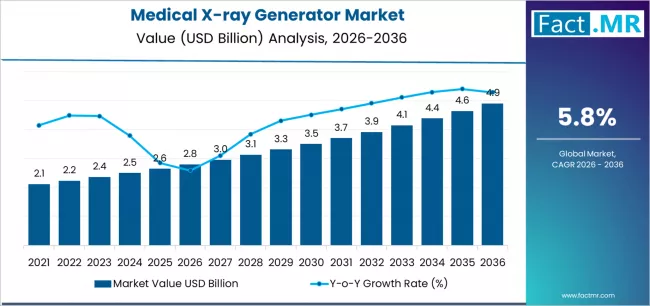
Medical X Ray Generator Market Market Value Analysis | Source: Fact.MR
Market expansion is fundamentally driven by the global imperative to modernize aging diagnostic imaging infrastructure and the transition from analog to digital radiography. This shift is critical for improving diagnostic accuracy, workflow efficiency, and patient dose management. The growing burden of chronic diseases requiring frequent imaging, alongside the expansion of healthcare access in emerging economies, creates a sustained demand for reliable and advanced X-ray generation technology across all care settings.
Technological integration and performance optimization will define growth over the forecast period. Innovations in high-frequency generator technology, advanced tube design, and sophisticated software for dose modulation and image processing are enhancing diagnostic capabilities while improving safety and operational efficiency. The integration of Artificial Intelligence (AI) for image acquisition, analysis, and workflow automation is transforming X-ray generators from simple power sources into intelligent components of a connected diagnostic ecosystem.
Medical X-ray Generator Market
| Metric | Value |
|---|---|
| Estimated Value in (2026E) | USD 2.8 billion |
| Forecast Value in (2036F) | USD 4.9 billion |
| Forecast CAGR (2026 to 2036) | 5.8% |
Source: Fact.MR analysis. Updated Dec 18, 2025
Category
| Category | Segments |
|---|---|
| Generator Type | Stationary, Portable, Mobile, Dental, Others |
| Application Sector | Hospitals, Diagnostic Centers, Specialty Clinics, Emergency Care, Others |
| Power Rating | Low Power, Medium Power, High Power, Other Platforms |
| Technology Type | High-frequency, Constant Potential, Battery-powered, Other Services |
| Region | North America, Europe, Asia Pacific, Latin America, MEA |
Source: Fact.MR analysis. Updated Dec 18, 2025
Segmental Analysis
Why do Stationary X-ray Generators Occupy the Dominant Position?

Medical X Ray Generator Market Analysis By Generator Type | Source: Fact.MR
The stationary X-ray generator segment will command a 46.2% market share in 2026. This dominance is attributed to their superior power output, stability, and reliability, which are essential for high-throughput departments like general radiography, fluoroscopy, and CR systems in hospitals and large diagnostic centers. They form the backbone of fixed-room installations, offering the consistent performance required for critical diagnostic imaging and supporting integration with complex digital image processing and archival systems.
- The ongoing replacement cycle of aging analog and early-digital systems in established healthcare markets is a primary driver for stationary generator sales.
- Technological advancements, such as connectivity with cloud-based AI analysis tools and automated dose reporting, are adding new value to stationary systems, extending their relevance in modern digital departments.
Why do Hospitals Account for Maximum Use of Medical X-ray Generators?
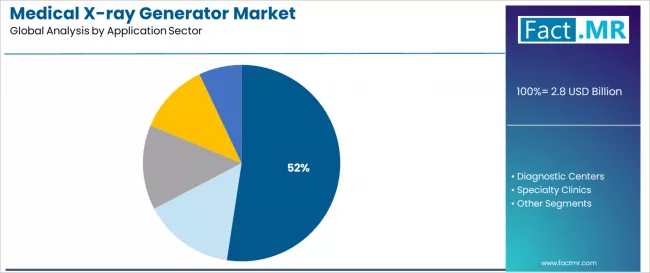
Medical X Ray Generator Market Analysis By Application Sector | Source: Fact.MR
Hospital applications are projected to hold a 52.4% share in 2026. Hospitals represent the largest and most diverse users of X-ray imaging, encompassing emergency departments, inpatient wards, surgical suites, and specialized outpatient clinics. The scale of operations necessitates a fleet of generators ranging from high-power stationary units to mobile and portable systems for bedside imaging, driving consistent demand for replacement, upgrade, and expansion of generator assets.
- Hospital consolidation and the construction of large, multi-specialty medical campuses are creating demand for centralized, high-capacity imaging departments equipped with the latest generator technology.
- The need for dose optimization and compliance with stringent radiation safety regulations in high-volume environments makes hospitals early adopters of generators with advanced dose management software.
What are the Drivers, Restraints, and Key Trends of the Medical X-ray Generator Market?
The market is driven by the global mandate to upgrade aging radiographic infrastructure to digital standards, improving diagnostic quality and operational efficiency. Secondary drivers include the rising global incidence of diseases requiring radiographic diagnosis and the expansion of healthcare services in developing regions. Key restraints include the high capital cost of advanced systems, budget constraints in public healthcare systems, and the competitive pressure from the robust refurbished equipment market.
The market is trending towards the integration of AI for automated image quality optimization, protocol selection, and preliminary read assistance. Another key trend is the development of more compact, powerful, and energy-efficient generators, particularly for portable and mobile systems, enhancing their utility in point-of-care and resource-limited settings.
Analysis of the Medical X-ray Generator Market by Key Countries
| Country | CAGR (2026-2036) |
|---|---|
| China | 7.1% |
| India | 6.9% |
| Germany | 5.2% |
| Brazil | 6.1% |
| USA | 5.6% |
| UK | 4.9% |
| South Korea | 6.4% |
Source: Fact.MR analysis. Updated Dec 18, 2025
What is Propelling China’s Leadership in Diagnostic Imaging Expansion?
The market in China is projected to grow at a leading CAGR of 7.1% through 2036. This growth is fueled by massive, government-led healthcare infrastructure initiatives aimed at expanding and modernizing hospital networks across tier-2 and tier-3 cities. National policies promoting domestic medical device manufacturing are also strengthening local supply chains, making advanced imaging technology more accessible and affordable for a broader range of healthcare facilities throughout the country.
How is India's Healthcare Investment Driving Generator Demand?
The market in India is forecast to grow at a CAGR of 6.9%. Demand is driven by substantial private investment in new multi-specialty hospitals and diagnostic chains, coupled with government schemes aimed at improving primary and secondary care infrastructure. The need to replace a vast installed base of outdated equipment presents a significant replacement market, while growing health insurance penetration is increasing patient access to advanced diagnostic services.
How does South Korea's Technologically Advanced System Shape the Market?
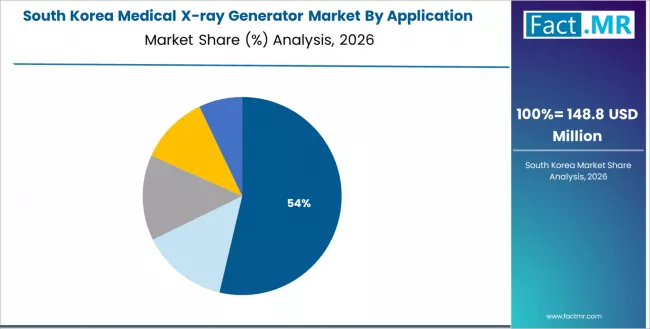
Medical X Ray Generator Market South Korea Market Share Analysis By Application Sector | Source: Fact.MR
The market in South Korea is projected to grow at a CAGR of 6.4%. The country's dense, tech-savvy healthcare system, with its high patient throughput and emphasis on precision diagnostics, drives demand for the latest high-frequency and digital generators. Continuous technological upgrades are standard practice, supported by strong local manufacturing capabilities and a healthcare culture that prioritizes cutting-edge diagnostic equipment for early and accurate disease detection.
Why is Brazil a Key Growth Market in Latin America?
The market in Brazil is set to grow at a CAGR of 6.1%. Growth is underpinned by the expansion and modernization of private hospital networks catering to a growing insured population. Additionally, public healthcare initiatives to decentralize and improve diagnostic access are driving procurement for public clinics and hospitals. Brazil's role as a regional medical hub further stimulates demand for high-quality imaging equipment.
What Underpins Steady Modernization in USA’s Market?
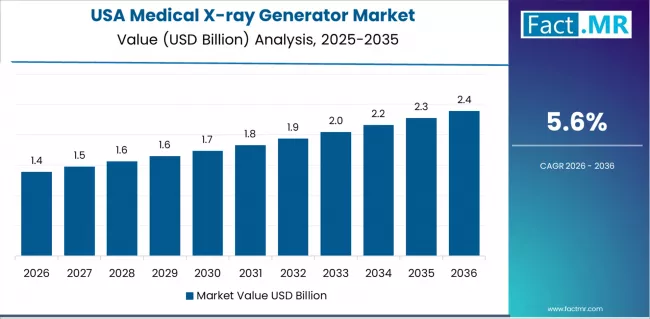
Medical X Ray Generator Market Country Value Analysis | Source: Fact.MR
The market in the USA is expected to grow at a CAGR of 5.6%. Growth in this mature market is driven by the ongoing need to replace aging generators, comply with evolving dose safety regulations, and integrate new AI and connectivity features. The shift towards outpatient imaging centers and ambulatory surgical centers also creates demand for compact, efficient generator solutions outside traditional hospital settings.
How does German Engineering and Regulation Influence Demand?
The market in Germany is forecast to grow at a CAGR of 5.2%. Germany's stringent radiation protection laws and high standards for diagnostic quality create a consistent demand for generators with superior dose control and image consistency. The market is characterized by a preference for reliable, high-performance engineering from established manufacturers, with growth supported by public and private investments in healthcare infrastructure modernization.
What Supports the UK’s Focus on Efficiency and Safety?
The market in the UK is projected to grow at a CAGR of 4.9%. The National Health Service's (NHS) focus on operational efficiency, patient safety, and equipment standardization drives the adoption of digital generators with advanced dose management and workflow features. Replacement programs for outdated equipment and investments in community diagnostic centers are key factors sustaining market growth.
Competitive Landscape of the Medical X-ray Generator Market
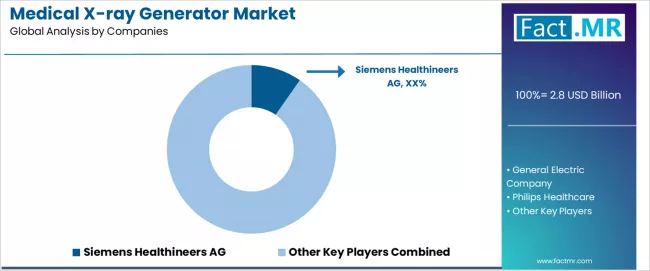
Medical X Ray Generator Market Analysis By Company | Source: Fact.MR
Global diversified healthcare technology giants with deep expertise in imaging dominate the competitive landscape. Competition centers on technological innovation in generator efficiency and digital integration, the strength of global service and distribution networks, and the ability to offer generators as part of a broader ecosystem of imaging equipment, software, and services.
Success depends on continuous R&D to improve dose efficiency and image quality, while forming strategic partnerships with healthcare providers to modernize entire imaging departments.
Key Players in the Medical X-ray Generator Market
- Siemens Healthineers AG
- General Electric Company
- Philips Healthcare
- Canon Medical Systems Corporation
- Fujifilm Holdings Corporation
- Hologic Incorporated
- Shimadzu Corporation
- Carestream Health Incorporated
- Agfa-Gevaert Group
- Konica Minolta Healthcare
- Hitachi Medical Corporation
- Varian Medical Systems Incorporated
- Planmed Oy
- Control-X Medical Limited
- Medical Econet Company Limited
Segmentation
Scope of the Report
| Items | Values |
|---|---|
| Quantitative Units (2026) | USD 2.8 Billion |
| Generator Type | Stationary X-ray Generators, Portable X-ray Generators, Mobile X-ray Generators, Dental X-ray Generators, Other Generator Configurations |
| Application Sector | Hospitals, Diagnostic Centers, Specialty Clinics, Emergency Care Facilities, Others |
| Power Rating | Low Power Generators, Medium Power Generators, High Power Generators, Other Power Platforms |
| Technology Type | High-frequency Generators, Constant Potential Generators, Battery-powered Generators, Other Technology Services |
| Regions Covered | North America, Europe, Asia Pacific, Latin America, MEA, Other Regions |
| Countries Covered | China, India, Germany, Brazil, USA, UK, South Korea, and 40+ countries |
| Key Companies Profiled | Siemens Healthineers AG, General Electric Company, Philips Healthcare, Canon Medical Systems Corporation, Fujifilm Holdings Corporation, and other leading medical generator companies |
| Additional Attributes | Dollar sales by generator type, application sector, power rating, technology type, and region; regional demand trends, competitive landscape, technological advancements in generator engineering, diagnostic performance optimization initiatives, dose control enhancement programs, and premium product development strategies |
Source: Fact.MR analysis. Updated Dec 18, 2025
Medical X-ray Generator Market by Segments
-
Generator Type :
- Stationary X-ray Generators
- Portable X-ray Generators
- Mobile X-ray Generators
- Dental X-ray Generators
- Other Generator Configurations
-
Application Sector :
- Hospitals
- Diagnostic Centers
- Specialty Clinics
- Emergency Care Facilities
- Others
-
Power Rating :
- Low Power Generators
- Medium Power Generators
- High Power Generators
- Other Power Platforms
-
Technology Type :
- High-frequency Generators
- Constant Potential Generators
- Battery-powered Generators
- Other Technology Services
-
Region :
-
North America
- USA
- Canada
- Mexico
-
Europe
- Germany
- UK
- France
- Italy
- Spain
- Nordic Countries
- BENELUX
- Rest of Europe
-
Asia Pacific
- China
- India
- Japan
- South Korea
- Australia
- Rest of Asia Pacific
-
Latin America
- Brazil
- Argentina
- Rest of Latin America
-
MEA
- Saudi Arabia
- UAE
- South Africa
- Rest of MEA
-
Frequently Asked Questions
How big is the medical x-ray generator market in 2026?
What will be the size of medical x-ray generator market in 2036?
How much will be the medical x-ray generator market growth between 2026 and 2036?
What are the key product types in the medical x-ray generator market?
Which application sector segment to contribute significant share in the medical x-ray generator market in 2026?
Who worked on this report


Preview the report firsthand - request a free sample
Free SampleGet the brochure for pricing and purchase details
Download PDF