Contactless Trigger Market (2026 - 2036)

Contactless Trigger Market Size and Share Forecast Outlook 2026 to 2036

Core Findings

    Contactless Trigger Market Forecast and Outlook 2026 to 2036

    The contactless trigger market is expected to be valued at USD 682.5 million in 2026, and reach USD 1,143.9 million by 2036, at 5.3% CAGR.

    Contactless Trigger Market Key Takeaways

    • Contactless Trigger Market Value (2026): USD 682.5 million
    • Contactless Trigger Market Forecast Value (2036): USD 1,143.9 million
    • Contactless Trigger Market Forecast CAGR 2026 to 2036: 5.3%
    • Leading Sensing Technology in Contactless Trigger Market: Hall-Effect Sensors (34.0%)
    • Key Growth Region in Contactless Trigger Market: Asia Pacific
    • Key Players in Contactless Trigger Market: KEYENCE, SICK, Omron, Banner Engineering, ifm electronic, Pepperl+Fuchs, Schneider Electric, Rockwell Automation, Pilz, Honeywell Sensing
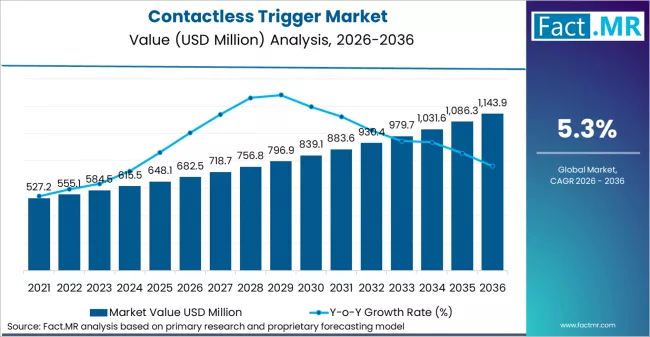
    Contactless Trigger Market Market Value Analysis

    Market development is shaped by rising deployment of touch-free activation interfaces across industrial machinery, medical devices, power tools, and access control systems. Contactless triggers function as critical input components that eliminate mechanical wear, reduce contamination risk, and improve operational reliability in high-cycle environments. Demand formation reflects increasing automation density and hygiene sensitivity in workplaces where repeated physical contact with switches creates durability and safety challenges. OEMs integrate contactless triggers to support sealed designs, compact form factors, and consistent actuation performance under dust, vibration, and moisture exposure.

    Growth behavior remains closely tied to system-level integration rather than standalone component replacement. Capital allocation favors sensing technologies delivering stable detection, low latency, and compatibility with industrial communication standards. Adoption concentrates within industrial HMI panels, automated equipment, and regulated environments prioritizing uptime and interface reliability. Market expansion aligns with broader trends toward smart infrastructure, ergonomic control design, and reduction of mechanical failure points across industrial and commercial applications.

    Contactless Trigger Market

    Metric Value
    Estimated Value in (2026E) USD 682.5 million
    Forecast Value in (2036F) USD 1,143.9 million
    Forecast CAGR 2026 to 2036 5.3%

    Category

    Category Segments
    Sensing Technology Hall-Effect; Optical / ToF; Inductive; Capacitive; Ultrasonic
    Application Industrial HMI / Machinery; Power Tools; Automotive Controls; Medical Devices; Access / Security
    Interface IO-Link / Industrial; Analog / TTL; Safety-Rated (SIL / PL); Wireless
    Sales Channel OEM Direct; Industrial Distributors; E-commerce; System Integrators
    Region North America; Europe; Asia Pacific; Latin America; Middle East & Africa

    Segmental Analysis

    What Is the Impact of Sensing Technology on the Contactless Trigger Market?
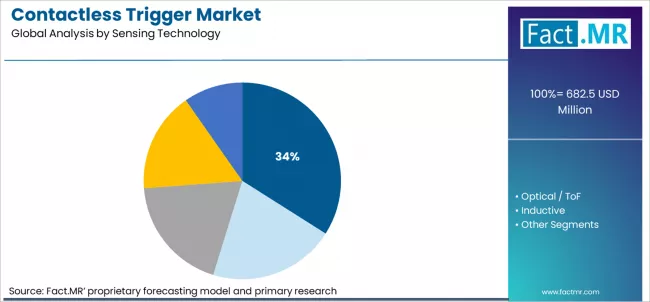
    Contactless Trigger Market Analysis By Sensing Technology

    In the contactless trigger market, sensing technology defines response accuracy, environmental tolerance, and integration feasibility across equipment interfaces. Hall effect sensing leads with a 34.0% share, reflecting its robustness under dust, vibration, and electromagnetic interference conditions. These sensors enable reliable non-contact actuation with consistent signal stability, making them suitable for harsh industrial environments. Their compact form factor and low power consumption support integration into control panels, handheld devices, and sealed interfaces where mechanical wear and false triggering must be minimized.

    How Does Application Influence Demand in the Contactless Trigger Market?
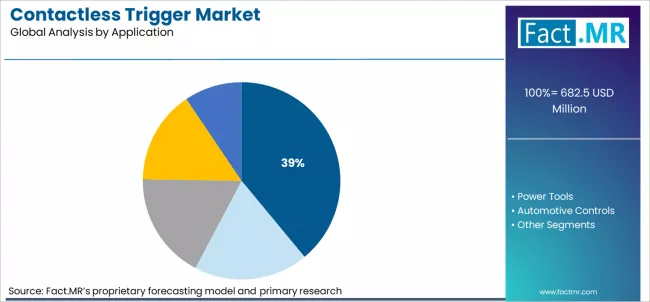
    Contactless Trigger Market Analysis By Application

    Application requirements strongly influence adoption patterns by determining durability expectations and interface complexity. Industrial HMI and machinery applications account for a 39.0% share, driven by the need for contactless inputs in automated production environments. These systems rely on touch-free triggers to improve hygiene, reduce mechanical failure points, and maintain consistent operation under continuous use. Integration into machinery controls supports safer operation, improved uptime, and compatibility with modern industrial automation architectures.

    What are the Drivers, Restraints, and Key Trends in the Contactless Trigger Market?

    • Drivers: Demand for contactless triggers is shaped by health and hygiene concerns in public, retail and commercial environments that require reduced touchpoints. Contactless triggers enable activation of doors, water dispensers, lighting and sanitation equipment without physical contact, supporting infection control and improved user confidence. Adoption is boosted by integration of sensor technology with smart building systems and by rising interest in accessible design that accommodates users with mobility limitations.
    • Restraints: Higher initial cost for contactless trigger systems can limit uptake in price sensitive segments, especially where legacy push plates and mechanical switches remain functional. Variability in sensor reliability under different environmental conditions, such as lighting changes or heavy foot traffic, can lead to false activations or missed activations and reduce user satisfaction. Integration with existing infrastructure requires compatibility checks with power supply and control systems, creating technical complexity for retrofit projects.
    • Trend 1: Development of multi-mode activation triggers that support both gesture recognition and proximity sensing to improve detection accuracy and user experience across diverse settings.
    • Trend 2: Increasing use of wireless protocols and battery assist power options to reduce wiring requirements and support flexible placement in retrofit and new build projects.

    Analysis of the Contactless Trigger Market by Key Country
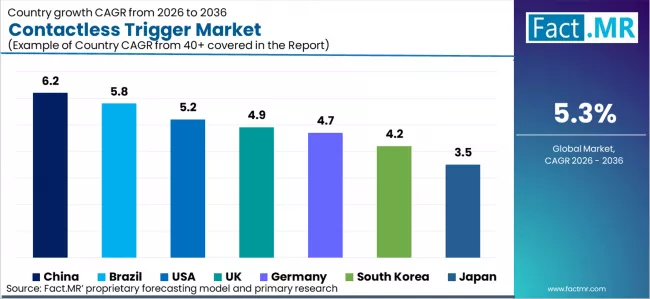
    Contactless Trigger Market Cagr Analysis By Country

    Country CAGR (%)
    China 6.2%
    Brazil 5.8%
    USA 5.2%
    UK 4.9%
    Germany 4.7%
    South Korea 4.2%
    Japan 3.5%

    The report covers an in-depth analysis of 40+ countries; top-performing countries are highlighted below.

    What is driving growth of contactless trigger demand in China?

    Demand for contactless triggers in China is expanding as manufacturing, healthcare, and consumer appliance sectors adopt touch-free control solutions. Growth at 6.2% CAGR reflects rising use in automated dispensing, industrial equipment, and public-use devices requiring hygiene assurance. Large-scale manufacturing increases integration of sensors supporting reliable activation without physical contact. Workplace safety standards emphasize reduction of repetitive strain and contamination risk. Domestic electronics suppliers enable cost-efficient production at scale. Demand remains concentrated within smart appliances, factory automation, and public infrastructure applications serving dense urban environments.

    • Expansion of automated manufacturing systems
    • Rising focus on hygiene and contamination control
    • High-volume electronics production capability
    • Adoption across public-use equipment

    Why is Brazil seeing expansion in contactless trigger adoption?

    Contactless trigger demand in Brazil is rising as healthcare, sanitation, and industrial sectors strengthen hygiene practices. Growth at 5.8% CAGR reflects adoption in dispensers, cleaning equipment, and industrial tools used in shared workspaces. Employers prioritize reducing cross-contact risks and improving worker ergonomics. Urban infrastructure projects increase deployment of touch-free control interfaces. Equipment selection emphasizes durability and reliable sensor performance under varied environmental conditions. Demand remains driven by domestic consumption across healthcare facilities, public buildings, and industrial operations.

    • Growth of hygiene-focused equipment deployment
    • Demand from healthcare and sanitation sectors
    • Focus on ergonomic tool operation
    • Expansion of urban public infrastructure

    What factors are shaping contactless trigger sales in the USA?

    Sales of contactless triggers in the USA are increasing as industries adopt touch-free interfaces for safety and efficiency. Growth at 5.2% CAGR reflects usage across medical devices, industrial machinery, consumer appliances, and smart dispensing systems. Regulatory standards encourage minimizing physical contact in shared environments. Employers address worker comfort and productivity through ergonomic activation solutions. Technology integration emphasizes reliability, response accuracy, and compatibility with digital control systems. Demand centers on professional and regulated applications rather than mass consumer novelty products.

    • Adoption in medical and industrial equipment
    • Emphasis on regulatory compliance and safety
    • Integration with digital control platforms
    • Focus on ergonomic and productivity benefits

    How is the UK supporting growth of contactless trigger demand?

    Contactless trigger demand in the UK is advancing as public facilities and workplaces prioritize hygiene and accessibility. Growth at 4.9% CAGR reflects adoption across healthcare settings, commercial buildings, and industrial environments. Public procurement policies encourage touch-free solutions to support infection control. Equipment buyers emphasize reliability and ease of maintenance. Demand remains concentrated within regulated sectors requiring documented safety and hygiene compliance rather than consumer-driven applications.

    • Public sector hygiene requirements
    • Demand from healthcare and commercial buildings
    • Focus on accessibility and safety compliance
    • Preference for reliable low-maintenance systems

    What is driving expansion of contactless trigger demand in Germany?

    Demand for contactless triggers in Germany is rising as precision engineering and industrial automation integrate touch-free controls. Growth at 4.7% CAGR reflects adoption within manufacturing equipment, laboratory devices, and public-use systems. Engineering standards emphasize operational reliability, sensor accuracy, and system integration. Workplace safety regulations support reduction of physical strain and contamination exposure. Demand remains driven by industrial and technical applications rather than disposable consumer products.

    • Integration within industrial automation systems
    • High standards for sensor accuracy
    • Emphasis on workplace safety compliance
    • Demand from laboratory and technical equipment

    How is South Korea shaping demand for contactless triggers?

    Contactless trigger demand in South Korea is growing as electronics and manufacturing sectors expand touch-free interface usage. Growth at 4.2% CAGR reflects adoption across smart appliances, industrial tools, and healthcare equipment. Export-oriented manufacturers align designs with global hygiene and safety standards. Compact design and sensor reliability influence purchasing decisions. Demand focuses on applications supporting automation and smart device integration.

    • Expansion of smart appliance manufacturing
    • Alignment with global hygiene standards
    • Demand for compact sensor-based controls
    • Integration with automated equipment

    What factors are influencing contactless trigger demand in Japan?

    Demand for contactless triggers in Japan is expanding steadily as industries emphasize precision, hygiene, and long-term reliability. Growth at 3.5% CAGR reflects cautious adoption across healthcare devices, industrial equipment, and specialized consumer products. Conservative investment patterns favor proven technologies with stable performance. Emphasis remains on quality, durability, and integration with existing systems. Demand concentrates within specialized manufacturing and medical environments rather than large-scale public infrastructure deployment.

    • Focus on precision and reliability
    • Adoption within healthcare and industrial devices
    • Conservative technology investment behavior
    • Emphasis on long service life

    What Defines the Competitive Landscape for the Contactless Trigger Market Globally?
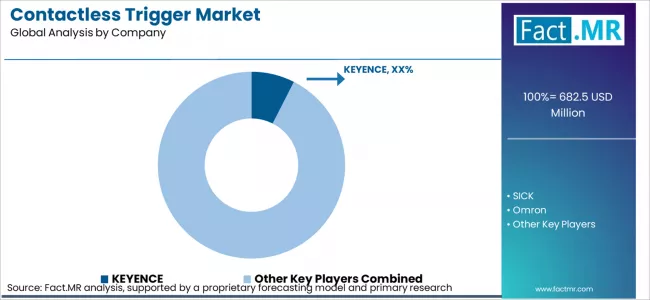
    Contactless Trigger Market Analysis By Company

    Global demand for contactless triggers is driven by automation density, hygiene requirements, and precision sensing needs across manufacturing, logistics, and packaging. System integrators and OEMs assess response time, sensing distance stability, immunity to dust and vibration, and repeatability at high cycle rates. Evaluation also includes IO-Link connectivity, ease of parameterization, environmental ratings, and compatibility with safety and motion systems. Procurement behavior favors suppliers with broad sensor portfolios, rapid availability, and application engineering support for fast commissioning. Industry direction reflects increasing use in high-speed inspection, robotic handling, and smart factories requiring reliable, non-contact actuation.

    KEYENCE holds leading positioning through high-performance optical and proximity triggers offering fast response and stable detection across varied surfaces. SICK competes with robust photoelectric and inductive solutions optimized for harsh industrial environments. Omron maintains relevance via compact sensors integrated with control platforms and factory automation ecosystems. Banner Engineering supports demand with flexible sensing options and strong presence in packaging and material handling. Pepperl+Fuchs participates through precision inductive and intrinsically safe triggers serving process and hazardous-area applications. Competitive differentiation centers on detection reliability, integration flexibility, environmental robustness, and global service coverage.

    Key Players in the Contactless Trigger Market

    • KEYENCE
    • SICK
    • Omron
    • Banner Engineering
    • ifm electronic
    • Pepperl+Fuchs
    • Schneider Electric
    • Rockwell Automation
    • Pilz
    • Honeywell Sensing

    Contactless Trigger Market Key Segment

    • Sensing Technology :

      • Hall-Effect
      • Optical / ToF
      • Inductive
      • Capacitive
      • Ultrasonic
    • Application :

      • Industrial HMI / Machinery
      • Power Tools
      • Automotive Controls
      • Medical Devices
      • Access / Security
    • Interface :

      • IO-Link / Industrial
      • Analog / TTL
      • Safety-Rated (SIL / PL)
      • Wireless
    • Sales Channel :

      • OEM Direct
      • Industrial Distributors
      • E-commerce
      • System Integrators
    • Region :

      • North America
        • USA
        • Canada
        • Mexico
      • Europe
        • Germany
        • UK
        • France
        • Italy
        • Spain
        • Nordic Countries
        • BENELUX
        • Rest of Europe
      • Asia Pacific
        • China
        • Japan
        • South Korea
        • India
        • Australia
        • Rest of Asia Pacific
      • Latin America
        • Brazil
        • Argentina
        • Rest of Latin America
      • Middle East and Africa
        • Kingdom of Saudi Arabia
        • United Arab Emirates
        • South Africa
        • Rest of Middle East and Africa
      • Other Regions
        • Oceania
        • Central Asia
        • Other Markets

    Bibliographies

    • International Organization for Standardization. (2023). ISO 13849-1: Safety of machinery-Safety-related parts of control systems-General principles for design. ISO.
    • International Electrotechnical Commission. (2024). IEC 60947-5-2: Low-voltage switchgear and controlgear-Proximity switches. IEC.
    • International Electrotechnical Commission. (2023). IEC 61131-9: Programmable controllers-Single-drop digital communication interface (IO-Link). IEC.
    • Occupational Safety and Health Administration. (2024). Engineering controls for contactless activation and hygiene-critical equipment. U.S. Department of Labor.
    • KEYENCE Corporation. (2024). Non-contact sensing technologies for industrial trigger applications. KEYENCE Technical Guide.

    Table of Content

    1. Executive Summary
      • Global Market Outlook
      • Demand to side Trends
      • Supply to side Trends
      • Technology Roadmap Analysis
      • Analysis and Recommendations
    2. Market Overview
      • Market Coverage / Taxonomy
      • Market Definition / Scope / Limitations
    3. Research Methodology
      • Chapter Orientation
      • Analytical Lens and Working Hypotheses
        • Market Structure, Signals, and Trend Drivers
        • Benchmarking and Cross-market Comparability
        • Market Sizing, Forecasting, and Opportunity Mapping
      • Research Design and Evidence Framework
        • Desk Research Programme (Secondary Evidence)
          • Company Annual and Sustainability Reports
          • Peer-reviewed Journals and Academic Literature
          • Corporate Websites, Product Literature, and Technical Notes
          • Earnings Decks and Investor Briefings
          • Statutory Filings and Regulatory Disclosures
          • Technical White Papers and Standards Notes
          • Trade Journals, Industry Magazines, and Analyst Briefs
          • Conference Proceedings, Webinars, and Seminar Materials
          • Government Statistics Portals and Public Data Releases
          • Press Releases and Reputable Media Coverage
          • Specialist Newsletters and Curated Briefings
          • Sector Databases and Reference Repositories
          • FMR Internal Proprietary Databases and Historical Market Datasets
          • Subscription Datasets and Paid Sources
          • Social Channels, Communities, and Digital Listening Inputs
          • Additional Desk Sources
        • Expert Input and Fieldwork (Primary Evidence)
          • Primary Modes
            • Qualitative Interviews and Expert Elicitation
            • Quantitative Surveys and Structured Data Capture
            • Blended A9oach
          • Why Primary Evidence is Used
          • Field Techniques
            • Interviews
            • Surveys
            • Focus Groups
            • Observational and In-context Research
            • Social and Community Interactions
          • Stakeholder Universe Engaged
            • C-suite Leaders
            • Board Members
            • Presidents and Vice Presidents
            • R&D and Innovation Heads
            • Technical Specialists
            • Domain Subject-matter Experts
            • Scientists
            • Physicians and Other Healthcare Professionals
          • Governance, Ethics, and Data Stewardship
            • Research Ethics
            • Data Integrity and Handling
        • Tooling, Models, and Reference Databases
      • Data Engineering and Model Build
        • Data Acquisition and Ingestion
        • Cleaning, Normalisation, and Verification
        • Synthesis, Triangulation, and Analysis
      • Quality Assurance and Audit Trail
    4. Market Background
      • Market Dynamics
        • Drivers
        • Restraints
        • Opportunity
        • Trends
      • Scenario Forecast
        • Demand in Optimistic Scenario
        • Demand in Likely Scenario
        • Demand in Conservative Scenario
      • Opportunity Map Analysis
      • Product Life Cycle Analysis
      • Supply Chain Analysis
      • Investment Feasibility Matrix
      • Value Chain Analysis
      • PESTLE and Porter’s Analysis
      • Regulatory Landscape
      • Regional Parent Market Outlook
      • Production and Consumption Statistics
      • Import and Export Statistics
    5. Global Market Analysis 2021 to 2025 and Forecast, 2026 to 2036
      • Historical Market Size Value (USD Million) Analysis, 2021 to 2025
      • Current and Future Market Size Value (USD Million) Projections, 2026 to 2036
        • Y to o to Y Growth Trend Analysis
        • Absolute $ Opportunity Analysis
    6. Global Market Pricing Analysis 2021 to 2025 and Forecast 2026 to 2036
    7. Global Market Analysis 2021 to 2025 and Forecast 2026 to 2036, By Sensing Technology
      • Introduction / Key Findings
      • Historical Market Size Value (USD Million) Analysis By Sensing Technology, 2021 to 2025
      • Current and Future Market Size Value (USD Million) Analysis and Forecast By Sensing Technology, 2026 to 2036
        • Hall-Effect
        • Optical / ToF
        • Inductive
        • Capacitive
        • Ultrasonic
      • Y to o to Y Growth Trend Analysis By Sensing Technology, 2021 to 2025
      • Absolute $ Opportunity Analysis By Sensing Technology, 2026 to 2036
    8. Global Market Analysis 2021 to 2025 and Forecast 2026 to 2036, By Application
      • Introduction / Key Findings
      • Historical Market Size Value (USD Million) Analysis By Application, 2021 to 2025
      • Current and Future Market Size Value (USD Million) Analysis and Forecast By Application, 2026 to 2036
        • Industrial HMI / Machinery
        • Power Tools
        • Automotive Controls
        • Medical Devices
        • Access / Security
      • Y to o to Y Growth Trend Analysis By Application, 2021 to 2025
      • Absolute $ Opportunity Analysis By Application, 2026 to 2036
    9. Global Market Analysis 2021 to 2025 and Forecast 2026 to 2036, By Interface
      • Introduction / Key Findings
      • Historical Market Size Value (USD Million) Analysis By Interface, 2021 to 2025
      • Current and Future Market Size Value (USD Million) Analysis and Forecast By Interface, 2026 to 2036
        • IO-Link / Industrial
        • Analog / TTL
        • Safety-Rated (SIL / PL)
        • Wireless
      • Y to o to Y Growth Trend Analysis By Interface, 2021 to 2025
      • Absolute $ Opportunity Analysis By Interface, 2026 to 2036
    10. Global Market Analysis 2021 to 2025 and Forecast 2026 to 2036, By Sales Channel
      • Introduction / Key Findings
      • Historical Market Size Value (USD Million) Analysis By Sales Channel, 2021 to 2025
      • Current and Future Market Size Value (USD Million) Analysis and Forecast By Sales Channel, 2026 to 2036
        • OEM Direct
        • Industrial Distributors
        • E-commerce
        • System Integrators
      • Y to o to Y Growth Trend Analysis By Sales Channel, 2021 to 2025
      • Absolute $ Opportunity Analysis By Sales Channel, 2026 to 2036
    11. Global Market Analysis 2021 to 2025 and Forecast 2026 to 2036, By Region
      • Introduction
      • Historical Market Size Value (USD Million) Analysis By Region, 2021 to 2025
      • Current Market Size Value (USD Million) Analysis and Forecast By Region, 2026 to 2036
        • North America
        • Latin America
        • Western Europe
        • Eastern Europe
        • East Asia
        • South Asia and Pacific
        • Middle East & Africa
      • Market Attractiveness Analysis By Region
    12. North America Market Analysis 2021 to 2025 and Forecast 2026 to 2036, By Country
      • Historical Market Size Value (USD Million) Trend Analysis By Market Taxonomy, 2021 to 2025
      • Market Size Value (USD Million) Forecast By Market Taxonomy, 2026 to 2036
        • By Country
          • USA
          • Canada
          • Mexico
        • By Sensing Technology
        • By Application
        • By Interface
        • By Sales Channel
      • Market Attractiveness Analysis
        • By Country
        • By Sensing Technology
        • By Application
        • By Interface
        • By Sales Channel
      • Key Takeaways
    13. Latin America Market Analysis 2021 to 2025 and Forecast 2026 to 2036, By Country
      • Historical Market Size Value (USD Million) Trend Analysis By Market Taxonomy, 2021 to 2025
      • Market Size Value (USD Million) Forecast By Market Taxonomy, 2026 to 2036
        • By Country
          • Brazil
          • Chile
          • Rest of Latin America
        • By Sensing Technology
        • By Application
        • By Interface
        • By Sales Channel
      • Market Attractiveness Analysis
        • By Country
        • By Sensing Technology
        • By Application
        • By Interface
        • By Sales Channel
      • Key Takeaways
    14. Western Europe Market Analysis 2021 to 2025 and Forecast 2026 to 2036, By Country
      • Historical Market Size Value (USD Million) Trend Analysis By Market Taxonomy, 2021 to 2025
      • Market Size Value (USD Million) Forecast By Market Taxonomy, 2026 to 2036
        • By Country
          • Germany
          • UK
          • Italy
          • Spain
          • France
          • Nordic
          • BENELUX
          • Rest of Western Europe
        • By Sensing Technology
        • By Application
        • By Interface
        • By Sales Channel
      • Market Attractiveness Analysis
        • By Country
        • By Sensing Technology
        • By Application
        • By Interface
        • By Sales Channel
      • Key Takeaways
    15. Eastern Europe Market Analysis 2021 to 2025 and Forecast 2026 to 2036, By Country
      • Historical Market Size Value (USD Million) Trend Analysis By Market Taxonomy, 2021 to 2025
      • Market Size Value (USD Million) Forecast By Market Taxonomy, 2026 to 2036
        • By Country
          • Russia
          • Poland
          • Hungary
          • Balkan & Baltic
          • Rest of Eastern Europe
        • By Sensing Technology
        • By Application
        • By Interface
        • By Sales Channel
      • Market Attractiveness Analysis
        • By Country
        • By Sensing Technology
        • By Application
        • By Interface
        • By Sales Channel
      • Key Takeaways
    16. East Asia Market Analysis 2021 to 2025 and Forecast 2026 to 2036, By Country
      • Historical Market Size Value (USD Million) Trend Analysis By Market Taxonomy, 2021 to 2025
      • Market Size Value (USD Million) Forecast By Market Taxonomy, 2026 to 2036
        • By Country
          • China
          • Japan
          • South Korea
        • By Sensing Technology
        • By Application
        • By Interface
        • By Sales Channel
      • Market Attractiveness Analysis
        • By Country
        • By Sensing Technology
        • By Application
        • By Interface
        • By Sales Channel
      • Key Takeaways
    17. South Asia and Pacific Market Analysis 2021 to 2025 and Forecast 2026 to 2036, By Country
      • Historical Market Size Value (USD Million) Trend Analysis By Market Taxonomy, 2021 to 2025
      • Market Size Value (USD Million) Forecast By Market Taxonomy, 2026 to 2036
        • By Country
          • India
          • ASEAN
          • Australia & New Zealand
          • Rest of South Asia and Pacific
        • By Sensing Technology
        • By Application
        • By Interface
        • By Sales Channel
      • Market Attractiveness Analysis
        • By Country
        • By Sensing Technology
        • By Application
        • By Interface
        • By Sales Channel
      • Key Takeaways
    18. Middle East & Africa Market Analysis 2021 to 2025 and Forecast 2026 to 2036, By Country
      • Historical Market Size Value (USD Million) Trend Analysis By Market Taxonomy, 2021 to 2025
      • Market Size Value (USD Million) Forecast By Market Taxonomy, 2026 to 2036
        • By Country
          • Kingdom of Saudi Arabia
          • Other GCC Countries
          • Turkiye
          • South Africa
          • Other African Union
          • Rest of Middle East & Africa
        • By Sensing Technology
        • By Application
        • By Interface
        • By Sales Channel
      • Market Attractiveness Analysis
        • By Country
        • By Sensing Technology
        • By Application
        • By Interface
        • By Sales Channel
      • Key Takeaways
    19. Key Countries Market Analysis
      • USA
        • Pricing Analysis
        • Market Share Analysis, 2025
          • By Sensing Technology
          • By Application
          • By Interface
          • By Sales Channel
      • Canada
        • Pricing Analysis
        • Market Share Analysis, 2025
          • By Sensing Technology
          • By Application
          • By Interface
          • By Sales Channel
      • Mexico
        • Pricing Analysis
        • Market Share Analysis, 2025
          • By Sensing Technology
          • By Application
          • By Interface
          • By Sales Channel
      • Brazil
        • Pricing Analysis
        • Market Share Analysis, 2025
          • By Sensing Technology
          • By Application
          • By Interface
          • By Sales Channel
      • Chile
        • Pricing Analysis
        • Market Share Analysis, 2025
          • By Sensing Technology
          • By Application
          • By Interface
          • By Sales Channel
      • Germany
        • Pricing Analysis
        • Market Share Analysis, 2025
          • By Sensing Technology
          • By Application
          • By Interface
          • By Sales Channel
      • UK
        • Pricing Analysis
        • Market Share Analysis, 2025
          • By Sensing Technology
          • By Application
          • By Interface
          • By Sales Channel
      • Italy
        • Pricing Analysis
        • Market Share Analysis, 2025
          • By Sensing Technology
          • By Application
          • By Interface
          • By Sales Channel
      • Spain
        • Pricing Analysis
        • Market Share Analysis, 2025
          • By Sensing Technology
          • By Application
          • By Interface
          • By Sales Channel
      • France
        • Pricing Analysis
        • Market Share Analysis, 2025
          • By Sensing Technology
          • By Application
          • By Interface
          • By Sales Channel
      • India
        • Pricing Analysis
        • Market Share Analysis, 2025
          • By Sensing Technology
          • By Application
          • By Interface
          • By Sales Channel
      • ASEAN
        • Pricing Analysis
        • Market Share Analysis, 2025
          • By Sensing Technology
          • By Application
          • By Interface
          • By Sales Channel
      • Australia & New Zealand
        • Pricing Analysis
        • Market Share Analysis, 2025
          • By Sensing Technology
          • By Application
          • By Interface
          • By Sales Channel
      • China
        • Pricing Analysis
        • Market Share Analysis, 2025
          • By Sensing Technology
          • By Application
          • By Interface
          • By Sales Channel
      • Japan
        • Pricing Analysis
        • Market Share Analysis, 2025
          • By Sensing Technology
          • By Application
          • By Interface
          • By Sales Channel
      • South Korea
        • Pricing Analysis
        • Market Share Analysis, 2025
          • By Sensing Technology
          • By Application
          • By Interface
          • By Sales Channel
      • Russia
        • Pricing Analysis
        • Market Share Analysis, 2025
          • By Sensing Technology
          • By Application
          • By Interface
          • By Sales Channel
      • Poland
        • Pricing Analysis
        • Market Share Analysis, 2025
          • By Sensing Technology
          • By Application
          • By Interface
          • By Sales Channel
      • Hungary
        • Pricing Analysis
        • Market Share Analysis, 2025
          • By Sensing Technology
          • By Application
          • By Interface
          • By Sales Channel
      • Kingdom of Saudi Arabia
        • Pricing Analysis
        • Market Share Analysis, 2025
          • By Sensing Technology
          • By Application
          • By Interface
          • By Sales Channel
      • Turkiye
        • Pricing Analysis
        • Market Share Analysis, 2025
          • By Sensing Technology
          • By Application
          • By Interface
          • By Sales Channel
      • South Africa
        • Pricing Analysis
        • Market Share Analysis, 2025
          • By Sensing Technology
          • By Application
          • By Interface
          • By Sales Channel
    20. Market Structure Analysis
      • Competition Dashboard
      • Competition Benchmarking
      • Market Share Analysis of Top Players
        • By Regional
        • By Sensing Technology
        • By Application
        • By Interface
        • By Sales Channel
    21. Competition Analysis
      • Competition Deep Dive
        • KEYENCE
          • Overview
          • Product Portfolio
          • Profitability by Market Segments (Product/Age /Sales Channel/Region)
          • Sales Footprint
          • Strategy Overview
            • Marketing Strategy
            • Product Strategy
            • Channel Strategy
        • SICK
        • Omron
        • Banner Engineering
        • ifm electronic
        • Pepperl+Fuchs
        • Schneider Electric
        • Rockwell Automation
        • Pilz
        • Honeywell Sensing
    22. Assumptions & Acronyms Used

    List Of Table

    • Table 1: Global Market Value (USD Million) Forecast by Region, 2021 to 2036
    • Table 2: Global Market Value (USD Million) Forecast by Sensing Technology, 2021 to 2036
    • Table 3: Global Market Value (USD Million) Forecast by Application, 2021 to 2036
    • Table 4: Global Market Value (USD Million) Forecast by Interface, 2021 to 2036
    • Table 5: Global Market Value (USD Million) Forecast by Sales Channel, 2021 to 2036
    • Table 6: North America Market Value (USD Million) Forecast by Country, 2021 to 2036
    • Table 7: North America Market Value (USD Million) Forecast by Sensing Technology, 2021 to 2036
    • Table 8: North America Market Value (USD Million) Forecast by Application, 2021 to 2036
    • Table 9: North America Market Value (USD Million) Forecast by Interface, 2021 to 2036
    • Table 10: North America Market Value (USD Million) Forecast by Sales Channel, 2021 to 2036
    • Table 11: Latin America Market Value (USD Million) Forecast by Country, 2021 to 2036
    • Table 12: Latin America Market Value (USD Million) Forecast by Sensing Technology, 2021 to 2036
    • Table 13: Latin America Market Value (USD Million) Forecast by Application, 2021 to 2036
    • Table 14: Latin America Market Value (USD Million) Forecast by Interface, 2021 to 2036
    • Table 15: Latin America Market Value (USD Million) Forecast by Sales Channel, 2021 to 2036
    • Table 16: Western Europe Market Value (USD Million) Forecast by Country, 2021 to 2036
    • Table 17: Western Europe Market Value (USD Million) Forecast by Sensing Technology, 2021 to 2036
    • Table 18: Western Europe Market Value (USD Million) Forecast by Application, 2021 to 2036
    • Table 19: Western Europe Market Value (USD Million) Forecast by Interface, 2021 to 2036
    • Table 20: Western Europe Market Value (USD Million) Forecast by Sales Channel, 2021 to 2036
    • Table 21: Eastern Europe Market Value (USD Million) Forecast by Country, 2021 to 2036
    • Table 22: Eastern Europe Market Value (USD Million) Forecast by Sensing Technology, 2021 to 2036
    • Table 23: Eastern Europe Market Value (USD Million) Forecast by Application, 2021 to 2036
    • Table 24: Eastern Europe Market Value (USD Million) Forecast by Interface, 2021 to 2036
    • Table 25: Eastern Europe Market Value (USD Million) Forecast by Sales Channel, 2021 to 2036
    • Table 26: East Asia Market Value (USD Million) Forecast by Country, 2021 to 2036
    • Table 27: East Asia Market Value (USD Million) Forecast by Sensing Technology, 2021 to 2036
    • Table 28: East Asia Market Value (USD Million) Forecast by Application, 2021 to 2036
    • Table 29: East Asia Market Value (USD Million) Forecast by Interface, 2021 to 2036
    • Table 30: East Asia Market Value (USD Million) Forecast by Sales Channel, 2021 to 2036
    • Table 31: South Asia and Pacific Market Value (USD Million) Forecast by Country, 2021 to 2036
    • Table 32: South Asia and Pacific Market Value (USD Million) Forecast by Sensing Technology, 2021 to 2036
    • Table 33: South Asia and Pacific Market Value (USD Million) Forecast by Application, 2021 to 2036
    • Table 34: South Asia and Pacific Market Value (USD Million) Forecast by Interface, 2021 to 2036
    • Table 35: South Asia and Pacific Market Value (USD Million) Forecast by Sales Channel, 2021 to 2036
    • Table 36: Middle East & Africa Market Value (USD Million) Forecast by Country, 2021 to 2036
    • Table 37: Middle East & Africa Market Value (USD Million) Forecast by Sensing Technology, 2021 to 2036
    • Table 38: Middle East & Africa Market Value (USD Million) Forecast by Application, 2021 to 2036
    • Table 39: Middle East & Africa Market Value (USD Million) Forecast by Interface, 2021 to 2036
    • Table 40: Middle East & Africa Market Value (USD Million) Forecast by Sales Channel, 2021 to 2036

    List Of Figures

    • Figure 1: Global Market Pricing Analysis
    • Figure 2: Global Market Value (USD Million) Forecast 2021 to 2036
    • Figure 3: Global Market Value Share and BPS Analysis by Sensing Technology, 2026 and 2036
    • Figure 4: Global Market Y to o to Y Growth Comparison by Sensing Technology, 2026 to 2036
    • Figure 5: Global Market Attractiveness Analysis by Sensing Technology
    • Figure 6: Global Market Value Share and BPS Analysis by Application, 2026 and 2036
    • Figure 7: Global Market Y to o to Y Growth Comparison by Application, 2026 to 2036
    • Figure 8: Global Market Attractiveness Analysis by Application
    • Figure 9: Global Market Value Share and BPS Analysis by Interface, 2026 and 2036
    • Figure 10: Global Market Y to o to Y Growth Comparison by Interface, 2026 to 2036
    • Figure 11: Global Market Attractiveness Analysis by Interface
    • Figure 12: Global Market Value Share and BPS Analysis by Sales Channel, 2026 and 2036
    • Figure 13: Global Market Y to o to Y Growth Comparison by Sales Channel, 2026 to 2036
    • Figure 14: Global Market Attractiveness Analysis by Sales Channel
    • Figure 15: Global Market Value (USD Million) Share and BPS Analysis by Region, 2026 and 2036
    • Figure 16: Global Market Y to o to Y Growth Comparison by Region, 2026 to 2036
    • Figure 17: Global Market Attractiveness Analysis by Region
    • Figure 18: North America Market Incremental Dollar Opportunity, 2026 to 2036
    • Figure 19: Latin America Market Incremental Dollar Opportunity, 2026 to 2036
    • Figure 20: Western Europe Market Incremental Dollar Opportunity, 2026 to 2036
    • Figure 21: Eastern Europe Market Incremental Dollar Opportunity, 2026 to 2036
    • Figure 22: East Asia Market Incremental Dollar Opportunity, 2026 to 2036
    • Figure 23: South Asia and Pacific Market Incremental Dollar Opportunity, 2026 to 2036
    • Figure 24: Middle East & Africa Market Incremental Dollar Opportunity, 2026 to 2036
    • Figure 25: North America Market Value Share and BPS Analysis by Country, 2026 and 2036
    • Figure 26: North America Market Value Share and BPS Analysis by Sensing Technology, 2026 and 2036
    • Figure 27: North America Market Y to o to Y Growth Comparison by Sensing Technology, 2026 to 2036
    • Figure 28: North America Market Attractiveness Analysis by Sensing Technology
    • Figure 29: North America Market Value Share and BPS Analysis by Application, 2026 and 2036
    • Figure 30: North America Market Y to o to Y Growth Comparison by Application, 2026 to 2036
    • Figure 31: North America Market Attractiveness Analysis by Application
    • Figure 32: North America Market Value Share and BPS Analysis by Interface, 2026 and 2036
    • Figure 33: North America Market Y to o to Y Growth Comparison by Interface, 2026 to 2036
    • Figure 34: North America Market Attractiveness Analysis by Interface
    • Figure 35: North America Market Value Share and BPS Analysis by Sales Channel, 2026 and 2036
    • Figure 36: North America Market Y to o to Y Growth Comparison by Sales Channel, 2026 to 2036
    • Figure 37: North America Market Attractiveness Analysis by Sales Channel
    • Figure 38: Latin America Market Value Share and BPS Analysis by Country, 2026 and 2036
    • Figure 39: Latin America Market Value Share and BPS Analysis by Sensing Technology, 2026 and 2036
    • Figure 40: Latin America Market Y to o to Y Growth Comparison by Sensing Technology, 2026 to 2036
    • Figure 41: Latin America Market Attractiveness Analysis by Sensing Technology
    • Figure 42: Latin America Market Value Share and BPS Analysis by Application, 2026 and 2036
    • Figure 43: Latin America Market Y to o to Y Growth Comparison by Application, 2026 to 2036
    • Figure 44: Latin America Market Attractiveness Analysis by Application
    • Figure 45: Latin America Market Value Share and BPS Analysis by Interface, 2026 and 2036
    • Figure 46: Latin America Market Y to o to Y Growth Comparison by Interface, 2026 to 2036
    • Figure 47: Latin America Market Attractiveness Analysis by Interface
    • Figure 48: Latin America Market Value Share and BPS Analysis by Sales Channel, 2026 and 2036
    • Figure 49: Latin America Market Y to o to Y Growth Comparison by Sales Channel, 2026 to 2036
    • Figure 50: Latin America Market Attractiveness Analysis by Sales Channel
    • Figure 51: Western Europe Market Value Share and BPS Analysis by Country, 2026 and 2036
    • Figure 52: Western Europe Market Value Share and BPS Analysis by Sensing Technology, 2026 and 2036
    • Figure 53: Western Europe Market Y to o to Y Growth Comparison by Sensing Technology, 2026 to 2036
    • Figure 54: Western Europe Market Attractiveness Analysis by Sensing Technology
    • Figure 55: Western Europe Market Value Share and BPS Analysis by Application, 2026 and 2036
    • Figure 56: Western Europe Market Y to o to Y Growth Comparison by Application, 2026 to 2036
    • Figure 57: Western Europe Market Attractiveness Analysis by Application
    • Figure 58: Western Europe Market Value Share and BPS Analysis by Interface, 2026 and 2036
    • Figure 59: Western Europe Market Y to o to Y Growth Comparison by Interface, 2026 to 2036
    • Figure 60: Western Europe Market Attractiveness Analysis by Interface
    • Figure 61: Western Europe Market Value Share and BPS Analysis by Sales Channel, 2026 and 2036
    • Figure 62: Western Europe Market Y to o to Y Growth Comparison by Sales Channel, 2026 to 2036
    • Figure 63: Western Europe Market Attractiveness Analysis by Sales Channel
    • Figure 64: Eastern Europe Market Value Share and BPS Analysis by Country, 2026 and 2036
    • Figure 65: Eastern Europe Market Value Share and BPS Analysis by Sensing Technology, 2026 and 2036
    • Figure 66: Eastern Europe Market Y to o to Y Growth Comparison by Sensing Technology, 2026 to 2036
    • Figure 67: Eastern Europe Market Attractiveness Analysis by Sensing Technology
    • Figure 68: Eastern Europe Market Value Share and BPS Analysis by Application, 2026 and 2036
    • Figure 69: Eastern Europe Market Y to o to Y Growth Comparison by Application, 2026 to 2036
    • Figure 70: Eastern Europe Market Attractiveness Analysis by Application
    • Figure 71: Eastern Europe Market Value Share and BPS Analysis by Interface, 2026 and 2036
    • Figure 72: Eastern Europe Market Y to o to Y Growth Comparison by Interface, 2026 to 2036
    • Figure 73: Eastern Europe Market Attractiveness Analysis by Interface
    • Figure 74: Eastern Europe Market Value Share and BPS Analysis by Sales Channel, 2026 and 2036
    • Figure 75: Eastern Europe Market Y to o to Y Growth Comparison by Sales Channel, 2026 to 2036
    • Figure 76: Eastern Europe Market Attractiveness Analysis by Sales Channel
    • Figure 77: East Asia Market Value Share and BPS Analysis by Country, 2026 and 2036
    • Figure 78: East Asia Market Value Share and BPS Analysis by Sensing Technology, 2026 and 2036
    • Figure 79: East Asia Market Y to o to Y Growth Comparison by Sensing Technology, 2026 to 2036
    • Figure 80: East Asia Market Attractiveness Analysis by Sensing Technology
    • Figure 81: East Asia Market Value Share and BPS Analysis by Application, 2026 and 2036
    • Figure 82: East Asia Market Y to o to Y Growth Comparison by Application, 2026 to 2036
    • Figure 83: East Asia Market Attractiveness Analysis by Application
    • Figure 84: East Asia Market Value Share and BPS Analysis by Interface, 2026 and 2036
    • Figure 85: East Asia Market Y to o to Y Growth Comparison by Interface, 2026 to 2036
    • Figure 86: East Asia Market Attractiveness Analysis by Interface
    • Figure 87: East Asia Market Value Share and BPS Analysis by Sales Channel, 2026 and 2036
    • Figure 88: East Asia Market Y to o to Y Growth Comparison by Sales Channel, 2026 to 2036
    • Figure 89: East Asia Market Attractiveness Analysis by Sales Channel
    • Figure 90: South Asia and Pacific Market Value Share and BPS Analysis by Country, 2026 and 2036
    • Figure 91: South Asia and Pacific Market Value Share and BPS Analysis by Sensing Technology, 2026 and 2036
    • Figure 92: South Asia and Pacific Market Y to o to Y Growth Comparison by Sensing Technology, 2026 to 2036
    • Figure 93: South Asia and Pacific Market Attractiveness Analysis by Sensing Technology
    • Figure 94: South Asia and Pacific Market Value Share and BPS Analysis by Application, 2026 and 2036
    • Figure 95: South Asia and Pacific Market Y to o to Y Growth Comparison by Application, 2026 to 2036
    • Figure 96: South Asia and Pacific Market Attractiveness Analysis by Application
    • Figure 97: South Asia and Pacific Market Value Share and BPS Analysis by Interface, 2026 and 2036
    • Figure 98: South Asia and Pacific Market Y to o to Y Growth Comparison by Interface, 2026 to 2036
    • Figure 99: South Asia and Pacific Market Attractiveness Analysis by Interface
    • Figure 100: South Asia and Pacific Market Value Share and BPS Analysis by Sales Channel, 2026 and 2036
    • Figure 101: South Asia and Pacific Market Y to o to Y Growth Comparison by Sales Channel, 2026 to 2036
    • Figure 102: South Asia and Pacific Market Attractiveness Analysis by Sales Channel
    • Figure 103: Middle East & Africa Market Value Share and BPS Analysis by Country, 2026 and 2036
    • Figure 104: Middle East & Africa Market Value Share and BPS Analysis by Sensing Technology, 2026 and 2036
    • Figure 105: Middle East & Africa Market Y to o to Y Growth Comparison by Sensing Technology, 2026 to 2036
    • Figure 106: Middle East & Africa Market Attractiveness Analysis by Sensing Technology
    • Figure 107: Middle East & Africa Market Value Share and BPS Analysis by Application, 2026 and 2036
    • Figure 108: Middle East & Africa Market Y to o to Y Growth Comparison by Application, 2026 to 2036
    • Figure 109: Middle East & Africa Market Attractiveness Analysis by Application
    • Figure 110: Middle East & Africa Market Value Share and BPS Analysis by Interface, 2026 and 2036
    • Figure 111: Middle East & Africa Market Y to o to Y Growth Comparison by Interface, 2026 to 2036
    • Figure 112: Middle East & Africa Market Attractiveness Analysis by Interface
    • Figure 113: Middle East & Africa Market Value Share and BPS Analysis by Sales Channel, 2026 and 2036
    • Figure 114: Middle East & Africa Market Y to o to Y Growth Comparison by Sales Channel, 2026 to 2036
    • Figure 115: Middle East & Africa Market Attractiveness Analysis by Sales Channel
    • Figure 116: Global Market - Tier Structure Analysis
    • Figure 117: Global Market - Company Share Analysis

    - FAQs -

    How big is the contactless trigger market in 2026?

    The global contactless trigger market is estimated to be valued at USD 682.5 million in 2026.

    What will be the size of contactless trigger market in 2036?

    The market size for the contactless trigger market is projected to reach USD 1,143.9 million by 2036.

    How much will be the contactless trigger market growth between 2026 and 2036?

    The contactless trigger market is expected to grow at a 5.3% CAGR between 2026 and 2036.

    What are the key product types in the contactless trigger market?

    The key product types in contactless trigger market are hall-effect, optical / tof, inductive, capacitive and ultrasonic.

    Which application segment to contribute significant share in the contactless trigger market in 2026?

    In terms of application, industrial hmi / machinery segment to command 39.0% share in the contactless trigger market in 2026.

    Contactless Trigger Market