- Market Value (2025): USD 106.3 Bn
- Estimated Value (2026): USD 113.1 Bn
- Forecast Value (2036): USD 210.3 Bn
- CAGR (2026-2036): 6.4%
What is the Neonatal Dialysis Market forecast to be worth by 2036?
USD 113.1 billion in 2026 to USD 210.3 billion by 2036 at a 6.4% CAGR.
- The Neonatal Dialysis Market was valued at USD 106.3 billion in 2025.
- Demand is projected to increase from USD 113.1 billion in 2026 to USD 210.3 billion by 2036.
- The market is forecast to expand at a 6.4% CAGR from 2026 to 2036.
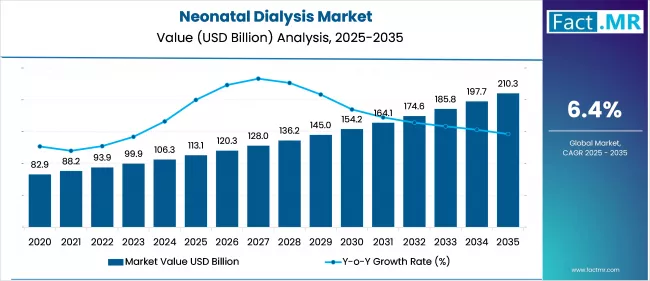
Neonatal Dialysis Market Value Analysis | Source: Fact.MR
What are the defining numbers behind Neonatal Dialysis Market growth?
An absolute opportunity of USD 97.2 billion is expected between 2026 and 2036.
- Demand Drivers in the Market
- Neonatal acute kidney injury creates urgent demand for kidney-support capability in intensive care. The AWAKEN multinational cohort found acute kidney injury in 29.9% of eligible neonatal intensive-care patients, with affected infants experiencing higher mortality and longer hospitalization.
- Treatment in very small infants requires tighter control of extracorporeal volume, ultrafiltration, temperature, and blood flow than adult dialysis. Dedicated pediatric platforms and smaller circuits reduce the need to adapt adult-scale equipment for neonates.
- Hospitals must maintain readiness even when procedure frequency is unpredictable. Filters, tubing sets, vascular-access products, dialysate, and trained staff need to be available before an unstable infant requires renal support, sustaining recurring consumables demand.
- Clinical teams increasingly use a modality portfolio rather than one treatment pathway. Peritoneal dialysis can be appropriate for some neonates, while continuous renal replacement therapy becomes important when hemodynamic instability, fluid overload, or abdominal limitations make other approaches less suitable.
- Regulatory recognition of pediatric-scale equipment is improving procurement confidence. The U.S. Food and Drug Administration granted De Novo classification to the CARPEDIEM System for pediatric renal replacement therapy, establishing a regulatory precedent for technology designed around very small patients.
- Key Segments Analyzed
- Consumables And Disposables account for 38.9% of Product in 2026 because filters, tubing, catheters, and dialysate require repeated replacement across treatment sessions.
- Acute Kidney Injury accounts for 44.2% of Application in 2026 because severe fluid overload, electrolyte imbalance, and kidney dysfunction can require rapid escalation to renal support in critically ill neonates.
- Continuous Renal Replacement Therapy accounts for 41.7% of Procedure Type in 2026 because gradual fluid and solute removal is better suited to unstable infants who may not tolerate rapid intermittent shifts.
- Direct Hospital Procurement accounts for 62.1% of Distribution Channel in 2026 because neonatal dialysis requires institutional review, equipment service, staff training, and dependable access to compatible consumables.
- Analyst Opinion at Fact.MR
- Shambhu Nath Jha, Principal Consultant, Fact.MR, states, “Neonatal dialysis purchasing is driven by readiness for a high-acuity event rather than routine procedure volume. Hospitals need systems that can control fluid balance at very low patient weights, but the device alone is insufficient. Consistent access to pediatric circuits, vascular-access products, training, and technical support determines whether a neonatal or pediatric intensive-care team can start treatment safely when kidney support becomes urgent.”
- Strategic Implications
- Hospitals should evaluate dialysis platforms by minimum patient weight, extracorporeal circuit volume, low-flow accuracy, fluid-balance control, and compatibility with pediatric consumables.
- Suppliers should secure continuity of filters, tubing sets, catheters, and fluids because treatment readiness can fail even when the capital system is available.
- Training and service response are commercial differentiators. Low-frequency use increases the value of standardized set-up guidance, refresher training, and rapid technical support.
- Manufacturers should document where neonatal, pediatric, and adult weight ranges differ so procurement teams can match equipment to specific intensive-care pathways without relying on informal workarounds.
How does the Neonatal Dialysis Market break down by segment?
The market is segmented by Product, Application, Procedure Type, and Distribution Channel.
Why do Consumables And Disposables lead Product?
Consumables And Disposables are projected to account for a 38.9% share in 2026.
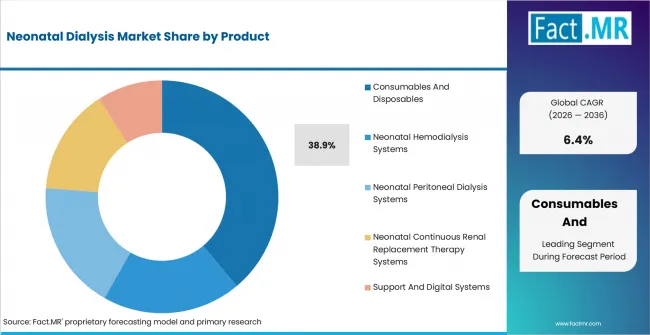
Neonatal Dialysis Market Analysis By Product | Source: Fact.MR
The category leads because neonatal dialysis depends on single-use components whose dimensions and flow characteristics must match small blood volumes. Dialyzers, tubing sets, catheters, access kits, and dialysate are part of the treatment circuit rather than optional accessories. Hemodialysis catheters are particularly important where vascular access is technically difficult and device size can constrain treatment.
Repeated replacement across treatment sessions creates recurring procurement. Hospitals also hold emergency stock because neonatal renal support may begin with little notice, making supply continuity a major factor in vendor selection.
Why does Acute Kidney Injury lead Application?
Acute Kidney Injury is projected to account for a 44.2% share in 2026.
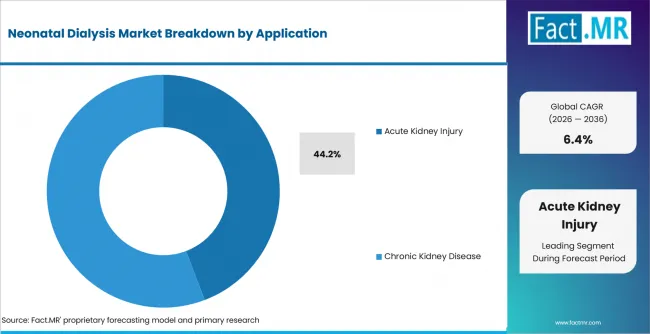
Neonatal Dialysis Market Analysis By Application | Source: Fact.MR
Acute Kidney Injury leads because renal function can deteriorate rapidly in neonates with sepsis, prematurity, cardiac disease, surgery, nephrotoxic exposure, or multiorgan failure. The AWAKEN cohort established that neonatal AKI is common in intensive care and is associated with worse clinical outcomes.
For hospitals, earlier recognition increases demand first for monitoring and fluid-management tools, then for renal support when conservative management is insufficient. This links neonatal dialysis procurement with the wider kidney dialysis equipment and supplies market, while neonatal use requires tighter control at lower body weights.
Why does Continuous Renal Replacement Therapy lead Procedure Type?
Continuous Renal Replacement Therapy is projected to account for a 41.7% share in 2026.
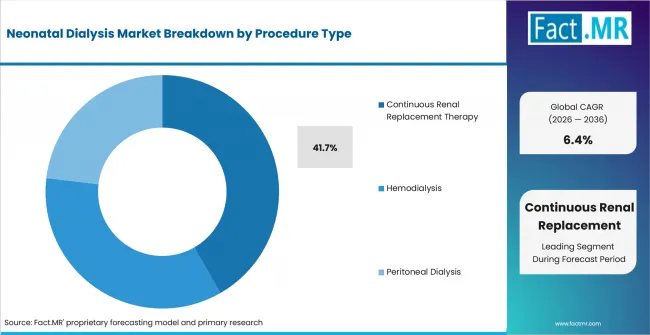
Neonatal Dialysis Market Analysis By Procedure Type | Source: Fact.MR
CRRT leads because critically ill neonates may not tolerate the rapid fluid shifts associated with intermittent treatment. Gradual removal of fluid and solutes can be used when hemodynamic instability, severe fluid overload, or metabolic disturbance requires continuous control.
The procedure does not displace every alternative. Peritoneal dialysis can remain practical in selected infants, while hemodialysis is used where intermittent extracorporeal treatment is clinically appropriate. The purchasing requirement is therefore a modality portfolio supported by compatible disposables and trained teams.
Why does Direct Hospital Procurement lead Distribution Channel?
Direct Hospital Procurement is projected to account for a 62.1% share in 2026.
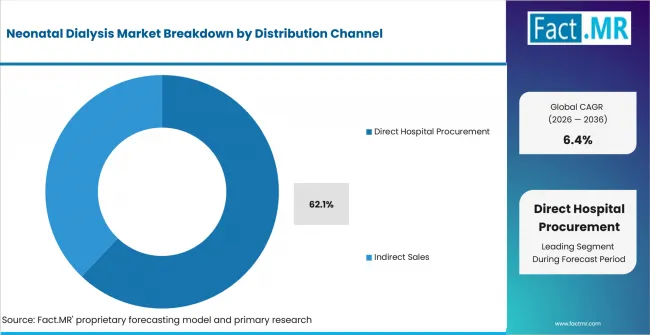
Neonatal Dialysis Market Analysis By Distribution Channel | Source: Fact.MR
Direct Hospital Procurement leads because neonatal dialysis is delivered in a controlled hospital environment involving neonatal or pediatric intensive care, nephrology, nursing, pharmacy, and biomedical engineering. Hospitals need formal review of equipment, consumables, maintenance, and treatment protocols before a system is placed into clinical use.
The same institutions often procure adjacent neonatal critical-care technologies, including monitoring and neonatal ventilator systems. Direct supplier relationships therefore support service response, training, and inventory planning across high-acuity equipment categories.
What is accelerating Neonatal Dialysis Market adoption, and what is holding it back?
Adoption is being accelerated by better recognition of neonatal acute kidney injury, more precise low-flow renal-support technology, and stronger hospital readiness for critically ill infants. Growth is constrained by vascular-access difficulty, extracorporeal blood-volume limits, specialized staffing requirements, and the availability of child-appropriate equipment and consumables.
Drivers Impact Analysis
| Factor | (~) % Impact on CAGR | Geographic Relevance | Impact Timeline |
|---|---|---|---|
| Improved recognition of neonatal acute kidney injury | +1.6% | Global | Short term (<= 2 years) |
| Adoption of neonatal-specific low-flow dialysis systems | +1.4% | USA, Germany and UK | Short term (<= 2 years) |
| Expansion of neonatal intensive-care capabilities | +1.1% | Global | Medium term (2-4 years) |
| More precise fluid-balance and solute-control technology | +0.9% | USA, Japan and Germany | Medium term (2-4 years) |
| Development of specialized neonatal kidney-support programs | +0.6% | Global | Long term (>= 4 years) |
Source: Fact.MR analysis. Updated Sep 4, 2026
Opportunity Impact Analysis
| Factor | (~) % Impact on CAGR | Geographic Relevance | Impact Timeline |
|---|---|---|---|
| Neonatal-specific continuous kidney replacement systems | +1.0% | USA, Europe and Japan | Medium term (2-4 years) |
| Lower extracorporeal-volume circuits and smaller filters | +0.8% | Global | Medium term (2-4 years) |
| Expansion of neonatal nephrology capabilities in emerging healthcare systems | +0.7% | India and other developing healthcare markets | Long term (>= 4 years) |
| Integrated neonatal kidney-support programs | +0.5% | USA, UK and Germany | Long term (>= 4 years) |
Source: Fact.MR analysis. Updated Sep 4, 2026
Restraints Impact Analysis
| Factor | (~) % Impact on CAGR | Geographic Relevance | Impact Timeline |
|---|---|---|---|
| Vascular-access difficulty in neonates | -1.1% | Global | Short term (<= 2 years) |
| Extracorporeal blood-volume and hemodynamic limitations | -0.9% | Global | Short term (<= 2 years) |
| Requirement for specialized clinical staff | -0.7% | Emerging healthcare markets | Medium term (2-4 years) |
| Limited availability of neonatal-specific equipment and consumables | -0.5% | Emerging healthcare markets | Long term (>= 4 years) |
Source: Fact.MR analysis. Updated Sep 4, 2026
Which countries are scaling the Neonatal Dialysis Market through 2036?
- Germany: Growth is supported by advanced pediatric nephrology capability and the need to maintain regulatory continuity and supply of child-appropriate dialysis equipment.
- Brazil: Expansion is supported by a broad renal-care service base, while demand remains concentrated in tertiary hospitals that can combine neonatal intensive care with pediatric nephrology.
- USA: Specialized pediatric critical-care centers and a defined FDA regulatory precedent for pediatric-scale dialysis technology support adoption.
- UK: A concentrated network of pediatric kidney centers supports consistent modality expertise, training, and procurement for hemodialysis and peritoneal dialysis.
- Japan: A mature dialysis infrastructure supports selective adoption of low-flow systems and pediatric consumables within tertiary neonatal and pediatric centers.
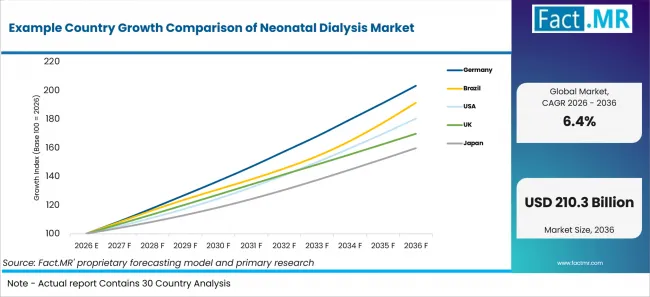
Example Country Growth Comparison Of Neonatal Dialysis Market | Source: Fact.MR
| Country | CAGR, 2026-2036 |
|---|---|
| Germany | 7.4% |
| Brazil | 6.7% |
| USA | 6.1% |
| UK | 5.4% |
| Japan | 4.8% |
Source: Fact.MR analysis. Updated Sep 4, 2026
What is driving Germany’s growth through 2036?
Germany is forecast to expand at a 7.4% CAGR from 2026 to 2036.
Germany combines specialist nephrology capability with a practical need to secure child-appropriate devices and consumables. In 2025, German nephrology societies highlighted shortages affecting pediatric nephrology equipment in the context of EU medical-device requirements. This increases the value of suppliers that can maintain pediatric regulatory coverage, replacement availability, and dependable consumable lines.
What is driving Brazil’s growth through 2036?
Brazil is forecast to expand at a 6.7% CAGR from 2026 to 2036.
Brazil has a broad dialysis service network, but neonatal treatment depends on tertiary centers that combine intensive care with pediatric nephrology and suitable equipment. Regional differences in renal-care capacity make local stocking, training, and distributor reach important for products that may be used infrequently but must be available for urgent cases.
What is driving the USA’s growth through 2036?
The USA is forecast to expand at a 6.1% CAGR from 2026 to 2036.
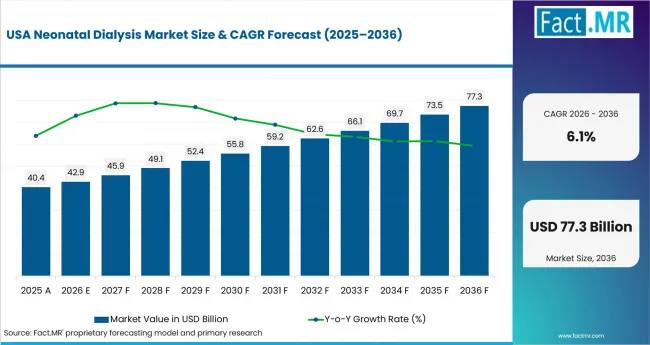
Neonatal Dialysis Market Country Value Analysis | Source: Fact.MR
Growth is supported by specialized pediatric critical-care centers and a clear regulatory precedent for small-patient renal replacement therapy. The FDA’s De Novo classification of the CARPEDIEM System established a pathway for pediatric dialysis technology designed around low patient weights and precise fluid control.
This regulatory and clinical base complements the wider neonatal infant care market, where hospitals invest in equipment that supports critically ill newborns across intensive-care pathways.
What is driving the UK’s growth through 2036?
The UK is forecast to expand at a 5.4% CAGR from 2026 to 2036.
The UK benefits from a concentrated pediatric kidney-care network. The UK Renal Registry reported 13 pediatric kidney centers in its 27th Annual Report, with all centers able to provide hemodialysis and peritoneal dialysis. This supports sustained expertise and creates demand for technology refresh, pediatric consumables, and low-weight extracorporeal options rather than broad expansion in provider sites.
What is driving Japan’s growth through 2036?
Japan is forecast to expand at a 4.8% CAGR from 2026 to 2036.
Japan’s mature dialysis infrastructure gives hospitals an established base of equipment, service, and clinical expertise. Neonatal growth is therefore concentrated in specialized products such as low-flow systems and pediatric consumables that can fit existing tertiary-care workflows while meeting the needs of very small patients.
Who Leads the Neonatal Dialysis Market?
Fresenius Medical Care AG leads the Neonatal Dialysis Market, supported by its established kidney-care technology base, service capabilities, and experience supplying dialysis equipment and consumables to institutional customers.
Competition is shaped by low-flow accuracy, validated patient-weight ranges, filter and tubing availability, alarm behavior, training, and regulatory continuity. B. Braun Melsungen AG, Nikkiso Co., Ltd., Asahi Kasei Medical Co., Ltd., and Infomed SA compete through dialysis and blood-purification technologies used across acute or chronic renal care.
The competitive structure has changed as several legacy kidney-care businesses moved to new operating entities. Baxter completed the sale of its Kidney Care business in January 2025, with the business continuing as Vantive. Medtronic transferred its Renal Care Solutions business to Mozarc Medical in 2023. These changes matter because hospital procurement should be aligned with the current entity responsible for product supply, service, and technical support.
Omnica Corporation was acquired by StarFish Medical in November 2024 and now operates within StarFish Medical rather than as a standalone company.
Which companies are the key providers?
Key Companies includes Fresenius Medical Care AG; Vantive; B. Braun Melsungen AG; Nikkiso Co., Ltd.; Asahi Kasei Medical Co., Ltd.; Infomed SA; Mozarc Medical
- Fresenius Medical Care AG
- Vantive
- B. Braun Melsungen AG
- Nikkiso Co., Ltd.
- Asahi Kasei Medical Co., Ltd.
- Infomed SA
- Mozarc Medical
Bibliography
- Jetton, J. G., et al. (2017). Incidence and outcomes of neonatal acute kidney injury (AWAKEN): a multicentre, multinational, observational cohort study. The Lancet Child & Adolescent Health.
- Forbes, T. A., et al. (2026). Neonatal acute kidney injury: diagnosis, recognition, and prevention. Kidney International.
- Coleman, C., Tambay Perez, A., Selewski, D. T., & Steflik, H. J. (2022). Neonatal Acute Kidney Injury. Frontiers in Pediatrics.
- Cortina, G., Daverio, M., Demirkol, D., Chanchlani, R., & Deep, A. (2024). Continuous renal replacement therapy in neonates and children: what does the pediatrician need to know? European Journal of Pediatrics.
- Ronco, C., et al. (2014). Continuous renal replacement therapy in neonates and small infants: development and first-in-human use of a miniaturised machine (CARPEDIEM). The Lancet.
- U.S. Food and Drug Administration. (2020). Device Classification Under Section 513(f)(2)(De Novo): CARPEDIEM System, DEN180055.
- UK Kidney Association. (2025). UK Renal Registry 27th Annual Report.
- Deutsche Gesellschaft für Nephrologie. (2025). Stellungnahme zu Geräteengpass in der Kindernephrologie.
- Nerbass, F. B., et al. (2026). Brazilian Dialysis Survey 2024. Brazilian Journal of Nephrology.
- Japanese Society for Dialysis Therapy. (2025). 2024 Annual Dialysis Data Report, JSDT Renal Data Registry.
- B. Braun. (2026). Acute Kidney Injury Treatment and OMNI extracorporeal blood treatment systems.
- Nikkiso Co., Ltd. (2026). Medical products and continuous renal replacement therapy overview.
- Fresenius Medical Care AG. (2023). Fresenius Medical Care completes change of legal form into a German stock corporation.
- Baxter International Inc. (2025). Baxter Reports Fourth-Quarter and Full-Year 2024 Results.
- Vantive. (2025). Product Updates: Vantive, formerly the Baxter Kidney Care segment.
- Medtronic plc. (2023). Full-year and fourth-quarter fiscal 2023 financial results.
- DaVita Inc. (2023). Medtronic and DaVita launch Mozarc Medical.
- Mozarc Medical. (2026). Carpediem System.
- StarFish Medical. (2024). StarFish Medical acquires Omnica Corporation.
This Report Answers
- What clinical conditions are creating demand for neonatal kidney-support technology?
- Why do recurring consumables account for a substantial share of Product demand?
- How do CRRT, hemodialysis, and peritoneal dialysis fit different neonatal treatment pathways?
- Why does direct hospital procurement remain important for neonatal dialysis systems and consumables?
- What operational constraints limit adoption in very small patients?
- How do country-specific clinical infrastructure and equipment availability shape growth?
- Which current companies compete in neonatal dialysis and acute kidney-support technology?
What does the Neonatal Dialysis Market cover?
The Neonatal Dialysis Market covers commercial revenue from systems and consumables used to provide renal replacement therapy to newborns and very small infants. It includes equipment and recurring products used for hemodialysis, peritoneal dialysis, and continuous renal replacement therapy in hospital-based neonatal and pediatric care.
What is included in the scope?
The scope includes Consumables And Disposables, Neonatal Hemodialysis Systems, Neonatal Peritoneal Dialysis Systems, Neonatal Continuous Renal Replacement Therapy Systems, and Support And Digital Systems. It includes treatment associated with Acute Kidney Injury, Sepsis Induced AKI, Congenital Kidney Disorders, Chronic Kidney Disease, End Stage Renal Disease, and Metabolic And Electrolyte Imbalance.
Procedure coverage includes Continuous Renal Replacement Therapy, Hemodialysis, and Peritoneal Dialysis. Distribution coverage includes Direct Hospital Procurement, Indirect Sales, Medical Device Distributors, and Online Medical Procurement Platforms. Primary buyers include hospitals and specialist care teams responsible for neonatal or pediatric renal support.
What is excluded from the scope?
The market excludes adult-only dialysis systems and consumables when they are not intended or configured for neonatal or pediatric use. Chronic outpatient dialysis services for adults are outside the market. General intensive-care equipment is excluded unless it is directly used to deliver or manage neonatal renal replacement therapy.
Standalone diagnostic tests, neonatal monitoring devices without a renal-support function, and kidney therapies that do not involve dialysis or continuous renal replacement are also excluded.
How Was the Analysis Built?
The analysis combines market sizing with clinical, regulatory, hospital-procurement, and company evidence relevant to neonatal renal replacement therapy.
- Primary Research: Relevant respondent groups include neonatal and pediatric nephrologists, NICU and PICU clinicians, dialysis nurses, hospital procurement teams, biomedical engineers, equipment suppliers, and distributors.
- Desk Research: Research uses peer-reviewed neonatal nephrology literature, regulator databases, clinical-trial registries, national renal registries, professional-society publications, and official company technical information.
- Market Sizing and Forecasting: Sizing considers installed renal-support capacity, recurring consumable use, hospital procurement, treatment modality, product pricing, patient-weight requirements, and country-level adoption of pediatric kidney-support technology.
- Data Validation and Update Cycle: Market values and shares are checked for consistency across the forecast period, segment totals, country growth, and company status. Updates account for product availability, regulatory changes, acquisitions, divestitures, and changes in pediatric treatment capability.
Segmentation
What is the report's scope and coverage?
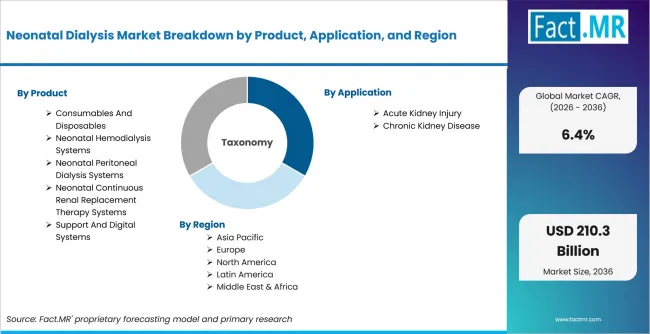
Neonatal Dialysis Market Breakdown By Product, Application, And Region | Source: Fact.MR
| Attribute | Details |
|---|---|
| Quantitative Units | USD billion |
| Market Definition | Systems, consumables, access products, fluids, monitoring tools, and related support used for neonatal hemodialysis, peritoneal dialysis, and continuous renal replacement therapy |
| Segments Covered | Product; Application; Procedure Type; Distribution Channel |
| Regions Covered | Global market with country analysis for Germany, Brazil, USA, UK, and Japan |
| Countries Covered | Germany; Brazil; USA; UK; Japan |
| Key Companies | Fresenius Medical Care AG; Vantive; B. Braun Melsungen AG; Nikkiso Co., Ltd.; Asahi Kasei Medical Co., Ltd.; Infomed SA; Mozarc Medical |
| Forecast Period | 2026 to 2036 |
| Base Year | 2025 |
| Market Value, 2026 | USD 113.1 billion |
| Market Value, 2036 | USD 210.3 billion |
| CAGR, 2026-2036 | 6.4% |
| Absolute Opportunity | USD 97.2 billion |
| Approach | Hybrid top-down and bottom-up approach using product demand, recurring consumable use, procedure mix, hospital procurement, pricing, country growth, and company activity |
Source: Fact.MR analysis. Updated Sep 4, 2026
How is the market segmented?
-
By Product:
- Consumables And Disposables
- Dialyzers
- Catheters And Access Kits
- Tubing Sets
- Dialysate Solutions
- Neonatal Hemodialysis Systems
- Portable Hemodialysis Machines
- Integrated Monitoring Systems
- Neonatal Peritoneal Dialysis Systems
- Automated Peritoneal Dialysis Systems
- Manual Peritoneal Dialysis Systems
- Neonatal Continuous Renal Replacement Therapy Systems
- Low Flow CRRT Systems
- Integrated CRRT Platforms
- Support And Digital Systems
- Patient Monitoring Systems
- Fluid Management Software
- Consumables And Disposables
-
By Application:
- Acute Kidney Injury
- Sepsis Induced AKI
- Congenital Kidney Disorders
- Chronic Kidney Disease
- End Stage Renal Disease
- Metabolic And Electrolyte Imbalance
-
By Procedure Type:
- Continuous Renal Replacement Therapy
- Hemodialysis
- Peritoneal Dialysis
-
By Distribution Channel:
- Direct Hospital Procurement
- Indirect Sales
- Medical Device Distributors
- Online Medical Procurement Platforms
-
By Region:
- North America
- Latin America
- Western Europe
- Eastern Europe
- East Asia
- South Asia and Pacific
- Middle East & Africa
Frequently Asked Questions
What is the Neonatal Dialysis Market value in 2026?
At what CAGR is the market projected to grow?
What is the projected market value by 2036?
Which Product leads the market?
Which Application leads the market?
Which Procedure Type leads the market?
Which Distribution Channel leads the market?
Which country records the highest listed CAGR?
Which company leads the Neonatal Dialysis Market?
What is the primary driver in this market?
What is the main restraint?
Which companies are included in the market assessment?
Who worked on this report


Preview the report firsthand - request a free sample
Free SampleGet the brochure for pricing and purchase details
Download PDF