- Market Value (2025): USD 114.5 Mn
- Estimated Value (2026): USD 117.5 Mn
- Forecast Value (2036): USD 151.9 Mn
- CAGR (2026-2036): 2.6%
What is the Leukocytoclastic Vasculitis Market forecast to be worth by 2036?
USD 151.9 million by 2036, at a 2.6% CAGR.
- The market reached USD 114.5 million in 2025 as dermatology, rheumatology, and hospital teams continued to treat persistent cutaneous disease.
- Demand is projected to increase from USD 117.5 million in 2026 to USD 151.9 million by 2036, creating a measured expansion path for a rare and frequently self-limited condition.
- The market is forecast to record a 2.6% CAGR from 2026 to 2036.
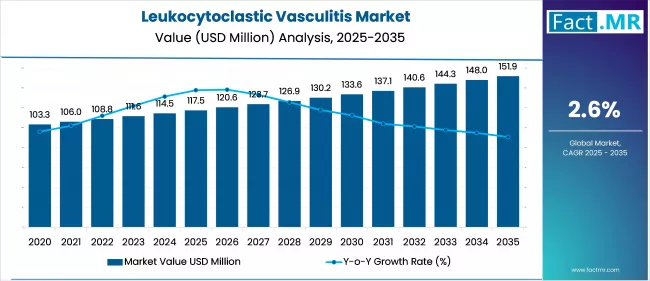
Leukocytoclastic Vasculitis Market Value Analysis | Source: Fact.MR
What are the defining numbers behind Leukocytoclastic Vasculitis Market growth?
USD 34.4 million absolute opportunity is expected by 2036.
- Demand Drivers in the Market
- Biopsy-led treatment qualification: Skin biopsy with direct immunofluorescence is a cornerstone of diagnosis. This matters commercially because treatment intensity depends on whether clinicians are dealing with a skin-limited process, an immune-complex subtype, or evidence of systemic disease.
- Persistent and recurrent disease: StatPearls notes that most idiopathic cutaneous cases resolve within weeks to months, but the remaining chronic or resistant cases may require a corticosteroid taper and, less commonly, steroid-sparing immunosuppressive treatment. This smaller recurrent pool generates more repeat prescriptions than one-off skin-limited episodes.
- Systemic involvement changes the treatment setting: Extracutaneous manifestations occur in a minority of patients, but renal, gastrointestinal, pulmonary, or neurologic findings can move care from symptomatic dermatology management to hospital-based evaluation and rheumatology or nephrology-led immunosuppression.
- Etiologic diversity keeps therapy class demand broad: Drugs, infections, autoimmune disorders, malignancy, and systemic vasculitides can all present with leukocytoclastic histology. The resulting market is distributed across corticosteroids, conventional immunosuppressants, biologic therapies, anti-inflammatory drugs, and plasma-based treatment rather than one product class.
- Key Segments Analyzed
- By Product: Corticosteroids are projected to hold 42.9% share in 2026. Their position reflects the common use of systemic corticosteroid tapers when cutaneous disease is persistent, severe, or recurrent, and their continuing role in more intensive systemic vasculitis regimens.
- By Route Of Administration: Oral therapy is projected to account for 46.3% share in 2026. Oral corticosteroids and several conventional steroid-sparing agents fit outpatient tapering and follow-up better than infusion-based treatment for many non-life-threatening cases.
- By Application: Skin Limited Vasculitis is expected to represent 39.4% share in 2026. The leading position is consistent with LCV presenting predominantly in the skin and with the clinical priority of separating cutaneous disease from systemic involvement.
- By End Use: Hospitals are projected to hold 48.6% share in 2026 because biopsy, systemic work-up, acute assessment, and escalation to intravenous or immunosuppressive therapy are concentrated in hospital-linked care for more complex presentations.
- By Distribution Channel: Hospital Pharmacy is projected to account for 55.1% share in 2026. The channel captures a large share of corticosteroid, injectable, biologic, and plasma-based treatment used when patients need specialist supervision or inpatient and outpatient hospital dispensing.
- Analyst Opinion at Fact.MR
- The commercial hinge in this market is not the visibility of palpable purpura. It is the clinical decision about whether the episode is self-limited, recurrent, drug-induced, infection-associated, or a marker of systemic vasculitis. Suppliers that support low-cost first-line treatment while maintaining access to steroid-sparing and specialist escalation options are better aligned with the actual care pathway than companies relying on a single premium therapy narrative.
- Strategic Implications
- Dermatology and rheumatology teams should preserve a clear escalation threshold. Treating every biopsy-positive episode as chronic systemic disease would add risk and cost, while missing renal or gastrointestinal involvement can delay necessary immunosuppression.
- Pharmaceutical suppliers should protect continuity of oral corticosteroids and conventional immunosuppressants while building specialist access for recurrent and organ-involved disease. The market rewards availability across treatment intensity levels more than a one-product positioning strategy.
- Commercial teams should prioritize hospitals and specialty clinics that can distinguish cutaneous-only disease from systemic involvement. Those centers are more likely to generate repeat pharmacologic demand and advanced-therapy use than transient, trigger-resolved cases managed with supportive care alone.
Germany is projected to record a 2.99% CAGR from 2026 to 2036, supported by work toward a structured national guideline for cutaneous immune-complex vasculitis. Brazil follows at 2.73%, where public-system protocols for ANCA-associated vasculitis strengthen specialist pathways for patients whose presentation extends beyond skin-limited disease. The USA is forecast at 2.47%, reflecting a mature biopsy and rheumatology pathway but also the large share of episodes that do not become prolonged pharmacologic cases. The UK is projected at 2.21% as primary and specialist care emphasize diagnostic exclusion and appropriate biopsy before escalation. Japan is expected to post 1.95%, with established vasculitis specialty infrastructure supporting systemic evaluation but limited evidence for long-duration treatment of uncomplicated cutaneous disease.
How does the Leukocytoclastic Vasculitis Market break down by segment?
Corticosteroids lead Product with 42.9% share, while Oral therapy leads Route Of Administration at 46.3% in 2026. The two leaders reflect a market in which many treated patients require a practical corticosteroid course rather than immediate progression to infusion-based or targeted biologic therapy.
Why do Corticosteroids lead Product in the Leukocytoclastic Vasculitis Market?
Corticosteroids are projected to account for 42.9% of Product revenue in 2026.
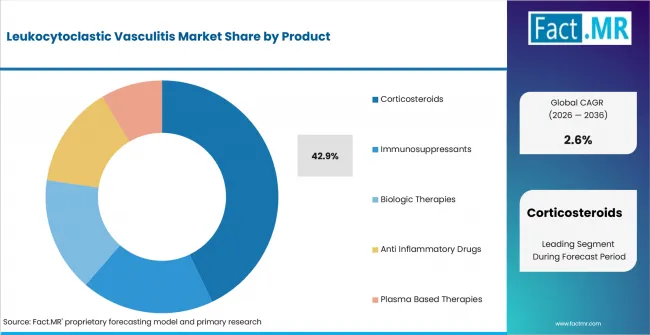
Leukocytoclastic Vasculitis Market Analysis By Product | Source: Fact.MR
Their leadership follows the treatment intensity curve of LCV. The Fraticelli review notes that skin-limited disease may need only supportive measures or low-dose steroids, while severe, intractable, or recurrent cutaneous disease commonly moves to systemic corticosteroids. When LCV reflects a systemic vasculitis or significant organ involvement, higher-dose corticosteroids remain part of escalation pathways, often alongside immunosuppressants or targeted agents. Immunosuppressants and biologics are important but serve narrower subsets because they bring greater monitoring, safety, and qualification requirements. Corticosteroids therefore span more clinical scenarios, from short oral tapers to hospital-managed systemic disease, even though the benign course of many cases constrains prolonged exposure.
Why does Oral lead Route Of Administration?
Oral therapy is projected to hold 46.3% share of Route Of Administration in 2026.
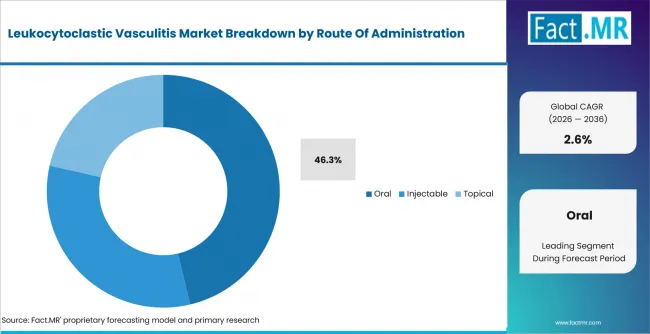
Leukocytoclastic Vasculitis Market Analysis By Route Of Administration | Source: Fact.MR
The route fits the most common pharmacologic bridge between supportive care and advanced treatment: outpatient corticosteroid tapers. Oral dosing also covers conventional steroid-sparing agents such as azathioprine, methotrexate, and mycophenolate mofetil when clinicians need longer control in recurrent disease. Injectable treatment becomes more important when disease is severe, systemic, or requires biologic or hospital-supervised therapy, but those cases represent a narrower clinical pool. Topical therapy can support symptom management for localized presentations, yet it does not address systemic inflammatory disease. Oral administration leads because it combines broad therapeutic class availability, titration flexibility, and compatibility with follow-up care after the diagnostic work-up has ruled out an immediate need for inpatient escalation.
Why does Skin Limited Vasculitis lead Application?
Skin Limited Vasculitis is projected to represent 39.4% of Application revenue in 2026.
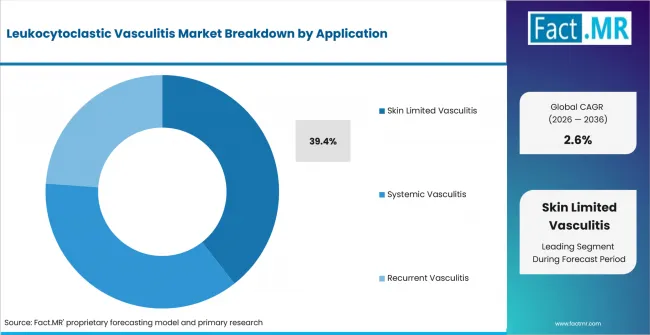
Leukocytoclastic Vasculitis Market Analysis By Application | Source: Fact.MR
LCV most often presents as a cutaneous small-vessel process, and StatPearls reports that extracutaneous involvement occurs in about 30% of affected individuals. The commercial nuance is that skin-limited disease is also the segment most likely to resolve without sustained therapy. Revenue comes from patients with painful, extensive, persistent, ulcerative, or recurrent skin disease rather than from every biopsy-positive episode. Systemic Vasculitis generates higher treatment intensity when kidneys, gastrointestinal tract, lungs, or nerves are involved, but it is a smaller application pool. Recurrent Vasculitis contributes repeat demand over longer periods. Skin Limited Vasculitis leads on case volume, while systemic and recurrent applications carry disproportionate per-patient treatment intensity.
Why do Hospitals lead End Use?
Hospitals are projected to hold 48.6% share of End Use in 2026.
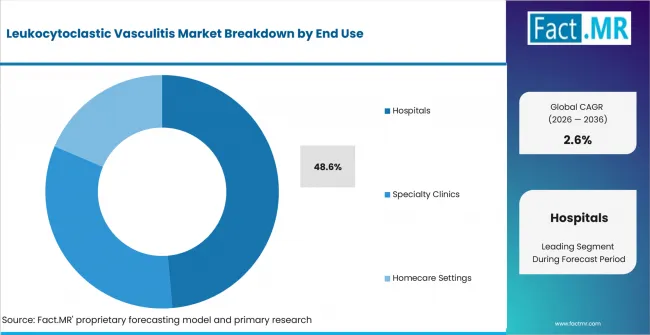
Leukocytoclastic Vasculitis Market Analysis By End Use | Source: Fact.MR
LCV often begins in dermatology, primary care, or an emergency setting, but hospital-linked care becomes important when clinicians need biopsy, direct immunofluorescence, laboratory work-up, renal assessment, or evaluation for systemic disease. More severe presentations may require intravenous treatment, specialist consultation, or inpatient monitoring. Hospitals also connect dermatology with rheumatology, nephrology, internal medicine, and pathology, which is particularly relevant because LCV is a histopathologic pattern that can sit inside several different diseases. Specialty clinics remain important for follow-up and recurrent skin disease, while homecare fits stable oral therapy. Hospitals lead because they concentrate diagnostic qualification and the highest-intensity therapeutic decisions, not because every LCV episode requires admission.
Why does Hospital Pharmacy lead Distribution Channel?
Hospital Pharmacy is projected to account for 55.1% share of Distribution Channel in 2026.
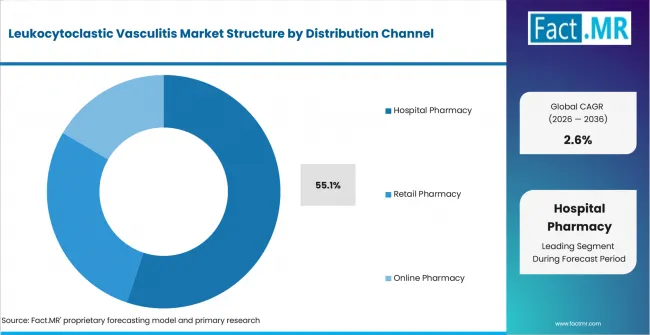
Leukocytoclastic Vasculitis Market Analysis By Distribution Channel | Source: Fact.MR
The channel is positioned at the point where treatment becomes more complex: systemic corticosteroids, injectable therapies, biologics, and plasma-based options generally require institutional protocols, specialist prescribing, or monitoring. Hospital pharmacies also serve outpatient specialty departments, so their role extends beyond inpatient dispensing. Retail pharmacies remain relevant for oral corticosteroids, NSAIDs, antihistamines, and conventional immunosuppressants used after discharge or specialist review. Online pharmacy is the smallest of the three controlled channels because the condition is uncommon and treatment frequently follows biopsy and specialist assessment rather than consumer-led selection. Hospital pharmacy leadership is therefore tied to case complexity and treatment governance rather than simple prescription volume.
What is accelerating Leukocytoclastic Vasculitis Market adoption, and what is holding it back?
The strongest support comes from better clinical separation of skin-limited disease from recurrent or systemic vasculitis, while the largest brake is the fact that most uncomplicated cutaneous episodes resolve without long-duration pharmacotherapy.
Drivers Impact Analysis
| DRIVER | QUALITATIVE RELEVANCE | GEOGRAPHIC RELEVANCE | IMPACT TIMELINE |
|---|---|---|---|
| Biopsy-based differentiation of cutaneous and systemic disease | High | North America and Europe | Current forecast period |
| Persistent or recurrent disease requiring systemic corticosteroids | High | Global | Current forecast period |
| Systemic organ involvement that triggers specialist escalation | Medium-High | USA, Germany, Brazil, Japan | Current forecast period |
| Multidisciplinary dermatology-rheumatology referral pathways | Medium | Developed and upper-middle-income markets | Current forecast period |
Source: Fact.MR analysis. Updated Sep 4, 2026
Opportunity Impact Analysis
| OPPORTUNITY | QUALITATIVE RELEVANCE | GEOGRAPHIC RELEVANCE | IMPACT TIMELINE |
|---|---|---|---|
| Steroid-sparing regimens for recurrent cutaneous disease | Medium-High | USA and Europe | Medium term (2-4 years) |
| Standardized cutaneous vasculitis diagnostic algorithms | Medium | Germany, UK, Brazil | Medium term (2-4 years) |
| Better differentiation of immune-complex subtypes and systemic risk | Medium | Global specialty centers | Medium term (2-4 years) |
Source: Fact.MR analysis. Updated Sep 4, 2026
Restraints Impact Analysis
| RESTRAINT | QUALITATIVE RELEVANCE | GEOGRAPHIC RELEVANCE | IMPACT TIMELINE |
|---|---|---|---|
| Self-limited course in most skin-only cases | High | Global | Persistent through forecast period |
| Removal of a drug or infection trigger can resolve disease | High | Global | Current forecast period |
| Limited randomized evidence for chronic cutaneous regimens | Medium-High | Global | Medium term (2-4 years) |
Source: Fact.MR analysis. Updated Sep 4, 2026
Which countries are scaling Leukocytoclastic Vasculitis Market fastest?
The 2.6% global CAGR is a weighted forecast and does not need to match every national rate. Germany and Brazil sit above the global pace, while the USA is slightly below it and the UK and Japan advance more slowly. The difference is better understood through care pathways, diagnostic standardization, and treatment escalation than through assumptions about disease incidence.
- Germany is the clearest protocol-development story: a new cutaneous immune-complex vasculitis guideline project is designed to standardize diagnosis, systemic-involvement assessment, treatment, and follow-up.
- Brazil is a public-system pathway story. Its 2025 ANCA-associated vasculitis protocol does not define the LCV market, but it strengthens specialist treatment routes for patients in whom cutaneous findings are part of more severe systemic disease.
- The USA combines a mature rheumatology guideline environment with a patient pool in which many cutaneous episodes remain self-limited, producing steady rather than rapid therapy expansion.
- The UK emphasizes exclusion of secondary causes, correct biopsy technique, and escalation only after clinical work-up, which supports disciplined treatment but limits unnecessary chronic prescribing.
- Japan has established specialist vasculitis guideline infrastructure, but cutaneous LCV lacks a dedicated high-volume branded pathway, keeping the growth rate below the global average.
Country-level growth therefore reflects the proportion of patients who move from diagnosis into sustained therapy, the speed of specialist referral, and the availability of hospital-based escalation. Similar clinical presentations can produce different commercial outcomes when those conversion steps differ.
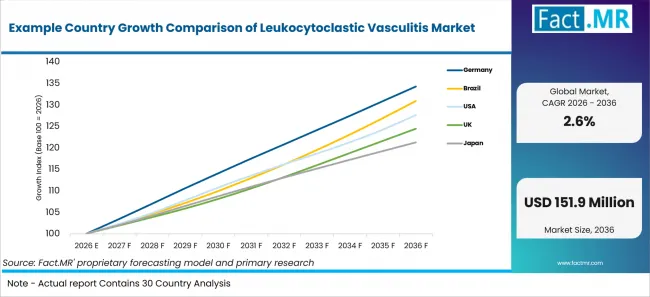
Example Country Growth Comparison Of Leukocytoclastic Vasculitis Market | Source: Fact.MR
| Country | CAGR |
|---|---|
| Germany | 2.99% |
| Brazil | 2.73% |
| USA | 2.47% |
| UK | 2.21% |
| Japan | 1.95% |
Source: Fact.MR analysis. Updated Sep 4, 2026
What is driving Germany's growth through 2036?
2.99% CAGR, supported by a more structured cutaneous vasculitis diagnostic and follow-up pathway.
Germany is projected to expand at a 2.99% CAGR from 2026 to 2036. In March 2026, the Association of the Scientific Medical Societies in Germany (AWMF) registered work on an interdisciplinary guideline for cutaneous immune-complex vasculitis. The stated goals include a structured diagnostic algorithm, standardized terminology, criteria for systemic involvement, disease-specific treatment recommendations, and follow-up. Those objectives matter directly to LCV because biopsy-positive skin disease can be either a limited episode or a sign of broader immune-complex vasculitis. Better classification can increase appropriate referral and treatment while reducing indiscriminate immunosuppression. Germany's leading CAGR is therefore tied to care-pathway refinement and specialist treatment qualification, not to a claim of unusually high LCV prevalence.
What is driving Brazil's growth through 2036?
2.73% CAGR, supported by formal public-system vasculitis protocols and specialist access for organ-involved disease.
Brazil is forecast to post a 2.73% CAGR through 2036. In July 2025, the Ministry of Health approved a Clinical Protocol and Therapeutic Guidelines pathway for ANCA-associated vasculitis within the Unified Health System. That protocol is not a treatment guideline for uncomplicated cutaneous LCV and should not be interpreted as one. Its relevance is downstream: patients with purpura plus renal, pulmonary, neurologic, or other systemic findings need a route into specialist vasculitis assessment and immunosuppressive care. Formal public protocols help define diagnosis, severity-based treatment, monitoring, and access. For the LCV market, Brazil's growth depends on better conversion of complex cases into appropriately treated systemic pathways while mild, trigger-limited skin disease remains conservatively managed.
What is shaping the USA's outlook through 2036?
2.47% CAGR, supported by mature biopsy, rheumatology, and systemic-vasculitis treatment pathways.
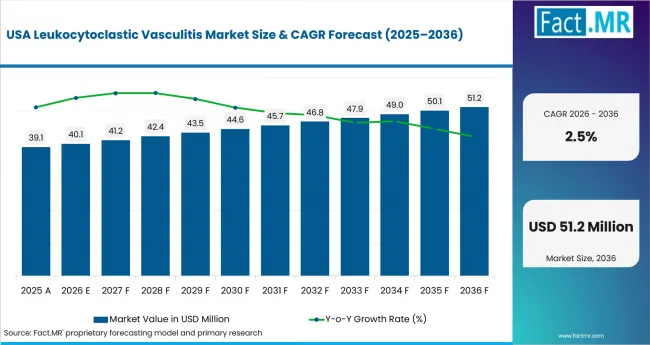
Leukocytoclastic Vasculitis Market Country Value Analysis | Source: Fact.MR
The USA is projected to grow at a 2.47% CAGR from 2026 to 2036. The Vasculitis Foundation describes cutaneous small-vessel vasculitis as an uncommon condition in which treatment starts with identifying and removing a trigger when possible, while the American College of Rheumatology and Vasculitis Foundation maintain evidence-based guidance for major systemic vasculitides. This creates a mature escalation environment: uncomplicated skin disease can remain in dermatology, but suspected renal or other organ involvement moves toward rheumatology and hospital care. The same maturity moderates commercial expansion because clinical guidance discourages unnecessary long-duration immunosuppression. Growth is consequently concentrated in recurrent, persistent, and systemically involved patients rather than in broad treatment of every cutaneous episode.
What is shaping the UK's outlook through 2036?
2.21% CAGR, supported by a conservative biopsy-first pathway and specialist escalation when disease extends beyond the skin.
The UK is expected to record a 2.21% CAGR through 2036. NHS guidance describes vasculitis as ranging from minor skin-only disease to serious organ involvement, while the Primary Care Dermatology Society emphasizes that primary cutaneous small-vessel vasculitis is a diagnosis of exclusion and recommends correct biopsy technique, including histology and direct immunofluorescence. This pathway tends to separate transient skin disease from cases that warrant systemic investigation. Commercially, that favors oral corticosteroids and short-duration therapy in selected patients, with specialty and hospital treatment reserved for recurrence or organ involvement. The UK's slower growth rate is therefore consistent with a mature, protocol-driven environment where appropriate non-treatment or trigger removal can be as important as prescribing escalation.
What is shaping Japan's outlook through 2036?
1.95% CAGR, supported by established vasculitis specialty infrastructure but limited long-duration treatment need in skin-limited LCV.
Japan is projected to expand at a 1.95% CAGR from 2026 to 2036. The Japanese Circulation Society published an updated vasculitis guideline in 2026 for large-vessel disease, while the broader Japanese specialist environment also references separate guidance for other vasculitis classes. These documents do not define treatment for cutaneous LCV, but they signal an established infrastructure for differentiating vessel size, organ involvement, and severity. For LCV, the growth mechanism is specialist recognition and escalation when biopsy findings are part of systemic disease. The constraint is the same one seen globally: many cutaneous episodes resolve or improve after trigger management. Without a dedicated high-volume chronic LCV therapy pathway, market expansion remains the slowest.
Who leads the Leukocytoclastic Vasculitis Market?
F. Hoffmann-La Roche Ltd. is one of the key companies active in the market, but competitive positioning is better understood by therapy class coverage than by a single LCV-specific franchise. The condition is treated with a mix of generic corticosteroids, conventional immunosuppressants, anti-inflammatory agents, and selected biologic or plasma-based therapies, many of which are used off-label or are approved for adjacent systemic vasculitis conditions rather than for cutaneous LCV itself.
Competition in leukocytoclastic vasculitis is therapy GSK has a vasculitis-adjacent biologic position through mepolizumab in eosinophilic granulomatosis with polyangiitis. These approvals do not make either medicine an LCV-specific treatment, but they show how B-cell and cytokine-targeted therapy enters the broader escalation landscape when a cutaneous presentation is part of a defined systemic vasculitis rather than a self-limited skin process.
Through 2036, competition will turn on reliable access to first-line corticosteroid therapy, continuity of conventional immunosuppressants, specialist channel reach, and evidence that supports escalation without blurring the boundary between cutaneous LCV and other vasculitides. Buyers will compare formulary availability, route flexibility, monitoring burden, specialist support, and the ability to serve both low-intensity outpatient care and complex hospital-managed disease.
Which companies are the key providers?
Key companies include F. Hoffmann-La Roche Ltd.; GlaxoSmithKline plc; Baxter International; Eli Lilly and Company; AstraZeneca; Teva Pharmaceutical Industries Ltd.; Novo Nordisk A/S; Daiichi Sankyo; Bristol Myers Squibb Company; ChemoCentryx (part of Amgen); Celgene Corporation (part of Bristol Myers Squibb); and Merck & Co., Inc.
- F. Hoffmann-La Roche Ltd.
- GlaxoSmithKline plc
- Baxter International
- Eli Lilly and Company
- AstraZeneca
- Teva Pharmaceutical Industries Ltd.
- Novo Nordisk A/S
- Daiichi Sankyo
- Bristol Myers Squibb Company
- ChemoCentryx (part of Amgen)
- Celgene Corporation (part of Bristol Myers Squibb)
- Merck & Co., Inc.
Bibliography
- Baigrie, D., & Crane, J. S. (2023). Leukocytoclastic Vasculitis. StatPearls, NCBI Bookshelf.
- Fraticelli, P., Benfaremo, D., & Gabrielli, A. (2021). Diagnosis and management of leukocytoclastic vasculitis. Internal and Emergency Medicine, 16, 831-841.
- DermNet New Zealand. (n.d.). Cutaneous small vessel vasculitis.
- Vasculitis Foundation. (n.d.). Cutaneous Small-Vessel Vasculitis.
- Association of the Scientific Medical Societies in Germany (AWMF). (2026, March 10). Diagnostik und Therapie der kutanen Immunkomplex-Vaskulitis.
- National Health Service. (2023, February 17). Vasculitis.
- Primary Care Dermatology Society. (n.d.). Vasculitis and capillaritis.
- Brazil Ministry of Health, CONITEC. (2025). Protocolo Clínico e Diretrizes Terapêuticas: Vasculite Associada aos Anticorpos Anti-citoplasma de Neutrófilos.
- American College of Rheumatology & Vasculitis Foundation. (2021). Vasculitis Clinical Practice Guidelines.
- Japanese Circulation Society Joint Working Group. (2026). JCS 2026 Guideline on Management of Large Vessel Vasculitis. Circulation Journal, 90(7), 908-943.
- ClinicalTrials.gov. (2021). NCT04008316: Efficacy of Colchicine to Prevent Skin Relapses in Adult IgA Vasculitis.
- GSK. (2017, December 12). Nucala (mepolizumab) approved in the US for eosinophilic granulomatosis with polyangiitis.
- Genentech. (2019, September 27). FDA approves Rituxan (rituximab) in children with granulomatosis with polyangiitis or microscopic polyangiitis.
- Amgen. (2022, October 20). Amgen successfully completes acquisition of ChemoCentryx.
- Bristol Myers Squibb. (2019, November 20). Bristol-Myers Squibb completes acquisition of Celgene.
This Report Addresses
- The size of the Leukocytoclastic Vasculitis Market in 2025 and 2026, the forecast value for 2036, the 2.6% CAGR, and the USD 34.4 million absolute opportunity.
- Treatment choices across Corticosteroids, Immunosuppressants, Biologic Therapies, Anti Inflammatory Drugs, and Plasma Based Therapies, with Corticosteroids leading at 42.9% in 2026.
- Country growth pathways in Germany, Brazil, USA, UK, and Japan, including the distinction between cutaneous-only disease and systemic vasculitis escalation.
- Competitive participation across large pharmaceutical groups, including corporate-status normalization for ChemoCentryx and Celgene to avoid double counting acquired businesses.
- Clinical use cases spanning mild skin-limited disease, recurrent vasculitis, renal or gastrointestinal involvement, hospital treatment, specialty-clinic follow-up, and home oral-therapy management.
What does the Leukocytoclastic Vasculitis Market cover?
The market covers pharmacologic treatment used specifically to manage leukocytoclastic vasculitis and clinically linked cutaneous small-vessel vasculitis episodes when therapy is required.
LCV is a histopathologic pattern rather than a single etiology. The scope therefore follows treatment, not a single branded diagnosis code. It includes corticosteroids, conventional immunosuppressants, selected biologic therapies, anti-inflammatory drugs, immunoglobulin, and plasmapheresis support when those therapies are used for skin-limited, recurrent, or systemically involved vasculitic disease. Revenue is counted through oral, injectable, and topical treatment across hospital, specialty-clinic, homecare, hospital-pharmacy, retail-pharmacy, and online-pharmacy channels.
The boundary is deliberately narrower than the total vasculitis market. It does not count the full value of therapies used for granulomatosis with polyangiitis, microscopic polyangiitis, eosinophilic granulomatosis with polyangiitis, lupus, rheumatoid arthritis, malignancy, or infection unless the treatment is attributable to the leukocytoclastic vasculitis episode or its clinically linked systemic manifestation.
What is included in the scope?
Included buyers and care settings are hospitals, dermatology and rheumatology specialty clinics, and homecare settings managing stable oral treatment and follow-up.
Product coverage includes systemic and topical corticosteroids; azathioprine, mycophenolate mofetil, and methotrexate; anti-TNF, B-cell-targeted, and complement-inhibitor biologic categories; NSAIDs and antihistamines; and immunoglobulin or plasmapheresis support. Route coverage includes oral immediate- and controlled-release forms, intravenous and intramuscular injection, and topical creams, ointments, and gels. Application coverage distinguishes Skin Limited Vasculitis, Systemic Vasculitis with renal or gastrointestinal involvement, and Recurrent Vasculitis requiring longer management or relapse prevention.
A therapy is included only when it is used to manage the vasculitic episode.. The same molecule may be outside scope when it is being used solely for an underlying infection, cancer, connective-tissue disease, or another vasculitis diagnosis without an attributable LCV treatment component.
What is excluded from the scope?
The scope excludes diagnostic services, pathology fees, laboratory testing, hospitalization charges, and therapies used only for unrelated underlying diseases.
Skin biopsy, direct immunofluorescence, ANCA testing, complement assays, renal-function testing, and imaging are clinically important but are diagnostic expenditures and therefore outside therapy revenue. The report also excludes supportive items such as compression stockings and general wound-care products when sold independently. Dedicated treatment markets for ANCA-associated vasculitis, IgA vasculitis, cryoglobulinemic vasculitis, systemic lupus erythematosus, rheumatoid vasculitis, and other vessel-size categories remain separate unless their pharmacologic spend is specifically attributable to an LCV presentation within the defined treatment boundary.
How Was the Analysis Built?
- Primary Research: The market framework is designed around the treatment decisions made by dermatologists, rheumatologists, internal-medicine specialists, hospital pharmacists, specialty pharmacists, and pharmaceutical suppliers, with emphasis on when a patient moves from supportive care to corticosteroid treatment, steroid-sparing therapy, or systemic escalation.
- Desk Research: Clinical mechanisms and country pathways are checked against peer-reviewed reviews, NCBI/NIH clinical references, professional vasculitis organizations, national health-system guidance, specialty-society guidelines, public clinical-trial records, and first-party company materials. External evidence is used to explain treatment pathways and current company status, not to replace the controlled market values, shares, or country growth rates.
- Market Sizing and Forecasting: Sizing combines treatment-class demand with the share of cases moving into pharmacologic management, route mix, care setting, distribution channel, recurrence and systemic-involvement pathways, and country-level growth assumptions.
- Data Validation and Update Cycle: Clinical claims are cross-checked against the disease boundary to avoid counting adjacent vasculitis markets as LCV revenue. Company identities are normalized for acquisitions and legacy entities, and treatment claims are limited to approved or clearly described clinical roles.
Segmentation
What is the report's scope and coverage?
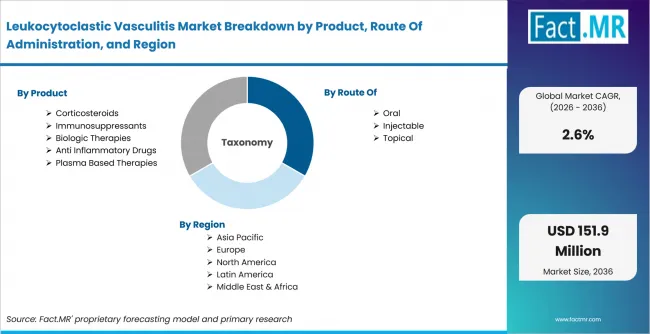
Leukocytoclastic Vasculitis Market Breakdown By Product, Route Of Administration, And Region | Source: Fact.MR
| Attribute | Details |
|---|---|
| Quantitative Units | USD Million |
| Market Definition | Commercial revenue from pharmacologic therapies used to manage leukocytoclastic vasculitis, including cutaneous, recurrent, and systemically involved cases within the approved Product, Route Of Administration, Application, End Use, and Distribution Channel. |
| Product | Corticosteroids; Immunosuppressants; Biologic Therapies; Anti Inflammatory Drugs; Plasma Based Therapies |
| Route Of Administration | Oral; Injectable; Topical |
| Application | Skin Limited Vasculitis; Systemic Vasculitis; Recurrent Vasculitis |
| End Use | Hospitals; Specialty Clinics; Homecare Settings |
| Distribution Channel | Hospital Pharmacy; Retail Pharmacy; Online Pharmacy |
| Regions Covered | North America; Latin America; Europe; East Asia; South Asia & Oceania; Middle East & Africa |
| Countries Covered | USA; Canada; Brazil; Mexico; Argentina; Germany; UK; France; Italy; Spain; Japan; China; South Korea; India; Australia; UAE; Saudi Arabia; South Africa |
| Key Companies Profiled | F. Hoffmann-La Roche Ltd.; GlaxoSmithKline plc; Baxter International; Eli Lilly and Company; AstraZeneca; Teva Pharmaceutical Industries Ltd.; Novo Nordisk A/S; Daiichi Sankyo; Bristol Myers Squibb Company; ChemoCentryx (part of Amgen); Celgene Corporation (part of Bristol Myers Squibb); Merck & Co., Inc. |
| Forecast Period | 2026 to 2036 |
| Approach | Hybrid top-down and bottom-up approach using therapy-class demand, treatment setting, route of administration, country-level growth, company participation, and clinical adoption pathways. |
Source: Fact.MR analysis. Updated Sep 4, 2026
How is the market segmented?
-
By Product:
- Corticosteroids
- Systemic Corticosteroids
- Topical Corticosteroids
- Immunosuppressants
- Azathioprine
- Mycophenolate Mofetil
- Methotrexate
- Biologic Therapies
- Anti TNF Agents
- B Cell Targeted Therapy
- Complement Inhibitors
- Anti Inflammatory Drugs
- NSAIDs
- Antihistamines
- Plasma Based Therapies
- Immunoglobulins
- Plasmapheresis Support
- Corticosteroids
-
By Route Of Administration:
- Oral
- Immediate Release
- Controlled Release
- Injectable
- Intravenous
- Intramuscular
- Topical
- Creams
- Ointments
- Gels
- Oral
-
By Application:
- Skin Limited Vasculitis
- Mild Rash Management
- Localized Purpura
- Systemic Vasculitis
- Renal Involvement
- Gastrointestinal Involvement
- Recurrent Vasculitis
- Long Term Management
- Relapse Prevention
- Skin Limited Vasculitis
-
By End Use:
- Hospitals
- Tertiary Care Centers
- Emergency Care Units
- Specialty Clinics
- Dermatology Clinics
- Rheumatology Clinics
- Homecare Settings
- Oral Therapy Management
- Follow Up Care
- Hospitals
-
By Distribution Channel:
- Hospital Pharmacy
- Retail Pharmacy
- Online Pharmacy
-
By Region:
- North America
- USA
- Canada
- Latin America
- Brazil
- Mexico
- Argentina
- Europe
- Germany
- UK
- France
- Italy
- Spain
- East Asia
- Japan
- China
- South Korea
- South Asia & Oceania
- India
- Australia
- Middle East & Africa
- UAE
- Saudi Arabia
- South Africa
- North America
Frequently Asked Questions
How big is the Leukocytoclastic Vasculitis Market in 2026?
What will the Leukocytoclastic Vasculitis Market be worth in 2036?
What is the forecast CAGR from 2026 to 2036?
Which Product leads the Leukocytoclastic Vasculitis Market?
Which Route Of Administration leads the market?
Which Application leads the market?
Which End Use leads the market?
Which Distribution Channel leads the market?
Which country is growing at a brisk CAGR?
What is Brazil's forecast CAGR?
What is the USA forecast CAGR?
What is the UK forecast CAGR?
What is Japan's forecast CAGR?
What is the primary demand driver?
What is the main restraint?
Who worked on this report


Preview the report firsthand - request a free sample
Free SampleGet the brochure for pricing and purchase details
Download PDF