Boxcar Scars Market Size, Share, Growth and Forecast (2026 - 2036)
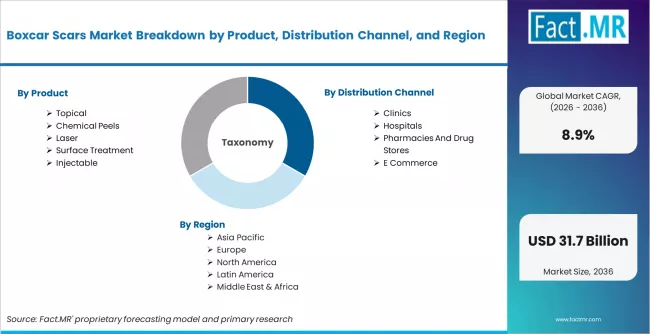
Boxcar Scars Market is segmented by Product (Topical, Chemical Peels, Laser, Surface Treatment, Injectable), Distribution Channel (Clinics, Hospitals, Pharmacies And Drug Stores, E Commerce), Application (Scar Reduction, Skin Resurfacing, Anti Aging Treatment, Dermatological Therapy), and Region, with forecasts covering the period from 2026 to 2036.
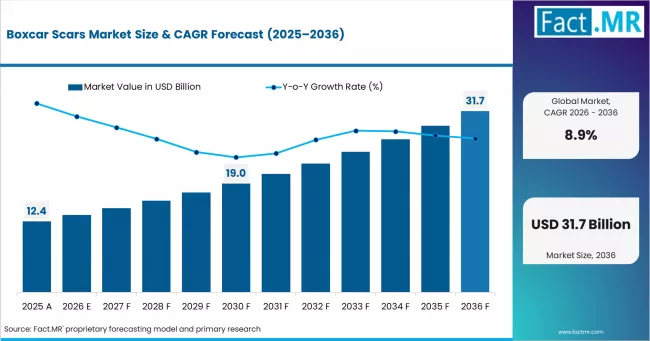
According to Fact.MR estimates, the global boxcar scars market market was valued at USD 12.4 billion in 2025. The market is projected to reach USD 13.5 billion in 2026 and is expected to grow to USD 31.7 billion by 2036, expanding at a CAGR of 8.9%. Topical is anticipated to account for 36.7% of the product segment in 2026, while Clinics is expected to remain the leading application with around 41.3% share.
Boxcar Scars Market Analysis and Forecast by Fact.MR
The boxcar scars market, valued at USD 12.4 billion in 2025, is expanding at an 8.9% CAGR to reach USD 31.676 billion by 2036. Boxcar scar treatments encompass topical formulations, chemical peels, laser therapies, surface treatments (microdermabrasion, microneedling), and injectable fillers used in dermatology clinics, hospitals, medical spas, and home care settings. Growth reflects rising consumer spending on aesthetic dermatology, expanding availability of minimally invasive treatment options, and increasing awareness of scar treatment efficacy. The USD 18.172 billion incremental opportunity between 2026 and 2036 is concentrated in laser-based and injectable treatments across Asia, North America, and Europe.
Summary of Boxcar Scars Market
- Market Snapshot
- Market value in 2025: USD 12.4 billion
- Projected value in 2026: USD 13.504 billion; forecast to reach USD 31.676 billion by 2036
- CAGR from 2026 to 2036: 8.9%
- Incremental opportunity (2026 to 2036): USD 18.172 billion
- Topical products lead product demand with 36.7% share in 2025
- China and India lead country-level growth, followed by Germany and Brazil
- Demand and Growth Drivers
- Consumer spending on aesthetic dermatology has grown steadily, driven by social media influence, selfie culture, and the normalization of cosmetic treatment seeking across wider demographic groups.
- Minimally invasive scar treatment technologies including fractional laser, microneedling, and injectable fillers have expanded accessibility by reducing downtime, discomfort, and cost compared to surgical scar revision.
- Dermatology clinic and medical spa proliferation in urban areas across China, India, South Korea, and the Middle East is increasing physical access to scar treatment services.
- Clinical evidence for combination treatment protocols using laser, microneedling, and topical retinoids in sequence is improving boxcar scar treatment outcomes and patient satisfaction.
- Product and Segment View
- Topical products hold 36.7% of product demand, driven by retail accessibility and home-use convenience for mild-to-moderate scar improvement.
- Laser technology accounts for 65.8% of technology share, reflecting the clinical effectiveness of fractional CO2 and non-ablative laser treatments.
- Clinics hold 41.3% of distribution channel share, as dermatology and aesthetic clinics are the primary service point for scar treatment.
- Key segmentation includes:
- Product: Topical, Chemical Peels, Laser, Surface Treatment, Injectable
- Distribution Channel: Clinics, Hospitals, Pharmacies and Drug Stores, E-Commerce
- Application: Scar Reduction, Skin Resurfacing, Anti Aging Treatment, Dermatological Therapy
- End Use: Dermatology Clinics, Hospitals, Medical Spas, Home Care Settings
- Technology: Laser Technology, Non Ablative Technology, Radiofrequency Technology, Chemical Treatment Technology, Microneedling Technology
- Geography and Competitive Outlook
- North America is the largest revenue region, with the USA contributing USD 4.657 billion in 2025 through established aesthetic dermatology infrastructure.
- East Asia is the fastest-growing region, with China recording the highest country CAGR driven by aesthetic treatment demand and clinic expansion.
- Europe maintains strong growth, with Germany leading through medical dermatology traditions.
- Galderma S.A. leads the competitive field with a 17.6% market share, followed by Merz Inc., Lumenis, Cynosure, and Smith and Nephew.
- Analyst Opinion
- The boxcar scars market is part of the broader aesthetic dermatology category where consumer demand is driven by appearance consciousness. Growth is sustained by the expansion of the treatment-seeking population enabled by lower treatment costs, reduced downtime, and social normalization. Fact.MR expects the fastest growth in combination treatment protocols that sequence laser resurfacing, microneedling, and injectable fillers, as clinical evidence for multi-modality approaches strengthens. The home-use device segment is a secondary growth vector, with RF microneedling and LED devices creating an at-home treatment tier below professional clinic services.
Key Growth Drivers, Constraints, and Opportunities
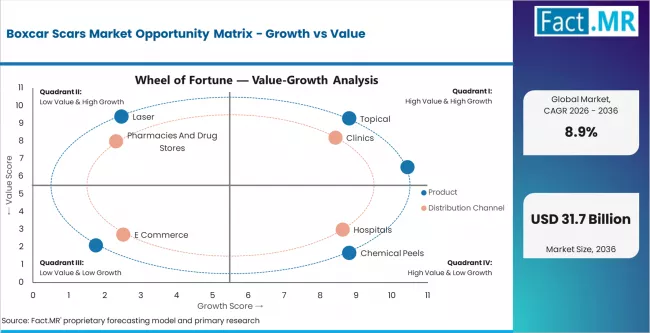
Key Factors Driving Growth
- Aesthetic treatment normalization: Social media and influencer culture have normalized cosmetic treatment seeking, expanding the market beyond severe scarring patients.
- Minimally invasive technology advancement: Fractional laser, RF microneedling, and injectable fillers continue to improve while reducing downtime.
- Dermatology clinic expansion: Urban clinic and medical spa proliferation in China, India, South Korea, and the Middle East increases treatment access.
Key Market Constraints
- Treatment cost barriers: Professional scar treatment protocols can cost USD 2,000 to USD 10,000 per course, limiting access.
- Outcome variability: Results vary based on scar depth, skin type, and treatment selection, creating patient satisfaction risks.
- Regulatory differences: Medical device classification and practitioner credentialing vary across jurisdictions.
Key Opportunity Areas
- Home-use device expansion: Consumer RF microneedling, LED therapy, and microcurrent devices create an at-home treatment tier.
- Combination protocol standardization: Evidence-based multi-modality protocols enable standardized treatment packages.
- Emerging market aesthetic adoption: Rising disposable incomes in India, China, and Southeast Asia drive rapid growth.
Segment-wise Analysis of the Boxcar Scars Market
- Topical products lead product demand at 36.7%, driven by retail accessibility and home-use convenience.
- Laser technology holds 65.8% of technology share, reflecting clinical effectiveness of fractional laser systems.
- Dermatology clinics hold 35.1% of end-use demand, as the primary professional setting for scar treatment.
Which product type dominates the Boxcar Scars Market?
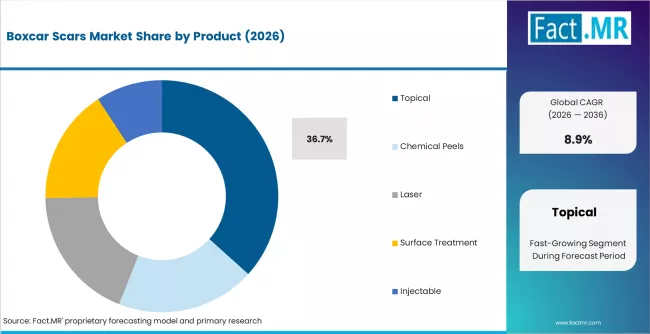
Topical products hold a 36.7% share of product demand in 2025, the largest single product category. The share reflects the broad accessibility of topical scar treatments through pharmacy, retail, and e-commerce channels. Topical treatments serve as both standalone mild-scar management and adjunctive therapy alongside professional treatments.
Laser treatments and injectables generate the highest per-procedure revenue but are accessed by a smaller patient population. Chemical peels and surface treatments occupy a mid-tier position, offering professional-grade treatment at lower cost points.
Which technology dominates the Boxcar Scars Market?
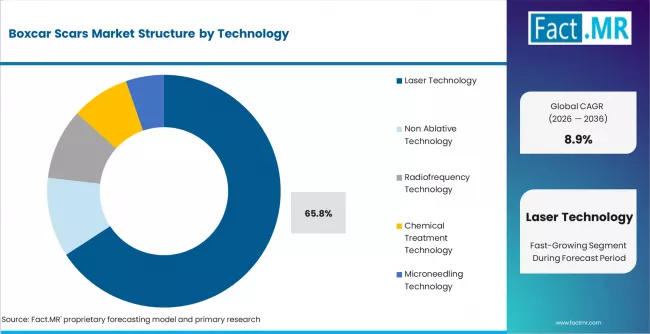
Laser technology accounts for 65.8% of technology share in 2025, the dominant treatment technology. Fractional CO2 lasers and non-ablative fractional lasers are the primary modalities, creating controlled micro-injuries that stimulate collagen remodeling and reduce scar depth. Declining per-treatment costs as device competition increases sustain the technology position.
Microneedling and radiofrequency technology are growing alternatives offering scar improvement with reduced downtime and lower costs compared to ablative laser treatments.
Which end use dominates the Boxcar Scars Market?
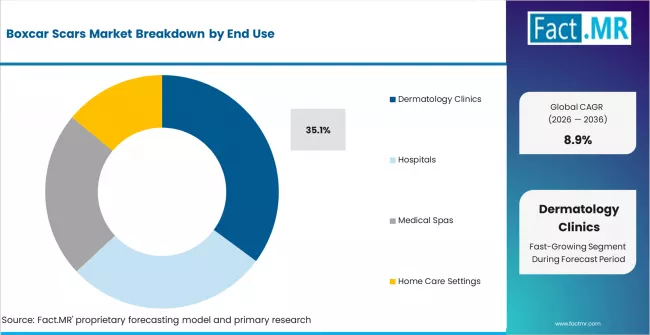
Dermatology clinics hold 35.1% of end-use demand in 2025, the largest category. The share reflects the concentration of professional scar treatment expertise, laser equipment investment, and patient consultation capacity in dedicated dermatology practice settings.
Medical spas and hospitals represent additional categories, with medical spas capturing cosmetically motivated consumers. Home care settings are the fastest-growing segment, driven by consumer-grade treatment devices.
Which Product Trend is Shaping the Next Phase of Growth in the Boxcar Scars Market?
RF microneedling combination platforms are shaping the next growth phase. These devices combine radiofrequency energy delivery with microneedling penetration, creating controlled thermal injury at precise dermal depths. The combination approach delivers superior scar improvement compared to either modality alone, with clinical studies demonstrating significant boxcar scar depth reduction after 3 to 4 sessions. Devices including Morpheus8 (InMode), Infini (Lutronic), and Genius (Cynosure) are driving clinic adoption.
The commercial trajectory benefits from the technology versatility across multiple aesthetic indications (scarring, skin tightening, wrinkle reduction), improving device utilization rates and ROI for clinic operators. This multi-indication capability makes RF microneedling platforms commercially attractive. Fact.MR projects that RF microneedling will gain technology share from both ablative laser and standalone microneedling, driven by superior risk-benefit profiles and growing comparative evidence.
Regional Outlook Across Key Markets
.webp)
- North America is the largest revenue region, with the USA contributing USD 4.657 billion in 2025.
- East Asia is the fastest-growing region, with China recording the highest country CAGR.
- Europe maintains strong growth, with Germany leading through medical dermatology traditions.
- South Asia is an emerging corridor, with India recording strong CAGR.
CAGR Table
| Country | CAGR (%) |
|---|---|
| China | 11.4% |
| India | 10.6% |
| Germany | 9.7% |
| Brazil | 8.9% |
| USA | 8.1% |
| U.K. | 7.2% |
| Japan | 6.4% |
Source: Fact.MR analysis, based on proprietary forecasting model and primary research.
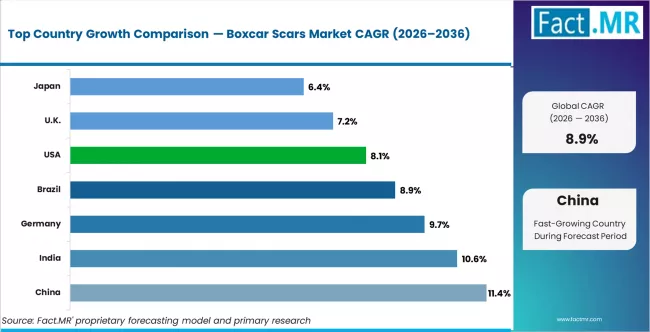
China: Aesthetic demand surge and clinic proliferation
China records the highest country-level CAGR driven by surging consumer spending on aesthetic dermatology, rapid proliferation of dermatology clinics in tier-1 and tier-2 cities, and social media-influenced beauty standards that normalize scar treatment seeking. Domestic aesthetic device companies are expanding the availability of affordable laser and RF microneedling platforms.
- Growth anchor: Aesthetic spending growth and clinic proliferation create dual expansion.
USA: Mature aesthetic market and treatment sophistication
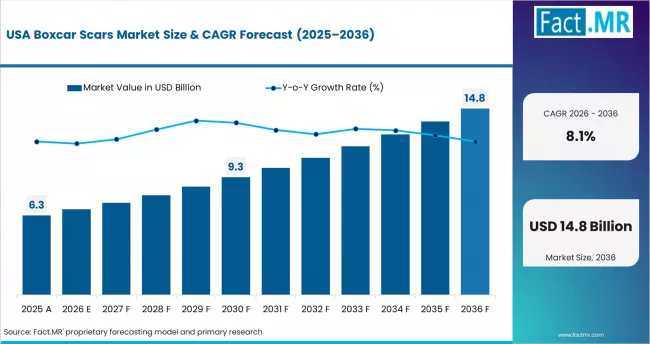
The USA contributes USD 4.657 billion in 2025. Growth reflects mainstream consumer adoption of aesthetic dermatology and the standardization of combination treatment protocols using laser, microneedling, and injectable fillers. Direct-to-consumer home treatment devices create a complementary revenue tier.
- Growth anchor: Mainstream adoption and combination protocols expand the treatment-seeking population.
India: Rising aesthetic consciousness and clinic access
India records strong growth driven by increasing aesthetic consciousness among urban consumers, rising disposable incomes, and expanding dermatology clinic access. Price-competitive treatment offerings using domestic aesthetic devices are broadening market access.
- Growth anchor: Rising aesthetic consciousness and clinic accessibility convert latent demand.
Germany: Medical dermatology precision and protocols
Germany leads European growth supported by medical dermatology tradition, evidence-based treatment protocols, and statutory health insurance coverage for medically indicated scar treatment. German dermatologists contribute to clinical evidence generation through published treatment series.
- Growth anchor: Evidence-based culture and insurance coverage create broader patient access.
Competitive Benchmarking and Company Positioning
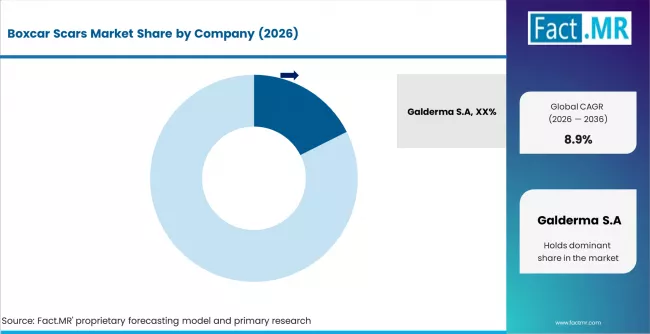
Boxcar Scars Market Analysis By Company
- Galderma S.A. leads with 17.6% market share, anchored by its Restylane injectable filler portfolio and dermatological skincare brands.
- Merz Inc. and Lumenis compete in the professional treatment tier, with Merz in injectable fillers and Lumenis in laser technology.
- Cynosure and Smith and Nephew maintain positions through aesthetic laser device platforms and wound care portfolios respectively.
The competitive field spans injectable filler companies, laser device manufacturers, and topical skincare brands competing across different treatment modalities. Galderma leads through its integrated positioning across both injectable fillers (Restylane) and topical skincare (Cetaphil, Differin).
In the device segment, competition is intensifying between established laser companies and RF microneedling platform companies. InMode Morpheus8 has achieved rapid market penetration through dermatologist and medical spa adoption.
The topical segment is highly fragmented, with differentiation depending on clinical evidence, dermatologist recommendation, and ingredient marketing.
Key Companies in the Boxcar Scars Market
Galderma S.A., Merz Inc., CeraVe, Smith and Nephew plc, Lumenis, Sonoma Pharmaceuticals Inc., Cynosure Inc., PCA SKIN, Solta Medical, and InMode Ltd. are the principal companies operating in the global boxcar scars market.
Recent Industry Developments
- Galderma: scar-specific filler formulation launch (2025)
- Galderma launched a Restylane formulation variant in 2025 optimized for atrophic scar filling, with modified cross-linking designed for superficial dermal depth suited to boxcar scar correction.
- Cynosure: RF microneedling platform update (2025)
- Cynosure released an updated Genius RF microneedling platform in 2025 with enhanced depth control and clinical protocols specifically developed for acne scar treatment.
- Lumenis: fractional laser scar protocol publication (2025)
- Lumenis published multi-center clinical data in 2025 supporting a standardized fractional CO2 laser treatment protocol for boxcar scars across diverse skin types.
- InMode: Morpheus8 scar indication expansion (2026)
- InMode expanded clinical indication claims for Morpheus8 in early 2026, publishing comparative data showing scar improvement outcomes comparable to fractional CO2 laser with reduced downtime.
Leading Companies Shaping the Boxcar Scars Market
-
Global Players
- Galderma S.A.
- Merz, Inc.
- Lumenis
- Cynosure Inc.
- Smith and Nephew plc
- Solta Medical
-
Regional Players
- PCA SKIN
- CeraVe
- Sonoma Pharmaceuticals Inc.
- Enaltus LLC
-
Emerging / Start-up Players
- InMode Ltd.
- Lutronic Corporation
- Scarsheal Inc.
Sources and Research References
- Galderma S.A. Annual Report 2024
- ISAPS Global Survey on Aesthetic Procedures
- ASDS Procedure Statistics
- Journal of the American Academy of Dermatology, Acne Scar Treatment Publications
- Lumenis Clinical Evidence Publications
- InMode Ltd. Annual Report 2024
All numerical data in this report is derived from Fact.MR proprietary research. Source references are provided for contextual and directional validation only.
Key Questions This Report Addresses
- What is the projected size of the boxcar scars market by 2036?
- Which product type holds the largest share?
- What CAGR is expected from 2026 to 2036?
- Which country is growing fastest?
- Who is the leading company?
- What is the incremental opportunity between 2026 and 2036?
- How is RF microneedling affecting growth?
- What role does home-use device expansion play?
Boxcar Scars Market Definition
The boxcar scars market covers treatment products and services for boxcar-type atrophic acne scars, which are broad, rectangular depressions in the skin with well-defined vertical edges. Treatments include topical formulations, chemical peels, laser therapies, microneedling, and injectable dermal fillers.
Boxcar Scars Market Inclusions
- Topical scar treatments including retinoids, vitamin C serums, and silicone-based formulations
- Chemical peel treatments for scar resurfacing
- Laser systems (fractional CO2, erbium, non-ablative) for scar treatment
- Injectable dermal fillers for scar volume restoration
Boxcar Scars Market Exclusions
- Acne treatment products targeting active breakouts
- Surgical scar revision procedures involving excision or skin grafting
- General anti-aging skincare without scar treatment claims
- Tattoo removal and non-scar laser services
Boxcar Scars Market Research Methodology
- Bottom-up revenue modeling using treatment procedure volumes, product retail sales, and average pricing across 15+ countries
- Primary interviews with dermatologists, aesthetic clinic operators, and medical device sales managers
- Cross-referencing aesthetic procedure statistics from ISAPS and ASDS
- Validation through aesthetic device sales data and retail skincare audit data
- Forecasting calibrated against aesthetic treatment adoption rates and disposable income trends
- Company-level revenue triangulation using annual reports and published sales data
Scope of Analysis

| Parameter | Details |
|---|---|
| Market size (2025) | USD 12.4 billion |
| Forecast period | 2026 to 2036 |
| CAGR | 8.9% |
| Base year | 2025 |
| Units | USD Billion |
| Segments covered | Product (Topical, Chemical Peels, Laser, Surface Treatment, Injectable); Technology (Laser, Non Ablative, RF, Chemical, Microneedling); Application (Scar Reduction, Skin Resurfacing, Anti Aging, Dermatological Therapy); End Use (Dermatology Clinics, Hospitals, Medical Spas, Home Care) |
| Regions covered | North America, Latin America, Europe, East Asia, South Asia and Pacific, Middle East and Africa |
| Countries profiled | USA, China, India, Germany, U.K., Brazil, Japan |
| Companies profiled | Galderma S.A., Merz Inc., Lumenis, Cynosure, Smith and Nephew, InMode |
| Forecasting approach | Bottom-up revenue modeling validated through primary research, aesthetic procedure statistics, and company-level financial triangulation |
Market Segmentation Analysis
-
Boxcar Scars Market Market Segmented by Product:
- Topical
- Gels
- Silicone Based Gels
- Water Based Gels
- Creams
- Medicated Creams
- Retinoid Creams
- Hydrating Creams
- Oils
- Essential Oils
- Vitamin Enriched Oils
- Lotions
- Lightweight Lotions
- Therapeutic Lotions
- Chemical Peels
- Superficial Peels
- Medium Depth Peels
- Deep Peels
- Laser
- CO2 Lasers
- Fractional CO2 Laser
- Ablative CO2 Laser
- Pulsed Dye Laser
- Vascular Targeted Laser
- Non Ablative Laser
- Surface Treatment
- Microdermabrasion
- Crystal Microdermabrasion
- Diamond Tip Microdermabrasion
- Dermabrasion
- Mechanical Dermabrasion
- Motorized Dermabrasion
- Microneedling
- Manual Microneedling
- Radiofrequency Microneedling
- Injectable
- Fillers
- Hyaluronic Acid Fillers
- Collagen Based Fillers
- Polymer Based Fillers
- Topical
-
Boxcar Scars Market Market Segmented by Distribution Channel:
- Clinics
- Dermatology Clinics
- Aesthetic Clinics
- Hospitals
- Public Hospitals
- Private Hospitals
- Pharmacies And Drug Stores
- Retail Pharmacies
- Chain Pharmacies
- E Commerce
- Brand Owned Websites
- Third Party Marketplaces
- Clinics
-
Boxcar Scars Market Market Segmented by Application:
- Scar Reduction
- Facial Scars
- Mild Scars
- Moderate Scars
- Severe Scars
- Skin Resurfacing
- Texture Improvement
- Pore Reduction
- Skin Smoothing
- Anti Aging Treatment
- Skin Rejuvenation
- Fine Line Reduction
- Elasticity Improvement
- Dermatological Therapy
- Clinical Treatment
- Chronic Scar Management
- Post Acne Treatment
- Scar Reduction
-
Boxcar Scars Market Market Segmented by End Use:
- Dermatology Clinics
- Professional Treatments
- Laser Procedures
- Injectable Procedures
- Hospitals
- Medical Treatments
- Advanced Dermatology Care
- Surgical Procedures
- Medical Spas
- Cosmetic Treatments
- Skin Rejuvenation Services
- Aesthetic Procedures
- Home Care Settings
- Consumer Use
- Topical Applications
- At Home Devices
- Dermatology Clinics
-
Boxcar Scars Market Market Segmented by Technology:
- Laser Technology
- Ablative Technology
- Carbon Dioxide Laser
- Erbium Laser
- Non Ablative Technology
- Fractional Laser
- Pulsed Light Systems
- Radiofrequency Technology
- Microneedle Radiofrequency
- Collagen Induction
- Skin Tightening
- Chemical Treatment Technology
- Chemical Peeling
- Acid Based Peels
- Combination Peels
- Microneedling Technology
- Collagen Induction Therapy
- Manual Devices
- Automated Devices
- Laser Technology
-
Boxcar Scars Market Market by Region:
- North America
- USA
- Canada
- Mexico
- Latin America
- Brazil
- Chile
- Rest of Latin America
- Western Europe
- Germany
- UK
- Italy
- Spain
- France
- Nordic
- BENELUX
- Rest of Western Europe
- Eastern Europe
- Russia
- Poland
- Hungary
- Balkan & Baltic
- Rest of Eastern Europe
- East Asia
- China
- Japan
- South Korea
- South Asia and Pacific
- India
- ASEAN
- Australia & New Zealand
- Rest of South Asia and Pacific
- Middle East & Africa
- Kingdom of Saudi Arabia
- Other GCC Countries
- Turkiye
- South Africa
- Other African Union
- Rest of Middle East & Africa
- North America
- Frequently Asked Questions -
What is the current size of the boxcar scars market?
The global boxcar scars market is valued at USD 12.4 billion in 2025.
What growth rate is expected?
The market is projected to grow at a CAGR of 8.9% from 2026 to 2036.
What will the market be worth by 2036?
The market is forecast to reach USD 31.676 billion by 2036.
Which product leads?
Topical products lead with 36.7% of product demand in 2025.
Which country is growing fastest?
China records the highest country-level CAGR.
Who is the market leader?
Galderma S.A. leads with a 17.6% market share in 2025.
What is the USA market value?
The USA contributes USD 4.657 billion in 2025.
Table of Content
- Executive Summary
- Global Market Outlook
- Demand to side Trends
- Supply to side Trends
- Technology Roadmap Analysis
- Analysis and Recommendations
- Market Overview
- Market Coverage / Taxonomy
- Market Definition / Scope / Limitations
- Research Methodology
- Chapter Orientation
- Analytical Lens and Working Hypotheses
- Market Structure, Signals, and Trend Drivers
- Benchmarking and Cross-market Comparability
- Market Sizing, Forecasting, and Opportunity Mapping
- Research Design and Evidence Framework
- Desk Research Programme (Secondary Evidence)
- Company Annual and Sustainability Reports
- Peer-reviewed Journals and Academic Literature
- Corporate Websites, Product Literature, and Technical Notes
- Earnings Decks and Investor Briefings
- Statutory Filings and Regulatory Disclosures
- Technical White Papers and Standards Notes
- Trade Journals, Industry Magazines, and Analyst Briefs
- Conference Proceedings, Webinars, and Seminar Materials
- Government Statistics Portals and Public Data Releases
- Press Releases and Reputable Media Coverage
- Specialist Newsletters and Curated Briefings
- Sector Databases and Reference Repositories
- Fact.MR Internal Proprietary Databases and Historical Market Datasets
- Subscription Datasets and Paid Sources
- Social Channels, Communities, and Digital Listening Inputs
- Additional Desk Sources
- Expert Input and Fieldwork (Primary Evidence)
- Primary Modes
- Qualitative Interviews and Expert Elicitation
- Quantitative Surveys and Structured Data Capture
- Blended Approach
- Why Primary Evidence is Used
- Field Techniques
- Interviews
- Surveys
- Focus Groups
- Observational and In-context Research
- Social and Community Interactions
- Stakeholder Universe Engaged
- C-suite Leaders
- Board Members
- Presidents and Vice Presidents
- R&D and Innovation Heads
- Technical Specialists
- Domain Subject-matter Experts
- Scientists
- Physicians and Other Healthcare Professionals
- Governance, Ethics, and Data Stewardship
- Research Ethics
- Data Integrity and Handling
- Primary Modes
- Tooling, Models, and Reference Databases
- Desk Research Programme (Secondary Evidence)
- Data Engineering and Model Build
- Data Acquisition and Ingestion
- Cleaning, Normalisation, and Verification
- Synthesis, Triangulation, and Analysis
- Quality Assurance and Audit Trail
- Market Background
- Market Dynamics
- Drivers
- Restraints
- Opportunity
- Trends
- Scenario Forecast
- Demand in Optimistic Scenario
- Demand in Likely Scenario
- Demand in Conservative Scenario
- Opportunity Map Analysis
- Product Life Cycle Analysis
- Supply Chain Analysis
- Investment Feasibility Matrix
- Value Chain Analysis
- PESTLE and Porter’s Analysis
- Regulatory Landscape
- Regional Parent Market Outlook
- Production and Consumption Statistics
- Import and Export Statistics
- Market Dynamics
- Global Market Analysis 2021 to 2025 and Forecast, 2026 to 2036
- Historical Market Size Value (USD Million) Analysis, 2021 to 2025
- Current and Future Market Size Value (USD Million) Projections, 2026 to 2036
- Y to o to Y Growth Trend Analysis
- Absolute $ Opportunity Analysis
- Global Market Pricing Analysis 2021 to 2025 and Forecast 2026 to 2036
- Global Market Analysis 2021 to 2025 and Forecast 2026 to 2036, By Product
- Introduction / Key Findings
- Historical Market Size Value (USD Million) Analysis By Product , 2021 to 2025
- Current and Future Market Size Value (USD Million) Analysis and Forecast By Product , 2026 to 2036
- Topical
- Gels
- Silicone Based Gels
- Water Based Gels
- Creams
- Medicated Creams
- Retinoid Creams
- Hydrating Creams
- Oils
- Essential Oils
- Vitamin Enriched Oils
- Chemical Peels
- Superficial Peels
- Medium Depth Peels
- Deep Peels
- Laser
- CO2 Lasers
- Fractional CO2 Laser
- Ablative CO2 Laser
- Pulsed Dye Laser
- Vascular Targeted Laser
- Surface Treatment
- Microdermabrasion
- Crystal Microdermabrasion
- Diamond Tip Microdermabrasion
- Dermabrasion
- Mechanical Dermabrasion
- Injectable
- Fillers
- Hyaluronic Acid Fillers
- Collagen Based Fillers
- Polymer Based Fillers
- Topical
- Y to o to Y Growth Trend Analysis By Product , 2021 to 2025
- Absolute $ Opportunity Analysis By Product , 2026 to 2036
- Global Market Analysis 2021 to 2025 and Forecast 2026 to 2036, By Distribution Channel
- Introduction / Key Findings
- Historical Market Size Value (USD Million) Analysis By Distribution Channel, 2021 to 2025
- Current and Future Market Size Value (USD Million) Analysis and Forecast By Distribution Channel, 2026 to 2036
- Clinics
- Dermatology Clinics
- Aesthetic Clinics
- Hospitals
- Public Hospitals
- Private Hospitals
- Pharmacies And Drug Stores
- Retail Pharmacies
- Chain Pharmacies
- E Commerce
- Brand Owned Websites
- Third Party Marketplaces
- Clinics
- Y to o to Y Growth Trend Analysis By Distribution Channel, 2021 to 2025
- Absolute $ Opportunity Analysis By Distribution Channel, 2026 to 2036
- Global Market Analysis 2021 to 2025 and Forecast 2026 to 2036, By Application
- Introduction / Key Findings
- Historical Market Size Value (USD Million) Analysis By Application, 2021 to 2025
- Current and Future Market Size Value (USD Million) Analysis and Forecast By Application, 2026 to 2036
- Scar Reduction
- Facial Scars
- Mild Scars
- Moderate Scars
- Severe Scars
- Skin Resurfacing
- Texture Improvement
- Pore Reduction
- Skin Smoothing
- Anti Aging Treatment
- Skin Rejuvenation
- Fine Line Reduction
- Elasticity Improvement
- Dermatological Therapy
- Clinical Treatment
- Chronic Scar Management
- Post Acne Treatment
- Scar Reduction
- Y to o to Y Growth Trend Analysis By Application, 2021 to 2025
- Absolute $ Opportunity Analysis By Application, 2026 to 2036
- Global Market Analysis 2021 to 2025 and Forecast 2026 to 2036, By End Use
- Introduction / Key Findings
- Historical Market Size Value (USD Million) Analysis By End Use, 2021 to 2025
- Current and Future Market Size Value (USD Million) Analysis and Forecast By End Use, 2026 to 2036
- Dermatology Clinics
- Professional Treatments
- Laser Procedures
- Injectable Procedures
- Hospitals
- Medical Treatments
- Advanced Dermatology Care
- Surgical Procedures
- Medical Spas
- Cosmetic Treatments
- Skin Rejuvenation Services
- Aesthetic Procedures
- Home Care Settings
- Consumer Use
- Topical Applications
- At Home Devices
- Dermatology Clinics
- Y to o to Y Growth Trend Analysis By End Use, 2021 to 2025
- Absolute $ Opportunity Analysis By End Use, 2026 to 2036
- Global Market Analysis 2021 to 2025 and Forecast 2026 to 2036, By Technology
- Introduction / Key Findings
- Historical Market Size Value (USD Million) Analysis By Technology, 2021 to 2025
- Current and Future Market Size Value (USD Million) Analysis and Forecast By Technology, 2026 to 2036
- Laser Technology
- Ablative Technology
- Carbon Dioxide Laser
- Erbium Laser
- Non Ablative Technology
- Fractional Laser
- Pulsed Light Systems
- Radiofrequency Technology
- Microneedle Radiofrequency
- Collagen Induction
- Skin Tightening
- Chemical Treatment Technology
- Chemical Peeling
- Acid Based Peels
- Combination Peels
- Microneedling Technology
- Collagen Induction Therapy
- Manual Devices
- Automated Devices
- Laser Technology
- Y to o to Y Growth Trend Analysis By Technology, 2021 to 2025
- Absolute $ Opportunity Analysis By Technology, 2026 to 2036
- Global Market Analysis 2021 to 2025 and Forecast 2026 to 2036, By Region
- Introduction
- Historical Market Size Value (USD Million) Analysis By Region, 2021 to 2025
- Current Market Size Value (USD Million) Analysis and Forecast By Region, 2026 to 2036
- North America
- Latin America
- Western Europe
- Eastern Europe
- East Asia
- South Asia and Pacific
- Middle East & Africa
- Market Attractiveness Analysis By Region
- North America Market Analysis 2021 to 2025 and Forecast 2026 to 2036, By Country
- Historical Market Size Value (USD Million) Trend Analysis By Market Taxonomy, 2021 to 2025
- Market Size Value (USD Million) Forecast By Market Taxonomy, 2026 to 2036
- By Country
- USA
- Canada
- Mexico
- By Product
- By Distribution Channel
- By Application
- By End Use
- By Technology
- By Country
- Market Attractiveness Analysis
- By Country
- By Product
- By Distribution Channel
- By Application
- By End Use
- By Technology
- Key Takeaways
- Latin America Market Analysis 2021 to 2025 and Forecast 2026 to 2036, By Country
- Historical Market Size Value (USD Million) Trend Analysis By Market Taxonomy, 2021 to 2025
- Market Size Value (USD Million) Forecast By Market Taxonomy, 2026 to 2036
- By Country
- Brazil
- Chile
- Rest of Latin America
- By Product
- By Distribution Channel
- By Application
- By End Use
- By Technology
- By Country
- Market Attractiveness Analysis
- By Country
- By Product
- By Distribution Channel
- By Application
- By End Use
- By Technology
- Key Takeaways
- Western Europe Market Analysis 2021 to 2025 and Forecast 2026 to 2036, By Country
- Historical Market Size Value (USD Million) Trend Analysis By Market Taxonomy, 2021 to 2025
- Market Size Value (USD Million) Forecast By Market Taxonomy, 2026 to 2036
- By Country
- Germany
- UK
- Italy
- Spain
- France
- Nordic
- BENELUX
- Rest of Western Europe
- By Product
- By Distribution Channel
- By Application
- By End Use
- By Technology
- By Country
- Market Attractiveness Analysis
- By Country
- By Product
- By Distribution Channel
- By Application
- By End Use
- By Technology
- Key Takeaways
- Eastern Europe Market Analysis 2021 to 2025 and Forecast 2026 to 2036, By Country
- Historical Market Size Value (USD Million) Trend Analysis By Market Taxonomy, 2021 to 2025
- Market Size Value (USD Million) Forecast By Market Taxonomy, 2026 to 2036
- By Country
- Russia
- Poland
- Hungary
- Balkan & Baltic
- Rest of Eastern Europe
- By Product
- By Distribution Channel
- By Application
- By End Use
- By Technology
- By Country
- Market Attractiveness Analysis
- By Country
- By Product
- By Distribution Channel
- By Application
- By End Use
- By Technology
- Key Takeaways
- East Asia Market Analysis 2021 to 2025 and Forecast 2026 to 2036, By Country
- Historical Market Size Value (USD Million) Trend Analysis By Market Taxonomy, 2021 to 2025
- Market Size Value (USD Million) Forecast By Market Taxonomy, 2026 to 2036
- By Country
- China
- Japan
- South Korea
- By Product
- By Distribution Channel
- By Application
- By End Use
- By Technology
- By Country
- Market Attractiveness Analysis
- By Country
- By Product
- By Distribution Channel
- By Application
- By End Use
- By Technology
- Key Takeaways
- South Asia and Pacific Market Analysis 2021 to 2025 and Forecast 2026 to 2036, By Country
- Historical Market Size Value (USD Million) Trend Analysis By Market Taxonomy, 2021 to 2025
- Market Size Value (USD Million) Forecast By Market Taxonomy, 2026 to 2036
- By Country
- India
- ASEAN
- Australia & New Zealand
- Rest of South Asia and Pacific
- By Product
- By Distribution Channel
- By Application
- By End Use
- By Technology
- By Country
- Market Attractiveness Analysis
- By Country
- By Product
- By Distribution Channel
- By Application
- By End Use
- By Technology
- Key Takeaways
- Middle East & Africa Market Analysis 2021 to 2025 and Forecast 2026 to 2036, By Country
- Historical Market Size Value (USD Million) Trend Analysis By Market Taxonomy, 2021 to 2025
- Market Size Value (USD Million) Forecast By Market Taxonomy, 2026 to 2036
- By Country
- Kingdom of Saudi Arabia
- Other GCC Countries
- Turkiye
- South Africa
- Other African Union
- Rest of Middle East & Africa
- By Product
- By Distribution Channel
- By Application
- By End Use
- By Technology
- By Country
- Market Attractiveness Analysis
- By Country
- By Product
- By Distribution Channel
- By Application
- By End Use
- By Technology
- Key Takeaways
- Key Countries Market Analysis
- USA
- Pricing Analysis
- Market Share Analysis, 2025
- By Product
- By Distribution Channel
- By Application
- By End Use
- By Technology
- Canada
- Pricing Analysis
- Market Share Analysis, 2025
- By Product
- By Distribution Channel
- By Application
- By End Use
- By Technology
- Mexico
- Pricing Analysis
- Market Share Analysis, 2025
- By Product
- By Distribution Channel
- By Application
- By End Use
- By Technology
- Brazil
- Pricing Analysis
- Market Share Analysis, 2025
- By Product
- By Distribution Channel
- By Application
- By End Use
- By Technology
- Chile
- Pricing Analysis
- Market Share Analysis, 2025
- By Product
- By Distribution Channel
- By Application
- By End Use
- By Technology
- Germany
- Pricing Analysis
- Market Share Analysis, 2025
- By Product
- By Distribution Channel
- By Application
- By End Use
- By Technology
- UK
- Pricing Analysis
- Market Share Analysis, 2025
- By Product
- By Distribution Channel
- By Application
- By End Use
- By Technology
- Italy
- Pricing Analysis
- Market Share Analysis, 2025
- By Product
- By Distribution Channel
- By Application
- By End Use
- By Technology
- Spain
- Pricing Analysis
- Market Share Analysis, 2025
- By Product
- By Distribution Channel
- By Application
- By End Use
- By Technology
- France
- Pricing Analysis
- Market Share Analysis, 2025
- By Product
- By Distribution Channel
- By Application
- By End Use
- By Technology
- India
- Pricing Analysis
- Market Share Analysis, 2025
- By Product
- By Distribution Channel
- By Application
- By End Use
- By Technology
- ASEAN
- Pricing Analysis
- Market Share Analysis, 2025
- By Product
- By Distribution Channel
- By Application
- By End Use
- By Technology
- Australia & New Zealand
- Pricing Analysis
- Market Share Analysis, 2025
- By Product
- By Distribution Channel
- By Application
- By End Use
- By Technology
- China
- Pricing Analysis
- Market Share Analysis, 2025
- By Product
- By Distribution Channel
- By Application
- By End Use
- By Technology
- Japan
- Pricing Analysis
- Market Share Analysis, 2025
- By Product
- By Distribution Channel
- By Application
- By End Use
- By Technology
- South Korea
- Pricing Analysis
- Market Share Analysis, 2025
- By Product
- By Distribution Channel
- By Application
- By End Use
- By Technology
- Russia
- Pricing Analysis
- Market Share Analysis, 2025
- By Product
- By Distribution Channel
- By Application
- By End Use
- By Technology
- Poland
- Pricing Analysis
- Market Share Analysis, 2025
- By Product
- By Distribution Channel
- By Application
- By End Use
- By Technology
- Hungary
- Pricing Analysis
- Market Share Analysis, 2025
- By Product
- By Distribution Channel
- By Application
- By End Use
- By Technology
- Kingdom of Saudi Arabia
- Pricing Analysis
- Market Share Analysis, 2025
- By Product
- By Distribution Channel
- By Application
- By End Use
- By Technology
- Turkiye
- Pricing Analysis
- Market Share Analysis, 2025
- By Product
- By Distribution Channel
- By Application
- By End Use
- By Technology
- South Africa
- Pricing Analysis
- Market Share Analysis, 2025
- By Product
- By Distribution Channel
- By Application
- By End Use
- By Technology
- USA
- Market Structure Analysis
- Competition Dashboard
- Competition Benchmarking
- Market Share Analysis of Top Players
- By Regional
- By Product
- By Distribution Channel
- By Application
- By End Use
- By Technology
- Competition Analysis
- Competition Deep Dive
- Galderma S.A
- Overview
- Product Portfolio
- Profitability by Market Segments (Product/Age /Sales Channel/Region)
- Sales Footprint
- Strategy Overview
- Marketing Strategy
- Product Strategy
- Channel Strategy
- Merz, Inc.
- CeraVe
- Smith & Nephew plc
- Lumenis
- Sonoma Pharmaceuticals Inc.
- Scarsheal Inc.
- Enaltus LLC
- Proactiv Company
- LLCMlnlycke Health Care
- CCA Industries Inc.
- Cynosure Inc.
- PCA SKIN
- Solta Medical
- Galderma S.A
- Competition Deep Dive
- Assumptions & Acronyms Used
List Of Table
- Table 1: Global Market Value (USD Million) Forecast by Region, 2021 to 2036
- Table 2: Global Market Value (USD Million) Forecast by Product , 2021 to 2036
- Table 3: Global Market Value (USD Million) Forecast by Distribution Channel, 2021 to 2036
- Table 4: Global Market Value (USD Million) Forecast by Application, 2021 to 2036
- Table 5: Global Market Value (USD Million) Forecast by End Use, 2021 to 2036
- Table 6: Global Market Value (USD Million) Forecast by Technology, 2021 to 2036
- Table 7: North America Market Value (USD Million) Forecast by Country, 2021 to 2036
- Table 8: North America Market Value (USD Million) Forecast by Product , 2021 to 2036
- Table 9: North America Market Value (USD Million) Forecast by Distribution Channel, 2021 to 2036
- Table 10: North America Market Value (USD Million) Forecast by Application, 2021 to 2036
- Table 11: North America Market Value (USD Million) Forecast by End Use, 2021 to 2036
- Table 12: North America Market Value (USD Million) Forecast by Technology, 2021 to 2036
- Table 13: Latin America Market Value (USD Million) Forecast by Country, 2021 to 2036
- Table 14: Latin America Market Value (USD Million) Forecast by Product , 2021 to 2036
- Table 15: Latin America Market Value (USD Million) Forecast by Distribution Channel, 2021 to 2036
- Table 16: Latin America Market Value (USD Million) Forecast by Application, 2021 to 2036
- Table 17: Latin America Market Value (USD Million) Forecast by End Use, 2021 to 2036
- Table 18: Latin America Market Value (USD Million) Forecast by Technology, 2021 to 2036
- Table 19: Western Europe Market Value (USD Million) Forecast by Country, 2021 to 2036
- Table 20: Western Europe Market Value (USD Million) Forecast by Product , 2021 to 2036
- Table 21: Western Europe Market Value (USD Million) Forecast by Distribution Channel, 2021 to 2036
- Table 22: Western Europe Market Value (USD Million) Forecast by Application, 2021 to 2036
- Table 23: Western Europe Market Value (USD Million) Forecast by End Use, 2021 to 2036
- Table 24: Western Europe Market Value (USD Million) Forecast by Technology, 2021 to 2036
- Table 25: Eastern Europe Market Value (USD Million) Forecast by Country, 2021 to 2036
- Table 26: Eastern Europe Market Value (USD Million) Forecast by Product , 2021 to 2036
- Table 27: Eastern Europe Market Value (USD Million) Forecast by Distribution Channel, 2021 to 2036
- Table 28: Eastern Europe Market Value (USD Million) Forecast by Application, 2021 to 2036
- Table 29: Eastern Europe Market Value (USD Million) Forecast by End Use, 2021 to 2036
- Table 30: Eastern Europe Market Value (USD Million) Forecast by Technology, 2021 to 2036
- Table 31: East Asia Market Value (USD Million) Forecast by Country, 2021 to 2036
- Table 32: East Asia Market Value (USD Million) Forecast by Product , 2021 to 2036
- Table 33: East Asia Market Value (USD Million) Forecast by Distribution Channel, 2021 to 2036
- Table 34: East Asia Market Value (USD Million) Forecast by Application, 2021 to 2036
- Table 35: East Asia Market Value (USD Million) Forecast by End Use, 2021 to 2036
- Table 36: East Asia Market Value (USD Million) Forecast by Technology, 2021 to 2036
- Table 37: South Asia and Pacific Market Value (USD Million) Forecast by Country, 2021 to 2036
- Table 38: South Asia and Pacific Market Value (USD Million) Forecast by Product , 2021 to 2036
- Table 39: South Asia and Pacific Market Value (USD Million) Forecast by Distribution Channel, 2021 to 2036
- Table 40: South Asia and Pacific Market Value (USD Million) Forecast by Application, 2021 to 2036
- Table 41: South Asia and Pacific Market Value (USD Million) Forecast by End Use, 2021 to 2036
- Table 42: South Asia and Pacific Market Value (USD Million) Forecast by Technology, 2021 to 2036
- Table 43: Middle East & Africa Market Value (USD Million) Forecast by Country, 2021 to 2036
- Table 44: Middle East & Africa Market Value (USD Million) Forecast by Product , 2021 to 2036
- Table 45: Middle East & Africa Market Value (USD Million) Forecast by Distribution Channel, 2021 to 2036
- Table 46: Middle East & Africa Market Value (USD Million) Forecast by Application, 2021 to 2036
- Table 47: Middle East & Africa Market Value (USD Million) Forecast by End Use, 2021 to 2036
- Table 48: Middle East & Africa Market Value (USD Million) Forecast by Technology, 2021 to 2036
List Of Figures
- Figure 1: Global Market Pricing Analysis
- Figure 2: Global Market Value (USD Million) Forecast 2021-2036
- Figure 3: Global Market Value Share and BPS Analysis by Product, 2026 and 2036
- Figure 4: Global Market Y-o-Y Growth Comparison by Product,2026 to 2036
- Figure 5: Global Market Attractiveness Analysis by Product
- Figure 6: Global Market Value Share and BPS Analysis by Distribution Channel, 2026 and 2036
- Figure 7: Global Market Y-o-Y Growth Comparison by Distribution Channel,2026 to 2036
- Figure 8: Global Market Attractiveness Analysis by Distribution Channel
- Figure 9: Global Market Value Share and BPS Analysis by Application, 2026 and 2036
- Figure 10: Global Market Y-o-Y Growth Comparison by Application,2026 to 2036
- Figure 11: Global Market Attractiveness Analysis by Application
- Figure 12: Global Market Value Share and BPS Analysis by End Use, 2026 and 2036
- Figure 13: Global Market Y-o-Y Growth Comparison by End Use,2026 to 2036
- Figure 14: Global Market Attractiveness Analysis by End Use
- Figure 15: Global Market Value Share and BPS Analysis by Technology, 2026 and 2036
- Figure 16: Global Market Y-o-Y Growth Comparison by Technology,2026 to 2036
- Figure 17: Global Market Attractiveness Analysis by Technology
- Figure 18: Global Market Value (USD Million) Share and BPS Analysis by Region, 2026 and 2036
- Figure 19: Global Market Y-o-Y Growth Comparison by Region,2026 to 2036
- Figure 20: Global Market Attractiveness Analysis by Region
- Figure 21: North America Market Incremental Dollar Opportunity,2026 to 2036
- Figure 22: Latin America Market Incremental Dollar Opportunity,2026 to 2036
- Figure 23: Western Europe Market Incremental Dollar Opportunity,2026 to 2036
- Figure 24: Eastern Europe Market Incremental Dollar Opportunity,2026 to 2036
- Figure 25: East Asia Market Incremental Dollar Opportunity,2026 to 2036
- Figure 26: South Asia and Pacific Market Incremental Dollar Opportunity,2026 to 2036
- Figure 27: Middle East & Africa Market Incremental Dollar Opportunity,2026 to 2036
- Figure 28: North America Market Value Share and BPS Analysis by Country, 2026 and 2036
- Figure 29: North America Market Value Share and BPS Analysis by Product, 2026 and 2036
- Figure 30: North America Market Y-o-Y Growth Comparison by Product,2026 to 2036
- Figure 31: North America Market Attractiveness Analysis by Product
- Figure 32: North America Market Value Share and BPS Analysis by Distribution Channel, 2026 and 2036
- Figure 33: North America Market Y-o-Y Growth Comparison by Distribution Channel,2026 to 2036
- Figure 34: North America Market Attractiveness Analysis by Distribution Channel
- Figure 35: North America Market Value Share and BPS Analysis by Application, 2026 and 2036
- Figure 36: North America Market Y-o-Y Growth Comparison by Application,2026 to 2036
- Figure 37: North America Market Attractiveness Analysis by Application
- Figure 38: North America Market Value Share and BPS Analysis by End Use, 2026 and 2036
- Figure 39: North America Market Y-o-Y Growth Comparison by End Use,2026 to 2036
- Figure 40: North America Market Attractiveness Analysis by End Use
- Figure 41: North America Market Value Share and BPS Analysis by Technology, 2026 and 2036
- Figure 42: North America Market Y-o-Y Growth Comparison by Technology,2026 to 2036
- Figure 43: North America Market Attractiveness Analysis by Technology
- Figure 44: Latin America Market Value Share and BPS Analysis by Country, 2026 and 2036
- Figure 45: Latin America Market Value Share and BPS Analysis by Product, 2026 and 2036
- Figure 46: Latin America Market Y-o-Y Growth Comparison by Product,2026 to 2036
- Figure 47: Latin America Market Attractiveness Analysis by Product
- Figure 48: Latin America Market Value Share and BPS Analysis by Distribution Channel, 2026 and 2036
- Figure 49: Latin America Market Y-o-Y Growth Comparison by Distribution Channel,2026 to 2036
- Figure 50: Latin America Market Attractiveness Analysis by Distribution Channel
- Figure 51: Latin America Market Value Share and BPS Analysis by Application, 2026 and 2036
- Figure 52: Latin America Market Y-o-Y Growth Comparison by Application,2026 to 2036
- Figure 53: Latin America Market Attractiveness Analysis by Application
- Figure 54: Latin America Market Value Share and BPS Analysis by End Use, 2026 and 2036
- Figure 55: Latin America Market Y-o-Y Growth Comparison by End Use,2026 to 2036
- Figure 56: Latin America Market Attractiveness Analysis by End Use
- Figure 57: Latin America Market Value Share and BPS Analysis by Technology, 2026 and 2036
- Figure 58: Latin America Market Y-o-Y Growth Comparison by Technology,2026 to 2036
- Figure 59: Latin America Market Attractiveness Analysis by Technology
- Figure 60: Western Europe Market Value Share and BPS Analysis by Country, 2026 and 2036
- Figure 61: Western Europe Market Value Share and BPS Analysis by Product, 2026 and 2036
- Figure 62: Western Europe Market Y-o-Y Growth Comparison by Product,2026 to 2036
- Figure 63: Western Europe Market Attractiveness Analysis by Product
- Figure 64: Western Europe Market Value Share and BPS Analysis by Distribution Channel, 2026 and 2036
- Figure 65: Western Europe Market Y-o-Y Growth Comparison by Distribution Channel,2026 to 2036
- Figure 66: Western Europe Market Attractiveness Analysis by Distribution Channel
- Figure 67: Western Europe Market Value Share and BPS Analysis by Application, 2026 and 2036
- Figure 68: Western Europe Market Y-o-Y Growth Comparison by Application,2026 to 2036
- Figure 69: Western Europe Market Attractiveness Analysis by Application
- Figure 70: Western Europe Market Value Share and BPS Analysis by End Use, 2026 and 2036
- Figure 71: Western Europe Market Y-o-Y Growth Comparison by End Use,2026 to 2036
- Figure 72: Western Europe Market Attractiveness Analysis by End Use
- Figure 73: Western Europe Market Value Share and BPS Analysis by Technology, 2026 and 2036
- Figure 74: Western Europe Market Y-o-Y Growth Comparison by Technology,2026 to 2036
- Figure 75: Western Europe Market Attractiveness Analysis by Technology
- Figure 76: Eastern Europe Market Value Share and BPS Analysis by Country, 2026 and 2036
- Figure 77: Eastern Europe Market Value Share and BPS Analysis by Product, 2026 and 2036
- Figure 78: Eastern Europe Market Y-o-Y Growth Comparison by Product,2026 to 2036
- Figure 79: Eastern Europe Market Attractiveness Analysis by Product
- Figure 80: Eastern Europe Market Value Share and BPS Analysis by Distribution Channel, 2026 and 2036
- Figure 81: Eastern Europe Market Y-o-Y Growth Comparison by Distribution Channel,2026 to 2036
- Figure 82: Eastern Europe Market Attractiveness Analysis by Distribution Channel
- Figure 83: Eastern Europe Market Value Share and BPS Analysis by Application, 2026 and 2036
- Figure 84: Eastern Europe Market Y-o-Y Growth Comparison by Application,2026 to 2036
- Figure 85: Eastern Europe Market Attractiveness Analysis by Application
- Figure 86: Eastern Europe Market Value Share and BPS Analysis by End Use, 2026 and 2036
- Figure 87: Eastern Europe Market Y-o-Y Growth Comparison by End Use,2026 to 2036
- Figure 88: Eastern Europe Market Attractiveness Analysis by End Use
- Figure 89: Eastern Europe Market Value Share and BPS Analysis by Technology, 2026 and 2036
- Figure 90: Eastern Europe Market Y-o-Y Growth Comparison by Technology,2026 to 2036
- Figure 91: Eastern Europe Market Attractiveness Analysis by Technology
- Figure 92: East Asia Market Value Share and BPS Analysis by Country, 2026 and 2036
- Figure 93: East Asia Market Value Share and BPS Analysis by Product, 2026 and 2036
- Figure 94: East Asia Market Y-o-Y Growth Comparison by Product,2026 to 2036
- Figure 95: East Asia Market Attractiveness Analysis by Product
- Figure 96: East Asia Market Value Share and BPS Analysis by Distribution Channel, 2026 and 2036
- Figure 97: East Asia Market Y-o-Y Growth Comparison by Distribution Channel,2026 to 2036
- Figure 98: East Asia Market Attractiveness Analysis by Distribution Channel
- Figure 99: East Asia Market Value Share and BPS Analysis by Application, 2026 and 2036
- Figure 100: East Asia Market Y-o-Y Growth Comparison by Application,2026 to 2036
- Figure 101: East Asia Market Attractiveness Analysis by Application
- Figure 102: East Asia Market Value Share and BPS Analysis by End Use, 2026 and 2036
- Figure 103: East Asia Market Y-o-Y Growth Comparison by End Use,2026 to 2036
- Figure 104: East Asia Market Attractiveness Analysis by End Use
- Figure 105: East Asia Market Value Share and BPS Analysis by Technology, 2026 and 2036
- Figure 106: East Asia Market Y-o-Y Growth Comparison by Technology,2026 to 2036
- Figure 107: East Asia Market Attractiveness Analysis by Technology
- Figure 108: South Asia and Pacific Market Value Share and BPS Analysis by Country, 2026 and 2036
- Figure 109: South Asia and Pacific Market Value Share and BPS Analysis by Product, 2026 and 2036
- Figure 110: South Asia and Pacific Market Y-o-Y Growth Comparison by Product,2026 to 2036
- Figure 111: South Asia and Pacific Market Attractiveness Analysis by Product
- Figure 112: South Asia and Pacific Market Value Share and BPS Analysis by Distribution Channel, 2026 and 2036
- Figure 113: South Asia and Pacific Market Y-o-Y Growth Comparison by Distribution Channel,2026 to 2036
- Figure 114: South Asia and Pacific Market Attractiveness Analysis by Distribution Channel
- Figure 115: South Asia and Pacific Market Value Share and BPS Analysis by Application, 2026 and 2036
- Figure 116: South Asia and Pacific Market Y-o-Y Growth Comparison by Application,2026 to 2036
- Figure 117: South Asia and Pacific Market Attractiveness Analysis by Application
- Figure 118: South Asia and Pacific Market Value Share and BPS Analysis by End Use, 2026 and 2036
- Figure 119: South Asia and Pacific Market Y-o-Y Growth Comparison by End Use,2026 to 2036
- Figure 120: South Asia and Pacific Market Attractiveness Analysis by End Use
- Figure 121: South Asia and Pacific Market Value Share and BPS Analysis by Technology, 2026 and 2036
- Figure 122: South Asia and Pacific Market Y-o-Y Growth Comparison by Technology,2026 to 2036
- Figure 123: South Asia and Pacific Market Attractiveness Analysis by Technology
- Figure 124: Middle East & Africa Market Value Share and BPS Analysis by Country, 2026 and 2036
- Figure 125: Middle East & Africa Market Value Share and BPS Analysis by Product, 2026 and 2036
- Figure 126: Middle East & Africa Market Y-o-Y Growth Comparison by Product,2026 to 2036
- Figure 127: Middle East & Africa Market Attractiveness Analysis by Product
- Figure 128: Middle East & Africa Market Value Share and BPS Analysis by Distribution Channel, 2026 and 2036
- Figure 129: Middle East & Africa Market Y-o-Y Growth Comparison by Distribution Channel,2026 to 2036
- Figure 130: Middle East & Africa Market Attractiveness Analysis by Distribution Channel
- Figure 131: Middle East & Africa Market Value Share and BPS Analysis by Application, 2026 and 2036
- Figure 132: Middle East & Africa Market Y-o-Y Growth Comparison by Application,2026 to 2036
- Figure 133: Middle East & Africa Market Attractiveness Analysis by Application
- Figure 134: Middle East & Africa Market Value Share and BPS Analysis by End Use, 2026 and 2036
- Figure 135: Middle East & Africa Market Y-o-Y Growth Comparison by End Use,2026 to 2036
- Figure 136: Middle East & Africa Market Attractiveness Analysis by End Use
- Figure 137: Middle East & Africa Market Value Share and BPS Analysis by Technology, 2026 and 2036
- Figure 138: Middle East & Africa Market Y-o-Y Growth Comparison by Technology,2026 to 2036
- Figure 139: Middle East & Africa Market Attractiveness Analysis by Technology
- Figure 140: Global Market - Tier Structure Analysis
- Figure 141: Global Market - Company Share Analysis