- Market Value (2025): USD 542.7 Mn
- Estimated Value (2026): USD 578.0 Mn
- Forecast Value (2036): USD 1,085.0 Mn
- CAGR (2026-2036): 6.5%
What is the Cyanoacrylate Adhesive Gels Market forecast to be worth by 2036?
USD 1,085.0 million by 2036 at 6.5% CAGR.
- The Cyanoacrylate Adhesive Gels Market reached USD 542.7 million in 2025.
- Demand is projected to increase from USD 578.0 million in 2026 to USD 1,085.0 million by 2036.
- The market is forecast to record a 6.5% CAGR from 2026 to 2036.
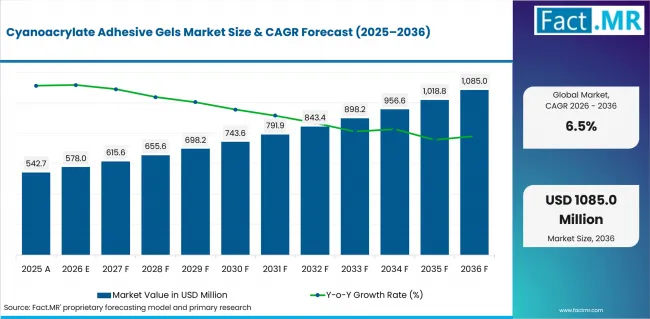
Cyanoacrylate Adhesive Gels Market Value Analysis | Source: Fact.MR
What are the defining numbers behind Cyanoacrylate Adhesive Gels Market growth?
An absolute opportunity of USD 502.0 million is expected between 2026 and 2036.
- Demand Drivers in the Market
- High-viscosity cyanoacrylate gels stay where they are dispensed instead of flowing into adjacent areas. This makes them useful for vertical joints, porous substrates and assemblies with small gaps where uncontrolled wicking can contaminate nearby surfaces. Henkel identifies gel consistency as a means of preventing adhesive flow on vertical surfaces, while selected formulations also provide gap-filling capability.
- Short fixture times reduce the amount of clamping and holding required during assembly. Parts can move to the next operation sooner, which lowers work-in-process and makes cyanoacrylate gels suitable for production lines where bonding speed affects throughput.
- Ethyl cyanoacrylate provides a familiar chemistry for bonding common industrial substrates and can be modified for specific production requirements. Low-bloom and gel variants extend its use where appearance, positioning control or reduced adhesive migration matters. Henkel markets low-bloom gel cyanoacrylates specifically for industrial assembly and vertical-surface bonding.
- Industrial assembly generates recurring consumption because cyanoacrylate gels are applied at the joint level rather than installed as durable equipment. Manufacturers therefore repurchase packaged adhesive as production volumes increase, particularly where the process requires consistent dispense control and predictable fixture performance.
- Medical and skin-contact applications create a more specialized demand segment because cyanoacrylate-based products intended for tissue contact must satisfy medical-device controls and biocompatibility requirements. FDA guidance identifies specific controls for cyanoacrylate tissue adhesives and references biological evaluation under the ISO 10993 framework, creating a separate qualification path from conventional industrial bonding.
- Key Segments Analyzed
- High-viscosity gel accounts for 42.0% of Viscosity Grade in 2026, as controlled flow helps keep the adhesive on vertical surfaces and reduces unintended migration beyond the bond area.
- Ethyl cyanoacrylate holds 41.0% of Formulation in 2026, supported by rapid fixture performance across commonly bonded industrial substrates and its adaptability into gel, low-bloom and other application-specific formulations.
- Industrial assembly represents 38.0% of Application in 2026 because short fixture times reduce reliance on prolonged clamping and allow bonded parts to move through subsequent production steps sooner.
- Analyst Opinion at Fact.MR
- Shambhu Nath Jha, Senior Consultant at Fact.MR, states, "Buyer decisions in the Cyanoacrylate Adhesive Gels Market will centre on controlled placement and rapid fixture in industrial assembly, repair and selected medical applications. Buyers will compare the 2026 segment leaders with qualification evidence and the operating cost of the full process. Suppliers that support application trials and preserve formulation or equipment consistency can move more quickly into repeat production."
- Strategic Implications
- Suppliers should document the process conditions that allow High-viscosity gel to deliver repeatable performance.
- Customer trials should use the intended substrate, fluid path or process stream before commercial qualification.
- Regional technical support is important in China and Germany because adoption depends on local production or infrastructure conditions.
- Commercial positioning should distinguish qualified application performance from general material or equipment capability.
How does the Cyanoacrylate Adhesive Gels Market break down by segment?
The market is segmented by Viscosity Grade, Formulation and Application.
Why does High-viscosity gel lead Viscosity Grade?
High-viscosity gel is projected to account for a 41.5% share in 2026.
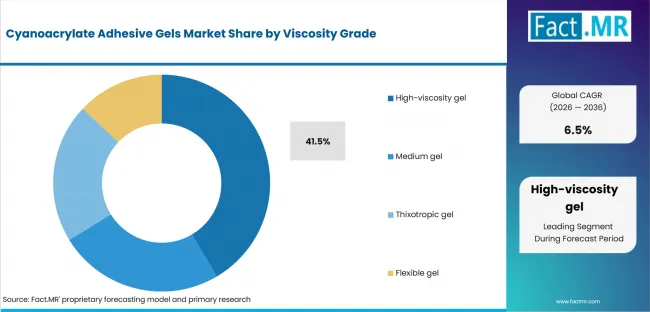
Cyanoacrylate Adhesive Gels Market Analysis By Viscosity Grade | Source: Fact.MR
High-viscosity gels are preferred where placement control matters. Their thicker consistency keeps the adhesive concentrated around the intended bond area on vertical, porous or irregular surfaces, reducing the risk of migration into adjacent components.
The gel format can also accommodate small gaps between mating surfaces and hold the adhesive in position while fixture develops. This makes it practical for assemblies where precise application is more important than very low-viscosity capillary flow.
Why does Ethyl cyanoacrylate lead Formulation?
Ethyl cyanoacrylate is projected to account for a 40.7% share in 2026.
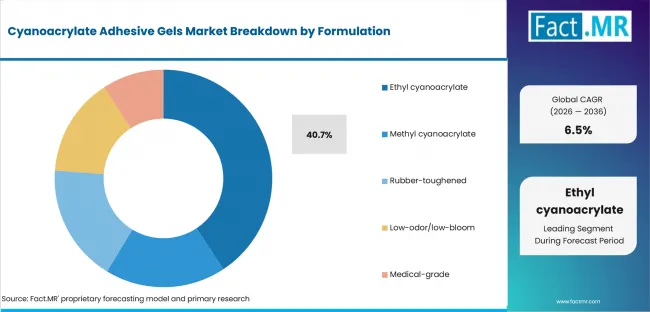
Cyanoacrylate Adhesive Gels Market Analysis By Formulation | Source: Fact.MR
Ethyl cyanoacrylate supports fast bonding across many substrates commonly encountered in industrial assembly, giving manufacturers a familiar formulation base for short-cycle joining applications.
The same chemistry can be adapted into toughened, gel and low-bloom formulations to address impact resistance, application control or appearance requirements. Manufacturers can therefore extend performance without moving to a completely different curing system.
Why does Industrial assembly lead Application?
Industrial assembly is projected to account for a 37.5% share in 2026.
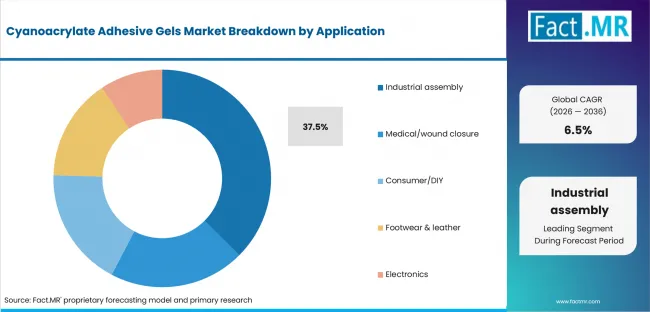
Cyanoacrylate Adhesive Gels Market Analysis By Application | Source: Fact.MR
Industrial assembly benefits from cyanoacrylate gels because bonded components can reach fixture strength without prolonged heating or extended clamping. This allows small parts to move through subsequent assembly steps sooner and reduces work-in-process.
The format is also suited to repair, component positioning and low-volume joining tasks where installing ovens or complex curing equipment would add unnecessary process cost.
What is accelerating Cyanoacrylate Adhesive Gels Market adoption, and what is holding it back?
Drivers Impact Analysis
| Factor | (~) % Impact on CAGR | Geographic Relevance | Impact Timeline |
|---|---|---|---|
| Faster assembly using high-viscosity gel adhesives | +1.7% | China, Germany, Japan, USA and South Korea | Short term (<= 2 years) |
| Broad industrial use of ethyl cyanoacrylate formulations | +1.4% | Germany, China, USA, Japan and Italy | Medium term (2-4 years) |
| Reduced clamping and fixture time in industrial assembly | +1.0% | Japan, Germany, USA, China and South Korea | Long term (>= 4 years) |
Source: Fact.MR analysis. Updated Aug 12, 2026
Opportunity Impact Analysis
| Factor | (~) % Impact on CAGR | Geographic Relevance | Impact Timeline |
|---|---|---|---|
| Low-bloom gels for visible and appearance-sensitive assemblies | +0.9% | China, Germany, Japan, USA and South Korea | Short term (<= 2 years) |
| Toughened grades for higher-impact industrial joints | +0.7% | Germany, USA, Japan, China and South Korea | Medium term (2-4 years) |
| Medical and specialty-grade cyanoacrylate qualification | +0.5% | USA, Germany, Japan, France and UK | Long term (>= 4 years) |
Source: Fact.MR analysis. Updated Aug 12, 2026
Restraints Impact Analysis
| Factor | (~) % Impact on CAGR | Geographic Relevance | Impact Timeline |
|---|---|---|---|
| Bond performance sensitivity to substrate condition and surface preparation | -0.8% | Global | Short term (<= 2 years) |
| Blooming on visible or appearance-sensitive components | -0.6% | Global | Medium term (2-4 years) |
| Dispensing losses from nozzle blockage and premature curing | -0.5% | Global | Long term (>= 4 years) |
Source: Fact.MR analysis. Updated Aug 12, 2026
Which countries are scaling the Cyanoacrylate Adhesive Gels Market through 2036?
- Germany: Germany’s automotive and machinery industries create a broad application base for cyanoacrylate gels in small-component bonding and maintenance. Destatis reported that automotive production rose 7.8% month over month in November 2025, while separate manufacturing data showed order growth in electrical equipment during the year. The concentration of engineered products supports demand for adhesives that reduce clamping time while maintaining controlled application on vertical or irregular surfaces.
- Japan: Japan combines automotive production with electrical machinery and precision manufacturing, where adhesive selection is closely tied to repeatability and component quality. METI continues to track production across electrical machinery, transport machinery and precision manufacturing as core industrial categories, while its 2025 manufacturing white paper emphasizes measures supporting advanced production technology. This environment favours gel formulations that provide precise placement and rapid fixture without additional thermal curing equipment.
- USA: The USA has a diversified industrial base spanning electrical equipment, transportation equipment and specialized manufacturing applications. Cyanoacrylate gels fit production and repair processes where small components must be fixed rapidly without ovens or prolonged clamping. Demand is also supported by medical-device and specialty applications, where higher-value grades can follow separate qualification requirements for skin contact or regulated use.
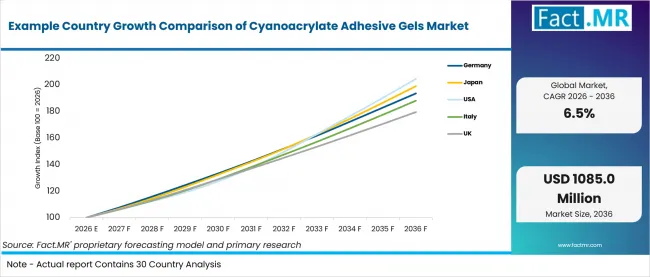
Example Country Growth Comparison Of Cyanoacrylate Adhesive Gels Market | Source: Fact.MR
| Country | CAGR (2026-2036) |
|---|---|
| Germany | 6.9% |
| Japan | 6.9% |
| USA | 7.4% |
Source: Fact.MR analysis. Updated Aug 12, 2026
What is driving Germany's growth through 2036?
Germany is forecast to expand at a 6.9% CAGR from 2026 to 2036.
Germany's automotive, machinery and electrical-equipment industries create demand for adhesives used in component positioning, small-part assembly and maintenance. In May 2026, new orders increased 3.7% in machinery and equipment and 5.7% in electrical equipment, indicating continued investment and production activity across sectors where controlled industrial bonding is relevant.
Manufacturers in these industries place emphasis on repeatable joining processes. High-viscosity cyanoacrylate gels can support that requirement by remaining at the dispense point while providing short fixture times, reducing dependence on prolonged clamping for suitable small joints.
What is driving Japan's growth through 2036?
Japan is forecast to expand at a 6.9% CAGR from 2026 to 2036.
Japan retains substantial production capability across electrical machinery, transport equipment and precision manufacturing. METI's Current Survey of Production separately tracks these industries, reflecting their continuing role in the country's manufacturing base.
These sectors create applications where suppliers must qualify adhesives against defined substrates and production conditions before volume use. Cyanoacrylate gels benefit where manufacturers require precise placement on compact parts and rapid fixture without adding ovens or other thermal-curing equipment.
What is driving the USA's growth through 2036?
The USA is forecast to expand at a 7.4% CAGR from 2026 to 2036.
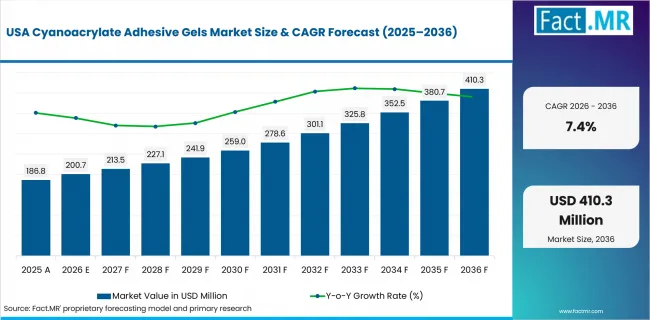
Cyanoacrylate Adhesive Gels Market Country Value Analysis | Source: Fact.MR
The USA has a diversified durable-goods manufacturing base that includes transportation equipment, computers and electronic products. In June 2026, orders for computers and electronic products increased 3.1% to USD 31.1 billion, supporting a continuing application base for adhesives used in electrical and industrial assembly.
Federal advanced-manufacturing programmes also emphasize automation and new production technologies. Manufacturing.gov defines advanced manufacturing as including automation and sensing, while the Manufacturing USA network supports adoption of technologies such as advanced robotics. Faster fixture adhesives fit these environments where reducing manual holding time can support shorter assembly cycles.
Who leads the Cyanoacrylate Adhesive Gels Market?
Henkel (Loctite) is positioned as a leading supplier through a broad cyanoacrylate portfolio and industrial distribution. Permabond and 3M compete through formulation depth and substrate guidance.
Competition centres on fixture speed and non-sag placement, with low blooming and impact resistance influencing visible or vibration-prone joints.
Pack and nozzle design affect repeat use because cured adhesive at the outlet can create waste.
Which companies are the key providers?
- Henkel (Loctite)
- Permabond
- 3M
- Bostik (Arkema)
- Pacer Technology
- H.B. Fuller
Bibliography
- U.S. Food and Drug Administration. (2024). Tissue Adhesive for Topical Approximation of Skin. U.S. Government.
- European Chemicals Agency. (2026). Ethyl 2-Cyanoacrylate Substance Information. European Union.
- ASTM International. (2019). ASTM D1002: Apparent Shear Strength of Adhesively Bonded Metal Specimens. ASTM International.
- ISO. (2018). ISO 10993-5: Biological Evaluation of Medical Devices. International Organization for Standardization.
- National Institute of Standards and Technology. (2025). Smart Manufacturing Systems. U.S. Department of Commerce.
- Ministry of Industry and Information Technology, China. (2026). Development of the Electronic Information Manufacturing Industry in 2025. Government of China.
- Federal Ministry for Economic Affairs and Climate Action, Germany. (2025). Industrial and Automotive Transformation Programmes. Government of Germany.
- Ministry of Economy, Trade and Industry, Japan. (2025). Strategy for Semiconductor and Digital Industry Revitalization. Government of Japan.
- U.S. Department of Commerce. (2025). CHIPS for America Advanced Packaging Manufacturing Program. U.S. Government.
- Ministry of Electronics and Information Technology, India. (2025). Electronics Manufacturing and Components Programme. Government of India.
- Henkel. (2026). LOCTITE Cyanoacrylate Adhesive Gels. Henkel.
- Permabond. (2026). Cyanoacrylate Adhesive Selection Guidance
This Report Answers
- The report examines demand across Viscosity Grade, Formulation, Application.
- Segment analysis explains the operating reason behind each leading category.
- Country analysis evaluates the listed markets and adoption conditions through 2036.
- Competitive analysis reviews the listed companies and clarifies ownership or research roles where relevant.
- The analysis considers qualification, process control and application fit that influence purchasing decisions.
What does the Cyanoacrylate Adhesive Gels Market cover?
Gel-form cyanoacrylate instant adhesives offering non-drip, gap-filling bonding for vertical surfaces and porous substrates across industrial, medical and consumer applications.
The assessment follows the stated segmentation by Viscosity Grade, Formulation, Application. Revenue is counted only where the stated product or equipment is sold for the listed applications.
What is included in the scope?
The scope includes High-viscosity gel, Medium gel, Thixotropic gel, Flexible gel.
It also covers Ethyl cyanoacrylate, Methyl cyanoacrylate, Rubber-toughened, Low-odor/low-bloom, Medical-grade.
Demand is assessed across Application: Industrial assembly, Medical/wound closure, Consumer/DIY, Footwear & leather, Electronics.
What is excluded from the scope?
Low-viscosity liquid instant adhesives that are not sold as gel or thixotropic formats are excluded.
Epoxy, polyurethane and structural acrylic adhesives are adjacent markets.
Dispensing tools and surface primers are excluded when sold separately.
How Was the Analysis Built?
The analysis combines product scope, segment demand, country outlook and supplier coverage.
- Primary Research: Interviews focus on formulators, distributors, equipment suppliers and end users responsible for bonding, potting or thermal management.
- Desk Research: The review covers technical standards, government manufacturing programmes and company product literature.
- Market Sizing and Forecasting: Estimates combine application volume, material use per part, formulation mix, pack size and realized pricing.
- Data Validation and Update Cycle: Findings are checked against public evidence and supplier portfolios. Updates review formulation changes, ownership changes and manufacturing shifts.
Segmentation
What is the report's scope and coverage?
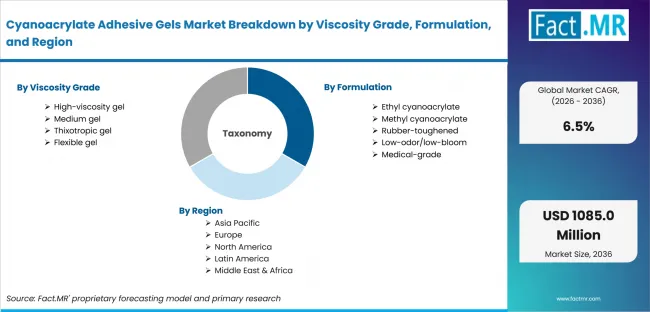
Cyanoacrylate Adhesive Gels Market Breakdown By Viscosity Grade, Formulation, And Region | Source: Fact.MR
| Attribute | Details |
|---|---|
| Quantitative Units | USD Million |
| Market Definition | Gel-form cyanoacrylate instant adhesives offering non-drip, gap-filling bonding for vertical surfaces and porous substrates across industrial, medical and consumer applications. |
| Segments Covered | Viscosity Grade; Formulation; Application |
| Regions Covered | North America; Latin America; Europe; East Asia; South Asia and Oceania; Middle East and Africa |
| Countries Covered | China; Germany; Japan; USA; India |
| Key Companies Profiled | Henkel (Loctite); Permabond; 3M; Bostik (Arkema); Pacer Technology; H.B. Fuller |
| Forecast Period | 2026 to 2036 |
| Base Year | 2025 |
| Market Value, 2026 | USD 578.0 million |
| Market Value, 2036 | USD 1,080.0 million |
| CAGR, 2026-2036 | 6.5% |
| Absolute Opportunity | USD 502.0 million |
| Approach | Combines application volume, material use per part, formulation mix, pack size and realized pricing. |
Source: Fact.MR analysis. Updated Aug 12, 2026
How is the market segmented?
-
By Viscosity Grade:
- High-viscosity gel
- Medium gel
- Thixotropic gel
- Flexible gel
-
By Formulation:
- Ethyl cyanoacrylate
- Methyl cyanoacrylate
- Rubber-toughened
- Low-odor/low-bloom
- Medical-grade
-
By Application:
- Industrial assembly
- Medical/wound closure
- Consumer/DIY
- Footwear & leather
- Electronics
-
By Region:
- Latin America
- Western Europe
- Eastern Europe
- East Asia
- South Asia and Pacific
- Middle East & Africa
Frequently Asked Questions
What is the Cyanoacrylate Adhesive Gels Market value in 2026?
At what CAGR is the market projected to grow?
What is the projected market value by 2036?
Which Viscosity Grade category leads the market?
Which Formulation category leads the market?
Which Application category leads the market?
What is the listed CAGR for India?
What is the primary driver in this market?
What is the main restraint?
Which companies are assessed?
Who worked on this report


Preview the report firsthand - request a free sample
Free SampleGet the brochure for pricing and purchase details
Download PDF